Which Countries Lead With Women Leaders?

Women made scarcely any progress increasing their presence in the top echelons of government last year, leaving gender equality in legislatures and ministries a distant goal, data showed on Wednesday.

A map ranking countries based on women in politics showed the number of women ministers and legislators barely rose, and the number of countries with a female head of state fell.

Progress getting women and men in equal numbers among the world’s political leaders is at a near standstill, said the Inter-Parliamentary Union (IPU) and U.N. Women, which compiled the map.

“The overall stagnation and specific reversals are warning bells of erosion of equality that we must heed and act on rapidly,” said Phumzile Mlambo-Ngcuka, executive director of U.N. Women.

Specifically, the number of women ministers nudged up to 732 from 730 in 2015, and their representation in parliaments rose less than a full percentage point to 23 percent. The number of countries with a female head of state or government fell to 17 from 19.

“These developments show that progress in gender equality remains slow in all structures of power and types of decision-making,” IPU Secretary-General Martin Chungong said in a statement.

“Power is still firmly in men’s hands,” he said. The Swiss-based IPU works to promote representative democracy.

Nordic countries suffered the largest setback globally, with a 6 percent drop in women ministers. Overall, however, women account for 44 percent of the top political executives.

In Africa, women hold one-fifth of the ministerial posts but, with the exception of the Congo and Zambia, saw a steady decline over the last two years.

Finland, which had the most women ministers in 2015, saw a sharp fall to 39 percent from 63 percent. Finland now ranks 14th, while Bulgaria, France, and Nicaragua share first place.

In those three top countries as well as in Sweden and Canada, the number of women in ministerial positions is slightly more than half.

Rwanda has the highest ratio of female legislators, at nearly two-thirds in its lower house, followed by Bolivia, Cuba and Iceland.

North, Central and South Americas made significant gains over the year, with women comprising a quarter of the legislatures.

In Arab states, the biggest improvement was in Tunisia, where the ratio of women in parliament rose to 23 percent from 11 percent.

By Anastasia Moloney @anastasiabogota, Editing by Ellen Wulfhorst. c Thomson Reuters Foundation.


Making The World Better For Women: From Respect to Ending Macho Violence

Celebrations and protests on Wednesday to mark International Women’s Day highlighted both progress and challenges in every part of the world, amid growing concern that women’s rights are being rolled back.

The origin of the global event dates to 1908 when women protested in various countries against working conditions, discrimination and being unable to vote or hold public office.

The 1945 United Nations charter was the first global agreement to affirm the principle of equality between women and men, and in 1975 the U.N. declared March 8 as International Women’s Day.

But while the day is meant to celebrate social, economic, cultural and political achievements of women, the 2017 event comes just weeks after millions of women marched around the world amid fears that progress is being eroded.

Against this backdrop, the Thomson Reuters Foundation asked various experts and campaigners what one thing would make the world better for women:

PHUMZILE MLAMBO-NGCUKA – Executive Director, UN Women

– “I would have to say the issue of challenging the stereotypes and the norms that we live with everyday in our families, in our work, in our schools that teach women differently. When it comes to gender inequality, women are still discriminated against and sexism is still well and alive with impunity. The threshold of tolerance for such things is just too high in society, especially by the leaders who do not demonstrate zero tolerance for gender inequality.”

CHELSEA CLINTON – Vice chair, Clinton Foundation

– “We know what gets measured gets managed. Tackling gender data gaps is crucial for ensuring every girl has every opportunity to lead a safe, healthy life full of opportunity. That’s good for girls and boys too – we know what when girls are empowered, societies thrive. Through the Clinton Foundation’s Full Participation Report, we learned that while girls and women have made significant strides, gaps in progress persist, in every country. We need to act on data and information that we know is accurate to know where to channel our energies and investments to close the gaps that exist as quickly as possible, for every girl everywhere and for our shared future.”

JAYNA ZWEIMAN – Co-Founder, Pussyhat Project

– “Respect for women’s bodies and respect for women as not just bodies. Using women’s health, safety and independence as tools for political power must stop. Women must make their own decisions, and that demands systemic freedom, trust and opportunity. Only then will women be able to participate fully and loudly as valued equals, regardless of age, race, sexual orientation, gender expression, religion, class, immigration status and disability.”

ROBIN MORGAN – author, former editor-in-chief of Ms. Magazine and founder of Sisterhood is Global Institute

– “Issues are so interconnected it’s difficult to pick one panacea. I’m tempted to choose full reproductive rights. But that would come about organically with the following, which I choose: The one thing that would make the world better for women (and men, children, indeed all life on the planet), is women holding full political leadership power in every country.”

ADA COLAU – First female mayor of Barcelona, social activist

– “A world without machismo. We have to reduce macho violence because in reality, it is the most serious structural violence we have, murdering women month after month… The big challenge is to make this a policy priority for states, and put in place programs – not just to support the victims but also to promote prevention and education, to change this systemic macho violence which has killed thousands of women around the world.”

MARIANA KATZAROVA – Founder of Reach All Women in WAR

– “Including women’s voices in peace talks is critical. Women are over half of the global population – 80 percent of survivors of armed conflict are women but they rarely get the chance to have a seat at the table and contribute to the peace process. Those who began the conflict in the first place are later in charge of making and building peace, with the majority of the population and survivors being excluded from the peace process. This is often the reason why peace is not achieved in any of the current armed conflicts around the world.”

By Ellen Wulfhorst. Additional reporting by Belinda Goldsmith and Megan Rowling. Editing by Ros Russell. c Thomson Reuters Foundation.


US Law Firm Employs Anti-mafia Laws to Sue Forest Activists

A Canadian forestry giant is using legislation most often deployed against the mafia to sue Greenpeace over allegations about the firm’s environmental record in the latest legal battle between campaigners and resource companies.

Launched by Montreal-based Resolute Forest Products the case will reverberate beyond the United States as it impacts how defamation and free speech rules are interpreted and how activist groups can be treated during prosecution.

A judge in the U.S. state of Georgia is weighing a motion by Greenpeace to dismiss the case and a decision on whether it can proceed is expected soon, lawyers for both sides said.

Resolute is seeking $300 million from Greenpeace International, Greenpeace U.S. and other branches of the environmental organization, along with Stand.earth, another North American activist group, Greenpeace said in a statement.

“This case is a big deal,” Ted Hamilton, a legal researcher with the Climate Defense Project, a U.S.-based advocacy group told the Thomson Reuters Foundation.

It’s one of the few sentiments upon which both sides agree in litigation launched under the Racketeer Influenced and Corrupt Organizations Act, normally reserved for illegal syndicates.

‘FOREST DESTROYER’

Michael Bowe, an attorney from Kasowitz, Benson, Torres & Friedman LLP representing Resolute, said Greenpeace leveraged false and defamatory claims against the company’s operations in Canada’s Boreal forest in order to solicit donations.

In its campaign materials, Greenpeace called Resolute a “forest destroyer” whose activities hurt indigenous people in Canada, threaten wildlife and contribute to climate change – claims rejected by the company’s lawyers.

“We are being slandered, donors are being misled and no legitimate environmental cause is being advanced,” Bowe told the Thomson Reuters Foundation.

Resolute says it has planted more than one billion trees in Canada’s Boreal forest and is responsible for virtually no permanent lost woodland acreage.

“The company cares about the Boreal forest a lot more than Greenpeace,” said Bowe.

CORPORATE PARTNERSHIPS

Attorneys for Greenpeace International stand behind the group’s “forest destroyer” statements, accusing the Resolute of trying to intimidate critics and trample free speech.

“This case … is about the right of advocacy groups to offer criticisms (of companies) without the threat of crippling lawsuits,” Greenpeace attorney Jasper Teulings told the Thomson Reuters Foundation.

If the company believes that statements by Greenpeace such as the “forest destroyer” moniker are inaccurate they should sue under defamation laws, rather than legislation designed to take down the mafia, Teulings said.

“Our work on forests focuses on exposing and documenting unsustainable industry practices, in an effort to get corporations to adopt better methods that protect crucial forest habitats,” said Teulings.

Other large companies, including Asia Pulp & Paper, Kimberley-Clark and McDonalds have worked with Greenpeace to improve their sustainability practices following criticism without resorting to Resolute’s “bully tactics”, he said.

Resolute said Greenpeace is not the victim in the case as the campaign group has offices in 41 countries, a 2014 budget of more than $330 million, and owns multi-million dollar yachts.

Greenpeace was able to raise these funds by spreading misinformation about Resolute and other firms, the company said, in a claim strongly denied by the environmental group.

By Chris Arsenault, Editing by Belinda Goldsmith. c Thomson Reuters Foundation.


UK’s First LGBT Retirement Community Set to Open in Manchester

The northern British city of Manchester has announced it is to open the country’s first retirement community for lesbian, gay, bisexual and transgender (LGBT) people.

There are more than 7,000 LGBT people over the age of 50 in Manchester and the number is expected to increase, the council said in a statement.

The project aims to meet a need for assisted accommodation for older LGBT people where they can be open about their identity, it said.

“Prejudice and discrimination can be a real problem facing older LGBT people,” Bev Craig, Manchester City Council’s lead member for LGBT women, said in a statement.

“People shouldn’t have to face the prospect as they get older of being surrounded by people who may not accept their sexuality or gender identity.”

The development will offer apartments to rent or buy for people aged 55 plus and will have a 24-hour care team on site. Just over half the accommodation will be reserved for LGBT people, but other residents are also welcome.

According to research by the Manchester-based charity LGBT Foundation, more than half of lesbian, gay and bisexual people in this age group fear isolation in their older life because of their sexual orientation.

Manchester will join a growing number of cities around the world offering retirement accommodation for LGBT people. Similar developments have opened in Sweden, the United States and Canada.

By Magdalena Mis. Editing by Emma Batha. c Thomson Reuters Foundation.


Seven Earth-size Planets Discovered Where Life is Possible

Astronomers have found a nearby solar system with seven Earth-sized planets, three of which circle their parent star at the right distance for liquid surface water, bolstering the prospect of discovering extraterrestrial life.

The star, known as TRAPPIST-1, is a small, dim celestial body in the constellation Aquarius. It is located about 40 light years away from Earth, close by astronomical standards, but about 44 million years away at the average cruising speed of a commercial passenger jet.

Researchers said the proximity of the system, combined with the proportionally large size of its planets compared to the small star, make it a good target for follow-up studies. They hope to scan the planets’ atmospheres for possible chemical fingerprints of life.

“The discovery gives us a hint that finding a second Earth is not just a matter of if, but when,” NASA chief scientist Thomas Zurbuchen said at a news conference.

The discovery, published in an issue of the journal Nature, builds on previous research showing three planets circling TRAPPIST-1. They are among more than 3,500 planets discovered beyond the solar system, or exoplanets.

“This is the first time that so many Earth-sized planets are found around the same star,” lead researcher Michael Gillon, with the University of Liege in Belgium, told reporters.

Researchers have focused on finding Earth-sized rocky planets with the right temperatures so that water, if any exists, would be liquid, a condition believed to be necessary for life.

“I think that we’ve made a crucial step towards finding if there is life out there,” University of Cambridge astronomer Amaury Triaud said on a conference call with media.

The diameter of TRAPPIST-1 is about 8 percent of the sun’s size. That makes its Earth-sized planets appear large as they parade past.

From the vantage point of telescopes on Earth, the planets’ motions regularly block out bits of the star’s light. Scientists determined the system’s architecture by studying these dips.

“The data is really clear and unambiguous,” Triaud wrote in an email to Reuters.

Because TRAPPIST-1 is so small and cool, its so-called “habitable zone” is very close to the star. Three planets are properly positioned for liquid water, Gillon said.

“They form a very compact system,” Gillon told reporters. “They could have some liquid water and maybe life.”

Even if the planets do not have life now, it could evolve. TRAPPIST-1 is at least 500 million years old, but has an estimated lifespan of 10 trillion years. The sun, by comparison, is about halfway through its estimated 10-billion-year life.

In a few billion years, when the sun has run out of fuel and the solar system has ceased to exist, TRAPPIST-1 will still be an infant star, astronomer Ignas Snellen, with the Netherlands’ Leiden Observatory, wrote in a related essay in Nature.

“It burns hydrogen so slowly that it will live for another 10 trillion years,” he wrote, “which is arguably enough time for life to evolve.”

By Irene Klotz; Editing by Letitia Stein and Tom Brown


Disrupting The Disruptors: The End of The Sharing Economy?

Singapore, a keen early adopter of the sharing economy, has fired a warning shot across the bow of Airbnb and Uber with tighter rules that could shake up their business models and growth ambitions in Asia.

The rules, some say, are a sign that even governments sympathetic to companies that allow citizens to rent out their expertise or property have a hard time striking the right balance between encouraging disruptive technologies and keeping them in line.

“I know a lot of people will give back their keys, that’s for sure,” said Lionel Ong, 33, an Uber driver, who wants to look for a less demanding part time job.

As its traditional manufacturing industry has hollowed out in the past decade or so, the affluent city-state has been quick to embrace opportunities in the digital economy, hosting the Asian headquarters of Airbnb and Uber, inviting its executives to conferences and investing in Uber’s regional rival Grab through a unit of its investment arm for Temasek. 

It’s too early to say what impact the new rules would have on Uber and Airbnb, but they highlight increasing scrutiny by regulators globally and growth challenges facing these new economy businesses.

April Rinne, an expert on the sharing economy who has advised companies and governments, including Singapore, says the city state’s case mirrors other early adopter countries like Denmark, where legislators are mulling laws which would require taxis to have seat sensors, video surveillance and taxi meters. 

“It’s a watershed that should also sound warning bells,” Rinne said.

Singapore’s new rules, passed this month, will be implemented in stages from the second half of this year. They allow officials to suspend a ride-sharing company for up to a month after three or more instances of their drivers getting caught without a proper licence or insurance. The drivers themselves face fines and jail.

In the case of Airbnb,  officials will have the right to force their way into homes to check whether residents were renting them out illegally, adding teeth to a rarely enforced law which bans the renting out of private property for less than six months.   

 HIGH GROWTH MARKET, HURDLES

The sharing economy business is billed for explosive growth, estimated by PricewaterhouseCoopers to reach $335 billion by 2025, from around $15 billion in 2016.

So there’s a lot at stake for companies. And the worry, says Adrian Lee, who runs a car-sharing service called Tribecar in Singapore, is that other markets might ape the city state’s stance.

“I’m afraid other legislators may take a leaf from our play book without allowing these services to get to critical mass.” 

Singapore had been one of the few bright spots in Asia for Uber, which has been facing legal scrutiny in many markets across the region. Uber has suspended its service in Taiwan and has withdrawn from China after selling its business there. And in South Korea and Japan, authorities have limited its operations.

Jean Chia, a Singapore-based academic who studies the sharing economy, says since short-term renters “were previously operating in a grey area”, the tighter regulations raise some immediate questions around the business model of Airbnb.

Airbnb’s director of public policy in Asia Pacific, Mike Orgill, echoed those concerns, saying there are “thousands of people earning supplemental income … so the lack of clarity is of concern for hosts.”  

Drivers of Uber and Grab said a requirement for all drivers to obtain a vocational licence would force out a lot of part-time drivers, while the threat of fines and even jail would deter others.

There is no comparable measure in “the more than 450 cities we operate in,” Uber’s Singapore general manager Warren Tseng said of the rule change, warning it would affect tens of thousands of drivers and “hundreds of thousands of commuters.”

Uber’s strong regional rival Grab, which is planning to invest $700 million in Indonesia, one of Asia’s biggest markets, is more sanguine about the new laws.

Grab’s country head Kell Jay Lim said though the company expects some drop-off after the regulations kick in, the rules showed that Singapore was now absorbing the sharing economy into the mainstream.

“It’s a stamp of approval of what we’re trying to do.” 

By Jeremy Wagstaff; Editing by Shri Navaratnam


Trump Presidency Pushing Business to Become Less Global, More Local

Business leaders in Davos, traditionally the high priests of globalization, are talking up the benefits of local production this week to shield themselves from criticism from incoming U.S. President Donald Trump.

Elected on a jobs-focused “America First” platform, Trump has taken to Twitter to rebuke major companies like General Motors, Lockheed Martin and United Technologies, either for making goods in Mexico or for the price of their products.

At this week’s World Economic Forum (WEF), a gathering of business and political elites in the Swiss Alps synonymous with free markets, company bosses said they were now preparing to adjust to the Trump era.

“The basic message is to be more national, don’t just be global,” Richard Edelman, CEO of communications marketing firm Edelman, told Reuters. “Let’s try and pre-empt that tweet by having a long-term discussion about the supply chain.”

General Motors on Tuesday highlighted moves it said would add nearly 2,000 U.S. manufacturing jobs, including a decision to shift some production of axles to an American factory, rather than have them supplied from Mexico. The automaker said it wanted to “build where we sell”.

“There is no doubt we need to adapt,” Carlos Ghosn, chief executive of Renault-Nissan, told Reuters. “All carmakers have to revise their strategy as a function of what is coming.”

At the same time, companies are reviewing potential mergers and rethinking job cuts, fearing the stigma of being labelled “anti-American”.

What companies have yet to spell out is the economic cost of such shifts or the extent of localisation that will be needed to keep the peace with the new White House administration.

TAX REFORM

Adding to the incentive to increase U.S. manufacturing is the promise of lower corporate taxes under the Trump administration.

“It could mean increased investment in the U.S.,” Novartis CEO Joe Jimenez told Reuters.

Vishal Sikka, chief executive of Infosys, which provides IT services to large companies including banks, said his company expected more business from helping companies localise.

“The irony is that when more walls show up it is a good opportunity for services companies to help do business across those walls,” he said.

The move to go local in response to Trump looks set to fuel a trend already evident in some industries, including food and fashion, which are trying to tap into consumer demand for homegrown materials and production.

Other businesses are also thinking locally to mitigate currency risks in certain markets. Food companies in Britain, for example, which have seen their costs soar after sterling plummeted in the wake of the Brexit vote, have started moving towards local suppliers where possible to keep costs down.

In some cases, technological advances are helping by making it easier for companies to shorten their supply lines.

“With 3D printing, for example, some of the supply chain will reshore and come back to the local economies,” said Frans van Houten, CEO of Dutch healthcare technology group Philips. “I think we will see supply chains becoming more regional.”

Such tech-fuelled localisation may be a competitive advantage for multinational companies in a world of increasing geopolitical uncertainty, but it brings fresh challenges for developing economies which could lose out as jobs return to richer countries like the United States.

Martin Sorrell, chief executive of WPP, the world’s largest advertising agency, said U.S. growth could come at the cost of nations elsewhere.

“The issue on Trump is what you win on the U.S. swings, you may lose on the international roundabouts,” he said.

By Elizabeth Piper; Writing by Carmel Crimmins; Editing by Pravin Char


Amazon Forest Guardians: Now it’s War

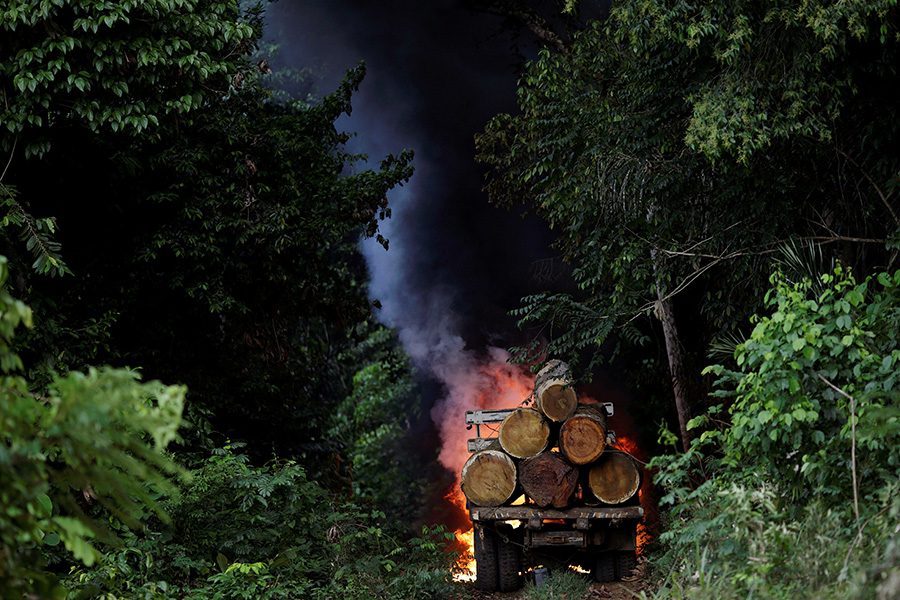
The rainforest shook with the sound of exploding tires and groaning steel as flames tore through a truck carrying giant tree trunks illegally sawn from the Amazon.

An agent of Brazil’s environment police had, moments earlier, ordered the driver from his cab at gun point. In a scuffed blue cap and muddied jeans, the 25-year-old fought back tears as he learned his truck would be set alight right there.

He walked away rather than watch it burn.

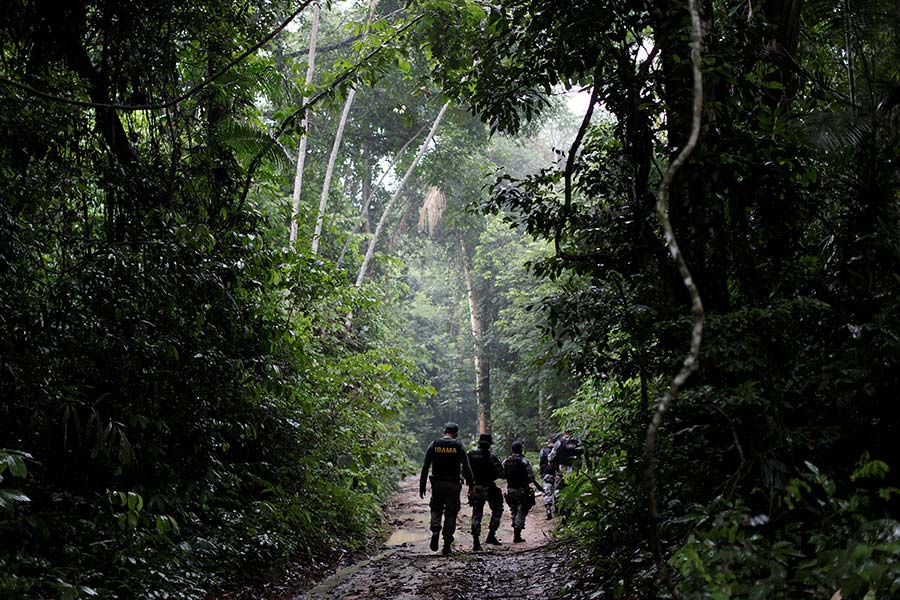
When able to do their job, agents of the Brazilian Institute for the Environment and Renewable Natural Resources, or Ibama, are decisive, punishing illegal loggers on the spot. But this seizure was the only success in four days of operations this month near the town of Novo Progresso in Brazil’s vast northern state of Para.

Hampered by poor radios with a maximum range of just 2 km (1.3 miles) and pick-up trucks easily recognised by those who cut down the forest, the exhausted Ibama agents were too often chasing shadows.

“The loggers are better equipped than we are,” said Uiratan Barroso, Ibama’s head of law enforcement in the state capital, Santarem. “Until we have the money to rent marked cars and buy proper radios we won’t be able to work.”

Nearly twice the size of India, the Amazon absorbs an estimated 2 billion tonnes of carbon dioxide per year, making its preservation vital in the fight to halt global warming.
Ibama, responsible for preserving Brazil’s 65 percent share of the world’s largest rainforest, is one of the most important groups in that fight. But after years of surprising success, the rate of deforestation is on the rise again.

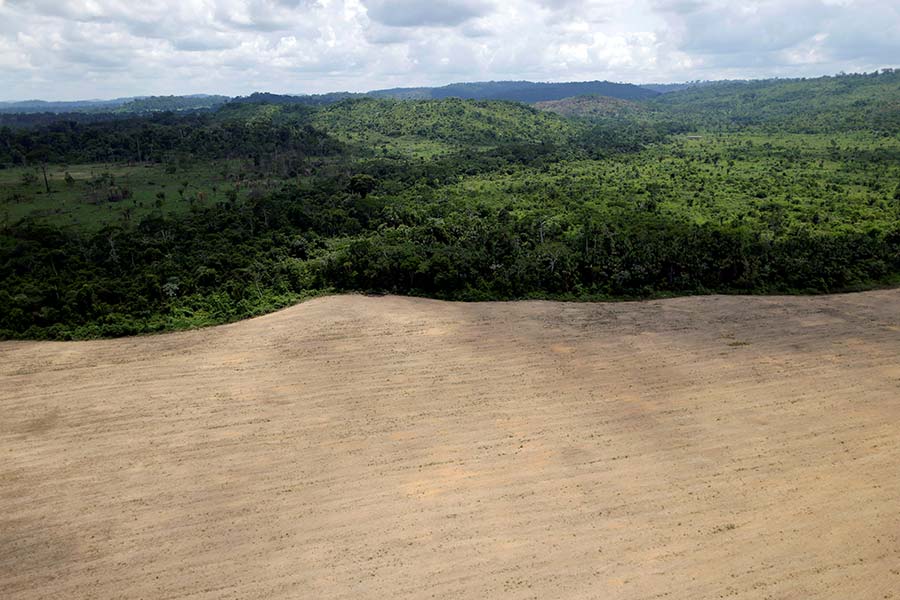
Over the past four years it has risen 35 percent, as Ibama suffered from a lack of funding amid Brazil’s worst recession in decades. Last year, rainforest five times the size of Los Angeles was cut down.

Leaders from nearly 200 different countries met in Morocco this month to move forward on commitments to cut greenhouse gas emissions, amid concerns that U.S. President- elect Donald Trump might cut funding for the deal signed in Paris last year.

Here, in the badlands of rural Para, the challenges to those commitments are all too clear. A 30 percent cut in Ibama’s budget has meant fewer operations this year. Helicopters and jeeps have been idle due to a lack of fuel.

“We haven’t even had enough money to pay for aptitude tests to allow our agents to carry guns,” said Barroso, adding the tests only cost 200 reais ($60).

It is dangerous work. In June, a policeman was shot dead during an Ibama operation in Novo Progresso, a grid of dirt streets whose 25,000 inhabitants rely on illegal mining and logging for survival.

Corruption is also a problem. Three Ibama officials in Santarem were charged last month for taking bribes from logging companies.

“I only trust around half the people I work with,” Barroso said.

Brazil’s environment ministry admits a lack of funds has reduced Ibama’s ability to operate. The situation should be helped by 56 million reais secured from the Fundo Amazonia, a fund principally financed by Norway and Germany.

But officials say a broader strategic change is also needed. “The effectiveness of our current measures and enforcement has reached its limit,” said Everton Lucero, the government’s undersecretary for climate change.
Until four years ago, the approach proved highly effective. Ibama helped to reduce the rate of deforestation by over 80 percent between 2004 and 2012. A mix of satellite imagery and a tough on-the-ground presence made Ibama a highly effective force in the fight against global warming.

Now, there is a sense that Brazil’s target of zero deforestation by 2030 will not simply be achieved with more 4x4s and semiautomatic rifles.

A carrot is needed alongside the stick, officials say. One option being discussed with other ministries, according to Lucero, is to create economic incentives for landowners and communities to preserve their forests. He said details on how this would work were still being finalized.

Persuading towns like Novo Progresso to preserve the rainforest means transforming their culture and economy. It lies on the BR-163 highway that runs north-to-south through the rainforest to join frontier farms with ports in the southeast. Environmental groups estimate 60 percent of Brazil’s Amazonian deforestation happens along this stretch.
Novo Progresso was one of many towns founded during Brazil’s drive deep into the Amazon during the military dictatorship of the 1970s and 1980s.

Then, cutting down the Amazon to construct roads and towns was patriotic, a means of securing Brazil’s borders. Many also got rich in the process.

Jose Carlos Rovaris, 62, bought his land near Novo Progresso in 1984, leaving his home in the southern state of Santa Catarina for a new life on the forest frontier. “This was all trees when I arrived,” he said, his belly protruding from a scrubby polo shirt as he moved his arm across the land now planted with soy as far as the eye can see. “I cut it down bit by bit, every year a little more.”

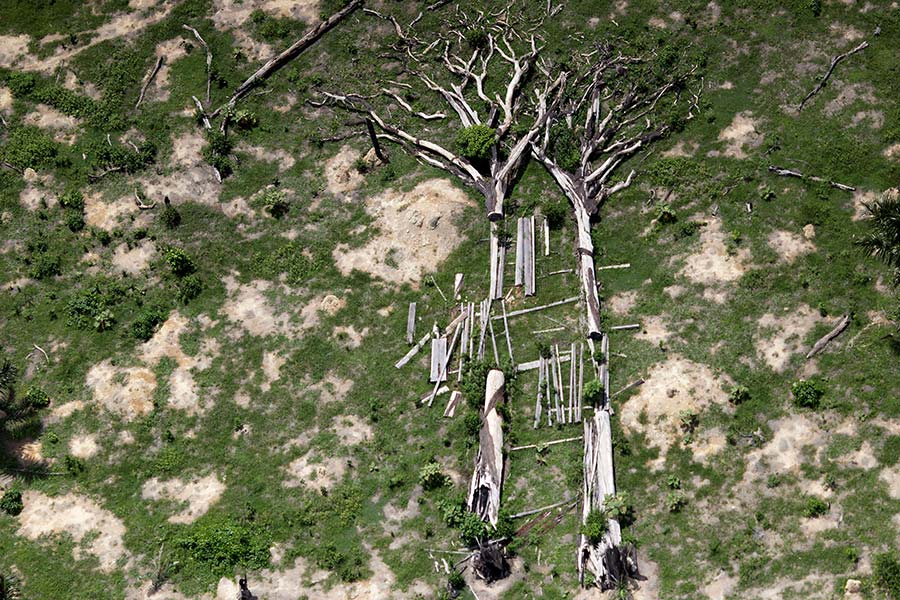
The impact of those pioneers is staggering. In 1933, British explorer Peter Fleming described neighbouring Mato Grosso state as “huge tracts of jungle which no white man has even attempted to enter.” Now, it is Brazil’s largest soy producer. Its transformation from jungle to agricultural heartland helped make Brazil the world’s largest exporter of beef and soy.

With that has come increased power in Congress and environmentalists fear President Michel Temer’s government will bow to pressure to ease environmental licensing laws as it aims to rekindle economic growth. The transition from forest to farmland is a devastating double blow for the environment. Trees absorbing CO2 are commonly replaced with methane polluting cattle.

Ibama operates on the limits of a law its agents regard as too soft.
Burning trucks is the most effective deterrent in their arsenal. They do this if the vehicle is on protected land inhabited by indigenous groups or if the truck cannot be removed because the driver has fled or the vehicle is damaged. But those caught cutting down the rainforest never see the inside of a jail cell unless convicted of a more serious, related crime such as money laundering or violence.

Many in Novo Progresso see no other way to get by. “There is nothing else,” said Elis Pereira, 25, at the Ibama office after his truck was burned. Sleep-deprived and famished after days in the forest waiting for the rain to pass, he said the fine and loss of his truck meant he would be “pushed into crime.”

With no new land legally available and farming so mechanized it requires little labour, Pereira is part of a generation growing up in towns like Novo Progresso with scant job prospects. Unless a sustainable source of employment can be created, deforestation is unlikely to stop.

Pereira’s future looks bleak. He bought the truck that is now charred steel for 60,000 reais just six weeks ago. That money was borrowed from the illegal loggers for whom he worked transporting timber.

“I’ll have to let them know,” he said, eyes vacant with exhaustion and fear. “I hope they understand.”

 

Is Apple Developing a Self-driving iCar?

Apple Inc. is wading in to the debate over regulation of self driving cars, declaring it is excited about the potential for automated transportation and calling on U.S. regulators not to restrict testing of such vehicles.

A five-page letter from Steve Kenner, Apple’s director of product integrity, to the National Highway Traffic Safety Administration is the company’s most comprehensive statement yet about its interest in self-driving vehicle technology. The Nov. 22 letter followed more than a year of industry speculation about the computer and iPhone maker’s plans for expanding into transportation. “The company is investing heavily in the study of machine learning and automation, and is excited about the potential of automated systems in many areas, including transportation,” Kenner wrote.

“Executed properly under NHTSA’s guidance, automated vehicles have the potential to greatly enhance the human experience — to prevent millions of car crashes and thousands of fatalities each year and to give mobility to those without.”

Apple urged regulators not to impose too many restrictions on testing of self-driving cars, saying “established manufacturers and new entrants should be treated equally.” Since software would decide what actions to take in potentially dangerous situations,

Apple said certain areas need special attention. These include the implications of algorithmic decisions for the safety, mobility and legality of automated vehicles and their occupants, ensuring privacy and security in design, and the impact of the cars on employment and public spaces. Some analysts forecast millions of jobs will be lost once self-driving cars largely replace truck, taxi and Uber drivers, and eliminate the need for most vehicle repairs, insurance adjusters and other functions.

Apple’s letter was prompted by its heavy investment in machine learning and autonomous systems, company spokesman Tom Neumayr said in an emailed statement. “There are many potential applications for these technologies, including the future of transportation, so we want to work with NHTSA to help define the best practices for the industry,” he said.

In September, the Obama administration proposed guidelines for the development of self-driving cars in a 15-point “safety assessment,” calling on automakers to voluntarily submit details of their systems to regulators.

Apple executives have been coy about their interest in cars. Chief Executive Tim Cook has suggested that Apple wants to move beyond integration of Apple smartphones into vehicle infotainment systems. But Apple has never confirmed reports last year that it was hiring automotive industry engineers and designers to develop a driverless electric car, or that those efforts have

been sharply scaled back this year. Other companies pursuing self-driving cars include Alphabet Inc’s Google unit, Ford Motor Co, Volkswagen AG, Daimler AG, Tesla Motors Inc and General Motors Co.

Apple has reportedly held talks about investing in British automaker McLaren Technology Group, but McLaren downplayed speculation that Apple had proposed an investment.

Apple joins a range of automakers and tech companies that have raised concerns about the proposed National Highway Traffic Safety Administration policy on self-driving cars,  and plans by California state regulators to make complying with the safety assessment mandatory.

An auto trade group in November urged the incoming Trump administration to conduct a “comprehensive regulatory review” of all regulations and actions since Sept. 1, including the Obama administration’s guidance on self-driving vehicles.

By David Shepardson; Editing by Richard Chang.