The Only 3 Meetings You’ll Ever Need

By Scot Chisholm

I’ve been a founder and CEO for nearly 20 years, and I’ve read countless books on management and leadership. My conclusion? Most meetings are a waste of time and money — but there are three meetings you shouldn’t operate without.

1 All-Hands Meeting

This is your most important meeting. Don’t waste it.

Who: Include everyone on the team. No one should be left out.

Why: It aligns the entire team on direction and progress.

When: Convene monthly (one hour) or quarterly (two hours).

Agenda

Where you’re going: Find ways to talk about the longer-term vision and goals.

How you’re doing: Share progress against monthly, quarterly, and annual goals.

Why it matters: A customer story shows the impact you’re having. A team member demonstrates your values.

2 Top-Goal(s) Meeting

Schedule a meeting to review progress against your annual goals (three maximum). You can also break it up into three separate meetings.

Who: Invite key people who are responsible for the goal (fewer than seven).

Why: It tracks progress against your top three most important items.

When: Meet biweekly (one hour per goal).

Agenda

How you’re doing: Each goal should have one main owner who leads the update to the group. 

If you’re behind: Dedicate the meeting to creating a plan to get back on track.

If you’re ahead: Talk about upcoming risks and how to mitigate early –– or just end the meeting early.

3 One-on-One Meeting

Plan a meeting with each person on your team. If you have a large team, it’s only with your direct reports.

Who: Have just you and the person.

Why: It tracks progress against individual goals and offers help.

When: Meet biweekly, or weekly if you feel it’s necessary (30 minutes to one hour).

Agenda

How you’re doing: The person should start by giving an update on their goals.

If they’re behind: Offer help. Create a plan together in the meeting to get back on track.

If they’re on pace: Use the time for other items, but let the person set the agenda.

Scot Chisholm founded software company Classy (acquired by GoFundMe), serving as CEO for over 10 years and leading it to 300+ people and billions in platform donations. More recently he founded Haskill Creek, a new spin on the traditional pharmacy. He coaches founders/CEOs, helping them transition to high-impact leaders.

Vital Farms is Cracking the Code on the Egg Industry

Vital Farms accelerates its growth while continuing to expand its impact in farming.

By Real Leaders

Vital Farms has grown from an idea to the leading seller of pasture-raised eggs in the U.S.

Founded in 2007, Matt O’Hayer set out to improve the standards of animal welfare in an industry with an ethics challenge. There are over 300 million commercial laying hens in the U.S., and around two-thirds of them are caged. The vast majority of them live packed in battery cages, unable to spread their wings, which makes them among the most intensively confined animals in agribusiness, according to the Humane Society.

Instead, Vital Farms raises its hens in pastures with outdoor access year round, focusing on humane treatment. It also looks out for the health of the land through sustainable farming practices. Its farmers rotate pastures and do not use pesticides or herbicides.

“Our mission is to bring ethical food to the table,” says Russell Diez-Canseco, president and CEO of Vital Farms. “We do everything we can to improve the lives of people, animals, and the planet through food.”

The company has grown from a single farm in Austin, Texas, to a national consumer brand that works with over 300 small family farms. More than 24,000 stores across the U.S. sell its products, including standard egg cartons, hard-boiled eggs, liquid whole eggs, and butter (added in 2015). They’re also on the menus of hundreds of foodservice operators across the country. From 2019-22 alone, Vital Farms has more than doubled its employees and increased its revenue by over 2.5x.

From Farm to Future: Vital Farms’ Roadmap for Positive Impact

“We continue to invest in our crew, innovate with our farmers, drive meaningful progress for the environment and our communities, support our consumers and customers, and deliver on our commitments to stockholders,” Diez-Canseco says. “We’re challenging ourselves every day to forge a path that we believe will deliver strong results and positive impact well into the future. We’re committed to raising the standards in the food industry, and as our goals demonstrate, we are taking cumulative steps every day.”

A Certified B Corporation, Vital Farms also provides long-term benefits to its stakeholders. Its core values include transparency and honesty, as evidenced by its traceability initiative that allows consumers to trace each carton of eggs back to the farm where they were laid.

In 2021, Vital Farms started producing some of its eggs using regenerative farming practices, planting certain cover crops and following other practices that revitalize and restore ecosystem functions while regenerating the soil to advance biodiversity, soil health, water quality, and nutrient density. Regenerative practices can result in higher profits for farmers, increase the land’s resiliency, and improve the health of waterways. In recognition of those efforts, in 2023, Vital Farms became the first national egg brand to earn a Regenified verification for four of its farms.

“We believe we should be restoring instead of depleting the earth through the practices we use to grow food,” Diez-Canseco says.

Vital Farms is working toward scaling regenerative agriculture practices to all of its farmers by 2026, as well as reducing carbon intensity in its operations by 25% by 2027. 

A Greener Facility

Here’s a closer look at Vital Farms’ award-winning egg washing and packing facility.

  • The building was designed to LEED Silver standards and is pursuing certification with the U.S. Green Building Council.
  • Crew-focused features capture natural light and manage engine room humidity.
  • A water filtration system allows for water reuse for up to eight hours (30+ wash cycles).
  • An offsite underground cold storage facility uses at least 25 percent less energy than above-ground storage.
  • LED lights improve energy efficiency by 50 percent.
  • Bioretention features clean and cool rainwater, provide for the recharge of local aquifers rather than runoff into storm sewers, and conserve over 700,000 gallons of water per year.
  • A solar array was added in 2023, generating close to 20 percent of the facility’s energy usage, lowering energy costs, and reducing greenhouse gas emissions. 

The Only 3 Meetings You’ll Ever Need

By Scot Chisholm

I’ve been a founder and CEO for nearly 20 years, and I’ve read countless books on management and leadership. My conclusion? Most meetings are a waste of time and money — but there are three meetings you shouldn’t operate without.

1 All-Hands Meeting

This is your most important meeting. Don’t waste it.

Who: Include everyone on the team. No one should be left out.

Why: It aligns the entire team on direction and progress.

When: Convene monthly (one hour) or quarterly (two hours).

Agenda

Where you’re going: Find ways to talk about the longer-term vision and goals.

How you’re doing: Share progress against monthly, quarterly, and annual goals.

Why it matters: A customer story shows the impact you’re having. A team member demonstrates your values.

2 Top-Goal(s) Meeting

Schedule a meeting to review progress against your annual goals (three maximum). You can also break it up into three separate meetings.

Who: Invite key people who are responsible for the goal (fewer than seven).

Why: It tracks progress against your top three most important items.

When: Meet biweekly (one hour per goal).

Agenda

How you’re doing: Each goal should have one main owner who leads the update to the group. 

If you’re behind: Dedicate the meeting to creating a plan to get back on track.

If you’re ahead: Talk about upcoming risks and how to mitigate early –– or just end the meeting early.

3 One-on-One Meeting

Plan a meeting with each person on your team. If you have a large team, it’s only with your direct reports.

Who: Have just you and the person.

Why: It tracks progress against individual goals and offers help.

When: Meet biweekly, or weekly if you feel it’s necessary (30 minutes to one hour).

Agenda

How you’re doing: The person should start by giving an update on their goals.

If they’re behind: Offer help. Create a plan together in the meeting to get back on track.

If they’re on pace: Use the time for other items, but let the person set the agenda.

Scot Chisholm founded software company Classy (acquired by GoFundMe), serving as CEO for over 10 years and leading it to 300+ people and billions in platform donations. More recently he founded Haskill Creek, a new spin on the traditional pharmacy. He coaches founders/CEOs, helping them transition to high-impact leaders.

3 YPO Alternatives: A Comprehensive Guide to Selecting a Leadership Network

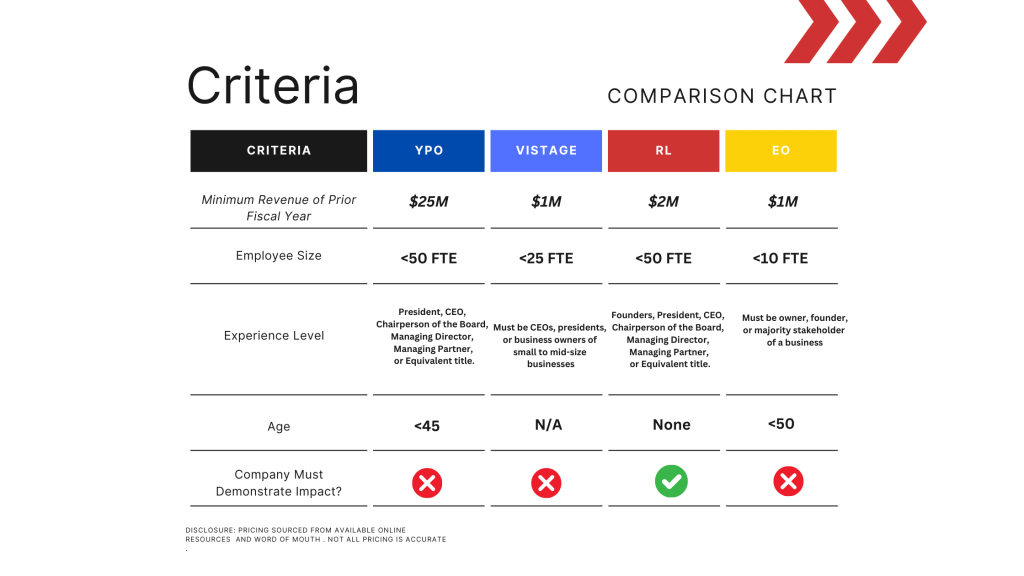
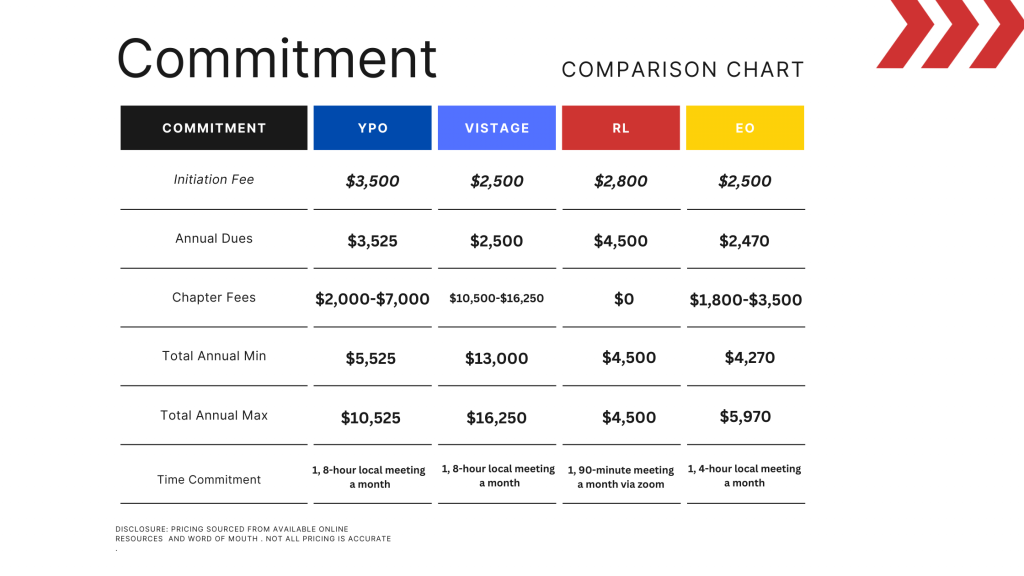
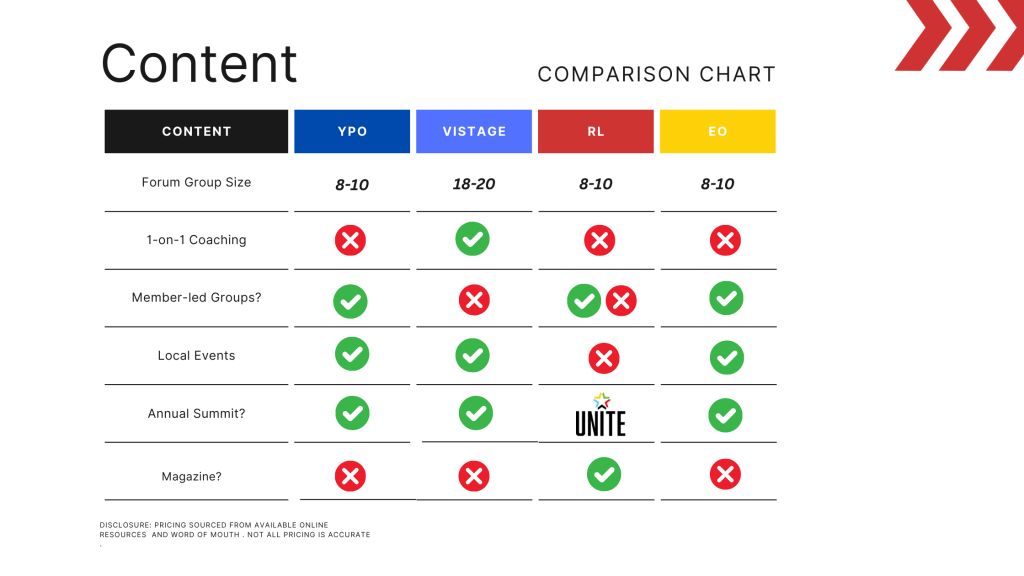
Whether you’re at the beginning or final stages selecting a leadership network, it’s important to know what to look for and what questions to ask your recruiter so that you have clarity on what to expect. This comprehensive guide was created to guide you through 3 crucial categories—Criteria, Commitment, and Content to determine which of the 4 major networks (YPO, Vistage, EO, and RL) are best for you.

Criteria:

Leaders face different challenges at different stages of growth. The conversations and experience levels are just different. If you’re a large and growing company you don’t want to be in a group with leaders trying to make payroll and if you’re a SMB owner, you may feel imposter syndrome if you haven’t raised over $100M in capital before. 

3 Questions to ask your recruiter is:

  1. What are the minimum revenue and employee requirements? 
  2. How are the groups formed?
  3. Do the members share my values?

RL difference: If you’re an impact company CEO, ask, “do you have forums or networks specifically for impact or ESG-minded businesses? Is that a requirement for you?” If you’re in a traditional network, you may get called “cute”, “Pollyanna”, or “get looked at like you have 3 heads” (all real experiences).

At the end of the day, you want to surround yourself around individuals who inspire you and there’s no quicker death of a forum if this balance isn’t right.

Commitment:

Generally speaking, a CEOs responsibility is to maximize their return on investment with the scarce resources they have.  Forums are sacred and should be taken very seriously and seen as a “must not miss meeting” but if you end up joining the wrong network, fees can create stress and the time commitment can become burdensome. Be wary of the recruiter who doesn’t let you be flexible with your annual dues and avoid joining the groups who don’t honor their time commitments. To avoid falling into a trap, you could ask: 

  1. Are there chapter dues on top of the annual dues? 
  2. What does the initiation fee go towards?
  3. How much of a monthly time commitment is this from me?
  4. Are the financing options available? 

RL Difference: Real Leaders offers the most competitive pricing and your initiation fee (orientation fee) goes toward your first Real Leaders UNITE summit. 

Content:

Whether you have experienced a forum or not, it’s important to know what to expect before registering for a leadership network. Each network also provides more content and networking opportunities called “micro-forums” outside of their confidential meetings. Another difference Vistage has is that their groups are recruited and facilitated by an executive coach or retired CEO. This is great if you’re looking for both forum and a 1-on-1 format. A few questions to ask your recruiter would be:

  1. How many members will be in my forum?
  2. Are they member-led or facilitated?
  3. Are the annual summits included in my membership? 
  4. Do you support my thought leadership as a CEO?

RL Difference: Warren Buffet is famous for saying, “speaking can improve your value by 50%.” Building your thought leadership can elevate your brand and business development and joining a leadership network is a great way to do this. Real Leaders editors go to members first for stories and quotes to be featured in its global publication.

Conclusion:

Joining a forum is one of the best decisions you can make as a CEO. Whether it’s the relationships you build, the insights you discover, or just the flat out energy you get after leaving the meeting, there’s a reason why forums have existed for centuries. At the end of the day, you get out what you put in. At Real Leaders, we have members in all 3 of the other networks who come to surround themselves with values-aligned leaders who get them. Regardless, you qualify for a network like YPO or not, we believe every isolated leader needs an outlet to get help with whatever is keeping them up at night and hope that this guide was helpful in finding alternatives. Best of luck on your journey.

3 YPO Alternatives: A Comprehensive Guide to Selecting a Leadership Network

Whether you’re at the beginning or final stages selecting a leadership network, it’s important to know what to look for and what questions to ask your recruiter so that you have clarity on what to expect. This comprehensive guide was created to guide you through 3 crucial categories—Criteria, Commitment, and Content to determine which of the 4 major networks (YPO, Vistage, EO, and RL) are best for you.

Criteria:

Leaders face different challenges at different stages of growth. The conversations and experience levels are just different. If you’re a large and growing company you don’t want to be in a group with leaders trying to make payroll and if you’re a SMB owner, you may feel imposter syndrome if you haven’t raised over $100M in capital before. 

3 Questions to ask your recruiter is:

  1. What are the minimum revenue and employee requirements? 
  2. How are the groups formed?
  3. Do the members share my values?

RL difference: If you’re an impact company CEO, ask, “do you have forums or networks specifically for impact or ESG-minded businesses? Is that a requirement for you?” If you’re in a traditional network, you may get called “cute”, “Pollyanna”, or “get looked at like you have 3 heads” (all real experiences).

At the end of the day, you want to surround yourself around individuals who inspire you and there’s no quicker death of a forum if this balance isn’t right.

Commitment:

Generally speaking, a CEOs responsibility is to maximize their return on investment with the scarce resources they have.  Forums are sacred and should be taken very seriously and seen as a “must not miss meeting” but if you end up joining the wrong network, fees can create stress and the time commitment can become burdensome. Be wary of the recruiter who doesn’t let you be flexible with your annual dues and avoid joining the groups who don’t honor their time commitments. To avoid falling into a trap, you could ask: 

  1. Are there chapter dues on top of the annual dues? 
  2. What does the initiation fee go towards?
  3. How much of a monthly time commitment is this from me?
  4. Are the financing options available? 

RL Difference: Real Leaders offers the most competitive pricing and your initiation fee (orientation fee) goes toward your first Real Leaders UNITE summit. 

Content:

Whether you have experienced a forum or not, it’s important to know what to expect before registering for a leadership network. Each network also provides more content and networking opportunities called “micro-forums” outside of their confidential meetings. Another difference Vistage has is that their groups are recruited and facilitated by an executive coach or retired CEO. This is great if you’re looking for both forum and a 1-on-1 format. A few questions to ask your recruiter would be:

  1. How many members will be in my forum?
  2. Are they member-led or facilitated?
  3. Are the annual summits included in my membership? 
  4. Do you support my thought leadership as a CEO?

RL Difference: Warren Buffet is famous for saying, “speaking can improve your value by 50%.” Building your thought leadership can elevate your brand and business development and joining a leadership network is a great way to do this. Real Leaders editors go to members first for stories and quotes to be featured in its global publication.

Conclusion:

Joining a forum is one of the best decisions you can make as a CEO. Whether it’s the relationships you build, the insights you discover, or just the flat out energy you get after leaving the meeting, there’s a reason why forums have existed for centuries. At the end of the day, you get out what you put in. At Real Leaders, we have members in all 3 of the other networks who come to surround themselves with values-aligned leaders who get them. Regardless, you qualify for a network like YPO or not, we believe every isolated leader needs an outlet to get help with whatever is keeping them up at night and hope that this guide was helpful in finding alternatives. Best of luck on your journey.

F*ck the Feedback Sandwich

If you make a sandwich out of anything, make it a clarification of your goals and your belief in the other person.

F*ck the feedback sandwich.

That’s right. I said it. I may not be the first to say it, but I’m taking a bold stance against the feedback sandwich even though it didn’t really do anything bad to me at all. I just think it’s a bunch of bologna.

What is a feedback sandwich? For those who don’t know, it’s a communication technique used in business settings in which you share something good, followed by the hard thing that is the whole point of the conversation anyway, followed by another positive thing about that person. You are sandwiching the negative feedback fixings of the sandwich between two slices of positivity bread. It softens the blow. It makes it easier to deliver. And it confuses the crap out of the person you’re delivering the message to.

“Did he really just feedback sandwich me?”

“Did I even do something bad?”

“Maybe I’m actually crushing it.”

As anyone who has eaten a real sandwich knows, while the bread is what officially makes a pile of ingredients a sandwich, it’s the inner contents that give that sandwich its unique essence. And the real point of the feedback sandwich is the meat, veggies and/or cheese—not the bread. 

The squishy positivity bread is added as a way to soften the impact of what needs to be said. The feedback sandwich is used as a way to comfort the vast majority of us who are conflict-averse. But I am going to suggest that softening the blow is counterproductive because it undermines your ability to work your way out of the conflict or to help your team improve. It sabotages the whole purpose of the conversation.

Saying the Hard Thing 

In the highest levels of business, saying hard things is a necessary task. That is a big part of what separates good teams from great teams. 

I’m currently writing a book on the most iconic entrepreneurs of our time (Musk, Jobs, Bezos, and Gates) and how their dark sides drive innovation. In my research, I have come across a grand total of zero feedback sandwiches deployed by these men. They say the hard thing all day long, loud and clear. They are vocal when the work isn’t up to their standards. Actually, to be more precise, they are often emotionally volatile when work doesn’t meet their standards. They seem to want the pain to be felt when good work is not done. It’s almost like giving out a ‘lashing’ when team members don’t get it right. I’m not saying this is admirable, but it’s the way they get things done. 

Fearlessly relaying negative/constructive feedback is an important part of these men’s leadership strategy. Accountability comes in the form of pain and difficulty when you don’t do what you say you will do. At times this can skew abusive—which I absolutely do not condone—but there is a hidden wisdom here that helps drive performance. The message is that if you don’t do a good job, there will be consequences. When you are off-track in my organization, you will feel tension, and the only way to resolve the tension is to do great work. To be clear, this strategy doesn’t work for the majority of teams. Most normal, well-adjusted people will have a challenging time in these environments. And for each of these four founders, there is a long line of people who have been traumatized by working under them. But for certain hardcore folks, extreme tactics can actually drive them to do great work.

I recognize that we’re venturing into tricky territory here. I would never advise someone to be more emotionally volatile, nor would I ever advise them to unleash their anger on their employees or say harmful things when good work isn’t done. I would never condone that.

But I do think there’s value in understanding how and why unapologetic feedback drives innovation. 

Don’t Hold Back the Emotional Impact 

A hallmark of good feedback is the ability to communicate the emotional impact of the person’s work or behavior. Some of you may know that I am a huge fan of Nonviolent Communication. Definitely check out my post on the topic if you haven’t or aren’t already familiar with NVC. In NVC, a big part of the process is to share how the person’s behavior impacted you emotionally. For example: When you were 10 minutes late to the meeting, I felt angry and disappointed. Or, When you send emails to clients with typos, I feel embarrassed. There is wisdom in sharing the emotional impact. Emotions have the power to inspire change. Emotions have the power to motivate. Emotions get people to do things differently. When we speak with our emotions, our words hit on a deeper level. 

The whole purpose of sharing feedback is to bring awareness to another person in order to drive change. When the impact is shared, it can really jolt the recipient into change. It can inspire or motivate them to really shift counterproductive behavior.

Musk, Jobs, Bezos, and Gates do this at the far extreme end of the spectrum. It can be abusive. It can be cruel. It can be bullying. It’s not a pretty picture. But it does really inspire their team to do great work. Again, I’m not condoning this. But sometimes looking at the most extreme examples can help us to find the wisdom to apply in a more balanced or moderate way. 

I believe the sweet spot is to be able to share the emotional impact directly and compassionately, but without sugar-coating it. Share the anger, the concern, the disappointment. Let it be felt fully. Don’t hide this part. This person did something and it had a negative impact. But the key is to share this in a way that is respectful and considerate of the other person. We can totally share our anger in a way that is kind and respectful, and that is the magic of NVC.

To recap: the major problem with the feedback sandwich is that it minimizes the emotional impact of the counterproductive behavior. It keeps us from truly addressing the thing that needs to change. If we were going to upgrade the sandwich, if we decide to bring in any ‘bread’ at all, what kind of bread might you bring in?

I think the first worthy slice of bread is a clarification and reiteration of the person’s goals. This ensures accountability and a mutual same-page-ness of what they are working towards with you. It reinforces a sense of shared aspiration. 

The second worthy slice is a statement of your belief in this person. You can wrap up the conversation by stating your trust and faith in their ability to do better. You believe that they can achieve their goals.

Those are the only two slices of bread that I would recommend in a feedback sandwich.

Beyond that, it’s all about honesty. Be clear, be straightforward, and don’t water it down. You are taking the time to have a difficult conversation with someone. Do not try to spin this into a positive conversation. Just say the hard thing.

It’s not supposed to feel great. It’s supposed to be potentially painful. It’s supposed to be awkward. It’s supposed to be uncomfortable. Being a leader is all of those things. Your ability and willingness to sit in the discomfort of tough conversations are directly correlated to your ability to succeed as a leader and founder. It’s also a prime motivator for your team to continue to improve.

Next time you have something difficult to say, just say it and leave the rest of the bologna behind.

If you want to hear more from Matt, subscribe to his newsletter The Unlock. It’s an email sent out every other week where bold leadership insights meet unfiltered wisdom.

F*ck the Feedback Sandwich

If you make a sandwich out of anything, make it a clarification of your goals and your belief in the other person.

F*ck the feedback sandwich.

That’s right. I said it. I may not be the first to say it, but I’m taking a bold stance against the feedback sandwich even though it didn’t really do anything bad to me at all. I just think it’s a bunch of bologna.

What is a feedback sandwich? For those who don’t know, it’s a communication technique used in business settings in which you share something good, followed by the hard thing that is the whole point of the conversation anyway, followed by another positive thing about that person. You are sandwiching the negative feedback fixings of the sandwich between two slices of positivity bread. It softens the blow. It makes it easier to deliver. And it confuses the crap out of the person you’re delivering the message to.

“Did he really just feedback sandwich me?”

“Did I even do something bad?”

“Maybe I’m actually crushing it.”

As anyone who has eaten a real sandwich knows, while the bread is what officially makes a pile of ingredients a sandwich, it’s the inner contents that give that sandwich its unique essence. And the real point of the feedback sandwich is the meat, veggies and/or cheese—not the bread. 

The squishy positivity bread is added as a way to soften the impact of what needs to be said. The feedback sandwich is used as a way to comfort the vast majority of us who are conflict-averse. But I am going to suggest that softening the blow is counterproductive because it undermines your ability to work your way out of the conflict or to help your team improve. It sabotages the whole purpose of the conversation.

Saying the Hard Thing 

In the highest levels of business, saying hard things is a necessary task. That is a big part of what separates good teams from great teams. 

I’m currently writing a book on the most iconic entrepreneurs of our time (Musk, Jobs, Bezos, and Gates) and how their dark sides drive innovation. In my research, I have come across a grand total of zero feedback sandwiches deployed by these men. They say the hard thing all day long, loud and clear. They are vocal when the work isn’t up to their standards. Actually, to be more precise, they are often emotionally volatile when work doesn’t meet their standards. They seem to want the pain to be felt when good work is not done. It’s almost like giving out a ‘lashing’ when team members don’t get it right. I’m not saying this is admirable, but it’s the way they get things done. 

Fearlessly relaying negative/constructive feedback is an important part of these men’s leadership strategy. Accountability comes in the form of pain and difficulty when you don’t do what you say you will do. At times this can skew abusive—which I absolutely do not condone—but there is a hidden wisdom here that helps drive performance. The message is that if you don’t do a good job, there will be consequences. When you are off-track in my organization, you will feel tension, and the only way to resolve the tension is to do great work. To be clear, this strategy doesn’t work for the majority of teams. Most normal, well-adjusted people will have a challenging time in these environments. And for each of these four founders, there is a long line of people who have been traumatized by working under them. But for certain hardcore folks, extreme tactics can actually drive them to do great work.

I recognize that we’re venturing into tricky territory here. I would never advise someone to be more emotionally volatile, nor would I ever advise them to unleash their anger on their employees or say harmful things when good work isn’t done. I would never condone that.

But I do think there’s value in understanding how and why unapologetic feedback drives innovation. 

Don’t Hold Back the Emotional Impact 

A hallmark of good feedback is the ability to communicate the emotional impact of the person’s work or behavior. Some of you may know that I am a huge fan of Nonviolent Communication. Definitely check out my post on the topic if you haven’t or aren’t already familiar with NVC. In NVC, a big part of the process is to share how the person’s behavior impacted you emotionally. For example: When you were 10 minutes late to the meeting, I felt angry and disappointed. Or, When you send emails to clients with typos, I feel embarrassed. There is wisdom in sharing the emotional impact. Emotions have the power to inspire change. Emotions have the power to motivate. Emotions get people to do things differently. When we speak with our emotions, our words hit on a deeper level. 

The whole purpose of sharing feedback is to bring awareness to another person in order to drive change. When the impact is shared, it can really jolt the recipient into change. It can inspire or motivate them to really shift counterproductive behavior.

Musk, Jobs, Bezos, and Gates do this at the far extreme end of the spectrum. It can be abusive. It can be cruel. It can be bullying. It’s not a pretty picture. But it does really inspire their team to do great work. Again, I’m not condoning this. But sometimes looking at the most extreme examples can help us to find the wisdom to apply in a more balanced or moderate way. 

I believe the sweet spot is to be able to share the emotional impact directly and compassionately, but without sugar-coating it. Share the anger, the concern, the disappointment. Let it be felt fully. Don’t hide this part. This person did something and it had a negative impact. But the key is to share this in a way that is respectful and considerate of the other person. We can totally share our anger in a way that is kind and respectful, and that is the magic of NVC.

To recap: the major problem with the feedback sandwich is that it minimizes the emotional impact of the counterproductive behavior. It keeps us from truly addressing the thing that needs to change. If we were going to upgrade the sandwich, if we decide to bring in any ‘bread’ at all, what kind of bread might you bring in?

I think the first worthy slice of bread is a clarification and reiteration of the person’s goals. This ensures accountability and a mutual same-page-ness of what they are working towards with you. It reinforces a sense of shared aspiration. 

The second worthy slice is a statement of your belief in this person. You can wrap up the conversation by stating your trust and faith in their ability to do better. You believe that they can achieve their goals.

Those are the only two slices of bread that I would recommend in a feedback sandwich.

Beyond that, it’s all about honesty. Be clear, be straightforward, and don’t water it down. You are taking the time to have a difficult conversation with someone. Do not try to spin this into a positive conversation. Just say the hard thing.

It’s not supposed to feel great. It’s supposed to be potentially painful. It’s supposed to be awkward. It’s supposed to be uncomfortable. Being a leader is all of those things. Your ability and willingness to sit in the discomfort of tough conversations are directly correlated to your ability to succeed as a leader and founder. It’s also a prime motivator for your team to continue to improve.

Next time you have something difficult to say, just say it and leave the rest of the bologna behind.

If you want to hear more from Matt, subscribe to his newsletter The Unlock. It’s an email sent out every other week where bold leadership insights meet unfiltered wisdom.

The Case for DEI: A Pathway to Innovation 

A journey from advocacy to action, and the imperative of building inclusive leadership in a changing world.

By Artika Tyner

Where My DEI Journey Started

When I started my career in DEI nearly twenty years ago, I remember pleading with my boss and other business leaders to invest in DEI through time, resources, and talent. I hoped that they would recognize the transformative power it holds for organizational success and societal impact. As an attorney, I stood ready to advance my case for the importance of inclusion. My opening statement focused on the necessity of evolving from diversity being viewed as a moral imperative of being well-intentioned to a business imperative of strategic action. 

I asked them to imagine the results outlined by research from A Great Place to Work for All.

  • Greater Profitability: Inclusion could increase your company’s revenue by more than 24%. 
  • Greater Productivity and Improved Employee Recruitment and Retention: Becoming more ethnically diverse increases the likelihood of outperforming your competitors by 35%.

I built the momentum for an unassailable closing argument by reiterating the data on the benefits of inclusion. My case was met with a passive shrug and dismissive nod. I was undeterred and committed to becoming an expert in advancing DEI.  

Fast forward to today, I am now in key leadership roles and reaping the benefits of my fervent commitment to mentoring young professionals from marginalized groups and unwavering faith in building inclusive workplaces. I have built teams where belongingness is a core value that drives strong performance, fuels innovation, and activates collaboration. 

What will you do to tap into the power of inclusion?

The rich diversity of the United States is one of our greatest strengths. We are the very essence of: E pluribus unum (“out of many, one”). 

Did you know today we have the most diverse communities in this Nation’s history? 

As we near the 2040s in the United States no racial group will represent the majority of the population (according to U.S. Census). Meaning the United States has evolved into a rich multicultural tapestry where not one single group will be the majority (over 50%). This also reflects that diversity coupled with equity and inclusion will help to strengthen our community as talented people of all colors, experiences, and backgrounds work to build a more perfect union and sustainable economy. 

Diversity tends to be mischaracterized as a conglomeration of people from different backgrounds. Or it is a declaration manifested by stating “all are welcome” through policy statements and colorful posters. For many organizations, diversity and inclusion may begin simply with representation, by bringing a woman’s or maybe a person of color’s perspective to the table. Often, this is seen as the first step in creating a melting-pot recipe of ideas, thoughts, and perspectives. Cultural assimilation is the broth and diverse individuals are the ingredients. Simmer on low for two or three years, and diversity will miraculously emerge. The challenge with cooking stews, however, is that the flavors are all absorbed into the broth, which means each employee is not valued for his or her unique contributions and individual attributes. Is this diversity? Another metaphor is the mixed salad, with each person representing a distinct vegetable, be it a crisp carrot, a vibrant beet, or lush romaine lettuce. Then the magic occurs when the salad is doused with dressing and all flavors become one—ranch, french, or a light balsamic vinaigrette. Once again, the dressing of choice masks the complexity and the very essence of diversity and inclusion. This still leaves us begging the question: Is this diversity? And where is the equity and inclusion? Inclusive leaders, like you, help to ensure that we move beyond words to deeds. You not only steer the ship by setting your organizational goals, but you also chart the course across the difficult tides of modern business practice.  

What will you do to serve as an inclusive leader?

Your commitment to serve as an inclusive leader is needed now more than ever as the future of diversity initiatives may feel uncertain as mounting legal cases emerge challenging DEI education, alleging discrimination by venture capital firms focused on serving minority business owners, and eliminating contract programming for minority-owned companies. CEOs are quietly disinvesting in DEI commitments and removing DEI positions. Yet, challenging times can serve as an invitation for you to lean into change and redefine the path forward. 

Inclusive leaders embark on a lifelong learning journey in these four key areas:

Intrapersonal: Engage in self-discovery by exploring your leadership story which is shaped by your cultural values, socialization, and beliefs. This self-reflection will aid you in gaining the insights needed to connect your leadership story to building an organizational culture of inclusion.

Interpersonal: Build and strengthen effective teams by challenging organizational barriers like stereotype threat, cultural taxation, and microaggressions. 

Organizational: Align your equity goals with strategic impact. Help your team define how inclusion advances business priorities, productivity, and engagement. 

Societal: Promote the values of our shared humanity and common destiny by addressing some of the most pressing social justice challenges of our time.

Diversity is needed to bring together the brightest minds to create solutions to business, economic, and social challenges of the 21st century and beyond. Diversity creates an atmosphere where inclusion can be unveiled as people come together and exchange ideas from diverse perspectives, life experiences, and cultural backgrounds. It empowers teams to see through the eyes of ingenuity and creativeness. This lays the foundation for future business success through the transformative power of innovation.

Reimagining Sustainable Building Practices

Mass Timber Home by Green Canopy Node revolutionizes construction and advances sustainable building practices.

By Real Leaders

For the last several decades, the U.S. housing supply has not kept pace with demand, leaving America short millions of homes today in a gap that continues to widen. To help address that problem, Green Canopy NODE, a sustainable construction technology company, developed a Mass Timber Model Home Assembly Kit that provides developers a path to deliver housing twice as fast with greater predictability.

Green Canopy NODE’s Mass Timber Model Home is a game-changer for developers,” Co-CEO Bec Wilder says. “We all want to solve the housing market’s pains, but we get stuck in long development timelines and traditional construction schedules. Our model home will help cut out a lot of hurdles and risks we all have traditionally struggled with and help us all simply deliver more housing.”

Pictured Above is Bec Wilder (Chapin) Co-CEO of Green Canopy NODE

From Months, Not Years: Building Better & Faster for Communities

The model home was designed as a turnkey housing unit and completed it in March 2023 in partnership with Mercer Mass Timber. They controlled costs with pre-planned and streamlined construction, delivered it faster through simultaneous manufacturing and site prep, and avoided weather delays in construction through off-site manufactured modular installation.

“Addressing the housing crisis with the same solutions we’ve been using for the last 100+ years simply isn’t going to achieve the outcomes we need,” Co-CEO Aaron Fairchild says. “We are excited to bring the power of manufacturing to help regenerate communities and environments all while reducing waste and minimizing embodied carbon.”

The Mass Timber Model Home is a 1,200-square foot, two-story modular home with a rooftop deck, two bedrooms, and one-and-a-half bathrooms. It was built using precision-engineered mass timber components manufactured offsite, demonstrating the power of prefabrication, installation, and logistics. 

Game-Changer for Developers: Speed & Sustainability

The modules for the home were assembled offsite in Spokane, Washington, and were ready for shipping in two days. Onsite assembly for the entire home occurred in two days during a blizzard, further testing the company’s process and capabilities to build under extreme conditions.

“Building with mass timber delivers increased efficiency, enhanced sustainability, health benefits, and unparalleled aesthetics, making it an ideal choice for developers and investors interested in low- and mid-rise residential construction technology,” Fairchild says. “One of our bigger goals is carbon negativity. I think that we will crack the code and we will be able to have people housed affordably, humanely, and with dignity.” 

Benefits of Mass Timber Homes

  • Increases efficiency and is 44% faster to complete than traditional construction (under 100 days from project start to completion)
  • Controls costs with pre-planned and streamlined construction
  • Avoids weather delays through off-site manufactured modular installation
  • Enhances sustainability by reducing embodied carbon footprint and waste 
  • Stores 6.6 times more carbon than a stick frame home and offsets two-and-a-half stick frame houses with carbon storage
  • Lasts longer than standard code-built homes and can be deconstructed and reused

The Case for DEI: A Pathway to Innovation 

A journey from advocacy to action, and the imperative of building inclusive leadership in a changing world.

By Artika Tyner

Where My DEI Journey Started

When I started my career in DEI nearly twenty years ago, I remember pleading with my boss and other business leaders to invest in DEI through time, resources, and talent. I hoped that they would recognize the transformative power it holds for organizational success and societal impact. As an attorney, I stood ready to advance my case for the importance of inclusion. My opening statement focused on the necessity of evolving from diversity being viewed as a moral imperative of being well-intentioned to a business imperative of strategic action. 

I asked them to imagine the results outlined by research from A Great Place to Work for All.

  • Greater Profitability: Inclusion could increase your company’s revenue by more than 24%. 
  • Greater Productivity and Improved Employee Recruitment and Retention: Becoming more ethnically diverse increases the likelihood of outperforming your competitors by 35%.

I built the momentum for an unassailable closing argument by reiterating the data on the benefits of inclusion. My case was met with a passive shrug and dismissive nod. I was undeterred and committed to becoming an expert in advancing DEI.  

Fast forward to today, I am now in key leadership roles and reaping the benefits of my fervent commitment to mentoring young professionals from marginalized groups and unwavering faith in building inclusive workplaces. I have built teams where belongingness is a core value that drives strong performance, fuels innovation, and activates collaboration. 

What will you do to tap into the power of inclusion?

The rich diversity of the United States is one of our greatest strengths. We are the very essence of: E pluribus unum (“out of many, one”). 

Did you know today we have the most diverse communities in this Nation’s history? 

As we near the 2040s in the United States no racial group will represent the majority of the population (according to U.S. Census). Meaning the United States has evolved into a rich multicultural tapestry where not one single group will be the majority (over 50%). This also reflects that diversity coupled with equity and inclusion will help to strengthen our community as talented people of all colors, experiences, and backgrounds work to build a more perfect union and sustainable economy. 

Diversity tends to be mischaracterized as a conglomeration of people from different backgrounds. Or it is a declaration manifested by stating “all are welcome” through policy statements and colorful posters. For many organizations, diversity and inclusion may begin simply with representation, by bringing a woman’s or maybe a person of color’s perspective to the table. Often, this is seen as the first step in creating a melting-pot recipe of ideas, thoughts, and perspectives. Cultural assimilation is the broth and diverse individuals are the ingredients. Simmer on low for two or three years, and diversity will miraculously emerge. The challenge with cooking stews, however, is that the flavors are all absorbed into the broth, which means each employee is not valued for his or her unique contributions and individual attributes. Is this diversity? Another metaphor is the mixed salad, with each person representing a distinct vegetable, be it a crisp carrot, a vibrant beet, or lush romaine lettuce. Then the magic occurs when the salad is doused with dressing and all flavors become one—ranch, french, or a light balsamic vinaigrette. Once again, the dressing of choice masks the complexity and the very essence of diversity and inclusion. This still leaves us begging the question: Is this diversity? And where is the equity and inclusion? Inclusive leaders, like you, help to ensure that we move beyond words to deeds. You not only steer the ship by setting your organizational goals, but you also chart the course across the difficult tides of modern business practice.  

What will you do to serve as an inclusive leader?

Your commitment to serve as an inclusive leader is needed now more than ever as the future of diversity initiatives may feel uncertain as mounting legal cases emerge challenging DEI education, alleging discrimination by venture capital firms focused on serving minority business owners, and eliminating contract programming for minority-owned companies. CEOs are quietly disinvesting in DEI commitments and removing DEI positions. Yet, challenging times can serve as an invitation for you to lean into change and redefine the path forward. 

Inclusive leaders embark on a lifelong learning journey in these four key areas:

Intrapersonal: Engage in self-discovery by exploring your leadership story which is shaped by your cultural values, socialization, and beliefs. This self-reflection will aid you in gaining the insights needed to connect your leadership story to building an organizational culture of inclusion.

Interpersonal: Build and strengthen effective teams by challenging organizational barriers like stereotype threat, cultural taxation, and microaggressions. 

Organizational: Align your equity goals with strategic impact. Help your team define how inclusion advances business priorities, productivity, and engagement. 

Societal: Promote the values of our shared humanity and common destiny by addressing some of the most pressing social justice challenges of our time.

Diversity is needed to bring together the brightest minds to create solutions to business, economic, and social challenges of the 21st century and beyond. Diversity creates an atmosphere where inclusion can be unveiled as people come together and exchange ideas from diverse perspectives, life experiences, and cultural backgrounds. It empowers teams to see through the eyes of ingenuity and creativeness. This lays the foundation for future business success through the transformative power of innovation.

0