Looking for ways to be a stronger leader in 2021? Here are eight tips on how to elevate your leadership presence in meetings.
If you’re a leader, you want to show up for your people in a way that makes them feel excited to be at work, makes them think they can trust you as a leader, allows them to trust each other as a team, and contribute meaningfully to the team and the organization.
Meetings are a great way to set the right cultural messages to your teams! Believe it or not, how you show up in a meeting can fairly quickly make people feel more trusted and empowered! To elevate your presence as a leader, try out these tips in your next meeting:
1. Be clear about why your team feels they need you there
Often, especially in businesses where the culture orbits around a well-observed hierarchy, team members tend to feel less autonomous and therefore feel the need to get permission or validation from their leaders. If this is why they are inviting you to the meeting, you should decline and let them know that you empower them to make the required decisions.
2. Do not pay attention to your phone or any other device
Make sure that your team has your undivided attention. By doing this, you are showing respect and consideration to your team.
3. Practice listening far more than you’re speaking
Try this: put a metric in your mind around 80-20 or even 90-10, where you are listening about 80 or 90% of the time and speaking the balance.
4. Watch your language
When you ask questions, avoid using long, flowery “impressive,” “look how smart I am” language. Keep your language very simple and relatable. Speak slowly and clearly.
5. If the group goes off-topic, pull them back
However, do this is by asking a question. Try asking the group: “Hey, is there a connection between what we’re talking about now and what we started talking about? I don’t see the connection, so can you guys let me know why we’re talking about this? What am I missing?”
6. Ask for advice
Once you get to the point of the meeting where people are starting to either talk about ideas or next steps, inevitably, at some point, all eyeballs might turn to you. Here’s what I recommend at that point. Before you share any of your ideas, Turn it back onto everyone else in the group and ask for their thoughts. Once they start to share their opinions, if it is different from what you probably had in your mind, again, continue with the line of questioning and say something like: “tell me more about that.”
7. Draw out all opinions in the room
Scope around and ask for the views of the quieter individuals. By doing this, you’re going to ensure a clear consensus across the team on the next steps. You are getting the more quiet individuals comfortable speaking. You are helping to re-balance the social dynamic across the team and making it very clear that every opinion matters.
8. End strong
I strongly recommend that you cap the meeting off with a statement like: Thank you for inviting me to this meeting, I enjoyed participating in this session”.
An all too common theme within work environments are the mounds of work that people have on their plates at any given time. If this is something you’re experiencing, you’re not alone! It’s a systemic issue that spans industries around the globe. Here are the steps to gain control and become a more effective leader.
In this article, I’ll break down:
The effects of an overflowing plate of work
The desired state that we should aspire toward
The formula that will help you right-size your workload and get closer to your desired state of control.
The adverse effects of an overflowing plate
How did we even get to this point? It usually starts when multiple deliverables are weighted the same in terms of value and urgency, leading to a sense of a lack of control over commitments.
Because it is impossible to complete everything with the same level of urgency, a general feeling of failure sets in; quality is compromised, and speed to completion is reduced.
What does the desired state look like?
We all long for a life where we feel in control, deliver high-quality work, add value to the world around us, and feel fulfilled. The question is: what can we do to lean more into this desired state and regain greater control?
The 3-step formula to help you right-size your workload
Frequently, employees struggling with work overload also tend to work in environments that overuse meetings and place a high value on tasks. Recognizing that part of the issue could be the environment itself, I’ll share a formula that will stand on its own and one that may also help to advance the DNA of your organization.
Step 1: Prioritization
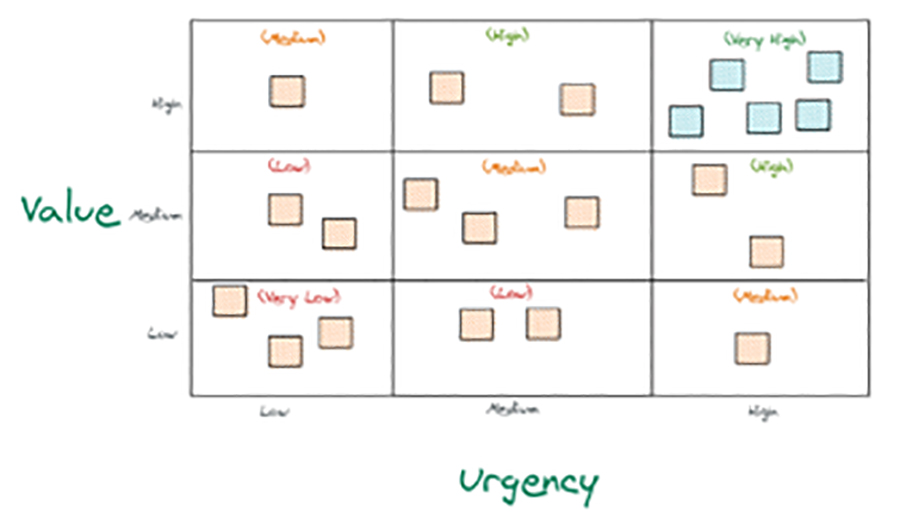
Ruthless prioritization is the first step toward regaining control. One technique that we use is a 3×3 matrix that compares High vs. Medium vs. Low Value against Urgency. Here are the steps to make this work:
Be clear on your definition of value.
Next, take it a step further and discuss how you would define High vs. Medium vs. Low Value.
Urgency means: The speed at which the value that you hope to gain will diminish if you do not work on it now. As you can see, it controls bias and motivation.
Repeat steps 1 and 2 for Urgency.
Make an inventory of the work on your plate.
Map each item on your list(s) to the various sections on the matrix. Scrutinize where you rank these work items. Whether you are creating a physical representation of this exercise in your office or using a collaboration tool. Once you plot your work, your matrix may look something like the chart below.
One recommendation that I always offer clients is to take the necessary steps to eliminate the “low” and “very low” items from their plates.
(I have colored the “very high” items differently from the rest – this is to make a point that I’ll drive home in the Visualization step).
Step 2: Visualization
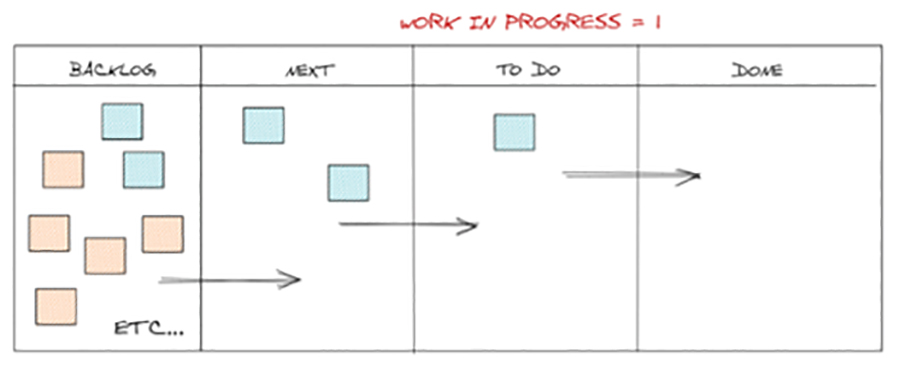
Start by creating a board with four columns and entitle each: Backlog, Next, To Do, and Done. This exercise may be done physically or virtually.
In the Backlog column, add your Very High, High, and Medium work items.
Once everything is in your backlog, move the highest priority items into the “Next” column. (Remember how I color-coded the “very high” items differently from the others? This helps illustrate that these items will be prioritized and worked on first, before anything else.)
Now here is where the most significant mindset shift happens: Move only ONE of the items from your “Next” column into your “To Do” column. This will be the item that you will focus on immediately. At this point, your board may look like this:
Reducing your Work in Progress (or WIP) to one feels uncomfortable and counterintuitive, in part because further work decomposition may need to be done. Here’s the reality:
Multitasking is not real.
Dividing your time and attention across multiple items results in lower throughput and a higher lead time to completion.
The collateral damage to a higher Work In Progress (WIP) is always some combination of poor quality, longer lead times, stakeholder disappointments, etc.
Lowering your WIP wherever possible results in higher throughput, faster lead times, a huge shift in focus, and a gratifying sense of completion.
Step 3: Conservation
To keep this system alive, establish policies, and cadences for yourself. Are there any items that can supersede anything in your existing hierarchy? How often will you review and prioritize your work? How frequently will you replenish your backlog? Getting clear on questions like these will help keep you grounded, focused, in control, and keep your system intact.
Bonus Step 4: Find time to Pause, Reflect, and Celebrate!
Breathe it in and celebrate your hard work with your team. Let me walk you through a couple of widespread scenarios I’ve seen with large, complex, matrixed organizations, and also some smaller, more straightforward businesses.
Common Scenario #1: “Dart Board Prioritization”
I worked with a large technology team charged with building an application to help facilitate the sign-up process for clients.
Our Client’s reality at the time we were asked to support:
The build was taking much longer than expected and quickly exceeded the budget.
Every feature seemed to be of equal importance, so the team built what they could when they could.
The business partners were not appropriately involved in the process.
With all the work seeming to be of equal value and a lack of business partner support to represent user needs adequately, the team seemed to defer to a “dartboard” approach to prioritization.
Here’s how we implemented the steps above to help the team regain traction:
To start:
We brought the necessary business, technology, and other stakeholders together to create the right blend of talent and perspective needed to move forward in a customer-centered direction.
We clearly understood the “why” behind the need to build the application in the first place. What problem were we hoping to solve for the end-user?
We collaboratively mapped the application from beginning to end and broke the elements of the map into smaller increments that could be built and delivered independently of each another.
Then:
We asked the cross-functional team to collaboratively prioritize the increments of value from the perspective of what they felt the customer needed the most. (Side note: A laser focus on the customer is a great way to help keep bias, self-interest, and ulterior motive at bay, which can adversely affect the creative process and outcome).
We built a physical board, and the increments of value were placed in order of priority in the backlog; we reduced the WIP to the lowest possible number
We included a couple of helpful policies and cadences. Examples include: 1) Cross-functional team members were asked to huddle together at least 2x per week. 2) Re-prioritization of work would require the input from the full cross-functional team
The quick wins:
Customer-centered prioritization sessions were happening collaboratively with, with both technology business expertise
A clear line of sight to which features would be released next, in order of priority
A deeper level of understanding across team members. Through technology we gained a clear understanding of end-user needs, and the business had a new appreciation for the technical intricacies involved in building each feature.
A clean flow of work and value delivered faster to the customer.
Common Scenario #2: “The ‘Impulsiastic’ Leader”
I worked with an organization whose teams were stretched too thin. Although there were several factors at play, one significant factor was their “Impulsiastic” leader.
Our client’s reality at the time we were asked to support:
“Impulsiastic” is a word that I came up with to describe a leader who is both Impulsive with their asks and enthusiastic about seeing their asks come to fruition.
At first glance, this may seem to be benign. But look a little closer, and you’ll notice that impulsiastic leaders tend to cause chaos and confusion for the people who report to them. Because they are excited about an idea or a direction, they are quick to add the associated work to their teams’ plates. Because the direction is coming from a leader, teams assume a change in priority, so they shift their attention accordingly. The result: tired, deflated teams who feel like they’re caught in a hamster wheel, moving at a rapid pace with no change in position.
Here were our recommendations to the team:
To visually represent all of their work (using an electronic solution for their distributed team). Using the simple format above, they would showcase the work in flight and add the work not yet started to the backlog.
Then, invite their leaders to review the board with them in detail. (Note: Teams tend to feel a sense of trepidation at first – but the shared understanding that comes out of this exercise is well worth it.) Introduce leaders to the benefits of reducing the “work in progress.”
Either in that same session or a second session, use the prioritization method above to re-establish priority and re-balance the workload.
Update the board to reflect the newly aligned-upon prioritization.
Establish a daily stand-up and bi-weekly prioritization review cadence and invite your leaders to attend the sessions as often as they can.
For the impulsiastic leaders: create the following policies: All “new” ideas or work items will be added to the backlog. These new items will be reviewed during the prioritization sessions. Any business-critical items should be brought to stand-ups for discussion.
An all too common theme within work environments are the mounds of work that people have on their plates at any given time. If this is something you’re experiencing, you’re not alone! It’s a systemic issue that spans industries around the globe. Here are the steps to gain control and become a more effective leader.
In this article, I’ll break down:
The effects of an overflowing plate of work
The desired state that we should aspire toward
The formula that will help you right-size your workload and get closer to your desired state of control.
The adverse effects of an overflowing plate
How did we even get to this point? It usually starts when multiple deliverables are weighted the same in terms of value and urgency, leading to a sense of a lack of control over commitments.
Because it is impossible to complete everything with the same level of urgency, a general feeling of failure sets in; quality is compromised, and speed to completion is reduced.
What does the desired state look like?
We all long for a life where we feel in control, deliver high-quality work, add value to the world around us, and feel fulfilled. The question is: what can we do to lean more into this desired state and regain greater control?
The 3-step formula to help you right-size your workload
Frequently, employees struggling with work overload also tend to work in environments that overuse meetings and place a high value on tasks. Recognizing that part of the issue could be the environment itself, I’ll share a formula that will stand on its own and one that may also help to advance the DNA of your organization.
Step 1: Prioritization
Ruthless prioritization is the first step toward regaining control. One technique that we use is a 3×3 matrix that compares High vs. Medium vs. Low Value against Urgency. Here are the steps to make this work:
Be clear on your definition of value.
Next, take it a step further and discuss how you would define High vs. Medium vs. Low Value.
Urgency means: The speed at which the value that you hope to gain will diminish if you do not work on it now. As you can see, it controls bias and motivation.
Repeat steps 1 and 2 for Urgency.
Make an inventory of the work on your plate.
Map each item on your list(s) to the various sections on the matrix. Scrutinize where you rank these work items. Whether you are creating a physical representation of this exercise in your office or using a collaboration tool. Once you plot your work, your matrix may look something like the chart below.
One recommendation that I always offer clients is to take the necessary steps to eliminate the “low” and “very low” items from their plates.
(I have colored the “very high” items differently from the rest – this is to make a point that I’ll drive home in the Visualization step).
Step 2: Visualization
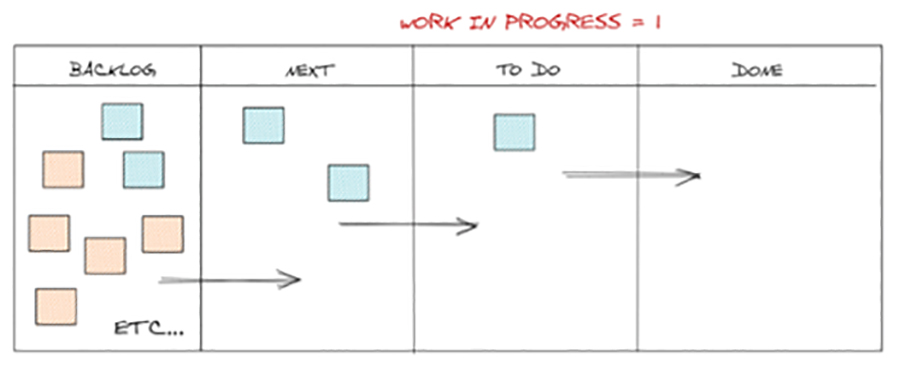
Start by creating a board with four columns and entitle each: Backlog, Next, To Do, and Done. This exercise may be done physically or virtually.
In the Backlog column, add your Very High, High, and Medium work items.
Once everything is in your backlog, move the highest priority items into the “Next” column. (Remember how I color-coded the “very high” items differently from the others? This helps illustrate that these items will be prioritized and worked on first, before anything else.)
Now here is where the most significant mindset shift happens: Move only ONE of the items from your “Next” column into your “To Do” column. This will be the item that you will focus on immediately. At this point, your board may look like this:
Reducing your Work in Progress (or WIP) to one feels uncomfortable and counterintuitive, in part because further work decomposition may need to be done. Here’s the reality:
Multitasking is not real.
Dividing your time and attention across multiple items results in lower throughput and a higher lead time to completion.
The collateral damage to a higher Work In Progress (WIP) is always some combination of poor quality, longer lead times, stakeholder disappointments, etc.
Lowering your WIP wherever possible results in higher throughput, faster lead times, a huge shift in focus, and a gratifying sense of completion.
Step 3: Conservation
To keep this system alive, establish policies, and cadences for yourself. Are there any items that can supersede anything in your existing hierarchy? How often will you review and prioritize your work? How frequently will you replenish your backlog? Getting clear on questions like these will help keep you grounded, focused, in control, and keep your system intact.
Bonus Step 4: Find time to Pause, Reflect, and Celebrate!
Breathe it in and celebrate your hard work with your team. Let me walk you through a couple of widespread scenarios I’ve seen with large, complex, matrixed organizations, and also some smaller, more straightforward businesses.
Common Scenario #1: “Dart Board Prioritization”
I worked with a large technology team charged with building an application to help facilitate the sign-up process for clients.
Our Client’s reality at the time we were asked to support:
The build was taking much longer than expected and quickly exceeded the budget.
Every feature seemed to be of equal importance, so the team built what they could when they could.
The business partners were not appropriately involved in the process.
With all the work seeming to be of equal value and a lack of business partner support to represent user needs adequately, the team seemed to defer to a “dartboard” approach to prioritization.
Here’s how we implemented the steps above to help the team regain traction:
To start:
We brought the necessary business, technology, and other stakeholders together to create the right blend of talent and perspective needed to move forward in a customer-centered direction.
We clearly understood the “why” behind the need to build the application in the first place. What problem were we hoping to solve for the end-user?
We collaboratively mapped the application from beginning to end and broke the elements of the map into smaller increments that could be built and delivered independently of each another.
Then:
We asked the cross-functional team to collaboratively prioritize the increments of value from the perspective of what they felt the customer needed the most. (Side note: A laser focus on the customer is a great way to help keep bias, self-interest, and ulterior motive at bay, which can adversely affect the creative process and outcome).
We built a physical board, and the increments of value were placed in order of priority in the backlog; we reduced the WIP to the lowest possible number
We included a couple of helpful policies and cadences. Examples include: 1) Cross-functional team members were asked to huddle together at least 2x per week. 2) Re-prioritization of work would require the input from the full cross-functional team
The quick wins:
Customer-centered prioritization sessions were happening collaboratively with, with both technology business expertise
A clear line of sight to which features would be released next, in order of priority
A deeper level of understanding across team members. Through technology we gained a clear understanding of end-user needs, and the business had a new appreciation for the technical intricacies involved in building each feature.
A clean flow of work and value delivered faster to the customer.
Common Scenario #2: “The ‘Impulsiastic’ Leader”
I worked with an organization whose teams were stretched too thin. Although there were several factors at play, one significant factor was their “Impulsiastic” leader.
Our client’s reality at the time we were asked to support:
“Impulsiastic” is a word that I came up with to describe a leader who is both Impulsive with their asks and enthusiastic about seeing their asks come to fruition.
At first glance, this may seem to be benign. But look a little closer, and you’ll notice that impulsiastic leaders tend to cause chaos and confusion for the people who report to them. Because they are excited about an idea or a direction, they are quick to add the associated work to their teams’ plates. Because the direction is coming from a leader, teams assume a change in priority, so they shift their attention accordingly. The result: tired, deflated teams who feel like they’re caught in a hamster wheel, moving at a rapid pace with no change in position.
Here were our recommendations to the team:
To visually represent all of their work (using an electronic solution for their distributed team). Using the simple format above, they would showcase the work in flight and add the work not yet started to the backlog.
Then, invite their leaders to review the board with them in detail. (Note: Teams tend to feel a sense of trepidation at first – but the shared understanding that comes out of this exercise is well worth it.) Introduce leaders to the benefits of reducing the “work in progress.”
Either in that same session or a second session, use the prioritization method above to re-establish priority and re-balance the workload.
Update the board to reflect the newly aligned-upon prioritization.
Establish a daily stand-up and bi-weekly prioritization review cadence and invite your leaders to attend the sessions as often as they can.
For the impulsiastic leaders: create the following policies: All “new” ideas or work items will be added to the backlog. These new items will be reviewed during the prioritization sessions. Any business-critical items should be brought to stand-ups for discussion.