World’s First Black Woman President: Weapons Don’t Kill, People do

  • Raised in one of the most troubled countries in Africa a woman rises to become the world’s first black woman president at age 67.
  • Personal struggles helped shape her attitude to war and violence, that she used to build a country torn apart by civil war.
  • An understanding of history and gender discrimination taught her that women must not be held back and insists they form part of any conflict resolution process.
  • In accepting a Nobel Peace Prize she emphasizes that weapons cannot kill by themselves – people do.

Born into poverty in Africa, getting married at 17 to an abusive husband, facing discrimination as a woman, imprisoned and being forced into exile, separated from your children – these things would test the will of the toughest leader. Yet this is what happened to Ellen Johnson Sirleaf, and despite insurmountable odds, she is now the world’s first elected black female president and Africa’s first elected female head of state. Elected in 2006, Sirleaf brought stability to Liberia, a volatile country that had seen two civil wars over a period of fourteen years. As if that wasn’t enough, she also added a Nobel Peace Prize to her long list of accolades in 2011.

Her popular title of the “Iron Lady” of Africa is a pleasant irony as her Nobel Peace Prize was awarded for her non-violent struggle to ensure the safety of women and for insisting that women have full participation in the peace-building process. Sirleaf shared her Nobel Prize with fellow Liberian Leymah Gbowee and Tawakkul Karman of Yemen for realising the great potential for democracy and peace that women can bring. War may traditionally be men’s work, but Sirleaf insists that women have a say in cleaning up the mess and ensuring that it won’t happen again. Her fight against corruption and violence could also be the reason she was voted back as president for a second term in 2011 and why the IMF and donor countries agreed to write off $4.6 billion of Liberia’s debt, based on her sound economic policies, freeing up funds to build new infrastructure.

Sirleaf was born with Americo-Liberian roots and German ancestry and she has qualifications and work experience from American institutions the World Bank, Citibank and the UN Development Programme. Her diverse cultural identity, exposure to global economic infrastructure and big picture thinking have all resulted in a leader who understands that diversity can actually keep things together, rather than tear things apart.

Sirleaf describes Liberia as, “A wonderful, beautiful, mixed-up country struggling to find itself.” The complications stretch back to 1847 when Liberia declared itself a nation, created by freed American slaves shipped back to Africa. They retained the cultures and traditions of the American South and even created a flag that mimics closely the American flag. “The settlers of modern-day Liberia decided they would plant their feet in Africa but keep their faces turned squarely toward the United States,” says Sirleaf. “This would trigger a profound alienation that led to a deeply cleaved society, and ultimately set the stage for the terror and bloodshed to come.”

The 1989-1996 Liberian civil war, one of Africa’s bloodiest, claimed the lives of more than 200,000 Liberians and further displaced a million others into refugee camps in neighboring countries. Entire villages were emptied as people fled. Child soldiers committed atrocities, raping and murdering people of all ages, including their parents. The war claimed the lives of one out of every 17 people in the country.

The seeds of the conflict can be traced back to leaders who either identified themselves with an Americo-Liberian identity or with ethnic, tribal sentiments. It’s a stark reminder of how political decisions and discrimination from generations ago can suddenly appear to haunt future generations at any time. 

One hundred and fifty eight years later it took a single woman to heal the wounds. Sirleaf refused to accept the limitations of her nation, or her gender, and refused to give up her beliefs despite being jailed and threatened by brutal dictators. She worked for, and ruffled the feathers, of every president she worked for in Liberia over a span of nearly 40 years, until she herself at age 67 became the first woman to be elected president of an African nation.
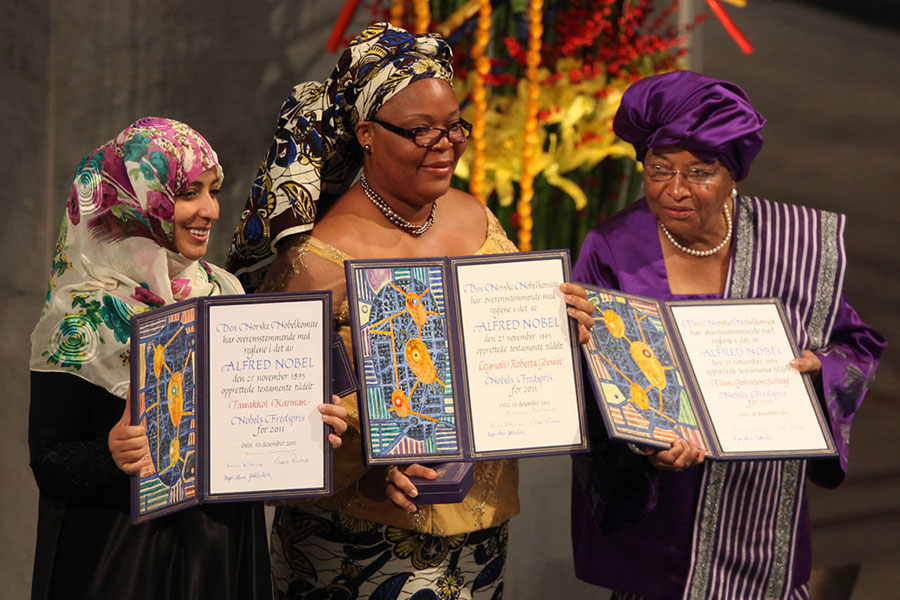
From left: Yemeni activist Tawakkul Karman, Liberian 'peace warrior' Leymah Gbowee and Liberian President Ellen Johnson Sirleaf jointly won the 2011 Nobel Peace Prize.

From left: Yemeni activist Tawakkul Karman, Liberian ‘peace warrior’ Leymah Gbowee and Liberian President Ellen Johnson Sirleaf jointly won the 2011 Nobel Peace Prize.


Many people are unaware that Alfred Nobel, after which the Peace Prize is named, was the inventor of dynamite. He was inspired to leaving his vast fortune to the prize that bears his name after a newspaper incorrectly reported his death with the headline: “Dr. Alfred Nobel, who became rich by finding ways to kill more people faster than ever before, died yesterday.” It was actually Nobel’s brother that had died, but from that moment he decided his legacy was going to be about peace and human advancement. Sirleaf accepted her Nobel Peace Prize by recounting this story and adding,” Alfred Nobel’s dynamite did not kill people. People kill people, whether it’s with a knife, machete, handgun, rifle, machine gun or explosive device packed with dynamite.”

She is also dismissive of those that assume military weapons are the only devices on which war can be blamed. “We must not forget that some of the most heinous crimes in war have been committed without explosives. Too often brute force has sufficed,” she says. “Rape remains one of the tested and most enduring weapons of war. But there have always been other men, and perhaps even more women, who have committed themselves to the cause of peace,” Sirleaf explains. “These are the people Alfred Nobel wanted to celebrate and have others emulate.”

In her inaugural speech Sirleaf said: “Our recent history teaches us that violence diminishes our nation and ourselves, not just within our borders, but more importantly in our dealings with other nations and people.” Conflict is never confined to a geographical area, especially in the age of globalization, and Sirleaf knows that a true leader sees themselves as a global citizen with a responsibility beyond their own citizens.

Sirleaf’s presidency firmly establishes the importance of women leaders on the world stage and her unique position as a woman with both African and Western roots – genealogically, geographically, and intellectually – signals a new kind of 21st century leadership that has broken gender stereotypes and challenged the idea that historical animosities cannot be healed.

She has also stressed that the tolerance of other viewpoints is crucial for the creation of peace, even when people disagree strongly with those around them. “Our shared values are more important than our individual interests,” she says, explaining how the bigger picture should always be kept in mind before pulling a trigger.

The Dalai Lama: The Spiritual CEO Of Happiness Says He Might be Back As A Woman


  • A global leader with billions of admirers has a simple message for the planet: be more compassionate.
  • The Dalai Lama considers himself an “engaged” Buddhist and is not shy of commenting on serious social problems, or that he might be reincarnated as a woman.
  • Call it Karma, destiny or just plain bad luck, most people have a sense that if they harm or destroy something it will rebound on them someday.
  • Isolation, exile and rejection are not necessarily a bad thing. If your message is pure people will know it and you’ll become more powerful than if you’d turned to violent means to achieve your goal.
  • The Dalai Lama says we are all selfish, but should be wise-selfish instead of foolish-selfish.
  • Times have changed and he believes that religious leaders, with their ability to take a long view on humanity, should participate in discussions of global business and economics.

Being ordained as a global leader of significance at age five with followers that number six percent of the world’s population, being made leader of a country at age 15 and being awarded a Nobel Peace Prize must make you an extraordinary leader with some pretty awesome powers, right? Yet, the 14th Dalai Lama, Tenzin Gyatso, has become an enduring symbol of human rights and peace by focusing on a simple concept throughout the 79 years of his life: compassion and non-violence. It doesn’t sound very proactive, but his outlook has struck a cord with more than 350 million Buddhists around the globe and endeared himself to billions more, regardless of their faith or worldview. He meets people from all walks of life who ask themselves the same question: “Can his message of peace and compassion be that simple?”

dalai-lama-3

The Dalai Lama could easily have rested on his reincarnated laurels and lived a life of relative privilege and fame, inherited from his predecessor, the 13th Dalai Lama, Thubten Gyatso. Instead, he has become a spiritual leader like no other, with a keen interest in the link between science and religion, and become outspoken on issues such as the environment, women’s rights, astronomy, physics and reproductive health. He is highly intelligent, determined and has a great sense of humor – all the great qualities of a spiritual leader. Or a good CEO.

He’s even written a book around the art of making business decisions, The Leaders Way, published in 2009. In it, he explains that every decision-making process should have values instilled in them. He calls these values dependent origination, interdependence and impermanence. Put another way, the intention behind every business decision must be beneficial to the greatest number of people. They must also be aware that nothing is permanent and that things change constantly. The Dalai Lama reckons a smart person will adapt and respond to changes in the world, in both their personal life and within the marketplace.

dalai-lama-4

Change has certainly been a feature of the Dalai Lama’s life, despite wearing the same outfit for almost eight decades and repeating the same mantra of compassion again and again.

Forced into exile from his Tibetan homeland by China in 1959, the Dalai Lama has travelled the world ever since, spreading a message that highlights the importance of compassion as the source of a happy life. It’s not an easy job. Many of the institutions that host him face pressure from China not to accept him. China refuses to acknowledge Tibet as an autonomous region, insisting instead that it forms part of the People’s Republic of China. The dispute has been at the heart of the Dalai Lama’s rejection and global wandering for the past 55 years, but which ironically has worked in his favor. He joins the ranks of other legendary leaders such as Nelson Mandela and Aung San Suu Kyi, both of whom experienced rejection, isolation and exile – which only made them stronger – resulting in their cause spreading to many more millions than if they had not been persecuted.

dalai-lama-2

The Dalai Lama considers himself an “engaged” Buddhist and does not shy away from controversy. He has even supported the possibility that his next incarnation might be a woman, or that he might not be back at all! His succession strategy is open to change, something a good CEO understands necessary for long-term sustainability.

He was awarded the Nobel Peace Prize in 1989 for his willingness to compromise and seek reconciliation with the Chinese, despite brutal violations and harassment. The Nobel Committee based its decision on the fact that he had a philosophy that showed reverence for all living things and that there existed a universal responsibility that embraced both man and nature. Call it Karma, destiny or just plain bad luck, most people have a sense that if they harm or destroy something it will rebound on them some day. The Dalai Lama has confirmed this small voice of conscience within all of us by stressing that we need to be more actively aware of our actions.

“Times have changed, and I believe that leaders of religious traditions – with their ability to take a long view of the human condition – should participate in discussions of global business and economics. Our world faces very serious problems, such as the negative impact of our ever-increasing population and the affect that rising standards of living are having on the environment,” says the Dalai Lama. “We are all selfish, but we should be wise-selfish instead of foolish-selfish.”

dalai-lama-prince-charles

The Dalai Lama’s leadership style might be based on a passive view of the world but he wants us to realize that expressing empathy and compassion in business is not a roadblock. As a global citizen who is not held back by any single organization, he is uniquely positioned to speak about the biggest problems we face as a planet. He is focused on what is good for humanity, and while many of us may put his advice into a box labeled “spirituality,” his insights can teach us that broadening our vision, and our limits, can be good for business too. He embraces new ideas and gets information from every level of society, allowing him to formulate opinions and solutions that help him understand situations in a very profound way. Imagine the business opportunities that might flow from thinking this way?

Compassion towards others builds trust and loyalty, something many good leaders strive for among employees, customers and even competitors. The seeds of the Dalai Lama’s compassion came from his mother, whom he still remembers carrying him around as a baby while working in the fields. “I never saw her with an angry face,” he recalls. “How is it that seven billion people on this planet also come from their mothers womb, received affection and drank their mother’s milk but never developed this same inner value?” It’s a question he leaves with each one of us to solve.

What do you think about the Dalai Lama saying that he might be reincarnated as a women one day, or maybe not at all? Comment below.

Nelson Mandela and Graça Machel: Building Love, Breaking Barriers

Nelson Mandela left us in 2013, but his wife, Graça Machel, remains an endearing symbol of his generous spirit and leadership. She’s still hard at work in Africa, promoting a vision she shared with Mandela – that we can achieve anything when we work collectively rather than individually. Graça Machel has played an historic role in two African nations, Mozambique and South Africa. After her marriage to former Mozambique president Samora Machel ended after a fatal plane crash in 1986 she married again in 1998. This time, to an iconic figure who possesed the same values and visionary leadership that she held dear – Nelson Mandela. An historic situation arose that made her the first woman in history to have been the First Lady of two different countries.

In true generous spirit, Mandela gave the world a gift on his 89th birthday when he announced the formation of The Elders – a group that includes Kofi Annan, Jimmy Carter, Desmond Tutu and nine other notable individuals.

In true generous spirit, Mandela gave the world a gift on his 89th birthday when he announced the formation of The Elders – a group that includes Kofi Annan, Jimmy Carter, Desmond Tutu and nine other notable individuals. The Elders work globally and describe themselves as “independent global leaders working together for peace and human rights.” The goal Mandela set for The Elders was to use their almost 1,000 years of collective experience to work on solutions for seemingly insurmountable problems, such as climate change, HIV/AIDS and poverty, as well as to use their political independence to help resolve some of the world’s most intractable conflicts. Machel has led The Elders’ work on child marriage, and was the founder of Girls Not Brides: The Global Partnership to End Child Marriage.

Not satisfied with settling on the title First Lady, Machel embarked on humanitarian work that took calculated risks to achieve results. She has challenged the staus quo business-as-usual mentality on many occassions while striving to deliver results for women and children. Mandela had always liked strong women and might be considered the ultimate male feminist. For him, democracy and gender equality were not separate issues.

His relationship with Machel created a formidable team that worked together on a global scale for the greater good, despite the onset of old age when many of their peers would have been seeking a more sedentary lifestyle. There was great respect and affection between them. Hillary Clinton recalled her fondest memory of the couple when she last saw them together: “What I like to remember is the way Madiba’s face would light up when he saw Graça come into a room or even heard her voice,” she says. “I think it is fair to say that Madiba had very good judgment and in Graça he found a partner worthy of his own incomparable soul.”

It was also a relationship forged on shared values and struggles. When Machel lost her first husband, Madiba wrote to her offering condolences and she replied, “From within your vast prison you have brought a ray of light into my hour of darkness.” A schoolteacher turned freedom fighter, she served as Mozambique’s Minister of Education for nearly 15 years. Under Machel’s leadership, primary school enrolment increased from only 40 percent in 1975 to more than 90 percent of boys and 70 percent of girls by 1989.

Under Machel’s leadership, primary school enrolment increased from only 40 percent in 1975 to more than 90 percent of boys and 70 percent of girls by 1989.

At the height of the recent financial crisis, she listened to talk of restructuring the financial system and analyzing what had gone wrong. She called a group of young people in the financial sector and said, “Look, moments of crisis are moments of opportunity.” From that sentiment, Machel started a powerful network of African women in finance that has already held three summits attended by ministers of finance, along with the CEOs of the largest financial banks and institutions on the continent. “We now have huge support from the African Development Bank and we engage with women in financial institutions who need to be encouraged to take up leadership positions,” says Machel.

“One of the things we’ve succeeded in doing with this network is creating new faces and voices within the financial sector; not only in Africa but within global institutions too. We’re not just trying to change the financial landscape but also to influence the thinking within financial institutions that will bring about more opportunities for women.” Many organizations talk about how critical health and education are for women, but access to credit, and being able to start and grow a business, is at the core of whether or not women and girls will have economic opportunities. It’s an area that is increasingly being recognized as critical to the development of emerging economies. Machel’s work with The Elders on child marriage and her studies on children in conflict may be highly  symbolic, but have an important role to play in changing a world where women and children are increasingly the victims of conflict – more than at any time in history.

“The Elders work with countries in conflict in a very subtle way,” says Machel.

“The Elders work with countries in conflict in a very subtle way,” says Machel. “We encourage people in an informal setting to look into each other’s minds and recognize that they belong to the same nation.” The issue of child marriage is a slightly more challenging one, ingrained, as it often is, among cultural and religious beliefs. Machel believes there are situations that allow much to be achieved in this area, but that you need to be strategic. Simple finger wagging won’t work.

“I like to use the phrase ‘sowing the seeds of social change’,” says Machel. “You need to give people incentives.” Rather than moral lectures, Machel believes that by presenting the economic benefits against child marriage, she will have a greater effect. “We talk about the importance of education and keeping children in school until they complete at least secondary level,” she says. “This is an age when you’re old enough to make a decision on whether you want to get married, to whom and whether you want to have a child. No child of 10 or 14 years old has a body that is ready for marriage and because they are then expected to have children themselves, we highlight the relationship between child marriage and maternal mortality and child mortality,” says Machel.

These facts help people see for themselves the economic short-sightedness of risking the lives of family members for social norms, rather than ensuring their longevity and reaping long-term benefits. “We need to change mindsets and allow the child to grow and have opportunities,” says Machel. “It’s a long and difficult process and we work with community and religious leaders. Organized religion in Africa has a huge network and through these institutions, we work to protect children from marriage.

We are building a new generation of women and also changing the mindset of people – that if a child is born a girl, she has the same rights as a boy.”

“Sport Has The Power to Change The World” – Nelson Mandela

A unique collaboration between luxury brands and the world’s greatest sporting legends has helped young people around the world overcome challenging social issues such as poverty, homelessness, war, violence, drug abuse, discrimination and AIDS.

As Michael Johnson settled into the starting blocks at the Atlanta Olympics in 1996 to set a new world record for the 200 meters, he could never have imagined jogging playfully alongside kids in Kenya a few years later, helping raise self-esteem among young people in one of Africa’s largest slums. When Nawal El Moutawakel crossed the finish line at the 1984 Los Angeles Games and became the first Moroccan, African and Muslim woman to win an Olympic gold medal, she had no idea that she’d one day be leading 30,000 Muslim girls on an annual 10 km fun run around Casablanca, and pioneering sport among women in Moroccan society.

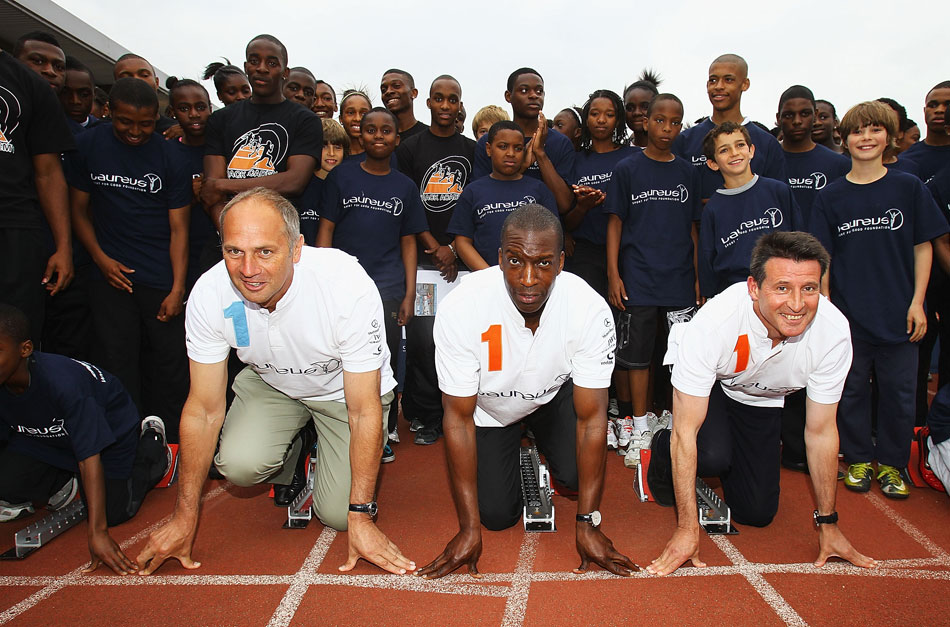
Britain’s greatest ever Paralympic athlete, Tani Grey-Thompson, six-time winner of the London Wheelchair marathon, despite a debilitating back disease that’s confined her to a wheelchair, could never have guessed that she’d find herself in the West Bank in Gaza one day, inspiring Israeli and Palestinian kids to work together through a basketball match. Johnson, El Moutawakel and Grey-Thompson form part of a unique association of 46 of the world’s greatest living sporting legends, The Laureus Academy, that embraces the principle of using sport to help bring positive change to disempowered communities.

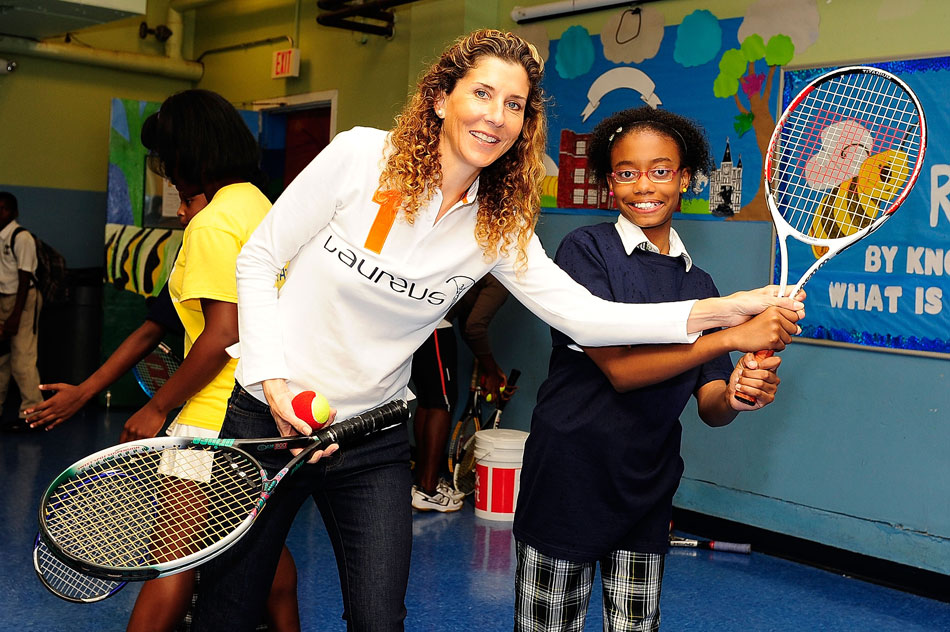
They offer their time to support the work of the Laureus Foundation, by visiting over 140 projects around the world, all utilizing sport to turn kids away from the negative influences in society, and helping them realize their true potential. Other sporting greats who have aligned themselves with the Laureus include, Boris Becker, Jack Nicklaus, Hugo Porta, Kapil Dev, Sebastian Coe, Monica Seles, Tony Hawk and Dan Marino.

seles

This grassroots, life-changing work, is offset by a glittering sports awards ceremony, held each year in a different city, that sees the Academy members mingle with top sportspeople, presidents and royalty, to recognize sporting excellence. Commonly referred to as the “Oscars of sport,” the award ceremony was conceived as a way of bringing together the biggest names in sport and raising awareness around sport as a catalyst for change.

While big sporting celebrities walk away with solid gold and silver trophies produced by Cartier, after acceptance speeches for categories such as Breakthrough of The Year and Spirit of Sport Award, they are typically found a few months later in the slums of India or surveying the aftermath of a Tsunami in Indonesia, offering their expertise to rebuild communities. Significant global brands have come onboard as sponsors to ensure the work is maintained, and in return, their brand travels the world and associates itself with top sports personalities and events.

One of the global partners, luxury Swiss watch manufacturer IWC Schaffhausen, has even developed a special, limited edition watch for the benefit of the foundation, featuring the engraved artwork of a winner from one of the global Laureus projects. CEO of IWC Schaffhausen, Georges Kern, who has personally driven the Swiss watch manufacturer’s social responsibility program, says: “The privileged people on this planet – and we are among them – must do something to help those who are socially, physically or economically disadvantaged.

Through sport, Laureus gives people fresh hope and promotes social skills such as respect for opponents, recognition of rules, fair play and teamwork.” Other sponsors and patrons, such as Mercedes-Benz, Richemont, Daimler and the cities that play host to the yearly awards, benefit from huge global exposure by participating in A-list events and through their association with household names in sport.

laureus2

From a logo on a T-shirt in Africa to major television coverage at a Formula One event, sponsors are perfectly positioned to do well by doing good. “Politicians love movie stars, and movie stars love sportspeople,” says Edwin Moses, Chairman of the Laureus World Sports Academy. “We’re at the top of the influence chain, and because our physical skills are not easily replicated, we command huge respect and can influence lives.”

Tennis legend Martina Navratilova, an active Academy member, has seen the benefits of this unique business model firsthand: “We have raised over $100 million since 2001 and now there are over 120 projects globally. Over 1.5 million kids have been helped in a positive way,” she says.

The Laureus story is a heady mix of corporate sponsorship, celebrity sport and the will to succeed in some of the most devastated and impoverished parts of the planet. Projects have saved kids from gangs in Sao Paulo, reformed child soldiers in Sierra Leone, given hope to special needs kids in Shanghai and helped clear mines in Cambodia. It embodies something every sportsperson who has ever achieved greatness can attest to – that winning comes through a combination of self discipline and teamwork – mirroring the same qualities needed to win in life. It was the lack of a formal platform to honor this greatness that sparked the idea for Laureus in the first place. The year 2000 dawned with a mixture of hope and expectation as the world prepared for the new Millennium.

The United Nations declared 2000 to be the International Year for the Culture of Peace, and global warming was something most people were hardly aware of. Indeed, Al Gore was a US Presidential candidate that year, and had yet to move on to become the maker of the award-winning ecological wake-up film An Inconvenient Truth. As ever, sport was full of promise. The Millennium Olympic Games were just around the corner in Sydney, and indeed proved to be one of the most successful ever. And something else significant was stirring: an idea which was to prove radical and innovative, and, once it became reality, a beacon of hope for disadvantaged young people.

The seed of the idea that grew to become Laureus was first planted several years before the Millennium by Johann Rupert, Executive Chairman of luxury goods company Richemont. A noted sports enthusiast, Rupert was at a dinner with friends one evening and mused over the fact that there was no Nobel Prize or Oscars-style awards for sport.

Rupert’s views on the power of sport were fundamentally influenced by the crucial role that the 1995 Rugby World Cup played in the reconciliation of the different communities in South Africa, and in 1998 he found a kindred spirit in Dieter Zetsche, Chairman of German automotive giant Daimler, like Richemont, another blue chip company with a long commitment to sport. Two years later, the Laureus World Sports Academy was created, with 30 of the greatest living sports legends named as founder members.

On May 25, 2000, the majority of the Academy members gathered in Monaco for the very first Laureus World Sports Awards. It was an impressive collection of sporting legends, but it is fair to say that the biggest name was a huge surprise all round, as the door to the Academy meeting room opened and in walked President Nelson Mandela. It was in Monaco that Mandela, who was to become the Patron of Laureus, made the visionary speech which has become the philosophy of Laureus and the driving force that has shaped its work for the last 13 years.

His speech has become the dictum not only for Laureus, but for the whole sport for good movement. He said: “Sport has the power to change the world. It has the power to inspire. It has the power to unite people in a way that little else does. It speaks to youth in a language they understand. Sport can create hope, where once there was only despair. It is more powerful than governments in breaking down racial barriers.

It laughs in the face of all types of discrimination.” With much conflict in the world based on ignorance or fear of other cultures, breaking down this discrimination could be seen as a crucial part of creating prosperity for future generations. Perhaps the power of sport can best be illustrated by an encounter Rupert once had with a friend of his.

“Some 30 years ago, while living in New York City, I had a black friend who was a true sports superstar,” says Rupert. “He was constantly mobbed for autographs. I noticed that he took extra care giving signed posters to white kids. I asked him about the apparent favoritism. His answer: “Johann, if a white kid has my poster in his bedroom, he can hardly discriminate against the black kid in his class.”


The Oprah Effect

Born into poverty in rural Mississippi to a teenage, single mother, Oprah Winfrey went on to become the first black woman billionaire in history. Arguably the world’s most powerful woman, she has overcome her adversities to become a benefactor to others. Now she’s producing movies.

In August this year The Hundred-Foot Journey produced by Steven Spielberg, Oprah Winfrey and Juliet Blake will hit our screens. Based on a novel by  Richard C. Morais, it explores the rivalry between an Indian and French restaurant, located one hundred feet apart. The plot might be one that Oprah typically explores on her shows: a clash of values and cultures, misunderstandings and strife, that resolves itself into a warm and passionate feel-good, where everyone wins.

The appeal of the storyline might be one reason Winfrey is helping produce this movie, but her association with Spielberg goes back to 1985 when she starred in The Color Purple as distraught housewife Sofia. The film went on to become a Broadway musical, with Winfrey credited as a producer too. In October 1998, she also produced and starred in the film Beloved, where to prepare for her role as Sethe, the protagonist and former slave, Winfrey experienced a 24-hour simulation of the experience of slavery,  including being tied up and blindfolded and left alone in the woods.

During filming, co-actor Thandie Newton described Winfrey as, “A very strong technical actress; because she’s so smart. She’s acute. She’s got a mind like a razor blade.” Winfrey has become an icon of compassion and empathy around the world, discovering early in her career that it had marketing potential. She was born into poverty in rural Mississippi, to a teenage, single mother, and later raised in an inner-city Milwaukee neighborhood. She experienced considerable hardship during her childhood, saying she was raped at age nine and became pregnant at 14; her son died in infancy.

Sent to live in Tennessee, Winfrey landed a job in radio while still in high school and began co-anchoring the local evening news at the age of 19. Her emotional ad-lib delivery eventually got her transferred to the daytime-talk-show arena, and after boosting a third-rated local Chicago talk show to first place, she launched her own production company, becoming internationally syndicated. Credited with creating a more intimate, confessional form of media communication, she is thought to have popularized and revolutionized the tabloid talk show genre, which a Yale study says broke 20th-century taboos, and allowed previously disenfranchised people to enter the mainstream.

By the mid-1990s, she had reinvented her show with a focus on literature, self-improvement and spirituality, and in 1986 The Oprah Winfrey Show began broadcasting across the United States. Time magazine wrote at the time: “Few people would have bet on Oprah Winfrey’s swift rise, to host the most popular talk show on TV.

In a field dominated by white males, she is a black female, and of ample bulk. What she lacks in journalistic toughness, she makes up for in plainspoken curiosity, robust humor and, above all, empathy.” In the mid-1990s, Winfrey adopted a less tabloid-oriented format, hosting shows on broader topics such as heart disease, geopolitics, spirituality and meditation, interviewing celebrities on social issues they were directly involved with, such as cancer, charity work, or substance abuse. Winfrey became the first black person to rank among the 50 most generous Americans and by 2012 she had given away about US$400 million to educational causes, including more than 400 scholarships to a college in Atlanta.

The following year, U.S. President Barack Obama awarded her the Presidential Medal of Freedom. In 1998, Winfrey created Oprah’s Angel Network, a charity that supported charitable projects and provided grants to nonprofit organizations around the world. The network raised more than US$80 million, with Winfrey personally covering all administrative costs so that 100 percent of all funds raised went to the charity programs.

Winfrey created the Oprah Winfrey Leadership Academy for Girls in South Africa in 2007, investing US$40 million in establishing the academy. A 21-day trip to the country, visiting schools and orphanages in poverty-stricken areas, struck a chord with Winfrey, who later described having maternal feelings toward the girls; perhaps wanting them to avoid the pitfalls of her own early years. She keeps in touch with them by teaching a class via satellite.

Nelson Mandela praised Winfrey for overcoming her own disadvantaged youth to become a benefactor for others, while others considered the school elitist and unnecessarily luxurious. Winfrey rejected these claims, saying: “If you are surrounded by beautiful things and wonderful teachers who inspire you, that beauty brings out the beauty in you.”

Now worth close to US$3 billion, according to Forbes, and the first black woman billionaire in world history, Winfrey is the richest self-made woman in North America. Yet, despite her fabulous wealth she continues to permeate world culture and help shape our lives in meaningful ways.

Royal Dutch Shell Endorses Shareholder Resolution on Climate Change

Supermajor’s Support for Resolution Co-Filed by As You Sow Sends Signal to Policymakers: It’s Time for Global Accord On Climate.

The Royal Dutch Shell Board of Directors has endorsed a shareholder resolution requiring the company to commit to reduce emissions and invest in renewable energy, to do away with bonus systems that promote climate harming activities, and to stress test its business model against the two degrees Celsius warming limit adopted by 141 governments in the UN’s Copenhagen Accord.

Nonprofit As You Sow co-filed the shareholder resolution at Royal Dutch Shell and a similar resolution at BP as part of the “Aiming for A” Coalition of investors, coordinated by ClientEarth and ShareAction. “It’s remarkable that a supermajor like Shell supports a shareholder resolution that boldly questions its own business model,” said Andrew Behar, CEO of As You Sow.

“This acknowledgement of the need for change will ripple through the entire industry, and not a second too soon, as we see reports of 2014 being the hottest year on record. We see this as a signal to policymakers that the business community supports a robust global climate accord in Paris in 2015.” Climate-related shareholder resolutions filed at Anadarko and CONSOL Energy by As You Sow in 2014 were supported by 30% and 18% of shareholders respectively.

A similar resolution at ExxonMobil was withdrawnwhen the company agreed to publish a report on stranded carbon asset risk, in which Exxon acknowledged the risk of climate change and noted that if regulations on carbon were to be adopted, carbon pricing would be the most business-friendly regulatory mechanism. “Shell’s statement provides evidence that business as usual is no longer working for shareholders or industry, either from a global warming or markets perspective,” said Danielle Fugere, President and Chief Counsel of As You Sow.

“Whether oil prices are high or low, producers are finding themselves between a rock and a hard place: when prices are low, they can’t earn enough to cover costs, and when prices are high consumers are driven to lower-price competitors like renewables. In the meantime, global warming is driving regulatory action that is likely to strand fossil fuel assets.”

Time to Wake up and Smell the CO2

The Intergovernmental Panel on Climate Change has just released its 2013 report on the state of our global environmental health. Compiled by 259 authors in 39 countries the report paints a sobering picture of our current situation and the consequences that await us in the future should we fail to act. These are not sensationalized facts by an author or alarmist marketing noises from organisations with hidden commercial agendas, but rather a compilation of scientific observations from hundreds of people across the globe.

We’ve been hearing these warnings for years, yet fail to realize that it will take decades, or longer, before we can undo the damage. This issue should not be seen as the responsibility of governments only, but rather as a global business plan that we can all subscribe to in whatever way we can. Seven billion people on the planet all saying, “My small contribution to climate change won’t make a difference anyway,” is exactly the problem – it allows seven billion people to stay locked into the very habits that are destroying our ecosystems.

Many consequences of climate change remain unknown, but can we afford to be surprised one day? You wouldn’t run your business like that would you? Below is a summary of the main findings from the Climate Change 2013 report:

Graphic by Boris Rasin

Graphic by Boris Rasin

Observed Changes in the Climate System

Each of the last three decades has been successively warmer at the Earth’s surface than any preceding decade since 1850. In the Northern Hemisphere, 1983–2012 was likely the warmest 30-year period of the last 1400 years (medium confidence). Ocean warming dominates the increase in energy stored in the climate system, accounting for more than 90% of the energy accumulated between 1971 and 2010 (high confidence).

It is virtually certain that the upper ocean (0–700 m) warmed from 1971 to 2010, and it likely warmed between the 1870s and 1971. Over the last two decades, the Greenland and Antarctic ice sheets have been losing mass, glaciers have continued to shrink almost worldwide, and Arctic sea ice and Northern Hemisphere spring snow cover have continued to decrease in extent (high confidence). The rate of sea level rise since the mid-19th century has been larger than the mean rate during the previous two millennia (high confidence).

Over the period 1901 to 2010, global mean sea level rose by 0.19 [0.17 to 0.21] m. The atmospheric concentrations of carbon dioxide, methane, and nitrous oxide have increased to levels unprecedented in at least the last 800,000 years. Carbon dioxide concentrations have increased by 40% since pre-industrial times, primarily from fossil fuel emissions and secondarily from net land use change emissions. The ocean has absorbed about 30% of the emitted anthropogenic carbon dioxide, causing ocean acidification.

Drivers of Climate Change

Warming of the climate system is unequivocal, and since the 1950s, many of the observed changes are unprecedented over decades to millennia. The atmosphere and ocean have warmed, the amounts of snow and ice have diminished, sea level has risen, and the concentrations of greenhouse gases have increased. Total radiative forcing is positive, and has led to an uptake of energy by the climate system. The largest contribution to total radiative forcing is caused by the increase in the atmospheric concentration of CO2 since 1750.

Understanding the Climate System and its Recent Changes

Human influence on the climate system is clear. This is evident from the increasing greenhouse gas concentrations in the atmosphere, positive radiative forcing, observed warming, and understanding of the climate system. Climate models have improved since the AR4. Models reproduce observed continental-scale surface temperature patterns and trends over many decades, including the more rapid warming since the mid-20th century and the cooling immediately following large volcanic eruptions (very high confidence).

Observational and model studies of temperature change, climate feedbacks and changes in the Earth’s energy budget together provide confidence in the magnitude of global warming in response to past and future forcing. Human influence has been detected in warming of the atmosphere and the ocean, in changes in the global water cycle, in reductions in snow and ice, in global mean sea level rise, and in changes in some climate extremes.

This evidence for human influence has grown since AR4. It is extremely likely that human influence has been the dominant cause of the observed warming since the mid-20th century.

Future Global and Regional Climate Change

Continued emissions of greenhouse gases will cause further warming and changes in all components of the climate system. Limiting climate change will require substantial and sustained reductions of greenhouse gas emissions. Global surface temperature change for the end of the 21st century is likely to exceed 1.5°C relative to 1850 to 1900 for all RCP scenarios except RCP2.6. It is likely to exceed 2°C for RCP6.0 and RCP8.5, and more likely than not to exceed 2°C for RCP4.5.

Warming will continue beyond 2100 under all RCP scenarios except RCP2.6. Warming will continue to exhibit interannual-to-decadal variability and will not be regionally uniform. Changes in the global water cycle in response to the warming over the 21st century will not be uniform. The contrast in precipitation between wet and dry regions and between wet and dry seasons will increase, although there may be regional exceptions.

The global ocean will continue to warm during the 21st century. Heat will penetrate from the surface to the deep ocean and affect ocean circulation. It is very likely that the Arctic sea ice cover will continue to shrink and thin and that Northern Hemisphere spring snow cover will decrease during the 21st century as global mean surface temperature rises. Global glacier volume will further decrease. Global mean sea level will continue to rise during the 21st century. Under all RCP scenarios, the rate of sea level rise will very likely exceed that observed during 1971 to 2010 due to increased ocean warming and increased loss of mass from glaciers and ice sheets.

Climate change will affect carbon cycle processes in a way that will exacerbate the increase of CO2 in the atmosphere (high confidence). Further uptake of carbon by the ocean will increase ocean acidification. Cumulative emissions of CO2 largely determine global mean surface warming by the late 21st century and beyond. Most aspects of climate change will persist for many centuries even if emissions of CO2 are stopped.

This represents a substantial multi-century climate change commitment created by past, present and future emissions of CO2.

The full report can be downloaded here. What are your thoughts on climate change? Can business make a difference and how? Let us know in the comments section below!

Source: Intergovernmental Panel on Climate Change / World Meteorological Organization, Switzerland.


A Leader For All Time

Nelson Mandela has died at age 95. While many still debate his political standpoints, one thing is clear: he was a moral compass for more than just South Africa, his compassion for people reached around the world and influenced statesmen and ordinary people alike. His tenacity and strong will are legendary, part of what has seen him live through unbelievable hardships and challenges, yet stay resolved in his will to see his dream become a reality.

Mandela is a shining example of what a long-term view can achieve, sticking steadfastly to his principles and repeating simple, insightful  phrases along the way until everyone finally gets it. A view that is now so widely accepted among South African’s and many others around the world, that to consider that he spent 27 years in jail for daring to think that diverse cultures might live together peacefully, sounds ludicrous today.

In the 1980’s wearing a T-shirt with Mandela’s image got you five years in jail under South African law. Today his image is everywhere, with hundreds of thousands of T-shirts worn in honour of his legacy and in respect for this remarkable man. It’s a stark reminder of the twists of history and how yesterdays “terrorist’s” can become tomorrow’s respected leaders.

As hard as it might be to believe, President George W Bush only signed a bill removing Nelson Mandela from the terror watch list in 2008, at age 90. Mandela emerged from 27 years of incarceration without an agenda of revenge or remorse. Instead he started rebuilding his dream of reconciliation among South Africa’s racially divided population. His first words were to affirm that all South African’s, whether black or white, were equal citizens and needed to work together to create a “Rainbow Nation.” Along with FW de Klerk, the serving president at the time, he began a negotiated political settlement that focussed on a sustainable future for the entire population.

He was clear that one bad mistake (apartheid) was not to be replaced with another equally extreme system of social engineering. Twenty-seven years of solitude, many of those in a cell on Robben Island measuring only 8-by-8-foot had amplified for him the effect of words and actions when chosen carefully. He has taught us that your background doesn’t have to define you and that change and disruption is a necessary tactic in life, even though most of us would prefer to choose a more comfortable, seemingly certain future.

Although known more for his political views, Mandela can teach business leaders valuable lessons too. A real leader is one whose words and actions are not confined to a sector of society, or even a time of history, but rather ring true and offer value for all time. It’s about finding shared values to cherish, respecting and acknowledging the beliefs of others that are different from yours and ultimately never giving up on an ideal you know has real value for humanity. Below are some of Nelson Mandela’s quotes on a variety of issues.

On speaking Long speeches, the shaking of fists, the banging of tables and strongly worded resolutions out of touch with the objective conditions do not bring about mass action and can do a great deal of harm to the organisation and the struggle we serve.

On the future Many people in this country have paid the price before me and many will pay the price after me.

On challenges Difficulties break some men but make others. No axe is sharp enough to cut the soul of a sinner who keeps on trying, one armed with the hope that he will rise even in the end.

On friendship I like friends who have independent minds because they tend to make you see problems from all angles.

On equality I have never regarded any man as my superior, either in my life outside or inside prison.

On time I never think of the time I have lost. I just carry out a programme because it’s there. It’s mapped out for me.

On death Death is something inevitable. When a man has done what he considers to be his duty to his people and his country, he can rest in peace. I believe I have made that effort and that is, therefore, why I will sleep for the eternity.

On ideology I had no specific belief except that our cause was just, was very strong and it was winning more and more support.

On freedom of expression A critical, independent and investigative press is the lifeblood of any democracy. The press must be free from state interference. It must have the economic strength to stand up to the blandishments of government officials. It must have sufficient independence from vested interests to be bold and inquiring without fear or favour. It must enjoy the protection of the constitution, so that it can protect our rights as citizens.

On character It is in the character of growth that we should learn from both pleasant and unpleasant experiences.

On leadership Real leaders must be ready to sacrifice all for the freedom of their people.

On words It is never my custom to use words lightly. If twenty-seven years in prison have done anything to us, it was to use the silence of solitude to make us understand how precious words are and how real speech is in its impact on the way people live and die.

On life What counts in life is not the mere fact that we have lived. It is what difference we have made to the lives of others that will determine the significance of the life we lead.

On Integrity Those who conduct themselves with morality, integrity and consistency need not fear the forces of inhumanity and cruelty.

On AIDS When the history of our times is written, will we be remembered as the generation that turned our backs in a moment of global crisis or will it be recorded that we did the right thing?

On humour You sharpen your ideas by reducing yourself to the level of the people you are with and a sense of humour and a complete relaxation, even when you’re discussing serious things, does help to mobilise friends around you. And I love that.

On selflessness A fundamental concern for others in our individual and community lives would go a long way in making the world the better place we so passionately dreamt of.

On determination Everyone can rise above their circumstances and achieve success if they are dedicated to and passionate about what they do.

Quotes copyright © 2010 by Nelson R. Mandela and The Nelson Mandela Foundation


Achieving Long Term Exceptional Performance

Authors Michael E. Raynor and Mumtaz Ahmed have set out to understand what truly great, long-term companies have in common versus the once-off, hero-of-the-moment type companies who might only be around for a short time. As business leaders we are constantly being swayed backwards and forwards by the “latest” thoughts and analysis from business experts.

While it’s interesting to read about how these companies came about and the flamboyant characters behind them, how much can the data be trusted in helping to build your company? Raynor and Ahmed, both involved in strategy and innovation at Deloitte, have set out to remove sheer luck and other coincidental criteria to analyze excellence through a cold, hard set of metrics.

Their book, The Three Rules: How Exceptional Companies Think, ignores celebrity infatuation and media hype around innovation, and digs deep into a sea of data from more than 25,000 com­panies spanning forty-five years. Their five-year study began with a sophisticated statistical analysis to identify which companies have truly exceptional performance.

From the initial 344 companies they examined, 27 where eventually put under the spotlight to examine what made these stand-out performers different. These companies are found in the unlikeliest of places and many have never been considered game changers. As they state in the book, “We started our investigation in a sector that, like air, is essential and invisible. America’s trucking companies literally keep the economy moving yet collectively make up what might just be the world’s least glamourous industry.

There has never been a trucking stock-market bubble, never a global crisis precipitated by trucking companies’ risk management practices, barely a whiff of glitz or glamour, not a single save-the-world invention, and no Nobel Prize winners.”

In the early 1980s we were fed international bestsellers such as Tom Peters’ In Search Of Excellence, one of the biggest selling and most widely read business books ever, selling over 3 million copies. Jim Collins followed in the 1990s with the first of four best sellers, Built To Last, Good To Great, How The Mighty Fall and Great By Choice.

While each of these titles became legendary, required reading among aspiring entrepreneurs of the day, they weren’t without controversy. Accusations of skewed data and the premise on which Collins selected companies emerged and questions around what defined “greatness” were levelled at Collins.

While both authors certainly got us thinking at the time and probably inspired many ventures, Raynor and Ahmed have now emerged to re-examine the concept of what makes a remarkable company by focussing firmly on the data. They found that exceptional companies, when faced with difficult decisions, follow three rules:

  1. Better before cheaper. They rarely compete on price.
  2. Revenue before cost. They drive profits through price and volume, not thrift.
  3. There are no other rules. Everything else is up for grabs, and they are willing to change anything to remain true to the first two rules.

Basically, don’t undervalue yourself during tough times, focus on creating value using better services and products before cheaper and stick to rule number 1 and 2 without becoming too distracted. The quest for greatness leads naturally to the study of great companies.

Unfortunately, the study of great companies does not lead to great insights. Moving beyond the entertaining corporate biographies we are fed by the marketing departments and advertising agencies of these companies falls short of the hidden and powerful generalizations that the authors set out to find – that can show who is truly performing over the long term.

“Getting beyond mere storytelling demands that we isolate the effects of a company’s behaviors on its performance from many other significant influencers, such as industry structure, the pace of technological change, unpredictable regulatory regimes, globalization and even dumb luck.” If you’re expecting to be dazzled with cool anecdotes from companies that produce desirable items then this is not the book for you.

Instead, Raynor and Ahmed have focused on “finding signals in the noise” as they put it. They are of the opinion that our intuitions are terrible judges of what constitutes a meaningful difference in performance. A 1 percent return in profits over 3 months sounds more important when it’s scaled up to the same return over 10 years.

The latter feels like a significant difference, yet is this a difference worth exploring, and more importantly, trying to replicate in your business? Raynor and Ahmed divided their findings into three categories, the Miracle Worker, the Long Runner and Average Joe, in a first step to uncovering the behavioral differences that make some companies better than others.

Picking apart typical business strategy plans such as customer focus, smart acquisitions, organic growth and risk-taking, the pair show that neither sound economics nor charismatic leadership are the key drivers in achieving exceptional performance.

The Miracle Workers made choices that were consistent with the three rules mentioned above while the Long Runner’s and Average Joe’s consistently violated them. In a recessionary environment where long-term sustainability has become a crucial objective for many companies it makes sense to remember that role models for exceptional performance are not only found among the cool, fashionable  companies we know so well, but among a broad, holistic field of different sectors that might reveal unlikely leaders.

While Raynor and Ahmed can be overly businesslike and analytical at times, their refreshingly frank views in the book cut through the guru hype of business coaching and deliver hard data that might alter the way you view Fortune 500 companies in the future.


Cleaning Up The Diaper Business

Turning biodegradable diapers into profits in the US$5.7 billion disposable diaper industry.

The lights dim and before an intrigued audience, the latest take on a familiar, everyday consumer good is beamed onto a large screen. The boring, industry-standard color has been replaced with trendy shades of blue, green, pink, red and yellow. The architecture has been redesigned with new and practical considerations, with end users in mind. The item is naturally intuitive to use through well-thought-out, engaging design. An item that no one ever glanced at twice, is suddenly a desirable, must-see fashion accessory.

The latest keynote presentation in Palo Alto? No, it’s the latest diaper, or nappy as it’s being called for the newly launched UK market. A product used in millions of homes every day around the world has just been reinvented, and promises to help save the environment too.

When Jason and Kim Graham-Nye (YPO Oregon) read a report a few years ago citing 50 million diapers were being dumped into U.S. landfills every day, they were astounded. They where even more horrified to learn that it took around 500 years for them to biodegrade. Kim was pregnant with their first child at the time and remembers feeling an incredible sense of responsibility that stretched beyond her pregnancy.

“Along with the awareness of my new baby growing inside me I had this vision of generations that had come before me and those that were yet to come. I thought of the ignorance of past generations who had done so much harm to the planet through bad environmental practices, in complete ignorance, and how we ourselves might be judged by our children in the future one day if we allowed this type of behavior to continue,” says Kim.

Clichés, such as “The planet is not something we inherit, it’s  something we’re looking after for our children,” suddenly rang true with Kim and became very personal to her.

“I could see my kid in the future asking me, ‘Didn’t you see we were going to run out of holes in the earth to dump our garbage?’ Somehow, my reply of ‘well it was just so convenient at the time,’ just wasn’t going to wash,” she explains.

The numbers they had read in the newspaper that day bothered the couple for months. Kim and Jason spent days trawling websites to find alternate solutions to a problem they wanted no part of. Eventually realizing that options in minimizing your toddler’s carbon ‘poop-print’ were limited, and with no prior industrial design or diaper production knowledge, they let the idea go and focused on more immediate issues, the arrival of their first-born. Kim and Jason embarked on the cloth diaper route at first, while still looking for alternatives. They found cloth inconvenient and not very reliable. At last, by complete chance, they came across a diaper online that consisted of a washable outer cover and biodegradable, compostable absorbent pad. While they didn’t invent this technology, the couple immediately saw the potential.

https://notablemagazine.com/youtube-co-founder-from-immigrant-to-multi-billionaire/

Cloth diapers cost around one tenth of disposable diapers and have captured around US$200 million of the diaper market, with disposable cornering a massive US$5.7 billion. Interestingly, the cheaper option has only been embraced by only 5 percent of American families, leaving disposable diapers a clear winner.

Kim and Jason had always been entrepreneurial and had rarely seen a widely available product, such as diapers, that only had two options – cloth or disposable. It was unbelievable to them that no third option existed in a multi-billion-dollar industry, which in other industries of this calibre would have hundreds. It was hard to believe that an opportunity wasn’t to be found here. Some basic observations helped clarify the business plan.

“We couldn’t see 90 percent of the population returning to cloth diapers, especially in this day and age of both parents working, children in childcare and the time constraint of washing and drying diapers. This model was not feasible, but it didn’t mean that plastic disposables needed to be used every day instead. The eco-disposable pad the couple had found online was given a ‘cuteness’ tweak by Kim and gDiapers was in business.

Disposable diapers cost around 10 times more a year, per child, than cloth, yet the couple aren’t marketing gDiapers as the money-saving option. They believe the novelty and environment-friendly aspects more than compensate for this.

“We’ve given our product an emotional appeal,” says Kim, “and in a world where design and user-friendliness have become a major factor in  a product’s success, we’re trying to make people feel good about diapers. Turning this process from a burden to an inspiration is what we’re aiming for.”

Kim has ideas for celebrity designers to contribute to the look of the brightly colored collection, and Jason is eyeing the potential of sports team branding. In the endless search by marketing firms to find untapped sites to place advertising, the couple have inadvertently unlocked a massive market. Move over Hollywood celebs who think it’s cool to expose designer underwear – the toddler market is about to get way cooler.

Kim recently shared a stage with Warren Buffet where she was recognized by Fortune as one of  the top 10 most powerful woman entrepreneurs in the United States. While most people can improve their products or services, Kim and Jason are more interested in how to  run a company in a very different way. At the Fortune event Kim also got to talk to the CEO of PepsiCo, Indra Nooyi, who wields incredible power as leader of the world’s second largest food and beverage business and also as a member of the Foundation Board of the World Economic Forum. Kim found it refreshing that Nooyi shared the same sustainability objectives as the couple – hers on the global stage and Kim’s at a local level (although this is changing fast).

“I think it’s so important for a business to have a code of ethics,” says Kim, whose original thoughts on sustainability had less to do with saving the planet and more to do with wondering if all the excess and disparity she saw around her was necessary. Moving  between developing countries, such as Tanzania, where she lived for many years, and developed countries such as Australia and the United States, has given her perspective on this.

“For me, the issue is more about asking questions such as, ‘how much do we really need and does this really make me any happier? My focus has always been more on humanity, rather than the environment. What happened in 2008 with the global economy really  made me think. Somewhere along the way business lost its conscience. Doctors and lawyers have a code of ethics they need to follow by law, but MBAs don’t. Business is a huge force in society and business owners should have a responsibility to communities, manufacturing supply chains and employees,” says Kim.

“Many people think that by us becoming involved in a sustainable business, it somehow qualifies us as being different from what others can achieve. As if running a baby diaper company gives us the exclusive right to run our business differently. Regardless of what business you’re in, there’s an unconventional paradigm that can be exploited.”

The whole idea of turning the diaper business into a desirable, game-changer has not, however, changed certain expectations among the wider business community when it comes to gender.

While Kim, as both co-founder of gDiapers and a mother marketing to other mothers, has a central role to play in the financial success of her business, it’s Jason’s voice business people want to hear in the boardroom and at presentations. While some of this can be put down to Jason’s innate humour and endearing Australian accent, it does reveal the bigger bias toward men in the world of big business.

“For the last ten years the number of women in senior management roles has stagnated in the United States,” says Kim. “Even Afghanistan has more women in these roles, per capita, than we do. I don’t think this is a conscious decision by our society, it’s more the fact that Americans have not created the platform for mothers to play an equal role in business, while still allowing them to be mothers.”

At gDiapers Kim is president and Jason is CEO. They joke that Kim gets to do all the fun stuff.  As ‘keeper of the brand,’ she gets to do the design and marketing, while Jason ends up with the opposite – legals, board management and raising capital. Although he has embraced social media in a big way and spends many hours tweeting and communicating on Facebook with a growing fan-base of parents.

Kim gives some insight into how they relate as a couple in business. “A couple that communicates clearly is critical. It’s very much like a successful marriage. Negotiations happen every day in a marriage and also in business – there is giving  and receiving along the way. We follow the philosophy of being ‘hard on issues, soft on people’. Nothing ever gets personal.”

With the company now firmly established in the United States, explorations underway in the French and Canadian markets, and the recent launch in the  U.K., gDiapers is set to prove that even the most mundane task or product has the potential to reinvent itself. “We see little value in launching a venture that is solely focused on profit when without a lot of incremental effort, a company can achieve far more, and go some way to changing the world.”

0