Hamdi Ulukaya: The Turkish Immigrant Who Just Made Americans Richer

Hamdi Ulukaya is an immigrant from Turkey who came to the USA with nothing and within 10 years is running a Yogurt company worth billions. He just gave 10% of the company to his employees – worth 100,000’s of dollars for each employee. He also gave $700m to Syrian refugees.

Ulukaya is the owner, founder, Chairman, and CEO of Chobani, the number one selling strained yogurt brand in the United States. Many consumer might recognize the name, but most don’t know the story of how it began.

In 1994 Ulukaya travelled from his family dairy farm in a small village in Turkey to America. His original goal was to study English and take a few business courses. On the advice of his father, and with his knowledge of dairy, he started a modest feta-cheese factory in 2002. It was met with moderate success until he decided to take a major risk in 2005: the purchase of a large, defunct yogurt factory in upstate New York.

With no prior experience in the yogurt business, he persevered and today has a yogurt empire, Chobani, valued at over $1 billion in annual sales within the first five years. It became the leading yogurt brand in America by 2011 and the popularity of his Greek-style yogurt had the knock-on effect of sparked the rise in Greek yogurt’s market share – from less than 1% in 2007 to more than 50% in 2013.

Ernst & Young named Ulukaya the World Entrepreneur of the Year in 2013 and the success of his yogurt empire has made Ulukaya a billionaire. According to Forbes, his net worth as of 2016 is $1.92 billion.

In April this year, Ulukaya handed his 2,000 full-time employees a surprise: an ownership stake in the company that could makesome of them millionaires. He is giving up to 10 percent of the company to his employees when it goes public or is sold. The number of shares given to each person is based on how long they have worked at Chobani. The average employee payout will be in the region of $150,000 with the earliest employees standing to get a staggering $1 million.

Ulukaya has stated that higher wages for employees leads to greater corporate success. Not only does he promote the position that companies can succeed when they pay their workers more, they also have a moral obligation to do so, stating that, “…for the sake of our communities and our people, we need to give other companies the ability to create a better life for more people.”

In an interview with Ernst and Young Global Chairman and CEO Mark A. Weinberger, Ulukaya took the position that businessmen should promote a sense of purpose in their corporate culture to create a climate of positive change in business and the world. He stated that companies should focus on humanity and not just on their bottom lines. “Business is still the strongest, most effective way to change the world,” he said.


Does UK’s Landmark Anti-slavery law Live up to The Hype?

From life imprisonment for human traffickers to forcing pimps to pay compensation to their victims, Britain has some of the world’s toughest sanctions against modern slavery.

Passed a little more than a year ago, Britain’s Modern Slavery Act has been hailed as a milestone in the anti-slavery fight, combining harsh penalties with progressive measures such as better protections for people at risk of being enslaved.

It also requires companies to disclose what they are doing to make sure supply chains are free from slavery, a crime that affects some 46 million people worldwide, with up to 13,000 in Britain.

Last week, British Prime Minister Theresa May warned traffickers: “We are coming after you.”

But does Britain’s approach to fighting slavery live up to the hype? Is it a model for other countries to follow? Does it offer the right balance of carrot and stick to ensure meaningful change on the front lines of the anti-trafficking fight?

As Britain marks Anti-Slavery Day, a day set by parliament to raise awareness of slavery and trafficking, we asked experts for their views on the effectiveness – or otherwise – of the Modern Slavery Act. Here are their responses.

KEVIN HYLAND, UK INDEPENDENT ANTI-SLAVERY COMMISSIONER:

When I meet with representatives of different organisations across the world, people do talk about the Modern Slavery Act as being groundbreaking and being world-leading… The legislation is seen as capturing all areas, from looking after the victims, from real rule of law, from prevention, from accountability and then from bringing in the private sector as well.

AIDAN MCQUADE, DIRECTOR, ANTI-SLAVERY INTERNATIONAL:

Anti-Slavery International has lobbied for a law like the Modern Slavery Act for nearly two decades, so it’s a strange feeling now to feel rather unsatisfied. We have argued for years that providing a comprehensive support and protection to all victims of modern slavery should be at the heart of anti-slavery law and practice. Sadly, this is the area that is still lacking the most. Too often victims are still not believed, don’t get the support they need, or are treated as immigration offenders and deported rather than protected.

ANDREW WALLIS, CEO, UNSEEN:

What’s needed is a complete overhaul where the focus is on how we help survivors long-term from a position of vulnerability to a place of resilience. Most survivors we work with want to thrive, despite the trauma of modern slavery, but the current system is perfectly designed to deliver the results we have: a safety net temporarily arresting the plunge down the side of a cliff.

NICK GRONO, CEO, THE FREEDOM FUND:

The UK transparency provisions are light touch – in the sense that companies can comply simply by saying they have no policies in place to deal with forced labour or slavery (assuming that’s the case). And the provisions are not backed by any meaningful sanctions. But their power comes from the fact that they require directors and management to turn their mind to issues of forced labour and modern slavery – often for the very first time.

GEORGETTE MULHEIR, CEO, LUMOS:

Tackling human trafficking is vital in destination countries such as the UK, to identify and support victims and prosecute offenders. The Modern Slavery Act provides the backbone for this work by many statutory agencies and NGOs. But if we fail to address the problem in source countries, then the number of people who go through the trauma of being trafficked will not reduce.

PHIL BLOOMER, EXECUTIVE DIRECTOR, BUSINESS & HUMAN RIGHTS RESOURCE CENTRE:

No company wants slavery in its supply chain. The Modern Slavery Act allows us to compare companies’ commitments to eliminate this scourge that was supposed to be abolished 150 years ago. Our Modern Slavery Act Registry of over 750 company statements enables investors and consumers to reward the leading companies, and press the laggards to improve. So far, only a handful of companies, such as M&S and SAB Miller, Burberry, Ford and Mothercare, have produced statements to be proud of.

GORDON MILLER, CHIEF OPERATING OFFICER, SUSTAIN WORLDWIDE:

The Transparency in Supply Chains clause is genius … All this doesn’t mean some companies will still treat it as a ‘tick box exercise’. But, equally, it does, at the very least, compel them to consider how their business impacts on the broader human rights of people working in their entire supply chain and not only those employed in their direct business operations.

BRANDEE BUTLER, HEAD OF JUSTICE AND HUMAN RIGHTS, C&A FOUNDATION:

Governments seeking to eradicate slavery should take note of the UK’s leadership, and learn from its flaws. The act requires only that companies report on their actions, and imposes few consequences for non-compliance with even this basic requirement. Early reporting shows that few companies have fully complied. There is tremendous opportunity to build upon the UK government’s efforts to crack down on slavery in supply chains. In consultation with business and civil society, legislators in other countries should craft policies that demand meaningful action to combat slavery and address the impacts of business practices on the lives and liberty of workers.

TJ BIRDI, EXECUTIVE DIRECTOR, HELEN BAMBER FOUNDATION:

The Modern Slavery Act has been lauded by politicians as a ‘world leader in the fight against modern slavery’. However, the only way to fight such a serious and prolific crime is by setting effective standards for the identification, support and sustained recovery of victims …  The experience of the Helen Bamber Foundation over decades has shown that if victims are not recognised and assisted, they remain vulnerable to further slavery and serious harm.

HOUTAN HOMAYOUNPOUR, TECHNICAL SPECIALIST, INTERNATIONAL LABOUR ORGANISATION:

Globally, there are at least 21 million people in situations of forced labour, and other forms of modern day slavery, generating $150 billion in illicit profits annually. It is in the context of this harsh reality that the UK continues to take a strong stance in the fight against slavery, by passing the Modern Slavery Act at home, as well as ratifying the ILO Protocol on forced labour. These are both giant steps towards the elimination of slavery and helping millions of children, women and men reclaim their freedom and dignity.

By Timothy Large @timothylarge; editing by Ros Russell. c Thomson Reuters Foundation, the charitable arm of Thomson Reuters, which covers humanitarian issues, conflicts, global land and property rights, modern slavery and human trafficking, women’s rights, and climate change. 

 

Experience A Gaza Refugee Camp in 3D

The Jabaliya refugee camp in the northern Gaza Strip is home to more than 110,000 refugees, according to the United Nations Relief and Works Agency (UNRWA). Among them are children, so many that the camp’s 20 schools work double shifts to accommodate them all. Some children are third-generation refugees, whose grandparents settled in the region in the late 1940s. While the UNRWA cites that the area has been plagued with air strikes, unemployment, and severe water contamination, for the children, life goes on as they play in the narrow alleys and rooftops of the only home they’ve ever known. By Mohammed Salem.


George Clooney Admits to Spying on Sudan

At some point actor George Clooney realized that swinging the spotlight off himself and onto pressing social issues was a good idea.

Since 2010 he’s been actively campaigning against the genocide in Sudan, an East African country that’s been torn apart by a bloody 21-year civil war that has claimed more than 2 million lives and seen people enslaved, sold, tortured, murdered and raped. A key factor in the conflict, as with so many other wars, has been the control of oil. Sudan is now the seventh largest oil producer in Africa.

Oil has brought corruption and turmoil in its wake, virtually everywhere it has been discovered in the developing world. Second only perhaps to the arms industry, its lack of transparency and concentration of wealth invites kickbacks and bribery, as well as distortions to regional economies. In poverty stricken regions such as East Africa, this combination can be lethal. When it comes to oil, there is no other commodity on earth that produces such great profit. 

In 2005 Clooney executive produced and starred in Syriana, a political thriller that unfolds against the intrigue of the global oil industry. Rather than leave his script lying around the dressing room after the movie, Clooney took the lessons he learned from the plot and turned it into action. After Syriana, Clooney became involved with the launch of Oil Change, a campaign to eliminate America’s dependence on foreign oil. The campaign also sought to educate Americans. “If you’re doing a movie about oil consumption and corruption, you can’t just talk the talk,” Clooney said. “You gotta walk the walk.”

Part of walking the talk was to marry British-Lebanese lawyer and activist Amal Alamuddin in 2014, who  specializes in international law and human rights. Not afraid of controversy, she has worked on cases involving disputed temples along the Cambodian-Thai border,  the Armenian Genocide, and has also represented Julian Assange.

The couple are preoccupied with revealing hidden truths and raising awareness around human rights across the world. While Amal prepares for a case at the European Court of Human Rights this year, representing imprisoned Azerbaijan  journalist Khadija Ismayilova, her husband is focused on saving lives in Sudan.

The sight of a government slaughtering its own people became too much for Clooney, who decided that the lack of media attention and world outrage around Sudan needed to be addressed. Used to being under the scrutiny of cameras on screen, he realized that atrocities that happened away from cameras are easily ignored. He established the Satellite Sentinel Project in conjunction with the DigitalGlobe and the Harvard Humanitarian Initiative, which uses satellite surveillance to make visible the atrocities in Sudan to anyone with a computer.

“We went to DigitalGlobal and asked ‘why, if you can Google Earth my house, can’t we do that to war criminals too,’” says Clooney. “Most of the money I make on the Nespresso commercials I spend keeping a satellite over the border of North and South Sudan to keep an eye on Omar al-Bashir (the Sudanese dictator charged with war crimes at The Hague),” says Clooney. “Then he puts out a statement saying that I’m spying on him and how would I like it if a camera was following me everywhere, and I go, ‘Well welcome to my life, Mr. War Criminal.’ I want the war criminal to have the same amount of attention that I get. I think that’s fair.”

Clooney has already been lauded for saving millions of lives by drawing international attention to an otherwise forgotten part of world, and he’s actively using his celebrity status to get people to care about something more important than just “celebrity.” He has found a kindred spirit in Amal, and together they are telling the stories that tyrants would rather leave untold.


What Tech Executives Don’t Understand About Talent

In a recent interview, IBM CEO Ginni Rometty said what most tech executives say about the growing talent shortage.  She said we need more STEM education.  She advocated channeling more students in to science, technology engineering and math courses. That’s of course the conventional wisdom . . . but it’s wrong.  Well, not so much wrong as it is incomplete.

What Ginni is missing in her message is that that the future doesn’t belong to the scientist or coder. It belongs to the people who can lead and collaborate with teams of scientists and coders.  The future belongs not so much to people with technical intelligence as it does to people who have emotional and social intelligence. It’s group intelligence that matters.  Here’s why.

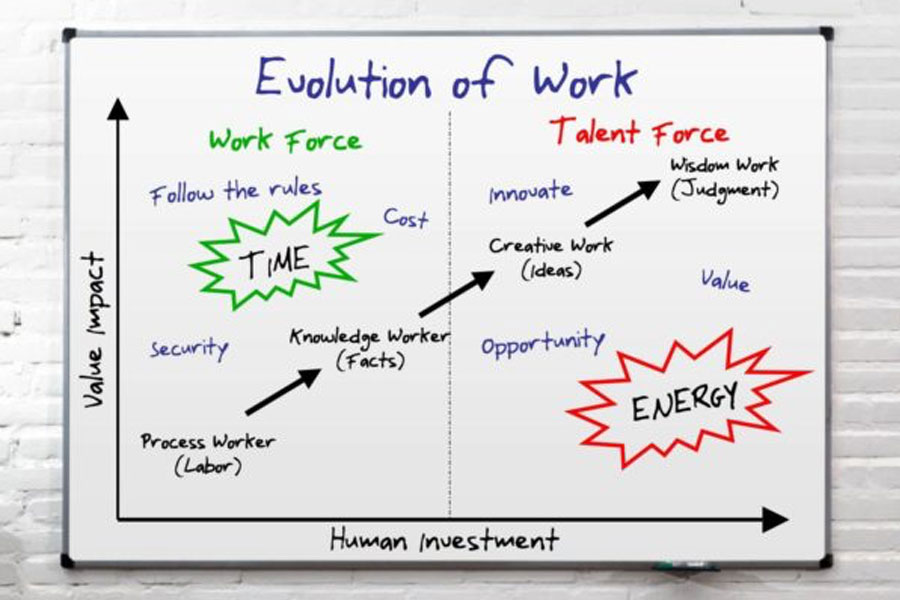
work

Just consider this graphic.  Before the Industrial Revolution we lived in a world of blacksmiths and cobblers who made custom shoes for horses and people. It’s true. Before machines and factories we relied on craftspeople to custom-make the necessities of life. The factory changed all that. Unskilled employees could be taught to do a repetitive process like screw on a front fender on a model T Ford. This was a massive productivity revolution.  Build-time for the Model T automobile shrunk from 14 hours to 90 minutes. This represented nothing less than a complete revolution of how work is performed.

Factory work has massive social consequences.  As work became scientifically designed to remove all variation and individuality workers became interchangeable cogs in a productivity machine.  All workers were supposed to show up on time and do what they were told.  If they did it long enough they could even earn something called a pension.

The social contract for workers was that if they were reliable and obedient they would have a job and retirement security.  That changed in the 1980s when McKinsey and Company advised Jack Welch to start laying off productive employees from his prosperous locomotive plant.  They argued that if he could cut labor costs arbitrarily, earnings would go up, stock prices would rise, and he would become very rich.

Welch loved this. Without having to invest any money in R&D, or take any new risks he could increase profitability by simply insisting that the workforce work harder.  He liked it so much he got the nickname of Neutron Jack. (A neutron bomb is designed to kill people without damaging buildings, an apt description of generating higher profits through layoffs.) Thus the social contract of being rewarded for hard work and loyalty was voided.

In the 1980s financial spreadsheets were invented and this enabled knowledge work to be automated.  It was really the beginning of artificial intelligence that is something that IBM and scores of other big data crunching companies are using to change the future.  Artificial intelligence is relentlessly turning whole professions into factories in which a few low skilled people can enter data and algorithms can turn it in to something valuable.  For instance, someone with a 10th grade mathematical literacy can use TurboTax software to complete most federal income tax forms within minutes. (That’s quite an achievement since the U.S. has the most complicated income tax laws in the world.)

That’s just the beginning. Industry analysts estimate the artificial intelligence embedded in Intuit’s small business software packages has eliminated the need for tens of thousands of bookkeepers and accountants. You see, bookkeepers are similar to blacksmiths.  In a way they are craft people and the new world we work in doesn’t need very many of them unless they bring something much more important than technical know how.

Artificial intelligence is now being used to write newspaper articles, novels and even songs. It seems that any mental activity that can be broken down into a formula can be turned into a job that a computer can do. New software tools are enabling coders to vastly increase their productivity so that what used to take weeks can be done in days and soon hours. This suggests that, in time, even the demand for computer engineers may wane like that of a shoe cobbler.

I believe that the great career opportunities, especially in technology businesses, will not be driven so much by technical expertise as it will be by emotional intelligence, thinking agility and good judgment.   

These qualities are in desperately short supply in most businesses I consultant in. Leadership research from companies like Zenger-Folkman reveal that 80% of people in management simply aren’t very effective managers.  They don’t know how to communicate clear goals that connect to strategic priorities.  They don’t know how to empower people and hold them accountable.  They don’t know how to inspire commitment and engagement.  They don’t even know how to complete projects in scope, on time and within budgets.  They certainly don’t know how to give effective feedback and coach teams to higher performance.

The same research confirms that over 30% of managers are so inept that they are actually the cause of failure. These are simply bad managers that people are loath to work for.  30% is a big number.  It corresponds to some recent gender research in tech companies in which 33% of women employees say that they would pay to have their boss fired.

On the right side of the chart you see where value is being created in organizations.  People who can collaborate and exercise good judgment are the people in the shortest supply.

Recently the Wharton business school released a study showing that 15% of employees produce 90% of the business value of almost any enterprise.  The single quality of the 15% is their ability to collaborate.  Human characteristics that predict good collaborators are self-knowledge, open mindedness, curiosity, empathy and versatile communication skills.  In your experience how often do you find people with these characteristics in your workplace? Not often, I would imagine.

The reason we find so few people with superb human skills in technology organizations is that there seems to be an inverse correlation with analytically dominant thinking and social–emotional intelligence.  There is more research going on in this field and we will know more in a few years but the simple reason is that analytical thinking tends to be binary, either/or, right/wrong rather than holistic.

So, my advice to Ginni and all leaders of technology companies is that they must over-invest in recruiting talent with high emotional intelligence.  I also recommend that every employee and every new-hire be engaged in developing the skills of collaboration, teamwork and management.  This kind of training will not have an effect if it’s treated like a one-off by which you are a certificate and declare yourself an emotionally intelligent team leader.

The truth about soft skills is that it is like bathing.  You have to do it every day or you will stink.  What I am getting at is that using social intelligence in high stress, high-pressure environments are not natural to most people.  Employees need to be constantly engaged with live learning experiences to open their minds and give them the skills they need to collaborate successfully.

The bottom line.

Science without humanity will lead to disaster . . . and a lousy place to work. If you want a great career, work on your humanity. It’s in short supply.


Jerry Yang, Founder of Yahoo

Yang was born in Taipei, Taiwan in 1968, and his father died two years later. He moved with the rest of his family to San Jose, California when he was eight years old. Upon arriving in America, Yang knew just one word of English: “shoe.”

But in spite of these massive disadvantages, Yang excelled in school and attended Stanford, graduating in 1990. He started Yahoo in 1995 and recently stepped down from the company, accumulating a networth of $1.15 billion along the way.

Yang founded Yahoo! in 1994, served as CEO from 2007 to 2009 and left in 2012. He then founded a venture capital firm called AME Cloud Ventures and, as of 2015, serves on several corporate boards. According to Rob Solomon, a venture capitalist Yang is “a great founder, evangelist, strategist and mentor”, having “created the blueprint for what is possible on the Internet”.

In February 2007, Yang and his wife gave $75 million to Stanford University, their alma mater, $50 million of which went to building the “Jerry Yang and Akiko Yamazaki Environment and Energy Building”, a multi-disciplinary research, teaching and lab building designed with sustainable architecture principles.


Young American Sailors Call for Action on Marine Pollution

Leading offshore sailors Charlie Enright and Mark Towill are sounding the alarm about the danger posed by marine debris and pollution, after recent research from the Ocean Conservancy estimated a staggering eight million tons of plastic trash is entering the ocean every year.

The duo spent much of last year in the most remote waters of the globe during the 2014-15 Volvo Ocean Race – and observed an eye-opening amount of debris littering the ocean all over the planet.

Enright, 32, led a discussion on the topic in front of representatives from the United Nations, the US State Department and the Swedish Embassy at Volvo Group’s Ocean Summit on Marine Debris in Newport, USA and Gothenburg, Sweden in 2015.

And now Enright and Towill, currently preparing their next round-the-world challenge, are eager to continue their call to action and speak at events throughout the 2017-18 route.

“It’s a passion of ours – and we have the ability to see the problem first hand so we feel like we’re credible witnesses,” said Rhode Islander Enright.

The pair has already signed up sustainability partner 11th Hour Racing, an environmental programme co-founded by the philanthropist Wendy Schmidt and her husband, Eric Schmidt, Google’s executive chairman, via the Schmidt Family Foundation.

“Our collaboration with 11th Hour Racing is unique to our campaign and it’s something we pride ourselves on,” he added.

“We’re actually working on a sustainability report reviewing the last edition. The basis of that will form a sustainability plan for the 2017/18 race and we’ll provide a guide for all of the other teams that take part.”

“Until people acknowledge that there is a problem no-one will really be motivated to create a solution,” suggested Hawaii-born Towill. “We would like to be involved in Summits on ocean pollution at all of the stopovers in the next race.”

In research released in 2015, the Ocean Conservancy explained that the majority of plastic in the ocean ‘comes from developing economies, where the increased use of disposable plastic goods is outpacing waste collection and management’.

“There is a pretty direct correlation from our experience with the amount of debris we saw and population density in some of the countries we were near, and of that some of the emerging markets too,” said Towill. “How that is managed in our lifetime is probably one of the biggest concerns.

“At certain times sailing in the Malacca Strait [which divides the Indonesian island of Sumatra from Malaysia] it felt like there was so much debris that we could have got off the boat and walked on it.”

Enright added: “We feel that being involved in the Volvo Ocean Race experience brings a responsibility to raise awareness about it. Through racing, speaking and volunteer work we want to engage the sailing community and beyond, to ultimately reduce the amount of marine debris and pollution in our oceans.”

Four-time Volvo Ocean Racer and marine biologist Will Oxley, who has spent almost 20 years working on the Great Barrier Reef, admits there is a general lack of education and understanding amongst the general public when it comes to ocean pollution and its consequences.

“Science needs to do a better job when it comes to education and to keep working at it,” he explained. “I would say visual pollution is something people can get their heads around but it’s far more difficult with the pollution that we can’t see.

“Micro-plastics, excess nutrients, freshwater runoff and rising sea surface temperatures are all big issues.”

“Plastic is the biggest ocean pollution concern for me right now, along with the problems of agricultural runoff into the Great Barrier Reef and that is a serious concern where I live,” said Oxley, who was the navigator for Team Alvimedica in the 2014/15 Volvo Ocean Race.

“The amount of plastic pollution seems to be growing exponentially. Just last week I was racing in Pala Bay in Mallorca and I have never seen so much plastic in the Mediterranean before.

“Thankfully we don’t see this in the Great Barrier Reef region yet. The concern of course is all the micro-plastics getting into the food chain.”


Charlize Theron: From African Farm to Hollywood

Charlize Theron is a South African and American actress and film producer who has starred in several Hollywood films, such as The Devil’s Advocate, The Italian Job, Hancock and more recently, Mad Max: Fury Road. Theron was born in Benoni, in the then-Transvaal Province of South Africa, the only child of Gerda and Charles Theron.

The Second Boer War figure Danie Theron was her great-great-uncle. She is from an Afrikaner family, and her ancestry includes Dutch, as well as French and German; her French forebears were early Huguenot settlers in South Africa. She grew up on her parents’ farm in Benoni, near Johannesburg where her father, an alcoholic, physically attacked her mother and threatened both her and her mother while drunk; Theron’s mother then shot and killed him. The shooting was legally adjudged to have been self-defence and her mother faced no charges.

She and her mother moved to New York City where she attended the Joffrey Ballet School, where she trained as a ballet dancer until a knee injury closed this career path. As Theron recalled in 2008: “I went to New York for three days to model, and then I spent a winter in New York in a friend’s windowless basement apartment. I was broke, I was taking class at the Joffrey Ballet, and my knees gave out. I realized I couldn’t dance anymore, and I went into a major depression. My mom came over from South Africa and said, ‘Either you figure out what to do next or you come home, because you can sulk in South Africa’.”

At 19, Theron flew to Los Angeles, on a one-way ticket her mother bought her, intending to work in the film industry. During her early months there, she went to a Hollywood Boulevard bank to cash a check her mother had sent her to help with the rent. When the teller refused to cash it, Theron engaged in a shouting match with him. On seeing this, talent agent John Crosby, in line behind her, handed her his business card and subsequently introduced her to casting agents and also an acting school. Her Hollywood career was born.

The Charlize Theron Africa Outreach Project (CTAOP) was created in 2007 by Theron in an effort to support African youth in the fight against HIV/AIDS. Their mission is to help keep African youth safe from HIV/AIDS.

In 2008, Theron was named a United Nations Messenger of Peace. In his citation, Ban Ki-Moon said of Theron “You have consistently dedicated yourself to improving the lives of women and children in South Africa, and to preventing and stopping violence against women and girls.”

She recorded a public service announcement in 2014 as part of a “Stop Rape Now” program. Theron is a supporter of same-sex marriage and attended a march and rally to support that in Fresno, California, in 2009. She has publicly stated that she refuses to get married until same sex marriage is legal in the United States.

Theron commented on the subject matter, saying: “I don’t want to get married because right now the institution of marriage feels very one-sided, and I want to live in a country where we all have equal rights.”


Eat Your Food Packaging, Don’t bin it – Scientists

Scientists are developing an edible form of packaging which they hope will preserve food more effectively and more sustainably than plastic film, helping to cut both food and plastic waste.

The packaging film is made of a milk protein called casein, scientists from the U.S. Department of Agriculture said at a meeting of the American Chemical Society.

The milk-based packaging does not currently have much taste, but flavors could be added to it, as could vitamins, probiotics and other nutrients to make it nutritious, they said.

The film looks similar to plastic wrapping, but is up to 500 times better at protecting food from oxygen, as well as being biodegradable and sustainable, the researchers said at the meeting in Pennsylvania, which runs until Thursday.

“The protein-based films are powerful oxygen blockers that help prevent food spoilage. When used in packaging, they could prevent food waste during distribution along the food chain,” research leader Peggy Tomasula said in a statement on Sunday.

Between 30 and 40 percent of food produced around the world is never eaten because it spoils at some time after harvest or during transport, or gets thrown away by shops and consumers.

Yet almost 800 million people worldwide go to bed hungry every night, according to U.N. figures.

Halving food waste by 2030 was included as a target in global development goals adopted by world leaders in 2015.

The U.S. scientists also want to reduce the amount of plastic that is thrown away.

“We are currently testing applications such as single-serve, edible food wrappers. For instance, individually wrapped cheese sticks use a large proportion of plastic – we would like to fix that,” said Laetitia Bonnaillie, co-leader of the study.

Single-serve pouches of cheese would still have to be encased in a larger plastic or cardboard container for sale on store shelves to prevent them from getting wet or dirty.

Edible packaging made of starch is already on the market, but it is relatively porous and does not block oxygen from reaching the food as effectively.

Bonnaillie said she hopes the milk protein packaging will be on store shelves within three years.

By Alex Whiting, Editing by Jo Griffin.

Refugee Girls, Hoping for More Than Survival, Need Education – Malala

Nobel laureate Malala Yousafzai has called on world leaders to provide education to girls in refugee camps to avoid them being forced into early marriage or child labour.

Yousafzai’s statement comes a week before U.S. President Barack Obama hosts the first U.N. summit on refugees in New York where he is expected to urge leaders to do more to help refugees in countries like Lebanon, Turkey, Jordan and Kenya.

“Why do world leaders waste our time with this pageant of sympathy while they are unwilling to do the one thing that will change the future for millions of children?” Yousafzai said in a statement ahead of the Sept. 20 summit.

She said refugee girls were wondering how long they can stay out of school before they are forced into early marriages or child labour.

“They’re hoping for more than survival” she said. “And they have the potential to help rebuild safe, peaceful, prosperous countries, but they can’t do this without education.”

Fighting in Syria, Afghanistan, Burundi and South Sudan has contributed to a record number of people who were uprooted last year, according to the U.N. refugee agency, which estimates there are 21.3 million refugees worldwide, half of them children.

Almost 80 percent of all refugee adolescents are out of school, with girls making up the majority of those excluded from education, according to a report issued by the Malala Fund, which campaigns and fundraises for educational causes.

It also blamed donor countries for failing to provide adequate funding for secondary education, and failing to deliver on funding pledges made earlier this year.

The report also criticised wealthy donor countries for diverting resources away from host countries in developing regions, such as Turkey and Lebanon, to meet their own domestic refugee costs.

The report concluded by urging donors to commit to providing $2.9 billion by September 2019 to the Education Cannot Wait Fund, a new body to raise finance for the education of refugee children.

Yousafzai, 19, rose to international fame after surviving a 2012 assassination attempt by the Taliban in Pakistan’s Swat valley to continue her fight for girls’ rights.

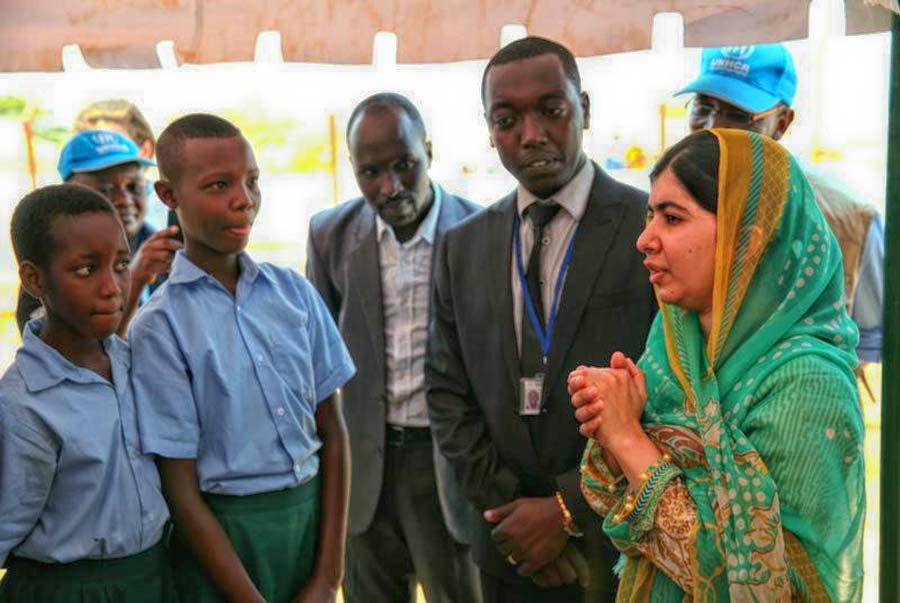
A regular speaker on the global stage, Yousafzai visited refugee camps in Rwanda and Kenya in July to highlight the plight of refugee girls from Burundi and Somalia.

In 2014, Yousafzai became the youngest-ever Nobel Prize winner for her work promoting girls’ education in Pakistan.

By Tom Gardner. Editing by Katie Nguyen. c Thomson Reuters Foundation, the charitable arm of Thomson Reuters, that covers humanitarian news, women’s rights, trafficking, property rights and climate change.