Corporate Impact Venturing: Building a Sustainable Future for All

Next to delivering profits to their shareholders, companies are also increasingly expected to contribute to development needs, and pay taxes in the locations where they create added value. But at a time when the expectations of corporate stakeholders around the world are rising, corporate social responsibility (CSR), the bolt-on approach that is compliance driven, costs money, and produces limited reputational benefits is gradually losing its utility.

In South Africa, for example, many companies are legally mandated to comply with the Broad-Based Black Economic Empowerment Act 53 (2003) that seeks to reverse economic and social inequalities inherited from the Apartheid period by requiring that all stakeholders are appropriately considered in the internal operations and external stakeholder interactions of a company. This translates into preferential procurement policies to empower groups that had been previously disadvantaged, resulting e.g. in the active involvement of such groups in economic value creation via CSR initiatives.

Many firms, moreover, need to comply with the King Reports on Corporate Governance. The third report, published in 2010, brought the issues of sustainability and risk management to the fore, and requires all companies to adopt an “apply or explain” approach. Compliance with King III is mandatory for companies listed on the Johannesburg Stock Exchange, which typically translates to a firm dedicating one percent of post-tax profits to CSR projects. For example, Standard Bank (JSE: SBK), a South African financial institution with global revenues of ZAR 66 billion and ZAR 8.3 billion net income in fiscal year 2013, funds its Corporate Social Investment expenditure via an annual allocation of no less than one percent of the previous year’s after-tax income from its South African operations.

Raising impact and competitiveness by leveraging four megatrends

When they take citizenship commitments seriously, corporations find they are up against a seemingly endless ocean of need. For example, in the recently published World Economic Forum’s Global Information Technology Report, which assesses a countries’ readiness to benefit from emerging opportunities in information and communications technology, South Africa ranked 146th for its overall quality of education, before Yemen and Libya; it ranked at the bottom (148th) in terms of the quality of its math and science education.

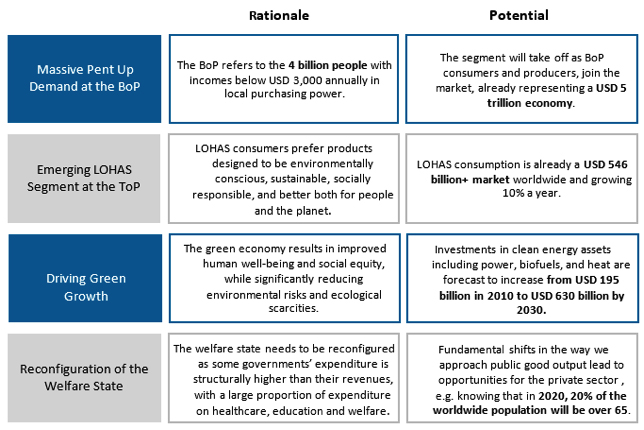
When companies regard the right balance between corporate responsibility and corporate opportunity, the overall transformation of the corporate value chain can help them deliver on both dimensions. Next to secular trends such as globalization and technical progress, four megatrends are creating new opportunities for profit and impact: (1) Growing demand for affordable products and services at the Base of the Pyramid (BoP), which is a 5 trillion dollar market opportunity; (2) People increasingly looking to gain meaning from their consumption, creating a virtuous consumer segment estimated at USD 546 billion globally; (3) The advent of green growth and the goal of a circular economy, which is creating, as just one example, a USD 700 billion cost-savings opportunity in fast moving consumer goods industries; and (4) A welfare state increasingly at odds with fiscal and demographic realities—with insufficient delivery of goods and services to cover fundamental basic needs being a particularly well-known challenge in South Africa.

Together, these trends are driving a reconsideration of the role of business in achieving financial, social and environmental goals (see graph below).
graph

The way forward: marry corporate venture capital and impact

To future-proof profits and stay in business for the long haul, companies need to now find ways to derive economic value from the megatrends reshaping the economy and society in ways that are compatible with stakeholder expectations about corporate responsibility. Acting on the opportunity, however, has proven challenging for many. At a time when sustainability considerations loom ever larger for global CEOs, and in the minds of consumers and regulators, many executives report that they are stuck on their climb: the path to transformation is not yet readily discernable.

Impact Economy—the global impact investment and strategy firm—recently released “Driving Innovation through Corporate Impact Venturing: A Primer on Business Transformation” to help address this issue. Corporations invest in research and development; corporate venture capital has helped them over the past fifty years to capitalize on their profound industry expertise, moving from early insights into emerging trends to actual investments that yield the new products and services that can power core business.

The pursuit of impact is now being added to this formula: sustainability is increasingly driving value creation, and assessing joint opportunities for financial and social returns is gradually becoming the way forward. This new modus operandi, Corporate Impact Venturing (CIV), builds on the proven channel of corporate venture capital in order to source the innovations now needed. The advent of Corporate Impact Venturing is especially relevant for BoP consumers. The ranks of the disadvantaged will not diminish considerably anytime soon if we expect governments and development agencies to do the job alone. Novel affordable products and services, and jobs are also needed. Companies from emerging markets are in prime position to serve new customer segments due to proximity.

Anyone who wants to be successful needs to understand what matters to their customers, the business models that work in practice, how to make distribution happen, and how to become a trusted product and service provider—at the Base of the Pyramid and elsewhere. This typically requires the identification of pioneering business models and taking time to learn from implementation before attempting to scale.

Seeding the next generation of transformative business models

Leveraging core business competences can offer a powerful pathway to systematically engage in corporate opportunity without neglecting corporate responsibility. Consider, for example, Standard Bank’s AccessPoint model, which includes 3,900 AccessPoints across South Africa, with 37 percent owned by women. The AccessPoint model operates via installed facilities at local traders and spaza shops and takes banking to customers in the community, enabling them to do basic banking operations in a store and avoid the costs of traveling to a branch or ATM; the model processes around ZAR 5.3 million in transactions through small businesses partners (2013).

Globally, corporate venture capital invested USD 29.4 billion into 3,995 deals in 2013. Now imagine what would happen if companies diligently applied the corporate venture capital logic with impact considerations, strategically made investments in start-ups and spin-offs that were economically viable and created social impact, and if emerging market companies leveraged their locational advantage. As the pathways for sourcing business innovation are being updated, the pendulum is swinging to a new approach that reconciles corporate responsibility to include opportunity.

The time has come to welcome Corporate Impact Venturing, and get serious about building a promising sustainable future for everyone.

Maximilian Martin, Ph.D. is the founder and global managing director of Impact Economy, an impact investment and strategy firm based in Lausanne, Switzerland, and the author of the report Driving Innovation through Corporate Impact Venturing.”

 

Twitter Co-Founder: Five Tips for Non-Profits

Giving back is the future of capitalism, according to Biz Stone. That’s why as Twitter’s co-founder, he hired a CSR officer before any sales people, and is now focused on his own foundation.

He also seeks new ways to use technology to help society. Here he offers advice on how non-profits can use technology to put themselves at the center of conversations, spread their message to thousands on a shoestring, and use metrics to bolster their mission.

Non-Profits: Think Like For-Profits

Non-profits should behave as if they are for-profit, but be smarter about it. You might not have a marketing budget, but there are a lot of free things you can do that are hugely impactful.

Listening, for example, is one of the biggest things any organization can do. Don’t plow right in based on a hunch. Search the name of your organization, or what you care about, and start listening and looking for patterns in how people are already engaging. Then get on that boat and figure out how to enhance it.

The most important thing you can do is make it easy for people to engage with your product, or service, or cause. Nowadays, individuals can reachthousands of people, but if even a dozen get the same idea, it quickly becomes contagious, which makes it more likely for that idea to become an action.

For-Profits: Think Like Non-Profits

The future of marketing is storytelling and philanthropy. People are attracted to meaning, so they’ll choose products and services that they feel are more meaningful. As a result, you need to develop a story for your product, or service, or even the people who work at your company.

It’s really smart business to weave doing good into the core of your philosophy. If you get a reputation for doing good by doing well, smarter people will want to work with you.

Content Drives Conversation

A lot of the discussions that happen across social platforms require traditional content of some kind to get started. A three-minute video on YouTube that’s well produced, or a thoughtful article, or an interview with someone important–these are the things that get passed around and discussed. There isn’t usually a spontaneous piece of information that everyone’s discussing that originated on social media. It’s usually something more traditional.

Look at Charity: Water, an organization that is incredibly good at marketing. They create well-produced videos that communicate what they do and visually show the impact donors have. They cut through a lot of the noise by creating an original piece of media that is worth talking about and passing around. Charity: Water is taking advantage of the amount of people looking at videos everyday and leveraging that to create awareness.

Measure Everything

One of the lessons we learned running Twitter is “measure everything to know what to do next.” So in running our personal foundation we wanted to have eyes on exactly what we were doing. The same things that work for a lot of companies also work for non-profits. For example, Donors Choose does a wonderful job of creating a feedback loop between the donor and the people who receive the donations. It’s really compelling: You get third-graders writing incredibly heartfelt thank you notes. When you get them, you can’t wait to donate again. Organizations that are savvy are creating feedback loops to create a higher retention rate of repeat donors.

That’s really, really important. Look at your consumers, treat them as “user accounting:” We get this many people per week, or month, or year, donating. How many of them are repeat donors? How many stop? How many don’t make it to the deal button? What can we do to move them back in? Any fraction of a percent gained now will end up having a massive impact over the course of a year. That’s as true for non-profits as it is for profits.

Don’t Wait

All altruism has compound interest: The earlier you get started, the more impact you have over time. So many people think that you wait until you’re “comfortable” before you start thinking about local and global problems and how you can help, but that’s wrong. In reality, you can do something right now. Young entrepreneurs are creating services that millions of people are freely accessing–you have such an opportunity to affect some sort of new mindset.

By D’Arcy Doran. Original article appeared on ThinkWithGoogle


Women Hold Up Half The Sky! (but occupy less than a quarter of MBA seats)

Twenty percent of the current Oxford Executive MBA class are female – a figure pretty much in line with many leading business schools but one which falls short of the parity to which most schools aspire. The reasons for women’s lower MBA participation rates are much discussed, as are mechanisms to address it, but the gap remains unbridged, and the need for diversity in the upper ranks of organisations is more pressing than ever.

‘Awareness of the opportunities business schools offer women is a critical part of the story’ says Kathy Harvey, Director of the Oxford Executive MBA. ‘Business schools  are not getting the MBA message across sufficiently clearly to high potential women in business, and I am therefore delighted to partner with the 30% Club to raise awareness of the benefits of a business education for aspiring women leaders. An MBA can create a bridge to the kind of boardroom performance which should be within the grasp of many high potential women managers, and not enough of them are taking advantage of this opportunity.

That’s something I’m determined to change. As a well-regarded and high profile organisation which works persistently to advance the representation of women in senior roles in business, the 30% Club’s endorsement of the Oxford EMBA, and their commitment to spreading the word about the benefits of an MBA for female executives, will do much to help us attract the talented female candidates we are seeking.’

The benefits to organisations of having women in senior roles are well documented. There is a powerful intuitive argument for having a varied board and executive team, with complementary skills and less danger of ‘groupthink’. Institutional investors are increasingly considering overall board effectiveness including diversity as an important aspect of good governance.

Helena Morrissey CBE, CEO of Newton Investment Management and Founder of the 30% Club said: ‘The 30% Club is delighted to partner with Saїd Business School on this Scholarship. Tackling the lack of female talent progressing to senior levels in industry is something that needs a continuum of efforts – and not just within companies but at all levels of education. Having such a prestigious business school tackle this head on is key to long term change being achieved.’

A growing body of research shows that women excel in precisely the traits necessary to address the challenges currently facing many large organisations – providing key inputs to enhance corporate performance. ‘Skills such as corporate diplomacy and greater competency around global risk are ever more important. All the more reason why women – and their organisations – should be considering how an MBA can boost their performance and accelerate their careers’ says Kathy Harvey.

‘Many of our female alumni have achieved great things as senior executives in large corporates or as entrepreneurs leading their own companies. But the continuing low numbers of women in leadership positions globally indicates that companies and individuals have still not found a way to utilise the skills and insights which women can offer. We hope that by working closely with the 30% Club, we can break through to women, and their employers, around the world, and convince them of the benefits of investing in their business education.

It is not enough to exhort women to “lean in”. Women need access to the knowledge, insights, resources, networks and mentoring which world-class business schools like Oxford are well placed to provide. At Oxford, women have an opportunity to argue their case, debate future solutions to some of the world’s most complex problems, and to emerge confident in their ability to make difficult judgements.

An Executive MBA, which allows participants to combine study with a demanding job, is also an opportunity to reflect on leadership style and to build a professional and personal development plan to manage career acceleration up to board level. Through this scholarship we hope to attract some of the best candidates for senior leadership positions globally.’

How Reputations Are Won And Lost In Modern Information Markets

A new white paper by the Saїd Business School at the  University of Oxford identifies challenges and opportunities for practitioners and policy makers.

Democratisation of online information, always-on media and the proliferation of audiences creates distorting effects that are not well understood, according to a new white paper published by the Oxford University Centre for Corporate Reputation at Saїd Business School and the University of San Diego School of Law.  ‘How Reputations are Won and Lost in Modern Information Markets’ seeks to identify the key challenges and opportunities for businesses and policy-makers in dealing with online information networks. Recipients of early copies include the Policy Unit at No 10 Downing Street, the White House and the European Central Bank.  Among the topics explored by the white paper are:

  • Why information networks breed extreme views
  • Positive and negative social potential of networks
  • Who owns your reputation and what influences them
  • How even ‘honest’ online ratings can ‘lie’ – and the broader implications of the ‘herding’ tendency

Based on a conference co-hosted in San Diego by the two university institutions, and including contributions from leading academics, business executives and journalists, the report also suggests initiatives to counter some of the ‘biases’ fostered by information networks and to create a more productive environment for the exchange of information between business, government and their audiences, as well as helping policy makers understand how they can use reputation ‘as a mechanism to hold organisations and institutions to account’.

‘The effects of information networks and 21st century instant communication work in surprising and often counter-intuitive ways,’ says Rupert Younger, Director of the Oxford University Centre for Corporate Reputation at Saїd Business School. ‘These effects can distort markets, and damage the reputation and health of businesses and governments. But they also provide particular challenges and opportunities in terms of how reputations can be created, sustained and rebuilt.’

The paper is organised under three headings:

  • Technology – the effects of the speed at which information is disseminated
  • Stakeholder Plurality – the challenges of addressing  ever broader stakeholder audiences with conflicting agendas
  • Polarisation – why the market in information encourages extreme viewpoints

The subject matter covered, based both on academic research and practitioner experience, ranges from: the growing distrust between business and media and its wider implications; the positive ‘herding’ effects of ratings websites; the reputational challenge of dealing with consumer data across different territories; maintaining long-term business goals in the face of short-term information cycles; and the survival of traditional publishing in a digital age.

It makes a number of recommendations that seek to redefine the way information networks are understood and engaged with, grouped under Trust, Humanity and Literacy:

  • Encourage Public-Private Engagement

Technology has democratised authority. At the same time it provides tools that allow large groups to know one another. The institutions of state and senior corporate leaders have yet to embrace this democratisation due to fears about losing control. Yet legitimacy and reputation can be gained by embracing this democratisation.

We recommend that government organisations formally ramp up their engagement with society in order to rebuild trust. At a minimum, this public-private engagement should include transparent focus groups, polling, and public consultations. The public sector should formalise relationships with private sector groups to study how governments and corporations can harness technology and instill reasonable principles of transparency and self-policing.

  • Help Manage the Information Cycle

Technology has led to quicker cycles of information, which have a profound effect on reputation. These quicker cycles present serious challenges for policy makers, given the nature of electoral cycles and the media. For businesses, pressure comes from the constant need to (re)act quickly and to deliver short-term financial results.

We recommend that government and business leaders put in place public-private teams to help leaders manage the increasing speed of the information cycle. These teams should include a wide range of media representation. The goals should include managing informational feedback loops, processing information as it arrives in stages and understanding – and potentially avoiding – quick reactions that are conditioned by biases.

  • Support financial literacy

Financial illiteracy is a serious problem in complex modern information markets. Unless there is a real understanding of the causes of economic problems, particularly the recent financial crisis, policy responses are likely to be inadequate. Basic literacy is important, not only in safeguarding vulnerable stakeholders, but also to improve the decision making of policymakers and corporate leaders and ensure that critics offer their views from an informed position

We recommend a systematic and sustained programme of public and private education related to core financial issues. Both the UK and US governments should target key audiences – policy, regulatory, business and the public – using clear and simple language, and employing technology to articulate basic financial constructs and how they work.

  • Help Counteract Biases

A strong ‘herding’ tendency occurs, especially around the early expression of views. In the United States, research has uncovered a clear bias toward positive reviews in online consumer rating sites. This herding effect gives rise to misinformation that can be very difficult to correct. Educating the public about these tendencies is important, as is ensuring that there is room for trusted translators and critics within any debate. Policy makers also should create safeguards to prevent powerful information intermediaries from abusing their status and power.

We recommend that government and business create public-private initiatives to counteract biases in two ways. First, teams should ensure that there is a counterweight to the instant views that often dominate search engines and technology-related feedback mechanisms. Second, teams should encourage a culture of welcoming and engaging views that are discordant with early accepted norms.

  • Encourage Businesses to Invest in Tools that Facilitate the Desire to Do Good.

Human networks and human impulses underpin all information markets. A clear theme that emerged from the conference is the power of humanity as a force for good in modern markets. There are signs that businesses are starting to recognise their responsibilities in this area. Strong policy initiatives are needed to support and nourish these nascent efforts, which will help to restore trust among business leaders, their employees, politicians, and the public.

We recommend that governments play a light-touch, yet important, role in this area, signalling through their actions that the way businesses relate to society is a national priority. Business leaders should consider formally articulating and embedding a culture of humanity in their mission and vision statements.Policy makers should consider tax incentives and reporting initiatives to encourage investment in tools that make it easy for companies’ employees, customers and other stakeholders to accomplish social goals. Technology, in particular, can help stakeholder groups to form information and communications networks that facilitate the basic human desire to do good.

  • Encourage ‘Yes And’ – Particularly in Risk Management

Positive working environments can generate productivity gains and make workers happier and better off. But the increasing plurality of stakeholders that corporations must consider often leads to a focus on risk management, rather than opportunity management, especially in areas such as social media.

We recommend that private and public leaders attempt to harness the power of ‘yes and’, rather than ‘yes but’, in their decision-making forums. We do not mean that decision makers should ignore risks or critical oversight, but rather that the analysis should embrace possibilities and be more constructive than restrictive. For example, businesses could focus their risk management efforts, not on regulatory requirements and negative possibilities, but on the potential for positive outcomes.

Contributors to  ’How Reputations Are Won And Lost In Modern Information Markets’ include: Twitter co-founder Biz Stone; senior executives from global companies eni,  Experian and Millennium Management; prominent journalists from Reuters, the New York Times and CNBC; and professors from the Universities of San Diego, Stanford, Oxford and MIT. The full list of contributors is available in the paper.

GE: The World’s Oldest Startup on Effective Marketing

General Electric CMO Beth Comstock (above) believes marketing is about seizing opportunities. That’s why she’s constantly on the lookout for innovation, driving GE’s partnerships in healthcare and clean energy. It’s why today’s GE is utilizing video and social media to tell a global story with a local accent, and why tomorrow’s will see the integration of people and machines in a truly wired world.

“To be an effective marketer, you have to go where things are,” says Beth Comstock. “You have to see what’s happening and be a translator. You have to immerse yourself and not be comfortable sometimes.”

The General Electric CMO is sitting in a sleek conference room in the GE Building high above Manhattan’s Rockefeller Center. When Comstock speaks, though, she conjures up images of rural doctors in China and farmers in Africa. These developing markets and technologies are what Comstock sees when she thinks about the future for GE and marketing in general.

The 52-year-old often describes her job as “connecting the dots”–between GE’s seven segments (Power & Water, Oil & Gas, Energy Management, Aviation, Transportation, Healthcare, Home & Business Solutions), its many markets, and between the company and the outside world.

It’s something Comstock regularly does as head of GE’s sales, marketing, and communications, and in her management of the company’s multi-billion-dollar Ecomagination and Healthymagination initiatives, dedicated to environmental and health care innovation respectively. In her travels and conversations with customers, she constantly scans for patterns. “When you’re in this business, you see a lot of things,” Comstock notes. “Marketers are in a great position to notice if something’s happening in an industry like energy or healthcare.”

What separates the good marketers from the great ones is the ability to translate those observations into insights that can move a business or product. As Comstock and her 5,000 GE marketers set about trendspotting in 2013, her top insight for the new year is that marketing’s mandate will continue to grow. “It’s no longer enough to just be about brand and communications,” she says. “Marketing is now about creating and developing new markets; not just identifying opportunities but also making them happen.”

THE WORLD’S OLDEST START-UP

GE has been cultivating new markets by creating customer innovation centers in places like China. Its Chengdu facility, for instance, brings together local workers, GE marketers, and researchers to collaborate on new initiatives in mobile, affordable healthcare, and green energy. It opened in May and has already developed two new healthcare products (GE isn’t ready to name them) that will launch locally with the potential to roll out to other markets.

Under Comstock, GE has also been importing fresh ideas through competitions, partnerships, and guest talks. She likes to call GE “the world’s oldest start-up,” but admits the 134-year-old company needs partners to accomplish its more ambitious goals, whether it’s developing clean energy sources, or rolling out smart grid technology worldwide.

One recent ally is Los Angeles-based Oblong Industries. Best known for making the multitouch interface featured in Minority Report, Oblong entered one of GE’s Ecomagination open innovation challenges. “They hadn’t worked in the energy space, but we felt they could help us visualize the smart grid,” says Comstock. After funding a proof-of-concept pilot, GE announced an investment and licensing deal with the start-up for smart grid analytics in March.

GE started leveraging its open innovation challenges in 2010 and has now partnered with 15 environmental and health start-ups. The start-ups get commercial and technological support under a group Comstock manages called GE Ventures. Alliances are key because while GE operates a pipeline for internal innovation projects, candidates typically need to show $100 million of revenue potential (over three to five years) to win and maintain support. “Scale matters a lot to us,” says Comstock. “It’s hard to do both speed and scale well. Start-ups have great ideas and work fast while we have access to markets and great technology.”

GE also generates ideas through a global insights network that invites professors and other experts to campus to discuss cutting-edge topics like robotics. “We look for the most disruptive people we can find,” says Comstock. “We don’t want to think too traditionally. We have had to open up a lot more.”

“It’s hard to do both speed and scale well. Start-ups have great ideas and work fast while we have access to markets and great technology.”

CONTENT, CONVERGENCE AND THE DIGITAL FACTORY

Digital technologies are pushing GE in new directions. Comstock estimates she spends 40 percent of her budget on digital marketing. Over the past two years, GE has ramped up its video content in particular, hiring boutique agencies like The Barbarian Group to create short yet captivating clips about GE manufacturing and products.

Some of the videos explore GE systems and factories in artful ways while others thrill with extreme science stunts, such as dropping a robot off a wind turbine. BBDO remains GE’s advertising agency of record but Comstock says GE values small agencies’ willingness to take risks. “The Barbarian Group are great storytellers,” says Comstock. “They can translate stories that might otherwise be boring and technical. You don’t have to be a scientist to love these videos.”

Social technologies have also altered the way GE interacts with its customers. The company is active on Facebook, Google+, Instagram, Pinterest, Tumblr, Twitter and YouTube. GE calls Facebook the “hub” of its social experience. The site is home to more than 30 GE pages as well as its social health and fitness app, HealthyShare. On Google+, GE posts pictures, videos, and quiz questions relating to its industrial products, zeroing in on the service’s digital-savvy audience. On female-focused Pinterest, GE “pins” upbeat, health-related quotes and kitchen appliance photos. YouTube, of course, is GE’s video base with dozens of clips ranging from Barbarian-produced web shows to researcher interviews to TV ads.

Indeed, GE produces so much content across these sites that it calls itself a “digital factory.” For Comstock, this media convergence and blurring of roles is another 2013 trend. “The idea of an ad as a separate entity is fading fast. Brands are content publishers and consumers are, too. The days when we had separate swimlanes are over.”

Considering its size, GE was a surprisingly early adopter of social. Nevertheless, Comstock is wary of fads: “There are concepts out there people grab onto. You have to be careful of chasing the hot thing,” she cautions. When Comstock tries new tools, she tracks engagement metrics to assess whether the technology is relevant and scalable. Instagram is one social tool that passed her test. GE started using the photo-sharing app as an experiment.

Today, nearly 150,000 people “follow” GE’s photos of engines and power modules on the mobile social network. Like their web videos, the pictures let GE connect with technology enthusiasts. “Instagram is a way to go into our factories and get shots you wouldn’t normally see,” explains Comstock. “We’re targeting the inner geek in everyone. Most people want to know why things work.”

BUSINESS IS SOCIAL

Comstock has that inner geek, too. Studying science instilled a lasting interest in global ecosystems. As a Biology major at the College of William and Mary, Comstock once planned to become a doctor and she still views herself as a behaviorist: “I can get very focused on how people are using technology. Is it making lives better or worse? How is technology going to change how people act? That part of biology appeals to me.”

Comstock’s studies will soon extend to machines as GE brings social to inanimate objects. One of the company’s biggest growth strategies–and challenges–in 2013 will revolve around what they are calling the “industrial internet.” Known more broadly as the “Internet of Things,” the industrial internet involves applying digital and social technologies to machines to predict and prevent problems and increase productivity. In the future, GE’s MRI machines, jet engines, and gas turbines will all be wired.

The company plans to integrate content related to the Industrial Internet into existing initiatives like Ecomagination and Healthymagination. That could mean GE-generated news articles, infographics, or data visualizations of industrial internet topics, plus apps and multimedia projects, too. Imagine a YouTube video that shows how remote monitoring of a GE transformer prevents power outage during a storm. The key for Comstock is that “the Industrial Internet involves all of GE and goes beyond GE.”

It also points up another of her 2013 trends: Business is social and social is no longer limited to personal connections. “We’re working aggressively to link machines and people so businesses can be more productive,” Comstock says. “You’re going to see machine data and people interacting in real time.”

For example, GE recently hooked up one of its GEnx engines to Salesforce’sChatter software. The Boeing Dreamliner jet used the social platform to “speak” status updates to Japan Airlines service teams and GE engineers. The innovation should increase fuel efficiency and engine reliability, aiding on-time arrivals.

GE is making a big bet on the Industrial Internet, and will be promoting it to everyday consumers even though its services are geared to corporations, institutions, and agencies. Indeed, the broader marketing push has already begun. Over Thanksgiving, GE rolled out a new ad campaign, Brilliant Machines, to introduce the Industrial Internet to consumers. A traditional TV spot saw famous machines like KITT and the Mars Curiosity rover making a pilgrimage to GE HQ to be hooked up to the Industrial Internet. Online, there were promoted social media posts and a Brilliant Machines Tumblr. The point, says Comstock, “is to be relevant. It’s important for us to tell a story that connects in the consumer marketplace.”

GLOBAL PERSPECTIVE, LOCAL FLAVOR

That story is remarkably consistent worldwide. GE cleaves to a core branding message and framework but permits regional customization. The company’s current corporate storytelling platform, GE Works, highlights GE products while emphasizing their impact. It’s a global initiative, says Comstock, but in Brazil and India, for instance, the company hired local artists to tell GE Works stories in their own style. These print and outdoor ads varied in appearance but still focused on GE’s technology and influence on the world.

During 2013, GE’s marketing became even more global. Besides China and Africa, Comstock is excited by prospects in Indonesia, Latin America, Myanmar, and Peru. Wherever GE goes, Comstock will be there, on the ground and on the hunt for new products and markets. “Sometimes marketers get accused of being too academic,” she admits. “But although a consultant might be able to tell me about something, I prefer to see it myself. Experts can help translate, but being there is essential.”

This article was written by Elizabeth Woyke and originally appeared on thinkwithgoogle.com


Which Countries are Greenwashing and Why?

New research into firms’ symbolic and substantive CSR practices has shed light on differing expectations of the role of business in society. The extent to which companies meet their CSR promises depends on national attitudes to competition and individualism says Oxford academic Thomas Roulet.

The assumption that corporations say one thing and do another when it comes to Corporate Social Responsibility (CSR) is not far from the truth, but just how much they follow through on their promises depends on cultural interpretations of the principles of liberal economics and the perceived role and strength of the government, says Thomas Roulet, Research Fellow at Saïd Business School, University of Oxford. In a paper for the Journal of Business Ethics, “The Intentions with Which the Road is Paved: Attitudes to Liberalism as Determinants of Greenwashing”, Thomas Roulet and his co-author, Samuel Touboul, IPAG Business School, explored the ambiguities surrounding firms’ commitments to social and environmental initiatives.

They discovered that in countries where people believed strongly in the virtues of competition, firms were more likely to practise “greenwashing” – that is, to make a lot of noise about their CSR but to do very little. In countries where liberalism was interpreted as predominantly about individual responsibility, firms were more likely to focus on concrete actions. “Our research suggested a highly complex relationship between beliefs in particular virtues of economic liberalism and the socially responsible behaviours of organisations,” said Dr Roulet.

“It also raises a number of subtle questions relating to the respective roles of business and the state. When a small state is favoured, for example, it seems more likely that companies will step in to ‘fill the gap’. Indeed, some businesses end up having more power than the state and, through becoming involved in developing infrastructures, even substitute for it. However, the business people we interviewed were keen to make a distinction between socially responsible things that businesses should be doing, such as reducing the harmful emissions that they generate themselves, and activities that they engage in that are not really part of their remit, but may enhance their reputations.”

Even when firms act responsibly, they can be doing so with a certain amount of cynicism.

Using qualitative and quantitative methods, the researchers calculated average country-level beliefs when it came to two central tenets of economic liberalism: a belief in the virtues of competition and a belief in the importance of individual responsibility. They found that developed market economies such as Switzerland, the United States, New Zealand and Canada tended to have higher cultural beliefs in favour of individual responsibility. While those countries also score highly in terms of cultural beliefs in favour of competition, it appears that countries with higher scores on this variable are fast developing countries such as India, China, and Morocco.

Mapping these country-level beliefs against the CSR actions of firms in those countries confirmed that firms are more likely to greenwash when populations’ beliefs in the virtue of competition are predominant, and when their beliefs in individual responsibility are less prominent. Therefore, in a country like Morocco, where beliefs in the virtue of individual responsibility are low, but in the virtue of competition are high, firms are more likely to greenwash. Conversely, in a country like France, where the population believes in the virtue of individual responsibility but prefers an absence of competition, firms are less likely to greenwash as they tend to implement socially and environmentally responsible actions without specifically signalling those actions.

“We tend to assume that firms are inherently selfish and more likely to indulge in symbolic CSR practices that look good, such as getting green accreditation, than actively trying to improve stakeholders’ welfare by, for example, reducing CO₂ emissions,” said Dr Roulet. “In fact, our research has shown that what a firm does in the context of CSR is influenced by the shared cultural expectations in its country of origin, which either unconsciously encourage greenwashing or demand substantive action.

Subtle distinctions between different countries’ interpretations of what a liberal economy is all about can lead to very different attitudes and actions when it comes to how businesses operate in relation to society.”


Why No One Wants to Hire You – and What You Can Do About It

No one really wants to hire you… not really. I’m not being mean. I am just stating the obvious. And believe me it’s not you. No one in business wants to hire anyone if they can possibly avoid it. That’s the reality… and I know this sounds harsh… but the sooner we face it the happier we’ll be. I just returned from DIG SOUTH which is a multi-day conference/festival for young digital entrepreneurs in the Southeast.

I gave the kickoff keynote titled “How to Start with Nothing, Save the World and Make a Fortune.” I hope you like the title. I was trying to attract thirty-something techies who like to work all night and sleep late. It seemed to work as a nice big crowd showed up. I told the story of Jeff Jordan, a recent client who started a marketing agency when he was 17 that focused on helping high-risk teens quit smoking.

He’s 30 now and business is good. Very good. He just landed a $150 million contract from the FDA because his track record of success is so remarkable. Jeff has created a very cool job for himself. He gets up every morning to help thousands of teenagers live healthier, happier lives. He also lives where he wants to live and has a highly individualized work schedule.  None of this happened by accident. Jeff has passion and a plan… a vision for his life.

His story created a launch pad for me to talk about the new reality of work.

The reality is that we are all entrepreneurs.  We are all in business for ourselves because all jobs are temporary. It didn’t used to be this way. When I first started working with leaders in the late 1970s CEOs actually took pride in the number of people they employed. The more, the better. It was a marker of business success.

I actually had a CEO tell me it was a great source of satisfaction for him to think of all the mortgages and college educations his company made possible. These distinctively communitarian values have since been shredded.  Now we hail the latest, greatest business achievement, which is selling a revenue-free company called WhatsApp for $19 billion to Facebook. And the crown jewel of this jaw dropping acquisition is that this virtually brand new company has only has 55 employees. Wow!

So let me restate it. Nobody wants to hire you.

The recession has been over for three years and economists tell us at the real unemployment rate is over 12%. That simply takes into account all the people working part-time that wish they were working full-time. One of the reasons that hiring has been so anemic is that leaders have been amazed how much work people could actually do when they’re scared of losing their jobs. The recession took the concept of doing more with less to new levels. This has created what I call ‘fake productivity.’ Productivity is simply a measure of total revenue divided by total payroll costs. So if you can maintain your revenue level and cut payroll, profitability rises. Duh. That’s why most big companies didn’t lose any money even in the depths of the recession. They cut payroll faster than sales dropped and got their workforce used to working lots harder. And most people just deal with it.  It’s the new normal but it’s not a good normal… at least not if you want to be healthy and happy. It’s also not good if you want to be innovative or provide an amazing customer experience.

Years of research confirm that overwork simply fries our brains, original thinking and commitment to excellence.

So here is my advice. It is the same advice I gave to the young entrepreneurs at DIG South. Is the same advice I give to employees of the progressive companies that hire me. It’s simply this.

Quit waiting.

Quit waiting for the world change. Quit waiting for things to go “back” to a time where loyalty was the adhesive of a social contract between employers and employees.

Instead… know what you want for your life… do work that makes the world a bit better… and say “No” to other people’s agenda for you.

We live in a time where most of us spend our lives achieving other people’s goals. If our own dreams and our own goals and our own lives are not crystal clear we will bounce around from job to job, house to house, even spouse to spouse hoping it will all work out. But the social science research is clear that this is not how to have deep life satisfaction.

What is… is to have a clear self-vision of the future you most want.

Over 90 years of research following people who started life from almost identical backgrounds found that those who live the longest are the healthiest, get the most education, make the most money and enjoy the happiest marriages are people whose daily decisions were guided by clear goals that they selected and fine-tuned to create the best life they could envision. Turns out not very many people do this.

Most of us wing it.

We often have specific goals that are in conflict with other goals. For instance most of us want deeply satisfying, mutually supportive, positive relationships with our loved ones. Well that doesn’t happen by simply hoping. It’s also unlikely to happen if we get trapped by work that keeps us engaged most of our waking hours.

Examples of conflicting life goals abound.

We all want to be healthy but we feel compelled to do really stressful work that leaves little time for exercise. We all want to be financially secure but we work for wages and salaries that can evaporate in an instant. What amazes me is how many people will sacrifice almost everything that matters for a $50,000 job.

It used to cost more to get people to sacrifice their health, their family and their peace of mind.

It’s like we’re hypnotized. Consider this, a single well-run Subway sandwich shop will make you $50,000 a year. With 10 you can make a half a million. Sure it’s a lot of work but is it any more work than you’re currently doing? Of course I’m not suggesting that we all go out and open Subway sandwich shops. What I am suggesting is that there is no reason to feel trapped into spending your life achieving other peoples goals. But the only way to awaken from this trance is to have goals of your own. Clear ones.

Try this exercise: Imagine your ideal future life two years from now… Think about where you want to live.

How do you want to feel about the community and neighborhood you live in? (Remember that wherever you dream of living there are people in all economic circumstances living there right now. So “anywhere” is possible.)

How do you want to feel about the home you live in?

Is your home a refuge, a safe place for you to relax and refresh yourself? Can you easily afford your home or does your home make you feel trapped? (Please keep in mind that there is no correlation between home ownership and happiness. Increasingly people find the flexibility of renting to be more important than the fiction of home ownership. It’s called fiction because most people will never own their home at all. They will simply pay a mortgage, pay the taxes, make improvements and repairs until they die.)

Think about how you want to live.

How do you want to feel about your life? When do you want to get up in the morning? When do you want to start working? Do you commute? How long is your commute? When do you come home? What do you do when you get home? What do you do on weekends? What are your hobbies? How often do you enjoy them? What kind of friends do you have? How often do you see them? What do you do together?

Think about your loved ones.

How do you want to feel about the most important people in your life?  Research is clear that the happiest people among us are in committed, intimate relationships with people they both trust and enjoy. Sometimes people are fortunate enough to find that in a romantic partner. Often these high functioning relationships are created with friends.

Now think about the work that you do.

How do you want to feel about your work? Is it purposeful to you? Does it call on you to grow and learn and become more capable?  Are you able to channel your unique personality and passionate interests into your work? Are you extraordinarily effective? Do you make an impact?  Does your work give you energy? These questions are neither silly nor unrealistic. I developed them by studying the lives of hundreds of people that I met during the eight years I lead the American Dream Project. What I discovered were scores of ordinary people living amazing lives right now.

They all had one thing in common. Their daily choices were intentional. And their intention was to create the life they most valued and enjoyed.

The time for vague longings and weak hopes has long passed. Each of us is the entrepreneur of our own lives… and all good entrepreneurs are driven by a furious vision to make the improbable… inevitable. What is your improbable dream? Imagine. Then just start!


20 Student Teams Race to Design the Car of the Future

Global automotive supplier Valeo today named the 20 teams shortlisted by its experts to compete in the second round of the Group’s global innovation challenge. The global competition is open to student around the world, who are encouraged to design and develop automobile products or systems that will revolutionise the car. The participating teams represent thirteen countries around the world: Australia, Belgium, Brazil, Canada, China, Egypt, France, Germany, India, Mexico, Poland, the United States and Spain. The teams have all given themselves unique names, such as Aero Commander from China, the Falcons from India, Hawkeye from France and Master Bolt from Mexico.

A large number of unique, innovative project submissions, some of very high quality, have been reviewed by Valeo’s experts. These technical solutions are illustrative of each country’s specific societal concerns. For example, the Indian engineering students are taking up the issue of road safety, while the emphasis for the Mexican contingent seems to be individual safety and security. The European students, like their North American peers, are more concerned about reducing CO2 emissions and creating a smart, connected and autonomous vehicle.

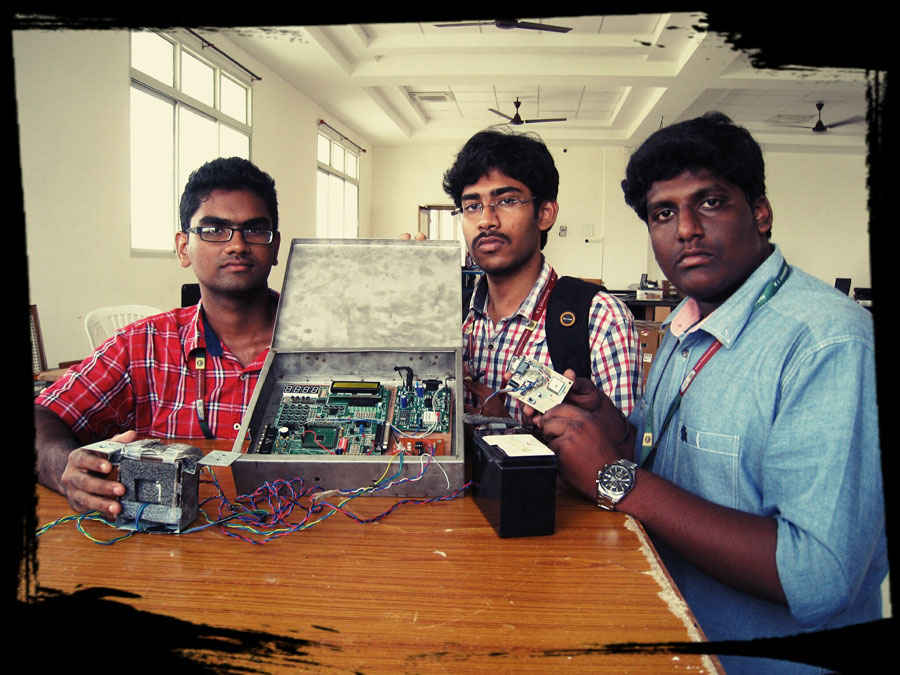
Blacklist

The Blacklist team from KL University, India

Across the board, they are working to make the car of 2030 a cleaner, safer and more enjoyable ride. The shortlisted teams now have until August 29, 2014 to develop a working prototype of their project using €5,000 in funding appropriated to each of them by Valeo. Six finalists will then be selected to present their project to the jury at the 2014 Paris Motor Show in October 2014. Comprised of Valeo experts and outside partners, the jury will be chaired by Valeo CEO Jacques Aschenbroich. The winning team will take home a €100,000 prize and the second and third-place teams will each receive €10,000.

Launched by Valeo in September 2013, the Valeo Innovation Challenge is a global contest open to engineering students around the world, invited to play an active role in automotive innovation by designing the product or system that will create smarter, more intuitive cars by 2030. Nearly 1,000 teams from 55 countries signed up for a chance to propose and develop daring solutions that will revolutionize the car of the future.

In 2013, for the second consecutive year, Valeo was featured in Thomson Reuters’ Top 100 Global Innovators ranking, reflecting the Group’s commitment to innovation. Most of the Group’s research and development programs are focused on the design of technologies that reduce motor vehicle carbon emissions and promote intuitive driving.

The company ranks among the leading patent filers in France and dedicates around 10% of its original-equipment revenue to innovation. With close to 9,000 researchers in 16 research centers and 35 development centers around the world, Valeo has developed an array of innovative products and technologies that represent more than 30% of orders.

Valeo was also awarded the Top Employers label in 18 countries for 2013. The Group plans to hire some 1,000 engineers and technicians a year over the next three years.

Valeo is an automotive supplier, partner to all automakers worldwide. As a technology company, Valeo proposes innovative products and systems that contribute to the reduction of CO2 emissions and to the development of intuitive driving.  In 2013, the Group generated sales of €12.1 billion euros and invested over 10% of its original equipment sales in research and development. Valeo has 124 production sites, 16 Research centers, 35 Development centers and 12 distribution platforms, and employs 74,800 people in 29 countries throughout the world. www.valeo.com


Google’s Eight Pillars of Innovation

How does a company like Google continue to grow exponentially while still staying innovative? Susan Wojcicki, Google’s Senior Vice President of Advertising, discusses some of the processes and principles in place to make sure that the company doesn’t get bogged down in the past as it keeps moving forward.

The greatest innovations are the ones we take for granted, like light bulbs, refrigeration and penicillin.

But in a world where the miraculous very quickly becomes common-place, how can a company, especially one as big as Google, maintain a spirit of innovation year after year? Nurturing a culture that allows for innovation is the key. As we’ve grown to over 26,000 employees in more than 60 offices, we’ve worked hard to maintain the unique spirit that characterized Google way back when I joined as employee #16. At that time I was Head of Marketing (a group of one), and over the past decade I’ve been lucky enough to work on a wide range of products. Some were big wins, others weren’t.

Although much has changed through the years, I believe our commitment to innovation and risk has remained constant. What’s different is that, even as we dream up what’s next, we face the classic innovator’s dilemma: should we invest in brand new products, or should we improve existing ones? We believe in doing both, and learning while we do it. Here are eight principles of innovation we’ve picked up along the way to guide us as we go.

1. HAVE A MISSION THAT MATTERS

Work can be more than a job when it stands for something you care about. Google’s mission is to ‘organize the world’s information and make it universally accessible and useful.’ We use this simple statement to guide all of our decisions. When we start work in a new area, it’s often because we see an important issue that hasn’t been solved and we’re confident that technology can make a difference.

For example, Gmail was created to address the need for more web email functionality, great search and more storage. Our mission is one that has the potential to touch many lives, and we make sure that all our employees feel connected to it and empowered to help achieve it. In times of crisis, they have helped by organizing life-saving information and making it readily available. The dedicated Googlers who launched our Person Finder tool (to learn more see Missions that Matter) within two hours of the earthquake and tsunami in Japan this March are a wonderful recent example of that commitment.

2. THINK BIG BUT START SMALL

No matter how ambitious the plan, you have to roll up your sleeves and start somewhere. Google Books, which has brought the content of millions of books online, was an idea that our founder, Larry Page, had for a long time. People thought it was too crazy even to try, but he went ahead and bought a scanner and hooked it up in his office.

He began scanning pages, timed how long it took with a metronome, ran the numbers and realized it would be possible to bring the world’s books online. Today, our Book Search index contains over 10 million books. Similarly, AdSense, which delivers contextual ads to websites, started when one engineer put ads in Gmail. We realized that with more sophisticated technology we could do an even better job by devoting additional resources to this tiny project. Today, AdSense ads reach 80 percent of global internet users – it is the world’s largest ad network – and we have hundreds of thousands of publishers worldwide.

3. STRIVE FOR CONTINUAL INNOVATION, NOT INSTANT PERFECTION

The best part of working on the web? We get do-overs. Lots of them. The first version of AdWords, released in 1999, wasn’t very successful – almost no one clicked on the ads. Not many people remember that because we kept iterating and eventually reached the model we have today. And we’re still improving it; every year we run tens of thousands of search and ads quality experiments, and over the past year we’ve launched over a dozen new formats. Some products we update every day. Our iterative process often teaches us invaluable lessons.

Watching users ‘in the wild’ as they use our products is the best way to find out what works, then we can act on that feedback. It’s much better to learn these things early and be able to respond than to go too far down the wrong path. Iterating has served us well. We weren’t first to Search, but we were able to make progress in the market by working quickly, learning faster and taking our next steps based on data.

4. LOOK FOR IDEAS EVERYWHERE

As the leader of our Ads products, I want to hear ideas from everyone – and that includes our partners, advertisers and all of the people on my team. I also want to be a part of the conversations Googlers are having in the hallways. Several years ago, we took this quite literally and posted an ideas board on a wall at Google’s headquarters in Mountain View. On a Friday night, an engineer went to the board and wrote down the details of a convoluted problem we had with our ads system.

A group of Googlers lacking exciting plans for the evening began re-writing the algorithm within hours and had solved the problem by Tuesday. Some of the best ideas at Google are sparked just like that – when small groups of Googlers take a break on a random afternoon and start talking about things that excite them. The Google Art Project, which brought thousands of museum works online, and successful AdWords features like Automated Rules, are great examples of projects that started out in our ‘microkitchens.’ This is why we make sure Google is stocked with plenty of snacks at all times.

5. SHARE EVERYTHING

Our employees know pretty much everything that’s going on and why decisions are made. Every quarter, we share the entire Board Letter with all 26,000 employees, and we present the same slides presented to the Board of Directors in a company-wide meeting. By sharing everything, you encourage the discussion, exchange and re-interpretation of ideas, which can lead to unexpected and innovative outcomes.

We try to facilitate this by working in small, crowded teams in open cube arrangements, rather than individual offices. When someone has an idea or needs input on a decision, they can just look up and say, ‘Hey…’ to the person sitting next to them. Maybe that cube-mate will have something to contribute as well. The idea for language translation in Google Talk (our Gmail chat client) came out of conversations between the Google Talk and Google Translate teams when they happened to be working near one another.

6. SPARK WITH IMAGINATION, FUEL WITH DATA

In our fast-evolving market, it’s hard for people to know, or even imagine, what they want. That’s why we recruit people who believe the impossible can become a reality. One example is Sebastian Thrun who, along with his team, is building technology for driverless cars to reduce the number of lives lost to roadside accidents each year. These cars, still in development, have logged 140,000 hands-free miles driving down San Francisco’s famously twisty Lombard Street, across the Golden Gate Bridge and up the Pacific Coast Highway without a single accident.

We try to encourage this type of blue-sky thinking through ‘20 percent time’ – a full day a week during which engineers can work on whatever they want. Looking back at our launch calendar over a recent six-month period, we found that many products started life in employees’ 20 percent time. What begins with intuition is fueled by insights. If you’re lucky, these reinforce one another. For a while the number of Google search results displayed on a page was 10 simply because our founders thought that was the best number. We eventually did a test, asking users, ‘Would you like 10, 20 or 30 search results on one page?’ They unanimously said they wanted 30.

But 10 results did far better in actual user tests, because the page loaded faster. It turns out that providing 30 results was 20 percent slower than providing 10, and what users really wanted was speed. That’s the beautiful thing about data – it can either back up your instincts or prove them totally wrong.

7. BE A PLATFORM

There is so much awe-inspiring innovation being driven by people all over the globe. That’s why we believe so strongly in the power of open technologies. They enable anyone, anywhere, to apply their unique skills, perspectives and passions to the creation of new products and features on top of our platforms. This openness helps to move the needle forward for everyone involved.Google Earth, for example, allows developers to build ‘layers’ on top of our maps and share them with the world.

One user created a layer that uses animations of real-time sensor data to illustrate what might happen if sea levels rose from one to 100 meters. Another famous example of open technology is our mobile platform, Android. There are currently over 310 devices on the market built on the Android OS, and close to half a million Android developers outside the company who enjoy the support of Google’s extensive resources. These independent developers are responsible for most of the 200,000 apps in the Android marketplace.

 8. NEVER FAIL TO FAIL

Google is known for YouTube, not Google Video Player. The thing is, people remember your hits more than your misses. It’s okay to fail as long as you learn from your mistakes and correct them fast. Trust me, we’ve failed plenty of times. Knowing that it’s okay to fail can free you up to take risks. And the tech industry is so dynamic that the moment you stop taking risks is the moment you get left behind. Two of the first projects I worked on at Google, AdSense and Google Answers, were both uncharted territory for the company.

While AdSense grew to be a multi-billion-dollar business, Google Answers (which let users post questions and pay an expert for the answer) was retired after four years. We learned a lot in that time, and we were able to apply the knowledge we had gathered to the development of future products. If we’d been afraid to fail, we never would have tried Google Answers or AdSense, and missed an opportunity with each one.

Our growing Google workforce comes to us from all over the world, bringing with them vastly different experiences and backgrounds. A set of strong common principles for a company makes it possible for all its employees to work as one and move forward together. We just need to continue to say ‘yes’ and resist a culture of ‘no’, accept the inevitability of failures, and continue iterating until we get things right. As it says on our homepage, ‘I’m feeling lucky.’ That’s certainly how I feel coming to work every day, and something I never want to take for granted.

This article originally appeared at thinkwithgoogle.com


Is This the End of the Billion-dollar Megaproject Disaster?

The number and costs of megaprojects are so large, and the penalties of failure so catastrophic, that there are signs that governments and private companies may at last be beginning to insist on better governance of these billion-dollar ventures, and to use academic research into the failures of megaproject management to improve practice, believes major programmes expert Professor Bent Flyvbjerg from Oxford University’s Saïd Business School.

In a paper for Project Management Journal, “What You Should Know About Megaprojects and Why: An Overview”, published April 2014, Professor Flyvbjerg argues that we are now entering a new “tera era”, in which projects cost trillions, rather than millions or billions of dollars, and that this represents the biggest investment boom in human history. It is unacceptable for projects of this scale to go ahead based on the under-estimated costs and over-estimated benefits that have been typical of large projects over the past 80 years.

He claims that a combination of increasing private finance in megaprojects, more stringent legislation in most countries against deliberate misrepresentation, and a greater understanding of megaproject failures as a result of academic research are all steps in the right direction for improving the management of these projects. “Although progress is slow, good governance is gaining a foothold even in megaproject management.

The main drivers of reform come from outside the agencies and industries conventionally involved in megaprojects and this is good because it increases the likelihood of success.

The cost overruns (anything between 50% and 1900% according to Professor Flyvbjerg’s figures) typical of these megaprojects come about because of deliberate or naïve miscalculation of costs at the commissioning stage.

While some theorists have suggested that optimistic miscalculations are often necessary simply to get projects off the ground, and that no one would now regret the building of the Sydney Opera House (1400% over budget), for example, Professor Flyvbjerg argues that the consequences of failure on the current scale are too great. In Hong Kong, months of obstacles during the opening of a new international airport made traffic go elsewhere, resulting in a fall in GNP for the entire city state. For Greece, a contributing factor to the country’s 2011 debt default was the 2004 Olympic Games in Athens, for which cost overruns and incurred debt were so large they negatively affected the credit rating of the whole nation.

“For reasons of economic efficiency alone, we must reject the argument that cost underestimation and benefit overestimation are justified for getting projects started. But the argument must also be rejected for legal and ethical reasons,” said Professor Flyvbjerg. “There is an ‘obligation to truth’ built into most democratic institutions that is violated by deliberate misrepresentation of costs and benefits, whatever the reasons for such misrepresentation may be.

Not only does economic efficiency suffer but also democracy, good governance, and accountability.” The UK Treasury now requires that all ministries develop and implement procedures for megaprojects that will curb so-called “optimism bias”. Funding will be unavailable for projects that do not take into account such bias, and methods have been developed for doing this.

The US government is implementing similar measures as are Switzerland and Denmark while, in Australia, the Parliament of Victoria has conducted an inquiry into how government may arrive at more successful delivery of significant infrastructure projects. Similarly, in the Netherlands, the Parliamentary Committee on Infrastructure Projects has held extensive public hearings to identify measures that will limit the misinformation about large infrastructure projects presented to the Parliament, public, and media.

In Boston USA, the government sued to recoup funds from contractor overcharges for the Big Dig related to cost overruns. “Things are moving in the right direction for megaproject management,” said Professor Flyvbjerg. “It is too early to tell whether the reform measures being implemented will ultimately be successful. It seems unlikely, however, that the forces that have triggered the measures will be reversed, and it is those forces that reform-minded individuals and groups need to support and work with in order to improve megaproject management.”

Professor Bent Flyvbjerg is founding chair of Major Programme Management at Saïd Business School, Oxford University. He is the most cited scholar in the world in megaproject management and his work has been featured by Harvard Business Review as “Ideas to Watch”. Flyvbjerg’s books and articles have been translated into 19 languages and his research has been covered by Science, The Economist, The Wall Street Journal, The Financial Times, The New York Times, The BBC, and many others. He has worked as advisor to government and business, including the UK and US governments and several Fortune 500 companies. Flyvbjerg has received numerous honours and awards. He was twice a Fulbright Scholar and holds the Knighthood of the Order of the Dannebrog. Flyvbjerg was Principal Investigator for the dams study. https://www.sbs.ox.ac.uk/community/people/bent-flyvbjerg


0