Berkshire Beyond Buffett

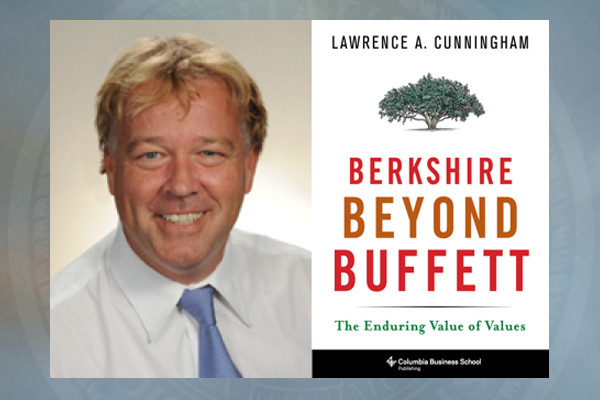
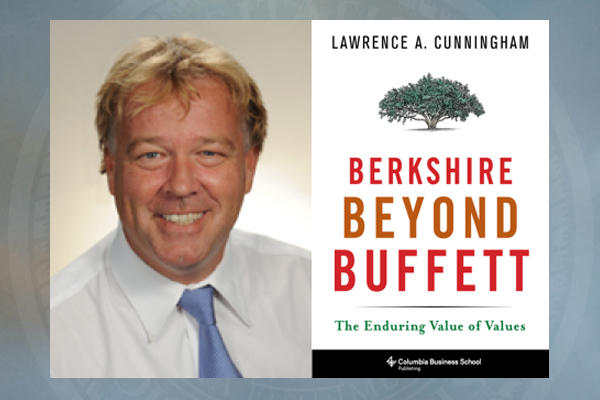
Berkshire Hathaway, the $300 billion conglomerate that Warren Buffett built, is among the world’s largest and most famous corporations. Yet, for all its power and celebrity, few people understand Berkshire, and many assume it cannot survive without Buffett. A new book by Lawrence Cunningham, Berkshire Beyond Buffett, proves them wrong. www.berkshirebeyondbuffett.com.

In a comprehensive portrait of the corporate culture that unites Berkshire’s subsidiaries, Cunningham unearths the traits that assure the conglomerate’s perpetual prosperity. Riveting stories of each subsidiary’s origins, triumphs, and journey to Berkshire reveal how managers generate economic value from intangibles like thrift, integrity, entrepreneurship, autonomy, and a sense of permanence.

Rich with lessons for those wishing to profit from the Berkshire model, this engaging book is a valuable read for entrepreneurs, business owners, managers, family business members and investors, and it makes an important resource for scholars of corporate stewardship. General readers will enjoy learning how an iconoclastic businessman transformed a struggling textile company into a corporate legacy.

Blessed by Buffett and based on interviews with Berkshire chief executives and other insiders, Berkshire Beyond Buffett provides new insights on the structure and future of the company. Cunningham, the editor and publisher since 1997 of The Essays of Warren Buffett: Lessons for Corporate America, tells riveting stories of Berkshire’s fifty most significant subsidiaries, to draw valuable takeaways about leadership, management, corporate culture, and succession.

cunninghambuffett

Some of the highlights from the book include:

1. Warren Buffett rose to prominence as a stock picker in the 1980s and 1990s, with Berkshire Hathaway then consisting 80 percent of his chosen share holdings and 20 percent of businesses; in the past decade, the mix quietly flipped and, with Berkshire now 80 percent businesses and 20 percent stocks, Buffett will soon become most famous for building and managing one of history’s largest corporations, now employing 300,000 workers.

2. People perceive Berkshire’s vastness and diversity as a throw-back to the discredited conglomerate era of the 1970s and 1980s that proved such companies unsustainable; in reality, Berkshire is united by a set of core values that give its subsidiaries coherence, common purpose, and sustenance, ratifying this business model.

3. While it isn’t easy to see how corporate culture translates into business performance or measure results, the stories of fifty Berkshire subsidiaries reveal a pattern of success from norms of thrift, integrity, entrepreneurship, trust, and a sense of permanence.

4. People don’t think of Berkshire Hathaway as an orphanage for the corporate homeless, yet a dozen of its subsidiaries, once damaged by leveraged buyouts and serial corporate parents with short-term outlooks, now prosper in Berkshire’s congenial culture that is averse to debt and adopts a long-term view.

5. Cynics doubt that big corporations can both make money and do good, but Berkshire’s subsidiaries routinely profit from virtue, whether GEICO passing on savings to customers, RC Willey furniture stores warranting merchandise out of its own pocket, or low-income housing supplier Clayton Homes assuring that customers can afford the homes they buy.

6. Skeptics warn that companies led by icons like Buffett cannot survive their passing, but Buffett’s greatest achievement is forging an institution larger than himself and designing it to outlast him. When people say, “Warren is so special that Berkshire can’t survive without him,” Cunningham counters with the book’s thesis: “Berkshire is, in fact, so special that it can thrive without Warren. That is his legacy.”

Prof. Lawrence Cunningham is a leading authority on Warren Buffett and Berkshire Hathaway and on corporate governance and culture. He is a Research Professor of Law at The George Washington University.

Teenager Malala Yousafzai Wins Nobel Peace Prize

Malala Yousafzai, along with Indian children’s rights campaigner, Kailash Satyarthis, have won the Nobel Peace Prize. Malala won the hearts of millions when she faced death for advocating education for girls in pakistan. She survived and has taken a global stance. On the afternoon of Tuesday, 9 October 2012, 15-year-old Malala Yousafzai boarded her school bus in the northwest Pakistani district of Swat. Shortly afterwards the bus was stopped by a gunman who boarded and asked for Malala by name. He then pointed a Colt 45 at her and fired three shots. One bullet hit the left side of Malala’s forehead, traveled under her skin the length of her face and then into her shoulder.

She remained unconscious and in critical condition for days, before being sent for specialist treatment in London, where she made a full recovery. The reason for the attack on this teenager surfaced shortly after the incident: The Taliban in the region didn’t like her promoting the education of girls, where they had recently taken control and had banned girls from attending school. From the age of 11, Malala had already been writing a blog under a pseudonym for the BBC, detailing her life under Taliban rule.

She rose to prominence and caught the attention of the Taliban after a New York Times documentary was made about her life and South African activist Desmond Tutu nominated her for the International Children’s Peace Prize.  Since her near-death incident there has been an international outpouring of support for Malala, to the point where she may have become the most famous teenager in the world.

Then Prime Minister of the U.K., Gordon Brown, launched a United Nations petition using the slogan “I am Malala” and demanded that all children worldwide be in school by the end of 2015. The petition led to the ratification of Pakistan’s first Right to Education Bill. The universal condemnation and subsequent call to action cut across cultural divides and genders.

Time magazine named her one of  The 100 Most Influential People in the World, Pakistan awarded her the country’s first National Youth Peace Prize and in 2013 she received the Sakharov Prize for Freedom of Thought, previously bestowed on the likes of Nelson Mandela, Kofi Annan and Aung San Suu Kyi. Thirty-three additional awards and honors have been given to Malala, focusing the world’s attention on what might have been just another tragic, and silent, crime against women.

On her 16th birthday, she spoke at the United Nations to call for worldwide access to education. The event was dubbed ‘Malala Day’ and was her first public speech since the attack. It also led to the first ever Youth Takeover of the U.N., with an audience of more than 500 young education advocates from around the world.

“The terrorists thought they would change my aims and stop my ambitions,” she said. “But nothing changed in my life except this: weakness, fear and hopelessness died. Strength, power and courage were born. We realize the importance of our voices only when we are silenced.”

Insights With Sir Martin Sorrell

WPP Chief Executive Sir Martin Sorrell oversees operations in over 100 countries and a workforce of thousands. He’s an evangelist for the new technologies shaping our world – not as a geek or a gadget freak, but as the hardest of hardheaded businessmen. In this wide-ranging interview, he discusses his approach to marketing, technology, and the changes affecting the business world. Great white sharks cannot stop swimming; if they do, they suffocate and die. Similarly, Sir Martin Sorrell finds it hard to stand still.

Our meeting in a London pub is squeezed between a visit to Turkey, talks at Downing Street and a flight to Mumbai. The head of the world’s largest advertising corporation also has his eyes on Iran and Cuba. Change and innovation are his lifeblood. Sorrell’s rise would make great material for Mad Men creator Matthew Weiner: our plucky protagonist buys a shopping basket company and uses it to take over the world. Well, some of the world’s best-known ad firms, anyway.

When he’s done, he goes to China and becomes the top man there. Now he’s got his sights set on the Middle East. And all this against three decades of momentous social, political and economic change. Such are Sorrell’s dramatic fortunes. The 66-year-old head of WPP oversees operations in over 100 countries and a workforce of thousands. He’s an evangelist for the new technologies shaping our world – not as a geek or a gadget freak, but as the hardest of hardheaded businessmen.

Nor can he stay out of the public eye. The day after the UK’s Chancellor of the Exchequer George Osborne’s 2011 budget announced big slashes to corporation tax, Sorrell announced he would take WPP back to the UK, having relocated to Dublin in 2008. As we meet, half a million people have just marched through London, protesting against government spending cuts. A few hundred rioted through the capital, keeping one step ahead of the police via social networks and cell phones.

It’s against this backdrop that Sorrell points to the difficulty in maintaining a single message: “While some demonstrators were trying to get their message across in a peaceful and ordered way, it gets inextricably interlinked with the more violent stuff. The two things get confused,” he says.

“Clients have the perception that the bigger you are, the worse you get,” he admits. “We try and break that down. Innovation is the ability to differentiate.”

“In the old days, you could segment happily. You could put out one message to one segment of the audience, and one to another. That has now gone. You say something to one community and instantly, literally at a click, it’s available to everybody. What it means is that if you’re trying to craft a message, it’s very difficult.”

For Sorrell, that lack of control is symptomatic of the new world. “I’m in a business where there’s complete anarchy. You can’t control it – you can only react to it. The control that people traditionally had over their message is gone. Look at Wikileaks: you have to approach everything you write on the basis it’s going to be on the front page of the newspaper.” Stocky and tough-looking (his face bears the legacy of a car accident at 18, which required extensive plastic surgery), Sorrell is a coiled spring – restlessly shifting while we talk. He attributes his drive to “the pressure cooker effect” of Harvard Business School. After graduating, he joined Saatchi & Saatchi, rising to the role of Group Finance Director before striking out on his own.

At February’s Mobile World Congress in Barcelona, Sorrell gave a talk entitled ‘The Power of Apps’. His business increasingly revolves around mobile communications and what they can offer the client. WPP is encouraging its established brands to invest in mobile talent, and exhorting its online agencies to embrace mobile in a more aggressive way. “Mobile for us is part of the online revolution,” he says. The side effect of all this is that “our willingness to sit down and really dig deep and take time to digest, turn over and develop more is rapidly diminishing because so much stuff is coming at you at such a pace – literally 24/7.

“It’s a disadvantage of the revolution,” he continues. “People used to say that information is power but that’s no longer the case. It’s analysis of the data, use of the data, digging into it – that is the power. You get so much of the stuff and everyone has access to it.” His interest in technology isn’t so much personal; he doesn’t innovate for its own sake but as a means to an end. Sorrell cares about what it can do, not what it is. He plunks down a BlackBerry and an ordinary Nokia mobile on the table in front of us. He has two phones because, he says, he hasn’t “got the mental stamina to unite the two.”

He doesn’t use Twitter or Facebook (“I suppose I’m a bit of a fuddy-duddy”) but his day revolves around breaking news, live business channels and his new iPad 2. He no longer uses his PC. “I don’t like schlepping a laptop around the place so I don’t travel with one.” With its global reach and profile, has WPP become too huge to be innovative? Sorrell’s argument is that Wire and Plastic Products plc was itself a genuine game changer. A British shopping basket manufacturer acquired by Sorrell when he was casting around for a listed corporate shell in 1985, it now owns famous ad brands such as JWT, Ogilvy & Mather, Young & Rubicam and Grey – as well as media investment giant GroupM.

“We’re interested in the application of technology – not its origination. We’re not in the garage with Sergey and Larry.”

WPP’s first board meeting in China was in 1989; now the country accounts for around $1bn of business, and Sorrell describes its government’s five-year plan as a “charter for WPP.” He retains a tight control, but is quick to point out that WPP is an amorphous agglomeration of 12 different companies. “Clients have the perception that the bigger you are, the worse you get,” he admits. “We try and break that down. Innovation is the ability to differentiate.”

For Sorrell, this means working out what technology can do: “We’re interested in the application of technology – not its origination,” he explains. “We’re not in the garage with [Google co-founders] Sergey and Larry coming up with the ideas, or dropping out of Stanford or Harvard to do that. We’re taking those ideas and applying them in a way that differentiates us.”

An interesting question is whether an innovator like Facebook’s Mark Zuckerberg could have flourished at a company like WPP. “Mark Zuckerberg wouldn’t have been comfortable working in any company – other than going into the garage and starting his own,” replies Sorrell. “That’s what I did in 1985. My garage was Wire and Plastic Products.”

Though a man whose business relies on hard data and evidence, Sorrell isn’t averse to leaving some things to fate. He wears two Brazilian wristbands given to him on a New Year vacation. Each one promises to make three wishes come true when the string rots away. “It’s not for effect,” he insists, “I am a bit superstitious. [The wishes] haven’t come true yet, so I can’t tell you what they are.” Away from the office, one of Sorrell’s big passions is cricket. He tries to play 10 matches a year, but is frustrated by being “a plodder, a grafter, slow but sure… You’re either good or you’re bad,” he muses as our time draws to a close. “It’s black or white, isn’t it? You don’t want to be average.”


Google’s Eight Innovation Principals

The latest quarterly reports for Google are out. It shows revenue rose 24% to $32.32 billion from a year ago, higher than analyst expectations of $31.86 billion. How do they do it? Here are Google’s 8 simple innovation principals that help them stay on top”

1. Focus on the user.

2. Open will win.

3. Ideas come from everywhere.

4. Think big, start small.

5. Never fail to fail.

6. Launch early and iterate.

7. Be a platform, float all boats.

8. Make it matter.

14.5 Million Books, 7 Million Children, 16,549 Libraries

Room to Read envisions a world in which all children can pursue a quality education through learning to read. Now 10 years old, and having helped over 7 million children in 10 countries, the 50 chapters of this remarkable organization are now on track to lift 10 million children out of poverty. Before images of studious, teacher-like types come to mind, consider that Room to Read has a leadership team comprised of corporate veterans from Goldman Sachs, Gap, Microsoft and Unilever.

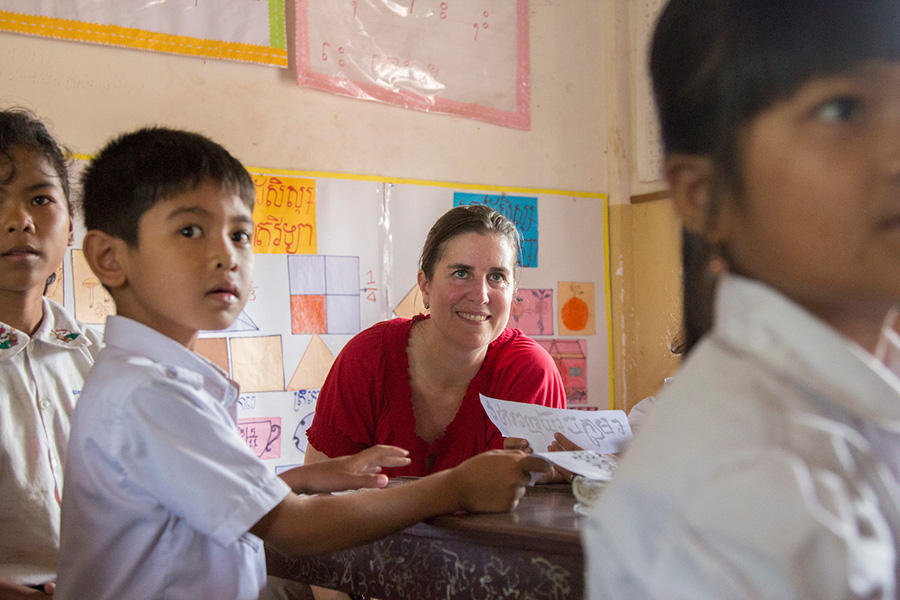
The team has a shared commitment to hiring and retaining a talented and passionate global team and they are now lending their expertise to kids around the world. A staggering 14.5 million books have already been distributed and 16,549 libraries have been established. Erin Ganju (above), CEO and co-founder of Room to Read was influenced by her university professor father and social worker mother. You could say that she is the perfect result of their combined talents.

“I grew up with a deep understanding of the value of education,” says Ganju. “My father was the first person in his family to go to college and even in my own country, the United States, it has only been a few generations since we’ve seen the impact that education can have,” she says. The importance of giving back was instilled in Ganju from an early age and she is fond of quoting, “To whom much is given, much is expected,” a philosophy she subscribes to when looking around the world wondering how she can make a difference.

Her early career as an investment banker at Goldman Sachs turned into a job at Unilever, which came with a posting to Vietnam. “This was a pivotal point for me,” recalls Ganju. “I was in my late twenties and working in a developing country where foreign direct investment had just been allowed and I could see how the work we were doing had already made a difference within one generation. I saw how education has the power to break the cycle of poverty,” she says.

“If you build a strong education system you can pull a country, community and every family out of the grips of poverty. I was also profoundly affected by how hard women were working – around the house, on child care and in the fields – and how much of the livelihood of a family depends on the work of women.” Ganjun realized that if you educate women in communities such as these, it creates a ripple effect. One of the most powerful ways to improve family nutrition and health and for a child to become literate is if there’s already a literate mother in the home.

“We began Room to Read to focus on child literacy and girls education in particular,” says Ganjun. “We try and keep girls in school for longer to ensure that they become empowered and take control of their own lives.” One of the greatest challenges of any global organization is to ensure that you are locally relevant. “The worst thing you can do is arrive with a cookie-cutter approach and develop solutions that aren’t relevant to the context of a country,” explains Ganju.

Partnerships with communities and government’s alike ensure proper support for Room to Read and employing local staff helps with language and cultural barriers. “People are driven by a passion for expertise. This is authentic leadership because it often comes from a deep sense of commitment for what you are doing,” says Ganju.

“The desire to create change speaks volumes about what committed leadership really means. I have developed cross-cultural skills and an ability to understand the global nature of the world around me. It’s no longer enough to just understand your own country’s perspective if you want to become a dynamic leader.

So much of the world today is interdependent and connected. “It’s critical to develop skills that understand and bridge cultural divides,” says Ganju.

Florence: The Art of Preservation For Future Generations

Once reserved for powerful merchants, the title ‘patron of the arts’ has been bestowed on ordinary citizens wanting to preserve the world’s most recognizable art and architecture.

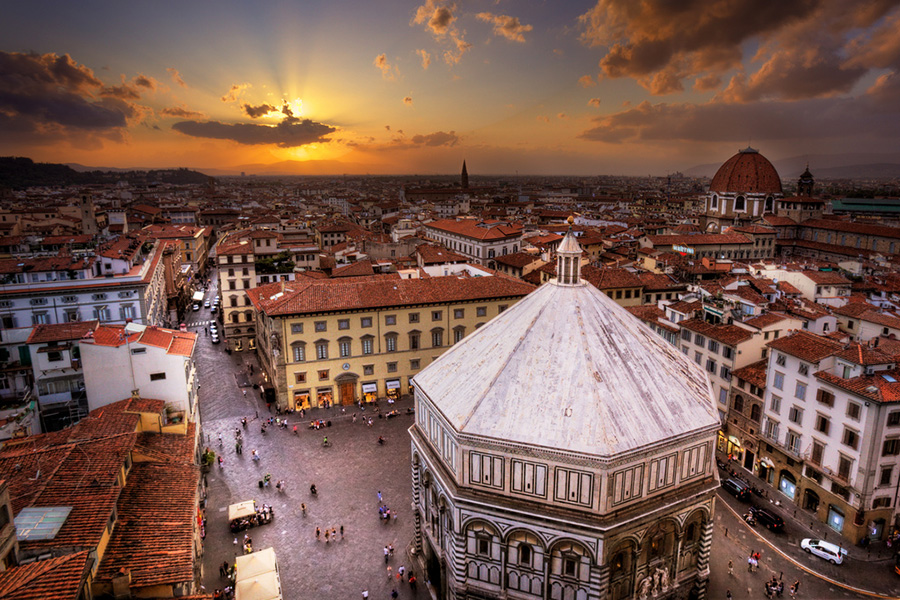
Nowhere in Italy – perhaps in the entire world – is the act of looking at art more rewarding than in Florence. Nowhere else can one be captivated by a wistful Botticelli smile, impressed by the graceful dignity of Donatello’s bronze David, and moved by Michelangelo’s provocative Slaves twisting restlessly in their marble prisons. Established by the Romans in 80 BC, Florence became a center of medieval European trade and later the birthplace of the Renaissance.

The proliferation of artworks and architecture during the Renaissance was mainly due to a system of artistic patronage by wealthy merchants, who commissioned portraits, statues and murals to celebrate and flaunt their success. The most famous of these patrons was the Medici family, which had checkered periods of fortune and influence over the city for around 300 years. Lorenzo Medici is credited with commissioning Michelangelo, Leonardo da Vinci and Botticelli with some of the worlds most recognized artworks.

Beyond the preservation of the artworks themselves, Florence is a cultural city that attracts almost 2 million tourists each year and was declared a World Heritage Site by UNESCO in 1982. Florence was also ranked by Forbes as one of the world’s most beautiful cities. It’s current status as a world fashion capital also means that preserving its past is an important factor in securing the city’s future. Friends of Florence is a U.S. non-profit organization supported by individuals from around the world who are dedicated to preserving the cultural and historical integrity of one of the worlds oldest and most creative cities.

Helping with this immensely important task is Contessa Simonetta Brandolini, the President and founder of Friends of Florence. Sixteen years ago she introduced a novel idea: why not allow ordinary people to become art patrons; those wanting to ensure the treasures of Florence are appreciated well into the future. This unique venture began in 1998 and has raised millions of dollars to restore priceless art treasures, including Michelangelo’s David, who was given a makeover for his 500th birthday in 2006.

Rather than undertake the restoration work itself, the organization provides financial support directly to the city’s restoration laboratories that refurbish, safeguard, and make available to the public a broad range of paintings and sculptures. Friends of Florence is the only organization to commit its full resources to restoration work and works closely with partners including the City of Florence, Italian Ministry of Art, and international committees.

They also work closely with the Opificio delle Pietre Dure, a leading and highly respected art restoration and teaching facility dating back to the late 1500s. Brandolini originally chose Florence for this venture as there is a perception that the majority of the world’s greatest art is found in Italy, with the best found in Florence.

So what caused Brandolini to set up an American non-profit organization, half way around the world, to preserve this important cultural city in Italy? “Italy offers almost zero tax deductions for charitable donations,” she says. “Even wealthy Italians find little incentive to be philanthropic. Americans love and appreciate this city and its art so I decided to set up Friends of Florence as a non-profit in the U.S. where tax incentives allow us to raise the amount of capital needed to fund this important work,” explains Brandolini.

Donations have ranged from $20,000 to $400,000 and a full tax deductible rating by the IRS has seen around $8,7 million in donations help preserve Florence’s extraordinary cultural legacy for future generations. The organization has attracted some household names to its advisory board including Sting, Mel Gibson and Bette Midler.

Twice a year, an intimate group of Friends of Florence patrons have a rare opportunity to become true citizens as they receive the keys to its artistic treasures and explore Florence in a way not possible for the casual visitor. They view private collections not normally open to the public and observe restoration projects. The rewards for patrons extends beyond Florence too, with unique events being held in other European cities and the U.S., offering art lovers behind-the-scenes experiences with private curators, art historians, prominent scholars and writers.

Since its creation, Friends of Florence has been the primary source of funding to the renowned Florentine restoration laboratories and the skilled preservation individuals who work to undo the damage to artworks from the ravages of time and pressures from modern development. From earthquakes to political upheaval and pollution to every-increasing tourism, Florence’s treasures have been subjected to constant stress and damage across the centuries.

Perhaps the most infamous event, broadcast around the world, was the flood of November 1966, when intense rains caused the Arno River to overflow its banks, damaging and destroying the city’s libraries, museums, churches and chapels, artistic masterpieces, precious books, and manuscripts. Great works such as Lorenzo Ghiberti’s Doors of Paradise were affected as well as Donatello’s Magdalene, Cimabue’s Santa Croce Crucifix, and hundreds more.

To consider a restoration project the organization receives a comprehensive historical documentation on the work, including a damage assessment, which is submitted to the Board for approval. A precise budget, timeline, and statement of skill for each restorer is reviewed before funding is provided directly to a pre-approved restoration laboratory.

In Florence, the organization closely monitors the terms of the contract and pace of the work to ensure the restoration proceeds on the agreed terms. This is critical when working on items that are priceless. Many artworks, such as Michelangelo’s David, have become such public icons and symbols of national pride that no insurance policy would ever be able to compensate against loss or permanent damage. They have gone beyond monetary terms.

Upon completion, projects are unveiled at a public ceremony and the donors are acknowledged with a permanent Friends of Florence plaque. The public perception of “ownership” of these historically important pieces is not lost on Brandolini who insists on keeping detailed records of each restoration. These are used for teaching and training and sometimes even a dedicated website is set up where people can follow the progress and restoration methods used. A DVD and book is made to accompany each project, which is sold to raise money. Support for Friends of Florence has come from some surprising places.

In 2011 a group of 11-year old school kids in Texas heard about the organization and decided to raise money to restore a bust of a Roman emperor. They got to work raising money through car washes and bake sales, not accepting a cent from their parents, and ended up earning $2,500. The restorer was so touched by their generosity that he agreed to restore another two busts at no extra charge. “A plaque was erected and they came to visit,” says Brandolini.

“They were so proud of what they had done and so was I. At such a young age they had become patrons of the arts. Imagine them returning in 30 years to show their children what they have done,” she says.

The True Cost of Capital: People

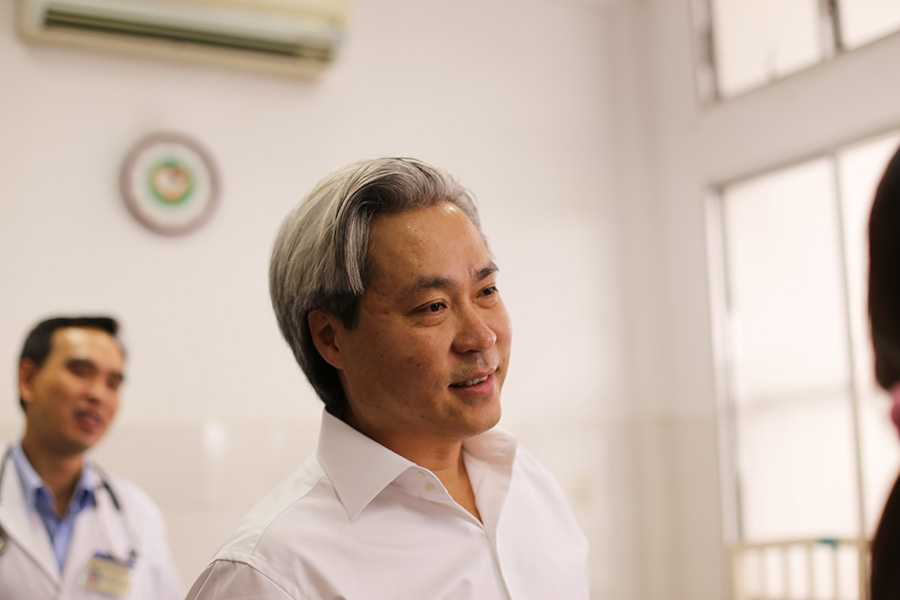
On a visit to rural Vietnam a few years ago Don Lam met with a mother who had just lost her 8-year old daughter to a heart condition because she didn’t have the money for surgery. When he discovered that it would only have cost $3,000 to save her, Lam decided to act. As the founding partner of Vina Capital, one of Vietnam’s leading asset management groups, he adopted an attitude of giving back to the communities in which they worked.

He has taken mainstream financial regulatory requirements of ethics, transparency and fairness, and applied this to a social business model that promotes good. “If we’re going to invest in the community then we should start giving back to the community,” says Lam.

Their latest venture, the Lotus Impact Fund started in 2013, is effectively an impact investment fund. Lotus Impact actively invests in private enterprises that help solve social and environmental problems. Projects that produce catering graduates, business graduates for rural economic growth and clean water projects are funded through a process that merges local market knowledge with financial and social analysis.

“We focus on high social intent, but not necessarily a high return,” explains Lam.  “The measure of social impact is more important to us.” Vina Capital’s investor base is mainly in Europe, where investors admire the positive developments Lam has introduced.  “Many of our investors visit us and say they want to become involved,” says Lam. “They tell me that if they’re looking at two funds, both being equal, they’d choose us because of our social impact.” “The key in business is to lead by example because then staff will look up to you and follow what you do.

You can talk as much as you want but if you don’t actually do it yourself then it won’t have any effect,” says Lam. With a succession of global financial crises behind us, Lam has sage advice for how we should view money. “You should see money as a tool to create stability in whatever you do,” he explains. “The money we generate should be looked at from a wider investment perspective. Not following traditional trends in finance and focusing beyond short-term profits can result in better profits down the line,” he says.

Don’s Investment Check List:

  1. The first thing Vina Capital does is look at the people they’re investing it, not the industry. What they manufacture is less important than the people managing the business.
  2. The people who manage the business might run a fantastic operation but if they’re not ethical it will go sideways very quickly
  3. Vina Capital looks at how the company treats the community around them. It’s important in the long-term that these businesses have a sense of social responsibility.
  4. They don’t invest in a business that is making a lot of money by cutting corners. An example would be in Bangladesh or Pakistan, where factories collapse and kill workers. You’ll make money in the short-term, but rather focus on a long-term return for your investment.

One Of India’s First Sugar Companies: Blessed By Ghandi

In the early 1900s Shishir Bajaj’s grandfather Jamnalal was involved in the Freedom Movement in India alongside Mahatma Ghandi, even spending time in jail as a freedom fighter in his fight against the British. Driven by strong ethics and a will for Indians to govern themselves he added philanthropy to his arsenal of weapons, alongside his strong political ideologies. So strong, in fact, that he refused the title of honorary magistrate bestowed on him by the British Raj. Instead, he opened the first temple to the downtrodden, now 100 years old.

While Jamnalal never saw his cherished dream of an independent India, dying five years before independence day celebrations in 1947, his principles and convictions have been passed down through generations of Bajaj children. His legacy is presently in the care of Shishir Bajaj, Chairman and Managing Director of Bajaj Hindusthan sugar company, the largest in Asia and fifth largest in the world.

The principles that his grandfather learnt under Gandhi have been applied to this large industrial business, one that almost qualifies as a regional government in scale and impact. Jamnalal, with Gandhi’s blessing, saw at an early stage that there was a need for new companies to feed the economic challenges of building a new nation and formed the sugar company in 1931.

“Because my grandfather was too busy with the Freedom Movement, he set up the business and let my father run it,” says Shishir. And in a move that predates Bill Gates and Warren Buffett’s Giving Pledge campaign by 80 years, Jamnalal formed a trust for the wealth because he didn’t want to own more than he needed; a very unusual move at the time.

Two foundations, the Bajaj Foundation and Jamnalal Bajaj Trust now support more than 100,000 families in 501 villages, positively affecting the lives of more than 615,000 individuals within the company’s 12 sugar production areas. In keeping with the family tradition of social change, Shishir’s son Kushagra suggested the formation of an action plan five years ago that scaled the company’s social good onto a much larger platform.

“The number of villages we’d like to cover in the next five years is 1,000,” says Shishir. “There are about 700 districts in India and if we can capture just two I think it will be a seriously good achievement.” As the most populous country on earth with just over 1.2 billion people, two districts is not the small number some would imagine. Some of the projects Shishir is involved in include sustainable agricultural practices, and women’s self help groups.

A water resource project has seen 82 rivers deepened, 120km of riverbeds rejuvenated and schools built at seven of the ten sugar factories. Other projects include an energy company that produces 450 megawatts of power, with plans for a 2,000-megawatt power plant underway that will cost $2 billion.

One wonders what Jamnalal would say today if he saw how his sugar factory, one of the first in India, had transcended profit to become a builder of infrastructure to a nation in need. As Gandhi would have said at the time, “You must be the change you wish to see in the world.”

Air Asia X Shows How Flying Can Be Guilt-free

A new and responsible business model shows that flying can be guilt-free.

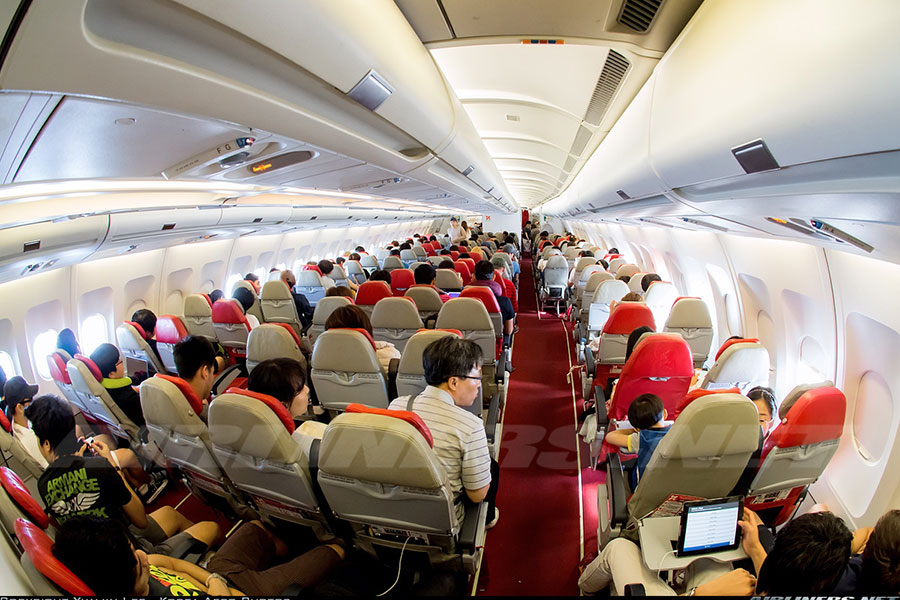
Azran Osman-Rani would like you to think that the lowest fares, in brand new planes with comfortable seats, on a time schedule comparable to any other mainstream airline is an attractive option to fly. Over two million passengers who’ve flown in the past year think he’s right. A passenger increase of  86 percent has made AirAsia X  the world’s fastest growing airline. Ticket prices which are 30-50  percent cheaper than other airlines, a fun and interactive brand people can relate to and the convenience of buying tickets online have also helped.

It all started 10 years ago when the Malaysian founder of AirAsia, Tony Fernandes, watched a reality show featuring European low cost airline Easyjet. He thought it would be a great idea to roll out in Asia. The region still suffered from expensive flights and a lack of travel infrastructure across rail and road systems. At that time Fernandes estimated that only 6 percent of Malaysians had ever flown in a plane. He recognized that low cost air travel in Asia could be the catalyst for connecting people better. AirAsia was launched in 2001 with the tagline “Now everyone can fly” with AirAsia X following in 2007, focusing on low cost, longhaul flights in larger planes such as the Airbus A330-300.

Before AirAsia X, the established players, such as Southwest, US Airways, RyanAir and Easyjet used small planes doing shorthaul regional flights, nothing more than four hours in duration. Longhaul had not been done successfully before and Fernandes thought there must be a way of capturing the growth he saw in shorthaul and translating it into a longhaul model. Shareholders were not convinced, however, and thought it was a risky idea, straying into territory that bigger and more successful and established airlines had steered clear of. Fernandes ploughed ahead, convinced of his intuition, and AirAsia X was formed as a separate company from Air Asia, with private equity money and with Osman-Rani instated as its first CEO. And what of longhaul flights resulting in more carbon emissions? Isn’t air travel increasingly being seen as a big contributor to our growing problem of burning more fossil fuels?

Osman-Rani has his own view on this. “We don’t agree with what other airlines are now doing to address this problem, which is offering carbon credits to offset emissions. This is basically shifting the guilt of air travel onto the passenger. What we focus on rather, is the fact that emissions resulting from burning jet fuel is a direct cost to us, the airline. We pay for these emissions as a direct consequence of buying the fuel. This is unlike other industries where pollution emissions are an externality of their manufacturing process. They pollute but do not bear the direct costs themselves of this pollution. Because we are committed to becoming the world’s lowest unit cost airline we keep figuring out a way to also become the world’s most fuel efficient airline.

The airline burns around 2.2 litres per seat per hundred kilometres as opposed to other airlines which burn around 4 litres. This also equates to 93 miles per gallon per passenger that we fly, a significantly better performance than most cars. Osman-Rani has achieved cost savings by placing it firmly on the agenda of the organization. While other airlines talk of financial instruments such as fuel hedgings as part of their savings plan, this doesn’t actually bring down the cost of fuel. AirAsia X focuses rather on the fact that the volume of fuel needs to be brought down, irrespective of its price.

“There’s no magic bullet in getting a 30-40 percent fuel burning saving in the airlines industry. We have various ways of getting the optimal saving possible though. For example we use new planes with the latest fuel efficient technology, fewer first and business class seats and more economy seats, resulting in a lower fuel to passenger ratio on take-off due to increased numbers onboard. Even when compared to a standard Airbus with standard seat configuration we are still burning lower than the industry.”

An obsession with weight has also seen load shedding on AirAsia X. Footrests on economy class seats have been removed. This might seem trivial, but 365 metal footrests can add up to quite a weight. Osman-Rani has not yet encountered any passenger who refuses to fly AirAsia X because the little footrest is missing.

“The quantity of water for lavatories is based on how many passengers are on a flight, or if it’s a night flight realizing that many people will be asleep. Many other airline groundcrews are instructed to simply ‘fill her up’. We’re very precise on measuring how much water is needed and if we can reduce a flight by 200 kilograms, that’s fuel saved.”

Pilots are trained in efficient route planning, managing and nursing the engines and immersing themselves in the AirAsia X culture which promotes sustainability. Because the company is not unionized, pilots feel part of this culture and take ownership of the process.

“Many airlines have pilots who have a ‘work to rule’ attitude, based on legislation negotiated by their unions.  In these environments many pilots don’t see any reason to implement fuel-saving measures,” explains Osman-Rani.

No airline works in isolation from the airport management companies with whom they need to negotiate parking bays and other logistics. Busy airports too, such as Heathrow, can scupper any fuel saving achieved from careful planning by making planes circle for half and hour before landing due to congestion. Avoiding peak hours at airports helps avoid this and keeps costs down. Osman-Rani would also like to see more ground power units at docking stations at airports. These diesel-powered generators plug into the plane while still parked and keep the plane powered  for lighting and other mechanical operations, avoiding using the plane engines to generate power and using less of the expensive and higher CO2 emitting fuel.

With fuel making up 90 percent of the environmental impact of air travel, it’s obvious that this is where the focus should be when it comes to saving.

With other industries able to supplement their energy needs with solar, wind and hydro, air travel is stuck with fuel for the foreseeable future. Biofuel blended with jet fuel or organically produced jet fuel from algae or palm oil is still at least five years away before it becomes commercially available.

“Of course the problem with biofuel is that it starts eating into arable land and takes away from food production. Food prices are extremely susceptible to agricultural resource allocation, so while we want to bring down the cost of fuel, we need to be careful we don’t inadvertently  increase the price of food.”

But surely many flights have become unnecessary in this day of free Skype calls, video conferencing and lightening fast communication, connecting people around the globe? Osman-Rani cannot imagine a world without air travel. Most importantly,  he sites tourism as critical for many economies. Understanding different people and cultures through physical contact is as important as the sustainability debate. “Look at conflict hotspots around the world, they all suffer from people who have limited interaction with the rest of the world. Put another way, the offset of air travel is economic stimulation and better human relations.”

With rising fuel prices, volcanic ash, viruses spreading through air travel, recession, tsunamis and the odd earthquake thrown in, times are certainly challenging for air travel.  “Air travel is not immune to the trend of responsible business we are seeing grow rapidly around the world. We strongly believe that there should be the market discipline to say that if you’re not an efficient air carrier you shouldn’t be artificially propped up, as we’ve seen with many national carriers over the past few years.”

Could You Live On a Dollar a Day?

Is it possible to scale your life down to the bare minimum and survive on a daily income equivalent to buying one song on iTunes? Chris Temple and Zach Ingrasci discovered what more than one billion people face every day.

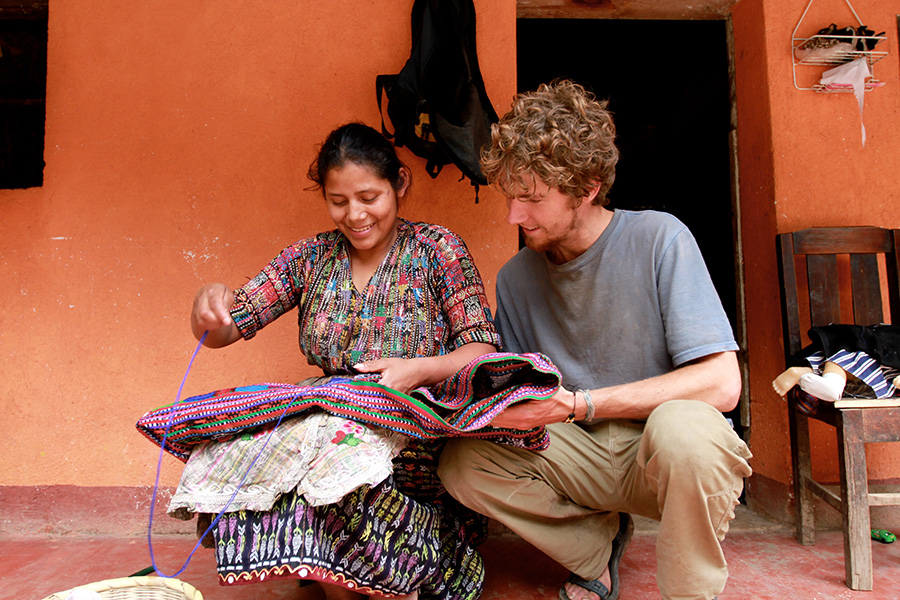
Chris Temple and Zach Ingrasci started an unusual journey in 2010. Armed with only two cameras, a handful of cash and lots of hope, they set out to spend the summer living on $1 a day in a rural Guatemalan village. Their academic and professional understanding of economic development didn’t quite prepare them for what they would experience.

They battled intense hunger, parasites and the realization that there were no easy answers, but ultimately the strength of their neighbors and friends along the way gave them hope that effective solutions to making a difference might exist. While in Guatemala, they released short YouTube videos about the experience to help their friends learn alongside them in real time.

The videos quickly received over 700,000 views, and inspired them to complete a feature-length film, Living on One Dollar, aimed at mobilizing others to help end extreme poverty. After graduating, they hit the road for four months in a renovated 1978 school bus to share the film around the U.S. The tour events sold out in 20 major cities and culminated in an extended interview on CBS This Morning with Charlie Rose. The film has gone on to win Best Documentary at the Sonoma International Film Festival, and received endorsements from Nobel Laureate Muhammad Yunus, USAID Administrator Rajiv Shah, and the Director of The Hunger Games, Gary Ross.

In 2012 the pair launched Living on One, a production and social impact studio that creates films and educational videos to raise awareness and inspire action around extreme poverty. Now two years down the line, Temple recalls the gap year that changed his life. “I grew up in Connecticut in a sheltered, small town community and I wanted to try something that was off the beaten path,” he recalls. The journey began in South America where he travelled through Argentina and then up through Bolivia and Peru.

During a home stay in a rural village in Bolivia he noticed a massive sign that read: ‘USA ID sponsored.’ The locals explained that a massive shower and bath facility had been built but no one had ever used it. When asked, community members explained that, “A guy came and built it, never asked us, and then left with the key!” It was Temple’s first frustrating glimpse at charitable development.

He couldn’t understand why something like this hadn’t been fixed yet. “My arrogant 18 year-old self decided that I would get involved and figure out a solution to global poverty,” he says, “But I was totally clueless!” Arriving home he read a couple of books about poverty alleviation, particularly The End of Poverty by Jeffrey Sachs, that mentions a concept called micro-finance. “It sounded really cool and way more grassroots and bottom-up than some of the ineffective development strategies that I had seen while travelling,” says Temple.

Fired up with enthusiasm, Temple applied for different jobs within micro-finance but didn’t get a single one – he was 18 years old and inexperienced. Eventually, a lucky break through a YPO member saw him helping out at a New York-based micro finance startup. He got to travel with one of his idols, micro finance pioneer Mohammed Yunus. Temple soaked up as much information as he could. Meanwhile, a lot of his friends were asking about his gap year and how they could get involved.

He met his co-founder Zach Ingrasci around this time and together they built the Living on One network, putting up a website and providing opportunities for people to get involved in micro-finance that served poorer communities. The website was aimed at harnessing the power of their generation and it worked. They set up Facebook page that allowed users to set up a profile and engage on forums and it grew to be one of the largest in the world, with students from 170 universities 49 countries taking part. They took 100 students to conferences in Kenya and Spain to get firsthand experience and to meet Mohammed Yunus and industry leaders.

Despite the impressive numbers and achievements Temple and Ingrasci struggled to find a job as their college years drew to an end. Industry players told them, “You don’t understand poverty and were not going to hire students fresh out of college.” “They said we had no reality of living in extreme poverty,” recalls Temple. “We were also frustrated at how the media portrayed poverty – really boring, ten-year-old, guilt-based documentaries that we fell asleep watching.” They realized that to walk the talk they needed to live on one dollar a day themselves.” They chose Guatemala.

The country has 50 percent of the population below the poverty line, with the number rising to 75 percent in rural areas. It was the perfect case study for an affliction what plagues over a billion people on the planet. It wasn’t easy. Temple contracted Giardia and E-Coli at the same time and remembers waking up in the mornings lying on a dirt floor, after being bitten by fleas all night. “We didn’t know if we had enough money for food, let alone the cost of medicine,” recalls Temple.

“We often hit a real low, when we considered going home or giving up, but sadly this is a reality that many others have no choice over,” says Temple. As economics majors, Temple and Ingrasci had to try hard to budget on a dollar a day. They realized that not having a bank account meant no access to traditional financial services. For the community around them, that daily dollar was not for food alone, but also for your kids education, firewood, transportation, medical emergencies, general emergencies and unforeseen events. Temple has learnt some lessons from his experience.

“Firstly, create understanding and real connection between people,” he says. “More fortunate people must realize that it’s not laziness or lack of ability that’s holding people back but rather a lack of opportunity. They also concluded that if they had moved from a dollar a day to a dollar fifty a day, it would have increased their daily calorie count dramatically. “Fifty cents extra might not seem like much, but it’s a massive change for someone living at that level.”

The experience would have been wasted, in their eyes, if they hadn’t shared their ordeal with as many people as possible, in the hope of sparking some kind of action. “We came home with over 300 hours of film footage and our YouTube video started getting a lot of attraction,” says Temple. “While in Guatemala, our online video received around 500,000 views,” he says.

A TEDX talk that followed made them realize it was an effective way of educating an audience and rallying people around global poverty. While the gap year had been informative and they had collected huge amounts of data they were now at a crossroads: try and find jobs or take the film, run with the idea and try to build a business out of it. It was a huge gamble. They decided to turn the idea into a viral marketable campaign and took it on the road.

“Someone gave us an old beaten-up 1978 school bus, so we took out the seats, put in beds, desks and solar panels and drove around the country for four months, visiting 25 major cities,” says Temple. “We raised about $40,000 for microfinance, poverty alleviation, education and scholarships.” Offers of free marketing exposure, donations and lots of support from the start has evolved into an enterprise that now sells T-shirts and sandals that benefit the rural Guatemalan manufacturers.

Their film is also available to download on iTunes and the pair are for hire for speaking engagements at public events. A dollar from every film downloaded goes into an educational scholarship to send one of the women they met in Guatemala to medical school. This added social dimension has resulted many people paying $20 for the movie, despite it only costing $9.99.

“To become a real leader you should want to create positive change in the world,” says Temple. “Take chances and then get out of the way for the sake of the cause.”

0