The Global Company That Turns Trash Into Cash

So you want to save money in your business? Where would you start? Most companies will begin looking at staff or existing suppliers when cutting costs. But what about waste?

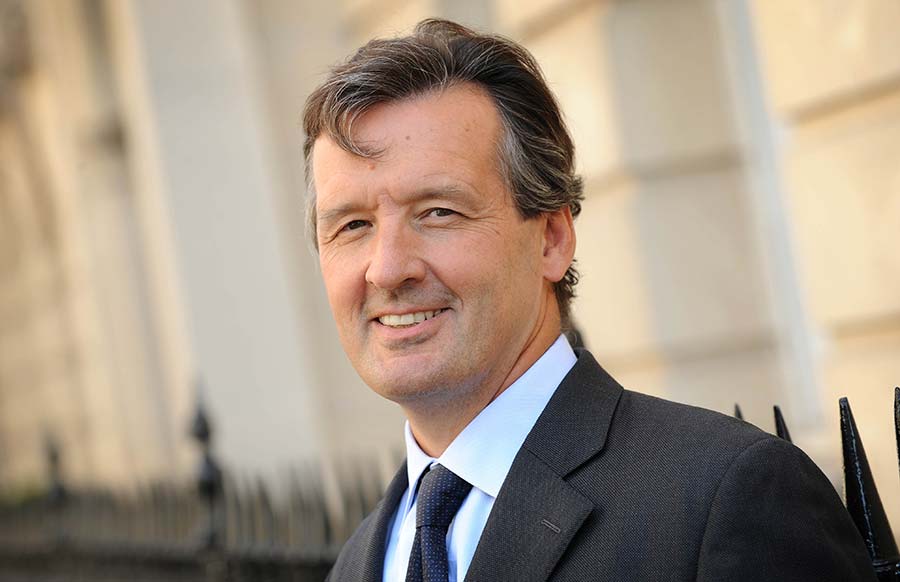
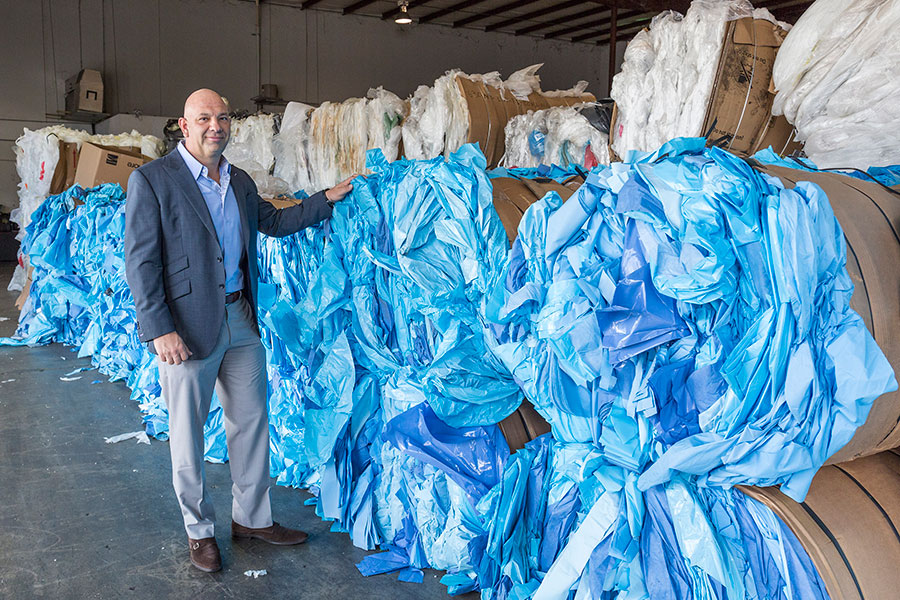
According to Rick Perez, Chairman and CEO of Houston-based Avangard Innovative (pictured above), there’s profit to be found in your factory waste bins. To prove it, some of his clients have reported returns of twelve times the savings on their waste. “You’ve already paid for the packaging on items you’ve bought,” says Perez, “so you’ll get 100 percent profit if you turn this waste into a commodity; something useful.” Rather than paying someone to cart trash away, Avangard has pioneered an ingenious business model that reverses the value chain, turning trash into an important budgetary item.

“We turn waste into money, something most companies don’t focus on,” says Perez. “It’s amazing what’s thrown into trash bins that companies are unaware of. We get skeptical glances at first, but once we’ve tracked it and presented a report, it’s much easier to show a dollar value to clients. Then they’re happy to pocket the cash.”

Perezs’ story is the classic American Dream. Arriving in the U.S. from Mexico City at an early age, he worked his way through school and university, always believing that new opportunities lay around the next corner. His father, a serial entrepreneur, had instilled a work ethic in Perez that taught him that hard work pays. His early career included a stint as a waiter and packing supermarket bags – work experience that any successful entrepreneur will only value later in life.

His ‘aha’ moment came when his brother, who worked at Merrill Lynch, told him about the deposit paid on returned Coca-Cola and Pepsi bottles. It had been an effective recycling system since being introduced in the U.S. in 1972, but Perez was one step ahead and had seen the future – discarded ‘one-way’ plastic bottles that would soon start flooding landfills. A fortunate trend at the time was an increase in the demand for synthetic fibers, used in the manufacture of polyester-based products. Avangard was soon processing 94,000 tons of plastic bottles and became the largest recycler of plastic bottles in the world.

Perez next swung his attention to supermarket chains, retailers and grocery stores, all with similar dilemmas around their waste packaging. Avangard developed a tech system that captured the data of recyclable material in real time. If you think Silicon Valley has an edge on innovation with their cool tech gadgets, think again. Perez has created the world’s first ‘trash-tech’ company.

So, how exactly do you convince a CEO to take their trash seriously? Perez reckons that once management moves beyond legislation and compliance issues and realizes they can make shareholders happy by increasing profit, the barriers disappear.

“Most annual reports have a page on sustainability nowadays. This offers a new opportunity for CEOs to shine,” says Perez.

The numbers don’t lie. A typical grocery store chain can achieve 20 percent of their net profit through waste recycling and improved efficiencies. “We’re mostly dealing with customers who already have a trash and recycling program in place, but we’ve redesigned the system to create profit,” says Perez. Most companies throw people at their trash problem, Avangard throws technology at it.

The cost of start-up equipment is minimal and the globally active company supplies all maintenance and training. Most customers will see a return on their investment within 12-18 months. Charlie Chanaratsopon, CEO of Charming Charlie Inc., was skeptical at first, but has now seen the benefits. “Avangard has allowed us to understand the composition of our waste, and therefore the value,” he says. “It’s brought an entirely new level of discipline to our sustainability program and by outsourcing this to Avangard, we can focus on what we do best: run our business.”

Finding value in your trash is great for generating profit, but Perez has always had his eye on a grander cause: helping save the planet. “Anything we can do that takes away from dumping things into landfills and acknowledges the importance of the environment, is a good goal,” he says. Most companies view sustainability programs as a cost, but Perez sees exactly the opposite – an opportunity to make money. “You’re also cleaning up cities and towns – there’s a social dimension as well,” he says.

Hosting events with quirky names, such as Styrofoam Amnesty Day, has helped Avangard raise awareness around the recycling of ‘difficult’ substances, while demonstrating they can indeed be recycled.

Waste is everywhere in a supply chain: cartons, pallets, buckets, tubs, lids, drums, used oil and organics. Many CEOs already know there’s a cost associated with getting rid of these items as they’ve paid for trucks to remove them, yet very few see waste as an asset – that someone owes you money on.

Recycling is not new either and Perez is aware that many view his sector as low-tech. His advantage lies with technology and tracking – a system that generates detailed reports through a control center that will inform CEOs on the status of a factory product, even before their own internal stock systems can. “When you have the right data, you can execute a plan,” says Perez.

It also helps that our software can generate sustainability numbers to use for marketing purposes – an important factor when positioning your brand with consumers who want to see a commitment to social impact before buying. “Think of us as your instant sustainability campaign,” laughs Perez.

Larry Del Papa, President of Del Papa Distributing, was surprised by the sheer volume of their waste. “We can now track our recyclables to maximize our revenue with Avangard, just like our other products,” he says. “We’ve increased our recycling revenue, cut our trash bill, helped the environment and boosted our bottom line.”

“Every company tracks their products, yet somehow waste and recyclables aren’t,” says Perez. “The receiving depot at the back of your store should be viewed as another money-making opportunity, on-par with the front-end, where consumers buy your products. Once you’ve convinced employees and your board that trash is a valuable commodity that is being given away, or even stolen, it will get treated differently.”

Perez feels the new generation of young people will usher in a new era of recycling, and with it bigger business opportunities.

“The kid’s of today know about recycling,” says Perez. “They know it’s the right thing to do, and a company that adopts a culture of recycling today will benefit from future generations (the future CEOs and employees of the world) who will understand that trash can be a normal part of any business plan.”

“We should all aim to leave something valuable behind for the future,” says Perez. “I’d like people to look back on my legacy one day and know that I turned trash into a valuable commodity.”
 

Beyond Charity: The Biggest Impact Is Business With A Heart

“People think that running a non-profit is easy,” says Vicki Escarra, Global CEO of Opportunity International. “Like something you do when you retire, kick back and work a couple of days a week. But the reality is: it’s very tough.”

Escarra knows all about tough: she was promoted to chief marketing officer of global operations for Delta Air Lines in the week before 9/11. What followed tested her leadership to the limits, and she learned that sometimes you need to recognize that certain business models have served you well, but might one day become obsolete. She’s of the opinion that In the midst of tremendous change lies real leadership.

Opportunity International provides small business loans, savings, insurance and training to more than five million people in the developing world. While big multi-national corporations usually come to mind when thinking about insurance and financial services, Escarra has shown the world that a) a non-profit can be big and global and b) it can generate wealth in a non-traditional way – human capital. Around 90 percent of the people they serve are women, a demographic supported by another fact – that women consumers care deeply about social impact.

The key to Escarra’s success has been to run her non-profit like a for-profit.

After all, there are still bills to pay, staff to support and a global infrastructure to maintain. The ‘charity’ route was never going to work for the scale she envisioned.

“The notion of classic philanthropy is changing, with two emerging trends within the non-profit sector,” states Escarra. Firstly, donors want to continue giving because they love the mission or because it offers a good tax write-off. While this might have been the only reason to donate a few years ago, we’re finding ourselves being pushed to find social impact investments from which donors can get a market return. We’re moving away from giving to investing.

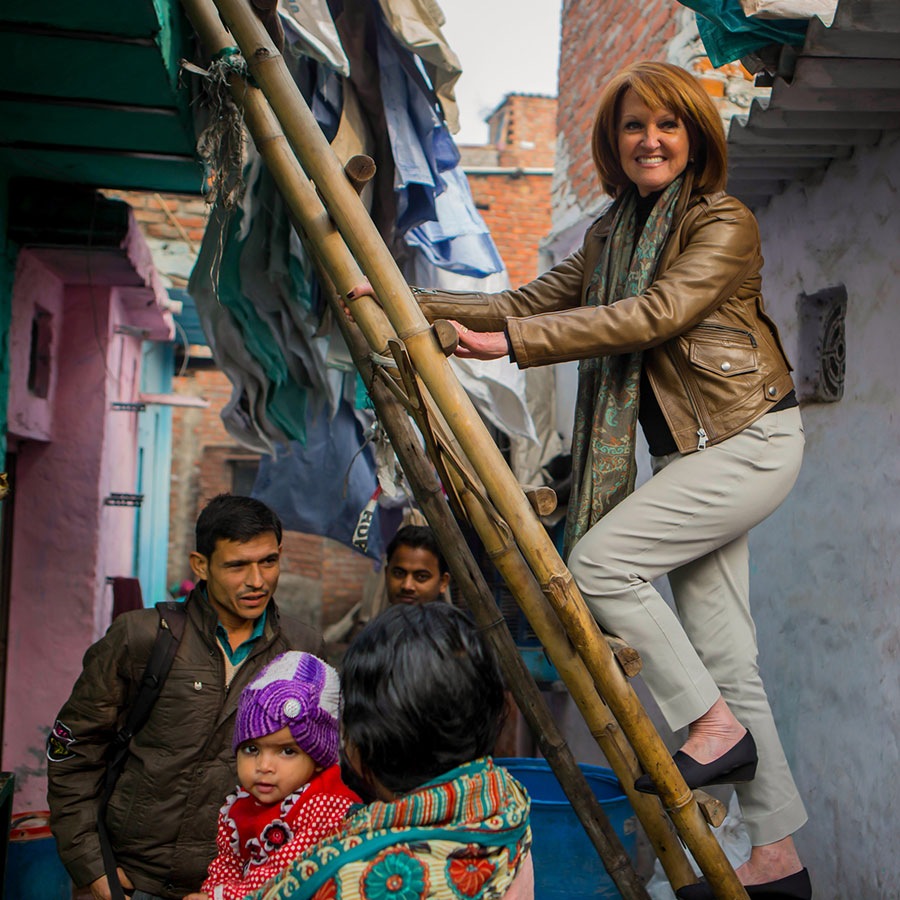
Vicki Escarra at a board meeting in India.

Vicki Escarra at a board meeting in India.


The second trend is around transparency and measuring impact. Who hasn’t heard that oft-repeated phrase, “So, we’re giving you money, but what impact are our dollars having?” Enter the University of Chicago Business School, that has joined Opportunity International to help discover exactly that. Researchers plan on fanning out across the globe to ask probing questions: ‘Is she holding down a job or growing her business? Are her children in school? Does she live in a decent home? Is she becoming a leader in her community?  Does she have clean water? Do her children have enough to eat?’ Having this information as hard academic fact, from a credible institution, can shift perceptions of non-profits from financially flaky to a professional image of corporate responsibility.

Escarra’s view is that there are too many non-profits in the world today, and that things might be more efficient if people collaborated more.

“We need to find ways of merging,” she says. “In the future there’ll be a lot of opportunity for us to all move in the same direction. There’s a high likelihood that we’ll become involved with technology firms too, who are fast-changing the way we approach everything these days.”

It really worries Escarra that the organizations she loves and cares about might become irrelevant one day. “Our world is changing so quickly that I wake up every morning thinking, ‘are we still relevant?’ If we disappeared tomorrow would it matter?  This is a question all leaders should be asking themselves on a regular basis.”

Financially, Escarra has reversed the revenue/donation model found at most non-profits. The last financial year saw Opportunity International raise $221 million in deposits and fund-raise $71 million from grants, corporations and individuals.

Escarra wants to help clients create 20 million jobs by 2020, which will affect more than 100 million lives. “It’s not just the impact of somebody opening a small grocery store and creating food security for their family,” she says. “They’ll also purchase stock from suppliers, that will create a ripple effect through the economy.”

“How much money is enough?” asks Escarra. “I think it’s important as a leader to ask yourself what your commitment is to the world. We should nurture a commitment to giving back because we’re all connected on this planet. We should all strive to become global citizens, especially those of us who’ve been given the gift of global influence.”

The Opportunity Network is made up of 49 organizations, 42 of which are microfinance institutions (program partners) operating in Africa, Eastern Europe, Central and East Asia and Latin America. These program partners provide loans and other support directly to families in need.  www.opportunity.org


Making Money Matter

Nick O’Donohoe moved from big finance to a big society bank when he realized that investment meant more than just money in the bank.

If you have a U.K. bank account that has been lying dormant for longer than 15 years, there’s a good chance Big Society Capital (BSC) now has your money. O’Donohoe is former CEO of Big Society Capital (BSC); a U.K. based social investment company and the world’s first social investment bank. He is now Senior Advisor to the Bill and Melinda Gates Foundation and spoke to Real Leaders about the innovative, world-first approach adopted by BSC.

It was formally launched in 2012 with an estimated £600 million of equity to be paid-in over five years. £400 million of this is from unclaimed assets left in dormant bank accounts for over 15 years. In 2004 Prime Minister Gordon Brown first put the idea on the table for unclaimed assets in bank accounts to be handing over to worthy charities, but it was David Cameron in 2010 who finally announced the £60 million seed funding for a “big society bank” that would enable charities, social enterprises and voluntary groups to take over the running of public services.

“These unclaimed assets, alongside the private sector investment that are leveraged, will mean that the big society bank will – over time – make available hundreds of millions of pounds of new finance to some of our most dynamic social organizations’,” Cameron said at the time. Brown had been forced to back down from critics who warned of administrative chaos and questions around whether the government had the right to seize the funds. Legislation was passed in 2008 finally paved the way for Cameron’s announcement two years later and the Dormant bank and Building Society Act was passed, giving the government the right to collect and distribute money from dormant accounts after 15 years.

O’Donohoe explains that the Dormant Accounts Act gave three choices at the time, around what to do with the money. One was to capitalize a social investment wholesaler (us), a second was to support youth activities and a third was for financial education. The government ended up liking the idea of a social investment bank so much that they decided to dedicate all the funds to BSC. O’Donohoe’s personal journey, into what become social finance, began around five years ago when he worked for JP Morgan Chase. Born in England, raised in Ireland and educated at Wharton in the U.S.A., he initially worked for 12 years at Goldman Sachs and then spent the next 15 years at JP Morgan Chase, running the European Equity division and then Global Head of Research.

In 2008 JP Morgan Chase identified a need for a social finance group. It was the brainchild of CEO Jamie Diamond, who felt the company could provide leadership and development in the relatively new areas of social finance, impact investing and social investing. “It was a really new idea at that time,” says O’Donohoe. “He wanted the bank to provide some leadership and someone at the bank to do it.

He wanted someone from the management committee to oversee it, and I got asked.” O’Donohoe was only supposed to spend a small amount of his time supervising this uncertain venture, but he soon got deeply involved in the new social finance group and produced an early research paper on impact investing.

At the end of 2010 a report they produced on impact investing as an emerging asset class became quite influential and that brought him into contact with some influential, like-minded people in the UK. “I met Sir Ronald Cohen, a founding partner of large private equity firm Apax, that had been developing a social investment agenda in the U.K. for more than a decade,” says O’Donohoe.

They also had a list of values that listed integrity, responsibility, sustainability and community among the core pillars of their business, something lacking among the bull-run approach of many other financial institutions at the time. Nick Hurd, a minister in the U.K. government was, at the same time, also looking for someone to set up the Big Society Bank, as government officials had coined it.

“It was intended to be a financial institution that developed a world of social investment, that helped to connect charities and social organizations with capital markets and helped them to raise and borrow money more easily,” says O’Donohoe. “It also aimed to develop social impact bonds, another way of funding charities.” Even though Ronnie Cohen was more closely associated with the government, they asked O’Donohoe to help, because of his experience with social investment at JP Morgan Chase.

“I’d been in banking for 28 years, but was at a stage in my life where I wanted to do something different, something that would make a contribution to the community and society.

“BSC is not really a bank,” says O’Donohoe. They don’t take deposits, other than the dormant account money and another £200 million pounds of investment from the four major U.K. banks. The significant political support in the beginning certainly helped, even though the original brand became slightly tarnished because of its political roots.

As witnessed with many idealistic government programs around the world, private enterprise involvement usually offers a better chance of success, but the high level political support BSC received at the outset has certainly helped get them to where they are today. O’Donohoe has always had a social conscience. His father was a doctor and his mother a social worker. “When your father’s a doctor you’re constantly aware of the fact that he’s out there every day, making a material difference to people’s lives,” says O’Donohoe. “Regardless of people’s wealth or ethnicity, that’s what doctor’s do.

I was given that awareness from an early age and even though I never regretted becoming a banker there was always that thought in the back of my mind asking, ‘Is this my purpose in life, helping rich people get richer?’

“Banks do fulfill a vitally important role in any sort of market economy, and the fact that we’ve had problems in the banking sector over the last few years seem to have created a bad impression around financial services. I was very lucky at JP Morgan Chase who were a safe port in the storm and weren’t implicated the way other banks were.

My journey to BSC was less about running away from something, and more about making a broader contribution to the world. I knew this would earn me a lot less money, but it would have a better defined purpose for my ideas,” explains O’Donohoe. Looking back, O’Donohoe sees the credit crisis as the catalyst for the development in the current social investment industry, and a signal to those with alternative solutions to step forward.

The nature of capitalism seems to be changing fast, yet won’t fundamentally affect the core financial markets for a while yet, according to O’Donohoe.

“It’s like turning a supertanker; it’s going to take a long time for a new direction to materially change our institutions.  What we’re seeing now, even beyond the world of investment, are companies and banks becoming much more aware of their role in the community. It’s changing the way they behave, making them more sensitive and aware towards environmental and social and governance issues.

Change is evident if you look back 10 years and compare. There now exists a whole impact and social investing movement, driven by individuals and institutions that want their money to do more than only deliver a financial return.

You’ll increasingly see companies doing more to furnish their environmental, social and governance criteria, and you’ll see an increasing number of investment opportunities, that offer more than financial return. In the future we’d like to see every investment being an impact investment.

In addition, companies and organizations will need to be doing good in order to attract investment and become much more transparent about how they conduct their business,” says O’Donohoe.

An immediate question might be why anyone would choose investments that are not social one’s. Why do people still invest in mainstream, ‘traditional’ funds when there is now clearly an alternative? O’Donohoe thinks we’re at the beginning of a long journey and looks to history to put things into perspective.

“It might take decades for this to play out.  We’re presently trying to encourage social investing, which means investing that delivers impact as well as actual monetary return. For this to be effective, we have to measure impact. How do we do that? There’s no consistency around how social impact can be measured, graded or evaluated. It took around 200 years for accounting principles to develop, so unlearning old ways of seeing the world can take time.”

Most funds have track records to prove to investors that they’re worth investing in. The impact investment industry has almost no such track record, and there’s no shortcut to creating a five or ten year track record. Data has to be generated, captured and analyzed, by tracking real investments and loans, for this market to grow. “Much of what has been developed for the impact investment market is very risky,” says O’Donohoe.

“You’ll find a lot of this investing is done with very small companies, often in deprived parts of the world, and it’s risky. There are many people who want to invest in companies that are developing education for the poor in Africa, or portable housing in India, and also many local U.K. investors who prefer very low risk, secure, reasonable yielding bond funds that channel money to charities or to other social enterprises. Regardless, the low-risk end of the impact investment market needs to be developed.”

“Today’s young entrepreneur wants to start a company with a dual purpose. Yet a big barrier to social enterprise, evident in most countries, are the two legal formats that exist for business.  One form is a charity, where you give away your money and the other is a for-profit company, seeking to maximize profits. The idea of a dual-purpose company is not embedded in any clear legal form yet and there’s a growing demand for it. When I speak at business schools, you hear that voice very clearly.”

Within the current crop of global business leaders, O’Donohoe sees a lack of knowledge around social investment. “If you asked a leading CEO whether they would consider making a social investment, they would probably say yes. If you asked whether they already had, they’d probably say no. If you asked why they hadn’t they’d reply, ‘We don’t know what they look like, we don’t know who does this type of investing or, our advisors don’t know anything about them,’” says O’Donohoe.

“A short-term goal, over the next three to five years is to simply educate  everyone to know what a social investment product looks like. That they’re available across a range of products and services, and that they’re available from mainstream as well as specialist organisations.”

“Ten years ago no-one had heard of corporate social responsibility,” says O’Donohoe. “A lot of people like to criticize it, but the fact is, at least we’re conscious of it now. Many large, global companies like Unilever are really at the cutting-edge of using their financial and human resources and global footprint to make a difference to important social issues. More transparency around this, and a desire to be rewarded will ultimately change big business, because change will happen more quickly if consumers are willing to reward companies for how they run their business.


Millennial Dads Turn to Digital in Their Moments of Need

Good news for moms and marketers: The new generation of millennial dads is playing a big role at home. They strive to be perfect fathers, influence purchase decisions, and turn to the web and their devices for help. The opportunity for brands is to be there in these micro-moments.

If there’s one thing that drives Tom Brantman crazy, it’s the “babysitter” comment. He hears it all the time, things like: “So nice to see a dad babysitting his kids” from a store clerk or a passerby on the street. “I understand they are trying to be nice, but the comment stings a little,” says the 35-year-old from Kansas City. “It’s not a job because I’m a father.”

Across the U.S., men like Tom are becoming much more involved in raising their children. In fact, fathers have nearly tripled their time with children since 1965, according to the Pew Research Center. And a Pew analysis of U.S. Census Bureau data shows that the number of stay-at-home dads has nearly doubled in the past two decades.

“Millennial dads are more involved in the day-to-day of childcare than any generation before them,” says Julie Michaelson, head of global sales at BabyCenter, a site for new and expecting parents. We dug into research conducted by BabyCenter, which surveyed millennial dads ages 18 to 34 who are expecting or have a child under the age of six (this is how we’ll define “millennial dads” here), and our own search data. We also spoke with a few dads around the country to figure out how dads are using the internet and mobile in their expanded roles at home.

Rising expectations lead millennial dads online
As the roles of fathers grow, so do expectations and the gap between what they know and what they think they’re supposed to know. “There’s so much to do, so much to buy,” says Duncan Snowden, a 35-year-old expectant dad from Brooklyn. “It feels insurmountable.”

These rising expectations are leading to a lot of anxiety for new dads. BabyCenter’s research revealed that 88% of millennial dads feel it’s at least somewhat important to be “the perfect dad,” a higher percentage than millennial moms who feel that way about their own role.

To help them get there, young dads are doing what they always do when they need information: They’re turning to the web. Seven in ten millennial dads seek parenting information online. They’re finding it in stolen moments throughout the day (and night), and they’re using whatever screen is at hand, often a smartphone.

Research further reveals that 59% of millennial dads looking for parenting information online use their smartphones the most when searching for that info—more than desktop, tablet, or laptop.1 Google data shows that searches for baby-related terms on mobile have grown 52% year over year (YoY).

As dads increasingly have mobile moments—we refer to these moments of need as I-want-to-know moments, I-want-to-go moments, I-want-to-do moments, and I-want-to-buy moments—what are they looking for? And how are they finding it? Are they finding it?

I-want-to-know moments
No matter what stage of fatherhood they’re in, men have questions, and they aren’t necessarily relying on traditional sources for answers. (“Ask my dad for help? Oh, God no, far too awkward a conversation,” Duncan laughs.) Forty-five percent of millennial dads are most reliant on search for parenting information, more than any other digital resource.

Duncan’s “anxiety-fueled” searches started as soon as he heard about his wife’s pregnancy. He read up on everything from birth plans to financial plans. Meanwhile, when Tom’s first child was born, he “questioned everything” and strove to learn as much as he possibly could.

“The hospital was great with providing all of the basic stuff such as how to change a diaper, how to swaddle a baby, different ways to burp your child,” he says. “But I had questions that don’t have easy answers. How do I make my baby smile? Will my kids know that dad is holding them? Where is the checklist for ‘world’s greatest dad’ and does it have an extra-credit second page?”

Once the baby comes home, I-want-to-know moments often strike in the middle of the night. Dain Van Schoyck, a new dad from Brooklyn, describes searching in “off hours”—early in the morning or middle of the night—about his baby’s health and development. He’d type in queries like “Why is he crying in the middle of the night?” and “Is he getting enough food?”

And he’s clearly not alone; we see that mobile peaks in the evenings for baby-related feeding and sleeping questions. After all, if baby doesn’t sleep, neither does dad.

And then comes the time when dads have even more questions—when their child learns the word “why?” More than half of millennial dads say they’ve used a phone to find out the answer to a question asked by their children.

I-want-to-go moments
One reason they’re using mobile so often is because new dads are constantly on the go and looking for nearby activities and baby products. Thirty-three-year-old Zack Yorke uses his phone to answer immediate questions when he’s strapped for time, which is most of the time.

A typical day with his 22-month-old is spent hustling from one activity to another around New York, and he relies on his phone to plan his next move. “I’m looking for store hours, when is the YMCA pool open, what are the family-friendly food options nearby, are there activities at the Brooklyn library or museum, things like that,” he says.

I-want-to-go moments happen even before the baby comes. Adam G. from Boston recently used his smartphone to find the chocolate-covered, peanut butter-filled pretzels his pregnant wife was craving. “I did a quick search on the phone to see where I could get them relatively close by,” he said in the moment. “Ultimately I found out Trader Joe’s has them. They got pretty good reviews, so I’m on my way right now to buy them.”

This isn’t just a dad thing. More and more, people are using local search to find things nearby. Google search interest in “near me” has increased 34X since 2011 and nearly doubled since last year.4 The vast majority come from mobile—80% in Q4 2014.5

How can you be there when dads are looking for your business location? Are you delivering useful local information? Read more about how to win I-want-to-go moments.

I-want-to-do moments
From the moment a man learns he’s going to be a dad, he has to do many things he’s never done—or even thought about—before. Suddenly he needs to know how to babyproof a house, burp a baby, warm a bottle, and on and on. Learning how to do these kinds of things used to be time-consuming, but today, dads can find out instantly. Ninety-one percent of smartphone users turn to their devices for ideas while completing a task.6 And on mobile, baby-related how-to searches are growing 49% YoY.7

These I-want-to-do moments change over the course of fatherhood. For example, when Tom found out his wife was pregnant, he started doing “nesting” research (“fresh coats of paint,” “new windows for a quiet room,” and “framing art” searches). Now that his kids are older, he’s often searching about health issues on mobile, things like “how to clean sand out of a cut.” And for many dads, mobile has become the new instruction manual. One in three dads has used a smartphone to help install or build a product he bought for his child.

Online video is especially helpful for time-strapped parents in search of quick answers. We see that baby-related searches on YouTube are growing (see chart) and watch time of parenting videos has doubled in the past year.9 “I’d often rather watch a quick five-minute video than read about something,” says Duncan.

New dad Dain uses YouTube for step-by-step instructions to learn things like how to put on a baby carrier or swaddle a baby. Many millennial dads seek out videos about parenting tips (62%), baby health (59%), product reviews (55%), and pregnancy/baby development (46%)

I-want-to-buy moments
As more parents divvy up responsibilities, the shopping list is being split as well. Seven in ten millennial fathers say they help with the shopping.

On smartphones, dads can chip away at these purchase decisions in small moments every day. For example, while waiting in line for a sandwich at lunch, expectant dad Duncan often does a search for something he needs to buy. (“Right now, that’s a stroller,” he says.) He’s not alone; searches for “strollers” on mobile have grown 80% in the last year, while “baby gear” is up 72%.10

New dads also make online purchases once the baby comes—for everything from food to financial services. When deciding what to buy, millennial dads care most about safety, brands that provide good value, and good online product reviews. Mobile gives them constant access to this information and can strongly influence what they end up buying—even if they’ve already bought it.

Adam and his wife were a month away from having their first child when they were shopping for car seats. “We bought one, and then I found it on sale as I was looking through my phone and just checking the prices. So we decided to re-buy it,” he reports. “Just did that right now. I’m pretty happy. Saved about 30 bucks.”

Not enough dad-focused content online
Despite how much they rely on the web, millennial dads aren’t finding as much relevant content there as they’d like. More than half (58%) say there is not enough or barely enough dad-focused content online, and 69% say they wish there was more parenting content available for dads online.

When they do find content, dads we spoke with were often disappointed with the user experience on mobile. Some described switching to their desktop simply for that reason.

“Some sites are not optimized for mobile, and there’s a lot of detail so it’s hard to read,” recounts Duncan. “There’s too much itty-bitty information on those comparison blogs and manufacturers’ sites.”

There’s no doubt that the mobile experience is important for anyone trying to reach young dads. Online parenting resource Fatherly reports that 75% of its traffic is from mobile.

“Parenting media and commerce consumption is not a lean-back experience; it’s generally a run-around-chasing-a-kid-with-a-phone-in-one-hand-while-trying-to-get-the-baby-in-the-room-to-stop-crying experience,” says Fatherly co-founder Mike Rothman. “We need to fit into that window of opportunity or else we’re doing our guys a disservice.”

The perfect moment to win customer loyalty
Brands that understand these windows of opportunity, these micro-moments, stand to win over the hearts and minds of a highly valuable audience. Not only do millennial dads take part in household shopping, they hold the most influence on big purchases like consumer electronics and financial services. And since starting a family, many of them report switching brand choices across a range of products, especially food/beverage/groceries and household cleaners.

“Marketers in these sectors should think about reaching both moms and dads if they want to take advantage of this important life stage, when new products are being purchased and new brand loyalties are being won,” says BabyCenter’s Michaelson.

There’s also a larger cultural shift at play that brands can’t ignore. “I think you can look at the Super Bowl from this past year, with the sheer number of dad-focused ads, as evidence that marketers are recognizing that the American family dynamic is shifting,” says Fatherly’s Rothman.

And right now, brands still have the chance to stand out by appealing to dads. Rothman continues: “Whereas moms are awash in marketing messages and socialize many of their purchasing decisions in advance with other moms, whether online or in-person, men are now making more of the decisions or influencing these decisions with significantly less information at their fingertips. As a result, men tend to be more receptive to marketing messages as those messages naturally occupy greater mindshare.”

As for Tom, he’s realized there are “10 million ways to raise a great kid,” and he needs to find his own path. Even as he draws inspiration from everywhere—websites, TV shows, books, brands—he’s constantly going online to dig deeper, learn more, and become the “best father in the world.”

By Allison Mooney, Jenny Fernandez. This story originally appeared on ThinkWithGoogle


Matt Damon: Lead Actor On The World’s Water Crisis

More people have access to cellphones than to clean water. This is a shocking fact in a world that has the technology and financial means to resolve one of humanity’s most basic problems, but in which we have failed to apply the solutions.

Matt Damon has taken his tough-guy, action hero character off the screen and chosen to tackle the ultimate global threat – lack of clean water. To Damon, water and sanitation are enormous problems that have a solution – they’re just not being implemented. Frustrated by what he saw on trips to developing countries, he realized that many practical solutions were already around. He found a like-minded partner and rolled up his sleeves to give the issue some attention.

Every 90 seconds a child dies from a water-borne disease,” says Damon. “This is a problem we, here in the West, solved over a hundred years ago. To put this in perspective, imagine if we cured AIDS or cancer tomorrow and in 100 years from now children were still dying in the millions from curable diseases. It’s unconscionable.” Damon founded H2O Africa to try and help, and in 2009  met Gary White, a lead advisor to major companies and organizations wanting to respond to the global water crisis. White had established WaterPartners a few years earlier. The pair decided to join forces and create Water.org.

Lack of clean water affects about 2.6 billion people on the planet. In addition to the obvious health concerns, Damon is of the opinion that we cannot solve poverty without first solving the water problem. He’s no armchair critic either, having seen the water crisis first-hand by meeting with people in different countries affected by it.

“The last time I was in Ethiopia, I was sitting over a hand-dug well and watching these children pull water out of this filthy hole. The water looked like chocolate milk,” says Damon. “We put a shot up on our website of a clean bottle of water next to one of these bottles of water to give people an idea of just how filthy the water was.”

Seeing these kids collecting dirty water in containers so they’d have something to drink during school, deeply affected Damon. Talking to some of the villagers revealed that some children had already died in the area from drinking the water.

“They were aware of the dangers, but they didn’t have a choice,” he says. “To be standing there watching these little kids, the same age as my four children, smiling and drinking something that could make them very sick or kill them was a disturbing moment. To stand there knowing there is clean water 20 ft. under your feet and those kids just can’t get to it was just unbelievable. It had a pretty big impact on me,” says the actor.

What resonates most with White is seeing people living without clean water and being forced to spend their entire day scavenging for an essential  commodity that will see them survive another day. Many people around the world find themselves in the grip of a crippling poverty cycle; a death spin they can’t possibly escape. Damon and White had seen lives change when clean water suddenly became available.

“It’s not only about children surviving but also about their hopes and dreams going forward, a chance at a real life, of getting an education,” says Damon.

“As a guy who has four daughters, this is also a huge issue for women and girls. Girls in many countries often have to leave school to go and find water, and it ends up having an enormous impact on the quality of their lives,” he says. With women and children spending 266 million hours a day collecting water and a child dying every 90 seconds somewhere from a water-related disease, there wasn’t a moment to spare.

Damon is a realist and acknowledges there’s never going to be enough charity in the world to solve the water problem. “You are never going to dig enough wells. That’s not the way to do it. What you need are smart solutions,” he explains.  One of these smart solutions was pioneered by White, who started WaterCredit. Using the ideas behind microfinance, White leverages small loans for people to be connected to a clean water source.

Purely through his observations, White realized that in many slums the municipality was pumping water right through a neighborhood to a single communal water source. This meant that residents would need to walk half a mile and sit in a line of people waiting to fill jugs and containers. Most of these people had jobs and fetching water was eating away at valuable time needed to earn an income.

“Gary figured out that the cost to directly connect to the water source could be as little as US$75. If they could secure a loan for this amount, they could connect a pipe that ran right inside their house,” says Damon. The pair genuinely feel they can help solve the water problem. Small, proven solutions can act as an inspiration to larger organizations and governments.  “It starts to get exciting when I walk down the street, and people come up and want to talk about this stuff,” says Damon.

It feels like we’re approaching a tipping point where enough people will say ‘enough’ and take action. We’re getting close, and once we get there, things are going to move very fast.” 


Marc Benioff of Salesforce: We’re One Step Closer To Equal Pay

One day last year, two female executives in my company came to me and said we might be paying women less than men. 

This was a complete surprise to me. It didn’t occur to me that inequality could creep into our company culture at Salesforce. We then looked at the salary of every employee in the company, and it turned out we did have a pay gap.

Now, we are spending $3 million on closing the gap so that women and men are paid equally at Salesforce, and we’ve instilled equality as one of the core values of our company.

The President has said that a world in which women are treated as equal to men is safer, more stable, and more prosperous — and I wholeheartedly agree. I believe that businesses are more successful when equality is built into the fabric of the company.

But we will never solve the issue of pay inequality if CEOs and business leaders continue to turn a blind eye to what’s happening right in their own organizations.

Businesses are the greatest platforms for change in the world — and business leaders, as well as government leaders, must set an example when it comes to equal pay for equal work.
Today, the government is taking a big step toward building a better world where every woman is paid the same as her male counterpart. Under the Equal Employment Opportunity Commission’s proposal, many businesses would be required to report their pay data by gender and race so that we can know when and how wage discrimination is happening.

It’s time for every leader to make equal pay for equal work a top priority. Going forward, we will be judged on whether we made the world a more equitable place for all.
I applaud the President and his team for continuing to look for ways to close the pay gap and bring more attention to this important issue.

Thanks, Marc Benioff
Chairman and CEO, Salesforce


New Report Identifies Business Opportunities Within Global Risk

From all corners of the world, business leaders echo the same message: societal risks need urgent action. However, some of the most pressing risks – such as youth unemployment and the global food crisis – are also where leaders see the greatest business opportunities. Business also increasingly sees itself as a key global activist and is calling on governments to increase political will to address world risks. These findings and more are revealed in the 2016 Global Opportunity Report, released today by DNV GL, the United Nations Global Compact and Monday Morning Global Institute.

Five global risks turned into 15 opportunities. That is the essence of the Global Opportunity Report, which stems from a survey of 5,567 business, governmental and social leaders across five continents.
The key findings include:

  • 42% of the leaders consulted rate youth unemployment as today’s most pressing global risk.
  • Corporate leaders see greatest business potential in getting youth in to work.
  • Business leaders have faith in the technology and the economy to address societal risks, but want politicians to do more.
  • Leaders see potential for new business in the Sustainable Development Goals (SDGs) adopted by the United Nations last year.

The Global Opportunity Report aims to inspire and encourage leaders to grasp the kinds of business opportunities that can help eliminate the world’s biggest risks. It complements the World Economic Forum’s Global Risk Report by showing the opportunity landscape beyond risks. This year, risks such as ‘loss of ocean biodiversity’, ‘accelerating transport emissions’, ‘resistance to life-saving medicine’, ‘youth unemployment’ and ‘global food crisis’ were transformed into 15 opportunities.

Who’s ready to act?


The report finds that business is a key activist, ready to join forces with civil society to tackle widespread change. It furthermore reveals that business leaders are calling on politicians to step up efforts to drive systemic change and are increasingly taking action themselves. CEO and founder of Monday Morning Global Institute Erik Rasmussen explains:
“We cannot solve the problems of today with the tools of yesterday. New opportunities are urgently needed to tackle complex issues such as youth unemployment in a world marked by jobless growth and the rise of robots”.

Where are the opportunities?


Leaders from both the public and private sector see ‘smart farming’ as the number one opportunity, followed by possibilities in the digital labour market. Both of the top two opportunities use digital technology as a force for good.
DNV GL Group President and CEO, Remi Eriksen, says the report highlights the key role of innovative technology in many of the opportunities.

“These are not future technologies – these are technologies already available to us, right now – but scaling is needed. A good example is one of this year’s opportunities, ‘Smart Ocean’. By the use of existing sensor technology and ocean traffic monitoring systems, we can observe the state of the world ocean to learn more about the marine ecosystems and utilise the opportunities it offers in a sustainable manner. With proper implementation and scaling this solution could have massive impact.”
“Many of these opportunities cannot be fully realized by the scope and knowledge within one industry alone, so I strongly believe in cross-industry collaboration to combine expertise to develop future-fit solutions.”

In addition, business leaders – who make up 83% of respondents – see the greatest business potential in the opportunity concerning youth job creation.

A political wake-up call


All surveyed leaders see potential for new business in the 17 Sustainable Development Goals (SDGs) adopted by world leaders at the United Nations last year.
Lise Kingo, Executive Director of the United Nations Global Compact notes:

“The new Sustainable Development Goals provide a clear and compelling direction for the future. For business, these new global goals are set to be a major driver of the markets of tomorrow and can unleash a wave ofsustainable products, services and business innovations. All companies can play a role by doing business responsibly and finding opportunities for growth and innovation.”

The road to the report

In addition to the 5,567 leaders surveyed, over 200 experts from eight countries have shared insights and contributed to creating the Global Opportunity Report. The report identifies and ranks 15 sustainability opportunities according to public and private sector interest and potential impact on societies and business. With the new report, the partners aim to demonstrate how global sustainability challenges and risks can be seen as opportunities. The work provides an open innovation platform where stakeholders worldwide can explore and capture sustainability opportunities and solutions across risk domains and regions. Additionally, the report identifies more than 120 readily available solutions.

The Global Opportunity Report and the global survey will be conducted annually.

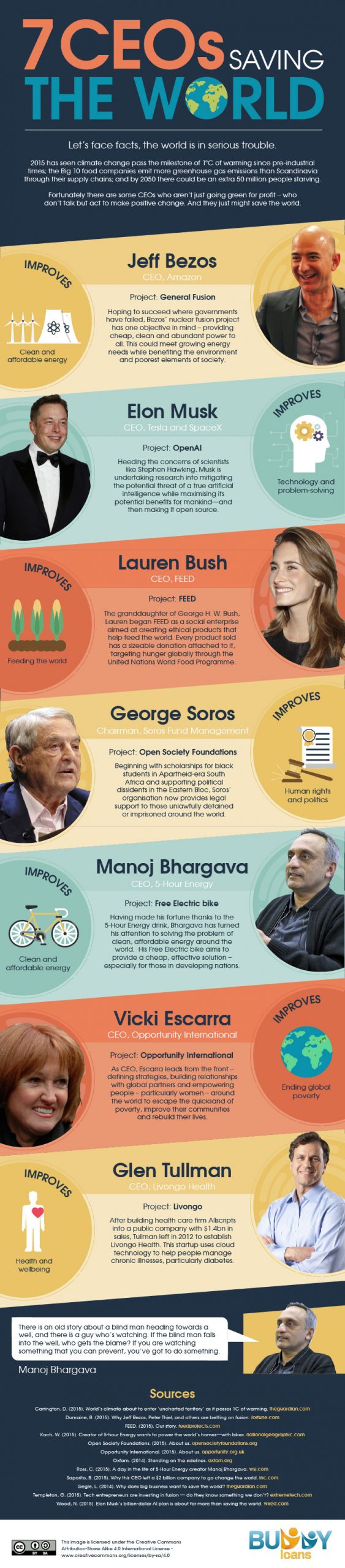
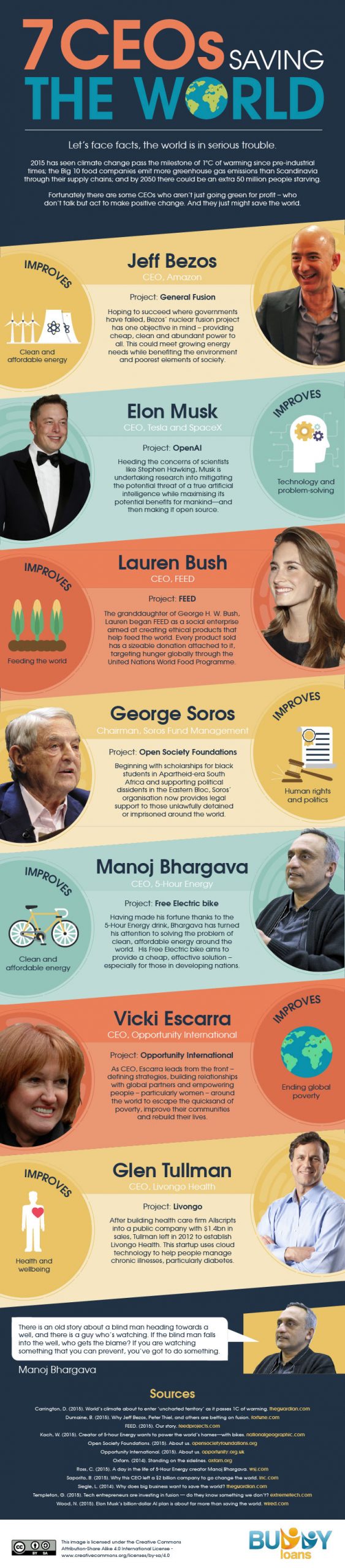
7 CEOs Saving The World

Let’s face it, the world is in serious trouble. 2015 has seen climate change pass the milestone 1 degree celsius of warming since pre-industrial times; the Big 10 food companies emit more greenhouse gas emissions than Scandinavia through their supply chains; and by 2050 there could be an extra 50 million people starving. Fortunately there are some CEOs who aren’t just going green for profit –who don’t talk but act to make positive change. And they just might save the world.7 CEOs

The original story appeared at Buddy Loans

Rhino Horn is Cheaper From a Lab Than From The Wild

Controversy awaits those who challenge the status quo – 23andMe, Airbnb, Uber – each has its supporters and detractors. My company, Pembient, is no different. In this post, I wish to address some of the concerns raised in the media about Pembient’s operations.

What is Pembient?

Pembient is a startup. In the words of serial-entrepreneur Steve Blank, that’s an organization in search of “a repeatable and scalable business model.” The space we’re exploring is the biofabrication of wildlife products. Such products have enormous cultural, practical, and artistic importance. Thus, there is tremendous value in making them available to the world in a legal and sustainable manner.

Presently, our work focuses on rhinoceros horn. Rhino horn has a long history as a folk medicine and carving material. We’ve experimented with addressing its medicinal uses through the creation of beverages and lotions containing biofabricated rhino horn. We’re now pivoting away from consumables due to the numerous requests we’ve received for solid horn. These requests come from carvers, artisans, and designers who want to produce durable goods, including traditional bracelets, ornamental combs, housewares, horn-rimmed glasses, smartphone cases, and chess pieces.

Implicit in our evolving business model is a social mission. Rhino horn currently sells for upwards of $65,000 per kilogram. We seek to biofabricate it at a fraction of this price. Our goal is to reduce the incentive for poachers, middlemen, and corrupt government officials to harm rhinos. This is frequently expressed by journalists as “flooding the market” with horn. What we’re actually doing is invoking a variant of an economic principle known as Gresham’s Law. Simply put, if some biofabricated horns can be passed off as wild horns, then consumers won’t be able to reliably determine any horn’s real value and the price of rhino horn will fall. It is in the context of this statement that our efforts should be evaluated.

What policies does Pembient support?

In order for us to achieve our social mission, the existing ban on the international trade in rhino horn must remain in place. If the ban is lifted and wild horn begins to trade on a regulated market, it will trade at a premium to biofabricated horn. This premium would not be due to any substantive differences between the two products. Rather, it would stem from the government-issued certificates attesting to the provenance of wild horn. A similar distinction exists in the diamond market, where certified natural diamonds trade at a premium to synthetic diamonds. Biofabricated horn cannot impact the market price of rhino horn if the trade in wild horn is legally sanctioned. Further, if the price stays high, an incentive to poach rhinos and launder their horns into the legal system will remain.

Another important policy we support is demand reduction. Demand reduction for rhino horn typically takes the form of media campaigns designed to discourage its use. We’re supportive of messages highlighting the health and safety dangers of consuming rhino horn. An exemplary message would be one that informs potential users that some rhino horns are sourced from taxidermists and may contain arsenic. We’re also interested in messages designed to dispel the many latter-day myths that have emerged regarding rhino horn. These include the notion that it can cure cancer.

Will Pembient counteract demand reduction efforts?

While we support demand reduction, we don’t do so unconditionally. We’re wary of messages that disparage traditional knowledge or communicate a double standard. Celebrity declarations that rhino horn is the same as fingernails because they’re both composed of keratin fall into this category. Doubly so when the celebrities themselves consume cosmetics and apparel made with keratin obtained from livestock. The danger of ill-conceived demand reduction messages is that they can trigger a “boomerang effect.” This effect, first documented by social psychologists, refers to a situation in which a message provokes the opposite of what is intended. Since rhino poaching in South Africa has gone from 13 animals in 2007 to 1,175 in 2015, we cannot assume demand reduction, as it is currently practiced, is working, let alone doing no harm.

Given the problematic nature of demand reduction efforts, our strategy is surprisingly safer. That is, if we satisfy the hypothesis of Gresham’s Law and biofabricated horn is passable as wild horn, demand reduction becomes irrelevant. On the other hand, if we biofabricate unpassable horn, we’re analogous to an abattoir producing ox or water buffalo horn. We would have the same effect on rhino horn demand as an abattoir too, which is to say none at all. Additionally, we would need to improve our product or face bankruptcy. Demand reductionists who fail to reduce, or accidentally increase, demand for rhino horn are not similarly punished.

Will Pembient complicate law enforcement efforts?

Besides being subject to feedback, we have the added potential of driving positive change in wildlife forensics. The forensic testing of suspected illegal wildlife products is a best practice. Unfortunately, it is not always done. A lack of testing means a lack of evidence, and a lack of evidence means that convictions for wildlife crimes are rare. We’re working with various regulatory agencies on ways to preserve and enhance forensic testing methods. One technique we’re particularly interested in is DNA watermarking. This technique embeds secret patterns in DNA. If our products contain DNA watermarks that are exclusively detectable by law enforcement during the normal course of an investigation, then we won’t complicate law enforcement efforts. Rather, we’ll necessitate the spread of a best practice.

Is the commercialization of wildlife products protective of wildlife?

The last issue we would like to address is the track record of wildlife product commercialization. For wildlife products with international appeal, such as vicuña wool sweaters or crocodile handbags, commercialization is the go-to conservation strategy. Luxury brands increasingly play a role in this process. For instance, Loro Piana, an Italian clothing company, has established reserves for vicuña in South America. The benefits from these reserves are shared with local communities. In turn, these communities shepherd the animals on the reserves.

Commercializing wildlife products isn’t always protective. Take tiger skins for example. It turns out that it is cheaper to kill a wild tiger than raise one to maturity in captivity. Similar economics haunt the bear bile industry. It is too expensive to grow a bear just to harvest its gallbladder. Bear farmers try to circumvent this fact by continually milking bile from their bears. Even though farmed bile is cheap, there is a market preference for intact gallbladders. This means that wild bears remain under threat.

The economics of our commercialization strategy for rhino horn tend toward being protective of rhinos. More specifically, it is known that only 14 rhinos were poached in South Africa in 1993 when the price of horn was an inflation-adjusted $7,720 per kilogram. Biotechnology can be adapted to produce rhino horn at this price point. Furthermore, the Carlson Curve, a biotechnological equivalent to Moore’s Law for computers, predicts rapid price-for-performance gains across a range of scientific tools. These advances will further reduce the price of rhino horn.

The day is coming when it will be cheaper to obtain a rhino horn from a lab than to farm or poach a rhino.

By Matthew Markus, Co-founder & CEO at Pembient.

What Happens When Robots Take Our jobs?

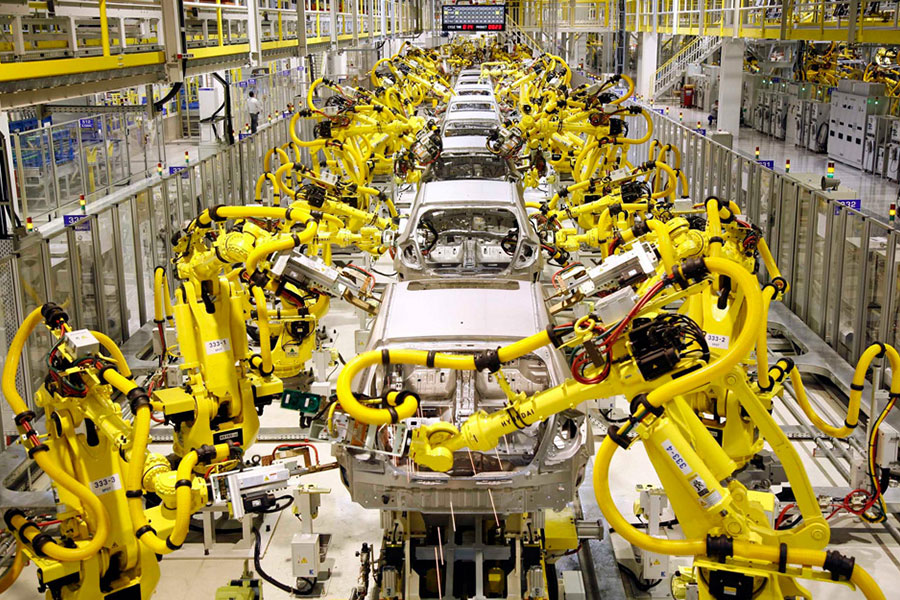
Technologies such as big data, advanced analytics, the internet of things, wearables, advanced robotics, learning machines and 3D printing are finding their way into factories.

Despite the sluggishness of change on today’s factory floors, this digital wave is slowly but surely revolutionizing manufacturing, contributing to major productivity enhancements and the emergence of innovative production paradigms that deliver more tailored and efficient solutions.

Needless to say, this transformation has profound implications for manufacturing employment, affecting everything from the size of the workforce, to the skillsets required and the locations of factories. Will this Fourth Industrial Revolution lead to a jobless future for manufacturing or will the “traditional” response of education and training allow workers to remain employable?

A factory with no employees?

According to Autodesk CEO Carl Bass, “The factory of the future will have only two employees: a man and a dog. The man will be there to feed the dog. The dog will be there to keep the man from touching the equipment.”

Indeed, from Jeremy Rifkin in the End of Work to Martin Ford in the Rise of the Robots, economists have been predicting that automation will make human jobs – at least as we know them today – obsolete in the not-too-distant future. In the United States alone, manufacturing jobs have fallen from 25% of the total in 1970 to approximately 10% today, as James H. Lee reminds us in his blog on the World Future Society website. Productivity and employment, which rose and fell in tandem until the early 2000s, now show an increasing gap, reflecting the fact that humans are being displaced by machines for many jobs.

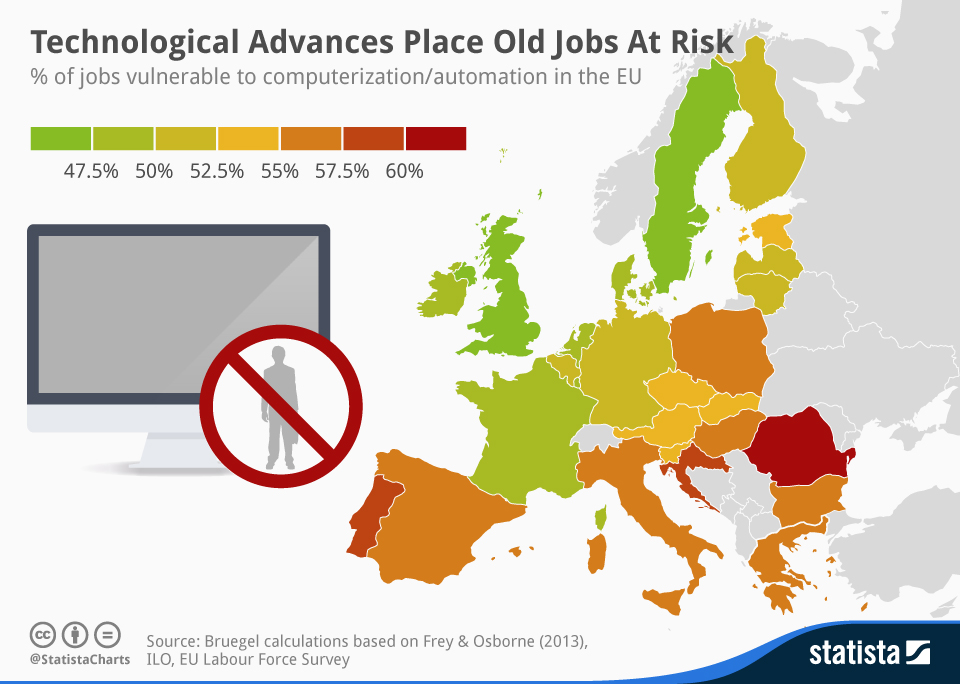
Carl Benedikt Frey and Michael A. Osborne estimate that 47% of US jobs are at risk due to “computerization”. This trend is not just a Western-centric phenomenon; according to David Rotman, “fewer people work in manufacturing today than in 1997, thanks at least in part to automation.” In fact, Foxconn announced in August 2012 that they would introduce one million of robots within three years to replace human labour.

So will this trajectory lead to a jobless future for manufacturing? Not quite – or at least not immediately. But there is no doubt that Industry 4.0 will fundamentally change the nature of manufacturing jobs.

robot jobs

A different type of manufacturing worker

Some human manufacturing tasks, such as heavy lifting, precision positioning and visual quality control, will most certainly be transferred to or supported by robots, which are not only more efficient and effective than humans, but can communicate seamlessly with one another. Human workers will have to learn to work side-by-side and in conjunction with robots. Advanced automation will increase workers’ acceptance of safe and collaborative machines with human-like physiognomies working close to them.

This, along with wearables, augmented reality and other technologies, will change the nature of traditional blue-collar work, which will become both more complex and sophisticated, but also increasingly supported by technology. It is hard to predict whether Industry 4.0 will call for more- or less-skilled workers, but it is clear that the requirements will be very different, with a greater focus on flexibility and adaptability, and potentially less on expertise and craftsmanship.

Nevertheless, robots are still imperfect, and their capabilities are not yet sufficient to fully displace humans. Furthermore, and despite constant progress, the ROI for fully automated manufacturing is still unproven, raising doubts about the speed with which Industry 4.0 is gaining traction. But the revolution is most certainly under way.

A challenging Schumpeterian transition

Throughout previous industrial revolutions, overall job creation has always been positive, but there are serious doubts that this will hold true for this fourth industrial revolution. There does seem to be a consensus that it will change all professions in ways perhaps we are yet to understand.

The other problem with looking at the future of manufacturing employment through the lens of history is that it does not take into account the exponential nature of digital technologies. The ubiquitous connectivity of people and machines, and the real-time data that define the Fourth Industrial Revolution, are governed by Moore’s law (doubling of the performance/cost ratio every 12 to 18 months), while we tend to think and react in a linear mode. In addition, this transformation is not limited to manufacturing. It potentially touches all knowledge and service jobs, thereby raising a much bigger question for society.

The risk we are facing in the near future is mass unemployment for some categories of workers, combined with lack of skills in other categories – and the political and social implications of such imbalances. Will companies, individual governments and society at large (including educational systems and social safety nets) be able to adapt quickly enough to this new paradigm and create an environment in which all can contribute? For this to happen, all parties will need to collaborate in order to invent a systemic, social and sustainable model for a better future of work.

Xavier Mesnard is a partner with A.T. Kearney where he leads the global Strategic Operations Practice. He is also a frequent commentator on Industry 4.0, sustainability, and food topics. 

0