Plastic Soup: What Goes Into our Oceans Goes Into you

The ocean is Vincent Kneefel’s biggest passion and his mission is to make people fall in love with the oceans. 

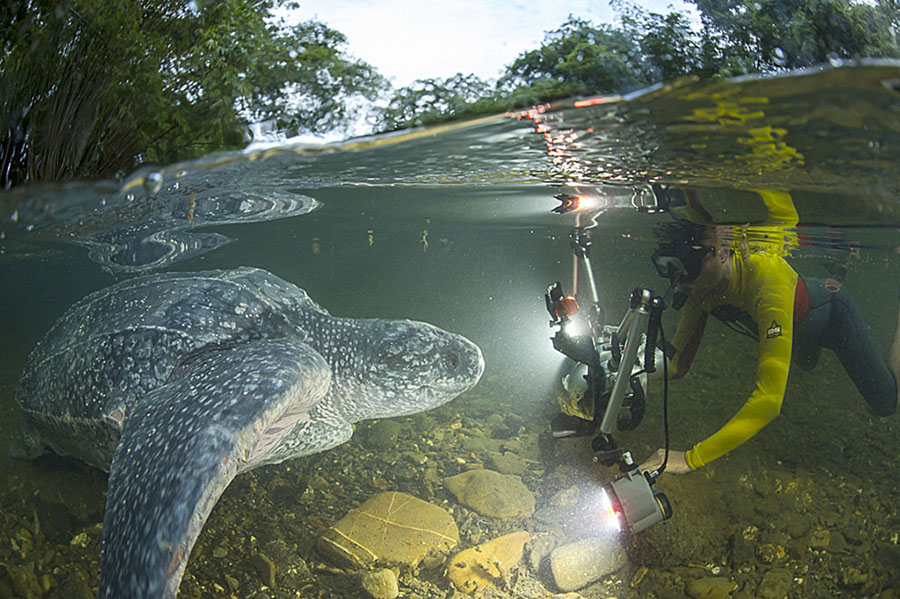
The Dutchman became a dive master and PADI instructor at the age of 18 and after seeing the extraordinary creatures and incredible marine life that live in our oceans, he decided to become an underwater photographer and story teller. He has witnessed the impacts of overfishing, pollution, ocean acidification, climate change and habitat destruction on marine life firsthand. He feels strongly that we all need to do something about this situation now, before it’s too late. As his hero, marine biologist and explorer Dr. Sylvia Earle has said, “The next 10 years are probably the most important of the next 10,000 years, so everyone should listen up.”

Kneefel writes about the ocean, conservation and sustainability and photographs his travel and expeditions. We asked him what’s needed to preserve the ocean for future generations.
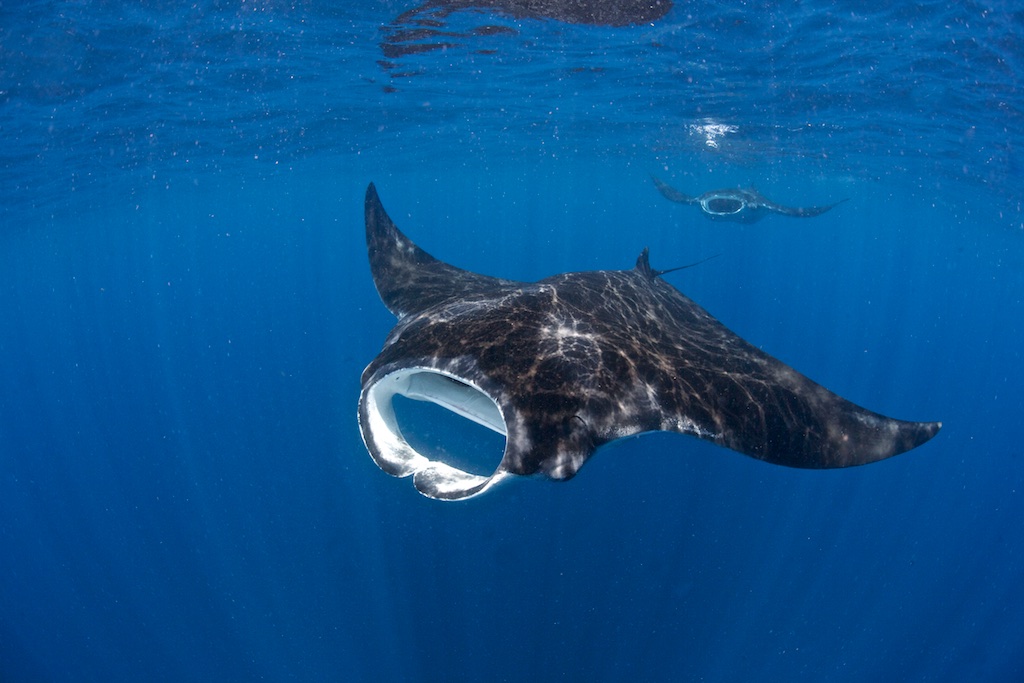
manta rays

What is the most shocking fact you can share about the world’s oceans? 

Although the ocean seems abundant today, it’s only a glimpse of what it once was. Fish stocks have decreased globally by 50% over the past 50 years, and some larger species, such as sharks, tunas and rays, by more than 90%. Before commercial fishing started, the ocean was 10 times as abundant as it is today. The ocean’s ecosystems have been severely impacted by human activity. Unfortunately, it’s hard for our generation to grasp the magnitude and gravity of all of this. We go diving and see a beautiful reef with maybe some sharks and think this was an amazing experience, but we have no idea what the original state of the coral reef was like before humans started over-fishing.
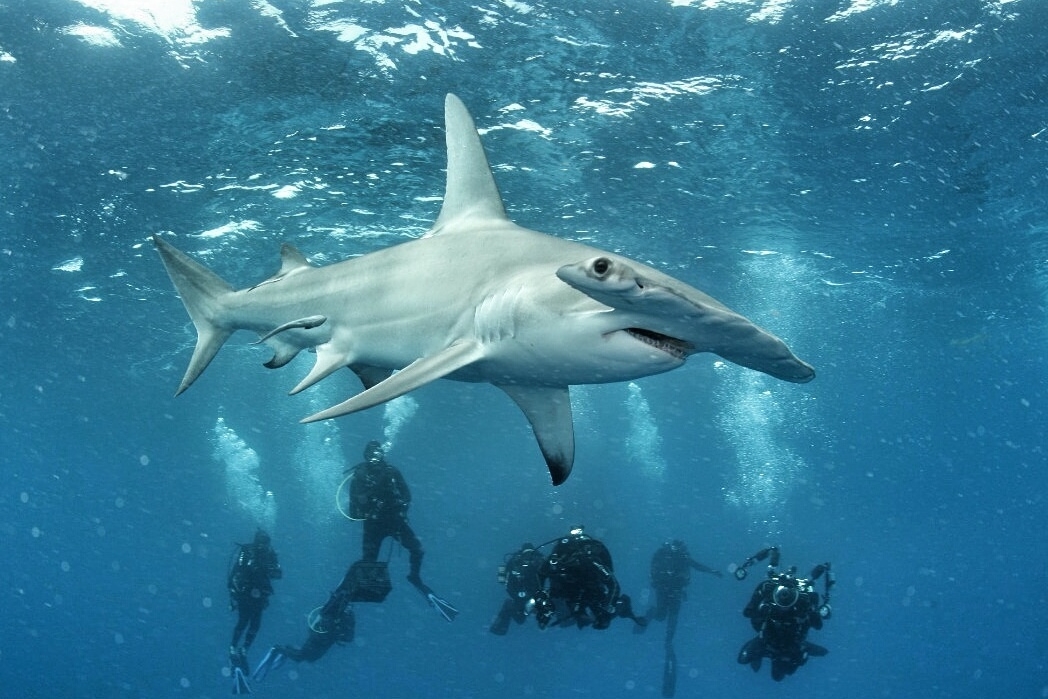
great hammerhead shark

What is the biggest threat to the world’s oceans?

Our ignorance. The ocean is in peril and facing over-fishing, acidification, habitat destruction and pollution. These are creating a perfect storm that could result in a major collapse of ecosystems and species extinction within the next 30 years. Our oceans have been around for millions of years, yet in the last 50 years we have destroyed much of it. We’re presently on course to destroy everything that’s left. Scientists predict that if we continue the current rate of fishing, our oceans could be empty be 2050. With more and more plastic ending up in our ocean, we could have more trash than fish in the ocean one day! All of this has to do with a lack of awareness. We continue to consume fish species which can’t be sustained, we continue to use single-use plastic, we continue to demand cheap products from all over the world that must be shipped across our oceans.

What do you believe needs to be done to protect the world’s oceans? 

Jacques Yves Cousteau once said “People protect what they love.” We can only save the ocean once we actually start caring and wanting to make a personal difference. I’m trying to inspire people to care about the oceans by taking portraits of its amazing inhabitants. My book Giants of the Caribbean is a collection of nine endangered species that each have a story. Through my photography I’m hoping to convince people how important it is to preserve these resources for future generations. We need action on all levels: more conscious decision making and activism, companies reducing their impact and governments to enact strict regulations. Only 3% of the ocean is part of a marine protected area (MPA) and less than 1% is fully protected within marine reserves. We need to create safe zones that are off-bounds for fishing and regulation for areas within international waters. This is where the United Nations can play an important role.
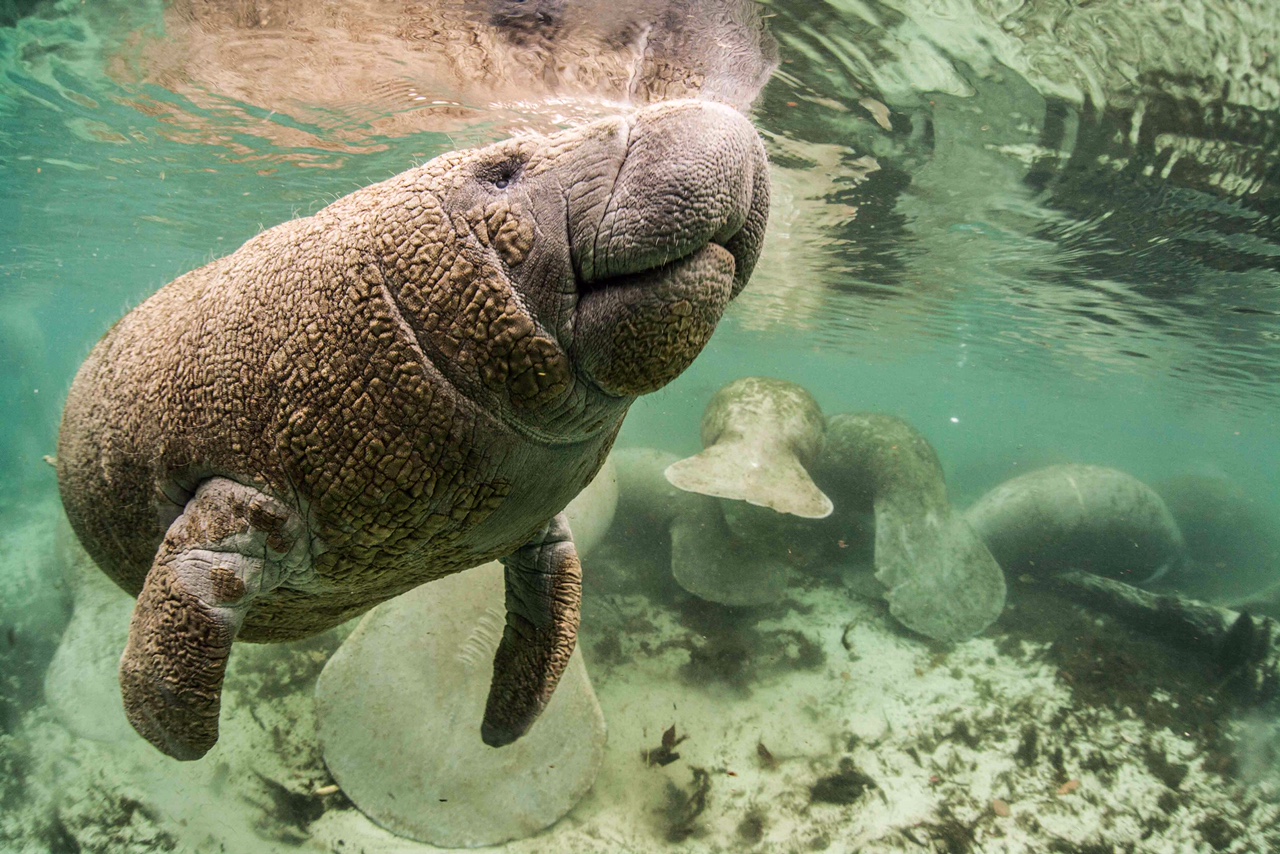
manatees

What advice can you give to young social entrepreneurs aiming to solve a sustainability problem?

Find your passion. Move away from your desk and into the real world. Find which sustainability problem you’d like to solve, think outside the box and think how you can leverage technology, partnerships and new business models to approach the issue from a radical and disruptive angle. A real leader is genuinely passionate about their cause – something that will drive your success. The most successful social entrepreneurs have found solutions with radical new solutions, not incrementally improving on existing solutions. Validate your idea with customers and stakeholders and create a story for yourself that people understand and are inspired by. Be genuine and don’t only do it for the money. You may become rich, but you won’t be successful.

www.vincentkneefel.com

 

How to Survive a Flight Without Fuel

In silence, without using a drop of fuel, but with much wonder in the eyes of hundreds of enchanted supporters, Solar Impulse 2 (Si2) took off on 21 April to complete a crossing of the Pacific.

Si2, the solar airplane of Bertrand Piccard and André Borschberg, capable of flying day and night powered only by the energy of the sun, was airborne during Earth Day – a powerful symbol. The flight, took three days and was another challenging leg of the Round-The-World Solar Flight.

Bertrand Piccard took off from Hawaii to North America – a journey similar to the one of American aviator Amelia  Earhart, who set off from Honolulu for the first solo flight to California. Despite the many parallels between these flights, one significant difference remains: while Earhart’s airplane took off carrying more than 500 gallons of gasoline, Si2 flies  with no fuel. Across the main wing, fuselage and horizontal stabilizer, 17’248 solar cells power the four lithium  batteries, which in turn power the four motors and propellers, allowing Si2 to fly through the night towards the next  dawn.

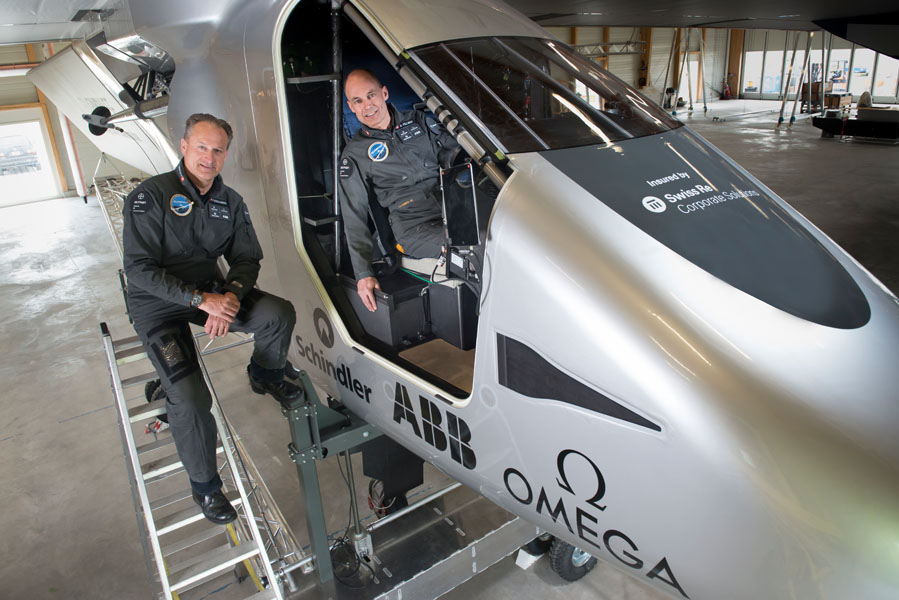
(From left to right) AndrÈ Borschberg, Co-founder and CEO and Bertrand Piccard, Initiator and Chairman beside the cockpit of Solar Impulse 2.

(From left to right) André Borschberg, Co-founder and CEO and Bertrand Piccard, Initiator and Chairman beside the cockpit of Solar Impulse 2. © Solar Impulse | Revillard | Rezo.ch

“During my round the world balloon flight in 1999, the seven days I spent over the Pacific were the most nerve- wrecking and thrilling,” said Bertrand Piccard, Initiator and Chairman of Solar Impulse, currently at the controls of the solar airplane. “With Solar Impulse the flight should last for three days, but this time I am alone in the cockpit, so the intensity is no less important. Every morning you have the suspense of knowing how much energy is left in your batteries. Then, with the sunrise comes the virtuous circle of perpetual flight.”

solar pulse journey

After his record breaking non-stop balloon flight around the world, Bertrand Piccard, a medical doctor and explorer at heart, decided that the next time he would circumnavigate the globe it would be with no fuel. He teamed up with André Borschberg, an innovation savvy entrepreneur and expert aviator. It was Borschberg who in July 2015, landed Si2 in Hawaii after a record breaking flight of five days and nights and around 8’900km from Japan. With the completion of the Pacific crossing by Bertrand Piccard, Si2 will not only be marking a first in the history of aviation, but also in the history of renewable energy.

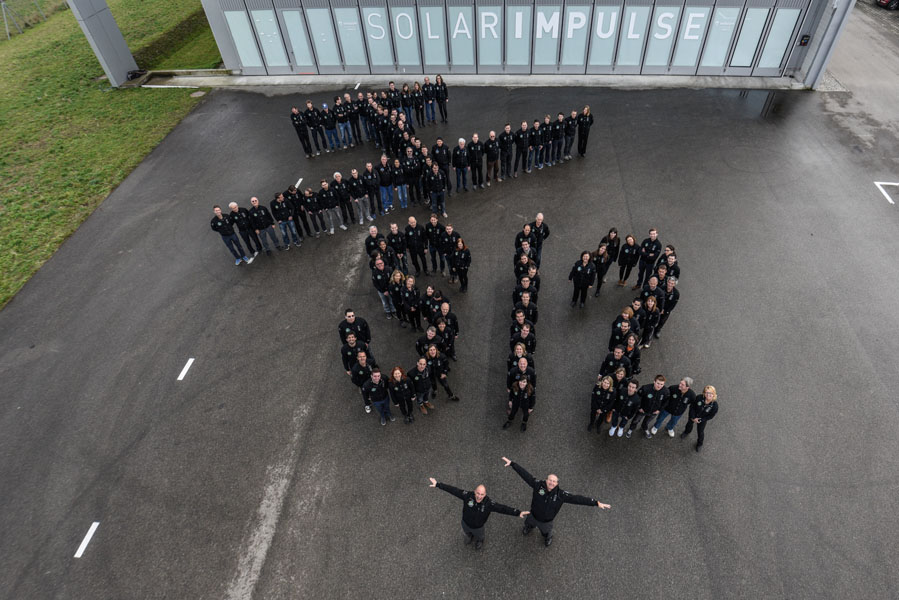
The Solar Impulse team. © Solar Impulse | Revillard | Rezo.ch

The Solar Impulse team. © Solar Impulse | Revillard | Rezo.ch

“Last year we demonstrated that Solar Impulse is capable of flying five days and five nights non-stop: the airplane, the technologies, the human being,” commented André Borschberg, CEO and Pilot of Solar Impulse. “Now what we want to do is continue our flight around the world and demonstrate that these technologies can be used, not only in an airplane, but on the ground. That is why Bertrand initiated the project and I am moved that he will be experiencing full day and night cycles without any fuel.”

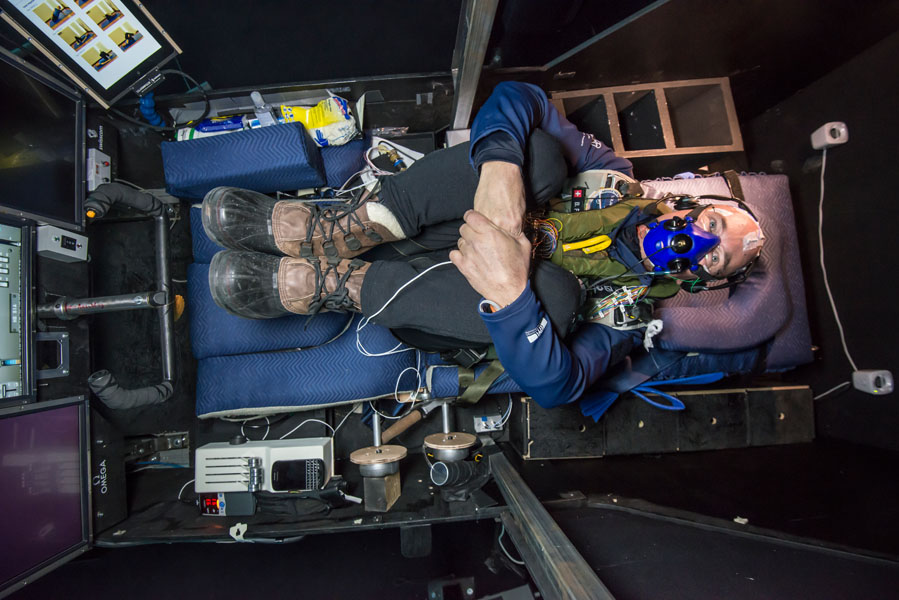
A 72 hours non-stop flight simulation. The is to make the pilot as “sustainable” as the aircraft.

A 72 hours non-stop flight simulation. The goal is to make the pilot as “sustainable” as the aircraft. © Solar Impulse | Revillard | Rezo.ch

Both men take turns piloting Si2 around the world, but have different respective roles within the project – while Piccard outlines the project’s vision, philosophy and political reach and brings together the partners to fund this adventure, Borschberg pulled together the team that designed and constructed Si2 and drives the airplane’s technological innovations into new engineering solutions. Together the two Swiss pioneers are attempting the first Round-The-World Solar Flight with no fuel, to support concrete actions for sustainability and demonstrate that the world can be run on clean technologies.

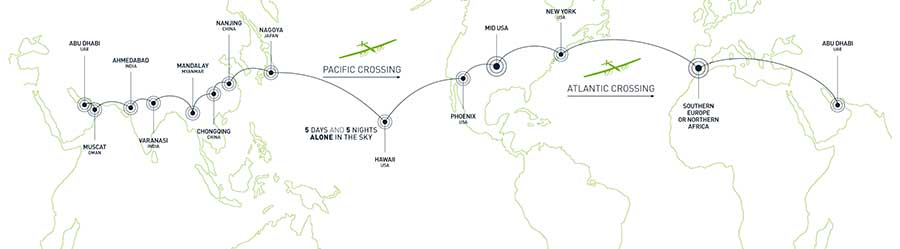
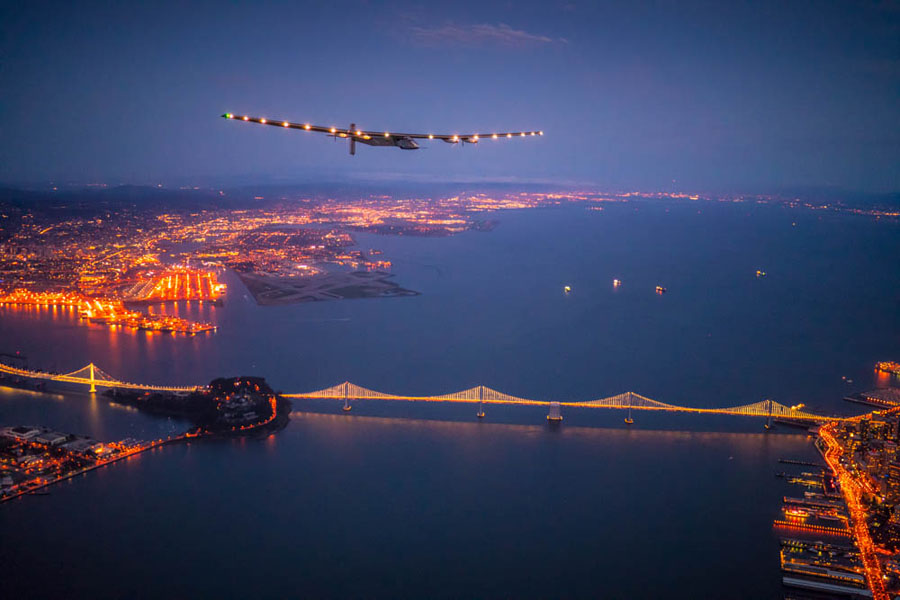
Mountain View, USA, April 23rd 2016: Solar Impulse landed at Moffett Airfield, completing the pacific crossing. Departed from Abu Dhabi on march 9th 2015, the Round-the-World Solar Flight will take 500 flight hours and cover 35í000 km. Swiss founders and pilots, Bertrand Piccard and AndrÈ Borschberg hope to demonstrate how pioneering spirit, innovation and clean technologies can change the world. The duo will take turns flying Solar Impulse 2, changing at each stop and will fly over the Arabian Sea, to India, to Myanmar, to China, across the Pacific Ocean, to the United States, over the Atlantic Ocean to Southern Europe or Northern Africa before finishing the journey by returning to the initial departure point. Landings will be made every few days to switch pilots and organize public events for governments, schools and universities.

Flying over the Golden Gate Bridge, San Francisco. © Solar Impulse | Revillard | Rezo.ch

Bertrand Piccard spoke with UN Secretary-General Ban Ki-moon directly from the cockpit of Solar Impulse 2 while flying over the Pacific Ocean during a video conference on Friday April 22 from the United Nations in New York where 175 nations had just signed the Paris Agreement on ClimateChange.

“You know, Mr Secretary-General, what you are doing today in New York by signing the Paris Agreement is more than protecting the environment – it is the launch of the clean revolution,” said Piccard. He urged Ban Ki-moon and the delegates to keep working hard to overcome resistance to fighting climate change.

“If an airplane like Solar Impulse 2 can fly day and night without fuel, the world can be much cleaner.”

“I am inspired by your pioneering spirit,” the Secretary-General said after telling Piccard he looked like an astronaut flying to the moon. “While you are making history flying around the world, we also are making history today. More than 175 countries signed the Climate Change Agreement. Thank you for your leadership and inspiration. We wish you a smooth flight. You are leading us into a new era. Bon voyage!”

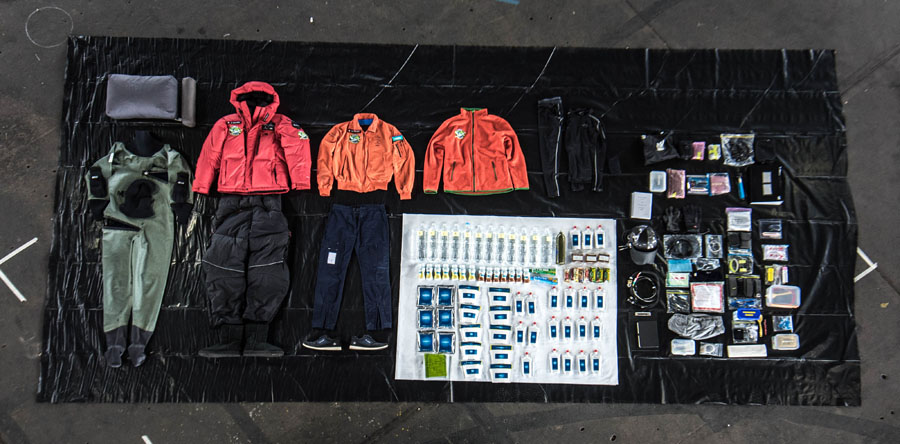
2016_04_13_Cockpit_Equipement_9

Cockpit Equipment laid out for the journey. © Solar Impulse | Revillard | Rezo.ch

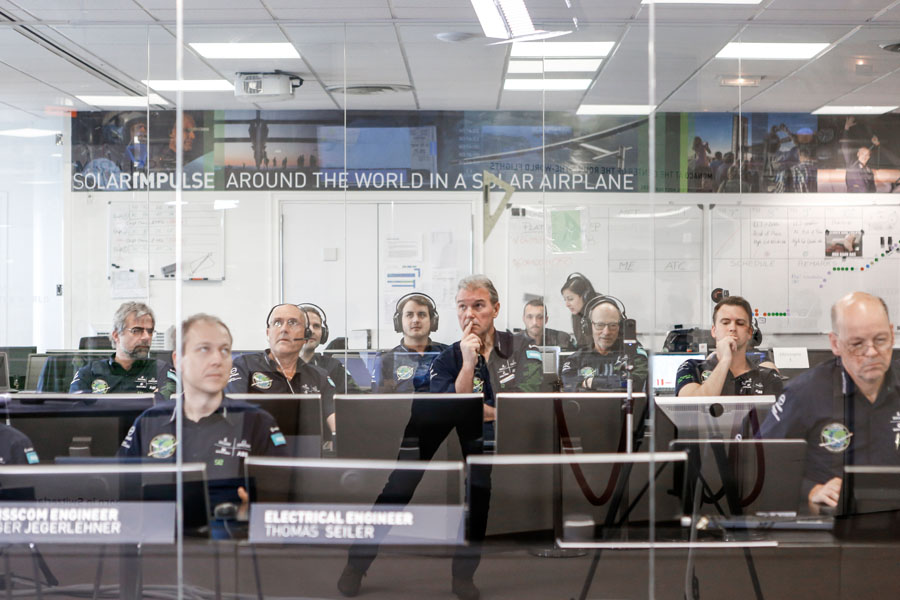
Hawaii, USA, April 9th 2016: The Mission Control Center in Monaco is working hard to ensure that Bertrand Piccardís last training flight is well accomplished. Departed from Abu Dhabi on march 9th 2015, the Round-the-World Solar Flight will take 500 flight hours and cover 35í000 km. Swiss founders and pilots, Bertrand Piccard and AndrÈ Borschberg hope to demonstrate how pioneering spirit, innovation and clean technologies can change the world. The duo will take turns flying Solar Impulse 2, changing at each stop and will fly over the Arabian Sea, to India, to Myanmar, to China, across the Pacific Ocean, to the United States, over the Atlantic Ocean to Southern Europe or Northern Africa before finishing the journey by returning to the initial departure point. Landings will be made every few days to switch pilots and organize public events for governments, schools and universities.

The Mission Control Center in Monaco. Landings will be made every few days to switch pilots and organize public events for governments, schools and universities. © Solar Impulse | Ottenwaelter | Rezo.ch

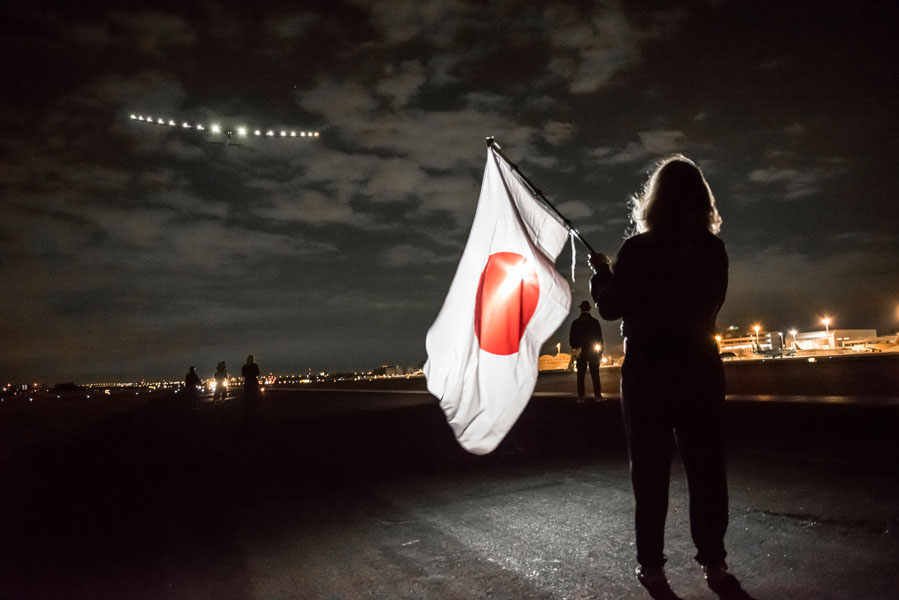
Nagoya, Japan, June 28, 2015: Solar Impusle 2 takes-off from Nagoya with AndrÈ Borschberg at the controls. The First Round-the-World Solar Flight will take 500 flight hours and cover 35í000 km, over five months. Swiss founders and pilots, Bertrand Piccard and AndrÈ Borschberg hope to demonstrate how pioneering spirit, innovation and clean technologies can change the world. The duo will take turns flying Solar Impulse 2, changing at each stop and will fly over the Arabian Sea, to India, to Myanmar, to China, across the Pacific Ocean, to the United States, over the Atlantic Ocean to Southern Europe or Northern Africa before finishing the journey by returning to the initial departure point. Landings will be made every few days to switch pilots and organize public events for governments, schools and universities.

Takes-off from Nagoya, Japan. André Borschberg’s wife wishes him good luck. © Solar Impulse | Revillard | Rezo.ch

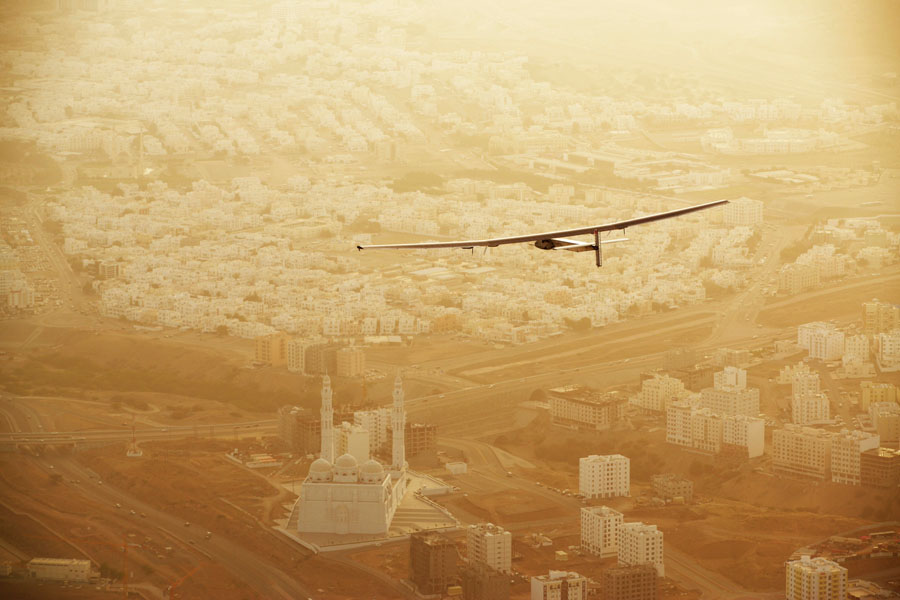
Muscat, Oman, March 10, 2015: Swiss explorers Bertrand Piccard and AndrÈ Borschberg launch their attempt at flying Round-The-World in a solar-powered airplane. Their experimental aircraft, Solar Impulse 2 took-off from Abu Dhabi (UAE) with AndrÈ Borschberg at the controls direction Muscat (Oman) where the plane made a pit stop of several hours in order to change pilot before continuing its route towards Ahmedabad (India) with Bertrand Piccard at the controls. The First Round-the-World Solar Flight will take 500 flight hours and cover 35í000 km, taking five months to complete. Swiss founders and pilots, hope to demonstrate how pioneering spirit, innovation and clean technologies can change the world. The duo will take turns flying Solar Impulse 2, changing at each stop and will fly over the Arabian Sea, to India, to Myanmar, to China, across the Pacific Ocean, to the United States, over the Atlantic Ocean to Southern Europe or Northern Africa before finishing the journey by returning to the initial departure point. Landings will be made every few days to switch pilots and organize public events for governments, schools and universities.

Flying over Muscat, Oman. © Solar Impulse | Stefatou | Rezo.ch

Payerne, Switzerland: Solar Impulse 2, the second single-seater solar aircraft of Bertrand Piccard and AndrÈ Borschberg designed to take up the challenge of the first round-the-world solar flight, without any fuel in 2015, is currently being tested at Payerne airfield. Today the team performed ground tests. They tested the 4 propellers, did some new ground crew maneuvers and made a magnetic mapping of the flight instruments. Solar Impulse 2 test flights are due to take place from end of May, followed by training flights of Bertrand Piccard and AndrÈ Borschberg over Switzerland. The attempt to make the first round-the-world solar-powered flight is scheduled to start in March 2015 from Gulf area. Solar Impulse will fly, in order, over the Arabian Sea, India, Burma, China, the Pacific Ocean, the United States, the Atlantic Ocean and Southern Europe or Northern Africa before closing the loop by returning to the departure point. Landings will be made every few days to change pilots and organize public events for governments, schools and universities.

Solar Impulse 2, the single-seater solar aircraft is designed to take up the challenge of the first round-the-world solar flight, without any fuel. © Solar Impulse | Revillard | Rezo.ch

2013_12_10__AltranVisit_Dubendorf_revillard_18

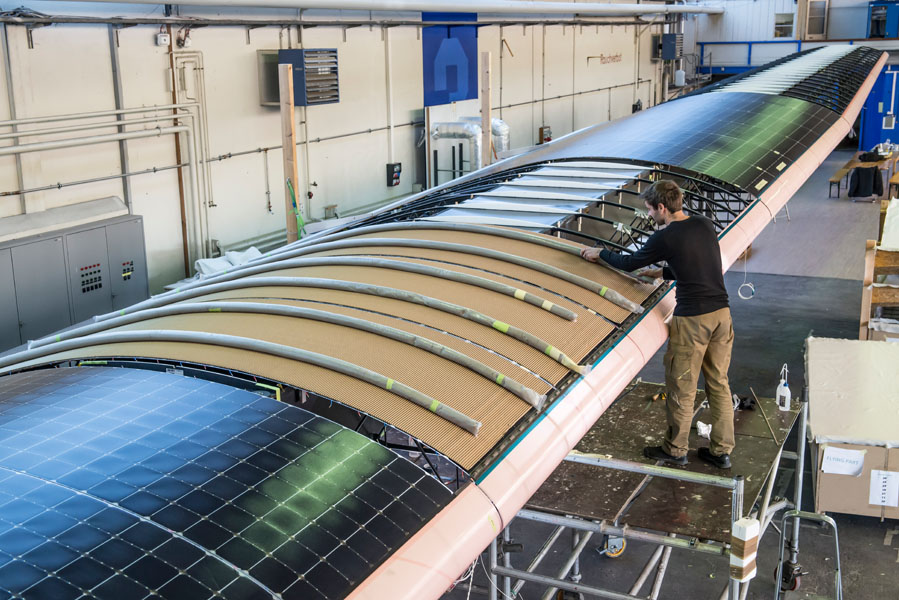
A wing of Solar Impulse 2, showing the solar panels. © Solar Impulse | Revillard | Rezo.ch

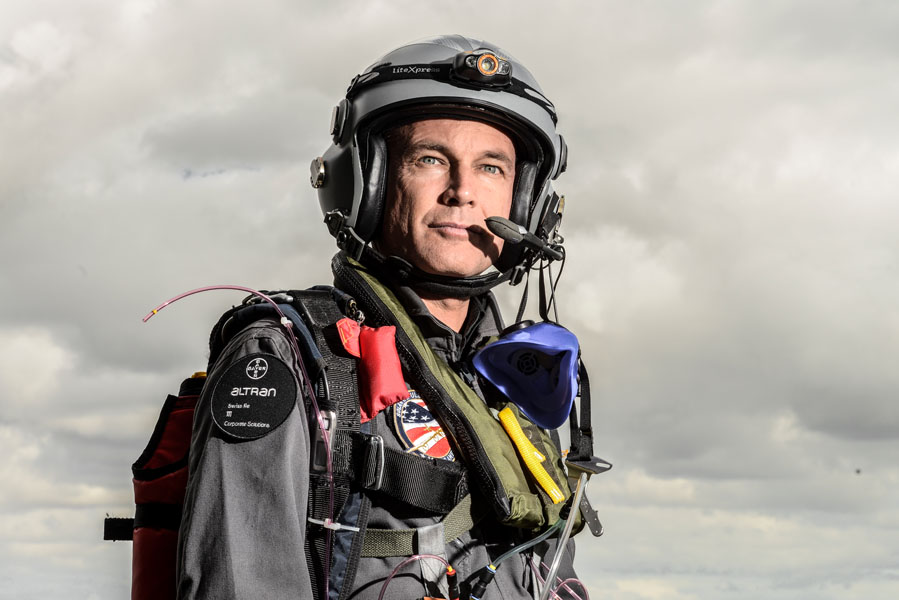
Solar Impulse, test flight Pilot equipement in Moffett CA Bertrand Piccard

Solar Impulse pilot Bertrand Piccard with his equipment in Moffatt, CA. © Solar Impulse | Revillard | Rezo.ch

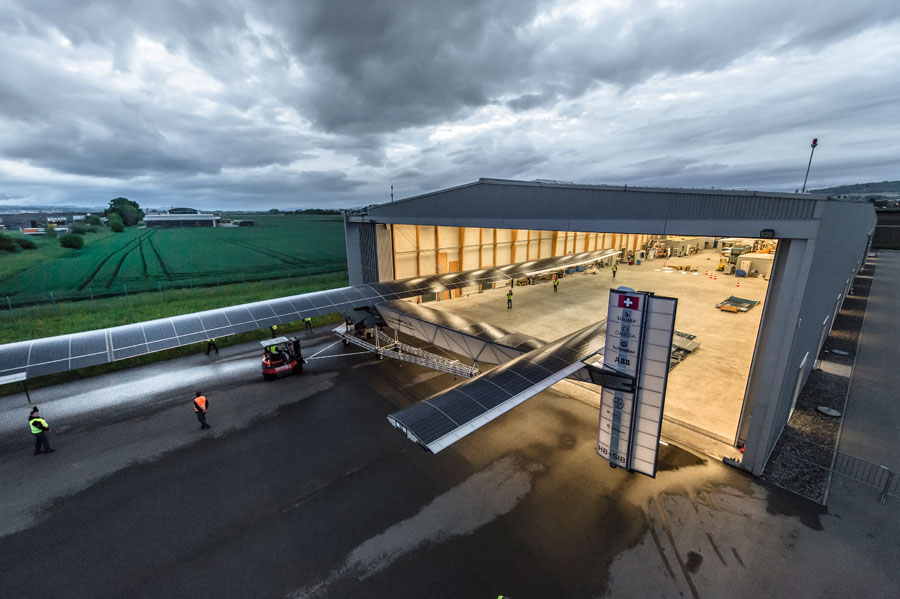
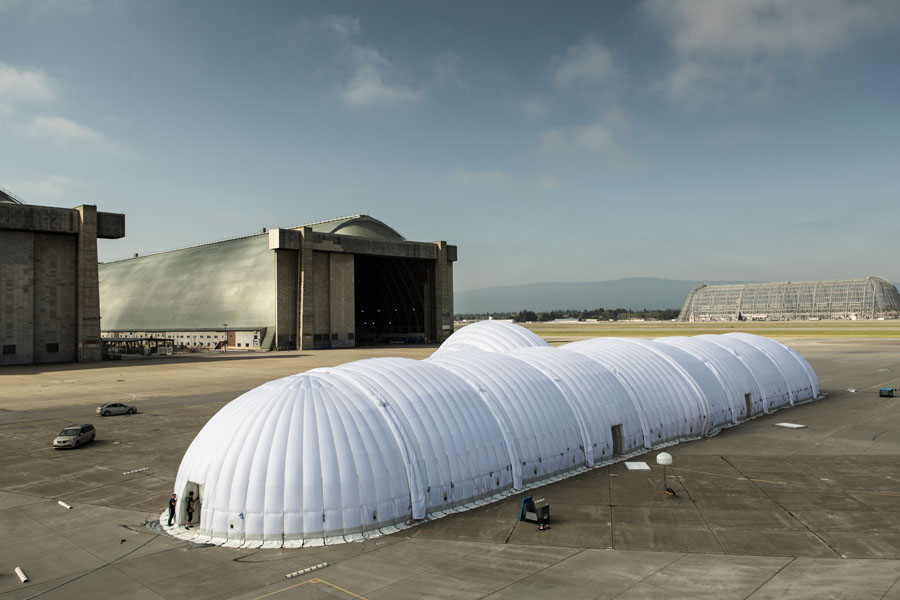
The mobile hangar that can be moved and used around the world.

A mobile hangar can be inflated and deflated, allowing it to move around the world. © Solar Impulse | Ackermann | Rezo.ch


Landfills Shouldn’t Be Laundry Piles

Today is Earth Day and companies around the world are thinking about how best to save the environment. Most of us would never consider our clothing being part of the problem, but it is.

Savers, a global thrift retailer, is challenging people to rethink their clothing footprint. A larger-than-life clothing spill installation (pictured above) on the famous Alki Beach in Seattle, Washington created a visually arresting wakeup call to remind everyone that clothing doesn’t need to end up in landfills. Americans throw away more than 10.5 million tons of clothing annually, 95 percent of which could have been reused or recycled.

For more than 60 years, Savers has been purchasing used clothing and textiles from nonprofit organizations and giving them a second, or third, life in its stores or through its recycling partners. They’re on a mission to create a better world through reuse – by inspiring local communities to rethink reuse.

“At Savers, reuse is in our DNA,” says Ken Alterman, president and CEO. “It’s who we are and how we operate, but not everyone considers reuse an option for their used clothing and household goods.

With the growing amount of clothing and textile waste ending up in landfills, we felt compelled to act. 

We want to help people better understand the environmental impact of their clothing waste and the steps they can take to reduce it. That’s why we are calling on everyone to rethink reuse – shopping thrift, donating used items to a nonprofit and consuming goods in a more sustainable way.”

Through its unique business model of purchasing, reselling and recycling secondhand merchandise, the Savers family of thrift stores (including Value Village, Unique Thrift and Village des Valeurs brands) benefits more than 120 nonprofit organizations, gives local consumers a smart way to shop and saves 650 million pounds of quality used goods from landfills each year.

Savers pays its nonprofit partners for donated goods, turning otherwise unused items into sustainable funding that supports their vital community programs and services.

Eighty-five percent of clothing waste ends up in landfills, with only 15 percent being reused or recycled. Companies such as Savers help give clothing and textiles another life through recycling and reuse – diverting millions of tons of clothing and textiles from landfills each year. Think about that next time you’re clearing out your closets.


Bottletop: A Luxury Purchase That Gives Back

Bottletop has taken an eye for detail, combined it with community craft and projected it into the realm of luxury. Oliver Wayman and Cameron Saul have unearthed skills from different cultures, that use different waste materials and refined them for an audience who wouldn’t normally come across these beautiful pieces.  

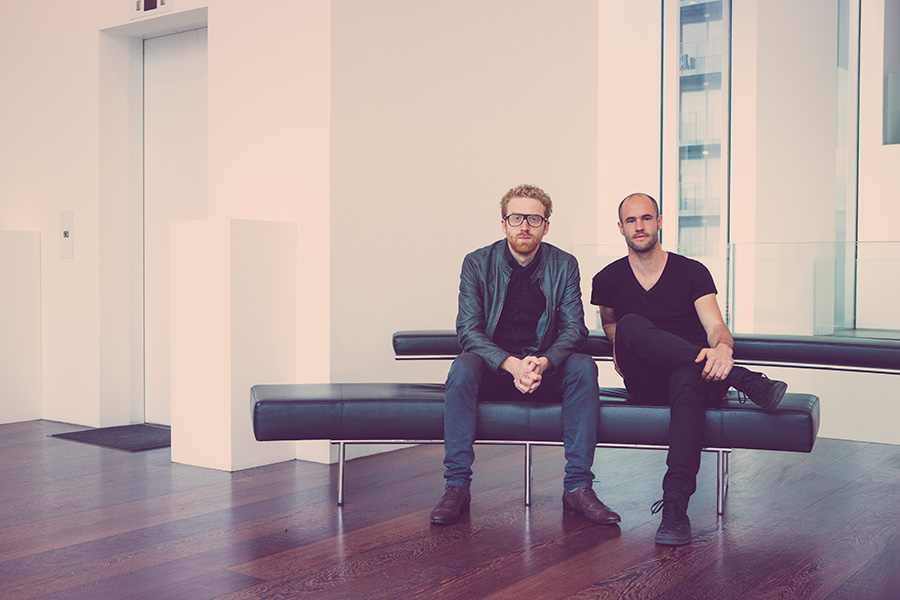
“We set out to redefine the concept of luxury,” says Oliver Wayman, co-founder of Bottletop. London-based Wayman and business partner Cameron Saul (above) decided that the hidden production techniques they discovered, and created by hand are objects of beauty and pride for both the artisan and consumer alike. The creation of fashion company Bottletop in 2012 not only saw these techniques coming to light, but also some of the most highly skilled artisans from around the world being set up in training programs that now support the artisans and their families.

It all began in the early 2000s when Saul was teaching sexual health education in Uganda as part of a charity project. He came across a bag made by locals, made from discarded bottle caps on a wire frame. Saul’s father Roger is the founder of luxury fashion brand Mulberry and he immediately recognized the potential for a unique fashion accessory when his son approached him with the idea. The design collaboration resulted in the recycled bottletop handbag lined with the finest Mulberry leather.

It became the bestselling bag of that season, sold internationally and created a sensation among the international fashion press. It also generated local employement opportunities in Uganda and raised vital funds for grassroots education projects.

Photgraph: Dan Medhurst

Photgraph: Dan Medhurst

Meanwhile, Wayman had discovered a silver chain mail bag in Brazil, made from upcycled aluminium ring pulls, held together by crotchet. He was amazed at the distinctly 1970s design that reminded him of Spanish fashion designer Paco Rabanne. The bestselling ‘Bellani’ handbag followed (named after Wayman’s mother who perfected the technique) and generated a new wave of international publicity. This paved the way for the establishment of the Bottletop collection, now an independent fashion label with some of their handbag creations selling anywhere upwards of $2,000.

The Bottletop Foundation, which preceded the establishment of the fashion brand by ten years, has a history of nurturing and educating at-risk youth. Started by Saul in 2002, it now empowers young people in Malawi, Mozambique, Rwanda, Brazil and the U.K., by making them aware of sensitive health issues such as HIV/AIDS, drug abuse and teenage pregnancy. Unlike many foundations that bring donors onboard, the Bottletop Foundation is 100 percent funded by the Bottletop fashion collection.

More than 35,000 young people benefit from the foundation each year through creative programs that engage the audience through film, newspapers, drama and music. Wayman and Saul select their projects based upon their demonstrated potential to equip young people with the skills and attitudes to be agents of change in their own lives, and their wider communities. To keep the charitable work alive in the developing world, Wayman and Saul have developed a range of luxury goods that are sold to customers who in many instances are living a world apart.

“Bottletop has shown what’s possible; what can be re-used and re-worked,” says Wayman “We’ve taken a raw material and made people see it differently. The fashion-buying public don’t see what is effectively a waste material, they see a coveted fashion item,” he says. In the early years, the pair started working with various corporates in the U.K. on their production processes but eventually established their our own atelier in one of the poorest areas in Brazil, making samples and training people from scratch.

“We provided the materials and empowered the community by teaching them the skills needed to make these products,” says Wayman. Surprised by the positive reaction to their venture, Wayman and Saul decided to scale up their idea into a fully fledged fashion brand. To do this they needed to sell a small portion of the company, which proved transformational as it opened the door to wider opportunities.

The ex accessory designer for Louis Vuitton, Vincent du Sartel, donated a collection to Bottletop and Iain Renwick, the ex CEO of Liberty department stores, was secured as company chairman. “We really managed to attract fantastic people to help in key parts of our business,” recalls Wayman. “We’ve also done some really interesting collaborations, most recently with Narciso Rodriguez, a U.S. designer who designed Michelle Obama’s inauguration dress. Rodriguez used his design team alongside our own to come up with some really interesting cross-cultural products, which wouldn’t have existed otherwise.”

Collaborating with established and respected designers is a crucial ingredient of the Bottletop business plan, giving credibility to the brand and firmly planting it within the luxury sector. “Once people find out what raw materials we actually use and how we make them, we run the risk of people devaluing our products,” says Wayman. “The pieces won’t have the aspirational quality they deserve, so pairing with established and recognized designers has really helped position the brand in the right place.”

“Quality control is one of our biggest challenges but it’s incredibly fulfilling when you’re now selling these bags in places like Harrods and other renowned department stores,” says Wayman. We’re sitting alongside some of the world’s most established fashion brands in stores, yet our products are made in some of the most challenging environments by some of the poorest people.” “Coco Chanel once said that luxury doesn’t have to be the opposite of poverty, but the opposite of vulgarity.

We focus on attention to detail and recognize the quality and handwork. This is key for us, especially in a world full of throwaway fashion stores which cause untold damage to the environment and promote unfair labor practice in developing countries. Making things well to last a long time – that’s luxury,” says Wayman. With ambitious plans to launch in Japan, Canada and the U.S. Bottletop is using existing capital for growth, but are on a good trajectory to become profitable within the next two years, according to Wayman. Online sales account for around about 30 percent of business and wholesales to department stores accounts for the rest.

Wayman and Saul both almost gave up when they first saw the poverty around them in Africa and Latin America over 12 years ago. Creative grit has kept them going and where most people would see only despair, the pair saw opportunity. As Thomas Edison once said, “We often miss opportunity because it’s dressed in overalls and looks like work.”

Modern Farming: Technology Helps Keep Food on the Table

From farm to table, much about food production has changed – for both farmers and consumers. Like any other business, farmers must adapt to a changing world –one that will see its population grow to 9.6 billion by 2050.

With finite resources, it will take innovation and a variety of technologies to meet the world’s food demand. This includes using new technologies like biotechnology (also referred to as genetic engineering), which can help produce more food on the same amount of land, without having to destroy wildlife habitats.

A 2014 study by the International Food Information Council (IFIC), “Consumer Perceptions of Food Technology,” shows that more than seven in 10 consumers agree that modern agriculture –conventional farming using today’s modern tools and equipment — can be sustainable and produce high-quality, nutritious foods. The survey also underscored that two-thirds (66 percent) of respondents say it is important that their food be produced in a sustainable way, including producing food affordably with the same or fewer resources, in a way that is better for the environment.

“When consumers understand the potential benefits that technology in food production can have for both people and the planet, they can get behind it,” said Marianne Smith Edge, MS, RD, LD, FADA, and senior vice president of Nutrition and Food Safety at IFIC. “People need to know what’s in it for them.” To this point, of consumers who ranked these factors of sustainability as important, most believe there is a role for biotechnology:

* Ensuring a sufficient food supply for a growing global population

* Producing more food with fewer natural resources

* Conserving the natural habitat

* Reducing carbon footprint

To address increasing interest in how our food is produced, IFIC Foundation provides a glimpse of modern agriculture in its new animated video, “Your Food, Farm to Table,” showing how farmers in the U.S. and globally are working to produce our food year-round, including using technology to safely produce more food, while putting less stress on our natural resources. With more “precise” information at their fingertips, farmers can be more selective with supplies and resources such as fertilizers, pesticides, tractors and other fuel-run equipment, and irrigation water. As a result, they can reduce carbon dioxide (CO2) emissions, pesticide applications, soil erosion and water run-off — in turn, improving sustainability.


How a Gender Equality Stamp of Approval Could Impact Business

Gender inequality remains pervasive in the workplace. It’s in every industry and on every level, and the uncomfortable conversation it requires to improve it is too often ignored. But there’s a new movement to do something tangible to address the shift that society needs to make on this issue.

What if, before interacting with a company — whether that’s as a consumer or employee — you could find out what they stand for, including gender parity in the workplace? It’s not a novel idea. Fair-trade certification has been giving a stamp of approval to companies who utilize equitable trade practices for years. Benefit corporations have created a new standard and mark for socially conscious business practices. LEED certifications show companies have exceptional environmental standards.

There may be a new addition to that list: The Economic Dividends for Gender Equality (EDGE) Certification, a global business certification for gender equality, which was announced officially at the World Economic Forum in 2011.

EDGE recently announced a partnership with IFC (part of the World Bank Group), the International Labor Organization, and the UN Global Compact to launch the “She Works” initiative to advance women’s employment in the private sector. EDGE, which is already in 60 companies in 29 countries and across 14 industries, is expecting much more adoption now that it is a global standard. Deloitte and Ikea in Switzerland were among the first companies, and L’Oreal recently announced it was the first US company to achieve certification.

“Gender equality is the right and the smart thing to do,” said Iris Bohnet, director of Harvard’s Women and Public Policy Program. “Often, gender gaps, for example, in hiring or promotion, are the result of unintentional biases that lead employers to base their decisions on stereotypes rather than individual performance, thus hurting productivity and creating inequity. EDGE enables companies to identify and weed out such mistakes.”

In the larger conversation about gender equality in the workplace, women — and men — are demanding that:

  • We examine the fact that men make up the vast majority of founders and executives
  • We refuse to turn our backs on sexual harassment
  • We leave behind the stereotypes of traditional male and female roles
  • We make sure women and men are paid the same amount for the exact same work

Why you should care

Women earned, on average, 78 cents on the dollar that men earned in 2013, according to the US Census Bureau. That wide disparity has essentially remained the same since 2001. The Institute for Women’s Policy Researchestimates it could take until 2056 to reach parity, based on the current trajectory.

One study from Harvard found that as women have more children, their pay suffers more. For men, it’s the opposite. Research over the years (including this recent survey by Fortune) have found that women, when portraying the same characteristics as males, are often called “abrasive,” “bossy,” or given more negative feedback about their personalities, whereas men are seen as confident and motivated.

Nevertheless, the Paycheck Fairness Act — which would make it more difficult for employers to pay women less and make it easier for people to sue on account of that — was blocked in the US Senate earlier this month. Despite the fact that a majority of Senators (52) voted for the measure, it was blocked again because the Senate’s minority Republican leadership used a filibuster, which would have required 60 votes to overcome. It was the fourth time since 2011 that Senate Republicans have organized to block the legislation.

A certification like the type that EDGE has implemented is used in areas where business meets social issues. It’s been successful in cases such as the butterfly logo for GMO-free food and the little bunny for makeup that hasn’t been tested on animals.

With EDGE, Oldin said, this new standard sends a clear signal to top talent in the organization and potential employees.

“It also tells a story to the shareholders, that the company gets it, a story of corporate governance,” she said. “It is no longer cosmetics. It is an authentic sign of commitment.”

EDGE is the first and only certification of its kind, and it took a long time to develop. Through tests over a period of several years, the team came to a final assessment that assesses such things as company practices and policies, company culture, and retention and hiring rates.

An EDGE consultant guides companies through the platform, and then the company is audited by a third party. It measures what the company thinks they do, what their records indicate they actually do (by assessing those policies and frameworks within the organization), and comparable statistics for their business type. They receive results compared to a global standard, and then the company can start to build an action plan with short term and long term goals.

Measuring real change — hiring numbers, retention rates, company testimonials and ratings — takes a while, so EDGE makes sure companies know this is a process, and everyone is starting on a different level. Short term goals may include gender bias and stereotype training, Oldin said. Every two years, the company must get recertified.

“The certification can be the signal the company needs to show that they are authentic in their commitments to gender equality,” said Maria Oldin, managing director of EDGE Foundation. “This is regardless if [it] is a corporation that is already performing very well or if the company is struggling and know they need to do something about it. At least then they are seriously starting the journey to change.”

Five years ago, Oldin added, this was just a thought. Many people questioned the value of it. Now, though, she’s hearing positive feedback from shareholders, consumers, and employees.

About 60 new companies around the world are in talks to start moving forward with the certification process. As for tech giants with the big gender problems? Oldin said EDGE is in discussion with big players in Silicon Valley.

“They know they have to do something. Shareholders and talent and consumers are getting tired of fancy words,” she said.

Moving forward

Progress starts with transparency. More tech companies (and businesses in other industries) are releasing their data about their own gender gaps, some even committing to changing the statistics in years to come.

Yes, some industries have less of a pay gap than others. Well-known Harvard University scholar Claudia Goldin looked at research and broke the wage gap down by industry for the New York Times earlier this year. She wrote in a paper on the subject that occupations that reward employees for long hours, face-to-face communication, and on-call hours such as law, medicine, and business, often have the widest pay gaps.

And research from various sources provides several different statistics — Pew Research, for instance, said that in 2012 women actually made 84% of what men made.

Whatever the percentages, anything less than 100% parity should be unacceptable. In tech (where the pay gap is less than other fields) this presents an opportunity — perhaps the gender gap could be narrowed more quickly as we try to get more women interested in pursuing careers in STEM fields.

Women are making progress, particularly in fields like pharmaceuticals, according to Goldin’s research. But pay gap is not the only issue. Gender equality in the workplace involves better benefits, maternity leave policies, and open conversations about all these issues to make certain that stereotypes, harassment, and biases don’t continue to flourish.

Anti-discrimination laws are important, but they don’t change cultural stereotypes. “Leaning in” is great, but the phrase is now so overused it has lost some of its meaning. Telling women to ask for more money upfront in interviews is worth doing, but it won’t change the bias on the other side of the desk.

It’s heartening to witness women standing up for their rights on social media and in the news — and even more so to see men commit to helping make change happen faster. Because let’s be honest: real change isn’t going to happen unless men take part in the discussion. Since so many companies are run by males, they must participate in the movement for gender equality.

A stamp of approval is no silver bullet, either. But it is another step in the right direction.

This story first appeared in TechRepublic


Where the World’s Top Companies Stand On Gender Balance

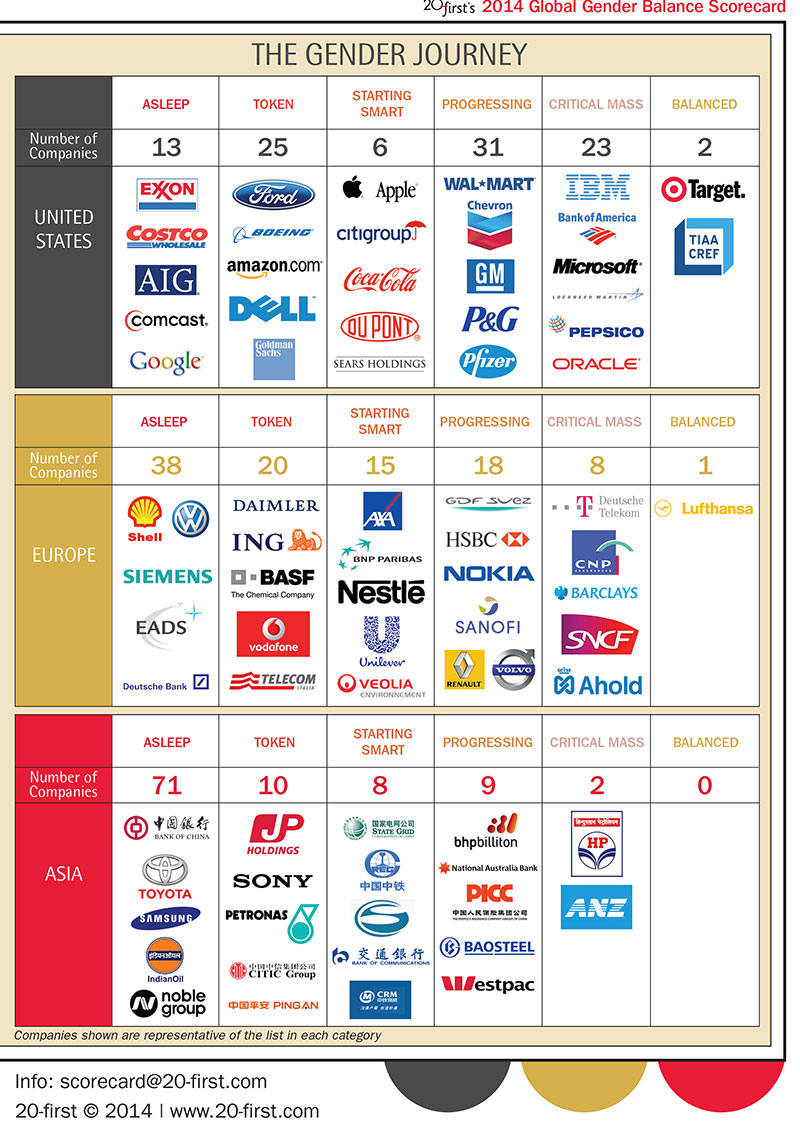
Every year, the 20-first Global Gender Balance Scorecard looks at a single measure of progress: the gender balance of the Executive Committee of the TOP 100 companies in three key regions of the globe.

A growing number of studies show the correlation between gender balance in leadership and improved corporate performance. The complementary skills and styles of men and women have a positive impact on business. Not surprising, when most of the educated talent in the world and a majority of the consumer market is female.

Today, more and more companies are waking up to this 21st century reality and have begun to make gender balance in leadership a strategic priority. Let’s take a look at last year’s scorecard on where the top companies around the world are on their gender journey. The descriptions below explain where companies are in terms of progress.

ASLEEP: Some companies haven’t even started the journey; we put them in our ‘Asleep’ category. These companies are still, in 2014, pictures of imbalance. They are run by an exclusively male team. TOKEN: Less than 15% of both genders on the Executive Team. In this category, the individual(s) is in a staff or support function rather than a line or operational role. STARTING SMART: Next are the ‘Starting Smart’ companies. They also have less than 15% of both genders in the mix, but they are in a central core or operational role, sometime even CEO. PROGRESSING: Reached a minimum of between 15% and 24% of both genders on their top team. CRITICAL MASS: These are companies that have achieved a balance of at least 25% of both genders, but less than 40%. BALANCED: The rare companies that have achieved gender balance, with a minimum 40% of both genders on the Executive Team. This is where balance at the top begins to reflect the reality of 21st century customers, leadership and talent and gives companies the competitive edge to innovate and deliver value sustainably and globally.

gender equality

Michelin Builds Eco-Friendly Tire Path in Yellowstone National Park

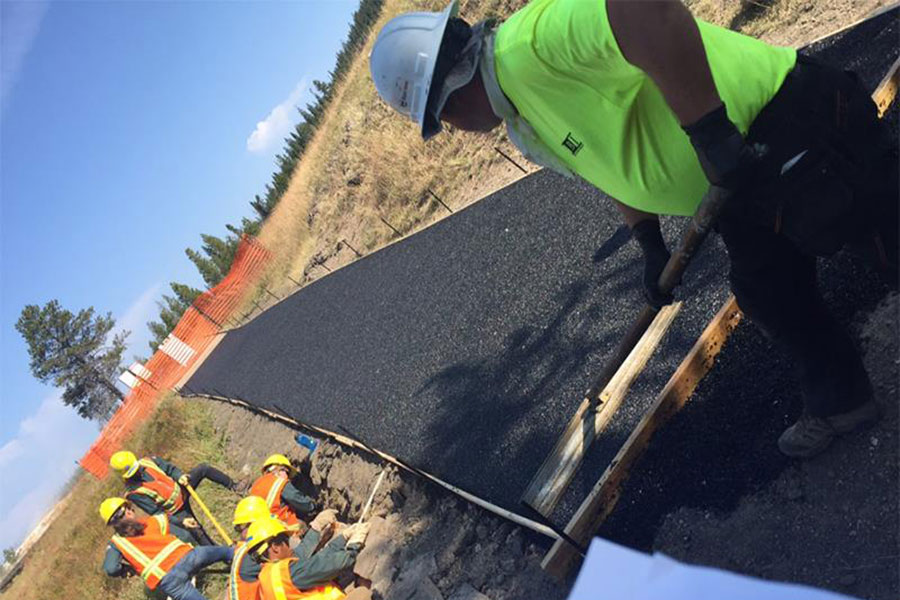
Visitors driving to Yellowstone National Park’s iconic geyser, “Old Faithful,” also will travel via tire once they exit their cars for a closer look. Old Faithful now boasts a porous, clean flexible walkway made mostly of recycled Michelin tires.

The pavement surface, known as Flexi-Pave and manufactured by the company K.B. Industries (KBI), is gentler to the environment than asphalt because the permeable composite material allows for better erosion control and preservation of the natural patterns of groundwater flow. In addition, the walkway surface is extremely durable and tolerant of heat and cold, and does not leach any oil into the surrounding environment.

“The material used to create KBI’s Flexi-Pave is completely benign and therefore can be used safely with the delicate aquifers here in Yellowstone,” said Kevin Bagnall, CEO and founder of KBI, in a statement. The Old Faithful Walkway Project covers 6,400 square feet and includes 900 Michelin tires. “The path allows 3,000 gallons of groundwater to pass per square foot. It also is designed to diffuse the water’s force, helping prevent erosion,” Bagnall noted.

“The Old Faithful Walkway Project is a great example of what a difference a company devoted to sustainability can make in the world’s first national park,” said Karen Bates Kress, president of the Yellowstone Park Foundation, in a statement. “We are fortunate to have a corporate partner as farsighted, public-spirited and generous as Michelin,” she added. In fact, Michelin flew in a team of employees from across the country to help complete the construction of the walkway. The 10 volunteers were winners of a company-wide contest to participate in the project.

Michelin serves as a major corporate sponsor of the Yellowstone Park Foundation, with a goal of helping the park curb operating expenses and reduce the consumption of raw materials. To that end, Michelin regularly donates and helps maintain thousands of tires for Yellowstone National Park’s more than 800 vehicles, including patrol cars, garbage trucks, snow plows and load-hauling tractor trailers. The tires feature the latest in green tire technology to help save fuel and reduce emissions.

“Helping build and provide material for this new pathway is very much in line with Michelin’s goal of working with the Yellowstone Park Foundation,” said Leesa Owens, director of community relations for Michelin, in a statement.


0