



Immigrants Find A Path to Your Heart: Through Your Stomach
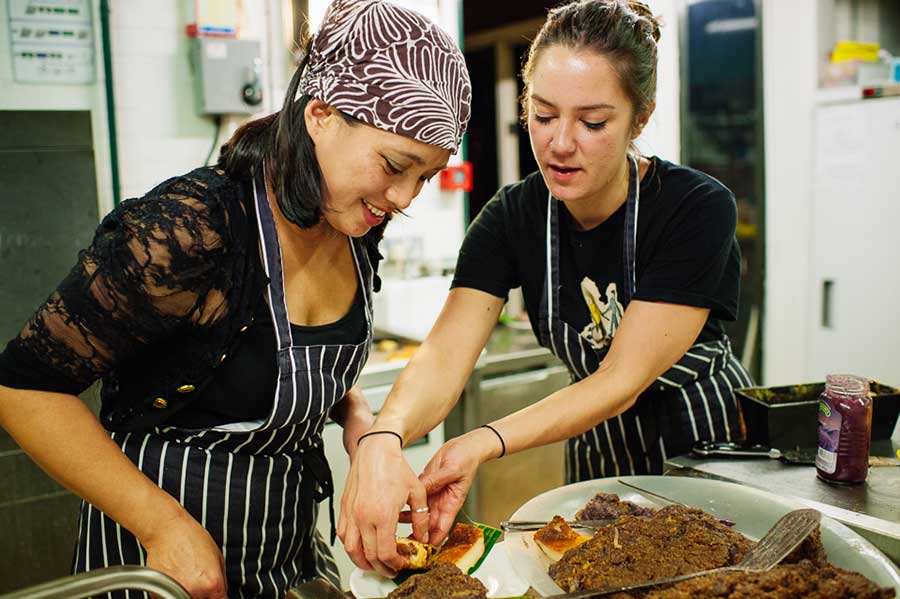
Is it Greek? Is it Filipino? Is it Brazilian? Is it Middle Eastern? Is it Senegalese? Visit Mazi Mas restaurant in London and you’d be forgiven for being just a little confused over the style of food being served.
That’s because entrepreneur Nikandre Kopke has decided that female immigrants from around the world deserve a chance at taking control of their lives – all within the same kitchen. And what an incredible gift from the immigrant to their new neighbors – a way to connect their worlds over a delicious meal.
Kopke’s journey to empowering women and establishing one of the world’s most unusual restaurants is personal. She was inspired by her Greek godmother, an immigrant to the U.S., who for 20 years dreamt what many other migrant women dream of – opening a food business of their own. She wanted to open a bakery yet was held back by a typically patriarchal husband who didn’t think women should run their own business. Destined to stay home, cook and take care of the children, she never got the chance to realize her dream. As a result of family circumstance, Kopke was sent to live with her as a little girl and became her protégé, learning all the amazing culinary talents that had never left the house. “She was never able to become an independent businesswoman in her own right, yet she would have been amazing at it,” says Kopke.
When Kopke moved from the U.S. to London, it was a story she saw everywhere. She volunteered to work in kitchens and migrant centers and met a lot of women who had incredible talent because they’d spent their lives in kitchens at home, with no outlet for their skills. “I thought what an amazing opportunity this was,” recalls Kopke. “It seemed very simple for me to give these women an opportunity, a platform to capitalize on skills they already had. It also cemented the legacy of my godmother, one of the most important people in the world to me.”
Kopke is no stranger to multi-culturalism. She was raised in New York by a German father and a Greek mother and now lives in London. It gave her a familiarity and strength in identifying with women from other cultures and helped her realize that, essentially, all women shared a similar burden – cast into a role by virtue of being a woman.
Kopke is quick to point out that she despises any suggestion of charity in her work. “The idea of charity goes against everything I’m trying to do,” she says. “These women are agents of change because so often women are cast as vulnerable victims, as victims of their circumstances, rather than people with incredible economic potential. They have huge potential to be their own boss, it’s just that they’ve never been given an opportunity to capitalize on it.”
“I have no interest in contributing to this narrative of victimhood, which is so common when speaking about migrant and refugee women. Mazi Mas will never be a charity, because these women are not charity cases. They are aspiring food entrepreneurs.”
Mazi Mas has turned the tables on brick-and-mortar stores too. The women do brief, short-term cooking residencies in underused kitchens around London that have been lying dormant, such as a kitchen at a theater. They are pioneering the art of the pop-up restaurant and recycling dormant commercial space into hives of economic activity while offering guests delicious cuisine in an otherwise underserved environment.
Yet, behind dishes such as marinated fish and kare-kare oxtail in peanut sauce lies a deep philosophy on empowering men and women through gender awareness.
“Some of the most amazing initiatives to come out of gender equality have been the campaigns led by men to educate other men on gender issues,” says Kopke. “Change in the terminology we use has been telling. It used to be women’s rights, now it’s gender equality, gender inequality and gender issues that are spoken of. This is symbolic as it recognizes these issues not only affect women, but men as well.”
Kopke is clear that she is retraining people and giving them a platform to use their skills, but funders hear the words “social enterprise restaurant” and stop listening; not that this business model is untried.
Waterhouse Restaurant in London provides skills and training to young people from the surrounding area and was voted runner-up for Best Ethical Restaurant in 2013. Jamie Oliver’s Fifteen Restaurant is probably the most famous example – empowering young, unemployed youth in Cornwall to become the chefs of the future.
Having skilled people at Mazi Mas, who aren’t being retrained and aren’t being encouraged to follow a celebrity chef’s vision (but rather their own) can have its drawbacks. A celebrity chef with massive, existing marketing behind them does have its advantages.
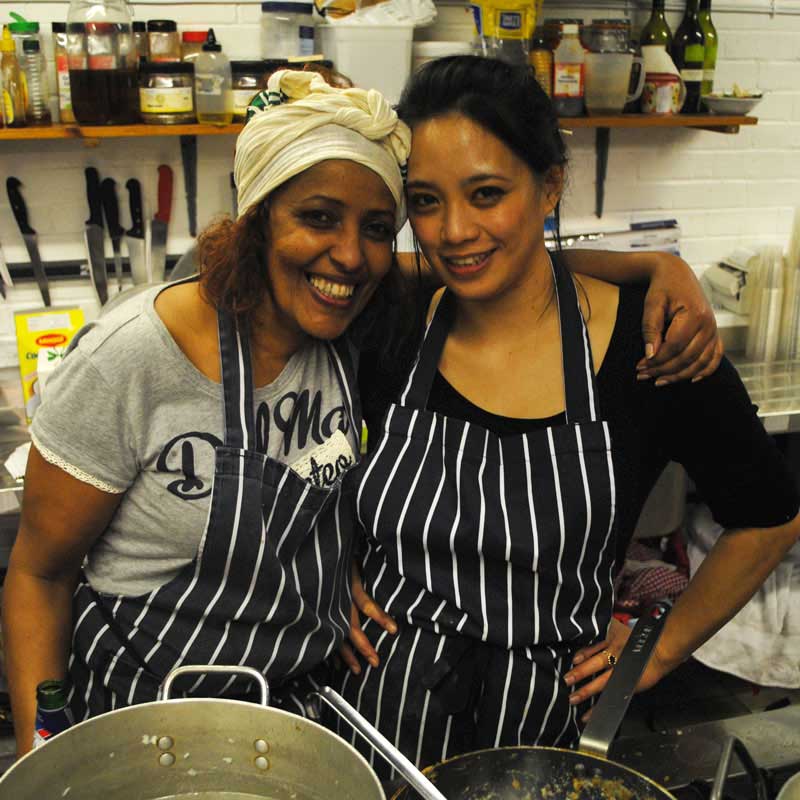
Six women from the Philippines, Brazil, Senegal, Ethiopia, Iran and Peru make up the current batch of Mazi Mas chefs, with another 10 busy with the application process. Their individual cooking experience ranges from 10 to 30 years. The restaurant takes inspiration from small family-run restaurants in Greece where Kopke lived as a child and the international variety comes from the diverse experiences of women from around the world.
One night customers are treated to Filipino cooking and the next night Senegalese. “It’s about educating people a little,” says Kopke. “In the U.K., it’s very unusual to have a menu that changes every day, but it should be normal. An ever-changing menu does run the risk of more food waste, but I’m working with women from low-income countries who understand the value of sustainability by not wasting anything. I don’t have to teach them this as it’s already there,” explains Kopke.
Kopke cites New York-based organization Hot Bread Kitchen as an inspiration that also employs migrant women to produce mostly baked goods. “If they can make a mainstream, commercial success of it then so can I,” she says. “The difference is that I want to make my people visible, not cloister women away in an assembly line out of sight. These are women who have spent their lives being invisible.”
Mazi Mas has a sister organization in Sydney and Kopke is developing plans with people in Italy. The business can scale easily and be replicated anywhere in the world, depending on local labor laws. In the U.K., asylum seekers don’t have the right to work but in Australia they do.
The investment Kopke’s godmother made in her is finally paying dividends and influencing the lives of women from around the world. She never could have imagined that her goddaughter would find the strength one day to break a generations-old cycle of gender bias. “She’s really amazing,” says Kopke. “But with the classic humility many women of her era have, she says ‘Agh, it has nothing to do with me, it only has to do with you.’”
Europe Dominates 2016 ‘Smart City” Leaderboard
Six of the top 10 global “smart cities” are based in Europe. A new study anticipates that smart grid technology deployment will deliver $18.8 billion in cost savings in 2021, through reduced energy use and avoided economic costs from emissions. The reduced emissions are equivalent to those produced by nearly 15 million homes annually.
Juniper Research in the United Kingdom has found that European cities are forging ahead with efforts to become smart cities, with 60% of the world’s leading smart cities based in this region. It was found that innovation to reduce congestion and energy consumption were key initiatives across many European cities. Juniper’s top ranking smart cities for 2016 are as follows:
- Singapore
- Barcelona
- London
- San Francisco
- Oslo
“When addressed effectively, the impacts of reduced congestion are substantial: higher economic productivity, potential for new revenue streams and services as well as a measurable benefit in reduced healthcare costs”, noted research author Steffen Sorrell.
Juniper’s Smart City Rankings have been compiled following an extensive study of cities around the globe as published in Worldwide Smart Cities: Energy, Transport & Lighting 2016-2021. Some 40 metrics have been evaluated, covering technology, transport, energy, open data and economy.
Singapore a Beacon for Smart City Efforts
The top ranked city, Singapore was found to be a world leader in applying smart mobility policies and technology. Meanwhile, the city’s fixed and cellular broadband services, city apps and strong open data policy led to it taking the top spot for 2016. With efforts to become a ‘smart nation’ fully underway, Singapore serves as a beacon from which other cities can learn best practices.
New Renewables Driving Smart Grids
Additionally, the research found that deployment of smart grid technologies has found its way onto the agenda for cities across the globe. Alongside increased pressure on resources from urban migration, this common goal is driven, in large part, by a shift towards ‘new renewable’ energy sources such as solar power and wind generation. North America and parts of Asia in particular, are showing strong investment in renewable energy technologies.
How an SMS is Helping Deliver Water To India’s Thirsty
[et_pb_section admin_label=”section”]
[et_pb_row admin_label=”row”]
[et_pb_column type=”4_4″]
[et_pb_text admin_label=”Text”]
- A mobile message informs consumers in India of when to expect water in areas with intermittent supply.
- Nextdrop has saved one million hours of wasted time – from people waiting for water – that is now put to more productive use.
- The 28 year-old is the CEO of a company of 20-something’s who feel they have a product that even developed countries could benefit from.
- They aim to become the world’s largest water network – informing governments and consumers on water use.
If you want water in Bangalore, India don’t turn on a tap, check your phone for an SMS. You’re likely to find a message that says: “Water will arrive in your area on 2015-12-17 around 10:00 AM to 11:00 AM”
In many countries with water problems, millions of people often find their taps running dry without any warning and wait for hours for piped water to finally arrive. Waiting for that window of opportunity can ruin your day and waste valuable time – better spent earning a living.
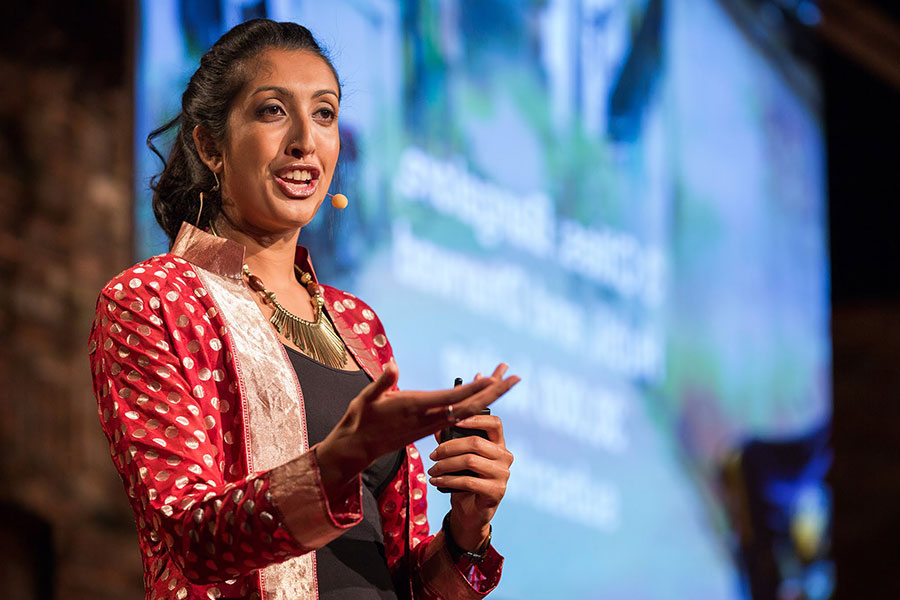
28-year-old Anu Sridharan decided that working with water engineers to determine when water would arrive exactly in a specific area was the perfect solution. She devised an SMS system that would let residents know when to expect water, allowing people to plan their day better. She’s called her company Nextdrop.
“The water utility companies said, ‘Hey, we want to see how this works too’ and so we began giving our data to them.” Says Sridharan. The idea has turned into an app that now allows consumers to lodge complaints and problems.
Those who’ve started reporting water problems have seen how utility companies have begun fixing problems quicker, as they can now identify them sooner. It’s turned into a win-win situation, with service provider and consumer working together to supply a vital service. Her efforts have not gone unnoticed. In 2013 Sridharan was a finalist in Unilever’s Sustainable Living Young Entrepreneurs Awards held at Buckingham Palace and hosted by The Prince of Wales.
She started Nextdrop when she was 23 years old and already feels old. “I have a colleague that’s 20 and the average age in our office is around 25,” she says – stressing the point of how old she feels. She’s already had years of experience working with local governments in India. With Nextdrop now operational in four cities across the country, she’s found government official helpful in getting things done. “They are very helpful in working with start-ups,” says Sridharan. “New ideas are risky, but they’ve taken a chance with us and I think they’re seeing the benefits.”
Nextdrop have calculated that one million hours of potentially wasted time has been saved across the four cities, over the past four years, from consumers using their SMS service. A new app is also in the pipeline, The Water Saver, that will help track the amount of water saved by utilities. “What drives our company is an idea that each product we create should try to make the world a better place,” says Sridharan.
Realizing that social impact should be run like a business, Nextdrop has gone beyond the ‘feel-good’ factor and is charging utility companies a fee for their service. Commercial brands can also sponsor SMS messages that are sent to consumers. Nextdrop wants to ensure that from a business perspective they never get to experience the ‘last drop.’
The company’s humble beginnings have revealed that water problems exist everywhere, even within developed countries. “After four years of being in business we finally have a mission,” says Sridharan. “To be the world’s largest water network that connects governments to the private sector and citizens, by supplying water information.”
Surprisingly, many countries that have far superior technology and infrastructure to a country such as India, have no technology developed specifically for the water sector. This makes Nextdrop an attractive solution, and one that has the potential to scale fast.
“It’s terrifying being an entrepreneur at age 28,” says Sridharan. “However, I don’t think that really age matters – it’s terrifying at any age. I live by a quote I once heard that explains that when you’re an entrepreneur, CEO or founder, things never get easier – you just get better at managing it!”
Fear of failure can drive some people their entire careers and Sridharan is no different. “I had no idea of knowing if my idea for Nextdrop would work, but in a worst-case scenario I reckoned I’d end up back where I started – a university graduate still full of potential. I figured it was worth a shot and I’m glad I took the plunge,” she says.
The best advice she ever got was from a fellow entrepreneur who told her to always be honest about what she didn’t know, and not to be scared of failure. “This honesty should also extend to yourself, the people you work with and your investors,” says Sridharan.
Fear, failure and lack of experience aside, there are still some great reasons that Sridharan is excited about having a company where all employees are under the age of 30. “One of the most beautiful things about building a company like this is that you get to work with really cool people,” she says. “On a day-to-day basis, it’s really all about the people you work with.”
[/et_pb_text]
[/et_pb_column]
[/et_pb_row]
[/et_pb_section]
Why Your Choice to Have Kids Responsibly is Awesome

Business as usual is a foolish strategy in a world that will triple in population during our lifetime. Several billion more people are placing an unprecedented demand on every resource and system on the planet.
As an entrepreneur, overpopulation can be seen as a crisis or an opportunity. One thing’s for sure – the current pace of exploitation of our natural resources will not create a brighter future for the next generation. Watch this video on the explosive growth of the world population over the last 200 years and consider the consequences of not taking action.
World population has experienced continuous growth since the end of the Great Famine of 1315–1317 and the Black Death in 1350, when it was near 370 million. The highest population growth rates – global population increases above 1.8% per year – occurred briefly during the 1950s, and for longer during the 1960s and 1970s.
The global growth rate peaked at 2.2% in 1963, and has declined to 1.1% as of 2012. Total annual births were highest in the late 1980s at about 139 million, and are now expected to remain essentially constant at their 2011 level of 135 million, while deaths number 56 million per year and are expected to increase to 80 million per year by 2040.
World population reached 7 billion on October 31, 2011 according to the United Nations Population Fund.
Do Female CEOs Outperform Men? There Aren’t Enough To Say
The television segment was less than 60 seconds but it was enough to capture my full attention and interesting enough that it prompted many of my extended family to alert me to its existence.
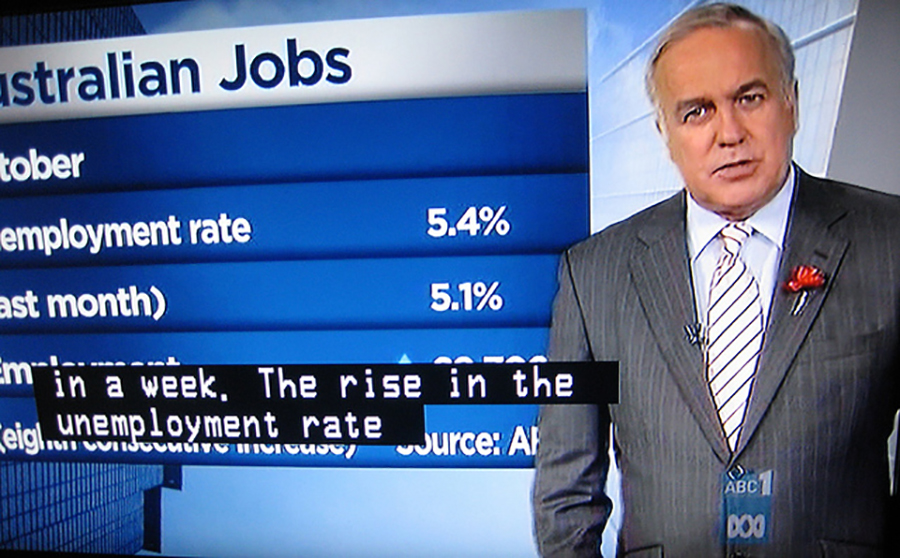
At the end of Alan Kohler’s regular Finance Report, broadcast during the ABC 7pm News, last night he showed a remarkable graph.
“Here’s a graph to get Australian boards and directors thinking. It shows the performance of US companies with female CEOs versus the general market index S&P 500,” Kohler told viewers.
And guess what it shows?
“Companies run by women do better than those run by men.”
His next line, however, was the real kicker.
“I can’t do that graph in Australia because the sample is too small here.”
Occasionally it is the little details that tell the bigger story best. The day before Kohler’s enlightening segment the Workplace Gender Equality Agency released research showing that the pay gap in management in Australia is as high as 45%.
It’s astounding and poses many questions. Why are women at the pointy end of corporate Australia paid considerably less than their male peers? It is because they are actually worth less? Is it because their male peers are actually paid more than they’re worth? Both? What is it that causes the pay gap to perpetuate and even widen at this level?
The pay gap that exists between fulltime earnings of men and women in Australia is 18.6%. It is a considerable gap and it reflects a number of factors including the different industries and roles that men and women tend to occupy.
When the research is refined to a single segment like management, for example, those differences are less informative. It is certainly more complex than one single factor but given the chasm between male and female managers is up to 45% in management, it’s hard to dismiss structural sexism as an influence.
Is this explained because corporate Australia still treats women as an anomaly? It seems possible because, in truth, they still are. Female managers are not the norm, any more than female-led publicly listed companies are.
The fact female-led companies out-performed the industry average in America doesn’t mean that every single female CEO will always outperform a male CEO. It’s obviously more complicated than that but the data is persuasive that female-led companies do better than average.
How ludicrous is it that here in Australia where women do not lack for educational opportunities or “merit”, there aren’t enough women running companies to even form a statistically-significant sample to prove it?
It indicates just how far Australia hasn’t progressed. We can’t demonstrate that Australian women are better or worse than men at running companies but we can prove that the women who eventually might are, in some cases, earning almost half their male peers are. Is this because they aren’t as good?
The research from America suggests not. Unless, of course, the results simply show that managers in the US are better able to train and develop female talent than we are?
Whatever the explanation it’s absurd that we can only guess rather than form a conclusion based on evidence.
I am inclined, once again, to ask whether our Minister for Women caught Alan Kohler’s report last night? If so can we expect a response? Are you there Tony?
This article originally featured on womensagenda.com.au
How Richard Branson, Oprah and Elon Musk Spend Their Weekends

Elon Musk collects James Bond memorabilia while Johnny Depp prefers Barbie, Taylor Swift makes her own snow globes. A solid commitment to play as hard as they work has ensured some of the most high profile success stories of our time are able to keep their minds inspired.
Managing stress with rewarding hobbies is a great way to incentivise putting in those extra hours when they’re needed.
Richard Branson has many successful traits which include excellent delegation and communication skills to keep his brand thriving and give him more “wind time”! The Virgin boss goes kitesurfing for kicks and can often be found riding the board offshore from his Caribbean island. No wonder his famously relaxed demeanour has endured for so long.
Actor Will Smith chooses a similarly active weekend lifestyle: he likes to don a head guard and indulge in a bout of fencing with mates such as Tom Cruise and David Beckham.
Oprah’s a big reader of fiction. It doesn’t stop with the final page, however, as she also re-publishes her favourites under her own imprint, selling 55m copies in the process. It just goes to show that success comes with pursuing your greatest enthusiasms.
Excellent organisers enjoy higher quality free time, so if these people’s leisure time stirs your envy as much as their bank balance does, put your affairs in order, delegate, prioritise – and get yourself to the Bingo hall. The prizes must be pretty hefty if Ronaldo’s playing, right?

Graphic courtesy of Best STL
Woody Harrelson Has a Message for the World
Woody Harrelson is no stranger to controversy, and he doesn’t shy away from it either. An outspoken environmental activist, Harrelson has attended environmental events around the world and is known to join protests that demonstrate alternative viewpoints.
He once traveled to the west coast in the U.S. on a bike and a domino caravan with a hemp oil-fueled biodiesel bus. Harrelson is also an ethical vegan and eats raw foods. Along with not eating meat or dairy, he also doesn’t eat sugar or flour. In Zombieland, in which he plays a character with an affinity for Twinkies, he did not eat the confectionery, replacing them with vegan faux-twinkles instead, made from cornmeal. He appeared on a postage stamp in 2011 as one of PETA’s 20 famous vegetarians, and he was named PETA’s Sexiest Vegetarian in 2012.
Here, Harrelson tells us how our spending has the power to influence harmful practices and help change policies at companies that are doing damage to our planet.
https://www.youtube.com/watch?v=jwJMy9PleXg
Richard Branson: Reinventing How We Live and Work to Become a Force For Good
The energetic and playful entrepreneur believes the time is right for a radically different approach to business. He’s ready to explore the next great frontier.
Your new vision for the future is a marked departure from the “business as usual” model. At what point in your career, and based on what personal experiences, did you start to recognize that business needed to start embracing the values-based approach that you are now evangelizing?
I first realized the power that business had to drive change at age 17. A school friend and I started Student, a youth magazine that gave young people a voice and access to politicians, business leaders and artists. I convinced my parents to let me leave school, persuading them about the possibilities of Student, and set out to pursue my first business endeavor.
We supported social enterprises like the Student Advisory Centre, created to help young people with their sexual health issues, and Mates Condoms, to help stop HIV/AIDS from spreading in the U.K. We were always thinking about using Virgin’s entrepreneurial energy and resources across our businesses as a force for good. Since then, Virgin has grown and now comprises more than 400 companies globally – in travel and leisure, financial services, mobile and media, health and wellness, clean technology, and even space travel.
The staff of Virgin established Virgin Unite, our non-profit foundation, in 2004 to do what the name suggests – to unite all the Virgin communities globally as a force for good. It’s not about a single issue or one big campaign: it’s about a way of living and working that aspires to put people and planet alongside profit at the core of all we do. Moving beyond charity and CSR, we’re reinventing how we live and work in the world, and showing that business can, and must, be a force for good and that this is also good for business.
What does your new business model look like today when it comes to balancing profit against caring for people, communities and the planet?
We believe the time is right for a radically different approach to business – one that puts people and planet at the core of how business is done. Whether it’s transforming an existing business or creating a new business whose sole purpose is to solve an issue, or inventing new financing vehicles, there are many exciting examples of models that work. Household names like Ben & Jerry and The Postcode Lottery have led the way. There is also a new generation of businesses using innovative hybrid models – like Participant, Better World Books, Husk Power and others.
“There is an incredible opportunity to make a difference as a ‘Real Leader’ – now.”
The traditional giving model of “do well and then give back … because that’s what’s expected.” Do you believe it’s possible to rather “do good while doing well… because that’s good business,” and what gives you the confidence to support this approach?
Doing good is good for business. Whether you’re an emerging entrepreneur or a champion of industry, now is an exciting time to explore the next great frontier where business puts people, planet and profit at its core. With the constraints of the world’s resources, business as usual won’t work: we need to build new business models. There are great examples of reinventing businesses that we can all learn from – like Ray Anderson from Interface Global, and Marks & Spencer.
What does it mean to be a “Real Leader?”
“Real Leaders” aren’t pressured by short-term reporting and profits to make poor decisions that may make their company look good in the near future but doesn’t consider the future. “Real Leaders” are taking a hard look at the real cost of doing business and are calculating how much of the planet’s natural resources are being spent on manufacturing and distributing their products – which will help them figure out cost savings and profit opportunities, and therefore make better decisions.
Also, “Real Leaders” see opportunities, where others only see challenges. That’s certainly how we view investing in clean energy companies. For example, we’ve got global airlines and are in the dirty fuels business – as customers of dirty fuels – so we’re taking a leadership role in developing alternative fuels. That mindset led me to pledge 100 percent transportation profits to clean energy and get more businesses to equally prioritize people, planet and profits.
While governments dither, debate and delay ending fossil fuel subsidies and their support of lasting growth in clean tech and resource efficiency, “Real Leaders” aren’t going to wait for someone else to take action: they’re going to move away from fossil fuels while slashing carbon emissions to become market leaders, growing innovative technology and profits.
I started a business initiative in 2103 called The B Team, which spreads concrete solutions to make capitalism a driving force for social, environmental and economic benefit – where people, planet and profits are equally prioritized. We’ve been talking with people we think are “Real Leaders,” many of whom are from the younger generation that start companies that put people and planet into their business model; examples include TOMS Shoes and Warby Parker, whose consumers purchase one item for themselves and one for someone in need
In 2007 you launched the Virgin Earth Challenge, a US$25 million prize for whoever can demonstrate a commercially viable design that results in the net removal of anthropogenic, atmospheric greenhouse gases towards a more stable climate. What’s next in this journey, what have you learned through this process and do you expect there will be a winner?
Removing CO2 from the air is essential if we are to maintain life on this planet. So we created Virgin Earth Challenge as one of the biggest prizes on earth as an incentive for scalable and sustainable net-carbon-negative activities, and that’s not an easy status to achieve.
Thanks to the excellent work being done, it’s not a question of “if ” there’ll be a winner, but rather “when.” Prizes help drive solutions forward but it doesn’t end there: these solutions should not, and will not, allow for business as usual. We must still cut global greenhouse gas emissions drastically, and we need to cut them fast. I call upon all companies, NGOs, governments and policymakers to further research negative-emissions to see how they can contribute.
Ocean Elders is one of your endeavors. What was your motivation for setting up Ocean Elders and how do you see technology playing a role in improving ocean health?
I’ve long been involved in ocean conservation and species preservation work. My travels have allowed me to see some beautiful parts of the world that have been ruined by ocean pollution, drilling, irresponsible fishing practices and cruel practices such as shark finning. Much of this can be stopped with education and advocacy, which is why you’ll see me swimming with sharks and whales (fish are more valuable to local communities alive than dead) and supporting organizations such as Greenpeace and WildAid. OceanElders was formed in 2010 by Dr Sylvia Earle to bring together people (such as Jean-Michel Cousteau, Queen Noor, Neil Young) to raise awareness and support organizations that protect the ocean.
The ocean is our life force, providing at least 50 percent of our oxygen and absorbing 25 percent of all our carbon emissions. Since the start of the industrial age, the ocean has become 30 percent more acidic and we have little idea of what this might entail for its long-term health.
This is something we should be very alarmed about, as today the ocean delivers an estimated $21 trillion in natural services, yet it’s being destroyed on all levels. Today, we sadly know little about our oceans; the ocean makes up most of the planet but it’s the least researched and explored (why is it called “planet earth” when 71 percent of the planet’s surface is ocean?).
OceanElders are championing new technology that can help us explore and learn from the ocean. For example, submarines now have technology that enables research and establishment of baselines, and Google’s Underwater Street View and the Catlin Seaview Survey will make available amazing images of the world’s reefs to millions of people. There’s also new technology in fishing equipment that will eliminate bycatch – so there are lots of different ways technology can help with ocean conservation.
What are your views on the role of business and technology in addressing many of the social issues we face?
The Carbon War Room, which works with a range of industries on practical and profitable ways to reduce carbon, is a good example of how business and technology can work hand-in-hand to address social issues. For example, in the shipping industry, CWR connected shipping companies with clean technologies and design elements for both new and existing ships, built a website (www.shippingefficiency.org) that rates ships on energy efficiency, and encourages businesses to choose environmentally friendly ships, not dirty ships – which saves them money on fuel.
Three of the world’s biggest charterers, Cargill, Huntsman and UMIPEC, announced they would drop energy inefficient ships and now only charter ships that are energy efficient. This represents US$425 million in new business for cleaner ships. This is incredible progress for the shipping industry.
What are the biggest challenges sitting in the way of us achieving a sustainable future?
Governments and non-profits cannot tackle these issues on their own; business can, and must, participate and contribute new entrepreneurial approaches. In Rio in 2012, Ted Turner and I sat on a panel with Denmark’s Prime Minister Helle Thorning-Schmidt. As early as the 1970s, Denmark confronted its dependence on fossil fuel imports, before many other countries, and decided to prioritize clean energy development.
Through a combination of government incentives, private sector leadership and ingenuity, Denmark is well on the path to not just using clean energy (the country will get to 50 percent wind power by 2025) but also to exporting its energy technology to a widening audience in need of this expertise. Market barriers are also a challenge. We need to create the right market environments for ideas to thrive and grow, including getting capital flowing into them and the right government policies in place
For example, Virgin Unite incubated The Carbon War Room to unlock market-based solutions to climate change. The Carbon War Room helped drive this change in the shipping industry by getting major transporters across the oil, agriculture and chemical industries to drop their fuel-inefficient vessels for more efficient vessels that operate in the shipping industry – in a clear signal to ship owners that the market will reward those that have more sustainable practices.
We must open our minds and see challenges as opportunities. Think about the hospitality industry and the millions of plastic water bottles that are wastefully used by tourists and business travelers alike. Necker Island, one of our resort islands near Puerto Rico, goes through more than 200,000 plastic bottles a year alone. Instead of further contributing to the water and waste problem, we got involved in a new initiative that gets hotels and restaurants to filter and bottle their own water and distribute it in beautiful recycled glass bottles (designed by Yves Behar), and then plow 10 percent of its profits into local water projects, which helps address the growing water crisis.
The scheme helps hotels do three important things: make money, contribute to local water projects, and reduce waste – a brilliant example of working toward business as a force for good and for a sustainable future.
What gives you the most hope that a sustainable future is possible?
There are so many companies and great initiatives already embracing this new way of doing business. We simply need to start doing. Time is ticking and if we don’t act fast enough we may miss this opportunity – and become a disappointment to our children and our children’s children.
We all want our businesses to be around for the next 100, 200, 500 years or more – that’s not going to be possible if we destroy our planet in the process. We’re investing in efforts to find green energy solutions and will continue to focus on groups such as the Carbon War Room to harness the power of entrepreneurs, with the aim of unlocking gigaton-scale, market-driven solutions to climate change. Especially inspiring are young entrepreneurs in South Africa and Jamaica – whom we work with through our Centers for Entrepreneurship.
They’re just getting started, but are already getting cool businesses off the ground, creating jobs and uplifting their communities. Each of you should visit and mentor them.
Planning Your Weekend? This Young Man is Planning our Future
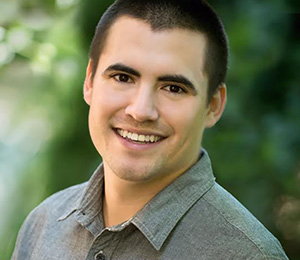
The Global Shapers Community is an initiative of the World Economic Forum and is a network of Hubs developed and led by young people who are exceptional in their potential, their achievements and their drive to make a contribution to their communities.
Real Leaders Marketing & Alliance Coordinator, Jesse Pyrch, is a Global Shaper from Portland Oregon and attended a gathering in New York recently. He was interviewed for medium.com
What brings you to New York?
A healthy combination of business and pleasure. I will be attending a book party with a Portland Shaper celebrating Arianna Huffington’s new book The Sleep Revolution. The following morning I will be meeting with a representative from the United Nations Global Compact to discuss ways to advance the 17 Sustainable Development Goals through the global media organization I work for – Real Leaders. I’m hoping to attend a baseball game to watch the Yankees play the Astros on Thursday, but the weather isn’t looking promising — I must have brought the rain from Portland with me. I’m particularly excited to have coffee and breakfast with fellow Shapers from New York, to get to know each other and explore ways of working together. The last two days I plan to be a tourist, spending time with a childhood friend and friend from college. And watching the 2016 Masters Golf Tournament.
What are you working on?
I’m working on advancing the United Nations Sustainable Development Goals, developing a new area of focus for Real Leaders called Young Real Leaders, and acting as a speaker representative for a CEO of a commercial real estate company who is speaking on the benefits of gender balanced leadership. In my personal life, and through Global Shapers, I am the Membership Chair working on recruiting more Shapers to our newly-formed Portland Hub. I’ve presented a project to our Portland Shapers which aims to implement Ashoka’s Youth Venture Program at a pilot school in Portland. The idea of creating the next generation of social entrepreneurs in a scalable manner excites me a lot!
What matters to you? And why?
I’m a big believer in business being the most powerful engine on the planet for creating good and doing less harm. I’m a huge proponent of for-profit social enterprises as a way of creating sustainable long-lasting change. Practicing what I preach, I work for a for-profit social enterprise that is a Certified B Corporation – a company that meets rigorous standards of social and environmental performance, accountability, and transparency.
What does being a part of the Global Shapers Community mean to you?
I’ve lived in or around the Portland area my whole life. Having an opportunity to give back to the place I call home, with like-minded aspiring young professionals, just feels right and makes me happy.
What is something you want readers to know about you?
I’m half Native American and a Absentee-Shawnee Tribal Member. My Native American name in Shawnee is Gelige pe Yase Kiki, which translates to, “the first bird to jump.”
What kind of impact do you want to make on the world?
I hope to make the world a more sustainable, just and peaceful place for all the people, animals, and plants living on it.
What’s the toughest challenge you are facing right now?
Getting people across the globe to have a sense of urgency in creating a more sustainable planet for all.
What’s the best advice you’ve ever received?
My grandpa once told me, “To find true joy, find a purpose in life and take it seriously.” It’s a quote that sticks in my mind everywhere I go.
For what in your life do you feel most grateful?
To have a loving group of family and friends. As well as being happy and healthy.
Something you wish we asked, but didn’t?
My favorite sports team — Portland Trail Blazers. I have season tickets.