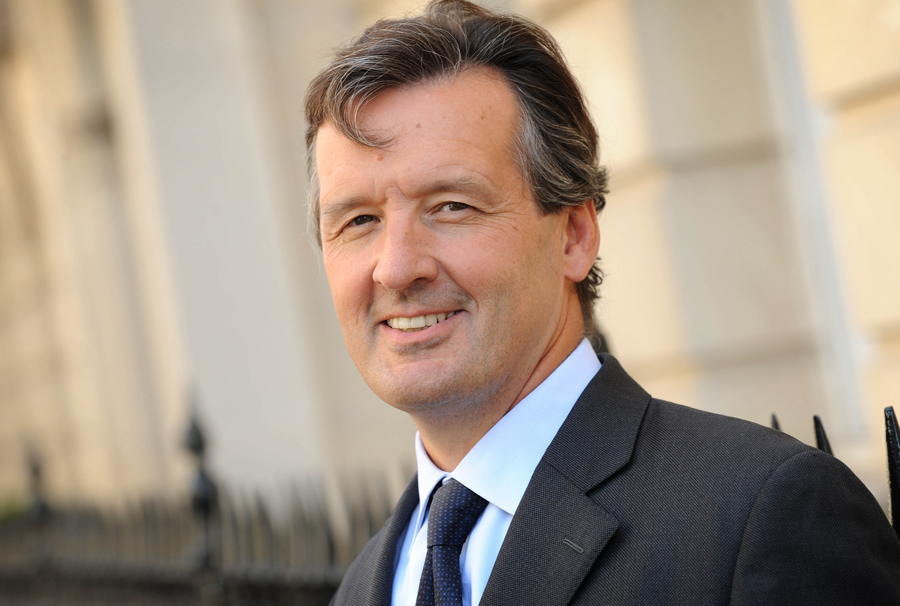
Nick O’Donohoe, CEO, Big Society Capital

RL-100-badge36

“If we achieve our goal, in the future the invisible heart of markets will guide the invisible hand to improve the lives of those who would otherwise be left behind.” Sir Ronald Cohen

Vision: A world where investors ask themselves a different question: not “What is the risk and return?”, but “What is the risk, return and impact?” Action: Created the world’s first social investment financial institution. They established a unique organization with a new way of investing – seeking both a social impact and financial return. www.BigSocietyCapital.com

The Organization Working At Ebola’s Ground Zero

To combat the unprecedented Ebola outbreak in West Africa, International Medical Corps has mobilized a comprehensive emergency response in Liberia, Sierra Leone and Mali, the epicenter of the humanitarian crisis. Led by President & CEO Nancy Aossey, International Medical Corps has responded to every major disaster of the last 30 years, delivering more than $1.8 billion in humanitarian relief and training in more than 70 countries.

The organization has been a First Responder in the world’s most challenging and remote places, including Darfur, the Democratic Republic of Congo, Syria, Afghanistan, Somalia, South Sudan, and Libya, among others. The Ebola outbreak has infected more than 17,000 people and caused more than 6,000 deaths in West Africa. The organization currently operates two Ebola Treatment Units in Liberia and one in Sierra Leone, where its first responders are providing lifesaving care.

In addition, they are  establishing another Ebola Treatment Unit in Sierra Leone and deploying an Emergency Response Team to Mali. Together, the four units will give more than 1.5 million people access to lifesaving care. International Medical Corps is also scaling up its training efforts and will train 3,500 frontline health workers to safely treat patients and manage Ebola treatment units that are critical to ending this deadly epidemic.

In addition, in Sierra Leone International Medical Corps has conducted ‘Ebola 101’ training of trainers for local organizations so that they can continue to safely operate.  This includes training 45 members of Street Child, an organization of schoolteachers, whom will themselves now train an additional 500 teachers in all provinces of the country.

Donating to a group like International Medical Corps, that is actually on the ground within the affected countries, treating patients, and helping to prevent further spread of disease is the best way to help. There are very few humanitarian agencies that have the capacity to manage and provide medical treatment to those infected with Ebola, and International Medical Corps is one of them.

For more information: httpss://internationalmedicalcorps.org/ebola To Donate: www.InternationalMedicalCorps.org/ebola-donate ebola2 ebola3

Google’s Eight Innovation Principals

The latest quarterly reports for Google are out. It shows revenue rose 24% to $32.32 billion from a year ago, higher than analyst expectations of $31.86 billion. How do they do it? Here are Google’s 8 simple innovation principals that help them stay on top”

1. Focus on the user.

2. Open will win.

3. Ideas come from everywhere.

4. Think big, start small.

5. Never fail to fail.

6. Launch early and iterate.

7. Be a platform, float all boats.

8. Make it matter.

One Of India’s First Sugar Companies: Blessed By Ghandi

In the early 1900s Shishir Bajaj’s grandfather Jamnalal was involved in the Freedom Movement in India alongside Mahatma Ghandi, even spending time in jail as a freedom fighter in his fight against the British. Driven by strong ethics and a will for Indians to govern themselves he added philanthropy to his arsenal of weapons, alongside his strong political ideologies. So strong, in fact, that he refused the title of honorary magistrate bestowed on him by the British Raj. Instead, he opened the first temple to the downtrodden, now 100 years old.

While Jamnalal never saw his cherished dream of an independent India, dying five years before independence day celebrations in 1947, his principles and convictions have been passed down through generations of Bajaj children. His legacy is presently in the care of Shishir Bajaj, Chairman and Managing Director of Bajaj Hindusthan sugar company, the largest in Asia and fifth largest in the world.

The principles that his grandfather learnt under Gandhi have been applied to this large industrial business, one that almost qualifies as a regional government in scale and impact. Jamnalal, with Gandhi’s blessing, saw at an early stage that there was a need for new companies to feed the economic challenges of building a new nation and formed the sugar company in 1931.

“Because my grandfather was too busy with the Freedom Movement, he set up the business and let my father run it,” says Shishir. And in a move that predates Bill Gates and Warren Buffett’s Giving Pledge campaign by 80 years, Jamnalal formed a trust for the wealth because he didn’t want to own more than he needed; a very unusual move at the time.

Two foundations, the Bajaj Foundation and Jamnalal Bajaj Trust now support more than 100,000 families in 501 villages, positively affecting the lives of more than 615,000 individuals within the company’s 12 sugar production areas. In keeping with the family tradition of social change, Shishir’s son Kushagra suggested the formation of an action plan five years ago that scaled the company’s social good onto a much larger platform.

“The number of villages we’d like to cover in the next five years is 1,000,” says Shishir. “There are about 700 districts in India and if we can capture just two I think it will be a seriously good achievement.” As the most populous country on earth with just over 1.2 billion people, two districts is not the small number some would imagine. Some of the projects Shishir is involved in include sustainable agricultural practices, and women’s self help groups.

A water resource project has seen 82 rivers deepened, 120km of riverbeds rejuvenated and schools built at seven of the ten sugar factories. Other projects include an energy company that produces 450 megawatts of power, with plans for a 2,000-megawatt power plant underway that will cost $2 billion.

One wonders what Jamnalal would say today if he saw how his sugar factory, one of the first in India, had transcended profit to become a builder of infrastructure to a nation in need. As Gandhi would have said at the time, “You must be the change you wish to see in the world.”

The Richest Man In American Medicine Seeks To Forge A ‘Cognitive Revolution’

Dr. Patrick Soon-Shiong is a surgeon, drug developer, entrepreneur and the richest man in American medicine. Since selling the company that makes his breakthrough cancer drug Abraxane in 2010, he has been developing and expanding NantWorks, an LA-based medical technology company with implications far beyond medicine. Kathleen Miles spoke to him about his groundbreaking work.  We’re on the NantWorks campus in Culver City. Can you explain what you are developing here?

I started this concept in 2005. It dawned on me that the world has not prepared itself for the convergence of supercomputing, cloud computing, machine vision and artificial intelligence. What we’re doing here is converging what I think is the next revolution of mankind. We’ve had the industrial revolution, and we’ve had mechanical and energy improvements. I think we’ve now reached a stage of enlightenment where technology will allow mankind to evolve to this era of cognitive power. A cognitive revolution will bring the wisdom of the Internet and what we know as mankind to somebody as they’re interacting with the real world. NantWorks is a company to figure out how we’re going to transform using the convergence of huge technology in how we work, live and play. Imagine if da Vinci – an engineer, an artist – had the supercomputer in his hands, instead of a quill. That’s what NantWorks is about.

Break down the elements of what you call the “ecosystem” of companies under the umbrella of NantWorks.

I needed to enable machines to talk to machines. So we built this operating system that ties to 25,000 medical devices, puts the data in the cloud and self-populates the electronic medical record. I call that the ability to capture the human signal engine – very much like when we send our astronauts up to space and capture their vital signs. If we can capture vital signs and medical records and give that to the doctor for decision support, that’s NantHealth. As we were building that, I realized that the fiber infrastructure doesn’t exist. The data centers don’t exist to address yottabytes of data. Ten thousand patients alone is equivalent to eight times the download of the entire Netflix library. So we needed to build a fiber infrastructure that runs across the country.

soon-shiong2

We now have 12,000 miles of fiber running across the country, in which we have seven data centers that are completely HIPAA-compliant, and that is NantCloud. I then realized that we need to have this information that is completely mobile. I needed to take the mobile device and give it machine vision, let it recognize physical objects and transport information. Then we could have a supercomputer in the hands of a physician. That’s NantMobile, which will also address the consumer and bring sports, entertainment, health and FitBit, all on your mobile device.

But the ability to transmit data fast on this mobile device required a chip that hadn’t been built yet. We needed a chip that can move data not at kilobits but at gigabits — without wiping out the battery life. Nobody could build that chip. So we created a company called NanTronics and created a chip that can move data 2.5 gigabits per second and go in a smartphone.

We just launched it in Barcelona. We’ve also built chips that can make a hearing aid that’s tunable by a smartphone and costs $300 (as opposed to $4,000 now). One phone can treat an entire village. Finally, we realized that it’s not only the genes that are important. There’s a whole world of proteomics and genomics, and the two had never been put together. So we created this company called NantOmics and built a supercomputer that measures the genes and the proteins in 47 seconds so that we can go from gene to protein to drug.

If artificial intelligence is part of this technological revolution that you would like to integrate into our health care system, do you anticipate it will ever fill in for human doctors?

I look upon the human-patient relationship like a priest-parish relationship. I don’t think there will ever or should there ever be the absence of human-human interaction. I don’t call it artificial intelligence – I call it amplified intelligence. We’re coining this term AI3, meaning amplified, actionable and adaptive intelligence. We’re going to enhance the cognitive capabilities of a human being who can’t recall information at the speed and depth that we need to make the right decision.

But this information is in the cloud and can give the doctor actionable information in real time. With actionable, adaptive intelligence, everybody learns from everybody else. Amplified intelligence makes sure we give the right care at the right time, especially when it comes to making life-threatening decisions.

How will the technology you are developing be used to treat cancer and other diseases?

According to a recent World Health Organization report, in 20 years, there will be about 24 million diagnoses of cancer per year. It’s an epidemic. There’s no question that we’re losing the war against cancer. The disease is so complex. It’s like whack-a-mole — you hit something and another thing pops up. And many cancer patients are getting inappropriate care.

How do we change that? The doctor is inundated with a deluge of information, or big data, and cannot address it in real time. So we’ve built a tool that is now adopted by most of the oncologists in the United States that takes thousands of protocols, the patient’s diagnosis, their biomarkers and their history and maps it in real time. As you treat the cancer patient with chemotherapy poisons, you’re affecting the genomic and proteomic profile of the cancer cell itself. We need to find the cell that’s now floating in the blood and do the genomic and proteomic analysis so we can predict early on what drug to give before it gets even worse.

It’s the only chance we have to put ourselves on the path to the cure. So we built a supercomputer that can do the genomic analysis rapidly. Think about the math. There are 10,000 new analyses that we need to do a day. It takes 11 weeks to do one patient’s analysis of the entire human genome. So we built a supercomputer that can do the entire analysis in 47 seconds.

In June, at the American Society of Clinical Oncology, for the first time, we will be presenting the results of the first 5,000 patients’ genome sequencing. We were able to do all theses analyses in less than 69 hours and provide the information of what drug to give to the patient based on their genetic fingerprint. We’ve built this clinical operating system to be completely inter-operable across the entire country as well as England, Canada and China.

Then we can present this complete information exchange to the pharmaceutical company and say, ‘Don’t treat lung cancer as one conglomerate disease, but as a multitude of rare diseases.’ The pharmaceutical industry used to always think that it needed to develop a blockbuster, billion-dollar drug. The problem is the blockbuster model before would help 20 percent of the people – say, with lung cancer. On the other hand, if you took lung cancer and you broke it down into 700 fingerprints of personalized medicine, you could have 90 percent response rate.

You have developed technology that helps the blind see. How does it work?

The technology is to have a camera recognize any physical object in the real world and then impart the knowledge of what the object is so the blind can hear from the camera what it’s looking at. In essence, we’re creating a seeing-eye dog with your mobile device. It’s very difficult to read money. Now you can take a $5 or $10 bill, no matter how it’s wrapped, and the camera will tell you what it is. That was released as LookTel Money Reader. We then released another app called LookTel Recognizer. It will let you recognize physical objects in the real world.

Are there other applications for machine vision?

In a sense, what we’ve done is created the actual browser of the physical world. Now the physical world can be brought to life by recognizing objects and curating information from the Internet. This also enables mobile commerce, including collecting coupons and closing a transaction. That’s in the context of NantMobile, which we’re about to launch in the retail space.

How will your information technology help the poor, particularly in LA’s inner city?

I grew up in South Africa. When I came here, I began to see that there is a medical apartheid in this country. The rich are well cared for, the middle class are sort of well cared for and the poor are just out of luck. A woman in Martin Luther King hospital in South LA called 911 from the hospital floor because no one was taking care of her. She died on that floor, and four hours later, nobody even knew she was dead. So I walked the floors where she was and went to see the doctor. I said, ‘How could this happen?’ They felt there was this inequality of information and care. She was Hispanic-speaking, so maybe it was a language barrier, but there was absence of care and skill sets down there. So they closed the hospital. But that wasn’t the answer.

The answer was to bring care down there. I’m glad to say [LA County Supervisor] Mark Ridley Thomas and myself fought very hard, and the hospital is about to reopen next year. The University of California system is bringing care there. And information technology will make it possible to have information transferred –whether you’re in South Central LA or Beverly Hills – in a patient’s time of need.

Kathleen Miles is Senior Editor of The WorldPost, a partnership of The Huffington Post and Berggruen Institute on Governance. This piece first appeared in Worldpost. logo

World Cup Soccer & Social Enterprise: A Hybrid Financing Model

The potential of hybrid financing strategies to accelerate the growth of the social business sector was one of the topics at the fourth edition of the Impact Economy Symposium & Retreat in Switzerland on June 13-15, 2014. A group of key influencers, thought leaders, and practitioners from the worlds of investment, business, government, and philanthropy once again convened to explore the most effective solutions, innovations, and opportunities that have surfaced in the promotion of impact. Real Leaders is one of the seven global official media partners of the symposium and, in this exclusive series, Impact Economy’s Dr Maximilian Martin discusses content covered at the conference.

On June 28, the Round of 16 kicks off at the 2014 FIFA World Cup. Football (or soccer, as it is known in the United States) has the amazing ability to engage people around the world. The 2010 World Cup in South Africa was televised across 245 television stations in 204 countries. The forthcoming World Cup in Brazil will reach even more people.

At a time when the military advances of ISIS in Iraq and Syria are bringing to the forefront the issues that divide different parts of national and global populations, fresh ideas on everything ranging from alternative energy to sanitation are needed to drive real progress around the world. Mega events such as the World Cup remind us of our shared humanity and intertwined destinies.

By taking place in an emerging market and including teams from the developing world, the World Cup also draws attention to the realities there, emphasizing that transformational progress is needed on a number of social and environmental issues; the street protests in Brazil against the cost of this year’s World Cup being just one of many reminders.

Achieving a step change in impact requires fresh ideas

Social entrepreneurs are increasingly viewed as a source of the solutions now needed. Less clear has been the kinds of businesses that need to be built in order to live up to the huge expectations; this is to say nothing of the most effective ways to actually finance them. Globalization, long-term demographic trends, changing consumer preferences, and the state of public finances are collectively driving the emergence of an integrated social capital market for the first time in human history.

This so-called impact investing market is targeting both financial return and social impact and contains a fast-growing stock of assets currently valued at USD 46 billion—and social enterprises are uniquely positioned to become the primary recipient of the resulting attention, knowledge, and resources. To make the most of the potentially vast amount of capital that stands to be allocated, however, social entrepreneurs will need to deliver a step change in impact on a number of protracted challenges that conventional approaches have not been able to solve.

Money and talent will be key to making this happen. Amidst increasing chatter about whether impact investing is indeed a golden opportunity to capitalize smart solutions to protracted challenges or just more hype, “Building Impact Businesses through Hybrid Financing: Special Impact Starter Edition,” a new Impact Economy report, looks at the first principles that determine the most compatible forms of financing given the problems to solve, and considers the structures of corresponding business models. Leveraging football for development is among the cases considered.

Social enterprises can use hybrid financing to drive greater impact

A key finding is that successful social enterprises can use hybrid financing to drive greater impact. Grants remain the best way to seed a social enterprise, but they tend to become insufficient in providing the capital required for the venture to scale if it achieves initial success. Moreover, they are expensive to raise, with the combined cost of fundraising often ranging from 22 to 43 percent of the grant, all costs considered.

Hybrid financing models therefore also use non-grant capital to fund social business activities, namely some combination of up to four forms of capital (e.g., grants, debt, equity, and mezzanine or convertible capital), as well as a variety of possible financial instruments such as internal credit enhancement through subordination or reserves, or external credit enhancement via letters of credit.

Time also plays a hugely important role in these structures: hybrid financing can be synchronic (or tiered),combining for example grant and non-grant sources of capital simultaneously to fund the joint expansion of profitable, and the optimization of unprofitable, elements of a social enterprise’s value chain and reduce risk. Or they can be diachronic, with hybrid funding unfolding over time, typically beginning with grant funding and then “graduating”—as the venture achieves critical mass—to equity, debt and mezzanine funding.

Some social entrepreneurs use football as a means for social change

Hybrid financing solutions can also be used to fund solutions delivery when sport is harnessed for achieving positive social impact, and when social entrepreneurs engage in what is called “football-for-development.” Building on the popular passion for football, social entrepreneurs have been reaching young people with an offering of education and training services to reduce socio-economic disparities and overcome gender discrimination.

For example, streetfootballworld, which is the leading global social enterprise in football for development and is covered in the report, focuses on advocacy to legitimize football in general as an instrument for social change; capacity development to help local grassroots organizations to achieve greater impact in their work with young people; network development to strengthen the football-for-development movement as a whole; and partnership development to match funding organizations with actors on the ground who can deliver football-for-development programs.

Jürgen Griesbeck, the organization’s Founder and CEO, is optimistic that hybrid financing strategies offer “important components to transform entire industries. Like subsidies or public research grants in the private sector, donations are highly important to the social sector to fund for the purposes of innovation and to support hard-to-monetize thematic areas.” Hybrid financing strategies “can help to bridge the gap: from the current reach of clients in the social sector to all of those that are not yet served,” said Griesbeck.

Via its partnerships with industry players, streetfootballworld is working on creating leading models that could be scaled, for example by applying the legacy requirements of bid books for FIFA World Cups to social issues. With an estimated latent demand of at least 45 million children and youth who would benefit from the approach, streetfootballworld would have to serve 60 times more clients to meet demand. Unsurprisingly, the organization is actively considering all types of capital, beyond grants, to overcome this scale gap.

It is time to innovate so football’s positive impact can match its footprint

The scale gap is especially interesting when put in relation to the status of the global football industry. There are an estimated 3.5 billion fans around the world (i.e., ahead of cricket with 2.5 billion fans, field hockey with 2 billion fans, and tennis with one billion). FIFA has 209 member associations with over 327,000 clubs and more than 270 million players—roughly 3.75 percent of the global population are actively involved in soccer, whereby 265 million play, and 5 million serve as judges and functionaries. The soccer business is booming. Over recent years, the primary driver of the strong revenue growth of many football clubs has been derived from television broadcasting. Salaries of top end players are exploding.

Leading Spanish football clubs FC Barcelona and Real Madrid pay average salaries of EUR 6 million to their players. In 2014, stars such as FC Barcelona’s Lionel Messi had a market value of EUR 120 million, and Real Madrid’s Cristiano Ronaldo was worth EUR 100 million. The top 30 football clubs each now generate over EUR 100 million annually. Leading club FC Barcelona had 44 million fans, Real Madrid 41 million, and Manchester United 37 million.

Even so, the football industry is at a relatively early stage in terms of high-impact corporate social responsibility (CSR) strategies, lacking the sophistication present in its core business and comparable industries. The good news is that some associations, such as FIFA, are relatively ambitious, and some clubs, such as FC Chelsea, engage in corporate responsibility as part of their brand development. Additional pathways and innovative financing could enhance impact.

As the report illustrates, the example of streetfootballworld shows that cooperation and orchestration are essential to closing the gap between supply and demand. As concepts of branding, merchandising and large-scale commitments expand into a professionalizing social sector, hybrid financing strategies will play a more important role going forward: funders may provide up-front risk capital in return for a share of future expected revenues, and financial engineering will help to monetize future grant commitments from reputable counterparts ahead of actual payment.

Many will start looking forward to the 2018 FIFA World Cup in Russia following the 2014 finals. A step change in impact is possible in a couple of years, provided the combined use of philanthropic and commercial capital is used to build and finance the social enterprises of the future, and help football to develop a positive social impact that is commensurable with its global footprint. Used properly, hybrid financing can provide a head start to build a future that football fans around can look forward to.

Maximilian Martin, Ph.D. is the founder and global managing director of Impact Economy, an impact investment and strategy firm based in Lausanne, Switzerland, and the author of the report “Building Impact Businesses through Hybrid Financing: Special Impact Starter Edition.”

GE: The World’s Oldest Startup on Effective Marketing

General Electric CMO Beth Comstock (above) believes marketing is about seizing opportunities. That’s why she’s constantly on the lookout for innovation, driving GE’s partnerships in healthcare and clean energy. It’s why today’s GE is utilizing video and social media to tell a global story with a local accent, and why tomorrow’s will see the integration of people and machines in a truly wired world.

“To be an effective marketer, you have to go where things are,” says Beth Comstock. “You have to see what’s happening and be a translator. You have to immerse yourself and not be comfortable sometimes.”

The General Electric CMO is sitting in a sleek conference room in the GE Building high above Manhattan’s Rockefeller Center. When Comstock speaks, though, she conjures up images of rural doctors in China and farmers in Africa. These developing markets and technologies are what Comstock sees when she thinks about the future for GE and marketing in general.

The 52-year-old often describes her job as “connecting the dots”–between GE’s seven segments (Power & Water, Oil & Gas, Energy Management, Aviation, Transportation, Healthcare, Home & Business Solutions), its many markets, and between the company and the outside world.

It’s something Comstock regularly does as head of GE’s sales, marketing, and communications, and in her management of the company’s multi-billion-dollar Ecomagination and Healthymagination initiatives, dedicated to environmental and health care innovation respectively. In her travels and conversations with customers, she constantly scans for patterns. “When you’re in this business, you see a lot of things,” Comstock notes. “Marketers are in a great position to notice if something’s happening in an industry like energy or healthcare.”

What separates the good marketers from the great ones is the ability to translate those observations into insights that can move a business or product. As Comstock and her 5,000 GE marketers set about trendspotting in 2013, her top insight for the new year is that marketing’s mandate will continue to grow. “It’s no longer enough to just be about brand and communications,” she says. “Marketing is now about creating and developing new markets; not just identifying opportunities but also making them happen.”

THE WORLD’S OLDEST START-UP

GE has been cultivating new markets by creating customer innovation centers in places like China. Its Chengdu facility, for instance, brings together local workers, GE marketers, and researchers to collaborate on new initiatives in mobile, affordable healthcare, and green energy. It opened in May and has already developed two new healthcare products (GE isn’t ready to name them) that will launch locally with the potential to roll out to other markets.

Under Comstock, GE has also been importing fresh ideas through competitions, partnerships, and guest talks. She likes to call GE “the world’s oldest start-up,” but admits the 134-year-old company needs partners to accomplish its more ambitious goals, whether it’s developing clean energy sources, or rolling out smart grid technology worldwide.

One recent ally is Los Angeles-based Oblong Industries. Best known for making the multitouch interface featured in Minority Report, Oblong entered one of GE’s Ecomagination open innovation challenges. “They hadn’t worked in the energy space, but we felt they could help us visualize the smart grid,” says Comstock. After funding a proof-of-concept pilot, GE announced an investment and licensing deal with the start-up for smart grid analytics in March.

GE started leveraging its open innovation challenges in 2010 and has now partnered with 15 environmental and health start-ups. The start-ups get commercial and technological support under a group Comstock manages called GE Ventures. Alliances are key because while GE operates a pipeline for internal innovation projects, candidates typically need to show $100 million of revenue potential (over three to five years) to win and maintain support. “Scale matters a lot to us,” says Comstock. “It’s hard to do both speed and scale well. Start-ups have great ideas and work fast while we have access to markets and great technology.”

GE also generates ideas through a global insights network that invites professors and other experts to campus to discuss cutting-edge topics like robotics. “We look for the most disruptive people we can find,” says Comstock. “We don’t want to think too traditionally. We have had to open up a lot more.”

“It’s hard to do both speed and scale well. Start-ups have great ideas and work fast while we have access to markets and great technology.”

CONTENT, CONVERGENCE AND THE DIGITAL FACTORY

Digital technologies are pushing GE in new directions. Comstock estimates she spends 40 percent of her budget on digital marketing. Over the past two years, GE has ramped up its video content in particular, hiring boutique agencies like The Barbarian Group to create short yet captivating clips about GE manufacturing and products.

Some of the videos explore GE systems and factories in artful ways while others thrill with extreme science stunts, such as dropping a robot off a wind turbine. BBDO remains GE’s advertising agency of record but Comstock says GE values small agencies’ willingness to take risks. “The Barbarian Group are great storytellers,” says Comstock. “They can translate stories that might otherwise be boring and technical. You don’t have to be a scientist to love these videos.”

Social technologies have also altered the way GE interacts with its customers. The company is active on Facebook, Google+, Instagram, Pinterest, Tumblr, Twitter and YouTube. GE calls Facebook the “hub” of its social experience. The site is home to more than 30 GE pages as well as its social health and fitness app, HealthyShare. On Google+, GE posts pictures, videos, and quiz questions relating to its industrial products, zeroing in on the service’s digital-savvy audience. On female-focused Pinterest, GE “pins” upbeat, health-related quotes and kitchen appliance photos. YouTube, of course, is GE’s video base with dozens of clips ranging from Barbarian-produced web shows to researcher interviews to TV ads.

Indeed, GE produces so much content across these sites that it calls itself a “digital factory.” For Comstock, this media convergence and blurring of roles is another 2013 trend. “The idea of an ad as a separate entity is fading fast. Brands are content publishers and consumers are, too. The days when we had separate swimlanes are over.”

Considering its size, GE was a surprisingly early adopter of social. Nevertheless, Comstock is wary of fads: “There are concepts out there people grab onto. You have to be careful of chasing the hot thing,” she cautions. When Comstock tries new tools, she tracks engagement metrics to assess whether the technology is relevant and scalable. Instagram is one social tool that passed her test. GE started using the photo-sharing app as an experiment.

Today, nearly 150,000 people “follow” GE’s photos of engines and power modules on the mobile social network. Like their web videos, the pictures let GE connect with technology enthusiasts. “Instagram is a way to go into our factories and get shots you wouldn’t normally see,” explains Comstock. “We’re targeting the inner geek in everyone. Most people want to know why things work.”

BUSINESS IS SOCIAL

Comstock has that inner geek, too. Studying science instilled a lasting interest in global ecosystems. As a Biology major at the College of William and Mary, Comstock once planned to become a doctor and she still views herself as a behaviorist: “I can get very focused on how people are using technology. Is it making lives better or worse? How is technology going to change how people act? That part of biology appeals to me.”

Comstock’s studies will soon extend to machines as GE brings social to inanimate objects. One of the company’s biggest growth strategies–and challenges–in 2013 will revolve around what they are calling the “industrial internet.” Known more broadly as the “Internet of Things,” the industrial internet involves applying digital and social technologies to machines to predict and prevent problems and increase productivity. In the future, GE’s MRI machines, jet engines, and gas turbines will all be wired.

The company plans to integrate content related to the Industrial Internet into existing initiatives like Ecomagination and Healthymagination. That could mean GE-generated news articles, infographics, or data visualizations of industrial internet topics, plus apps and multimedia projects, too. Imagine a YouTube video that shows how remote monitoring of a GE transformer prevents power outage during a storm. The key for Comstock is that “the Industrial Internet involves all of GE and goes beyond GE.”

It also points up another of her 2013 trends: Business is social and social is no longer limited to personal connections. “We’re working aggressively to link machines and people so businesses can be more productive,” Comstock says. “You’re going to see machine data and people interacting in real time.”

For example, GE recently hooked up one of its GEnx engines to Salesforce’sChatter software. The Boeing Dreamliner jet used the social platform to “speak” status updates to Japan Airlines service teams and GE engineers. The innovation should increase fuel efficiency and engine reliability, aiding on-time arrivals.

GE is making a big bet on the Industrial Internet, and will be promoting it to everyday consumers even though its services are geared to corporations, institutions, and agencies. Indeed, the broader marketing push has already begun. Over Thanksgiving, GE rolled out a new ad campaign, Brilliant Machines, to introduce the Industrial Internet to consumers. A traditional TV spot saw famous machines like KITT and the Mars Curiosity rover making a pilgrimage to GE HQ to be hooked up to the Industrial Internet. Online, there were promoted social media posts and a Brilliant Machines Tumblr. The point, says Comstock, “is to be relevant. It’s important for us to tell a story that connects in the consumer marketplace.”

GLOBAL PERSPECTIVE, LOCAL FLAVOR

That story is remarkably consistent worldwide. GE cleaves to a core branding message and framework but permits regional customization. The company’s current corporate storytelling platform, GE Works, highlights GE products while emphasizing their impact. It’s a global initiative, says Comstock, but in Brazil and India, for instance, the company hired local artists to tell GE Works stories in their own style. These print and outdoor ads varied in appearance but still focused on GE’s technology and influence on the world.

During 2013, GE’s marketing became even more global. Besides China and Africa, Comstock is excited by prospects in Indonesia, Latin America, Myanmar, and Peru. Wherever GE goes, Comstock will be there, on the ground and on the hunt for new products and markets. “Sometimes marketers get accused of being too academic,” she admits. “But although a consultant might be able to tell me about something, I prefer to see it myself. Experts can help translate, but being there is essential.”

This article was written by Elizabeth Woyke and originally appeared on thinkwithgoogle.com



Google’s Eight Pillars of Innovation

How does a company like Google continue to grow exponentially while still staying innovative? Susan Wojcicki, Google’s Senior Vice President of Advertising, discusses some of the processes and principles in place to make sure that the company doesn’t get bogged down in the past as it keeps moving forward.

The greatest innovations are the ones we take for granted, like light bulbs, refrigeration and penicillin.

But in a world where the miraculous very quickly becomes common-place, how can a company, especially one as big as Google, maintain a spirit of innovation year after year? Nurturing a culture that allows for innovation is the key. As we’ve grown to over 26,000 employees in more than 60 offices, we’ve worked hard to maintain the unique spirit that characterized Google way back when I joined as employee #16. At that time I was Head of Marketing (a group of one), and over the past decade I’ve been lucky enough to work on a wide range of products. Some were big wins, others weren’t.

Although much has changed through the years, I believe our commitment to innovation and risk has remained constant. What’s different is that, even as we dream up what’s next, we face the classic innovator’s dilemma: should we invest in brand new products, or should we improve existing ones? We believe in doing both, and learning while we do it. Here are eight principles of innovation we’ve picked up along the way to guide us as we go.

1. HAVE A MISSION THAT MATTERS

Work can be more than a job when it stands for something you care about. Google’s mission is to ‘organize the world’s information and make it universally accessible and useful.’ We use this simple statement to guide all of our decisions. When we start work in a new area, it’s often because we see an important issue that hasn’t been solved and we’re confident that technology can make a difference.

For example, Gmail was created to address the need for more web email functionality, great search and more storage. Our mission is one that has the potential to touch many lives, and we make sure that all our employees feel connected to it and empowered to help achieve it. In times of crisis, they have helped by organizing life-saving information and making it readily available. The dedicated Googlers who launched our Person Finder tool (to learn more see Missions that Matter) within two hours of the earthquake and tsunami in Japan this March are a wonderful recent example of that commitment.

2. THINK BIG BUT START SMALL

No matter how ambitious the plan, you have to roll up your sleeves and start somewhere. Google Books, which has brought the content of millions of books online, was an idea that our founder, Larry Page, had for a long time. People thought it was too crazy even to try, but he went ahead and bought a scanner and hooked it up in his office.

He began scanning pages, timed how long it took with a metronome, ran the numbers and realized it would be possible to bring the world’s books online. Today, our Book Search index contains over 10 million books. Similarly, AdSense, which delivers contextual ads to websites, started when one engineer put ads in Gmail. We realized that with more sophisticated technology we could do an even better job by devoting additional resources to this tiny project. Today, AdSense ads reach 80 percent of global internet users – it is the world’s largest ad network – and we have hundreds of thousands of publishers worldwide.

3. STRIVE FOR CONTINUAL INNOVATION, NOT INSTANT PERFECTION

The best part of working on the web? We get do-overs. Lots of them. The first version of AdWords, released in 1999, wasn’t very successful – almost no one clicked on the ads. Not many people remember that because we kept iterating and eventually reached the model we have today. And we’re still improving it; every year we run tens of thousands of search and ads quality experiments, and over the past year we’ve launched over a dozen new formats. Some products we update every day. Our iterative process often teaches us invaluable lessons.

Watching users ‘in the wild’ as they use our products is the best way to find out what works, then we can act on that feedback. It’s much better to learn these things early and be able to respond than to go too far down the wrong path. Iterating has served us well. We weren’t first to Search, but we were able to make progress in the market by working quickly, learning faster and taking our next steps based on data.

4. LOOK FOR IDEAS EVERYWHERE

As the leader of our Ads products, I want to hear ideas from everyone – and that includes our partners, advertisers and all of the people on my team. I also want to be a part of the conversations Googlers are having in the hallways. Several years ago, we took this quite literally and posted an ideas board on a wall at Google’s headquarters in Mountain View. On a Friday night, an engineer went to the board and wrote down the details of a convoluted problem we had with our ads system.

A group of Googlers lacking exciting plans for the evening began re-writing the algorithm within hours and had solved the problem by Tuesday. Some of the best ideas at Google are sparked just like that – when small groups of Googlers take a break on a random afternoon and start talking about things that excite them. The Google Art Project, which brought thousands of museum works online, and successful AdWords features like Automated Rules, are great examples of projects that started out in our ‘microkitchens.’ This is why we make sure Google is stocked with plenty of snacks at all times.

5. SHARE EVERYTHING

Our employees know pretty much everything that’s going on and why decisions are made. Every quarter, we share the entire Board Letter with all 26,000 employees, and we present the same slides presented to the Board of Directors in a company-wide meeting. By sharing everything, you encourage the discussion, exchange and re-interpretation of ideas, which can lead to unexpected and innovative outcomes.

We try to facilitate this by working in small, crowded teams in open cube arrangements, rather than individual offices. When someone has an idea or needs input on a decision, they can just look up and say, ‘Hey…’ to the person sitting next to them. Maybe that cube-mate will have something to contribute as well. The idea for language translation in Google Talk (our Gmail chat client) came out of conversations between the Google Talk and Google Translate teams when they happened to be working near one another.

6. SPARK WITH IMAGINATION, FUEL WITH DATA

In our fast-evolving market, it’s hard for people to know, or even imagine, what they want. That’s why we recruit people who believe the impossible can become a reality. One example is Sebastian Thrun who, along with his team, is building technology for driverless cars to reduce the number of lives lost to roadside accidents each year. These cars, still in development, have logged 140,000 hands-free miles driving down San Francisco’s famously twisty Lombard Street, across the Golden Gate Bridge and up the Pacific Coast Highway without a single accident.

We try to encourage this type of blue-sky thinking through ‘20 percent time’ – a full day a week during which engineers can work on whatever they want. Looking back at our launch calendar over a recent six-month period, we found that many products started life in employees’ 20 percent time. What begins with intuition is fueled by insights. If you’re lucky, these reinforce one another. For a while the number of Google search results displayed on a page was 10 simply because our founders thought that was the best number. We eventually did a test, asking users, ‘Would you like 10, 20 or 30 search results on one page?’ They unanimously said they wanted 30.

But 10 results did far better in actual user tests, because the page loaded faster. It turns out that providing 30 results was 20 percent slower than providing 10, and what users really wanted was speed. That’s the beautiful thing about data – it can either back up your instincts or prove them totally wrong.

7. BE A PLATFORM

There is so much awe-inspiring innovation being driven by people all over the globe. That’s why we believe so strongly in the power of open technologies. They enable anyone, anywhere, to apply their unique skills, perspectives and passions to the creation of new products and features on top of our platforms. This openness helps to move the needle forward for everyone involved.Google Earth, for example, allows developers to build ‘layers’ on top of our maps and share them with the world.

One user created a layer that uses animations of real-time sensor data to illustrate what might happen if sea levels rose from one to 100 meters. Another famous example of open technology is our mobile platform, Android. There are currently over 310 devices on the market built on the Android OS, and close to half a million Android developers outside the company who enjoy the support of Google’s extensive resources. These independent developers are responsible for most of the 200,000 apps in the Android marketplace.

 8. NEVER FAIL TO FAIL

Google is known for YouTube, not Google Video Player. The thing is, people remember your hits more than your misses. It’s okay to fail as long as you learn from your mistakes and correct them fast. Trust me, we’ve failed plenty of times. Knowing that it’s okay to fail can free you up to take risks. And the tech industry is so dynamic that the moment you stop taking risks is the moment you get left behind. Two of the first projects I worked on at Google, AdSense and Google Answers, were both uncharted territory for the company.

While AdSense grew to be a multi-billion-dollar business, Google Answers (which let users post questions and pay an expert for the answer) was retired after four years. We learned a lot in that time, and we were able to apply the knowledge we had gathered to the development of future products. If we’d been afraid to fail, we never would have tried Google Answers or AdSense, and missed an opportunity with each one.

Our growing Google workforce comes to us from all over the world, bringing with them vastly different experiences and backgrounds. A set of strong common principles for a company makes it possible for all its employees to work as one and move forward together. We just need to continue to say ‘yes’ and resist a culture of ‘no’, accept the inevitability of failures, and continue iterating until we get things right. As it says on our homepage, ‘I’m feeling lucky.’ That’s certainly how I feel coming to work every day, and something I never want to take for granted.

This article originally appeared at thinkwithgoogle.com


Is This The World’s Most Affordable House?

Forty percent of all energy demands comes from real estate, so if you can solve that, you will be richly rewarded. After all, the cleanest and cheapest energy is energy saved.

A zero energy house that guarantees no energy bills for 10 years is capturing the attention of communities and may redefine home ownership. “Our mission is to make every home a zero energy home, that’s smart, stronger and affordable for the masses,” says David Goswick Founder and CEO of Houze, a man on a global quest to  build the most energy efficient homes possible. In addition, he’s aiming at a $250,000 price point for his homes, making them affordable to the widest market possible. While his take on the spelling of “house” is attention grabbing, the companies full name, Houze Advanced Building Science, suggests a far more serious mission.

Goswick has even engaged scientist from NASA in the Houston area to create new technologies that change the performance of homes and transform them from energy eaters to energy generators. “Homes are the last American product to embrace the technology revolution,” says Goswick.

“With the greatest technologies the cost reduces and performance improves. With our new construction techniques, the total cost of  home ownership is now less than renting an apartment,” says  Goswick. “In addition, our houses are stronger, safer and more durable.”

In 1983 Goswick started a public relations and marketing firm.  Interests rates were sky-high and the economy had nose-dived. The turbulent times gave Goswick a chance to experiment, and he learned how to steer his company through the most difficult of times. Three years later he noticed his clients were starting to  outperform their competitors and the firm won some marketing  awards.

American General Life Insurance, one of the biggest master plan developers in America, approached them on one of their largest projects with the president of the company asking Goswick what he could do to improve a community in West Houston. Goswick’s innovative thinking and initial success soon saw him representing all their developments across the U.S.

Nothing focuses the mind like a great recession, and the real estate market collapse of 2008 was a major setback for Goswick. The subsequent years of market turmoil caused Goswick to pause and reassess what real estate was all about, and more importantly, what problem could he solve that could become the next big thing. He identified low energy homes, buildings and communities as being the future and realized that if he could accelerate this trend by five or ten years it would be a powerful catalyst for change.

He rethought everything he knew and struggled to come up with an alternative way of building a home. Eventually the idea of Houze was born, the result of Goswick working with some brilliant minds in the real estate, energy and space industries. The “ze” of Houze stands for zero-emmission, and that’s exactly what Goswick

eventually revealed to the world – a house with no energy bills.Houze integrates disruptive technologies into real estate developments and buildings, and has launched a first-of-its-kind, affordable, zero-energy home into the U.S. market. Houze construction costs are about 10% higher than conventional homes, but the energy savings make homeownership cheaper.

“I needed to clarify our product and our mission,” says Goswick. “Our idea was to make every house zero energy and self sufficient. This was a big goal and we decided to start small with an Under-serviced area. We found a suburb called Independence Heights, just outside Houston, that was perfect for this purpose.

Realizing that similar communities to Independence Heights existed across the U.S. inspired Goswick to make his first test area a success. “If we could make it work here, our idea could move anywhere,” says Goswick. “Houze is completely revolutionizing the way homes are built, how they consume and generate energy and the overall total cost of ownership,” says Goswick. “Our approach of combining durable, efficient building materials, innovative energy management systems, advanced energy-saving and storing technologies are fundamentally redefining the American Dream,” he says.

The original homes at Independence Heights involved consultation with the community on suitable architectural styles and even what constitutes good community leadership. To keep the character of the area, some of the Houze buildings look as if they were built 70 years ago. The idea is not to restyle a suburb, but rather to work with it.

Bloomberg TV called Goswick earlier this year and told him they had identified Houze as one of only a handful of companies globally that had the potential to reinvent the home. A home, of course, has hundreds of components and building materials and it was natural that companies related to construction, fittings and finishings would come knocking on the Houze door.

Leaders in the building, technology and energy industries are already showing their support, resulting in an impressive coalition of strategic brands. Some partners include AT&T, Carrier, CHASE, James Hardie, Pella, Murff Turff, and the American Gas Association.

Together they are helping  Houze accelerate the transformation of the residential and commercial building industry, from being one of the largest consumers of energy, to zero energy ones, leaving a near zero carbon footprint on the environment. AT&T has implemented their Digital Life product into Houze homes, a wireless-based home security and automation service that enables users to access, monitor, and effortlessly control devices in their home using a smartphone, tablet or PC.

Natural gas has been identified as a core energy source of the new Houze homes and Goswick is working closely with The American Gas Association, that already pipes gas to 71 million residential and commercial customers. Most people don’t realize that natural gas already meetsalmost one-fourth of the United States’ energy needs.

Goswick is seeking manufactures who will design household appliances that tie into the new technology he has created in his homes. “We’d love to have a line of appliances that work with the way we’re building these homes,” he says. “We’re bringing together every building and technology relationship we’re aware of to create something new.” Building manufacturers and system developers from around the world are approaching Goswick with ideas on how to integrate their products with Houze. Instead of seeing them as competition, Goswick says, “Bring it on!”

“The numbers are staggering when you realize the implications for both energy and financial savings,” says Goswick.

“One of my key strategies is to promote the category of energy sustainability, ratherthan just my business, as this new category promotes national and energy security and helps avoid global conflicts over oil.”

Goswick believes that by becoming a central player in developing new energy alternatives, he will benefit regardless. “We’re the friend of any company that is innovative, wants to reduce their carbon footprint, and delivers energy independence,” says Goswick.

The trademarked Houze Power Cell is the heart of the new homes and produces both on-site electricity and thermal heat from 100 percent natural gas. Unlike traditional renewable energy technologies, which are intermittent, the natural gas power cell provides reliable power 24/7. Roughly the size of a traditional air conditioning unit, the power cell generates more energy than the home requires, using natural gas. This surplus is then stored in back-up batteries and sold back to the electricity grid, providing increased energy security for the homeowner and offsetting the cost of the natural gas.

The Home Energy Rating System (HERS) is used to measure efficiency. Typical American homes have a HERS rating of 130, with the government-backed Energy Star program requiring a rating of 85 to gain accreditation. Houze homes currently have a HERS rating of 44 (the lower, the better), based on the structure alone. With the addition of the power cell and advanced heating and cooling technologies, Houze homes will ultimately achieve a HERS rating of 0.

These construction, energy and technology advancements lead to discounts and incentives from leading mortgage and insurance companies, including reduced mortgage rates and down payment assistance, as well as significant insurance discounts, ranging from 40 to 70 percent. In addition to these third-party incentives, Houze also provides homeowners with a world first – the Zero Energy Warranty, guaranteeing no electricity or gas payments for the first 10 years of home ownership. Building a Houze home cost around 10 percent more than an average home, but the energy savings quickly make up for it.

Presently, where things all began a year ago, at Independence Heights, Houze is busy construction ten new homes, each using a different advanced building system and eight of them using different power sources. “It’s like a laboratory out there at the moment,” says Goswick. “The data here will help consumers make more informed decisions.

Back in 2008, during the housing crisis many people who bought houses had no idea of the hidden energy costs of running a home. By cutting these cost, and even allowing owners to sell power back to the grid, it changes the entire value of their asset.”

Goswicks 20 staff are running, “A living laboratory of advancement,”as he put’s it. Scaling the business through alliances with global partners and local builders will gradually create more demand for Houze homes as people realize the cost effectiveness and savings. Goswick feels that his personal journey in life has been more rewarding than his days as a marketing executive. “It’s the opportunity to apply all I’ve learned over the last 30 years and makea positive impact on lives,” says Goswick. “Improving  national security through energy independence would be a great legacy to leave behind.”


Adapt or Fail – Why 70% of Your Team Isn’t Committed to Your Success

Whenever you work really, really hard and fail, it is because you’re missing something. Usually it’s reality. It is tempting to deny that anything has changed. Or that you need to know something that you don’t. Or that others aren’t inspired by the same things you are. Or that you’re going to have to take responsibility for things you don’t want to. The list goes on. There are countless reasons to deny the real reasons we are failing. So we wait.

We wait for things to get back to normal. Well, things are not going to go back to normal because something really, really big has changed. It is a revolution of epic proportion. It is simply this.

Anyone can know anything, instantly. 

In the last five years, access to knowledge through smartphones enables almost everyone to know anything they want to know within minutes. I frequently tell my career classes that anyone can become an expert in a specific field within six months. 

Hell, you can become more knowledgeable about a certain topic than 80% of people in three weeks. All you need to do is spend 20 minutes a day with a search engine on the Internet watching videos, reading articles, or searching the research. Want to become knowledgeable about 3D printing, how to finance a business, what makes a happy marriage, how to surf, garden, play the guitar, write a book, write code, manage a project, meditate, or quantum physics? It’s all there.

And there’s more. You can connect with people who are interested in the same things you are very, very easily. I know, you’ve heard versions of these breakthroughs incessantly. This is hardly new news.

But what is new is the radical impact these things are having on businesses and organizations of all types.

And radial is not too strong a word. Consider this. The invention of the printing press in 1450 was the beginning of the end of the dark ages. Remember the dark ages were really dark. In many places, human beings took a step back in terms of their calling in life and even life expectancy. For instance, in Roman times indoor plumbing, clean water and municipal sewage systems were common.

In the dark ages, people threw their crap out the window. Only 1% of Europeans could read or write the year the printing press was inventing. 50 years later, 50% of Europeans were literate. This democratization of knowledge spurred new questions and massive curiosity. The grip of the Catholic Church on people’s thinking violently conflicted with the Protestant Reformation.

The age of world exploration was born and the Renaissance flourished. The philosophers of the Enlightenment created new models of thinking about individual rights and human potential, and led to modern democracies, explosive growth in university education and the scientific method. Okay, that was a big change. Now, imagine that kind of world shaking change happening in a very compressed timeframe. That’s what’s going on. In my work, I see it being played out every day in the area of business. It shows up in tow powerful palaces… leadership and culture.

I think we should face the fact that most of our efforts at leadership development have failed. 

Although billions have been invested over the last 50 years and tens of thousands of books written to promote better leadership, there is virtually no evidence that leaders are any better today than they were five decades ago. When I ask business audiences today how many great leaders they have enjoyed working for over their careers, the highest number I get is two. That’s exactly the same number of audiences were giving me 35 years ago when I started working with Stephen Covey. Perhaps that’s not because developing great leaders is futile, but rather because the challenges of leadership are expanding faster than our ability to help leaders improve.

And, I’m convinced the gap between what’s needed and what’s happening is getting worse. 

It is because the technology and social revolution has changed the way value is created, work gets done and they very nature of the workforce. Here are the main points.

1. Organizational hierarchies are relics of the industrial age.

They are in the way of success. They are designed to maximize the productivity of routine work and minimize risk. When General McChrystal took over the Special Forces command nearly a decade ago it took 96 hours to plan a special operation. Within two years he was able to reduce that time to 20 minutes. He did it by converting the Special Forces command from a hierarchy to a network. Leading networks is a very different skill set than leading a chain of command. And most current business leaders are very, very bad at leading networks.

2. Competence is measured by strategic velocity.

That is the speed at which strategy is decided upon and executed. Most leaders today are still relying on PowerPoints and annual planning cycles. That is leadership malpractice. Today there is a huge gulf between what must be done and what gets done.

3. To be competent, leaders must open-minded enough to constantly evolve strategy and agile enough to stay engaged in the details of execution.

This requires the expertise to create strategy that is responsive to constantly changing trends, opportunities and threats and the social intelligence to work with teams of people as a peer to execute it. (Steve Jobs was an emperor in terms of strategy. But he was a teammate in product development meetings.) In my experience most leaders don’t have a clue on how to do this.

4. The workforce is changed.

Not just millennial’s… everyone. Employees used to give their best efforts because they had the security of long-term employment. They also felt they had a stake in the organization’s long-term success. No more. Research reveals that 80% of employed people constantly search the Internet for a better job. Global surveys that determine the level of commitment employees have to their employer’s success reveal that 70% are not very committed. This is unsustainable. For a network to thrive people must be focused, creative, collaborative and absolutely committed to results. Creating that requires number 5.

5. Human purpose is not optional. Since virtually all employees feel like they are simply hired guns it is impossible to create high-performing teams without genuine shared purpose. Survival and success on their own are not shared purpose. Shared purpose is working together to improve the quality of life of customers’ in a distinct way.

This is not just corporate social responsibility. It is not simply sustainability. It must be your reason for being in business. Real value-driving-purpose has to be at the core of an organization’s money making business model. Haley Rushing of the Purpose Institute recently shared their research with me. It’s simple.

Clear purpose drives:

    • Innovation, product development, pricing, brand, culture, advertising, hiring, technology investment, market segmentation, supply chain management… everything.
    • Purpose makes hard decisions easier and faster.
    • Most important, human purpose connects people directly with their job and the enterprise. It increases commitment and reduces friction.
    • Purpose is the inspirational glue that keeps networks working at very high rates of innovation execution.

6. You have to know what the hell you doing. Leaders must have extremely high levels of business acumen and competence. Purpose is no substitute for competence. Passion alone can put you out of business faster because you mistake your good intentions for good outcomes.

That’s my brief explanation of why old models don’t work, employees are disengaged and once great enterprises will fail if they are not lead in radically new ways. The good news is there are lots of people interested in this new way of leading and working. I hope you are.