

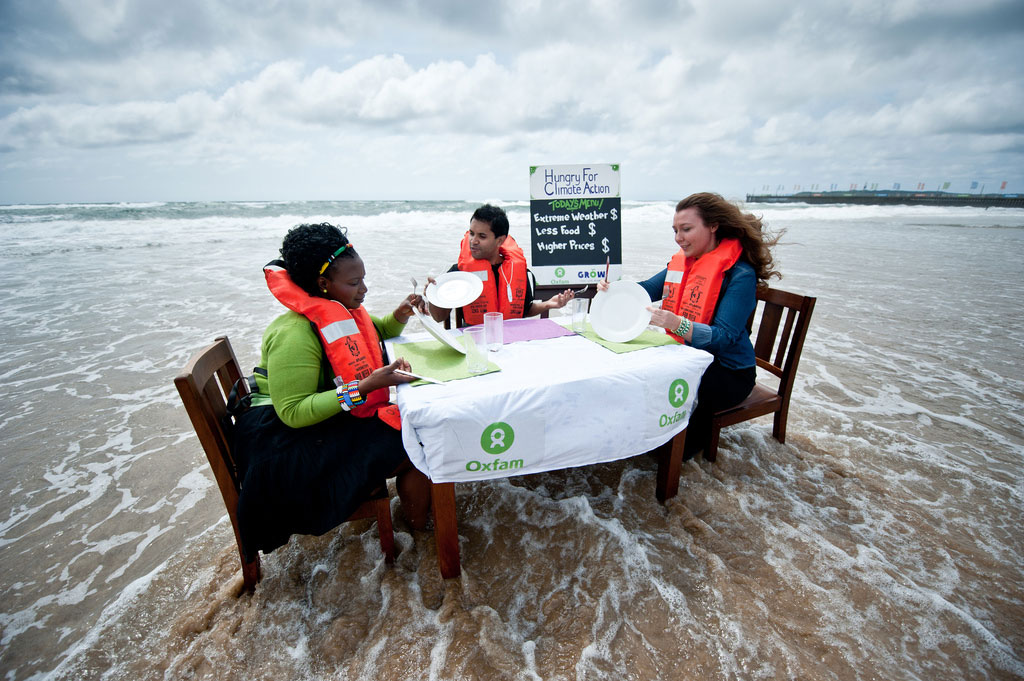
Time to Wake up and Smell the CO2

The Intergovernmental Panel on Climate Change has just released its 2013 report on the state of our global environmental health. Compiled by 259 authors in 39 countries the report paints a sobering picture of our current situation and the consequences that await us in the future should we fail to act. These are not sensationalized facts by an author or alarmist marketing noises from organisations with hidden commercial agendas, but rather a compilation of scientific observations from hundreds of people across the globe.

We’ve been hearing these warnings for years, yet fail to realize that it will take decades, or longer, before we can undo the damage. This issue should not be seen as the responsibility of governments only, but rather as a global business plan that we can all subscribe to in whatever way we can. Seven billion people on the planet all saying, “My small contribution to climate change won’t make a difference anyway,” is exactly the problem – it allows seven billion people to stay locked into the very habits that are destroying our ecosystems.

Many consequences of climate change remain unknown, but can we afford to be surprised one day? You wouldn’t run your business like that would you? Below is a summary of the main findings from the Climate Change 2013 report:
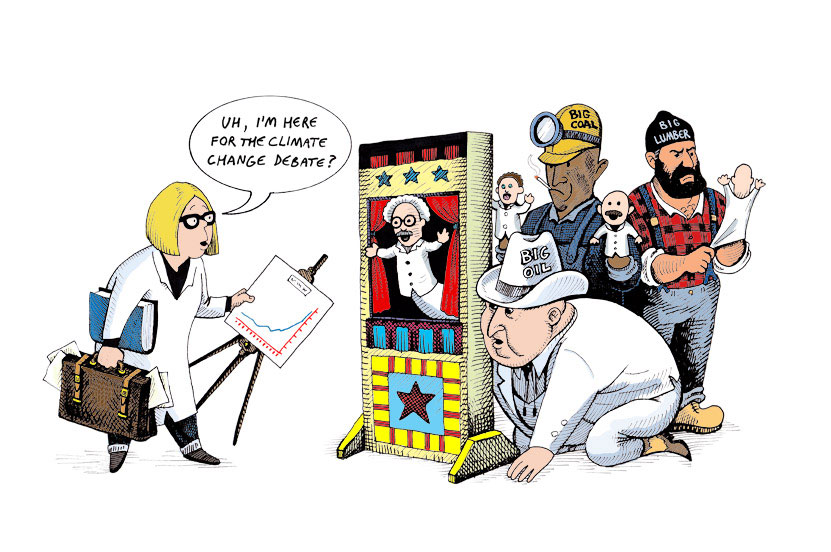
Graphic by Boris Rasin

Graphic by Boris Rasin

Observed Changes in the Climate System

Each of the last three decades has been successively warmer at the Earth’s surface than any preceding decade since 1850. In the Northern Hemisphere, 1983–2012 was likely the warmest 30-year period of the last 1400 years (medium confidence). Ocean warming dominates the increase in energy stored in the climate system, accounting for more than 90% of the energy accumulated between 1971 and 2010 (high confidence).

It is virtually certain that the upper ocean (0–700 m) warmed from 1971 to 2010, and it likely warmed between the 1870s and 1971. Over the last two decades, the Greenland and Antarctic ice sheets have been losing mass, glaciers have continued to shrink almost worldwide, and Arctic sea ice and Northern Hemisphere spring snow cover have continued to decrease in extent (high confidence). The rate of sea level rise since the mid-19th century has been larger than the mean rate during the previous two millennia (high confidence).

Over the period 1901 to 2010, global mean sea level rose by 0.19 [0.17 to 0.21] m. The atmospheric concentrations of carbon dioxide, methane, and nitrous oxide have increased to levels unprecedented in at least the last 800,000 years. Carbon dioxide concentrations have increased by 40% since pre-industrial times, primarily from fossil fuel emissions and secondarily from net land use change emissions. The ocean has absorbed about 30% of the emitted anthropogenic carbon dioxide, causing ocean acidification.

Drivers of Climate Change

Warming of the climate system is unequivocal, and since the 1950s, many of the observed changes are unprecedented over decades to millennia. The atmosphere and ocean have warmed, the amounts of snow and ice have diminished, sea level has risen, and the concentrations of greenhouse gases have increased. Total radiative forcing is positive, and has led to an uptake of energy by the climate system. The largest contribution to total radiative forcing is caused by the increase in the atmospheric concentration of CO2 since 1750.

Understanding the Climate System and its Recent Changes

Human influence on the climate system is clear. This is evident from the increasing greenhouse gas concentrations in the atmosphere, positive radiative forcing, observed warming, and understanding of the climate system. Climate models have improved since the AR4. Models reproduce observed continental-scale surface temperature patterns and trends over many decades, including the more rapid warming since the mid-20th century and the cooling immediately following large volcanic eruptions (very high confidence).

Observational and model studies of temperature change, climate feedbacks and changes in the Earth’s energy budget together provide confidence in the magnitude of global warming in response to past and future forcing. Human influence has been detected in warming of the atmosphere and the ocean, in changes in the global water cycle, in reductions in snow and ice, in global mean sea level rise, and in changes in some climate extremes.

This evidence for human influence has grown since AR4. It is extremely likely that human influence has been the dominant cause of the observed warming since the mid-20th century.

Future Global and Regional Climate Change

Continued emissions of greenhouse gases will cause further warming and changes in all components of the climate system. Limiting climate change will require substantial and sustained reductions of greenhouse gas emissions. Global surface temperature change for the end of the 21st century is likely to exceed 1.5°C relative to 1850 to 1900 for all RCP scenarios except RCP2.6. It is likely to exceed 2°C for RCP6.0 and RCP8.5, and more likely than not to exceed 2°C for RCP4.5.

Warming will continue beyond 2100 under all RCP scenarios except RCP2.6. Warming will continue to exhibit interannual-to-decadal variability and will not be regionally uniform. Changes in the global water cycle in response to the warming over the 21st century will not be uniform. The contrast in precipitation between wet and dry regions and between wet and dry seasons will increase, although there may be regional exceptions.

The global ocean will continue to warm during the 21st century. Heat will penetrate from the surface to the deep ocean and affect ocean circulation. It is very likely that the Arctic sea ice cover will continue to shrink and thin and that Northern Hemisphere spring snow cover will decrease during the 21st century as global mean surface temperature rises. Global glacier volume will further decrease. Global mean sea level will continue to rise during the 21st century. Under all RCP scenarios, the rate of sea level rise will very likely exceed that observed during 1971 to 2010 due to increased ocean warming and increased loss of mass from glaciers and ice sheets.

Climate change will affect carbon cycle processes in a way that will exacerbate the increase of CO2 in the atmosphere (high confidence). Further uptake of carbon by the ocean will increase ocean acidification. Cumulative emissions of CO2 largely determine global mean surface warming by the late 21st century and beyond. Most aspects of climate change will persist for many centuries even if emissions of CO2 are stopped.

This represents a substantial multi-century climate change commitment created by past, present and future emissions of CO2.

The full report can be downloaded here. What are your thoughts on climate change? Can business make a difference and how? Let us know in the comments section below!

Source: Intergovernmental Panel on Climate Change / World Meteorological Organization, Switzerland.


A Leader For All Time

Nelson Mandela has died at age 95. While many still debate his political standpoints, one thing is clear: he was a moral compass for more than just South Africa, his compassion for people reached around the world and influenced statesmen and ordinary people alike. His tenacity and strong will are legendary, part of what has seen him live through unbelievable hardships and challenges, yet stay resolved in his will to see his dream become a reality.

Mandela is a shining example of what a long-term view can achieve, sticking steadfastly to his principles and repeating simple, insightful  phrases along the way until everyone finally gets it. A view that is now so widely accepted among South African’s and many others around the world, that to consider that he spent 27 years in jail for daring to think that diverse cultures might live together peacefully, sounds ludicrous today.

In the 1980’s wearing a T-shirt with Mandela’s image got you five years in jail under South African law. Today his image is everywhere, with hundreds of thousands of T-shirts worn in honour of his legacy and in respect for this remarkable man. It’s a stark reminder of the twists of history and how yesterdays “terrorist’s” can become tomorrow’s respected leaders.

As hard as it might be to believe, President George W Bush only signed a bill removing Nelson Mandela from the terror watch list in 2008, at age 90. Mandela emerged from 27 years of incarceration without an agenda of revenge or remorse. Instead he started rebuilding his dream of reconciliation among South Africa’s racially divided population. His first words were to affirm that all South African’s, whether black or white, were equal citizens and needed to work together to create a “Rainbow Nation.” Along with FW de Klerk, the serving president at the time, he began a negotiated political settlement that focussed on a sustainable future for the entire population.

He was clear that one bad mistake (apartheid) was not to be replaced with another equally extreme system of social engineering. Twenty-seven years of solitude, many of those in a cell on Robben Island measuring only 8-by-8-foot had amplified for him the effect of words and actions when chosen carefully. He has taught us that your background doesn’t have to define you and that change and disruption is a necessary tactic in life, even though most of us would prefer to choose a more comfortable, seemingly certain future.

Although known more for his political views, Mandela can teach business leaders valuable lessons too. A real leader is one whose words and actions are not confined to a sector of society, or even a time of history, but rather ring true and offer value for all time. It’s about finding shared values to cherish, respecting and acknowledging the beliefs of others that are different from yours and ultimately never giving up on an ideal you know has real value for humanity. Below are some of Nelson Mandela’s quotes on a variety of issues.

On speaking Long speeches, the shaking of fists, the banging of tables and strongly worded resolutions out of touch with the objective conditions do not bring about mass action and can do a great deal of harm to the organisation and the struggle we serve.

On the future Many people in this country have paid the price before me and many will pay the price after me.

On challenges Difficulties break some men but make others. No axe is sharp enough to cut the soul of a sinner who keeps on trying, one armed with the hope that he will rise even in the end.

On friendship I like friends who have independent minds because they tend to make you see problems from all angles.

On equality I have never regarded any man as my superior, either in my life outside or inside prison.

On time I never think of the time I have lost. I just carry out a programme because it’s there. It’s mapped out for me.

On death Death is something inevitable. When a man has done what he considers to be his duty to his people and his country, he can rest in peace. I believe I have made that effort and that is, therefore, why I will sleep for the eternity.

On ideology I had no specific belief except that our cause was just, was very strong and it was winning more and more support.

On freedom of expression A critical, independent and investigative press is the lifeblood of any democracy. The press must be free from state interference. It must have the economic strength to stand up to the blandishments of government officials. It must have sufficient independence from vested interests to be bold and inquiring without fear or favour. It must enjoy the protection of the constitution, so that it can protect our rights as citizens.

On character It is in the character of growth that we should learn from both pleasant and unpleasant experiences.

On leadership Real leaders must be ready to sacrifice all for the freedom of their people.

On words It is never my custom to use words lightly. If twenty-seven years in prison have done anything to us, it was to use the silence of solitude to make us understand how precious words are and how real speech is in its impact on the way people live and die.

On life What counts in life is not the mere fact that we have lived. It is what difference we have made to the lives of others that will determine the significance of the life we lead.

On Integrity Those who conduct themselves with morality, integrity and consistency need not fear the forces of inhumanity and cruelty.

On AIDS When the history of our times is written, will we be remembered as the generation that turned our backs in a moment of global crisis or will it be recorded that we did the right thing?

On humour You sharpen your ideas by reducing yourself to the level of the people you are with and a sense of humour and a complete relaxation, even when you’re discussing serious things, does help to mobilise friends around you. And I love that.

On selflessness A fundamental concern for others in our individual and community lives would go a long way in making the world the better place we so passionately dreamt of.

On determination Everyone can rise above their circumstances and achieve success if they are dedicated to and passionate about what they do.

Quotes copyright © 2010 by Nelson R. Mandela and The Nelson Mandela Foundation


Achieving Long Term Exceptional Performance

Authors Michael E. Raynor and Mumtaz Ahmed have set out to understand what truly great, long-term companies have in common versus the once-off, hero-of-the-moment type companies who might only be around for a short time. As business leaders we are constantly being swayed backwards and forwards by the “latest” thoughts and analysis from business experts.

While it’s interesting to read about how these companies came about and the flamboyant characters behind them, how much can the data be trusted in helping to build your company? Raynor and Ahmed, both involved in strategy and innovation at Deloitte, have set out to remove sheer luck and other coincidental criteria to analyze excellence through a cold, hard set of metrics.

Their book, The Three Rules: How Exceptional Companies Think, ignores celebrity infatuation and media hype around innovation, and digs deep into a sea of data from more than 25,000 com­panies spanning forty-five years. Their five-year study began with a sophisticated statistical analysis to identify which companies have truly exceptional performance.

From the initial 344 companies they examined, 27 where eventually put under the spotlight to examine what made these stand-out performers different. These companies are found in the unlikeliest of places and many have never been considered game changers. As they state in the book, “We started our investigation in a sector that, like air, is essential and invisible. America’s trucking companies literally keep the economy moving yet collectively make up what might just be the world’s least glamourous industry.

There has never been a trucking stock-market bubble, never a global crisis precipitated by trucking companies’ risk management practices, barely a whiff of glitz or glamour, not a single save-the-world invention, and no Nobel Prize winners.”

In the early 1980s we were fed international bestsellers such as Tom Peters’ In Search Of Excellence, one of the biggest selling and most widely read business books ever, selling over 3 million copies. Jim Collins followed in the 1990s with the first of four best sellers, Built To Last, Good To Great, How The Mighty Fall and Great By Choice.

While each of these titles became legendary, required reading among aspiring entrepreneurs of the day, they weren’t without controversy. Accusations of skewed data and the premise on which Collins selected companies emerged and questions around what defined “greatness” were levelled at Collins.

While both authors certainly got us thinking at the time and probably inspired many ventures, Raynor and Ahmed have now emerged to re-examine the concept of what makes a remarkable company by focussing firmly on the data. They found that exceptional companies, when faced with difficult decisions, follow three rules:

  1. Better before cheaper. They rarely compete on price.
  2. Revenue before cost. They drive profits through price and volume, not thrift.
  3. There are no other rules. Everything else is up for grabs, and they are willing to change anything to remain true to the first two rules.

Basically, don’t undervalue yourself during tough times, focus on creating value using better services and products before cheaper and stick to rule number 1 and 2 without becoming too distracted. The quest for greatness leads naturally to the study of great companies.

Unfortunately, the study of great companies does not lead to great insights. Moving beyond the entertaining corporate biographies we are fed by the marketing departments and advertising agencies of these companies falls short of the hidden and powerful generalizations that the authors set out to find – that can show who is truly performing over the long term.

“Getting beyond mere storytelling demands that we isolate the effects of a company’s behaviors on its performance from many other significant influencers, such as industry structure, the pace of technological change, unpredictable regulatory regimes, globalization and even dumb luck.” If you’re expecting to be dazzled with cool anecdotes from companies that produce desirable items then this is not the book for you.

Instead, Raynor and Ahmed have focused on “finding signals in the noise” as they put it. They are of the opinion that our intuitions are terrible judges of what constitutes a meaningful difference in performance. A 1 percent return in profits over 3 months sounds more important when it’s scaled up to the same return over 10 years.

The latter feels like a significant difference, yet is this a difference worth exploring, and more importantly, trying to replicate in your business? Raynor and Ahmed divided their findings into three categories, the Miracle Worker, the Long Runner and Average Joe, in a first step to uncovering the behavioral differences that make some companies better than others.

Picking apart typical business strategy plans such as customer focus, smart acquisitions, organic growth and risk-taking, the pair show that neither sound economics nor charismatic leadership are the key drivers in achieving exceptional performance.

The Miracle Workers made choices that were consistent with the three rules mentioned above while the Long Runner’s and Average Joe’s consistently violated them. In a recessionary environment where long-term sustainability has become a crucial objective for many companies it makes sense to remember that role models for exceptional performance are not only found among the cool, fashionable  companies we know so well, but among a broad, holistic field of different sectors that might reveal unlikely leaders.

While Raynor and Ahmed can be overly businesslike and analytical at times, their refreshingly frank views in the book cut through the guru hype of business coaching and deliver hard data that might alter the way you view Fortune 500 companies in the future.


Cleaning Up The Diaper Business

Turning biodegradable diapers into profits in the US$5.7 billion disposable diaper industry.

The lights dim and before an intrigued audience, the latest take on a familiar, everyday consumer good is beamed onto a large screen. The boring, industry-standard color has been replaced with trendy shades of blue, green, pink, red and yellow. The architecture has been redesigned with new and practical considerations, with end users in mind. The item is naturally intuitive to use through well-thought-out, engaging design. An item that no one ever glanced at twice, is suddenly a desirable, must-see fashion accessory.

The latest keynote presentation in Palo Alto? No, it’s the latest diaper, or nappy as it’s being called for the newly launched UK market. A product used in millions of homes every day around the world has just been reinvented, and promises to help save the environment too.

When Jason and Kim Graham-Nye (YPO Oregon) read a report a few years ago citing 50 million diapers were being dumped into U.S. landfills every day, they were astounded. They where even more horrified to learn that it took around 500 years for them to biodegrade. Kim was pregnant with their first child at the time and remembers feeling an incredible sense of responsibility that stretched beyond her pregnancy.

“Along with the awareness of my new baby growing inside me I had this vision of generations that had come before me and those that were yet to come. I thought of the ignorance of past generations who had done so much harm to the planet through bad environmental practices, in complete ignorance, and how we ourselves might be judged by our children in the future one day if we allowed this type of behavior to continue,” says Kim.

Clichés, such as “The planet is not something we inherit, it’s  something we’re looking after for our children,” suddenly rang true with Kim and became very personal to her.

“I could see my kid in the future asking me, ‘Didn’t you see we were going to run out of holes in the earth to dump our garbage?’ Somehow, my reply of ‘well it was just so convenient at the time,’ just wasn’t going to wash,” she explains.

The numbers they had read in the newspaper that day bothered the couple for months. Kim and Jason spent days trawling websites to find alternate solutions to a problem they wanted no part of. Eventually realizing that options in minimizing your toddler’s carbon ‘poop-print’ were limited, and with no prior industrial design or diaper production knowledge, they let the idea go and focused on more immediate issues, the arrival of their first-born. Kim and Jason embarked on the cloth diaper route at first, while still looking for alternatives. They found cloth inconvenient and not very reliable. At last, by complete chance, they came across a diaper online that consisted of a washable outer cover and biodegradable, compostable absorbent pad. While they didn’t invent this technology, the couple immediately saw the potential.

https://notablemagazine.com/youtube-co-founder-from-immigrant-to-multi-billionaire/

Cloth diapers cost around one tenth of disposable diapers and have captured around US$200 million of the diaper market, with disposable cornering a massive US$5.7 billion. Interestingly, the cheaper option has only been embraced by only 5 percent of American families, leaving disposable diapers a clear winner.

Kim and Jason had always been entrepreneurial and had rarely seen a widely available product, such as diapers, that only had two options – cloth or disposable. It was unbelievable to them that no third option existed in a multi-billion-dollar industry, which in other industries of this calibre would have hundreds. It was hard to believe that an opportunity wasn’t to be found here. Some basic observations helped clarify the business plan.

“We couldn’t see 90 percent of the population returning to cloth diapers, especially in this day and age of both parents working, children in childcare and the time constraint of washing and drying diapers. This model was not feasible, but it didn’t mean that plastic disposables needed to be used every day instead. The eco-disposable pad the couple had found online was given a ‘cuteness’ tweak by Kim and gDiapers was in business.

Disposable diapers cost around 10 times more a year, per child, than cloth, yet the couple aren’t marketing gDiapers as the money-saving option. They believe the novelty and environment-friendly aspects more than compensate for this.

“We’ve given our product an emotional appeal,” says Kim, “and in a world where design and user-friendliness have become a major factor in  a product’s success, we’re trying to make people feel good about diapers. Turning this process from a burden to an inspiration is what we’re aiming for.”

Kim has ideas for celebrity designers to contribute to the look of the brightly colored collection, and Jason is eyeing the potential of sports team branding. In the endless search by marketing firms to find untapped sites to place advertising, the couple have inadvertently unlocked a massive market. Move over Hollywood celebs who think it’s cool to expose designer underwear – the toddler market is about to get way cooler.

Kim recently shared a stage with Warren Buffet where she was recognized by Fortune as one of  the top 10 most powerful woman entrepreneurs in the United States. While most people can improve their products or services, Kim and Jason are more interested in how to  run a company in a very different way. At the Fortune event Kim also got to talk to the CEO of PepsiCo, Indra Nooyi, who wields incredible power as leader of the world’s second largest food and beverage business and also as a member of the Foundation Board of the World Economic Forum. Kim found it refreshing that Nooyi shared the same sustainability objectives as the couple – hers on the global stage and Kim’s at a local level (although this is changing fast).

“I think it’s so important for a business to have a code of ethics,” says Kim, whose original thoughts on sustainability had less to do with saving the planet and more to do with wondering if all the excess and disparity she saw around her was necessary. Moving  between developing countries, such as Tanzania, where she lived for many years, and developed countries such as Australia and the United States, has given her perspective on this.

“For me, the issue is more about asking questions such as, ‘how much do we really need and does this really make me any happier? My focus has always been more on humanity, rather than the environment. What happened in 2008 with the global economy really  made me think. Somewhere along the way business lost its conscience. Doctors and lawyers have a code of ethics they need to follow by law, but MBAs don’t. Business is a huge force in society and business owners should have a responsibility to communities, manufacturing supply chains and employees,” says Kim.

“Many people think that by us becoming involved in a sustainable business, it somehow qualifies us as being different from what others can achieve. As if running a baby diaper company gives us the exclusive right to run our business differently. Regardless of what business you’re in, there’s an unconventional paradigm that can be exploited.”

The whole idea of turning the diaper business into a desirable, game-changer has not, however, changed certain expectations among the wider business community when it comes to gender.

While Kim, as both co-founder of gDiapers and a mother marketing to other mothers, has a central role to play in the financial success of her business, it’s Jason’s voice business people want to hear in the boardroom and at presentations. While some of this can be put down to Jason’s innate humour and endearing Australian accent, it does reveal the bigger bias toward men in the world of big business.

“For the last ten years the number of women in senior management roles has stagnated in the United States,” says Kim. “Even Afghanistan has more women in these roles, per capita, than we do. I don’t think this is a conscious decision by our society, it’s more the fact that Americans have not created the platform for mothers to play an equal role in business, while still allowing them to be mothers.”

At gDiapers Kim is president and Jason is CEO. They joke that Kim gets to do all the fun stuff.  As ‘keeper of the brand,’ she gets to do the design and marketing, while Jason ends up with the opposite – legals, board management and raising capital. Although he has embraced social media in a big way and spends many hours tweeting and communicating on Facebook with a growing fan-base of parents.

Kim gives some insight into how they relate as a couple in business. “A couple that communicates clearly is critical. It’s very much like a successful marriage. Negotiations happen every day in a marriage and also in business – there is giving  and receiving along the way. We follow the philosophy of being ‘hard on issues, soft on people’. Nothing ever gets personal.”

With the company now firmly established in the United States, explorations underway in the French and Canadian markets, and the recent launch in the  U.K., gDiapers is set to prove that even the most mundane task or product has the potential to reinvent itself. “We see little value in launching a venture that is solely focused on profit when without a lot of incremental effort, a company can achieve far more, and go some way to changing the world.”

0