

Building the Case for Impact: New Alliance Unites Profit and Purpose

So, you want to spend a career building wealth without regard for its impact on the environment, economy and society, and then allocate a small portion of this later in life through grant-making to create a favorable legacy?

Why not get it right from the beginning, a win-win for all stakeholders that generate positive impacts and financial returns?

It’s an idea for which Fran Seegull fiercely advocates. To say she’s passionate about impact investing’s possibilities is a major understatement; indeed, it permeates her career, education and latest project, the U.S. Impact Investing Alliance.

Seegull is part of a broader effort to make the case that sustainable investing can lead to solid investment returns alongside positive social and environmental outcomes. And she wants to show successful entrepreneurs and executives how they can do it.

Backed by a growing body of research and data, impact investors are continually refining techniques and tools to innovate, identify opportunities and better align investment capital with their values.

For Seegull, the current momentum was a long time coming.

“I began my career at a small family foundation putting grant money to work in very creative ways,” she says. “I started to get more interested in how our endowment was invested and wondered about why a foundation might use 5 percent of their assets to make an impact with grants, only to invest the other 95 percent, probably unconsciously, without regard for its mission.”

She “wondered” her way back to business school as a result, and explored how to use for-profit business models for impact. Seegull’s turning point came with a paper she wrote for her Harvard Business School professor of venture capital examining the nature of value—specifically financial, economic, social, and environmental value—which led to important conclusions.

“One was that, through a model similar to venture capital, you could invest for high financial returns while making a philanthropic impact,” Seegull adds. “The other was that a traditional model of wealth accumulation (and then transfer to a charitable tax vehicle like a foundation) without regard for impact wasn’t the best way to maximize overall societal value.”

What she came away with was a blueprint for her career, eventually landing at impact investing pioneer ImpactAssets as the organization’s managing director and chief investment officer where she developed still more “must haves” for success in the space.

“The first was the fundamental need to create relationships with investors and investees, and the power of connecting the two through shared values and visions for impact.”

The second was an understanding of what drives interest in impact investing, and how to respond to the growing need for more public and private impact investing products, down to the retail level.

“We saw that up close at ImpactAssets, and developed products to meet that demand,” she notes.

The third take away was the importance of infrastructure. According to Seegull, ImpactAssets and other leaders in the field are “building the train cars and laying the train tracks to move impact investing out of the station and down the road.” Ultimately, she said, “Impact investing can’t broaden and deepen without the ecosystem that allows capital to flow.”

What Seegull quickly realized was the infrastructure build-out couldn’t be successful if it remained fragmented and piecemeal. The field needed help, an alliance of sorts, which led to her current position with the U.S. Impact Investing Alliance, which launched in late July.

“The U.S. Impact Investing Alliance is a field-building organization committed to raising awareness of impact investing in the United States,” she enthusiastically explains. “It seeks to foster the deployment of capital across asset classes globally and to work with various stakeholders, including government, to build out that the impact investing ecosystem. Our long-term vision is to put measurable social and environmental impact alongside financial risk and return so it’s at the center of every investment decision.”

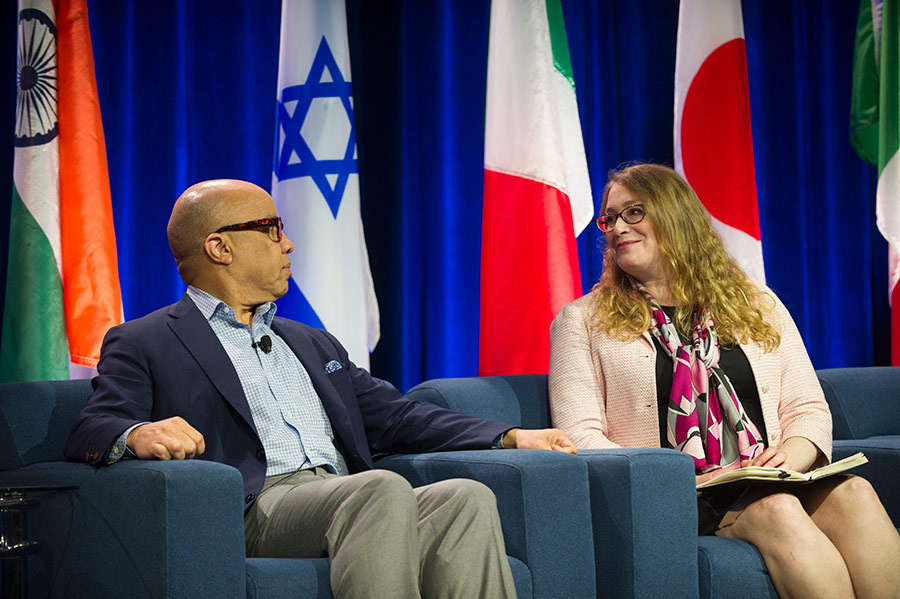
The Alliance has a three-pillar strategy. The first is to advocate for policies that enable impact investing. The second is to “catalyze investor deployment to impact,” and the third is to build a broad impact investing movement. Partners include members of the Alliance’s Advisory Board (chaired by Ford Foundation President Darren Walker), the Industry Advisory Council (including the GIIN and Mission Investors’ Exchange, among others) and the Presidents’ Council on Impact Investing comprising the heads of 20 foundation presidents.

And like any professional organization, the Alliance has a long-term plan which includes greater transparency across asset classes so investors can fully understand the impact of their investments.

“We seek to partner with others in the field to transform finance by moving from a paradigm of shareholder value to one of maximizing stakeholder value.”

All well and good, but what about successful entrepreneurs and executives who are looking to harness the power of business to generate environmental and social benefits while realizing positive financial returns? How do they get involved, and why should they?

“For startups, established entrepreneurs and public company managers alike, I challenge you to consider how social, environmental and governance practices impact your business, because they do. It might be the use of fuels that generate greenhouse gas emissions, or it might be the gender and racial diversity of your boards/management.

“Regarding how to get started with impact investing, there are a number of entry points,” Seegull concludes. “As a plan sponsor, you might look at your 401(k) to see if there are values-aligned choices for your employees. Regarding private wealth, foundations or donor-advised funds, impact investing is a terrific opportunity to sit down with your family to articulate commonly shared values and to explore how those values may or may not be expressed through your portfolios. All investing has an impact. Make sure it’s the impact that you and your family desire.”
 

Why The World Bank Needs a Loan From You

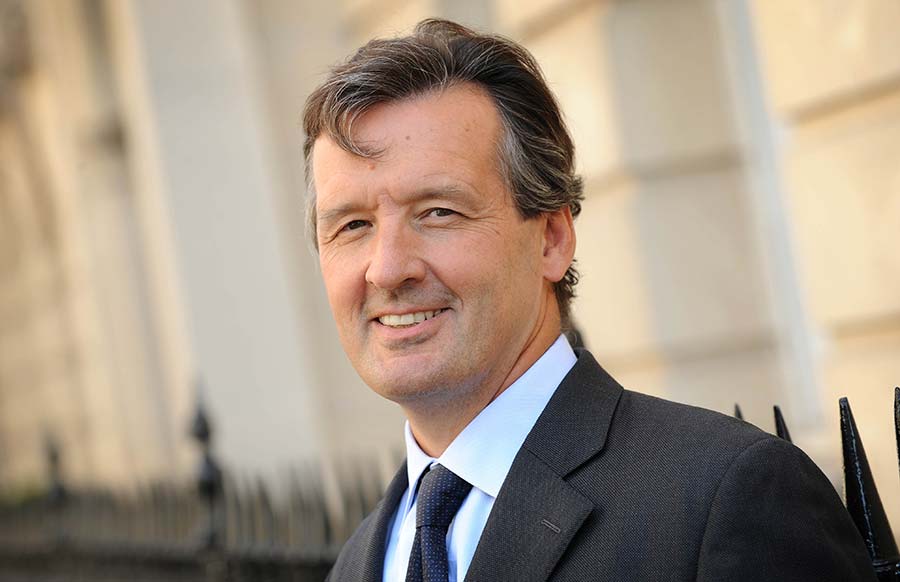
Dr. Jim Yong Kim, head of the World Bank, acknowledges that even their huge budgets are not enough to transform the world into a better place. They need you.

You are head of the world’s leading development and aid organization and your shareholders are in just about every country in the world. Why is your work at the World Bank so important to the private sector?

Not very long ago almost half the world lived in extreme poverty, on less than a dollar a day. Then something interesting happened: China lifted 600 million people out of extreme poverty, and with this rapid growth, uplifted many other countries too. Between 2008 and 2014, emerging markets made up more than half of global growth. We’ve seen an explosion of growth and now only 10 percent of people live in extreme poverty. While an increase in the standard of living is a great success story on one hand, the explosion of technology has created a new, unforeseen dynamic.

Just about everyone can now see how everyone else lives in the rest of the world. Poor people didn’t always know how rich people lived. The new demand for development, opportunity and jobs is huge, and along with it, an increase in the cost of our “sustainability bills,” that we now know are an important part of responsible development. Without the private sector there is literally no hope of getting where we need to go. It’s also in the interests of world peace and stability.

By 2020, as many as half of all people living in extreme poverty will be in conflict with the United States. I have just returned from Tunisia, Jordan, Lebanon and Iraq and the development of a thriving private sector in these countries is the biggest challenge we face, and one that may provide stability to those countries.

How do you engage the private sector?

We have a private sector division within the World Bank that used to be very small, but now occupies a third to a half of our yearly activities. We also try and make economic sense out of complex deals that can deliver benefits to countries and the environment.

As an example, if all countries across Asia proceed with plans to use coal to generate energy, we’ll see the 2 degrees Celsius increase in global temperature we’ve been warned about by scientists. In Vietnam, we found that the cost of coal is around USD9 cents a kilowatt-hour and the cost of solar is around USD13 cents a kilowatt-hour. I asked myself if there was anything we could do to make the country steer away from coal, and go in another direction. Just a month before, I recalled that a private company had offered Mexico a price of USD4 cents for solar on an auction, including storage facilities. My challenge became how to attract private investors to Vietnam, to take their solar price down from USD13 cents down to USD4 cents.

How do you deal with differences in ideology when trying to implement economic change across the world?

Around two years ago I met with Pope Francis to talk about Catholic social teaching. I don’t think he walked into our meeting with a particularly warm feeling about the World Bank. He found a Korean guy speaking comfortably about Catholic social teaching in Spanish. We found that we were both focused on lifting the extreme poor out of poverty, and it was impossible to have an ideological viewpoint that opposed this. We had the same agenda. Even what the Pope desires for the world cannot be achieved without setting up deals to help the private sector engage with poor countries.


Capitalism Gets Reinvented – For a Mere $27


  • Muhammad Yunus solves a social problem by giving micro-loans to the poor – turning them into entrepreneurs.
  • The effects of his first loan, a total of $27 to 42 people, make him realize that people are not poor from being lazy, but because financial institutions do not help them.
  • He forms Grameen Bank, providing loans totalling $16 billion to 8.5 million families in Bangladesh, with almost every country in the world now copying his lending model.
  • In this exclusive interview, the Nobel Peace Laureate tells Real Leaders about the link between peace, jobs and money.

What is your idea of peace?

The lack of violence is a superficial peace. Feeling happy is not peace either. Peace is a balance of all the elements found within society: economic, political and social. When you achieve this you leave no room for confrontation because one segment of society is not enjoying special privilege over another.

Peace happens when one does not disrupt somebody else’s rights. It’s the constant acknowledgement of human rights for everyone. You should be allowed to lead your life according to your own desires and beliefs. This applies to people, entities and states alike.

How would you activate peace in the world?

We need to redesign the economic system. This is the only way, because the current system is unsustainable.

We need to work towards the creation of zero poverty, zero unemployment and zero net carbon emission by 2050 to close the widening gap between rich and poor. If we all create strong social businesses we can completely transform the world.

We all have the option of being an entrepreneur. Young people should be told that they should not start their lives as job seekers; they should start as job creators. More and more people should develop the potential to become job creators.

We should not live a life on this planet without caring for the future safety of it and should be careful how we use its resources. We should be aware that we have to ensure that future generations can enjoy their lives with the resources we leave behind. We shouldn’t use all the world’s resources and leave nothing for them. We must take good care of – not just for the next five or ten generations, but for all generations to come

The new world of business will have three elements, each equal in importance: people, planet and profit. A world that is only money seeking is not good, it has to come to an end. If not, it will put us to an irreversible path towards social, economic, and environmental disaster.

What is the biggest threat to world peace right now?

The unsustainable nature of world economics and social structures. A huge number of people in the world have nothing, and a handful of people – you can literally count them in the hundreds – own all the wealth of the world.

The vast majority on the planet control less than one percent of the world’s wealth while a few people and families control around 90 percent. That’s not sustainable. Then you have the environment – under threat from a carbon-based economy. Producing carbon is creating an unsustainable planet.

Do you think the planet can sustain a world that is all middle class? Are there enough natural resources?

No, you will need to undo the present system to achieve this. At present, wealth is like a magnet: if you have a small magnet you attract small amounts of additional wealth. If your magnet becomes bigger you attract more, sucking up resources for yourself while others remain empty-handed.

Under the present economic framework, human beings are imagined as being a selfish species, wanting simply to enhance personal wealth. This is a wrong perception of who we really are. Real human beings are not just moneymakers and selfish, they are equally caring, sharing and selfless beings. They are a combination of selfishness and selflessness.

Today selflessness is imagined to be a feature of some special people, the philanthropists, who make money first and then donate it to help others. They do wonderful work but philanthropy has a limitation – it’s not sustainable. Philanthropy money does not come back, it has a one-time use. Social business is a better solution as it has the goal of philanthropy and the sustainability of business.

I consider employment an artificial creation of our present system. From an early age we are told that we need to find a job. This is a wrong perception. Human beings are not made to work under someone else. Human are go-getters who can solve their own problems. We are all basically entrepreneurs, yet we are teaching our children that they need education to get a good job. This is absolutely the wrong message. Each child should grow up to become an entrepreneur, a creative person who believes they can do things on their own.

Is business more powerful in solving problems than governments?

Definitely not the businesses we see around us who are not concerned with the problems of the world. They are too busy making money for their shareholders. But social businesses, yes, they are built to solve people’s problems. There should be no conflict between a business and a social business. Governments should support them because they are in business to solve social problems. If you leave things to the present business model, I’m sorry to say we won’t have a good future.

What is the most valuable lesson you’ve learned on your journey as a leader?

That people are good and given an opportunity they will do the right thing. The political, economic and social systems we have created for ourselves have pushed good people to do wrong things. These systems have not created alternative options for us as human beings.

Was there anything that held you back when you started your business venture?

I didn’t have any doubts because I didn’t have any plans. When you have a plan, you have doubts. I was pushed by circumstances and was so desperate that I just jumped in.

Every day I saw people being financially exploited in cruel ways, with tiny loans from loan sharks. I reflected that this was a problem no one had ever solved before. It was a global problem and I knew that I was just one small guy. I decided that I couldn’t solve the whole world’s problems, but could solve the problems of a few.

I start giving loans with my own money, without any intention of making money for myself. People came to me for loans and I could help solve their problems. I took money from my own pocket and started lending to people. I wasn’t thinking of banking at that stage; simply trying to protect people from loan sharks. It kept growing and I eventually created Grameen Bank in 1983, based on the same values and principles as when I first started lending.

Some opposed me but I didn’t get upset. I thought it was part of the process that you have to go through. If you do something new, naturally some people who get affected will oppose you.

What is a real leader?

A leader enjoys the company of other people and has an ability to inspire them. It’s not about power and giving orders. You may not carry a title or hold a position, but people will admire you for what you say, what you do and how you live your life. People see consistency in words and work and you shouldn’t say one thing and do something else.

Leadership is about vision, if you see and think ahead, people follow you because they are convinced that you see more than they do. Others will believe in you because you have shown them a better way of doing things which they never believed possible.


Making Money Matter

Nick O’Donohoe moved from big finance to a big society bank when he realized that investment meant more than just money in the bank.

If you have a U.K. bank account that has been lying dormant for longer than 15 years, there’s a good chance Big Society Capital (BSC) now has your money. O’Donohoe is former CEO of Big Society Capital (BSC); a U.K. based social investment company and the world’s first social investment bank. He is now Senior Advisor to the Bill and Melinda Gates Foundation and spoke to Real Leaders about the innovative, world-first approach adopted by BSC.

It was formally launched in 2012 with an estimated £600 million of equity to be paid-in over five years. £400 million of this is from unclaimed assets left in dormant bank accounts for over 15 years. In 2004 Prime Minister Gordon Brown first put the idea on the table for unclaimed assets in bank accounts to be handing over to worthy charities, but it was David Cameron in 2010 who finally announced the £60 million seed funding for a “big society bank” that would enable charities, social enterprises and voluntary groups to take over the running of public services.

“These unclaimed assets, alongside the private sector investment that are leveraged, will mean that the big society bank will – over time – make available hundreds of millions of pounds of new finance to some of our most dynamic social organizations’,” Cameron said at the time. Brown had been forced to back down from critics who warned of administrative chaos and questions around whether the government had the right to seize the funds. Legislation was passed in 2008 finally paved the way for Cameron’s announcement two years later and the Dormant bank and Building Society Act was passed, giving the government the right to collect and distribute money from dormant accounts after 15 years.

O’Donohoe explains that the Dormant Accounts Act gave three choices at the time, around what to do with the money. One was to capitalize a social investment wholesaler (us), a second was to support youth activities and a third was for financial education. The government ended up liking the idea of a social investment bank so much that they decided to dedicate all the funds to BSC. O’Donohoe’s personal journey, into what become social finance, began around five years ago when he worked for JP Morgan Chase. Born in England, raised in Ireland and educated at Wharton in the U.S.A., he initially worked for 12 years at Goldman Sachs and then spent the next 15 years at JP Morgan Chase, running the European Equity division and then Global Head of Research.

In 2008 JP Morgan Chase identified a need for a social finance group. It was the brainchild of CEO Jamie Diamond, who felt the company could provide leadership and development in the relatively new areas of social finance, impact investing and social investing. “It was a really new idea at that time,” says O’Donohoe. “He wanted the bank to provide some leadership and someone at the bank to do it.

He wanted someone from the management committee to oversee it, and I got asked.” O’Donohoe was only supposed to spend a small amount of his time supervising this uncertain venture, but he soon got deeply involved in the new social finance group and produced an early research paper on impact investing.

At the end of 2010 a report they produced on impact investing as an emerging asset class became quite influential and that brought him into contact with some influential, like-minded people in the UK. “I met Sir Ronald Cohen, a founding partner of large private equity firm Apax, that had been developing a social investment agenda in the U.K. for more than a decade,” says O’Donohoe.

They also had a list of values that listed integrity, responsibility, sustainability and community among the core pillars of their business, something lacking among the bull-run approach of many other financial institutions at the time. Nick Hurd, a minister in the U.K. government was, at the same time, also looking for someone to set up the Big Society Bank, as government officials had coined it.

“It was intended to be a financial institution that developed a world of social investment, that helped to connect charities and social organizations with capital markets and helped them to raise and borrow money more easily,” says O’Donohoe. “It also aimed to develop social impact bonds, another way of funding charities.” Even though Ronnie Cohen was more closely associated with the government, they asked O’Donohoe to help, because of his experience with social investment at JP Morgan Chase.

“I’d been in banking for 28 years, but was at a stage in my life where I wanted to do something different, something that would make a contribution to the community and society.

“BSC is not really a bank,” says O’Donohoe. They don’t take deposits, other than the dormant account money and another £200 million pounds of investment from the four major U.K. banks. The significant political support in the beginning certainly helped, even though the original brand became slightly tarnished because of its political roots.

As witnessed with many idealistic government programs around the world, private enterprise involvement usually offers a better chance of success, but the high level political support BSC received at the outset has certainly helped get them to where they are today. O’Donohoe has always had a social conscience. His father was a doctor and his mother a social worker. “When your father’s a doctor you’re constantly aware of the fact that he’s out there every day, making a material difference to people’s lives,” says O’Donohoe. “Regardless of people’s wealth or ethnicity, that’s what doctor’s do.

I was given that awareness from an early age and even though I never regretted becoming a banker there was always that thought in the back of my mind asking, ‘Is this my purpose in life, helping rich people get richer?’

“Banks do fulfill a vitally important role in any sort of market economy, and the fact that we’ve had problems in the banking sector over the last few years seem to have created a bad impression around financial services. I was very lucky at JP Morgan Chase who were a safe port in the storm and weren’t implicated the way other banks were.

My journey to BSC was less about running away from something, and more about making a broader contribution to the world. I knew this would earn me a lot less money, but it would have a better defined purpose for my ideas,” explains O’Donohoe. Looking back, O’Donohoe sees the credit crisis as the catalyst for the development in the current social investment industry, and a signal to those with alternative solutions to step forward.

The nature of capitalism seems to be changing fast, yet won’t fundamentally affect the core financial markets for a while yet, according to O’Donohoe.

“It’s like turning a supertanker; it’s going to take a long time for a new direction to materially change our institutions.  What we’re seeing now, even beyond the world of investment, are companies and banks becoming much more aware of their role in the community. It’s changing the way they behave, making them more sensitive and aware towards environmental and social and governance issues.

Change is evident if you look back 10 years and compare. There now exists a whole impact and social investing movement, driven by individuals and institutions that want their money to do more than only deliver a financial return.

You’ll increasingly see companies doing more to furnish their environmental, social and governance criteria, and you’ll see an increasing number of investment opportunities, that offer more than financial return. In the future we’d like to see every investment being an impact investment.

In addition, companies and organizations will need to be doing good in order to attract investment and become much more transparent about how they conduct their business,” says O’Donohoe.

An immediate question might be why anyone would choose investments that are not social one’s. Why do people still invest in mainstream, ‘traditional’ funds when there is now clearly an alternative? O’Donohoe thinks we’re at the beginning of a long journey and looks to history to put things into perspective.

“It might take decades for this to play out.  We’re presently trying to encourage social investing, which means investing that delivers impact as well as actual monetary return. For this to be effective, we have to measure impact. How do we do that? There’s no consistency around how social impact can be measured, graded or evaluated. It took around 200 years for accounting principles to develop, so unlearning old ways of seeing the world can take time.”

Most funds have track records to prove to investors that they’re worth investing in. The impact investment industry has almost no such track record, and there’s no shortcut to creating a five or ten year track record. Data has to be generated, captured and analyzed, by tracking real investments and loans, for this market to grow. “Much of what has been developed for the impact investment market is very risky,” says O’Donohoe.

“You’ll find a lot of this investing is done with very small companies, often in deprived parts of the world, and it’s risky. There are many people who want to invest in companies that are developing education for the poor in Africa, or portable housing in India, and also many local U.K. investors who prefer very low risk, secure, reasonable yielding bond funds that channel money to charities or to other social enterprises. Regardless, the low-risk end of the impact investment market needs to be developed.”

“Today’s young entrepreneur wants to start a company with a dual purpose. Yet a big barrier to social enterprise, evident in most countries, are the two legal formats that exist for business.  One form is a charity, where you give away your money and the other is a for-profit company, seeking to maximize profits. The idea of a dual-purpose company is not embedded in any clear legal form yet and there’s a growing demand for it. When I speak at business schools, you hear that voice very clearly.”

Within the current crop of global business leaders, O’Donohoe sees a lack of knowledge around social investment. “If you asked a leading CEO whether they would consider making a social investment, they would probably say yes. If you asked whether they already had, they’d probably say no. If you asked why they hadn’t they’d reply, ‘We don’t know what they look like, we don’t know who does this type of investing or, our advisors don’t know anything about them,’” says O’Donohoe.

“A short-term goal, over the next three to five years is to simply educate  everyone to know what a social investment product looks like. That they’re available across a range of products and services, and that they’re available from mainstream as well as specialist organisations.”

“Ten years ago no-one had heard of corporate social responsibility,” says O’Donohoe. “A lot of people like to criticize it, but the fact is, at least we’re conscious of it now. Many large, global companies like Unilever are really at the cutting-edge of using their financial and human resources and global footprint to make a difference to important social issues. More transparency around this, and a desire to be rewarded will ultimately change big business, because change will happen more quickly if consumers are willing to reward companies for how they run their business.


0