Tesla’s New Solar Roof Can Make Money From The Sun

Elon Musk has just put your old, unemployed roof to work – by creating one that converts the suns rays into energy that will power your home. If you’re lucky, you may even earn some money from it.

Innovative electric car manufacturer Tesla has announced the U.S. rollout of its glass, solar roof tiles, with worldwide orders expected to be fulfilled next year. Solar panels on roofs are nothing new, but instead of fixing a standalone (and let’s face it, ugly) panel to your beautiful slate or clay tiled roof, you can now turn your whole roof into one big solar panel. And the results are stunning – both visually and financially.

According to Tesla, their mission is to “accelerate the world’s transition to a sustainable energy future by creating products that are so compelling, there is no alternative.” Solar energy has always been part of their master plan, and like their groundbreaking electric cars, have recognized the need for a roof that is simultaneously affordable, durable, beautiful and integrated with battery storage.

Solar Roof complements a home’s architecture while turning sunlight into electricity. With an integrated Tesla Powerwall unit, energy collected during the day is stored and made available anytime, effectively turning a home into a personal utility. Solar energy can be generated, stored and used day and night, providing uninterrupted power even if the grid goes down.

And here’s what should convince you if saving natural resources seems too much of an effort: Solar Roof is more affordable than conventional roofs because in most cases, it ultimately pays for itself by reducing or eliminating a home’s electricity bill.

Consumer Reports estimates that a Solar Roof for an average size U.S. home would need to cost less than $24.50 per square foot to be cost-competitive with a regular roof. The cost of Solar Roof is less. The typical homeowner can expect to pay $21.85 per square foot for Solar Roof, and benefit from a beautiful new roof that also increases the value of their home.


As an example of total cost, the out-of-pocket cost of a Solar Roof for a typical home in Maryland will be around $52,000, but after considering a 30% federal tax credit (in the U.S. only) and the value of energy it generates, the roof will actually pay for itself and earn you about $8,000 over 30 years, according to Tesla.

Solar Roof uses two types of tiles – solar and non-solar. Looking at the roof from street level, the tiles look the same and homeowners can select how many solar tiles they need based on their home’s electricity consumption. For example, households that charge an electric vehicle every day may want more solar tiles on their roof.


In doing research on the roofing industry, it became clear to Tesla that roofing costs vary widely, and that buying a roof is often a worse experience than buying a car through a dealership. Initial contracts tend to be overly optimistic, and later customers face hidden costs that were never mentioned up front. In the spirit of transparency Tesla has created a Solar Roof calculator that lets homeowners estimate the upfront price of a new roof, as well as the value of the energy it can generate for their home. The calculator is based on factors like roof size, the average local price of electricity, and how much sunlight a neighborhood receives throughout the year.

Made with tempered glass, Solar Roof tiles are more than three times stronger than standard roofing tiles, yet half the weight. They do not degrade over time like asphalt or concrete and the glass itself will come with a warranty for the lifetime of the house, or infinity, whichever comes first. Oh, and they’ll also cart away your unemployed, lazy roof that’s been hanging over your head for years.


Exaggerated Truth-Telling Is Commonplace, But Not Admirable

In 1919, as the White and Red armies fought a brutal, seesaw war for control of Russia, British War Secretary Winston Churchill prodded his government to commit troops to the fight.

The Bolsheviks, he declared, were “swarms of typhus bearing vermin.” They “hop and caper like ferocious baboons amid the ruins of their cities and the corpses of their victims.” Churchill’s rhetoric was so inflammatory that, after he addressed the House of Commons on the topic, Tory Party leader A.J. Balfour felt compelled to comment. With quintessential British coolness, the former Prime Minister told the future Prime Minister, “I admire the exaggerated way you tell the truth.” 

Unfortunately, exaggerated truth-telling is as commonplace in business as in politics. Walter Isaacson cites Steve Job’s “reality-distortion field” repeatedly in his go-to biography of the Apple’s mercurial chief. “[Jobs] would assert something—be it a fact about world history or a recounting of who suggested an idea at a meeting—without considering the truth,” writes Isaacson. He would conjure up an impossible production date, for instance, and demand it be met. Surprisingly, as Isaacson recounts, it often was.

Elon Musk seems to have picked up Job’s penchant for exaggerated truth-telling. Musk says that Tesla’s factory in Fremont, CA will produce as many as 500,000 vehicles in 2018—an “extraordinary leap in production” from less than 84,000 in 2016, according to Jeff Rothfeder’s insightful analysis in The New Yorker. Can Musk’s employees and suppliers deliver on his promise or is this exaggerated truth-telling? Well, as The Wall Street Journal calculates it, Tesla has missed Musk’s projections more than 20 times in the past five years.

The problem is that exaggerated truth-telling is a two-edged sword. If your exaggerations can be transformed into reality, you’re a hero. If not, you’re on a slippery slope. If she didn’t know that before, Elizabeth Holmes should know it now that her $4 billion stake in Theranos, the company she founded to disrupt blood testing, has evaporated and the lawsuits are piling up. So, too, should Josh Tetrick of Hampton Creek and the leaders of Volkswagen.

Winston Churchill was, of course, one of the greatest communicators of the 20th century, and business leaders can learn a lot from his rhetorical prowess. But as you study him, keep this in mind: When University of Exeter historian Richard Toye examined contemporaneous reactions to the WWII speeches that are the most cited evidence of Churchill’s reputation as a communicator, he found that they did not produce “unanimous or near unanimous rapture” in the British people.

Plenty of listeners found them depressing and alienating—especially when the news of the war was bad. The greatest value in Churchill’s WWII speeches turned out be the information and perspective they communicated. Even Churchill’s formidable command of language was “no substitute for meaningful content,” concludes Toye.

This finding might explain why the British government ignored Churchill’s exaggerated truth-telling in 1919 and withdrew from Russia, rather than escalate its involvement in the fight against the Bolsheviks. It also should give today’s business leaders pause as they craft their own communiques.


India’s Solar Farm Overtakes California’s as World’s Largest

India has overtaken California and now has the largest solar farm in one location in the world. It was built in a record eight months, despite monsoons and floods.

The vast 2,500 acre site in Tamil Nadu is the size of nearly 60 Taj Mahals, while the area of the solar panels alone could hold 476 football pitches. And, during the construction, just the storage area was the equivalent of 6 Sydney Opera Houses.

The southern Indian solar farm can generate 648 megawatts of clean, green electricity. By 2022, India aims to power 60 million homes by the sun. This will help propel India as a world leader in renewable energy generation.

Vneet Jaain, CEO of Adani Power, says, “Before us, the largest solar power plant at a single location was in California in the U.S. That was 550 MW and was completed in around three years. We wanted to set up a solar plant of 648 MW in a single location in less than a year.”

The enormous solar farm took just eight months to build by 8,500 people in Kamuthi, Ramanathpuram, in the southern state of Tamil Nadu – a staggeringly short amount of time, given the sheer scale of the project and the massive floods and monsoon in the region at the time of construction.

The plant comprises of 380,000 foundations, 2,500,000 solar modules, 27,000 metric tonnes of structure, 576 inverters, 154 transformers and 6,000 km of cables (that’s almost the equivalent distance of India to Australia). The overall cost of the mega-structure was approximately U.S. $679 million.

Chairman of the Adani Group – the company who owns the solar farm – Guatam Adani says, “We have a deep commitment to nation-building. We plan to produce 11,000 MW of solar energy in the next five years, putting India on the global map of renewable energy.”

The huge number of solar panels is cleaned daily by a robotic system, itself charged by its own solar panel. The solar farm is part of the Indian government’s ambitious targets to reduce carbon emissions by 33-35% and to produce 40% of its power by non-fossil fuels by 2030.


Business Can’t Solve The World’s Problems. But Capitalism Can

Business and capitalism get conflated — in our media, in our language and in our thinking. They are not the same thing. One is a sector, the other a methodology.

By inextricably linking the two, we confine the practice of real, turbo-charged capitalism to business, and we dangerously limit the capacity of non-business organizations to innovate, fund and bring to scale the kind of breakthrough ideas that will begin to solve the huge social problems we face today.

To be sure, business can change the world. That is one of the things it does, consistently. Innovations such as the assembly line, the car itself, the distribution of electricity and gasoline, and now the iPad, Google and so on have by many measures made the world a better place. Indeed, as Carl Schramm writes in his provocative essay, “All Entrepreneurship Is Social,” the fashionable new term “social business” in some ways “diminishes the contributions of regular entrepreneurs…people who… create thousands of jobs, improve the quality of goods and services available to consumers, and ultimately raise standards of living.”

He uses the refrigerated box car and its achievements in reducing food-borne illness and saving millions of lives in the process to make his point. Business will move the great masses of humanity forward with advancements in pharmaceuticals, materials, process and technology — but it will almost always leave 10 percent behind. It will almost always leave unaddressed humanity’s most disadvantaged and unlucky. Even social business will not address those issues for which markets cannot be developed. I serve on the board of a center for the developmentally disabled. More than anything, its clients need love. How do you monetize that?

This is where philanthropy comes in. Philanthropy is the market for love. The word itself derives from the Greek for “love of humanity.” Philanthropy and, specifically, the charities that benefit from it and that are chartered to solve social problems can address those people and issues that business leaves behind. But they can do so effectively only if we allow them to use the tools of capitalism — tools that the sector has thus far been denied, nearly wholesale.

We have two rulebooks — one for charity and one for the rest of the economic world. We blame capitalism for creating huge inequities in our society, and then we refuse to allow the “nonprofit” sector to use the tools of capitalism to rectify them. This nonprofit rulebook discriminates against charities in at least five different areas: compensation, marketing, risk taking, time horizons and capital itself. We allow people to make a fortune doing any number of things that will harm the poor but crucify anyone who wants to make money helping them.

This sends the top talent coming out of the nation’s best business schools directly into the for-profit sector and gives our youth the mutually exclusive choice between making a difference and making money. This we call ethics. We let Apple Inc. and The Coca-Cola Co. plaster our billboards and television sets with advertising, but we are appalled at the notion of important causes “wasting” money on paid advertising.

So the voices of our great causes are all but silenced, and consumer products get lopsided access to our attention, 24/7. This we do in the name of frugality. Amazon Inc. was permitted to forgo investor returns for six years to build market dominance. But if a charity embarks on a long-term plan with no return for the needy for six years, we are outraged.

This we call caring. We aren’t upset when The Walt Disney Co. makes a USD200 million movie that flops, but if a USD1 million charity walk doesn’t make a 75 percent profit to the cause in year one, we want the attorney general to investigate. So charities are petrified of exploring new revenue-generating methods and can’t develop the powerful learning curves that the for-profit sector can. This we call prudence. We let for-profit companies raise massive capital in the stock market by offering investment returns, but we forbid the payment of a financial return (“profit”) in charity. The result? The for-profit sector monopolizes the capital markets, while charities are left to beg for donations. This we call philanthropy.

Combine those five things and you have just put the humanitarian sector at an extreme disadvantage to the for-profit sector. Yet we still expect it to solve the world’s problems. Our social problems are gigantic in scale. We need gigantic responses to them. And if we freed the humanitarian sector to use the tools of capitalism, we could bring private ingenuity to bear on those problems, and we wouldn’t have to depend on the government to fill the gaps.

Where would all the money come from? From us! If we were to give the humanitarian sector the right capital, talent, time, and ability to innovate, it could build the kind of demand for philanthropy that, say, Apple builds for music on iTunes (which, by the way, stimulates the same reward centers in the brain as giving). Then we’d be on our way to the kind of scale we need.


US$2.3 Trillion by 2030 From New Business Models in Food & Agriculture

New research shows sustainable business models could generate 80 million jobs by unlocking opportunities across 14 areas, including food waste, low-income markets, aquaculture and urban agriculture.

There’s a reason why Real Leaders is a signatory to the United Nations Sustainable Development Goals – it makes financial and ethical sense. The 17 goals to transform our world started out as far-fetched ideas, but are rapidly being put into action by companies around the world, that have seen the economic benefits to adopting a way of thinking that solves pressing social problems. Feeding 7.5 billion people on the planet is one such challenge and the food and agriculture sector has just realized the massive benefits to adopting sustainable business models.

Companies could unlock US$2.3 trillion a year in the food and agriculture sectors with an annual investment of US$320 billion in sustainable business models by 2030, a 7-fold return on investment. This could also lead to more than 80 million jobs, according to a new report, Valuing the SDG Prize in Food & Agriculture, from the Business and Sustainable Development Commission. The release of the report coincides with World Food Day 2016 (which is Sunday 16 October).

The opportunities are broken down across 14 areas, including food waste, farming technology, low-income food markets, micro-irrigation, restoring land and forests, product reformulation, changing diets, aquaculture, reducing package waste, cattle intensification and urban agriculture. Researchers estimate a range of value for each opportunity; the lowest in the range is US$15 billion per year (for cattle intensification) while the highest goes up to US$405 billion per year (for reducing food waste across the production process, or value chain).

Of the 80 million jobs the report estimates could be created by 2030, 90% could be in developing countries, including 21 million in Africa and more than 49 million in Asia. The report further breaks down job creation potential in Asia to 22 million in India, 12 million in China, and the remaining 15 million in developing Asia. There could also be an additional 5 million new jobs in Latin America.

“As the world’s population is expected to increase by another one billion by 2030, the global food and agriculture system requires a new way of doing business, and new approaches to feed more than 800 million people who today suffer from chronic hunger as well as to meet future demand,” said Lord Mark Malloch-Brown, Chair of the Business and Sustainable Development Commission. “This report makes clear both the social and economic incentives for companies to seize upon the SDGs as compelling growth opportunities. It is part of our larger argument for why the private sector must accelerate new business models that open truly sustainable and inclusive markets.”

The authors caution that the annual investments needed to open these market opportunities must be scaled significantly, requiring an estimated US$320 billion a year to unlock these opportunities by 2030. They argue that the current capital base in 31 leading agriculture funds is just under US$4 billion a year—less than 1.5% the annual investment needed to capture these opportunities. Partnering with government will also be critical to put in place enabling policies and the right regulatory frameworks as well as to advance research for facilitating product innovation.

The report looks at how food and agriculture businesses can experience growth by pursuing sustainable and inclusive business models aligned with the Sustainable Development Goals (SDGs), or Global Goals. Launched in 2015, the SDGs are 17 time-bound targets for ending poverty and hunger, reducing inequality and tackling urgent challenges such as climate change, by 2030. The food and agriculture sectors directly relate to SDGs 2 (ending hunger), 3 (health & well-being), 8 (decent work and economic growth), 10 (reduced inequalities), 12 (responsible consumption and production), 13 (climate action), 14 (protect life below water) and 15 (protect life on land), but they are cross-cutting sectors that also affect the remaining Global Goals.

The research shows that developing countries have the most to gain from SDG-aligned business opportunities, capturing more than two-thirds of the estimated economic value due to their large shares of arable land, high future consumption growth and large potential efficiency gains. Across regions, the biggest business opportunity in developing Asia is in cutting food waste across the value chain; while in developed Asian countries like South Korea and Japan, the opportunity is greatest in consumer waste. In India, low-income food markets are the strongest opportunity for businesses, and in Latin America and Africa, it is forest ecosystem services.

Paul Polman, CEO of Unilever and member of the Business and Sustainable Development Commission, urges more food and agriculture companies to integrate sustainability practices into their models: “Unilever’s experience clearly demonstrates that business, can create value by putting sustainability at its very heart and adopting inclusive growth models. At Unilever, we have helped hundreds of thousands of smallholder farmers improve agricultural practices enabling them to double or even triple their yields. All stakeholders can share in the benefits: Smallholder farmers improve their livelihoods; suppliers gain increased security of supply with improved quality; and we reduce volatility and uncertainty with a more secure and sustainable supply chain. The SDGs present a clear moral case for change, but companies must recognise that they represent the business opportunity of a lifetime too and must adapt to take advantage of it.”

Companies will need to operationalize sustainability across its supply chain and internalize social and environmental costs, while transforming consumption. Unlocking social and economic rewards in food and agriculture will require closer collaboration among business, government and society, and new ways of working together to advance common social, economic and environmental objectives.

If the private sector can put these prerequisites in place, the social benefits, including food security, job creation and health outcomes, could be significant. Improving technology in smallholder farms and restoring degraded land, for example, could double the incomes of smallholder farmers in the world, who are among the poorest in the global economy, the report finds. According to the UN, of the 2.5 billion people in poor countries living directly from the food and agriculture sector, 1.5 billion people live in smallholder households.

“The best way to build an enduring business is to put sustainability at its heart. Value is then unlocked for all, from shareholder to supplier, and nature is not depleted.  Values and value creation do not have to, and actually should not be, traded in the long-term.” said Sunny Verghese, Co-Founder and Group CEO of Olam, a global agribusiness with a portfolio of 47 agri-commodities, and a member of the Business Commission.

“Many commentators have incorrectly perceived the SDGs to represent an additional headwind to growth and profitability. The reality is that in many cases the SDGs offer a new and higher quality channel for economic growth and business profitability,” said Dr. Fraser Thompson, Director, AlphaBeta, which conducted the research for the Business Commission. “This is particularly the case in these sectors. This study is the first attempt to provide a holistic assessment and quantification of the business opportunities related to the SDGs in food and agriculture.”

Valuing the SDG Prize in Food & Agriculture is part of a larger body of research that quantifies the value of business opportunities across four key systems, including cities, health and well-being, and energy and materials. The findings for these systems will be revealed in the Business Commission’s flagship report, to be launched in January 2017. The report will show how the Sustainable Development Goals (SDGs) —17 objectives to end poverty, reduce inequality and tackle climate change and other urgent challenges by 2030—provide the private sector with the framework for achieving sustainable and inclusive growth. The report will also cover the new business models and financing required to open these opportunities, and will include key action points for the private sector to take the findings forward and accelerate. 

 

What Tech Executives Don’t Understand About Talent

In a recent interview, IBM CEO Ginni Rometty said what most tech executives say about the growing talent shortage.  She said we need more STEM education.  She advocated channeling more students in to science, technology engineering and math courses. That’s of course the conventional wisdom . . . but it’s wrong.  Well, not so much wrong as it is incomplete.

What Ginni is missing in her message is that that the future doesn’t belong to the scientist or coder. It belongs to the people who can lead and collaborate with teams of scientists and coders.  The future belongs not so much to people with technical intelligence as it does to people who have emotional and social intelligence. It’s group intelligence that matters.  Here’s why.

work

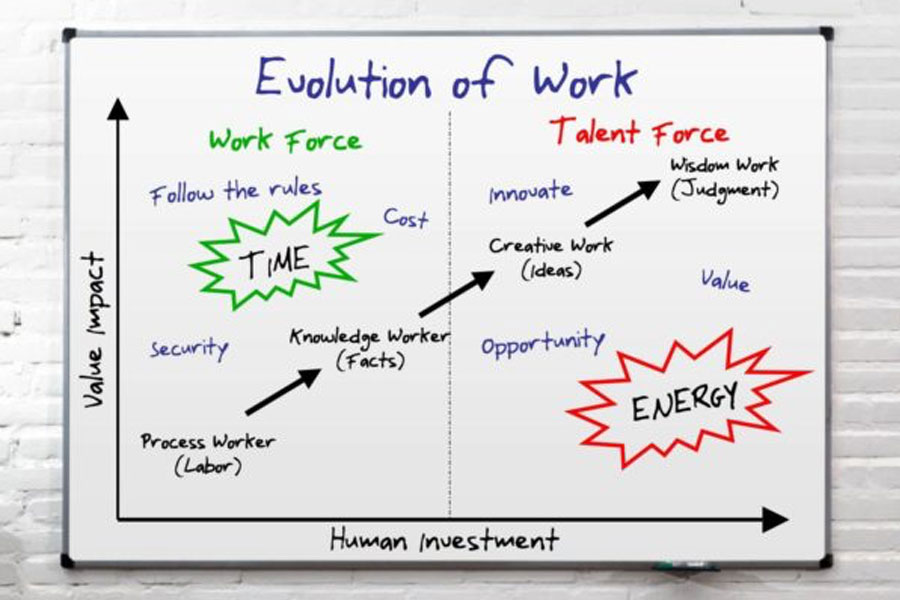
Just consider this graphic.  Before the Industrial Revolution we lived in a world of blacksmiths and cobblers who made custom shoes for horses and people. It’s true. Before machines and factories we relied on craftspeople to custom-make the necessities of life. The factory changed all that. Unskilled employees could be taught to do a repetitive process like screw on a front fender on a model T Ford. This was a massive productivity revolution.  Build-time for the Model T automobile shrunk from 14 hours to 90 minutes. This represented nothing less than a complete revolution of how work is performed.

Factory work has massive social consequences.  As work became scientifically designed to remove all variation and individuality workers became interchangeable cogs in a productivity machine.  All workers were supposed to show up on time and do what they were told.  If they did it long enough they could even earn something called a pension.

The social contract for workers was that if they were reliable and obedient they would have a job and retirement security.  That changed in the 1980s when McKinsey and Company advised Jack Welch to start laying off productive employees from his prosperous locomotive plant.  They argued that if he could cut labor costs arbitrarily, earnings would go up, stock prices would rise, and he would become very rich.

Welch loved this. Without having to invest any money in R&D, or take any new risks he could increase profitability by simply insisting that the workforce work harder.  He liked it so much he got the nickname of Neutron Jack. (A neutron bomb is designed to kill people without damaging buildings, an apt description of generating higher profits through layoffs.) Thus the social contract of being rewarded for hard work and loyalty was voided.

In the 1980s financial spreadsheets were invented and this enabled knowledge work to be automated.  It was really the beginning of artificial intelligence that is something that IBM and scores of other big data crunching companies are using to change the future.  Artificial intelligence is relentlessly turning whole professions into factories in which a few low skilled people can enter data and algorithms can turn it in to something valuable.  For instance, someone with a 10th grade mathematical literacy can use TurboTax software to complete most federal income tax forms within minutes. (That’s quite an achievement since the U.S. has the most complicated income tax laws in the world.)

That’s just the beginning. Industry analysts estimate the artificial intelligence embedded in Intuit’s small business software packages has eliminated the need for tens of thousands of bookkeepers and accountants. You see, bookkeepers are similar to blacksmiths.  In a way they are craft people and the new world we work in doesn’t need very many of them unless they bring something much more important than technical know how.

Artificial intelligence is now being used to write newspaper articles, novels and even songs. It seems that any mental activity that can be broken down into a formula can be turned into a job that a computer can do. New software tools are enabling coders to vastly increase their productivity so that what used to take weeks can be done in days and soon hours. This suggests that, in time, even the demand for computer engineers may wane like that of a shoe cobbler.

I believe that the great career opportunities, especially in technology businesses, will not be driven so much by technical expertise as it will be by emotional intelligence, thinking agility and good judgment.   

These qualities are in desperately short supply in most businesses I consultant in. Leadership research from companies like Zenger-Folkman reveal that 80% of people in management simply aren’t very effective managers.  They don’t know how to communicate clear goals that connect to strategic priorities.  They don’t know how to empower people and hold them accountable.  They don’t know how to inspire commitment and engagement.  They don’t even know how to complete projects in scope, on time and within budgets.  They certainly don’t know how to give effective feedback and coach teams to higher performance.

The same research confirms that over 30% of managers are so inept that they are actually the cause of failure. These are simply bad managers that people are loath to work for.  30% is a big number.  It corresponds to some recent gender research in tech companies in which 33% of women employees say that they would pay to have their boss fired.

On the right side of the chart you see where value is being created in organizations.  People who can collaborate and exercise good judgment are the people in the shortest supply.

Recently the Wharton business school released a study showing that 15% of employees produce 90% of the business value of almost any enterprise.  The single quality of the 15% is their ability to collaborate.  Human characteristics that predict good collaborators are self-knowledge, open mindedness, curiosity, empathy and versatile communication skills.  In your experience how often do you find people with these characteristics in your workplace? Not often, I would imagine.

The reason we find so few people with superb human skills in technology organizations is that there seems to be an inverse correlation with analytically dominant thinking and social–emotional intelligence.  There is more research going on in this field and we will know more in a few years but the simple reason is that analytical thinking tends to be binary, either/or, right/wrong rather than holistic.

So, my advice to Ginni and all leaders of technology companies is that they must over-invest in recruiting talent with high emotional intelligence.  I also recommend that every employee and every new-hire be engaged in developing the skills of collaboration, teamwork and management.  This kind of training will not have an effect if it’s treated like a one-off by which you are a certificate and declare yourself an emotionally intelligent team leader.

The truth about soft skills is that it is like bathing.  You have to do it every day or you will stink.  What I am getting at is that using social intelligence in high stress, high-pressure environments are not natural to most people.  Employees need to be constantly engaged with live learning experiences to open their minds and give them the skills they need to collaborate successfully.

The bottom line.

Science without humanity will lead to disaster . . . and a lousy place to work. If you want a great career, work on your humanity. It’s in short supply.


Drug-inspired Fashion: It’s to die for

Terrorists move over. There’s a far worse terror in town that is targeting kids and adults, killing well over ten times more Americans this year than all terrorist attacks of the last 16 years combined.

That’s correct. While politicians have spent several trillion dollars on foreign wars, they’ve distracted us from the very real threat that can be found literally in our own homes, targeting our families. In 1997, the U.S. became one of only two developed countries on the planet that made it legal for pharmaceutical companies to advertise drug use directly to consumers, including children. Since then prescription drug addiction and prescription drug overdoses have skyrocketed – actually quadrupled.

We now have a generation of young adults who grew up with a drug dealer living in their homes 24/7 – the television and magazines pushing pills as a solution to every imaginable condition. Eighty percent of opioid addictions begin with a prescription for pain medication at your doctor’s office. It must be safe if a doctor prescribes it, right? According to the Centers for Disease Control and Prevention, in 2014 47,055 people died of an accidental drug overdose – 29,467 of those from opioid-related drugs, which includes prescription pain medication.

These facts have not stopped Nordstrom and Saks Fifth Avenue from promoting a new line of Italian-designer products that glamorize drug use. The Moschino collection features pill-shaped handbags, backpacks, and clothing emblazoned with pill designs starting at $650 for a pill-adorned black dress and rising to $1,095 for a pill-encrusted purse.

Many customers are outraged, declaring that they are boycotting Nordstrom and Saks for carrying these products after the U.S. Department of Health and Human Services declared that we are in the midst of a prescription opioid overdose epidemic.

Randy Anderson, an alcohol and drug counselor in Minneapolis, has seen firsthand the havoc that addiction has on individuals, families, communities, business, healthcare systems and the country, and he’s not impressed. He started a petition at change.org last week asking consumers to say no to Nordstrom and Saks Fifth Avenue. To save money and lives by shopping elsewhere.

“Do you have any idea of the message your company is sending to those who have suffered the loss of a loved one due to a drug overdose?” says Anderson in his letter to the retailers. “Have you not seen the countless number of media reports on overdose deaths from prescription pain medication?”

httpss://www.instagram.com/p/BLKPA8ZBSyH/?taken-by=moschino


Drug overdose is now the leading cause of accidental death in the United States. Four out of five people who become addicted to heroin start out with a legal prescription from a physician – a result of injury, post-operative care or a medical procedure.

At a time when most large companies are trying hard, in some way, to align themselves with social good and positive causes, these executives have trivialized the important issue of drug addiction. They seem oblivious to the harm it may cause others, by promoting pills as “cool”, or even the harm it may cause their brand if public outrage goes viral.

There are plenty of examples of how fashion norms have found themselves on the wrong side of public opinion and been forced to change. Anti-anorexia campaigns have resulted in the boycotting of fashion weeks, governments legislating to ban too-thin models and fashion magazines refusing to print undernourished models on their pages. Kids clothing with sexist messaging has been ridiculed and forced off the shelves around the world. Each brand has lost the battle against public opinion.

httpss://www.instagram.com/p/BK1UG-Vh6mq/?taken-by=moschino


In a written statement Nordstrom said: “We’ve heard from some customers about this collection, and we’re sorry to learn they’re disappointed. Every customer we serve has unique tastes, which is why we offer a wide range of products.”

Nordstrom faced a similar decision four years ago while promoting gun related jewelry following the New Town massacre and promptly responded to customer’s outrage by removing all of the product from the store. A reputation of being responsive to customers is what Nordstrom’s success was built on.

They appear to be taking a different approach today in defending their intention to serve customers with “unique tastes”. Even if these executives were old-school capitalists who believe business has no responsibility beyond creation of profits and shareholder value, the fact that there are far more customers impacted by addiction in their family than there are customers dying to buy overpriced pill-promoting backpacks, it’s likely that Saks or Nordstrom will decide that this product line is not good business. Whichever one announces first will win in the competition for customer loyalty.

httpss://www.instagram.com/p/BKuExJAh0Wd/?taken-by=moschino


To end on a positive note, the most respected leaders of business today are putting their customers and community first. In 2014 CVS Drug Stores made the bold decision to stop selling cigarettes in their stores, putting the well-being of their customers above their $2 billion a year in tobacco revenues. In 2016 they launched a $50 million anti-smoking campaign. That’s real leadership. The kind of leadership that is rewarded with employee and customer loyalty.

Sign the Change.org petition here

Update: The Star Tribune reported on Thursday 6 October that Nordstrom, via an email, has agreed to discontinue the Moschino Capsule clothing line in their stores. Saks has yet to respond to any correspondence or to comment on the issue.


Eat Your Food Packaging, Don’t bin it – Scientists

Scientists are developing an edible form of packaging which they hope will preserve food more effectively and more sustainably than plastic film, helping to cut both food and plastic waste.

The packaging film is made of a milk protein called casein, scientists from the U.S. Department of Agriculture said at a meeting of the American Chemical Society.

The milk-based packaging does not currently have much taste, but flavors could be added to it, as could vitamins, probiotics and other nutrients to make it nutritious, they said.

The film looks similar to plastic wrapping, but is up to 500 times better at protecting food from oxygen, as well as being biodegradable and sustainable, the researchers said at the meeting in Pennsylvania, which runs until Thursday.

“The protein-based films are powerful oxygen blockers that help prevent food spoilage. When used in packaging, they could prevent food waste during distribution along the food chain,” research leader Peggy Tomasula said in a statement on Sunday.

Between 30 and 40 percent of food produced around the world is never eaten because it spoils at some time after harvest or during transport, or gets thrown away by shops and consumers.

Yet almost 800 million people worldwide go to bed hungry every night, according to U.N. figures.

Halving food waste by 2030 was included as a target in global development goals adopted by world leaders in 2015.

The U.S. scientists also want to reduce the amount of plastic that is thrown away.

“We are currently testing applications such as single-serve, edible food wrappers. For instance, individually wrapped cheese sticks use a large proportion of plastic – we would like to fix that,” said Laetitia Bonnaillie, co-leader of the study.

Single-serve pouches of cheese would still have to be encased in a larger plastic or cardboard container for sale on store shelves to prevent them from getting wet or dirty.

Edible packaging made of starch is already on the market, but it is relatively porous and does not block oxygen from reaching the food as effectively.

Bonnaillie said she hopes the milk protein packaging will be on store shelves within three years.

By Alex Whiting, Editing by Jo Griffin.

Ever Been Told, “Don’t Act Like a Tourist”? Here’s Why

With nearly 200 countries in the world and countless communities, why do we all end up visiting the same tourist-infested places?

At 28, when she started her travel company, Elvira Museri was already a habitual traveller. Despite the thrill of seeing new places in countries they’d never seen before, she and her husband started feeling as if they were in a giant tourist trap.

The couple visited the same places that everybody else had visited, and took their travel advice from the same websites and guidebooks as all the other travelers they met. Meeting locals and seeing inside their homes was out of the question, made more difficult by the foreigner clothes they wore and backpacks slung over their shoulders, which marked them as strangers. Tour guides sometimes helped with introductions but it got Museri thinking about how best to meet local families and share a meal with them.

Realizing that the same phenomena happened in her home country, Argentina, Museri (pictured above) started researching responsible tourism and within three months of returning from yet another familiar-looking  trip she formulated a plan. Museri now runs Andara Travel from an office in Buenos Aires, helping hundreds of people discover a deeper and more responsible travel experience every year.

Her career started in social work and political science and she completed a stint in the charity sector for seven years before starting Andara Travel. “I wanted to give people an opportunity to meet local people and get to talk to them,” she says. It works equally as well in big cities as it does in rural villages. In fact, Museri decided to start her business in central Buenos Aires in one of the city’s most famous streets, Caminito; the very idea she was hoping to avoid.

“The street personifies Argentina to many tourists,” says Museri.  “It’s only 100 meters long and there’s nothing really to see in my opinion, so we started exploring the neighborhood behind this street,” she says. They discovered a wealth of social and art programs that they added to their new travel itinerary. Andara Travel now offers visits to indigenous Guarani communities in the Iguazú rain forest, where they learn about jungle resources, medicinal plants and belief systems, while those looking for something more active can take private tango lessons at real milongas (tango ball rooms) in Buenos Aires. A visit to the Mandoza winelands won’t have you sipping Chardonnay in an easy chair either, you’ll find yourself learning about wine culture first-hand – by picking the grapes.

Museri has found a unique way of combining her social work with tourism that is now seeing growth of between 200-400 percent a year. Even more remarkable is that she began Andara Travel at the age of 28.

Aligning herself with the World Wildlife Fund and being the founder of the Argentinian Responsible Travel Association has certainly helped to foster trust with her clients and to align her business with broader, internationally recognized values around conservation and sustainability.

People began to notice from the start. Lonely Planet listed them after only one year in business, helped in part by the fact that nothing like Andara Travel had ever existed before.  

Museri typically sends her clients a draft proposal for discussion on their trip. There’s no set package tour conveniently bundled by self-serving holiday resorts in Museri’s world. She sometimes refines up to five versions of a trip until she finds one that fits the client’s expectations. Many approach Andara Travel with no idea of where they want to go.

Museri doesn’t sit in an office all year round either, choosing to make at least two trips a year to new destinations or existing one’s on the itinerary that they want to check on again. Keeping tabs on their supply chain of operators, destinations and guides is particularly important in her remodeled tourism company. “We had real problems when we started,” she says. “Because we couldn’t find anyone with the same values as us. The customers weren’t happy and we weren’t happy either,” recalls Museri.

caminito

Now with an established reputation as a trusted tour operator she invites all her new partners to join the Argentinian Responsible Travel Association, inspiring them to get more involved in sustainable tourism. “In many instances they’ve already been practicing sustainable tourism, yet just didn’t know it yet, and the amazing benefits it can bring to their business,” says Museri.

Not fazed by the rise of online holiday and travel websites, Museri is of the opinion that much value can be found in a curated vacation that delivers the best local experience, while saving up to 40 hours of research. “What’s the big deal about just selling hotels?” she says. “Delivering an experience is a far more rewarding pastime for us.”

In an age of cheap air travel, that allows people to see the world, discover cultures and learn about the rest of humanity, an obvious dilemma arises: carbon footprint.  “That’s why we call ourselves ‘responsible travel’ and not ‘sustainable travel’,” says Museri. “If we were sustainable, we shouldn’t accept any traveler to Argentina arriving from more than 800 miles away. Obviously we can’t do that, it’s not realistic.”

buenos aires

Ninety-five percent of Andara’s travelers come from the U.S., Australia, Europe, Canada and New Zealand, making long trips to get to Buenos Aires. “We explain to our clients that they should make the best choices available at their destinations to lessen any further environmental impact,” says Museri.

“Hotels will ask you to refrain from changing your towels and bed sheets in your room, which is okay, but they also do this for commercial reasons. In addition, a hotel should have some type of water recycling and garbage separation. My biggest enemies are the amenities. I can’t believe that hotels still give you shampoo in little plastic bottles, it’s incredible.”  Museri suggests refillable containers and biodegradable products instead. She also discourages frantic hopping around, trying to spend two days at each destination and flying from place to place.

Every time Museri feels the need to re-charge her batteries and re-confirm she’s on the right track she visits the NGOs she began with. She sees the heads of these charities, struggling in terrible situations. “They get up and continue every day and for me that’s a big part of my inspiration.”

“To share finances and knowledge with your team might seem counter-intuitive to running a business, but I’ve partnered with some of my team members and consider this the best type of leadership,” she explains. A former employee is now a 15 percent shareholder of Andara Travel and has helped boost the company growth. The team of eight now makes monthly payments to dozens of charities that form part of their tourism network. At the outset Andara sent only two travelers a month to these charities. They now receive between 50 to 100 travelers, and are making a decent income from it.

“The team is so much wider than what we have in our office,” says Muresi.


0