5 Amazing Destinations That Are Good For The Planet

Visit these five unique places that have put social impact or the environment at the center of their business. Proof that you can have fun and be socially responsible at the same time.

1. Norway. The Most Fun South of The Arctic Circle.

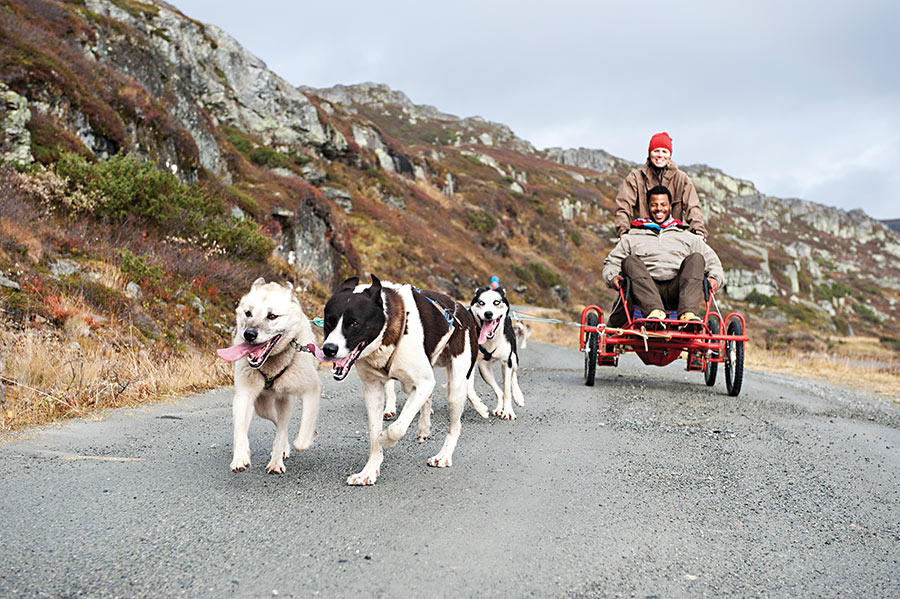
There are more than 6,500 reasons to visit the Vega archipelago in Norway – the number of islands, islets and reefs waiting to be explored. The UNESCO-protected islands of Vega, just south of the Arctic Circle, is a World Natural and Cultural Heritage site and has Sustainable Tourism certification. Locals claim that spending time in Vega means “living your life slowly.” Replace the rat race with a dog sled race for something different.  www.visitnorway.com


2. Dublin. A River Runs Through it.

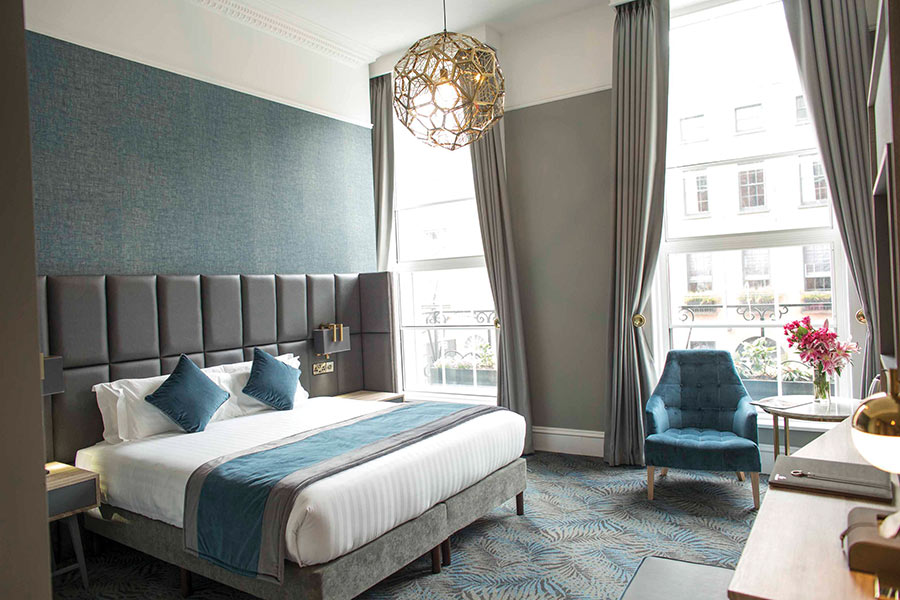
When designing The Iveagh Garden Hotel the owners set out to create the lowest carbon footprint possible when compared to other hotels in Europe. What they didn’t count on was the discovery of a massive energy reserve – an underground river – that has been harnessed for all their geothermal heating and cooling needs. Nature has become their greatest asset. www.iveaghgardenhotel.ie


3. Costa Rica. The World’s Best EcoCountry.

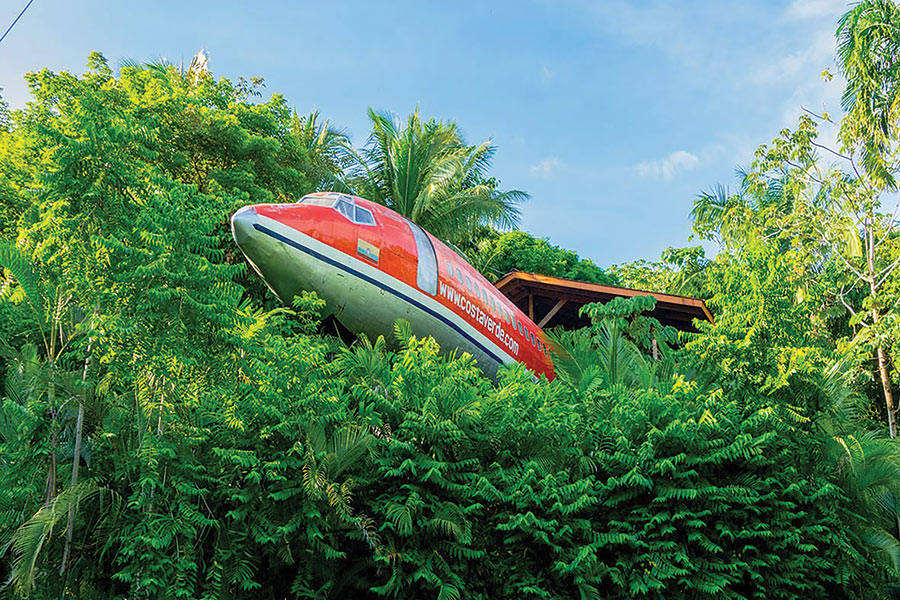
One of the world’s most successful eco-tourism destinations, Costa Rica is home to the largest percentage of protected areas in the world. Known for its array of wildlife, plants, pristine beaches, rainforests, volcanoes and incredible natural beauty – the Central American country is a fitting destination for one of the most sustainable on the planet. It hosts 5% of the world’s biodiversity with 20 natural parks, 8 biological reserves, 800 miles of beautiful coastline and an incredible 98% of its electricity generated from renewable sources. Not surprisingly, it’s also one of the happiest countries in the world, and spends nothing on its military. Situated on the edge of the Manuel Antonio National Park, the Costa Verde Resort (pictured) features an incredible hotel suite set inside a 1965 Boeing 727. We can think of no better place to unwind after a long flight.  www.VisitCostaRica.com


4. Canada. Turn Dining Out in Helping Out.

The next time you notice a fork symbol alongside a menu item in Canada, you’ll know that a young person will get a meal. MealShare provides needy youth with a free meal every time a customer chooses that meal. They have partnered with restaurants across the country and have served 1.8 million free meals to date. www.mealshare.ca


5. United Kingdom. Prison Food Goes Upmarket.

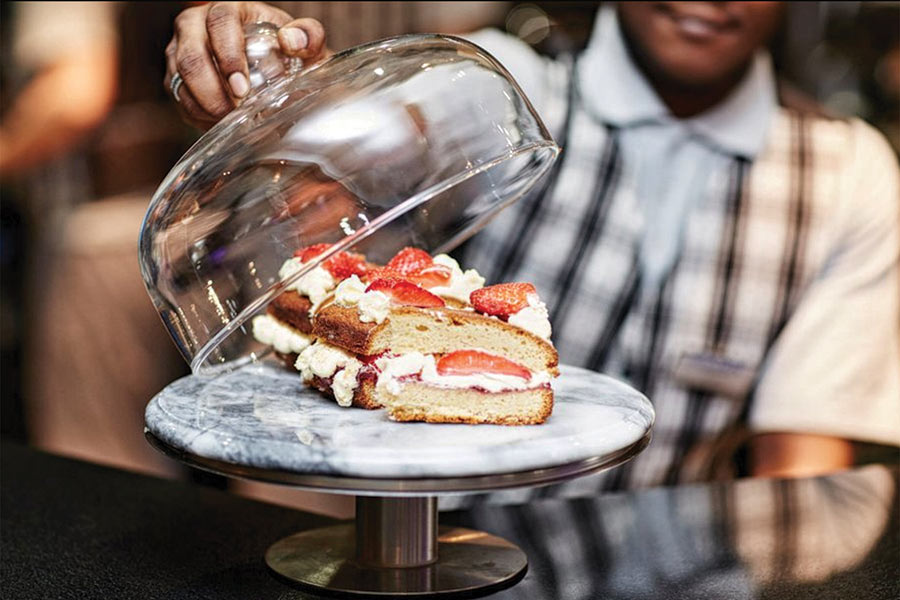
The Clink is a restaurant in the U.K. entirely staffed by prisoners, offering an innovative approach to rehabilitation. It trains former offenders to get them back into the community. More than 800 prisoners have graduated from The Clink’s four training restaurants and the organization is now able to train up to 160 prisoners a day. Each prisoner works and trains for 40 hours a week, so by the time they graduate, they have all the skills needed to get back on their feet. www.TheClinkCharity.org

Highlight a World Heritage Site: Land on it!

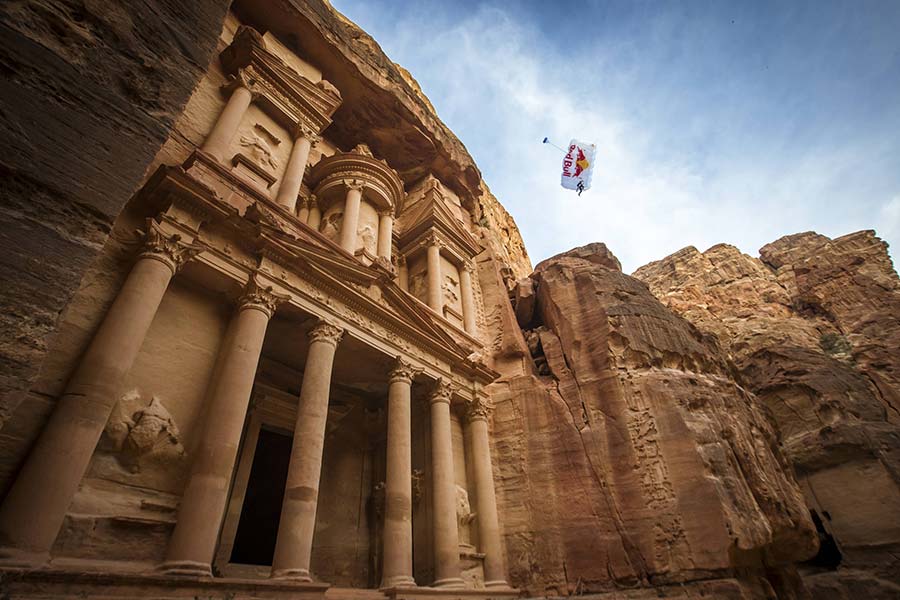
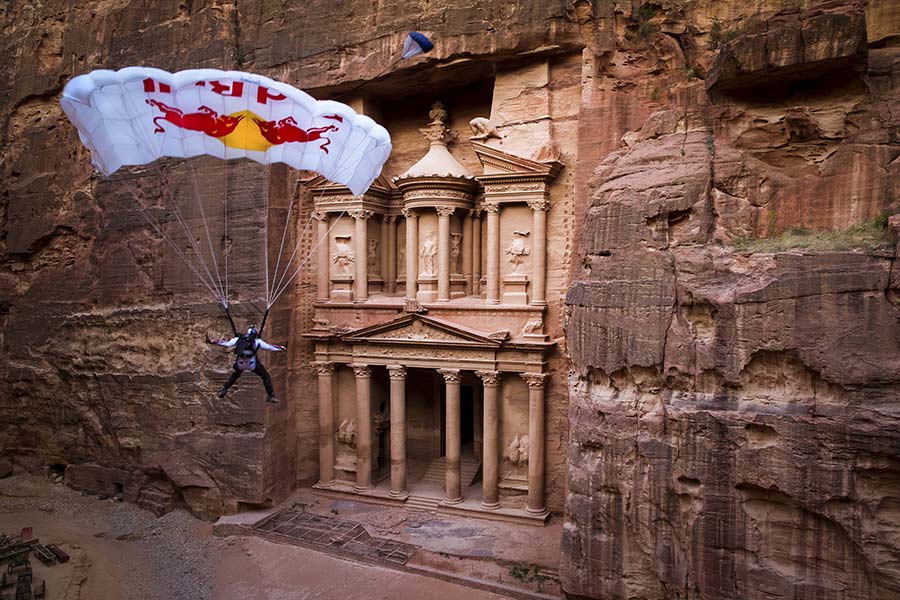
Red Bull Air Force Team member Miles Daisher chose Petra, one of the Wonders of the World, as the stunning location to celebrate his 4,300rd BASE jump and make history.

The American legend, who has completed a staggering 7,200 skydives in his career as well, travelled to Jordan intent on becoming the first to BASE jump Petra with amazing scenery at the UNESCO World Heritage site. Thankfully for the Georgia native, the weather obliged to help make his BASE jump from the top of The Treasury in the depth of the Lost City that extra bit special.

The iconic Treasury dates back to first century BC and is perfectly hidden beneath high reaching mountains in the South of the Jordanian desert, positioned at the end of a main narrow route that no cars can access. Carved deep into a rose rock face and concealed in a high-walled ellipse of a valley, both the Bedouins and the mountains of Petra have protected it from wind and rain.


Setting up his early morning gear inside an opening of the mountain over The Treasury, Miles waited for the right blow and speed of wind to let go with the help of his teammate Andy Farrington. With no tourists in sight and the light yet to reach the top, Andy leaned over the edge on a rope and held Miles’ parachute to secure a static line for him to jump. Once they were happy with the conditions at 7am, Miles then said “See ya” to Andy and BASE jumped – a leap of faith that Indiana Jones would have been proud of. Thankfully, after going 32 kilometres per hour in a circular motion across the 100-feet wide space between the valley and The Treasury, he landed perfectly right in front of the doorway in less than 15 seconds.

The extreme challenge for Miles was in the short length and altitude of the jump along with the incredibly tight space that left him with little room to escape the walls of the limestone mountains.

Afterwards, Miles enthused: “My heart is coming out of my chest. The lowest I’ve ever BASE jumped over land! It took all of those jumps that I have done since the beginning to prepare me for this one.”


Branching Out: The World’s Coolest Tree Houses

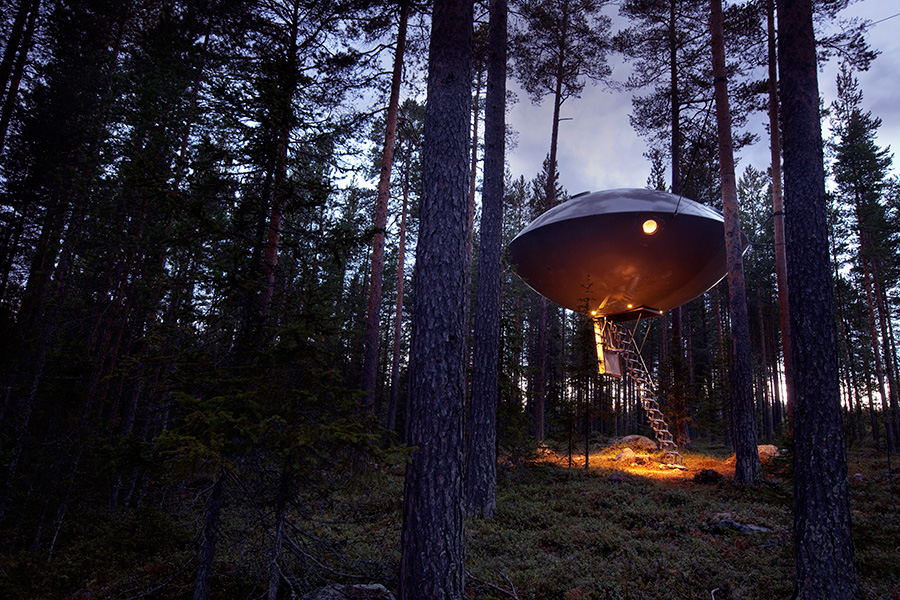
You’re in a forest. Through the trees up ahead a dim orange glow tells you it’s almost dawn. Except, the sun is rising in the opposite direction. You move closer to have a look. A shiny, metallic flying saucer is wedged between some pines about 20 ft. off the ground. With horror you watch as a trapdoor at the base opens and a retractable staircase unfolds to the ground. Something is coming out. “God morgon!” Shouts a familiar figure, still in his pajamas, holding a cup of coffee and straightening his back after a good night’s rest. It’s Kent Lindvall, the originator of one of the world’s most unique weekend getaways.

Not satisfied to start just any old B&B, Kent and his wife Britta decided that some fun, mixed with luxury and breathtaking views of nature was the way to go and have created a series of themed tree houses that are delighting discerning guests from around the world. Situated 630 miles north of Stockholm near the village of Harads, population 600, you’ll find Treehotel.

The idea began seven years ago when a joint friend of the couple, Jonas Selberg Augustsen, made a documentary film in the area called The Tree Lover. Part of the documentary involved building a simple tree house to illustrate the philosophical meaning of what a tree stands for. The tree house stood empty after filming and the couple, who already ran a guesthouse nearby, asked if they could start renting it out. After a couple of years they realized that everyone who stayed in it had a really good experience – high off the ground, great views, nature at its best and a nostalgic connection to their childhood.

However, while guests were enthralled, Kent found it tough going. “We had to drive five miles every day to serve breakfast, 40 feet up a tree, it was hard work for a single tree house.” They decided to build their our own tree houses closer to the guest house. A chance meeting with three well-known architects on a fishing trip to Russia in 2008 saw all three joining the project. With nothing more than an idea and their personal motto: “It’s going to work out, do it!” the couple bought some land and got to work. Britta had 20 years experience in the nursing and healthcare industry and Kent was a former educator and part-time fireman.

ufo_exterior_1

Britta was big on design from the outset and insisted that the tree houses not resemble anything seen before. Each architect was given the freedom to create their dream tree house, resulting in the unique designs now floating among the Swedish pines, with spectacular views over the Lule River.

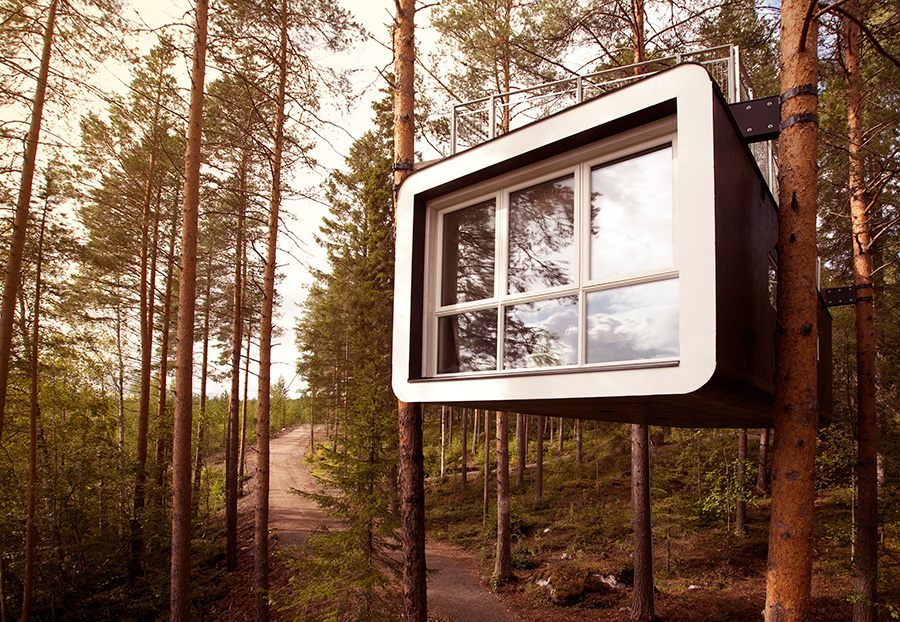
Some of Scandinavia’s leading architects became involved and now a total of five rooms, each with its own theme, are suspended up in the air. A sense of fun and playfulness prevails in the design. You’ll find The Mirrorcube covered with reflective glass measuring exactly 4x4x4 meters, The UFO, complete with underbelly landing light and The Cabin, offering a giant flatscreen-like window onto the surrounding forest. Northern Sweden, while beautiful, is known for its harsh winter. Has this put discerning guests off from trekking into the middle of nowhere and climbing a tree? “Not at all,” says Kent.

“We’ve made sure the tree houses have toilets, a heating system and quality furnishings, all the comforts you’d expect from a luxury establishment. Some guests come and stay when it’s minus 35 degrees so we’ve had to install triple glazing on the windows. In fact, winter is high season for our guests from abroad, who love the extreme experience.” Situated 200-400 ft. apart, neighboring guests have their privacy and can also order in when the snow gets too deep outside. In fact, for those guests who want a regressive “back to the nest” experience, Kent and Britta have created just that: a gigantic bird’s nest made from hundreds of sticks, completely camouflaging you from your surroundings. Inside, of course, is a spacious wood paneled environment where a family with two children can comfortably spread out.

While most hotels are graded with stars according to their quality, Kent chooses to define luxury as something beyond the norm. “We’re not luxury in the traditional sense of a luxury hotel,” he explains,  “It’s more about a new kind of luxury experience. To be in nature, high up in the trees surrounded by peace and quiet in beautifully well-designed rooms – it’s a luxury experience that people take away with them.” While the couple complied with strict eco friendly guidelines for the construction, the irony is that no trees were cut down to clear the land or to be used for building. In fact, the trees in their original glory are crucial to the whole concept of a tree house.

Tree Hotel took less than one year to get off the ground, helped along by a local community, government and finance institution that recognized the value of what the couple wanted to achieve. “It was rather easy,” says Kent, “because our community was really positive and found a solution together with us. The bank was interested in our project and government departments pushed the zoning regulations through.”

Northern Sweden is also home to another spectacular hotel concept, the Ice Hotel, which has been rebuilt from ice every winter for the last 25 years. Perhaps a country that recognizes wacky innovation makes it easier for new pioneers to follow at an accelerated pace.  [pullquote]“It was rather open-minded of the people who live here to embrace this crazy idea,” he says.[/pullquote] You’d assume a rural village of 600 people would be conservative by nature, but Kent discovered quite the opposite.“It was rather open-minded of the people who live here to embrace this crazy idea,” he says.

Already, 70 percent of guests come from all over the world, most of them never having been to Sweden before. The village of Harads has now become the main reason an American or Australian tourist might discover Sweden, adding to the broader tourism industry. “Most guests are interested in nature and sustainable accommodation,” explains Kent.

“Britta and myself wanted to build a sustainable hotel among living trees.  We don’t touch or interfere with nature. Untouched nature and quietness is what most of our guests are looking for. We hope our guests appreciate our sustainability work, even if it does make their accommodation a bit simpler. While we want to have our hotel in the middle of nature, we want to do it on nature’s terms,” he asserts.

The couple want to build their ideas elsewhere and are currently in discussions with other countries. Franchising the trees, now there’s a new concept: coming to a tree near you.

Our 25 Day Italian Experiment On Sustainable Travel

I love Italy! The people, the food (Eat-aly), the wine, the history and the warmth… what’s not to love? Well ok, the overwhelming shiploads and busloads of tourists that sometimes give it that overwhelming “Disneyland” feeling. My PIBAL (Partner in Business and Life) Julie and I recently set out to experience the best of Italy in 25 days and explore how the real leader inside all of us can make travel more sustainable. Many of the strategies we employed can help you in your travels, no matter where you go.

I began with my travel agent of 20 years who knows my preferences well, but is no expert on eco-tourism. I honestly didn’t even think to tell him of our sustainability mission from the start. This actually worked out well, because he did what most agents do and recommended some excellent (and horrifyingly wasteful) examples of unsustainable luxury hotels.

To his credit he did also throw in some world leaders in sustainability too. We agreed that four nights each in Venice, Florence, Sardinia, Cinque Terre, Amalfi, and Rome would allow us to see as much as possible without feeling too stressed about the constant moving between cities. This turned out to be just the right formula.

With so much moving between planes, trains and automobiles, packing light is essential. I was able to convince Julie to limit our luggage to two carry-on bags each, and she did (I love her!) Remember that you can always use the housekeeping service to launder items as you go, or simply buy items as you need them. Carry-on also meant less time wasted in terminals. She thanked me later.

We left at the end of May to take advantage of the best weather, without having to deal with the high-season crowds. We experienced four very different examples of how responsible hospitality businesses have created innovative and sustainable accommodation. Most had converted and repurposed their underutilized real estate to dramatically increase the number of people who could enjoy it, instead of building newer or additional buildings. All four of the examples below are ways you can enjoy a luxury vacation in a more sustainable manner, rather than selecting a more recently built property.

1. In Tuscany (Greve, near Florence) we stayed in a beautiful 6,000-foot, hilltop Italian family villa owned by a countess and managed by luxury vacation club Inspirato. For thousands of years the world’s wealthy have owned vacation homes to enable them to enjoy the same privacy and luxury while on vacation as they do at home. Inspirato has disrupted the status quo with a business model that manages and staffs 130 luxury estate and villas around the world for their members at a small fraction of the cost of ownership. Why would anyone choose to buy a second home when they could enjoy a professionally managed luxury home anywhere in the world? Inspirato provides a concierge, housekeepers, cooks, gardeners and maintenance for a carefree vacation.

Upon arrival we were welcomed by a multi-lingual concierge who had stocked our kitchen with requested items and arranged for a private wine tasting in the surrounding region of Chianti. In the morning we were greeted with coffee and breakfast. In addition to the obvious appeal of a having a low-cost alternative to choose from rather than owning a second home that sits empty most of the time, you’ll feel good knowing that you’re supporting a more sustainable vacation solution that more fully utilizes these properties, meaning fewer need to be built and maintained. The particular villa we stayed at sleeps 18 and is great for a family reunion, forum, business retreat or private getaway.

2. Our next stop was Villa La Massa in Florence, a spectacular 16th century Medici villa that has been recycled into an intimate 37-roomed luxury hotel in 1948. The restaurant patio is alongside the Arno River, with world-class service and food. The food has more flavor, because the vegetables are picked fresh in their organic garden.

The organic olive oil is also grown and bottled on-site. In addition, this property requires no piped municipal water, choosing to supply all its own water from a well on the property. This villa is a peaceful oasis 10 minutes away from the seething crowds of Florence. Villa La Massa is an excellent choice for couples, forum or chapter retreats, a romantic getaway, or even an intimate wedding in their chapel! This was another great example of how the owners took a property that had been underutilized for hundreds of years and greatly expanded its use and functionality, rather than build more. 

3. We rented a car and drove for two hours from Naples to Amalfi (what were we thinking!). Frommer’s describes the “technical difficulty” of this drive as “easier than the road to Hana in Maui, let’s say, but more difficult than the Pacific Coast Highway”. Having driven both several times (who would do that?) I must agree with Frommer’s. Technically, however there is something about this stunningly beautiful, terrifying 3,000-foot cliff and the passionate, crazed Italian drivers that put this route on my list of top driving challenges.

The narrow and winding drive was very exciting and was also perhaps the best test on earth for the compatibility of any couple in a rental car. We survived without incident and actually had fun, not to mention our newfound gratitude for life! You might think that a 12th century convent is the antithesis of a luxury vacation, but don’t be too hasty in your judgment. Those nuns might have known what they were doing after all. Convento Di Amalfi enjoys the best location and views of Amalfi from its’ hillside perch. Our friendly hotel manager was quick to point out that historically it hadn’t actually been a convent with nuns, it was a monastery.

What was still unclear, however, was why they call it “convento” instead of “monastero”. Regardless of what it was called, the 53 room five star hotel is full of pleasant surprises, from the 800-year-old church and infinity pool to the contemporary interiors and breathtaking views.

It was recently renovated and was reopened last year with an international quality management system award (the ISO 2000). This old convent/monastery turned out to be the most energy-efficient of all the places we stayed during our 25 days in Italy!

The manager pointed out that the hotel is one of 400 hotels owned by NH Hotels of Spain, who’d made a pledge five years ago to reduce their environmental footprint by 25%. They have since exceeded this goal and their aim is to now inspire the hospitality industry to follow their lead in sustainable practices.

4. The only experience we had of Italy without the presence of tour buses and crowds of tourists was thequaint 13th century village of Trevignano, situated outside Rome on the shores of beautiful Lake Bracciano. Here you can go beyond the simple looking and tasting of Italy, you can experience living in Italy with local Italians. We were the guests of Borgo Vistalago, one of about 40 Albergho Diffuso-type renovations found throughout Italy.

Albergho Diffuso is an innovative concept of hospitality that was launched in Italy in the early 1980s as a means of reviving small, historic Italian villages and town centers that are situated off the beaten tourist tracks. The idea is of a hotel, that is not in a single block, but rather created from various historic buildings within a small community, with a central hotel manager. If you want an authentic Italian experience and can live without room service, fitness room and pool this may be for you

Found about 40 minutes outside of Rome, we enjoyed the authentic local culture of Borgo Vistalago – the playing Italian children and the conversations of locals at the café during breakfast. We had dinner with the proprietor and architect of Borgo Vistalago and found the food to be unexpectedly exceptional. After dinner we had a Skype call with her husband and chef, Simon, at his restaurant in New York, that had just been recognized by the Wall Street Journal.

This was our first attempt at aligning our values with vacation spending and it was far from perfect, but it did give us the motivation and confidence to continue exploring eco-tourism and sustainable options for the future. Hopefully we’ve inspired you to give it a try too and to challenge the status quo of tourism on your next trip.

PS. We still have a lot to learn so please share your experiences or suggestions below.

0