The Electricity-generating Bikes of Guatemala

Carlos Marroquin has shown that bicycles are good for much more than just transport.

The Guatemalan inventor, inspired by the complexity of these two-wheeled contraptions, met representatives of PedalCanada, an organization that promotes bicycles as a way of helping local communities, especially widows affected by the armed conflict in Central America.

Marroquin saw more potential in bicycles than just using them to get from point A to B. He realized he could use the gear-powered design to harvest alternative energy.

His creation? Bicimáquinas — pedal-powered machines made from discarded bicycles parts. Since 1997, Marroquin has been partnering with PedalCanada to establish Maya Pedal, a Guatemalan NGO based in San Andrés Itzapa. The nonprofit accepts donated bikes from the USA and Canada, repairing them to sell, or deconstructing them for Bicimáquinas — making them 100% recycled (no pun intended).

His pedal-powered machines have increased productivity in rural Guatemala where access to electricity is limited. A third of Guatemalans work in the agricultural sector, and often rely on conventional manpower to do essential tasks, such as grinding corn or pumping water.

Marroquin’s newly-designed models perform these back- breaking tasks and speed up the process — leg-powered pedaling requires five times less energy than hand power. Bicimáquinas also produces zero emissions, offering a completely clean and infinite renewable form of energy, replacing the need for expensive electric or gas-powered machines.

Marroquin has now created 30 different designs for his Bicimáquinas, among them pedal-powered water mills, washing machines, corn de-grainers, grain mills, water pumps, coffee de-pulpers, corn grinders, threshers, tile makers, nut-shellers, blenders, mobility trikes and trailers. More than 5,000 Bicimáquinas are now spread across Guatemala, making farming and household tasks easier.

Marroquin wants everyone to have access to his technology and has made his designs open source and available for copying. As a result, Bicimáquinas are now being designed and used in Mexico, India, Senegal, and Tanzania.

Marroquin’s goal is to give people the power and autonomy to create their own jobs and to sustain their own economies. Bicimáquinas give them the power to become independent producers, and prove that economies can thrive on 100% clean energy.

This is particularly noteworthy when considering the detrimental effect of electric and gas-powered economies. In 2018, global carbon emissions reached a record high of 37 billion tons, a number that continues to rise.

As Marroquin’s designs become more widespread, he continues to experiment. His next dream is to build a Bicimáquina that powers recycling. When he’s not building new machines, he travels the world educating people on the effectiveness of his idea, proving that clean, sustainable energy can benefit anyone, anywhere.

How Balfegó Tuna Can Help Executives Grow as Leaders

A few years ago, I began developing team-building and coaching programs around nature. I learned how animals and nature had a way of cutting through the masquerades of executives to allow more in-depth, more honest conversations. I’ve taken teams to mountains and horse ranches, but never to swim with 550 lbs tuna.

Early this year, a client called and asked me to design a program for a tuna tour. He asked, “can you do that?” and I said “Of course!” before I even knew what we were talking about. A few months later, our driver fetched my client’s team at the Tarragona train station, a port city in northeastern Spain’s Catalonia region. We turned off our cellphones and began to leave our problems and “to do” lists far behind, as the quiet rumble of the bus took us to a holiday home we had rented for a few days.

Once settled in, we walked to a small “Cala” – a small, rocky beach enclosed on both sides – and did some stretching to help ground our bodies and quiet our minds. The wind blew all around us, as if playfully whisking away our worries and evoking deeper feelings about who we were, why we were there, and what we wanted to improve in ourselves.

One thing I love about working in nature is the sheer power she holds over every single one of us. It’s only a matter of time before we each melt into a softer, more humane and more sensitive version of ourselves. “Nature does all the work,” as a fellow trainer once told me. I also love that I never know what’s going to happen next, and what happens seems to always be precisely what we needed to grow as a team.

My client has an excellent sense of humor. He’s from the North of Spain; the Basque country. Basque men are strong, no-nonsense lads, yet sensitive at the same time. More often than not, they’ve lived with a fair deal of emotional pain around them, since forever. Like the Northern Irish, they’ve also learned to laugh in the face of adversity, and laugh we did, throughout our program in Tarragona.

Twenty-four hours later, we were ready to embark on our tuna tour. We’d already shared much personal information between us through several exercises, and practiced mindfulness routines to help us unwind. All this was in preparation for the main attraction: swimming with massive tuna fish in the ocean.

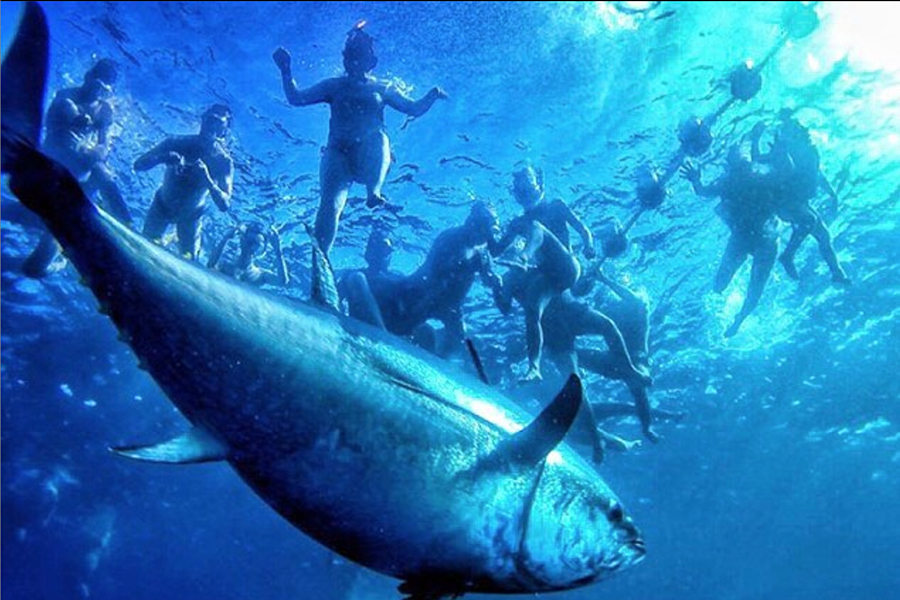
Balfegó Tuna started their business eight years ago. They created a 50-meter wide pool surrounded by a vast net, 20 minutes off the coast. They now have 17 different pools, like this one, where tuna are fed varying amounts of fat to satisfy different consumer preferences.

Once a year, they go out to hunt for tuna the Mediterranean with an official inspector on board to ensure they don’t catch more than their yearly allocation. They find tuna in areas they go to mate, and two boats work together to entrap the fish in a huge net and transport them slowly back to the Balfegó offshore pools. Tuna fish lose up to 30 percent of their body mass on the long journey back to mating spots, so Balfegó feed them for months, until each fish is sold. Until then, the animals continue to swim around in their natural habitat, getting free food and even getting on with mating while still in season!

It’s in one such pool that our boat drops us — to swim and observe the spectacle of 550 lbs fish swimming peacefully around. Food was thrown into the water to give them a reason to come up to where we were, as they typically live 50 feet under the surface. We wore neoprene suits and masks to resist the chilly water and sunk into the water to blend into this amazing spectacle.

To be honest, I didn’t expect to learn much or grow from this tuna experience. I had already designed many other team building activities for that week to ensure a successful result for my client. But this experience moved us in a new way. It changed our opinions and opened us up to the spectacle of life and death.

It inspired us to see how some entrepreneurs had found more humane ways to treat animals. We arrived at the conclusion that Balfegó tuna taste better because the fish don’t suffer a stressful or painful death. Once a fish is sold, a diver goes down to kill it painlessly with a water pistol. Because mating continues, fertilized eggs can easily drift through the nets and out into the open sea, allowing Mediterranean tuna populations to be sustained.

Several team members experienced a profound shift in themselves. Some learned to manage their own stress when faced with an unknown situation. Others activated old, very primal emotional patterns which affected the way they protect their personal space and interests at work. There were plenty more personal revelations among the group, each revealing new sensitivities.

The Balfegó’s tuna tour did something to us all. I was amazed by the mood afterward: The honesty and the sharing of feelings. There were realizations among sophisticated bankers who had never before talked in this way to anyone. There was an undeniable sense of us all being connected to the ocean and the life it nurtures on our behalf. For a couple hours, we were all one, in the circle of life.

Imagine what we might become as a species if executives and decision makers experienced this example of real leadership from time to time.

Earth’s Call. Are you Listening?

“It is time for less ego and more eco to help our troubled earth!” That was the primary message expressed by climate scientists, youth activists, indigenous leaders, and philanthropists brought to Aspen, Colorado in May by Earth’s Call to explore bold solutions to the climate crisis.

Patti LaBelle was among those who raised decibel levels inside Aspen’s Benedict Music Tent during a globally-streamed concert, launching us out of our seats and inspiring two days of collaboration around radical climate solutions. Hundreds left Aspen heartened that significant partnerships, collaborations, and individual acts of consciousness were now in play.

My most profound insight from the gathering was the spirit of hope, energy, and activism unleashed by youth leaders. They see complacency in our older generations who have selfishly consumed fossil fuels, plundering the earth without regard for their legacy. Young leaders have emerged with an urgency to reverse climate devastation. For instance, Earth Guardians just launched its EarthTrack app, a kind of fitness tracker for the planet to help calculate one’s personal impact on the environment.   

In our survey of Earth’s Call guests, many said they are choosing to become “vegan” or more plant-based to improve their own health and the planet’s diet. The role of agriculture, soil regeneration, and carbon sequestration’s impact on the climate crisis was shared by The Carbon Underground. Brand guru Simon Mainwaring further shared their strategy in his blog to help amplify awareness of solutions, like The Carbon Underground’s Adopt-A-Meter campaign. Healthy soil is crucial to climate change, as well as food security. The UN warned the rate of soil destruction may mean we have just sixty years, or 60 harvests, left to feed the planet. That should wake people up to take action. But the good news is how hopeful things look when you learn about the power of the soil.

Earth’s Call also showcased the launch of an exciting, new philanthropic initiative, Lever for Change, by the John D. and Catherine T. MacArthur Foundation. Its aim is to inspire philanthropists to dramatically increase their giving by helping them find the most promising ideas and impact the issues they care about most.  In the spirit of making a significant impact, Earth’s Call has pledged $50 million to find and fund solutions to the climate crisis. Our primary donor, John “Spike” Buckley, says he envisions the promise of Earth’s Call as, “a global megaphone to develop strategic partnerships and collaborations, drive awareness and engagement; and catalyze urgent action to answer Earth’s Call.”

Earth’s Call’s first investment via its new partnership with Lever for Change will be the launch, early next year, of a $20 million “custom competition” around a soon-to-be-named climate solution. At a meeting at the MacArthur Foundation, President Julia Stasch said,“Climate change is the defining threat of our lifetime. If we do not get it right, nothing else will matter.”  

Lever for Change was designed to create leverage. That’s what attracted Earth’s Call to be in partnership. We want to find and support individuals, communities, and organizations engaged in strategic climate initiatives that need support to effectively scale up. In some cases, there are organizations and groups emerging with ideas, but not in collaboration, because they aren’t aware of each other. For example, during our Earth’s Call planning stages we were contacted by three different organizations recommending we convene a panel on “gender and climate.” We were intrigued that this idea was circulating and brought the three groups together. One panelist, Hewlitt Foundation’s environmental program officer Erin Rogers, announced a magnanimous $12 million gift by the Hewlitt Foundation to launch a non-profit initiative devoted to “climate justice” led by feminist leaders. 

Another participant, Onno Ruhl, General Manager of the Aga Khan Agency for Habitat, described the devastation facing a sprawling part of the world where glaciers are melting at a precipitous rate. It’s not the North or South Poles, but the so-called Third Pole, the Hindu Kush-Himalayan region where hundreds of millions of people will be impacted. The avalanches, mudslides, floods, and eventual drought will eliminate the water feeding the vital sources of rivers in Asia when the melting glaciers disappear entirely. Imagine the future of climate refugees who are able to escape from the perils of this vast region. David Brashears, the mountaineer IMAX filmmaker of Everest and founder of GlacierWorks met with Onno at Earth’s Call in Aspen. Today they are planning a scoping trip to raise awareness of the Third Pole’s unfolding climate catastrophe.

These types of collaboration are at the heart of Earth’s Call’s launch to build productive relationships and scale up solutions to the climate crisis. There are a myriad of bold efforts to address our climate emergency and we want to showcase, support, and collaborate with the best of them. Unfortunately in America, some of our top leaders ignore the scientific evidence and are rolling back policies to combat climate change. The good news is there’s a global business movement stepping up to create its own positive impact on the environment  and to build a more sustainable economy in the process. B Corp co-founder, Bart Houlahan, gave an inspiring talk during Earth’s Call’s Impact 2030 panel. He explained how the 2,750 certified B Corporations across 150 industries are obliged to adhere to specific standards and metrics to build a better world. I encourage everyone to buy from a B Corp in order to support companies with a consciousness that extends beyond its responsibility to shareholders. In case you don’t know, Real Leaders magazine is a B Corp!

Finally, just as Real Leaders and B Corps support the UN’s Sustainable Development Goals, so does Earth’s Call. In 2015, the General Assembly adopted the 17 Global Goals, a call to action to promote prosperity while protecting the planet. It was the first time the whole world unanimously agreed to anything. Although SDG #13 addresses climate action, all of the Global Goals are in synch with climate action. Perhaps most important is SDG #17: Partnerships for the Goals. We only have 11 years left to achieve the audacious global mission to leave no one behind. It’s going to take all of us doing our part, pushing public policy, changing our behavior, and working together to prevent runaway climate catastrophe from destroying what we have and what we will leave to our children. Let’s act with hope, love and determination to answer Earth’s Call and leave to the next generation the inheritance they deserve – a planet and a future that works for all.

Now, please let us know what you’re doing to answer Earth’s Call! 

The Plastic Pollution Solution

Two surfers are navigating uncharted waters to keep our oceans clean.

When Andrew Cooper and Alex Schulze planned a surfing trip to the legendary waves off the coast of Bali, Indonesia, they never imagined the impact this vacation would have.

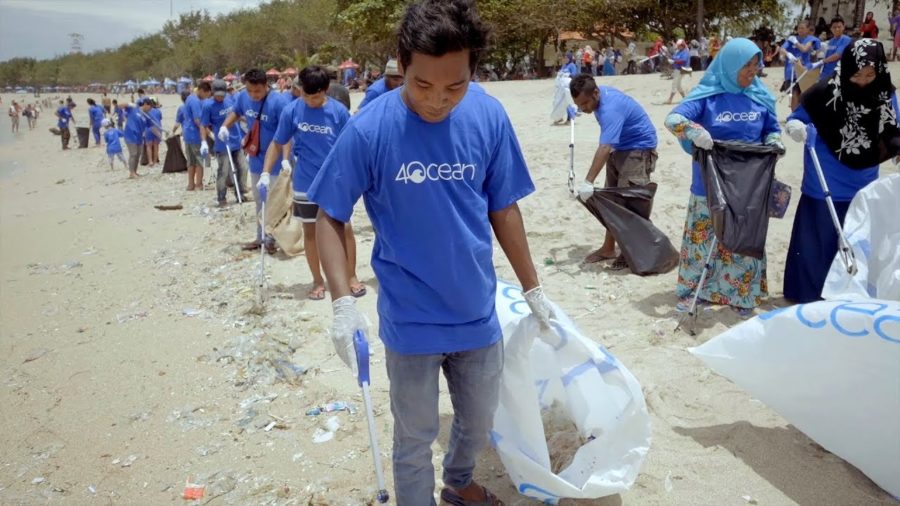
While Bali’s waves may have been just what these surfers had always dreamed of, Bali’s waters themselves were more of a nightmare. The beaches were covered in garbage, and fisherman parted seas of trash each day, catching much more plastic than fish. Without a waste management infrastructure, plastic caught in fishing nets was simply dumped back into the ocean. Plastic only continued to accumulate, leaving the water contaminated and the fisherman unable to earn a decent living.

Seeing this gave Cooper and Schultze an idea. What if plastic was, in fact, what the fisherman set out to catch each day? While there may have been a shortage of fish, there was no shortage of garbage. There just needed to be a market for it.  

Flash forward a couple of years and this idea is now 4ocean, a global ocean cleanup company funded entirely through the sale of 4ocean sustainability products and the 4ocean bracelet, made from post-consumer recycled glass and plastic. The sale of each bracelet promises the removal of at least one pound of trash from the ocean. Currently 4.5 million pounds of trash have been successfully removed, clearing the coastlines of 27 different countries.

After Bali, the 4ocean team set up operations in Haiti where they aim to pull 3,000 pounds of plastic a day. Their first priorities are locations that do not have infrastructure for recycling or waste management and which consequently use a high volume of single-use plastic.

With their ever-growing team, Cooper and Schultze have created a sustainable economy for ocean conservation, employing over 300 people across the globe, and working in conjunction with 15 different nonprofit organizations supporting marine conservation. Dedicated to sustainable innovation, 4ocean’s ultimate goal is to promote awareness regarding the problems of single-use plastic and the necessity of educating consumers so as to prevent future plastic pollution and keep our oceans clean.

How to Solve the Climate Crisis: Take Responsibility for Your Hidden Violence

If we were little green men from Mars (or Venus for that matter) looking down on planet Earth, we would rapidly conclude that humans were killing the planet. While it’s obvious to an outsider, we seem unable to acknowledge our own endemic violence. We hide, deny and run from our deepest, most global truth.

Extinction Rebellion took to the streets of London recently, resulting in 900 protesters landing in jail. When London mayor Sadiq Khan urged them on twitter to “Let London return to business as usual”, George Monbiot – journalist at The Guardian – retorted “business as usual is destroying our life support systems.”

He’s not wrong.

While we continue blindly with our unconscious killing spree, or as we call it, “business as usual”, our hidden violence is quite apparent to someone like Greta Thurnberg, the sixteen-year-old Swedish girl with Aspergers disease who talks in unapologetic black and white terms about our climate crisis — against the tones of gray that politicians and world leaders seem to excel at when making a speech. 

Solving our climate problem is clearly not just a matter of recycling, it’s way bigger. It’s now about our entire way of life. We live and consume like planet-harassing bullies. The structure of our global economy, the pillars of capitalism and democracy, the very way we interact and negotiate with each other need to be radically redefined in order to stop this massacre.

But if we want to change the world, as any ancient wisdom, spiritual theology or decent life coach would tell us, we must start by changing ourselves. We need to face, accept and heal the hidden bullies we have unknowingly become.

I’ve been going through a harsh exercise of self-change for a while now, resulting in articles around my personal and painful revelations, which you’ll find on Real Leaders. I have shared with some friends and colleagues my tough quest to build self-awareness around the hidden violence that I have suffered for decades, from those I loved the most. It wasn’t easy.

On one hand, confessing to everyone I cared about that I’d been bullied since childhood meant that I had to confront the hidden violence in my life on a new level. I felt stupid, worthless, weak and unworthy all over again, now that it wasn’t hidden anymore.

On the other hand, I realized how much I’d been playing along with it, before making the facts publicly known. I had a dream about this life change the night the article was published. I saw myself engaging in a superficial, happy conversation with Javier, my romantic bully, hoping to reduce the risks of a possible ambush. I woke up suddenly, startled, with a terrible heartache pulsating slowly through my body, waves of grief and anguish growing. Luckily, I have taught myself to process and relieve emotional pain effectively.

The dream taught me that the pattern of violence between the two of us, was as much mine, as it was his. Maybe I wasn’t doing the insulting, but I was playing along with it. I was reactively taking it in my stride as a means of avoiding more violence. In doing so, however, I was unknowingly negating, suppressing and ignoring the wounded victim in me.

Years ago, someone told me that attending therapy was about taking responsibility for things that are not your responsibility. Growing as a person and as a leader is no different. The only way we solve, and end a pattern of violence, is by acknowledging  our part in it. It’s a tricky concept in our current culture, that is full of moral judgment and blame — both essentially acts of hidden violence themselves.

Just for fun, let’s ask the little green men once more to give us their opinion on human history: Do they see violence in it? Do they see us as taking responsibility for that violence and gradually reducing it over generations? Or, do they see us coming up with increasingly sophisticated methods and excuses to continue inflicting hidden, morally-superior, and easy-to-deny violence on past and present enemies? Even far-away, innocent bystanders.

Such are the tough questions we all need to come to terms with. Despite our ignorance – and innocence or lack of responsibility in the making of it – the fact is we are all part of this cycle of hidden violence. We play along with it to avoid unforeseen consequences down the road: We hoard money, power, Instagram likes, and all kinds of single-use stuff, just in case it all runs out, or there isn’t enough to go around. In doing so we negate, suppress and ignore the wounds such behavior inflicts on the planet, on the two-hundred species that disappear each day, on the distant, unseen  villages that are most vulnerable to climate change. We suppress this in ourselves too.

I have to agree with the little green men on one thing — the fact that hidden violence is significantly more destructive and far-reaching than obvious, physical violence. There is a refinement and cold dissociation to be found in a financial venture that  leaves thousands of people without jobs or homes, in contrast to the football hooligan who thumps an opponent in a drunken haze. A hooligan is a lot likelier to admit his faults and change than the slick, rich, carefully-crafted executive who plays carelessly with numbers in his excel sheet. The first crime is punishable by law, while the second is “business as usual.”

When I look at my family and romantic life, I know we didn’t choose our roles. We never intended to become helpless receivers of violence, less so the bad guys. Just as I had not fully grasped that I was a victim, Javier doesn’t even know he is a bully. He works himself to the absolute limit every day in an effort to hide it, deny it and run from his deepest truth.

In a way we were meant for each other. Both his family and mine inherited patterns of violence from earlier generations. No one ever spoke of it. It was hidden in plain sight between our jokes and our mean laughter, inside our inconsequential daily gossip, beneath the addiction we each chose to help us cope with our assigned roles.

Where there is violence there is an old wound. The only animals in nature who inflict pain on others, beyond their instinct to survive, are ones that have been previously traumatized. Recuperating violent horses, for example, is all about retraining their responses, rebuilding their trust, and letting them express anger in safe spaces until it’s gone.

Recuperating the violent, planet-killing species that the human race has become is no different. It starts with acknowledging and admitting our role in the violence. It continues through many sessions of rebuilding broken trust, and expressing our anger, fear and grief in safe spaces. Until it’s gone.

Only then can we build a new life and global economy for ourselves which inflicts no violence on anyone or anything.

The $70 Trillion Arctic Ice Problem We Shouldn’t Ignore

Atmospheric CO2 has been consistently measured since 1956 in Hawaii. Calculated figures over geological times have suggested vast changes in CO2 levels, surface temperatures and changes in the climate; now we are in the Anthropocene Era, in which mankind alone is responsible for rapid climate change, implied from the very rapid rise in CO2 and other atmospheric pollutant volumes. 

The economic impact of change is large – the melting of Arctic ice alone might cost $70 trillion, under current national pledges to cut carbon emissions.

Pre-industry pollution levels were unchanged for centuries, then industry demanded more energy. The global population numbers increased, and a rapid upward spiral began, creating today’s issues – now the big question is how to reverse the pollution, and thus diminish its effect. Confusingly, it is not only CO2 that is problematic, but a range of other pollutants that were drawn into an equation formulated before the 1989 Montreal Protocol on the Ozone Hole – creating the ‘CO2 equivalent’, conveniently called the Carbon Footprint. In parallel, the 1987 UN Brundtland Committee suggested there were three major energy-demanding, thus polluting sectors – Industry, Transport, Buildings. Since then all developed nations’ governments have implemented programs designed to reduce their pollution. Above all, fossil fuel demand has fallen globally relative to early predictions due to better engineering of efficient engines, and the capturing of renewable energy at scale. 

Scientific studies on the climate became focused when the IPCC (Intergovernmental Panel on Climate Change) was incorporated in 1988, charged with regularizing and extending the science and to produce Framework Reports, now at the 5th Edition. In the latter they call strongly to halt average annual surface temperature rising above 1.5 Celsius annually (against pre-industrial levels) by reducing pollution levels.  Beyond 2.0 C massive disasters are predicted: severe droughts, tempests, and fluctuating weather patterns: “climate is what we have, weather is what we get”.

The IPCC holds annual global meetings and regularly pressures heads of government to ‘do something’ – one such at Kyoto in 1997 resulted in the world’s first attempt to co-ordinate against pollution with the target date of national actions being 2015. Following, a new set of global actions were agreed in the 2015 Paris Accord with a target date of 2030: supplementary resolutions were formulated at the IPCC COP24 in Katowice, December 2018.

Sadly, many governments are defaulting on their new interim goals, and observers worldwide have become anxious – even schoolchildren are protesting against perceived inaction on the part of governments, science and businesses. The media apparatus has focused on these  worldwide protests – such as in the UK, highlighting Greta Thunberg a Swedish schoolchild who flew in to join UK children; and upon many other protesters who blocked parts of London and its airport. 

Fact finding, one can read data which shows the EU is on target, averaged over its nations. As part of the Europe 2020 strategy, the EU set three climate and energy targets called the ‘20-20-20.’ That is, a 20 percent reduction in pollution emissions compared with 1990 levels, a 20 percent share of renewable energy in gross final energy consumption, and a 20 percent cut in the energy consumption compared to the 2020 business-as-usual projection. If the EU can do this, why not others? And, if the EU has done so well up to now, why don’t people know this? Why protest – causing havoc, and loading the policing costs upon tax-payers?

We ought to note that global leaders and businesses have done much to support science and its commercialization. For instance –

  • The Brundtland Commission forced a redesign of fossil-fuelled power stations to thoroughly clean their exhaust gasses. Plus, fossil-fuelled power plants can be co-located with others manufacturing that demands CO2 as a feedstock. Furthermore, science shows how to extract CO2 from the air, converting it into an inert chemical that has potential to be further converted into a clean-burning fuel (but of course re-creating CO2 to be captured later). 
  • The IMO (International Maritime Organization) is to ban the use of heavy oil by shipping from 2020. Ships will use much less polluting low-sulphur diesel fuel. 
  • In cities many governments and mayors are banning fossil-fuelled vehicles, commencing with diesels, in favour of battery power. In fact, this has a low effect on overall pollution as the electricity needed for battery charging comes from power stations (though fossil-fuelled ones are polluting, electricity is often sourced from renewables – wind and solar, predominantly). This modal change reduces city pollution, especially of the killer smog which is derived from vehicle exhausts combining with ozone, and with sun-light.

These brief examples indicate wide-spread progress is being made, and businesses are seeing strong opportunities to combat climate change. 

Too little calm and realistic discussion is taking place between action takers (governments, businesses and scientists) with the client population: presently confusion reigns. Also, rampant consumerism across the relatively rich world ensures we produce and buy too much, only to send it unused to land-fills.

We do have solutions that are perhaps too weakly applied (all are well formulated in the IPCC targets) but some Big Business as well as lobbyists resist change: and some government leaders are climate change deniers.  And as the results of the 1997 Kyoto Protocol showed, those who did not meet their legally binding obligations had no sanctions placed on them thereafter – thus the 2015 Paris Accord was not formulated as a legally enforceable document.

However, I am optimistic – global population will soon begin to fall, demand for fossil fuels is falling as many more renewables come on-line and battery technology advances; and we are becoming more personally aware of our own pollution patterns. 

Stemming from protests and from better, clearer information, as well as a transparent analysis of future decisions about their feasibility and cost-benefit we will be able to proceed. The developed nations should accede to the reasonable demands of the poorer. Eventually, let us hope, social pressures will force better management of pollution and climate change in the future.

The $70 Trillion Arctic Ice Problem We Shouldn’t Ignore

Atmospheric CO2 has been consistently measured since 1956 in Hawaii. Calculated figures over geological times have suggested vast changes in CO2 levels, surface temperatures and changes in the climate; now we are in the Anthropocene Era, in which mankind alone is responsible for rapid climate change, implied from the very rapid rise in CO2 and other atmospheric pollutant volumes. 

The economic impact of change is large – the melting of Arctic ice alone might cost $70 trillion, under current national pledges to cut carbon emissions.

Pre-industry pollution levels were unchanged for centuries, then industry demanded more energy. The global population numbers increased, and a rapid upward spiral began, creating today’s issues – now the big question is how to reverse the pollution, and thus diminish its effect. Confusingly, it is not only CO2 that is problematic, but a range of other pollutants that were drawn into an equation formulated before the 1989 Montreal Protocol on the Ozone Hole – creating the ‘CO2 equivalent’, conveniently called the Carbon Footprint. In parallel, the 1987 UN Brundtland Committee suggested there were three major energy-demanding, thus polluting sectors – Industry, Transport, Buildings. Since then all developed nations’ governments have implemented programs designed to reduce their pollution. Above all, fossil fuel demand has fallen globally relative to early predictions due to better engineering of efficient engines, and the capturing of renewable energy at scale. 

Scientific studies on the climate became focused when the IPCC (Intergovernmental Panel on Climate Change) was incorporated in 1988, charged with regularizing and extending the science and to produce Framework Reports, now at the 5th Edition. In the latter they call strongly to halt average annual surface temperature rising above 1.5 Celsius annually (against pre-industrial levels) by reducing pollution levels.  Beyond 2.0 C massive disasters are predicted: severe droughts, tempests, and fluctuating weather patterns: “climate is what we have, weather is what we get”.

The IPCC holds annual global meetings and regularly pressures heads of government to ‘do something’ – one such at Kyoto in 1997 resulted in the world’s first attempt to co-ordinate against pollution with the target date of national actions being 2015. Following, a new set of global actions were agreed in the 2015 Paris Accord with a target date of 2030: supplementary resolutions were formulated at the IPCC COP24 in Katowice, December 2018.

Sadly, many governments are defaulting on their new interim goals, and observers worldwide have become anxious – even schoolchildren are protesting against perceived inaction on the part of governments, science and businesses. The media apparatus has focused on these  worldwide protests – such as in the UK, highlighting Greta Thunberg a Swedish schoolchild who flew in to join UK children; and upon many other protesters who blocked parts of London and its airport. 

Fact finding, one can read data which shows the EU is on target, averaged over its nations. As part of the Europe 2020 strategy, the EU set three climate and energy targets called the ‘20-20-20.’ That is, a 20 percent reduction in pollution emissions compared with 1990 levels, a 20 percent share of renewable energy in gross final energy consumption, and a 20 percent cut in the energy consumption compared to the 2020 business-as-usual projection. If the EU can do this, why not others? And, if the EU has done so well up to now, why don’t people know this? Why protest – causing havoc, and loading the policing costs upon tax-payers?

We ought to note that global leaders and businesses have done much to support science and its commercialization. For instance –

  • The Brundtland Commission forced a redesign of fossil-fuelled power stations to thoroughly clean their exhaust gasses. Plus, fossil-fuelled power plants can be co-located with others manufacturing that demands CO2 as a feedstock. Furthermore, science shows how to extract CO2 from the air, converting it into an inert chemical that has potential to be further converted into a clean-burning fuel (but of course re-creating CO2 to be captured later). 
  • The IMO (International Maritime Organization) is to ban the use of heavy oil by shipping from 2020. Ships will use much less polluting low-sulphur diesel fuel. 
  • In cities many governments and mayors are banning fossil-fuelled vehicles, commencing with diesels, in favour of battery power. In fact, this has a low effect on overall pollution as the electricity needed for battery charging comes from power stations (though fossil-fuelled ones are polluting, electricity is often sourced from renewables – wind and solar, predominantly). This modal change reduces city pollution, especially of the killer smog which is derived from vehicle exhausts combining with ozone, and with sun-light.

These brief examples indicate wide-spread progress is being made, and businesses are seeing strong opportunities to combat climate change. 

Too little calm and realistic discussion is taking place between action takers (governments, businesses and scientists) with the client population: presently confusion reigns. Also, rampant consumerism across the relatively rich world ensures we produce and buy too much, only to send it unused to land-fills.

We do have solutions that are perhaps too weakly applied (all are well formulated in the IPCC targets) but some Big Business as well as lobbyists resist change: and some government leaders are climate change deniers.  And as the results of the 1997 Kyoto Protocol showed, those who did not meet their legally binding obligations had no sanctions placed on them thereafter – thus the 2015 Paris Accord was not formulated as a legally enforceable document.

However, I am optimistic – global population will soon begin to fall, demand for fossil fuels is falling as many more renewables come on-line and battery technology advances; and we are becoming more personally aware of our own pollution patterns. 

Stemming from protests and from better, clearer information, as well as a transparent analysis of future decisions about their feasibility and cost-benefit we will be able to proceed. The developed nations should accede to the reasonable demands of the poorer. Eventually, let us hope, social pressures will force better management of pollution and climate change in the future.

Reduce, Reuse, Recycle, Refuse

Recycling has become a capitalist war…. one that nobody wins.

“Reduce, reuse, recycle” is the mantra we’ve lived by for years, but it has come to encourage an over-zealous recycling campaign that has been doing more harm than good.

Americans tend to recycle for a clear conscience, which means throwing as much as we can in recycling bins, assuring ourselves that we’re being good Samaritans by opting to not use the trash. But recycling isn’t as simple—or nearly as easy—as we’re been lead to believe. And much of what we toss out isn’t actually reusable. We throw dirty and contaminated containers away, assuming some environmental enthusiast on the other end will lovingly sort our yogurt containers and pizza boxes. For a while, there was someone on the other end to do just that—the many Chinese workers at manufacturing plants overseas. But this is no longer the case.  

Until recently, China and its endless demand for materials was our biggest market for recycled goods. But after years of low-quality, contaminated materials, China has raised its standards, leaving the US in a bind regarding what to do with tons of the allegedly “reusable” waste we generate each day.

Without a foreign market for our recyclables to generate a profit, the cost of recycling programs has skyrocketed. Recycling companies claim they can’t break even selling used materials because of the costs that go into processing them, which means charging more for recycling services and often adding additional contamination fees for recycled materials mixed in with the trash. Before China changed its policies, contamination was never an issue. This poses the question: Is contamination the only issue, or are recycling companies capitalizing on an opportunity to make a greater profit now that they have a monopoly?

In any case, exorbitant recycling rates have left many small and mid-sized municipalities unable to afford recycling. Even though their citizens still sort recyclables from the trash, it all ends up in the same place, taking up much more space in landfills and increasing a toxic build-up of methane gas. And for the communities that can’t morally bring themselves to throw recyclables away, many are incinerating them, which releases emissions into the atmosphere that create a health risk.  

Currently it’s still cheaper to generate new materials instead of taking the time and energy to recycle used ones. The solution lies in the problem. Without a second thought, we are mass-producing and mass-consuming materials that end up straight in the trash. What we need is the capacity to engineer 100% recyclable packaging materials that can truly be reused, and a domestic market for recycled goods that could begin a circular approach to American Waste Management, and a sustainable form of consumerism.

The only question remaining is: Who, or what, is stopping us?

Earth Day: Take Part in the Biggest Volunteer Event in History

Earth Day Network is implementing a nationally coordinated environmental volunteer cleanup to mark Earth Day 2019, in collaboration with partners across the U.S., including National CleanUp Day and Keep America Beautiful. All over the country people are encouraged to get up, get out, and help clean their communities to celebrate Earth Day on 22 April.

People have a right to expect a clean environment and can exercise that right by helping to clean their own communities. More than 3,000 cleanups are planned for green spaces, urban landscapes and waterways, in conjunction with grassroots organizations. Events will take place throughout the remainder of the month of April.

“The Great Global Cleanup will bring together millions of people around the globe to create the largest coordinated volunteer event in history,” Earth Day Network President Kathleen Rogers said. “We are excited to kick off in cities across the U.S. in 2019, and to expand globally in 2020 in honor of the 50th anniversary of Earth Day.”

Plastic pollution and waste challenge every community, every day, and these cleanups offer a chance to make a real difference. Cleanups are planned in over 80 cities and towns, including Chicago, Dallas, Denver, Honolulu, Los Angeles, Miami, New York, Richmond, San Diego, San Francisco, Seattle and Washington, D.C.

More cities and sites are being added every day and volunteer registration is open now. Sign up here.

Earth Day Network’s mission is to diversify, educate, and activate the environmental movement worldwide. Growing out of the first Earth Day in 1970, Earth Day Network now works with more than 50,000 partners in 190 countries to build environmental democracy. More than one billion people now participate in Earth Day activities each year, making it the largest civic observance in the world.

The Earth Day 2019 Cleanup aims to inspire volunteerism and achieve a tangible impact on the waste we see in our environment. The campaign includes mobile registration, digital mapping, social media, photo sharing, corporate volunteer engagement, and data collection on the cleanup results.

Building on best practices from 2019, this event will then be scaled up for the 50th Anniversary of Earth Day in 2020, which will be known as the Great Global Cleanup, featuring more than 100,000 events globally with a goal of collecting more than one billion pieces of trash.

For more information visit: earthday.org/greatglobalcleanup.


New Zealand Native Know-how Lauded for Big Business

Instead of a wasteful ‘take, make and throw’ approach, companies should copy indigenous principles and aim for a ‘circular’ way of work that recycles and re-uses.

Global businesses should heed traditional, indigenous knowledge to better protect land, honour old customs and boost profits, participants at a conference in New Zealand said on Thursday.

Instead of a wasteful ‘take, make and throw’ approach, companies should copy indigenous principles and aim for a ‘circular’ way of work that recycles and re-uses, said participants at a summit devoted to the circular economy.

“We’re a Maori organisation so while there’s a very strong commercial and business arm to what we do, there’s also a cultural, charitable and community focus,” said Kerensa Johnston, chief executive of Wakatu Incorporation.

New Zealand-based Wakatu has about 4,000 shareholders who mostly descend from the region’s original Maori land owners.

Johnston said the firm followed the traditional tenets shared by many indigenous people, whose way of life is under threat globally as governments and corporations seek to develop the land and resources that sustain their native communities.

“We understand that our relationship to the land is inherent in the health and well-being of our people,” she said.

The multi-million dollar enterprise has businesses that range from farming to food and drink, and operates with a 500-year, inter-generational business plan, said Johnston.

NO MYTH, NO FABLE

Protecting land and promoting sustainable development were built into indigenous culture yet were often lost in modern firms, said Joe Iles of the Ellen MacArthur Foundation, a British charity that promotes the circular economy and hosted the two-day meeting.

Such principles could help companies reduce waste and use a host of products longer, while still boosting growth, he told the Thomson Reuters Foundation, by phone from New Zealand.

“The Maori world view places a great emphasis on the interconnectedness of everything,” said Iles.

“It’s serious technical knowledge. It’s not based purely on altruism or fables or myths.”

Up to 2.5 billion people around the world depend on indigenous and community lands, which make up more than half of all land globally.

Hinemoa Awatere of New Zealand’s Ministry for Environment said there was “increasing willingness” by her government to embed indigenous knowledge in the wider economy.

Indigenous businesses were flourishing in New Zealand and could do so elsewhere, she said, so long as mainstream currents that shape Western business listened to ideas from the South.

For Chris Kutarna, an academic at Britain’s Oxford University, indigenous principles with appeal to consumers could easily be woven into modern business, be it in a more sustainable use of raw materials to better product packaging.

“The big cognitive shift that we need to make is from discounting the past to revaluing the past,” he said.

“Knowledge is a collectible too,” Kutarna said.

The rights of indigenous people to land is protected by international legal conventions including the United Nations’ Declaration on the Rights of Indigenous Peoples, which was endorsed by hundreds of countries in 2007.

Yet from India to Brazil, indigenous communities are often threatened by logging, mining and agribusiness companies.

By Adela Suliman; editing by Lyndsay Griffiths. 

0