The World On Fire: Five Global Health Stories To Watch In 2020

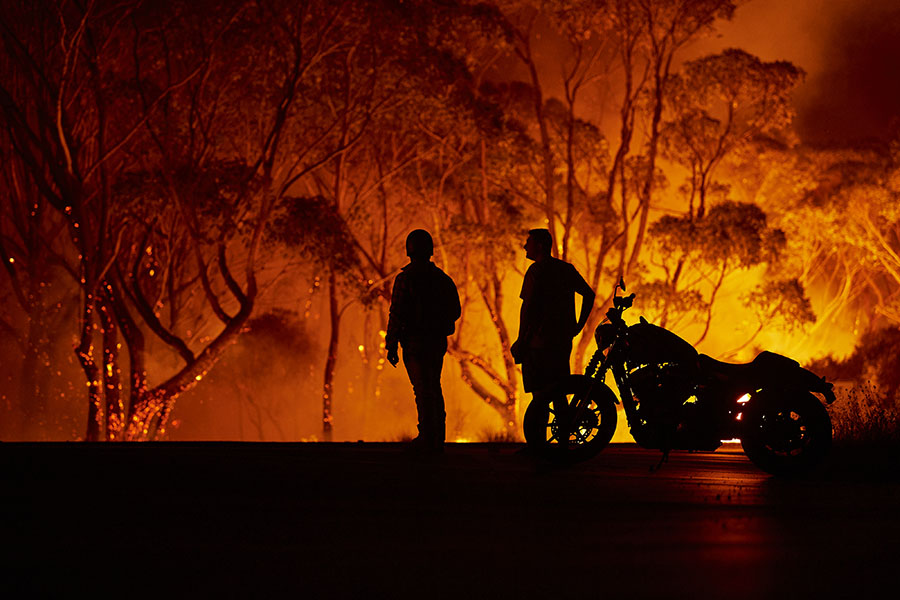
The failed 2019 UN Climate Conference in Madrid ended in mid-December just about when the massive wildfire destruction of Australia’s bushlands was beginning.

The wildfires that broke shortly afterward took the form of a Gaia-like revenge. Australia, along with the United States, Japan and Brazil, had been among the countries that had blocked real progress at the UN Conference of Parties (COP25) on a more realistic system of carbon emissions accountancy – that could track and ensure real progress on emissions reductions over the critical coming decade.

And the price exacted was almost immediate – in terms of ecosystems and wildlife damaged, and ultimately human health and well-being.

The converging problems of global warming, environmental degradation, and public health have been well-reflected in the bushfire destruction, along with a record drought in southern Africa, floods elsewhere, and off-the charts air pollution in Delhi, India, all occuring just as 2019 ended and the new decade of 2020 began. And therefore it is not surprising that climate has been placed at the top of the 2020 agenda by groups as diverse as the World Economic Forum (WEF), as well as the World Health Organization.

The Global Risks 2020 Report, released last week, just ahead the WEF meeting that begins Tuesday in Davos (21-24 January), notes “climate response shortcomings” as well as “biodiversity loss impacts” among the top two out of five categories of risks faced by the world for 2020.  “Creaking health systems” is listed as a sixth.

WHO has also listed the climate and health crisis as among the 13 top threats to global health in the next decade. Among the other threats highlighted by the agency – as well as by a range of experts interviewed by Health Policy Watch about the globala health outlook for 2020, include:

  • Emergence of new diseases at an increasing rate and intensity – as reflected in the Wuhan pneumonia outbreak;
  • Stalled action on medicines price tranparency – watch to see if European countries take a lead this year in adopting stronger measures;
  • Failing medicines markets contributing to the rise of anti-microbial resistance (AMR) – when prices for other vital drugs, particularly antibiotics, dip too low;
  • Non-communicable Diseases (NCDs) and Universal Health Coverage – how the global “syndemic” of obesity, undernutrition and climate change creates barriers to achieving UHC.

Digital health and AI technologies – which hold much promise for improving health, but also create new ethical challenges – were among the other issues cited by experts interviewed by Health Policy Watch. Long-simmering neglected diseases, often pushed to the sidelines of health agendas was another issue noted, as the world prepares to observe on 31 January, the first-ever World NTD Day.

The global shortfall of health workers, as well as gender challenges faced by women who dominate the lowest ranks of healthcare professionals, is another issue that will be highlighted prominently this year, which WHO member states have designated as “The Year of the Nurse and Midwife.”

Climate and Health 

The real-world convergence of climate and health agendas has been playing out in the Australia story, which has left some 29 people dead, uncounted numbers of people displaced, and over 1 billion animals killed – driving some species to the brink of extinction. There has been a 30% increase in asthma cases and more children presenting with respiratory infections, Sydney doctors have reported. Scientists, meanwhile, have said that the long-term human health impacts of exposures to the air pollutants “won’t be known for years.

But immediate health impacts were visibly demonstrated to global audiences during the initial, pre-qualifying rounds of the Australia Open, where the Slovenian Dalila Jakupović collapsed on the tennis court choking for air, and other stars also cancelled matches underway. Canadian Liam Brody later tweeted that players’ blood was “boiling” over the decision to continue the games in such hazardous air quality conditions.

Ironically, just four weeks earlier, as the December COP25 climate talks wound up, it was Indians in Delhi who were gasping for breath, and Australia was among the handful of countries to thwart a critical deal on how to count countries’ carbon reductions, in order to meet the pledges of the 2030 Paris Climate Agreement.

Along with Brazil and the United States, the conservative government of Prime Minister Scott Morrison, insisted on using carryover credits from the expiring 1992 Kyoto protocol, a loophole criticized by Costa Rica, New Zealand, France as something that would thwart accurate measurement of real progress, and even described as “cheating” by former French minister Laurence Tubiana, an architect of the 2015 Paris Agreement.

The Australia narrative illustrates the Global Risks Report finding that “climate response shortcomings” are among the top five risks faced in 2020. “Weak international agreements belie rising investor and popular pressure for action, against a multitude of natural catastrophes and indicators of longer-term disruptions,” the report states. “2020 is a critical year for nations to accelerate progress towards major emissions reductions and boosting adaptation actions.”

Experts have described Australia’s experience as just a taste of what to expect in the world’s most fire-prone continent from a changing climate. The year 2019 was the hottest year for the country on record, with average temperatures 1.5C° higher. Rising temperatures and lower levels of winter rainfall dried out bush and forest cover, which more readily become fuel for summer fires, occurring with greater frequency in the prolonged heat and drought conditions.

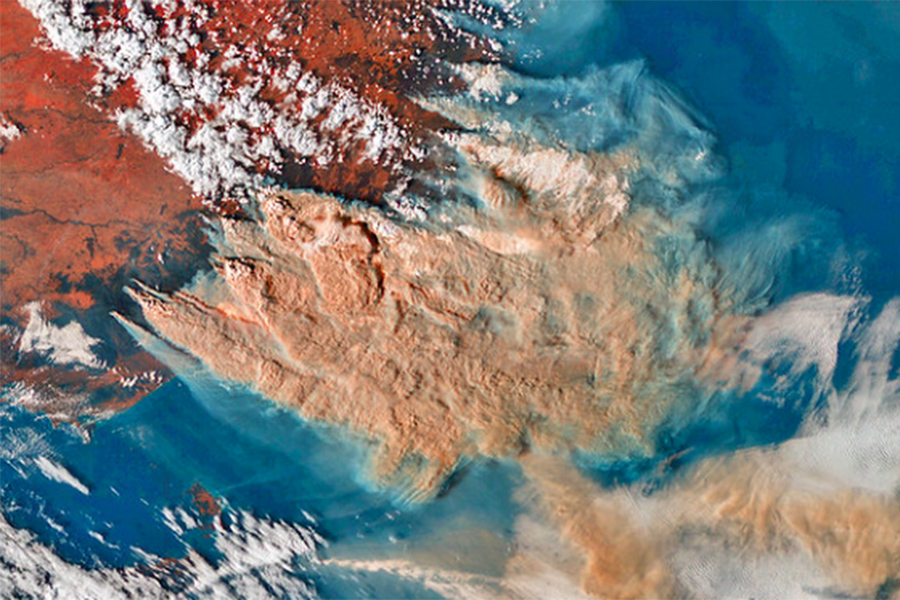
In just three months, Australia’s fires are estimated to have released 350 million metric tons of carbon dioxide, said climate experts quoted by the Sydney Morning Herald, warning that a century or more will be needed to absorb the carbon dioxide released. Drifting smoke from the fires has by now lapped around the world, and turned glaciers in nearby New Zealand brown – darker glaciers accelerate ice melt, in turn threatening the long-term stability of water reserves.

It’s also a record year for drought in Southern Africa with 12 countries affected, including Zimbabwe, Angola, Eswatini, Mozambique, and South Africa. The World Food Programme estimates a record 45 million people in Southern Africa are food insecure, including 5.1 million in Zimbabwe.  That face of climate change may have had even more dire, immediate, human health consequences. But there is no Australia Open playing in Harrare.

Smoke from a wildfire near Gosford, New South Wales, Australia turns the sunset an ominous red. Photo: Rob Russell

Climate & Health Lack Synergies

Within the broader spectrum of government failure, health and climate sectors remain disconnected –  sapping efforts to face a common threat to human health and well-being.

“The climate community lacks both the political leverage, the experience and the institutional mechanisms of the health sector—this expertise is badly needed for climate negotiations, but we don’t really work together,” lamented one senior European negotiator to Health Policy Watch, during the Madrid COP25.

He contrasted the high-profile October Global Fund Replenishment event in Lyon that had raised $US 14 billion to combat just three diseases, HIV/AIDS, TB and malaria, against the Green Climate Fund Replenishment conference that took place in Paris two weeks later. The latter raised less than US$10 billion for four years – and that was far short of the $US 100 billion in near-term climate finance that developed economies had pledged to channel to developing countries at the 2015 Paris Climate Conference.

“If you look at the Global Fund Replenishment, Emmanuel Macron, Bill Gates as well as Bono were all there,” lamented the negotiator.  “But who even heard about the Green Climate Fund event? Was there a Gates or a Macron or a celebrity like Bono?  No.”

In fact, behind the rhetoric, there are few formal institutional mechanisms to bring the knowledge, capacity and power of the health sector to bear on climate negotiations or to inform effective climate policies, at either national or global levels, he remarked.

One obvious reflection of that is the fact that year after year, attendees of the COP climate meetings include virtually no health ministers – with the exception of delegations that have been sponsored by WHO from time to time, from groups such as Small Island States, are faced with the virtual disappearance of their nations as a result of climate change.

This year, while climate delegates were huddling in Madrid in December, major health conferences were also going on in Brussels and in Oman, around non-communicable diseases. Meanwhile, WHO Director General Tedros Adhanom Gheyebresus was in Geneva putting the final touches on an organizational restructuring plan. WHO’s Maria Neira, who has won acclaim as the WHO’s lead on climate, health and environment, was pulled back to Geneva by the WHO Director General before the conference ended.

“With the exception of the Gender Action Plan, agreed by the end of the meetings, discussions did not bring to agreements and ended up in a disillusioned domain of unmet expectations,” reported Flavia Bustreo, chair of governance for the Interagency Partnership for Maternal, Newborn and Child Health, one of the few health officials to attend Madrid’s COP25.

She added that: “A low number of debates concerning the link between climate change and health suggests a low prioritization of what is now one of the biggest issues in this ongoing crisis.”
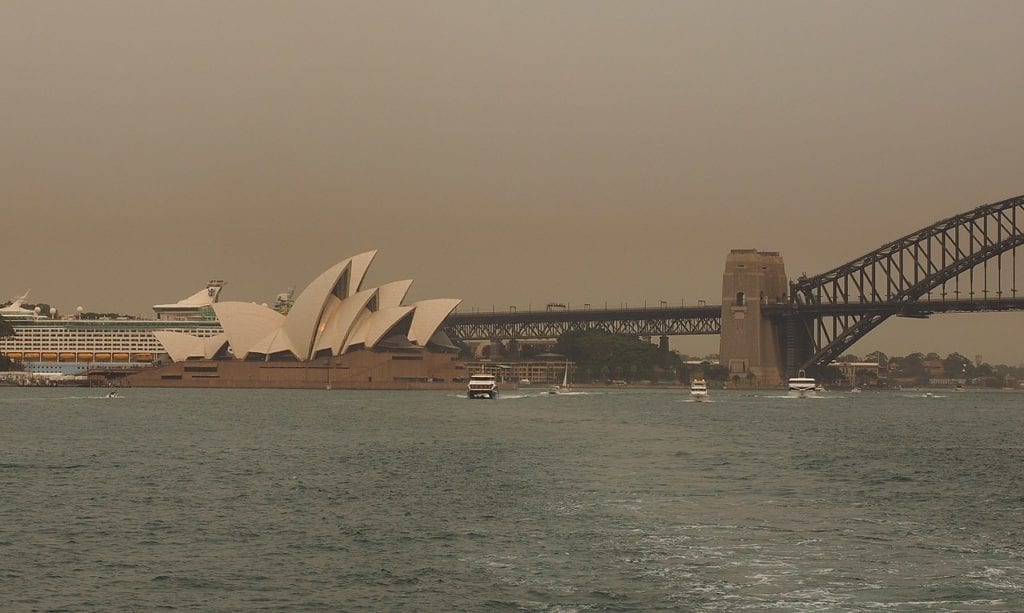
Bushfire smoke over Sydney Opera House, 29 December 2019. Photo: Nick-D

Grassroots Activists Target Finance & Fossil Fuel Producers

Outside the halls of debate, however, youthful protestors have been ramping up their campaigns against governments, fossil fuel producers, as well as their industrial and financial partners. Here too, Australia’s government has been a recent target, and tennis has even played a role.

Late last year, the Australian government approved the long delayed opening of the Carmichael open pit coal mine, the world’s largest, to supply fuel to India – just weeks before the bush fire emergency. The 447 square kilometre project owned by the Indian company Adani, has been hotly criticized by Australian environmentalists as a threat to the Great Barrier Reef.

Then in January, climate activists, including Sweden’s Greta Thunberg, called on the German engineering group Siemens to withdraw from the project; Siemens is to supply rail technology to transport coal from the mine. On Monday (January 13), Siemens rebuffed those calls.

Another prominent target has been Credit Suisse. In mid-December, in fact, the bank announced that it would stop lending for new coal-fired power plants, following on its decision to halt lending for new coal mine development. But the bank remains one of the world’s largest investors in fossil fuel companies with a US $57 billion portfolio, critics say. Swiss climate activists have called upon the bank, as well as its ambassador the billionaire tennis star Roger Federer, calling on them both to step back from fossil fuels.

Last Friday, Thunberg joined Swiss activists at a climate protest in Lausanne, at the end of a week where protestors ramped up a @RogerWakeUpNow campaign aimed at Credit Suisse and Federer, who is also competing in the Australian Open.

That followed a landmark Swiss ruling on Monday (13 January), where young activists associated with Lausanne Action Climat  were acquitted by a local court of CHF 21,600 in fines for storming a Credit Suisse office in 2018 with tennis rackets and balls. In an unprecedented decision, the judge declared that the urgency of climate action in the public interest outweighed their violations of the law.

A day later the protestors entered the Swiss offices of UBS, another major investor in fossil fuels, and dropped bags of coal on the floor.

“So far during this decade, we have seen no signs whatsoever that real climate action is coming and that has to change. To the world leaders and those in power I would like to say, that you haven’t seen anything yet, you have not seen the last of us. We can assure you that,” Thunberg told cheering crowds in Lausanne on Friday.

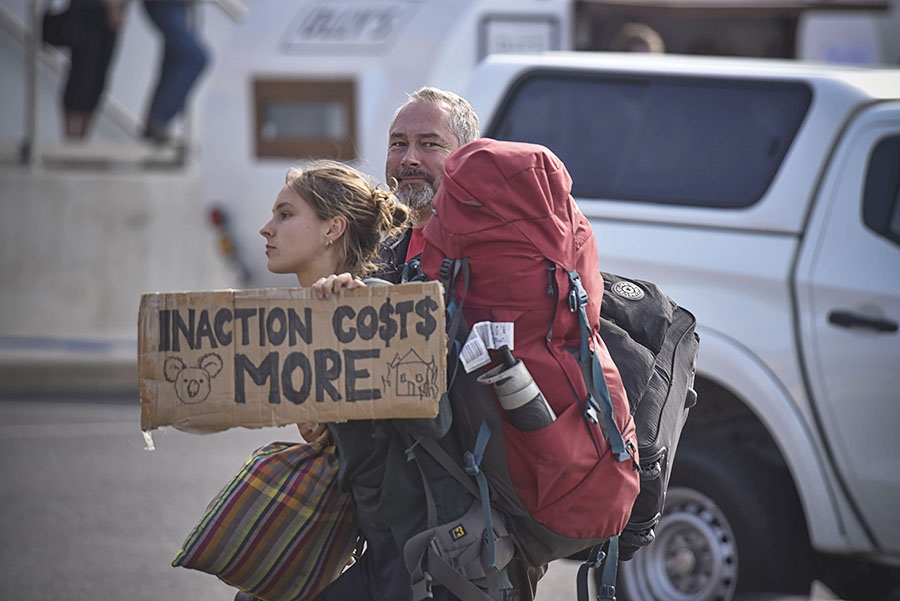
Such scenes may become more common throughout 2020 as youth activism, fueled by public concern over climate grows, while governments and industries try to carry on business as usual with fossil fuels.  As the next stop, Thunberg and other climate activists are heading to the WEF in Davos, to demand that financial leaders halt investments in fossil fuels.

“We don’t want these things done by 2050, 2030 or even 2021. We want this done now – as inright now,” Thunberg said in a Guardian Op-Ed published Monday (20 January) with other youth climate activists.  Since the 2015 Paris Climate Agreement, 33 leading banks have poured some $1.9 trillion into fossil fuels, the op-ed noted, and an International Monetary Fund report estimates that in 2017, the world spent $US 5.7 trillion in fossil fuel subsidies.

Although oil-producing Abu Dhabi rang in 2020 with a Futures Energy Summit devoted to clean energy, in fact investments in renewables in developing countries “plummeted” in 2018, according to a November 2019 MIT Technology Review.  Coal power production in 2018 reached an all-time high according the International Energy Agency. And across southeast Asia as well as parts of Southern Africa and the Middle East new coal power plant development continues apace, much of it driven by Chinese and Japanese investment.

Natural gas is also having a heydey. While less damaging than coal, natural gas development has often been at the expense of even cleaner solar energy sources, critics say. In the sun-drenched Mediterranean region, Turkey celebrated the New Year with the launch of a new natural gas pipeline connection to Russia; Israel launched its second major natural gas platform; and regional tensions heightened over conflicting claims between Turkey and Libya on the one hand, and Greece and Cyprus, on the other, to other potential Mediterranean gas reserves – creating new and dangerous sources of regional political tension.

What To Watch in 2020

The 2020 Climate Conference in Glasgow on 9-19 November (COP26) will confront all of these financial and political forces head-on. This is when countries will gather to make new political commitments on emissions reductions. The European Union’s landmark agreement to reach net zero emissions by 2050, formally announced on 13 December, represented one important bright spot in the otherwise dim closing hours of the Madrid COP.  Significantly, that commitment was also accompanied by a €100 billion pledge in funding by the European Commission to help the ease the energy transition, particularly among some of the region’s most coal-dependent countries, such as Poland, as part of a European Green Deal Investment Plan that aims to attract €1 trillion in public and private finance over the next decade.

But the last hope for the global community to prevent temperatures from rising above 1.5°C still appears dim – if fossil fuel development across the rest of the world moves forward unabated, and the United States, which has announced that it will withdraw from the 2015 Paris Climate Agreement, follows through on that promise right after the US Presidential elections. Those elections are scheduled for 3 November, just days before the Glasgow COP26 commences.

Whether European leaders can and will wield sufficient muscle to convince the other big drivers of climate change to change course, including both high-income Australia, Japan and the US, as well as emerging economies led by the “BRICS” of Brazil, Russian, China and South Africa, remains an open question. Not only will COP26 be the year’s climax in climate policy-making – it could be the most decisive meeting for decades to come.

Leading up to that, observers can expect to see more youth-driven protests around Europe and elsewhere, and more civil disobedience.  It remains to be seen if this will capture the imagination of the broad public – or exacerbate social confrontations  with other interests, such as public opposition to higher fossil fuel prices. It was, after all, Emmanuel Macron’s earlier moves to raise fuel prices, which triggered the prolonged, and often violent, “Gilet Jaune” (Yellow Vest) protests seen in France over the winter of 2019, as well as civil disturbances in Africa and the Middle East on other occasions.

Also expect to see a series of protracted technical negotiations between countries over the new 2020 commitments to protect the world’s biodversity. Biodiveristy underpins what scientists call critical “ecosystem services” to health, such as food and fresh water supplies, sources of existing and future medicinal plants, as well as certain forms of natural regulation of infectious diseases.

At February meeting of the UN Convention on Biodiversity (CBD) in Kunming, China, technical experts will wrangle over proposed new targets for protecting the world’s seas, open spaces and species, hopefully paving the way for a new global agreement at the 15thCBD Conference of Parties in October. The agreement aims to halt the increasingly rapid decline and extinction of plant and animal species – after the 2010 CBD targets were largely missed.

Biodiversity loss is another topic on the Davos agenda, having been included among the top five risks in the Global Risks 2020 Report. The ways in which biodiversity loss threatens the stability of future food supplies and medicines discoveries, as well as other life support systems, are laid out in a WEF blog by a top official at Zurich Insurance Group – illustrating how an longtime scientific concern is now drawing attention from actors such as the insurance industry.

As for measuring progress on bringing health and climate agendas just a little bit closer together, watch out for where WHO’s top leadership will be in that critical week of November 9-19 – and what ministers of health, as well as rank and file doctors and nurses are saying and doing during Glasgow’s Climate Conference.

By Elaine Ruth Fletcher. This story originally appeared in Health Policy Watch and is republished here as part of Covering Climate Now, a global journalism collaboration to strengthen coverage of the climate story.

The Akashinga: Zimbabwe’s Female Anti-Poaching Team

Zimbabwe’s all-female anti-poaching team is helping to improve the economy by empowering women and protecting wildlife.  

Poaching has taken a severe toll on the elephant population of Zimbabwe. By 2017, numbers in the Lower Zambezi region had declined by 40 percent since 2001. According to the African Wildlife Foundation (AWF) as many as 35,000 elephants are killed in Africa each year. If this rate continues, African elephants (along with other vulnerable species such as Black Rhinos, Lions, and Mountain Gorillas) may become extinct within our lifetime. 

Illegal trophy hunting and poaching has become such a large part of Africa’s economy that there has become little incentive to promote conservation. Without alternate sources of income, poaching will continue to destroy the rich biodiversity of the continents ecosystem. 

Enter the Akashinga, “The Brave Ones,” a branch of the International Anti-Poaching Foundation with a new approach to protecting Africa’s wildlife — employing only marginalized women from rural communities. Single mothers, abandoned wives, survivors of sexual and physical abuse, widows, and orphaned girls are trained as rangers and biodiversity managers. They now protect the vast tracts of land previously ruled by poachers. Their business model gives the most vulnerable women an opportunity to become empowered by earning a living, while protecting wildlife.

Training to become an Akashinga ranger is rigorous and grueling. The women must be prepared to face the harshest conditions, and heavily-armed poachers. But the wet, cold, and hunger isn’t something that intimidates them — the hellish conditions they face aren’t any worse than the conditions they already endured as marginalized members of their community. Troubled backgrounds make the Akashinga rangers particularly adept at their job. 

Over 60 percent of Akashinga’s operational costs go directly back to local communities, and up to 80 percent of this goes directly to households. It’s a more profitable and longterm, sustainable income for the community than the short-term financial returns of poaching. Akashinga yields the same profit in 34 days than trophy hunting yields in a year, with the added benefit of simultaneously promoting conservation. It demonstrates that endangered wildlife are more valuable to the Zambezi Ecosystem alive than dead, and provides an incentive to promote conservation.   

The success of Akashinga’s business model is proof that empowering women in the workforce leads to economic growth. According to the UN, closing the gender gap in the workplace is a key component to achieving the 17 Sustainable Development Goals. 

Akashinga plans to expand its conservation work. By 2025, they intend to recruit 1,000 women to protect a network of 20 former hunting reserves — securing a future for the species that live there, creating better lives for their communities, and inspiring people around the world to take action in bettering our world. These women prove each day that taking action can have an immediate, positive effect.  

Click here to make a donation to the IAPF and Akashinga project

Photographs courtesy of Adrian Steirn.

The Akashinga: Zimbabwe’s Female Anti-Poaching Team

Zimbabwe’s all-female anti-poaching team is helping to improve the economy by empowering women and protecting wildlife.  

Poaching has taken a severe toll on the elephant population of Zimbabwe. By 2017, numbers in the Lower Zambezi region had declined by 40 percent since 2001. According to the African Wildlife Foundation (AWF) as many as 35,000 elephants are killed in Africa each year. If this rate continues, African elephants (along with other vulnerable species such as Black Rhinos, Lions, and Mountain Gorillas) may become extinct within our lifetime. 

Illegal trophy hunting and poaching has become such a large part of Africa’s economy that there has become little incentive to promote conservation. Without alternate sources of income, poaching will continue to destroy the rich biodiversity of the continents ecosystem. 

Enter the Akashinga, “The Brave Ones,” a branch of the International Anti-Poaching Foundation with a new approach to protecting Africa’s wildlife — employing only marginalized women from rural communities. Single mothers, abandoned wives, survivors of sexual and physical abuse, widows, and orphaned girls are trained as rangers and biodiversity managers. They now protect the vast tracts of land previously ruled by poachers. Their business model gives the most vulnerable women an opportunity to become empowered by earning a living, while protecting wildlife.

Training to become an Akashinga ranger is rigorous and grueling. The women must be prepared to face the harshest conditions, and heavily-armed poachers. But the wet, cold, and hunger isn’t something that intimidates them — the hellish conditions they face aren’t any worse than the conditions they already endured as marginalized members of their community. Troubled backgrounds make the Akashinga rangers particularly adept at their job. 

Over 60 percent of Akashinga’s operational costs go directly back to local communities, and up to 80 percent of this goes directly to households. It’s a more profitable and longterm, sustainable income for the community than the short-term financial returns of poaching. Akashinga yields the same profit in 34 days than trophy hunting yields in a year, with the added benefit of simultaneously promoting conservation. It demonstrates that endangered wildlife are more valuable to the Zambezi Ecosystem alive than dead, and provides an incentive to promote conservation.   

The success of Akashinga’s business model is proof that empowering women in the workforce leads to economic growth. According to the UN, closing the gender gap in the workplace is a key component to achieving the 17 Sustainable Development Goals. 

Akashinga plans to expand its conservation work. By 2025, they intend to recruit 1,000 women to protect a network of 20 former hunting reserves — securing a future for the species that live there, creating better lives for their communities, and inspiring people around the world to take action in bettering our world. These women prove each day that taking action can have an immediate, positive effect.  

Click here to make a donation to the IAPF and Akashinga project

Photographs courtesy of Adrian Steirn.

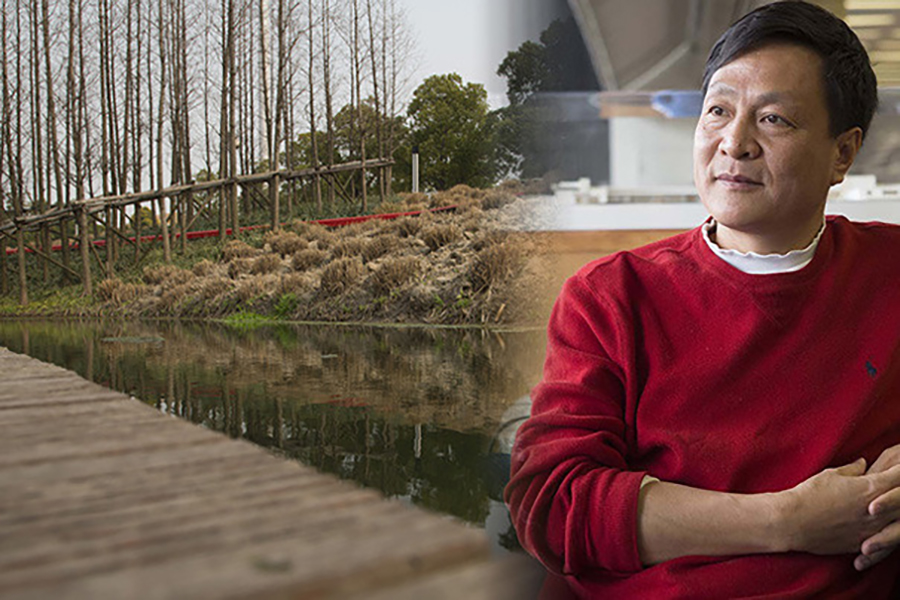
The Chinese Architect who Defied Centuries of Tradition to Build Something New

Kongjian Yu is a Chinese architect who defies the norms imposed on him as an architect. He promotes environmental thinking by building contemporary eco structures for urban developments while preserving cultural integrity. Here, he shares his journey.

“I had a shock! I saw how rivers were being polluted, ancient cities were being torn down, trees were being felled. All this seemed so wrong to me. I started writing articles and made as much noise as I could because I wanted to expose the flaws within Chinese policy; to the extent that policy was also disrupting values and people’s behavior. The response I got was anger from my local community, and even from other professionals and former teachers. They said I was betraying Chinese culture for having criticized tradition and culture. “You are a traitor to our whole culture,” they said to my face.

You have to be brave to be a good leader. I was born a peasant, and my family became landlords. As such, I was classified as “the enemy” while growing up in China. I suffered a lot financially, and to survive, I had to learn to stand up for myself.
I was a critical thinker and earned a Harvard degree, which brought with it new ideas. At first, I was respected in China because of my success in the United States and was invited to speak at conferences. Articles were even based on my ideas. But then people began realizing that I had different opinions, ones that went against the status quo. They started to call me and wrote letters saying that they didn’t like what I was doing.

I kept going and started building projects to demonstrate my thinking about China’s ongoing destruction of the environment. Pollution has gotten so bad in China, and we are no longer in a position to deny our responsibility to fix this situation. If our government officials take the initiative, we can still become the leading nation when it comes to cleaning up the environment.
My first project was to clean up a shipyard in Thungsan, in the Gongdan district, in the late 1990s. I was lecturing a group of mayors about ecology, sustainability, and a new way to approach the problem when one of the mayors came up to me after my speech. He liked my ideas. The city had a piece of land, an old shipyard that was heavily polluted, filled with garbage, and which had gone bankrupt. He wanted to clean it all up, dismantle it, sell things off and build a park. He showed me a picture with a rusty railroad and rusty machinery.

I found this site valuable – an old industrial park is a memory for the city. I was able to convince the mayor not to tear it down and that the shipyard was part of our history. I took an ecological approach and told him that we could create a new cultural park, repurposing the existing buildings. It was both contemporary and controversial, and everyone was skeptical about how a rusty industrial park could be transformed into a flowering cultural park.
Ninety-nine percent of the architects fought me. They thought I should instead build it according to old Chinese traditions of gardening. But I stuck to my plan. Finally, we put on an exhibition for the public and found that 80 percent of the local people loved the idea.

The project was awarded the 2002 American Society Landscape Architects Award and recognized as the first contemporary project in China. Yet, it was not recognized or awarded anything in China!
I turned my efforts to convince the mayors instead of the architects. Mayors have more awareness around the global environmental crisis that we all find ourselves in. They also have a more hands-on approach and are more enthusiastic about new methods of urban planning.

Knowledge has made me brave. More and more young people are also becoming my friends and supporters. Within circles that were previously against me, young people now support me. It’s sometimes easier to convince young people, whereas the older generations are stuck in their ways. You ultimately need to rely on yourself, which is not the traditional Chinese way of living. As the farmer that I am, I have to tell the truth. It’s much easier to work together if you have the same values.

After 20 years of denial, my ecological thinking is finally becoming a reality. It’s not just a victory, but also a hope for the future. You always have to stick to what you know and believe in.

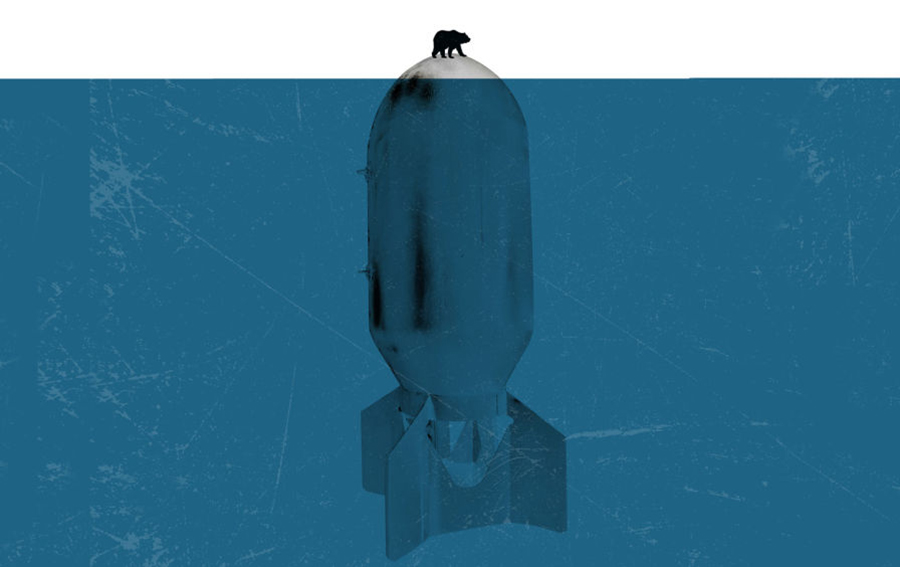
How Rising Temperatures Increase the Likelihood of Nuclear War

As climate changes stresses our human institutions, we are likely to face deadly conflicts over critical resources.

President Donald Trump may not accept the scientific reality of climate change, but the nation’s senior military leaders recognize that climate disruption is already underway, and they are planning extraordinary measures to prevent it from spiraling into nuclear war. One particularly worrisome scenario is if extreme drought and abnormal monsoon rains devastate agriculture and unleash social chaos in Pakistan, potentially creating an opening for radical Islamists aligned with elements of the armed forces to seize some of the country’s 150 or so nuclear weapons. To avert such a potentially cataclysmic development, the US Joint Special Operations Command has conducted exercises for infiltrating Pakistan and locating the country’s nuclear munitions. Most of the necessary equipment for such raids is already in position at US bases in the region, according to a 2011 report from the nonprofit Nuclear Threat Initiative. “It’s safe to assume that planning for the worst-case scenario regarding Pakistan’s nukes has already taken place inside the US government,” said Roger Cressey, a former deputy director for counterterrorism in Bill Clinton’s and George W. Bush’s administrations in 2011.

Such an attack by the United States would be an act of war and would entail enormous risks of escalation, especially since the Pakistani military—the country’s most powerful institution—views the nation’s nuclear arsenal as its most prized possession and would fiercely resist any US attempt to disable it. “These are assets which are the pride of Pakistan, assets which are…guarded by a corps of 18,000 soldiers,” former Pakistani president Pervez Musharraf told NBC News in 2011. The Pakistani military “is not an army which doesn’t know how to fight. This is an army that has fought three wars. Please understand that.”

A potential US military incursion in nuclear-armed Pakistan is just one example of a crucial but little-​discussed aspect of international politics in the early 21st century: how the acceleration of climate change and nuclear war planning may make those threats to human survival harder to defuse. At present, the intersections between climate change and nuclear war might not seem obvious. But powerful forces are pushing both threats toward their most destructive outcomes.

In the case of climate change, the unbridled emission of carbon dioxide and other greenhouse gases is raising global temperatures to unmistakably dangerous levels. Despite growing worldwide reliance on wind and solar power for energy generation, the global demand for oil and natural gas continues to rise, and carbon emissions are projected to remain on an upward trajectory for the foreseeable future. It is highly unlikely, then, that the increase in average global temperature can be limited to 1.5 degrees Celsius, the aspirational goal adopted by the world’s governments under the Paris Agreement in 2015, or even to 2°C, the actual goal. After that threshold is crossed, scientists agree, it will prove almost impossible to avert catastrophic outcomes, such as the collapse of the Greenland and Antarctic ice sheets and a resulting sea level rise of 6 feet or more.

Climbing world temperatures and rising sea levels will diminish the supply of food and water in many resource-deprived areas, increasing the risk of widespread starvation, social unrest, and human flight. Global corn production, for example, is projected to fall by as much as 14 percent in a 2°C warmer world, according to research cited in a 2018 special report by the UN’s Intergovernmental Panel on Climate Change (IPCC). Food scarcity and crop failures risk pushing hundreds of millions of people into overcrowded cities, where the likelihood of pandemics, ethnic strife, and severe storm damage is bound to increase. All of this will impose an immense burden on human institutions. Some states may collapse or break up into a collection of warring chiefdoms—all fighting over sources of water and other vital resources.

A similar momentum is now evident in the emerging nuclear arms race, with all three major powers—China, Russia, and the United States—rushing to deploy a host of new munitions. This dangerous process commenced a decade ago, when Russian and Chinese leaders sought improvements to their nuclear arsenals and President Barack Obama, in order to secure Senate approval of the New Strategic Arms Reduction Treaty of 2010, agreed to initial funding for the modernization of all three legs of America’s strategic triad, which encompasses submarines, intercontinental ballistic missiles, and bombers. (New START, which mandated significant reductions in US and Russian arsenals, will expire in February 2021 unless renewed by the two countries.) Although Obama initiated the modernization of the nuclear triad, the Trump administration has sought funds to proceed with their full-scale production, at an estimated initial installment of $500 billion over 10 years.

Even during the initial modernization program of the Obama era, Russian and Chinese leaders were sufficiently alarmed to hasten their own nuclear acquisitions. Both countries were already in the process of modernizing their stockpiles—Russia to replace Cold War–era systems that had become unreliable, China to provide its relatively small arsenal with enhanced capabilities. Trump’s decision to acquire a whole new suite of ICBMs, nuclear-armed submarines, and bombers has added momentum to these efforts. And with all three major powers upgrading their arsenals, the other nuclear-weapon states—led by India, Pakistan, and North Korea—have been expanding their stockpiles as well. Moreover, with Trump’s recent decision to  abandon the Intermediate-Range Nuclear Forces (INF) Treaty, all major powers are developing missile delivery systems for a regional nuclear war such as might erupt in Europe, South Asia, or the western Pacific.

All things being equal, rising temperatures will increase the likelihood of nuclear war, largely because climate change will heighten the risk of social stress, the decay of nation-states, and armed violence in general, as I argue in my new book, All Hell Breaking Loose. As food and water supplies dwindle and governments come under ever-increasing pressure to meet the vital needs of their populations, disputes over critical resources are likely to become more heated and violent, whether the parties involved have nuclear arms or not. But this danger is compounded by the possibility that several nuclear-armed powers—notably India, Pakistan, and China—will break apart as a result of climate change and accompanying battles over disputed supplies of water.

Together, these three countries are projected by the UN Population Division to number approximately 3.4 billion people in 2050, or 34 percent of the world’s population. Yet they possess a much smaller share of the world’s freshwater supplies, and climate change is destined to reduce what they have even further. Warmer temperatures are also expected to diminish crop yields in these countries, adding to the desperation of farmers and very likely resulting in widespread ethnic strife and population displacement. Under these circumstances, climate-related internal turmoil would increase the risk of nuclear war in two ways: by enabling the capture of nuclear arms by rogue elements of the military and their possible use against perceived enemies and by inciting wars between these states over vital supplies of water and other critical resources.

The risk to Pakistan from climate change is thought to be particularly acute. A large part of the population is still engaged in agriculture, and much of the best land—along with access to water—is controlled by wealthy landowners (who also dominate national politics). Water scarcity and mismanagement is a perennial challenge, and climate change is bound to make the problem worse. Climate and Social Stress: Implications for Security Analysis, a 2013 report by the National Research Council for the US intelligence community, highlights the danger of chaos and conflict in that country as global warming advances. Pakistan, the report notes, is expected to suffer from inadequate water supplies during the dry season and severe flooding during the monsoon—outcomes that will devastate its agriculture and amplify the poverty and unrest already afflicting much of the country. “The Pakistan case,” the report reads, “illustrates how a highly stressed environmental system on which a tense society depends can be a source of political instability and how that source can intensify when climate events put increased stress on the system.” Thus, as global temperatures rise and agriculture declines, Pakistan could shatter along ethnic, class, and religious lines, precisely the scenario that might trigger the sort of intervention anticipated by the US Joint Special Operations Command.

Assuming that Pakistan remains intact, another great danger arising from increasing world temperatures is a conflict between it and India or between China and India over access to shared river systems. Whatever their differences, Pakistan and western India are forced by geography to share a single river system, the Indus, for much of their water requirements. Likewise, western China and eastern India also share a river, the Brahmaputra, for their vital water needs. The Indus and the Brahmaputra obtain much of their flow from periods of heavy precipitation; they also depend on meltwater from Himalayan glaciers, and these are at risk of melting because of rising temperatures. According to the IPCC, the Himalayan glaciers could lose as much as 29 percent of their total mass by 2035 and 78 percent by 2100. This would produce periodic flooding as the ice melts but would eventually result in long periods of negligible flow, with calamitous consequences for downstream agriculture. The widespread starvation and chaos that could result would prove daunting to all the governments involved and make any water-related disputes between them a potential flash point for escalation.

As in Pakistan, water supply has always played a pivotal role in the social and economic life of China and India, with both countries highly dependent on a few major river systems for civic and agricultural purposes. Excessive rainfall can lead to catastrophic flooding, and prolonged drought has often led to widespread famine and mass starvation. In such a setting, water management has always been a prime responsibility of government—and a failure to fulfill this function effectively has often resulted in civil unrest. Climate change is bound to increase this danger by causing prolonged water shortages interspersed with severe flooding. This has prompted leaders of both countries to build ever more dams on all key rivers.

India, as the upstream power on several tributaries of the Indus, and China, as the upstream power on the Brahmaputra, have considered damming these rivers and diverting their waters for exclusive national use, thereby diminishing the flow to downstream users. Three of the Indus’s principal tributaries, the Jhelum, Chenab, and Ravi rivers, flow through Indian-controlled Kashmir (now in total lockdown, with government forces suppressing all public functions). It’s possible that India seeks full control of Kashmir in order to dam the tributaries there and divert their waters from Pakistan—a move that could easily trigger a war if it occurs at a time of severe food and water stress and one that would very likely invite the use of nuclear weapons, given Pakistan’s attitude toward them.

The situation regarding the Brahmaputra could prove equally precarious. China has already installed one dam on the river, the Zangmu Dam in Tibet, and has announced plans for several more. Some Chinese hydrologists have proposed the construction of canals linking the Brahmaputra to more northerly rivers in China, allowing the diversion of its waters to drought-stricken areas of the heavily populated northeast. These plans have yet to come to fruition, but as global warming increases water scarcity across northern China, Beijing might proceed with the idea. “If China was determined to move forward with such a scheme,” the US National Intelligence Council warned in 2009, “it could become a major element in pushing China and India towards an adversarial rather than simply a competitive relationship.”

Severe water scarcity in northern China could prompt yet another move with nuclear implications: an attempted annexation by China of largely uninhabited but water-rich areas of Russian Siberia. Thousands of Chinese farmers and merchants have already taken up residence in eastern Siberia, and some commentators have spoken of a time when climate change prompts a formal Chinese takeover of those areas—which would almost certainly prompt fierce Russian resistance and the possible use of nuclear weapons.

In the Arctic, global warming is producing a wholly different sort of peril: geopolitical competition and conflict made possible by the melting of the polar ice cap. Before long, the Arctic ice cap is expected to disappear in summertime and to shrink noticeably in the winter, making the region more attractive for resource extraction. According to the US Geological Survey, an estimated 30 percent of the world’s remaining undiscovered natural gas is above the Arctic Circle; vast reserves of iron ore, uranium, and rare earth minerals are also thought to be buried there. These resources, along with the appeal of faster commercial shipping routes linking Europe and Asia, have induced all the major powers, including China, to establish or expand operations in the region. Russia has rehabilitated numerous Arctic bases abandoned after the Cold War and built others; the United States has done likewise, modernizing its radar installation at Thule in Greenland, reoccupying an airfield at Keflavík in Iceland, and establishing bases in northern Norway.

Increased economic and military competition in the Arctic has significant nuclear implications, as numerous weapons are deployed there and geography lends it a key role in many nuclear scenarios. Most of Russia’s missile-carrying submarines are based near Murmansk, on the Barents Sea (an offshoot of the Arctic Ocean), and many of its nuclear-armed bombers are also at bases in the region to take advantage of the short polar route to North America. As a counterweight, the Pentagon has deployed additional subs and antisubmarine aircraft near the Barents Sea and interceptor aircraft in Alaska, followed by further measures by Moscow. “I do not want to stoke any fears here,” Russian President Vladimir Putin declared in June 2017, “but experts are aware that US nuclear submarines remain on duty in northern Norway…. We must protect [Russia’s] shore accordingly.”

On the other side of the equation, an intensifying arms race will block progress against climate change by siphoning resources needed for a global energy transition and by poisoning the relations among the great powers, impeding joint efforts to slow the warming.

With the signing of the Paris Agreement, it appeared that the great powers might unite in a global effort to slash greenhouse gas emissions quickly enough to avoid catastrophe, but those hopes have since receded. At the time, Obama emphasized that limiting global warming would require nations to work together in an environment of trust and peaceful cooperation. Instead of leading the global transition to a postcarbon energy system, however, the major powers are spending massively to enhance their military capabilities and engaging in conflict-provoking behaviors.

Since fiscal year 2016, the annual budget of the US Department of Defense has risen from $580 billion to $738 billion in fiscal year 2020. When the budget increases for each fiscal year since 2016 are combined, the United States will have spent an additional $380 billion on military programs by the end of this fiscal year—more than enough to jump-start the transition to a carbon-​free economy. If the Pentagon budget rises as planned to $747 billion in fiscal year 2024, a total of $989 billion in additional spending will have been devoted to military operations and procurement over this period, leaving precious little money for a Green New Deal or any other scheme for systemic decarbonization.

Meanwhile, policy-makers in Washington, Beijing, and Moscow increasingly regard one another as implacable and dangerous adversaries. “As China and Russia seek to expand their global influence,” then–Director of National Intelligence Dan Coats informed Congress in a January 2019 report, “they are eroding once well-established security norms and increasing the risk of regional conflicts.” Chinese and Russian officials have been making similar statements about the United States. Secondary powers like India, Pakistan, and Turkey are also assuming increasingly militaristic postures, facilitating the potential spread of nuclear weapons and exacerbating regional tensions. In this environment, it is almost impossible to imagine future climate negotiations at which the great powers agree on concrete measures for a rapid transition to a clean energy economy.

In a world constantly poised for nuclear war while facing widespread state decay from climate disruption, these twin threats would intermingle and intensify each other. Climate-​related resource stresses and disputes would increase the level of global discord and the risk of nuclear escalation; the nuclear arms race would poison relations between states and make a global energy transition impossible.

But such an outcome is not inevitable. Mass movements have emerged to close coal plants, halt fracking, block the construction of fossil fuel infrastructure, and divest from fossil fuel companies. Swedish climate activist Greta Thunberg, with her School Strike 4 Climate campaign, has inspired millions of young people around the world to engage in climate activism. On the nuclear side, groups like Global Zero and Back From the Brink are campaigning for a global no-first-use policy by the nuclear-armed states; in Congress, progressive Democrats fought to deny funds for the procurement of new missiles that would have violated the terms of the INF Treaty.

What is essential and still largely missing is a recognition that climate and peace activism must be linked if the twin perils of global warming and nuclear war are to be overcome. People must understand that it will be very difficult to slow global warming unless the nuclear arms race is also slowed—and, likewise, that the risk of nuclear war will grow as long as nuclear-armed states are threatened by climate disruptions. Only by uniting our efforts toward climate and nuclear sanity in a joint campaign for human survival will it be possible to triumph over these destructive forces.

This story originally appeared in The Nation and is republished here as part of Covering Climate Now, a global journalistic collaboration to strengthen coverage of the climate story.

Climate Leadership in Davos: What It Is, and How To Get It Done

Davos, Switzerland — At the World Economic Forum 2020, Jakob Trollbäck, the architect of the U.N. Sustainable Development Goals framework, has unveiled a new initiative to foster Climate Leadership across corporate, investor, donor and NGO institutions.

Trollbäck advances the core principles of opportunity in a published booklet released in Davos called The Climate Leadership Playbook, and through a two-wall exhibit at the Global 17 Partners space in the heart of Davos.

“Everybody knows that we have to be more environmental and work urgently to fulfill the Global Goals,” Trollbäck noted. “We know what to do: but how do we make it happen, and how do we make sure our enterprises are relevant to the challenge?”

This is the subject of a discussion panel on the same subject hosted at the Global 17 Partners space, which features Sam Goldman, co-founder and President of d.light, and Sonia Lo, CEO of FreshBox Farms, along with Trollbäck , Ezgi Barcenas OF AB InBev, and others.

d.light, a leading innovator in financed solar energy and sustainable products, and FreshBox Farms, a leading innovator in hydroponic farming and environmental sustainability, provided sponsorship for the initial run of the Climate Leadership Playbook for World Economic Forum 2020 attendees.

“We’re here in part to celebrate the milestone of reaching 100 million customers with our sustainable energy solutions, and we’re pivoting toward a billion,” Goldman said. It’s in no small part because of our adherence to the principles that Jakob highlights.”

“We think that those organizations that commit to climate leadership have a clear marketplace advantage,” said Lo. “This framework is important, and we’re delighted to be the first signatory to it.”

In coming weeks, the Climate Leadership Playbook and related resources will be available online and supported by a variety of services for enterprise leaders who adopt it.

The initiative is created by Trollbäck’s company, The New Division, and The ForeSight Group. Impact management company 5th Element Group PBC along with Gitterman Wealth Management will help market the campaign and related resources in the coming months. 

Australia, Your Country is Burning – Dangerous Climate Change is Here With You Now

I am a climate scientist on holiday in the Blue Mountains, watching climate change in action. After years studying the climate, my work has brought me to Sydney where I’m studying the linkages between climate change and extreme weather events.

Prior to beginning my sabbatical stay in Sydney, I took the opportunity this holiday season to vacation in Australia with my family. We went to see the Great Barrier Reef – one of the great wonders of this planet – while we still can. Subject to the twin assaults of warming-caused bleaching and ocean acidification, it will be gone in a matter of decades in the absence of a dramatic reduction in global carbon emissions.

We also travelled to the Blue Mountains, another of Australia’s natural wonders, known for its lush temperate rainforests, majestic cliffs and rock formations and panoramic vistas that challenge any the world has to offer. It too is now threatened by climate change.

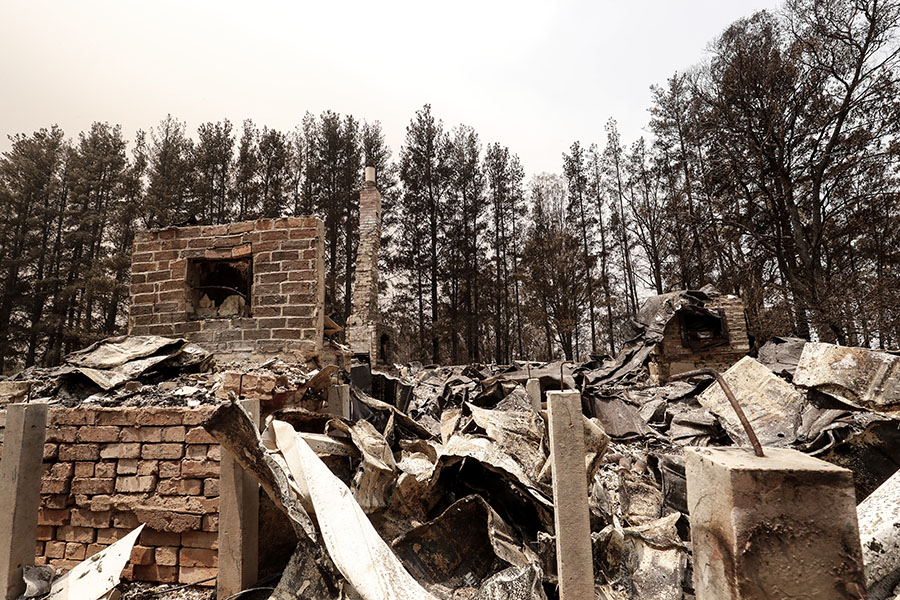
Debris of a burnt house are seen on January 04, 2020 in Sarsfield, Australia. Two people are dead and 28 remain missing following bushfires across the East Gippsland area, with Victorian premier Daniel Andrews declaring a state of disaster in the region. Thousands of people remain stranded in the coastal town of Mallacoota and are being evacuated by navy ships to Melbourne. (Photo by Darrian Traynor/Getty Images)

I witnessed this firsthand.

I did not see vast expanses of rainforest framed by distant blue-tinged mountain ranges. Instead I looked out into smoke-filled valleys, with only the faintest ghosts of distant ridges and peaks in the background. The iconic blue tint (which derives from a haze formed from “terpenes” emitted by the Eucalyptus trees that are so plentiful here) was replaced by a brown haze. The blue sky, too, had been replaced by that brown haze.

The locals, whom I found to be friendly and outgoing, would volunteer that they have never seen anything like this before. Some even uttered the words “climate change” without any prompting.

The songs of Peter Garrett and Midnight Oil I first enjoyed decades ago have taken on a whole new meaning for me now. They seem disturbingly prescient in light of what we are witnessing unfold in Australia.

The brown skies I observed in the Blue Mountains this week are a product of human-caused climate change. Take record heat, combine it with unprecedented drought in already dry regions and you get unprecedented bushfires like the ones engulfing the Blue Mountains and spreading across the continent. It’s not complicated.

The warming of our planet – and the changes in climate associated with it – are due to the fossil fuels we’re burning: oil, whether at midnight or any other hour of the day, natural gas, and the biggest culprit of all, coal. That’s not complicated either.

When we mine for coal, like the controversial planned Adani coalmine, which would more than doubleAustralia’s coal-based carbon emissions, we are literally mining away at our blue skies. The Adani coalmine could rightly be renamed the Blue Sky mine.

An evacuee holds a sign as she arrives at the Somerville relief center on January 4, 2020 in Somerville, Australia. She had just been bused to the relief centre from HMAS Choules. HMAS Choules was deployed to help evacuate thousands of people stranded in the remote Victorian coastal town of Mallacoota following fires across East Gippsland.

In Australia, beds are burning. So are entire towns, irreplaceable forests and endangered and precious animal species such as the koala (arguably the world’s only living plush toy) are perishing in massive numbers due to the unprecedented bushfires.

The continent of Australia is figuratively – and in some sense literally – on fire.

Yet the prime minister, Scott Morrison, appears remarkably indifferent to the climate emergency Australia is suffering through, having chosen to vacation in Hawaii as Australians are left to contend with unprecedented heat and bushfires.

Morrison has shown himself to be beholden to coal interests and his administration is considered to have conspired with a small number of petrostates to sabotage the recent UN climate conference in Madrid (“COP25”), seen as a last ditch effort to keep planetary warming below a level (1.5C) considered by many to constitute “dangerous” planetary warming.

But Australians need only wake up in the morning, turn on the television, read the newspaper or look out the window to see what is increasingly obvious to many – for Australia, dangerous climate change is already here. It’s simply a matter of how much worse we’re willing to allow it to get.

Australia is experiencing a climate emergency. It is literally burning. It needs leadership that is able to recognise that and act. And it needs voters to hold politicians accountable at the ballot box.

Australians must vote out fossil-fuelled politicians who have chosen to be part of the problem and vote in climate champions who are willing to solve it.

This article originally appeared in The Guardian and is republished here as part of Covering Climate Now, a global journalistic collaboration to strengthen coverage of the climate story.

UK’s Prince William Launches Prize to Solve Earth’s Top Environmental Challenges

The Earthshot Prize, described as the ‘most prestigious environmental prize in history’, will be awarded to five winners a year over the next decade.

Britain’s Prince William launched a multi-million pound prize on Tuesday to encourage the world’s greatest problem-solvers to find answers to Earth’s biggest environmental problems, saying the planet was now at a tipping point.

The Earthshot Prize, described in its publicity as the “most prestigious environmental prize in history”, will be awarded to five winners a year over the next decade with the aim of producing at least 50 solutions to the world’s most pressing challenges.

“The earth is at a tipping point and we face a stark choice: either we continue as we are and irreparably damage our planet or we remember our unique power as human beings and our continual ability to lead, innovate and problem-solve,” William, 37, said in a statement.

“Remember the awe-inspiring civilisations that we have built, the life-saving technology we have created, the fact that we have put a man on the moon,” he added. “People can achieve great things. The next 10 years present us with one of our greatest tests – a decade of action to repair the Earth.”

The British royal family have for many years been vocal campaigners on a host of environmental issues, with William’s father Prince Charles speaking out for decades about the impact of climate change and the importance of conservation.

The Earthshot initiative, which comes after more than a year of consultations with over 60 organisations and experts, aims to generate new technologies, policies and solutions for issues of climate and energy, nature and biodiversity, oceans, air pollution and fresh water.

Kensington Palace said the prize drew its inspiration from the concept of Moonshots, which it said since the 1969 moon landings was synonymous with ambitious and ground-breaking goals.

“Just as the Moonshot that (U.S. President) John F. Kennedy proposed in the 1960s catalysed new technology such as the MRI scanner and satellite dishes, the Earthshots aim to launch their own tidal wave of ambition and innovation,” the palace said.

It gave no detailed figures of the size of the prizes or how they would be funded, saying the project was supported by a global coalition of philanthropists and organisations.

The project will be formally launched later in 2020 with challenges announced at events around the world and annual award ceremonies in different cities between 2021 and 2030.

A film to coincide with Tuesday’s launch was narrated by veteran British broadcaster and naturalist David Attenborough, who has been making nature programmes such as the popular Blue Planet series since the 1950s.

“This year Prince William and a global alliance launch the most prestigious environment prize in history: The Earthshot Prize,” Attenborough said, describing it as “a global prize designed to motivate and inspire a new generation of thinkers, leaders and dreamers to think differently”.

By Michael Holden; Editing by Alison Williams.

UK’s Prince William Launches Prize to Solve Earth’s Top Environmental Challenges

The Earthshot Prize, described as the ‘most prestigious environmental prize in history’, will be awarded to five winners a year over the next decade.

Britain’s Prince William launched a multi-million pound prize on Tuesday to encourage the world’s greatest problem-solvers to find answers to Earth’s biggest environmental problems, saying the planet was now at a tipping point.

The Earthshot Prize, described in its publicity as the “most prestigious environmental prize in history”, will be awarded to five winners a year over the next decade with the aim of producing at least 50 solutions to the world’s most pressing challenges.

“The earth is at a tipping point and we face a stark choice: either we continue as we are and irreparably damage our planet or we remember our unique power as human beings and our continual ability to lead, innovate and problem-solve,” William, 37, said in a statement.

“Remember the awe-inspiring civilisations that we have built, the life-saving technology we have created, the fact that we have put a man on the moon,” he added. “People can achieve great things. The next 10 years present us with one of our greatest tests – a decade of action to repair the Earth.”

The British royal family have for many years been vocal campaigners on a host of environmental issues, with William’s father Prince Charles speaking out for decades about the impact of climate change and the importance of conservation.

The Earthshot initiative, which comes after more than a year of consultations with over 60 organisations and experts, aims to generate new technologies, policies and solutions for issues of climate and energy, nature and biodiversity, oceans, air pollution and fresh water.

Kensington Palace said the prize drew its inspiration from the concept of Moonshots, which it said since the 1969 moon landings was synonymous with ambitious and ground-breaking goals.

“Just as the Moonshot that (U.S. President) John F. Kennedy proposed in the 1960s catalysed new technology such as the MRI scanner and satellite dishes, the Earthshots aim to launch their own tidal wave of ambition and innovation,” the palace said.

It gave no detailed figures of the size of the prizes or how they would be funded, saying the project was supported by a global coalition of philanthropists and organisations.

The project will be formally launched later in 2020 with challenges announced at events around the world and annual award ceremonies in different cities between 2021 and 2030.

A film to coincide with Tuesday’s launch was narrated by veteran British broadcaster and naturalist David Attenborough, who has been making nature programmes such as the popular Blue Planet series since the 1950s.

“This year Prince William and a global alliance launch the most prestigious environment prize in history: The Earthshot Prize,” Attenborough said, describing it as “a global prize designed to motivate and inspire a new generation of thinkers, leaders and dreamers to think differently”.

By Michael Holden; Editing by Alison Williams.

Amazing Portraits: 7 Days of Garbage

Californian photographer Gregg Segal tells carefully constructed stories that have a story teller’s sense of theme, irony and a penchant for drama. His ongoing project, 7 Days Of Garbage, shows ordinary people with their seven days worth of waste. He shared his thinking on the project with us.

The seeds for this project have been germinating for a long time – ever since I began considering how much we Americans consume and how much garbage we produce. I’m reminded, each week, as we all roll our immense garbage cans to the curb, often loaded to the brim (I requested a smaller can from my sanitation company because the standard size is just too big for my needs).

The average American generates about 28 pounds a week, I found. Multiply that by 321 million – the U.S. population. Where does our 9 billion pounds of garbage go each week? Though I’m not an environmental activist, I am concerned – not only by how much we consume and throw away, but by how blind we seem to be to all the waste and how blithely we go about our routine of carting our vast quantities of garbage to the curb each week.

I set out to create pictures that make the trash problem impossible to ignore. I asked friends, family, neighbors, friends of friends and other acquaintances to save their trash and their recyclables for a week and then to lie down and be photographed with all of it. Some of the subjects volunteered to be photographed because they thought the project was worthwhile. Others, I paid.

The series of portraits is inclusive, representing a range of socio-economic backgrounds and ethnicities. I photographed myself and my family, too, because I’m not pointing my finger at others; I’m part of the problem, too, and I want my 10-year-old son to be aware of this. I had people include their recyclables for several reasons: much of what is designated recyclable is not recycled (large areas of our oceans, like the Pacific Garbage Patch, are filled with plastic); recycling plastic doesn’t make sense, economically or environmentally, as a great deal of energy is required to repurpose plastic (New York City did away with recycling plastic because these costs far outweighed the benefits); finally, I want to underscore just how much unnecessary packaging we all use, particularly in the U.S. I’ve created three environments for the pictures, all in my own yard: water, forest and beach.

For the water setting, I built an 8’ square frame, lined it with black plastic, and filled it with water (about 14” deep). I made a bed of moss, duff, twigs, sticks, leaves, and pine cones for the forest floor. For the beach, I brought in sand (about 1,000 pounds) for the subjects to lie on. I plan to continue the series, creating other environments (or shooting on location if necessary): snow, rocks, wildflowers, etc.

The point is to highlight how pervasive garbage is; no corner of the earth is untouched.

The photos in this series may not change anyone’s habits, but by holding up a mirror and asking us to look at ourselves, I’ve found that some are considering the issue more deeply. Several of the subjects I photographed have said the process of saving their garbage – and then laying in it – reconciled them to how much waste they make.

Others have commented how small and powerless they feel in the face of the problem. What can any one of us do? It isn’t our fault that the products we buy come with excessive packaging. It isn’t our fault either that the products available to us are designed to have a short life span. General Electric could make a refrigerator that keeps our beer cold for 400 years, but if they did, they wouldn’t make a profit and as a company, they wouldn’t grow.

This economic model and its necessity for continual growth is what is fueling much of the waste epidemic – and makes conservation seem impossible.

Still, some of us are finding that there are small steps we can take to mitigate the crisis (compost if you have a yard, bring your own re-usable water bottle when you travel, buy produce without the packaging). Reflecting on the pictures I’ve made so far (below), I see 7 Days of Garbage as instant archeology, a record not only of our waste but of our values – values that just may be evolving a little.


7-days-of-garbage-environmental-photography-gregg-segal-12
 
7-days-of-garbage-environmental-photography-gregg-segal-1 7-days-of-garbage-environmental-photography-gregg-segal-2 7-days-of-garbage-environmental-photography-gregg-segal-3 7-days-of-garbage-environmental-photography-gregg-segal-4 7-days-of-garbage-environmental-photography-gregg-segal-5 7-days-of-garbage-environmental-photography-gregg-segal-6 7-days-of-garbage-environmental-photography-gregg-segal-7 7-days-of-garbage-environmental-photography-gregg-segal-8 7-days-of-garbage-environmental-photography-gregg-segal-10 7-days-of-garbage-environmental-photography-gregg-segal-11
0