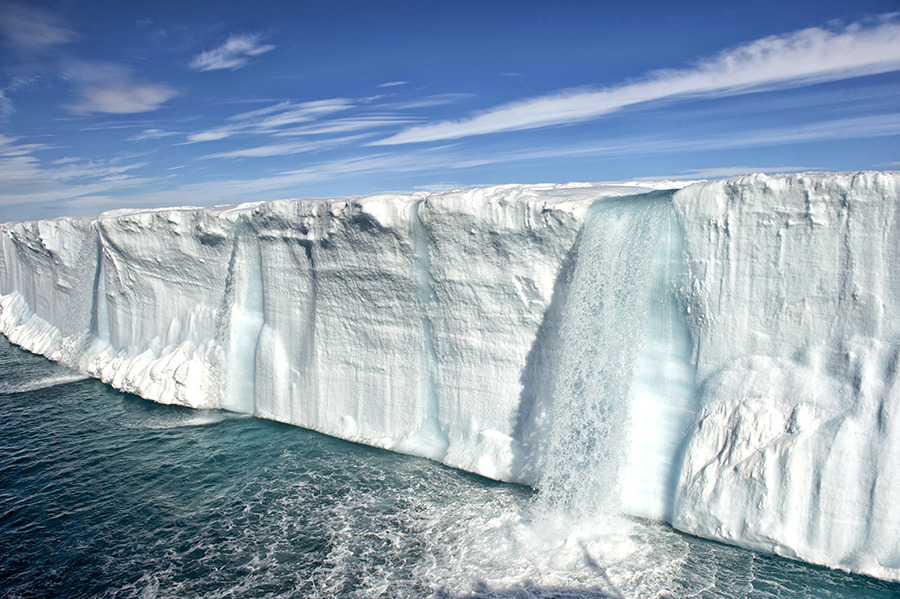
Photo Above: Melting water on icecap: In both the Arctic and Antarctic regions, ice is retreating. North East Land, Svalbard, Norway. Photo: Cotton Coulson / Keenpress.
We are one human race living on one planet. We aspire for the same things: food, water, good health, and, most of all, dignity and loving relationships. We yearn for opportunity, voice, and resources to develop our potential. We want to raise our children in a safe and healthy environment. We want to experience the Earth’s beauty and natural bounty.
Realizing our common humanity invites us to embrace common responsibility and to care for one another and the planet on which we live. The emergence of such grave global challenges as biodiversity loss and climate change demands our urgent and undivided attention. The health of the oceans, the air, the water, and the land affect human health. Specifically, the size of the human family and the way that we live influence the quality of life for people today as well as for future generations. Our numbers and behavior profoundly affect nonhuman species, all of the creatures with which we share this beautiful planet. The web of life that these species create is what makes the Earth habitable and lovely.
I have devoted most of my professional life to advocating for and advancing the universality of human rights, the rights of women and girls, and the rights of poor people. I am not naive about either the complexity of factors affecting public policy or about the imbalance of power, voice, and resources across nations, genders, generations, and cultures. Yet, I sincerely believe that family planning is a human right that yields multiple benefits for women, children, and poor people — ultimately, for all humanity.
Family planning helps sustain a mother’s health and gives women choices beyond childbearing. Well-spaced children are healthier, and fewer children per family help their parents to support their growth and development better. All these step-by-step and one-person-at-a-time actions add up to immense social good when implemented on a large scale.
These times call for an unprecedented level of cooperation and common purpose among genders, cultures, peoples, and nations. The legacy for future generations and so much of Earth’s living heritage depends on we who are living today. Our problem is not ignorance. We are drowning in knowledge. Perhaps we lack discernment, or else we are too selfish to care for the future of those to come after us! But indeed, the world community can act — and act quickly — when faced with significant threats. Now is the time to take the problem of overshoot seriously and to act while we still have an opportunity to ensure that future generations inherit a sustainable world.
Musimbi Kanyoro is a Kenyan human rights advocate who served as the CEO and president of the Global Fund for Women from 2011 until 2019. She also serves with former president of Ireland Mary Robinson on several projects, including the board of directors of Realizing Rights: the Ethical Globalization Initiative.
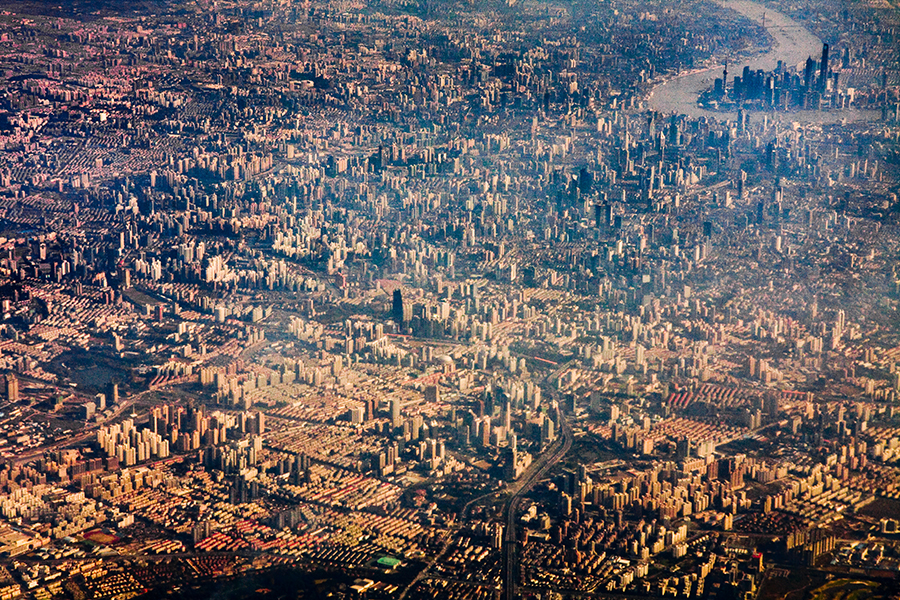
Megalopolis: Shanghai, China, a sprawling megacity of more than 24 million. Photo: Mike Hedge.
“Can you think of any problem in any area of human endeavor on any scale, from microscopic to global, whose long-term solution is in any demonstrable way aided, assisted, or advanced by further increases in population, locally, nationally, or globally?” — Albert Bartlett, a professor of physics who regarded the failure to understand the laws of the exponential equation as The Greatest Challenge facing humanity, and promoted sustainable living.
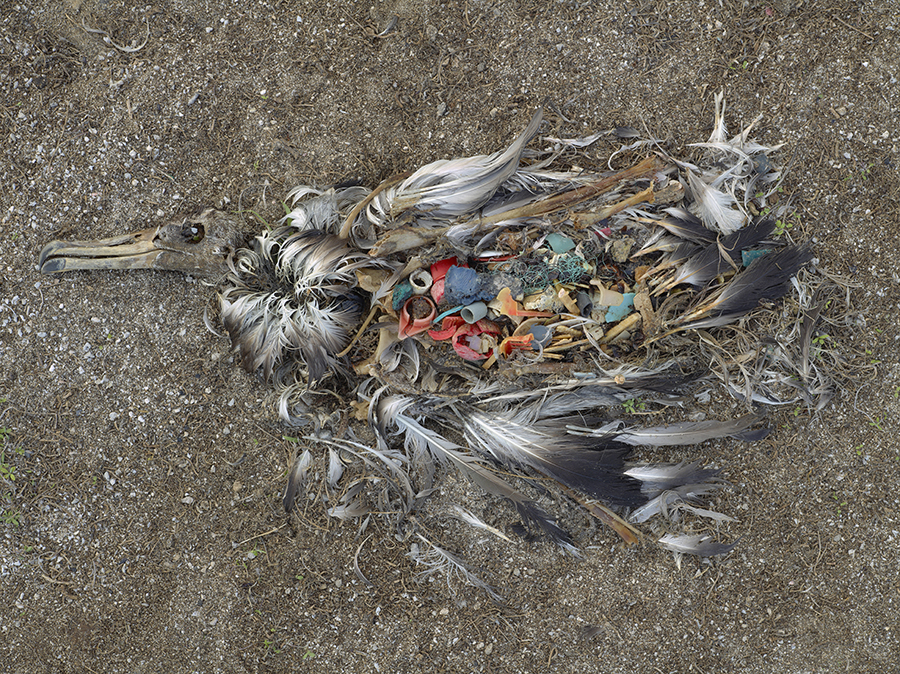
Dead Bird: On Midway Island, 1,300 miles northwest of Honolulu, far from the centers of world commerce, an albatross, dead from ingesting too much plastic, decays on the beach. This is a common sight on the remote island. Photo: Chris Jordan.
“The immediate relief problems and earthquake casualties would be much less with a smaller population. The size of the population now, with the scale of the problems it creates, leads to an increasingly chaotic situation. More population exacerbates any efforts needed to solve humanity’s problems, anywhere, be they immediate or long term.” — Walter Youngquist, U.S. petroleum and minerals geologist who has visited more than 70 countries, observing the ongoing problem of continued population growth and declining Earth resources.
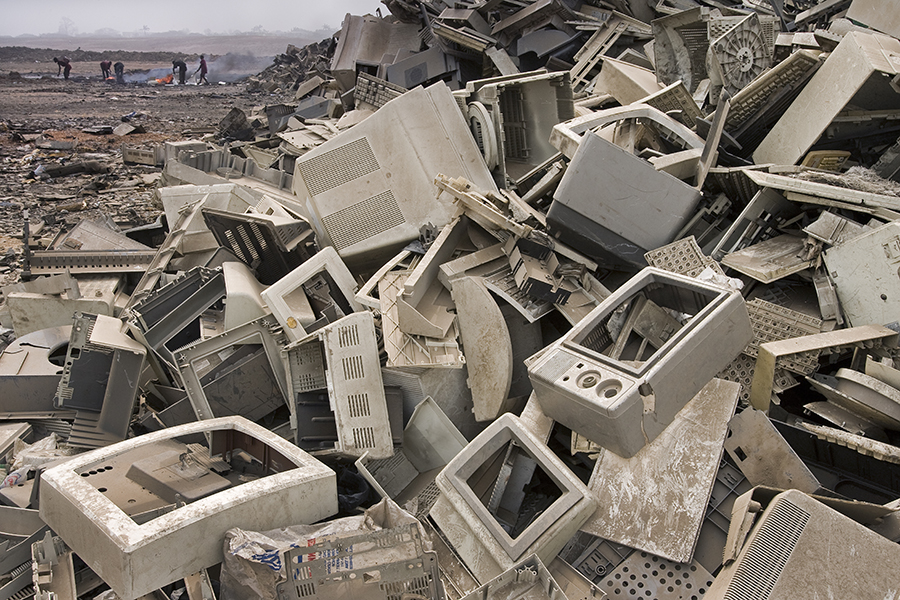
Computer Dump: Massive quantities of waste from obsolete computers and other electronics are typically shipped to the developing world for sorting and disposal. Accra, Ghana. Photo: Peter Essick. Angry Crowd: People jostle for food relief distribution following the 2010 earthquake in Haiti. Photo: Carolyn Cole/ LA Times
“The Arctic situation is snowballing: Dangerous changes in the Arctic derived from accumulated anthropogenic greenhouse gases lead to more activities conducive to further greenhouse gas emissions. This situation has the momentum of a runaway train.”— Carlos Duarte, marine ecologist researching marine ecosystems around the world.
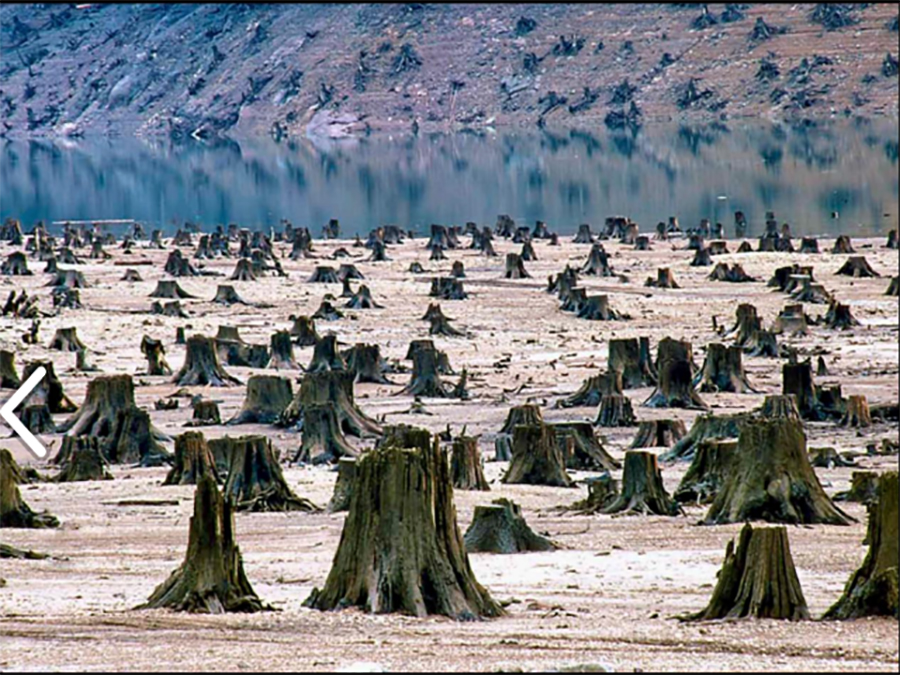
Clearcut: These trees were replaced by bleeding stumps. Industrial forestry degrading public lands, Willamette National Forest, Oregon. Photo: Daniel Dancer.
These photographs are from the book Overdevelopment, Overpopulation, Overshoot by Global Population Speak Out. www. PopulationMedia.org
Microsoft will erase its entire carbon footprint since 1975 from the atmosphere. The global software giant has a goal of removing existing carbon from the atmosphere, setting the company’s climate goals apart from other corporate pledges, which have mostly focused on cutting ongoing emissions or preventing future ones.
Microsoft is aiming to remove more carbon from the atmosphere than it emits by 2030, and by 2050, it hopes to have removed enough to offset all the direct emissions the company has ever made.
“If the last decade has taught us anything, it’s that technology built without these principles can do more harm than good,” says chief executive Satya Nadella. “We must begin to offset the damaging effects of climate change,” he continues, adding that if global temperatures keep rising unabated, “the results will be devastating.”
Microsoft plans to cut carbon emissions across its supply chain by more than half by 2030. The plan includes creation of a Climate Innovation Fund, which will invest $1 billion over the next four years to hasten development of carbon removal technology.
“Our effort will require technology by 2030 that doesn’t fully exist today,” explains company president Brad Smith.
Microsoft will widen the reach of an internal fee it has been charging to its business groups to account for their carbon emissions. Since 2012, the company has pegged the fee on direct emissions, electricity use, and air travel but will now widen it to cover all Microsoft-related emissions.
“That money will then be used to invest in our work to reduce our carbon emissions,” says Smith. Microsoft co-founder Bill Gates was an early backer of British Columbia-based Carbon Engineering, one of a few companies to develop direct air capture technology.
“A company’s most powerful tool for fighting climate change is its political influence, and we’re eager to see Microsoft use it,” says Elizabeth V. Sturcken of the Environmental Defense Fund, a nonprofit advocacy group. Negative emission technologies include the capture, removal, and storage of carbon from the atmosphere, and Microsoft’s goal is to remove all the carbon by 2050 that has been emitted since its founding in 1975. This includes emissions from company vehicles and indirect emissions from electricity use. The company’s pledge comes as big investors pay more attention to how companies tackle climate change. The race is on — Microsoft plans to become net-zero carbon a decade earlier than Amazon.
Stephen Nellis and Jeffrey Dastin are San Francisco-based business journalists covering technology companies for Reuters.
The same forest destruction that accelerates climate change can also encourage the emergence of diseases such as the coronavirus, Indigenous Peoples’ leaders said March 13 in New York, as they criticized Cargill and other multinational companies for replacing forests with soy, palm and cattle plantations.
“The coronavirus is now telling the world what we have been saying for thousands of years—that if we do not help protect biodiversity and nature, then we will face this and worse future threats,” said Levi Sucre Romero, a BriBri indigenous person from Costa Rica who is the Coordinator of the Mesoamerican Alliance of Peoples and Forests.
The loss of habitat has brought wild animals into closer contact with humans and domesticated animals, research has found, enabling diseases such as the coronavirus to jump the animal-human barrier and spread through human-to-human contact.
“It is likely that an animal [is responsible for a virus that] has infected tens of thousands of people worldwide with coronavirus and placed a strain on the global economy,” said Mina Setra, a Dayak Pompakng indigenous person from Indonesia who is the deputy secretary-general of the Indigenous Peoples’ Alliance of the Archipelago (AMAN), which represents 17 million Indigenous Peoples across Indonesia. “If only the world [had] worked to strengthen the rights of Indigenous Peoples–who have learned to live in nature with biodiversity and protect animal and plant species–we would see fewer epidemics such as the one that we are currently facing.”
Brazil in particular has experienced a growing assault on the rights of Indigenous Peoples, at some of the highest levels of government, according to Dinamam Tuxá, the coordinator and legal advisor to the Association of Indigenous Peoples of Brazil, where “Our people are being criminalized and murdered.”
“One of the main companies that has been financing genocide and destruction of indigenous lands is Cargill,” Tuxá said. “What we are asking from the multinationals is that they not buy commodities that cause deforestation and conflict and that are produced on indigenous lands. We are also demanding that bilateral trade agreements … demand respect for Indigenous rights and ensure there are no products linked to deforestation coming into their countries.”
Recent peer-reviewed science has concluded that protecting the land and human rights of Indigenous Peoples who occupy much of the earth’s forested areas is the best way to keep forests standing, which in turn reduces global warming and biodiversity loss.
“Communities living in and around forest areas can play a vital role in successful conservation and restoration but are too often excluded from decision-making about forest policy in part because of unclear and contested land tenure,” wrote some of the world’s top forestry experts in a recent blog. “The absence of secure legal rights leaves communities and their forests vulnerable.”
“For us, climate change is not abstract,” said Sucre Romero. “Just in my small community…we are [now] struggling to produce certain foods because of the changing climate. All of the Caribbean coast of Central America is confronting rising sea levels, and that is having an impact on the economy.”
In 2019, the UN’s Intergovernmental Panel on Climate Change called protection of land and human rights for Indigenous Peoples “vital” to tackling the climate crisis. Indigenous lands experience a rate of tree cover loss less than half of what other lands experience, according to the World Resources Institute’s Global Forest Watch monitoring program; where indigenous rights are recognized, the difference is even greater.
Indigenous territories are increasingly under siege. A recent study in Proceedings of the National Academies of Sciences of the situation in the Amazon concluded that, “The trend toward weakening of environmental protections, indigenous land rights, and the rule of law…poses an existential threat to [Indigenous Peoples, local communities] and their territories. Reversing this trend is critical for the future of climate-buffering Amazon forests and the success of the Paris Agreement.”
Protecting indigenous rights and forests can also help the world find medicines to treat the coronavirus and potential future pandemics, the indigenous leaders said. But too often, global companies enter indigenous lands and take their products and traditional knowledge without compensation.
“We know that 25 percent of the medicines [the world] uses come out of the forests and that by losing the forests we put in danger future solutions,” said Sucre Romero.
“The cure for the next pandemic might be in our lands, and what’s important is that our traditional knowledge is adequately recognized,” said Tuxá. Instead, he added, “these large pharmaceutical companies come into our communities, extract our traditional knowledge and plants without recognizing our rights … and take them to the cities and say they’re their own discoveries.”
This story originally appeared in Covering Climate Nowand is republished here as part of Covering Climate Now, a global journalistic collaboration to strengthen coverage of the climate story.
Do you ever think about your garbage once it’s been thrown away? Lizl Naude does, because everyday waste is what eventually pulled her out of the dumps.
When a business deal went awry, Naude lost everything – her house, car, and most of her possessions. With two children to feed and no way to support them, she had to come up with a sustainable solution. She decided to start at the end — using her creative streak to give new life to items that had seemingly run their course.
“I looked to my environment and saw the possibilities,” Naude says. Realizing that people often discarded functional materials, the self-taught designer began turning trash into products she could sell through something she calls ‘hip-cycling’. “You see waste, I see a possible lamp,” Naude says. In 2016, she founded Lilly Loompa. Her company manufactures a range of homeware, from elegant table accessories to stylish glass platters – all handcrafted from scrap. “An item’s second life can be more significant than the first,” Naude says.
With the increasing demand for more sustainable products, Lilly Loompa is growing. Not only can Naude now provide for herself and family, but she has hope for a bright, fruitful future. “Just as I give these pieces a second chance, this business gave me a second chance,” she says. All of our lives are capable of being crafted into something better than it was before – it’s just up to us to recognize, shape, and renew our potential.
No Cobra meetings, no sombre speeches from No 10, yet the consequences of runaway global heating are catastrophic.
It is a global emergency that has already killed on a mass scale and threatens to send millions more to early graves. As its effects spread, it could destabilize entire economies and overwhelm poorer countries lacking resources and infrastructure. But this is the climate crisis, not the coronavirus. Governments are not assembling emergency national plans and you’re not getting push notifications transmitted to your phone breathlessly alerting you to dramatic twists and developments from South Korea to Italy.
More than 3,000 people have succumbed to coronavirus yet, according to the World Health Organization, air pollution alone – just one aspect of our central planetary crisis – kills seven million people every year. There have been no Cobra meetings for the climate crisis, no sombre prime ministerial statements detailing the emergency action being taken to reassure the public. In time, we’ll overcome any coronavirus pandemic. With the climate crisis, we are already out of time, and are now left mitigating the inevitably disastrous consequences hurtling towards us.
While coronavirus is understandably treated as an imminent danger, the climate crisis is still presented as an abstraction whose consequences are decades away. Unlike an illness, it is harder to visualise how climate breakdown will affect us each as individuals. Perhaps when unprecedented wildfires engulfed parts of the Arctic last summer there could have been an urgent conversation about how the climate crisis was fuelling extreme weather, yet there wasn’t. In 2018, more than 60 million people suffered the consequences of extreme weather and climate change, including more than 1,600 who perished in Europe, Japan and the US because of heatwaves and wildfires. Mozambique, Malawi and Zimbabwe were devastated by cyclone Idai, while hurricanes Florence and Michael inflicted $24bn (£18.7bn) worth of damage on the US economy, according to the World Meteorological Organization.
As the recent Yorkshire floods illustrate, extreme weather – with its terrible human and economic costs – is ever more a fact of British life. Antarctic ice is melting more than six times faster than it was four decades ago and Greenland’s ice sheet four times faster than previously thought. According to the UN, we have 10 years to prevent a 1.5C rise above pre-industrial temperature but, whatever happens, we will suffer.
Pandemics and the climate crisis may go hand in hand, too: research suggests that changing weather patterns may drive species to higher altitudes, potentially putting them in contact with diseases for which they have little immunity. “It’s strange when people see the climate crisis as being in the future, compared to coronavirus, which we’re facing now,” says Friends of the Earth’s co-executive director, Miriam Turner. “It might be something that feels far away when sitting in an office in central London, but the emergency footing of the climate crisis is being felt by hundreds of millions already.”
Imagine, then, that we felt the same sense of emergency about the climate crisis as we do about coronavirus. What action would we take? As the New Economic Foundation’s Alfie Stirling points out, a strict demarcation between the two crises in unwise. After all, coronavirus may trigger a global slowdown: the economic measures in response to this should be linked to solving the climate crisis. “What tends to happen in a recession is policy-makers panic about what the low-lying fruits are; it’s all supply chains and sticking plasters,” he tells me. During the 2008 crash, for example, there was an immediate cut in VAT and interest rates, but investment spending wasn’t hiked fast enough, and was then slashed in the name of austerity. According to NEF research, if the coalition government had funded additional zero-carbon infrastructure, it would not only have boosted the economy but could have reduced residential emissions by 30%. This time round, there’s little room to cut already low interest rates or boost quantitative easing; green fiscal policy must be the priority.
What would be mentioned in that solemn prime ministerial speech on the steps of No 10, broadcast live across TV networks? All homes and businesses would be insulated, creating jobs, cutting fuel poverty and reducing emissions. Electric car charging points would be installed across the country. Britain currently lacks the skills to transform the nation’s infrastructure, for example replacing fuel pumps, says Stirling: an emergency training programme to train the workforce would be announced.
A frequent flyer levy for regular, overwhelmingly affluent air passengers would be introduced. As Turner says, all government policies will now be seen through the prism of coronavirus. A similar climate lens should be applied, and permanently.
This would only be the start. Friends of the Earth calls for free bus travel for the under-30s, combined with urgent investment in the bus network. Renewable energy would be doubled, again producing new jobs, clean energy, and reducing deadly air pollution. The government would end all investments of taxpayers’ money in fossil fuel infrastructure and launch a new tree-planting programme to double the size of forests in Britain, one of Europe’s least densely forested nations.
There is a key difference between coronavirus and climate crisis, of course, and it is shame. “We didn’t know coronavirus was coming,” says Stirling. “We’ve known the climate crisis was on the cards for 30 or 40 years.” And yet – despite being inadequately prepared because of an underfunded, under-resourced NHS – the government can swiftly announce an emergency pandemic plan.
Coronavirus poses many challenges and threats, but few opportunities. A judicious response to global heating would provide affordable transport, well-insulated homes, skilled green jobs and clean air. Urgent action to prevent a pandemic is of course necessary and pressing. But the climate crisis represents a far graver and deadlier existential threat, and yet the same sense of urgency is absent. Coronavirus shows it can be done – but it needs determination and willpower, which, when it comes to the future of our planet, are desperately lacking.
Owen Jones is a Guardian columnist. This story originally appeared in The Guardian and is republished here as part of Covering Climate Now, a global journalistic collaboration to strengthen coverage of the climate story, of which Real Leaders is a partner.
The climate factors contributing to Australia’s bushfires are strikingly similar to those at play in California.
Australia’s frightening bushfires, which kicked off an early fire season in September 2019, have already had cataclysmic effects, and the continent is still just in the early months of the southern hemisphere’s summer. The New South Wales Rural Fire Service has described the bushfires as unprecedented in size and scale, having burned more than 46 million acres (18.6 million hectares), killed at least 29 people, and destroyed more than 2,200 homes.*
Parts of Australia have had the worst air quality in the world. The air quality in Sydney has literally been alarming, having set off smoke alarms in buildings throughout the city’s central business district and exceeded hazardous levels for more than 30 days. Military assets have been deployed in response to the fires at a scale not seen since World War II. Researchers estimate that more than a billion animals have been killed. Several species will likely be pushed to extinction.
The conditions and climate change-wildfire connections in Australia have been strikingly similar to those amplifying California’s record 2018 wildfire season, but on a much larger scale. Scientific unknowns remain regarding some of those connections, but others are a straightforward result of physics – more heat creates more wildfire fuel.
The politics and climate policy environment down under, on the other hand, more closely bring to mind those at the national level in the U.S. than to the situation in California.
How climate change exacerbated Australian and Californian fires
Despite widespread conspiracy theories about the bushfires, emerging science continues to find links between global warming and worsening wildfires, with the issue a focus of continuing investigation. As climate scientist Kevin Trenberth explained in a recent interview with videographer Peter Sinclair, global warming directly intensifies wildfires by drying out soil and vegetation, creating more fuel to burn farther and faster. That’s particularly a problem in drought-prone regions like Australia and California.
The Millennium drought in southeastern Australia from 1997 to 2009 was the driest 13-year period on record, according to a report by Australia’s Commonwealth Scientific and Industrial Research Organisation (CSIRO). The drought was broken by Australia’s two wettest periods on record in 2010 and 2011, but then came yet another intense drought from 2017 to the present. In fact, 2018 and 2019 were Australia’s hottest and driest years on record. On December 18, the continent had its hottest day on record, with an average high temperature of 107.4 degrees F. California experienced a similar “weather whiplash,” swinging from record-breaking drought in 2012–2016 to a very wet rainy season in 2017–2018. That combination generated growth of new plants that were subsequently dried out by record heat, creating fuel for the state’s record 2018 wildfire season.
California’s drought was made worse by a persistent high-pressure system off the coast known as the “Ridiculously Resilient Ridge.” That high-pressure ridge diverted storm systems to California’s north, leading to years of low precipitation. Researchers have suggested that climate change may cause such blocking systems to form more frequently. A 2018 study led by UCLA’s Daniel Swain found that as temperatures continue to rise, California will see a shift to less precipitation in the spring and fall and more in the winter, lengthening the wildfire season.
The situation in Australia is again strikingly similar to that in California. Researchers have shown that global warming is expanding an atmospheric circulation pattern known as the Hadley cell. This circulation is caused by hot air at the equator rising and spreading toward the poles, where it begins to cool and descend, forming high pressure ridges. In Australia, this process creates what’s known as the subtropical ridge, which as CSIRO notes, has become more intense as a result of global warming expanding the Hadley cell circulation. A 2014 study, CSIRO’s David Post and colleagues reported that stronger high-pressure ridges have been decreasing rainfall in southeastern Australia in the autumn and winter. The significance? The lack of rainfall creates more dry fuel for fires and lengthens the bushfire season.
Based on this scientific research, the latest IPCC report found in 2014 that “fire weather is projected to increase in most of southern Australia,” with days experiencing very high and extreme fire danger increasing 5-100% by 2050. And a 2015 CSIRO report concluded, “Extreme fire weather days have increased at 24 out of 38 Australian sites from 1973-2010, due to warmer and drier conditions … [forest fire danger index] increase across southeast Australia is characterised by an extension of the fire season further into spring and autumn … partly driven by temperature increases that are attributable to climate change.”
Australia has among the world’s worst climate policies
According to the Climate Change Performance Index created by environmental groups, Australia is 56th out of 61 countries evaluated. In the category of climate policy, Australia comes in dead last with a score of zero because “experts observe that the newly elected government has continued to worsen performance at both national and international levels.”
Australia is the world’s leading exporter of coal and the second-largest producer and exporter of liquid natural gas, and the government recently proposed opening new coal mines and ports in what would be one of the world’s largest fossil fuel expansions. According to a recent report produced by the United Nations Environment Programme, Australia’s fossil fuel extraction-based emissions will nearly double from 2005 to 2030. In November, the Swedish central bank divested from Australian government bonds because of the country’s high emissions. Despite all this, as record bushfires continue to rage, Liberal Party leaders have maintained their position that Australia does not need stronger climate policies.
In short, as the country’s citizens and many visitors get a glimpse at its potentially dystopian future of worsening droughts and bushfires, its political leaders are doing everything they can to increase the fossil fuel extraction and combustion that experts conclude are exacerbating these extreme events. If the Paris climate goals are exceeded, the current record Australian temperatures will become the norm for the country. The public appears increasingly concerned: In a November Guardian Essential poll, 60% of Australian voters said the government should do more to reduce risks posed by the warming climate, and this concern has been clear in U.S. network and cable TV coverage of Australian citizens’ reactions to the fires. But Morrison and his Liberal party nonetheless prevailed in the last federal election in May 2019, and barring an early dissolution, they won’t face re-election until 2022.
This story originally appeared in Yale Climate Connectionsand is republished here as part of Covering Climate Now, a global journalistic collaboration to strengthen coverage of the climate story.
The climate factors contributing to Australia’s bushfires are strikingly similar to those at play in California.
Australia’s frightening bushfires, which kicked off an early fire season in September 2019, have already had cataclysmic effects, and the continent is still just in the early months of the southern hemisphere’s summer. The New South Wales Rural Fire Service has described the bushfires as unprecedented in size and scale, having burned more than 46 million acres (18.6 million hectares), killed at least 29 people, and destroyed more than 2,200 homes.*
Parts of Australia have had the worst air quality in the world. The air quality in Sydney has literally been alarming, having set off smoke alarms in buildings throughout the city’s central business district and exceeded hazardous levels for more than 30 days. Military assets have been deployed in response to the fires at a scale not seen since World War II. Researchers estimate that more than a billion animals have been killed. Several species will likely be pushed to extinction.
The conditions and climate change-wildfire connections in Australia have been strikingly similar to those amplifying California’s record 2018 wildfire season, but on a much larger scale. Scientific unknowns remain regarding some of those connections, but others are a straightforward result of physics – more heat creates more wildfire fuel.
The politics and climate policy environment down under, on the other hand, more closely bring to mind those at the national level in the U.S. than to the situation in California.
How climate change exacerbated Australian and Californian fires
Despite widespread conspiracy theories about the bushfires, emerging science continues to find links between global warming and worsening wildfires, with the issue a focus of continuing investigation. As climate scientist Kevin Trenberth explained in a recent interview with videographer Peter Sinclair, global warming directly intensifies wildfires by drying out soil and vegetation, creating more fuel to burn farther and faster. That’s particularly a problem in drought-prone regions like Australia and California.
The Millennium drought in southeastern Australia from 1997 to 2009 was the driest 13-year period on record, according to a report by Australia’s Commonwealth Scientific and Industrial Research Organisation (CSIRO). The drought was broken by Australia’s two wettest periods on record in 2010 and 2011, but then came yet another intense drought from 2017 to the present. In fact, 2018 and 2019 were Australia’s hottest and driest years on record. On December 18, the continent had its hottest day on record, with an average high temperature of 107.4 degrees F. California experienced a similar “weather whiplash,” swinging from record-breaking drought in 2012–2016 to a very wet rainy season in 2017–2018. That combination generated growth of new plants that were subsequently dried out by record heat, creating fuel for the state’s record 2018 wildfire season.
California’s drought was made worse by a persistent high-pressure system off the coast known as the “Ridiculously Resilient Ridge.” That high-pressure ridge diverted storm systems to California’s north, leading to years of low precipitation. Researchers have suggested that climate change may cause such blocking systems to form more frequently. A 2018 study led by UCLA’s Daniel Swain found that as temperatures continue to rise, California will see a shift to less precipitation in the spring and fall and more in the winter, lengthening the wildfire season.
The situation in Australia is again strikingly similar to that in California. Researchers have shown that global warming is expanding an atmospheric circulation pattern known as the Hadley cell. This circulation is caused by hot air at the equator rising and spreading toward the poles, where it begins to cool and descend, forming high pressure ridges. In Australia, this process creates what’s known as the subtropical ridge, which as CSIRO notes, has become more intense as a result of global warming expanding the Hadley cell circulation. A 2014 study, CSIRO’s David Post and colleagues reported that stronger high-pressure ridges have been decreasing rainfall in southeastern Australia in the autumn and winter. The significance? The lack of rainfall creates more dry fuel for fires and lengthens the bushfire season.
Based on this scientific research, the latest IPCC report found in 2014 that “fire weather is projected to increase in most of southern Australia,” with days experiencing very high and extreme fire danger increasing 5-100% by 2050. And a 2015 CSIRO report concluded, “Extreme fire weather days have increased at 24 out of 38 Australian sites from 1973-2010, due to warmer and drier conditions … [forest fire danger index] increase across southeast Australia is characterised by an extension of the fire season further into spring and autumn … partly driven by temperature increases that are attributable to climate change.”
Australia has among the world’s worst climate policies
According to the Climate Change Performance Index created by environmental groups, Australia is 56th out of 61 countries evaluated. In the category of climate policy, Australia comes in dead last with a score of zero because “experts observe that the newly elected government has continued to worsen performance at both national and international levels.”
Australia is the world’s leading exporter of coal and the second-largest producer and exporter of liquid natural gas, and the government recently proposed opening new coal mines and ports in what would be one of the world’s largest fossil fuel expansions. According to a recent report produced by the United Nations Environment Programme, Australia’s fossil fuel extraction-based emissions will nearly double from 2005 to 2030. In November, the Swedish central bank divested from Australian government bonds because of the country’s high emissions. Despite all this, as record bushfires continue to rage, Liberal Party leaders have maintained their position that Australia does not need stronger climate policies.
In short, as the country’s citizens and many visitors get a glimpse at its potentially dystopian future of worsening droughts and bushfires, its political leaders are doing everything they can to increase the fossil fuel extraction and combustion that experts conclude are exacerbating these extreme events. If the Paris climate goals are exceeded, the current record Australian temperatures will become the norm for the country. The public appears increasingly concerned: In a November Guardian Essential poll, 60% of Australian voters said the government should do more to reduce risks posed by the warming climate, and this concern has been clear in U.S. network and cable TV coverage of Australian citizens’ reactions to the fires. But Morrison and his Liberal party nonetheless prevailed in the last federal election in May 2019, and barring an early dissolution, they won’t face re-election until 2022.
This story originally appeared in Yale Climate Connectionsand is republished here as part of Covering Climate Now, a global journalistic collaboration to strengthen coverage of the climate story.
Kilometres short of the Mexico-U.S. border, rough hands yanked Javier Hernandez from the trunk. They beat him, fractured his skull and then buried him with straws poking from his nostrils for air.
Known as coyotes, Javier’s smugglers threatened to abandon his bloodied body in the desert unless his family paid a hefty ransom.
Javier had been on the road for three days. He’d left his rural farming village in central Oaxaca, one of Mexico’s poorest states, to find work in “El Norte.” One by one, Javier’s siblings had quit the family’s rain-dependent corn patch to slip over the border as undocumented immigrants. His eldest brother had immigrated to California before Javier was born. The summer Javier turned 19, drought withered the corn on the stalk. With no employment possibilities, Javier hired a coyote. He was the seventh Hernandez child to bid his teary-eyed mother goodbye.
He didn’t make it this time.
Before burying him alive, Javier’s kidnappers called the brothers, who dismissed the call as a scam. The kidnappers held the phone close to Javier: “Soy yo! Soy yo! — It’s me, it’s me,” he cried.
The family paid the $10,000 extortion fee with borrowed funds. A traumatized Javier was set free. To spare his mother the sight of his broken face, he stayed in a safe house. When I saw him at home months later, he complained of memory loss and anxiety. His sisters said he jumped at small noises and was terrified of leaving his room alone. Despite his ordeal, he told me he would try to get to the other side — “el otro lado” — again. “There’s nothing for me here,” he said softly.
Hundreds of thousands of young Indigenous campesinos, farmers, like Javier are putting down their tools to seek work abroad as harvests continue to drop dramatically. This migration coincides with an increased demand for work in Canada as foreign workers are recruited from Mexico.
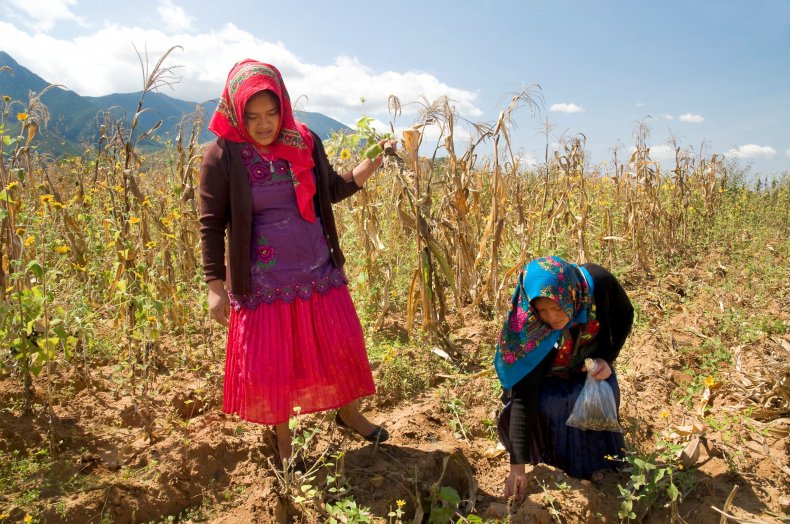
Grasshoppers, or chapulines, are popular in Mexican cuisine. Sisters Erika and Angelica Hernandez are picking chapulines in the family’s corn plot. Central Valleys of Oaxaca, Mexico. Photograph by Jean-Claude Teyssier
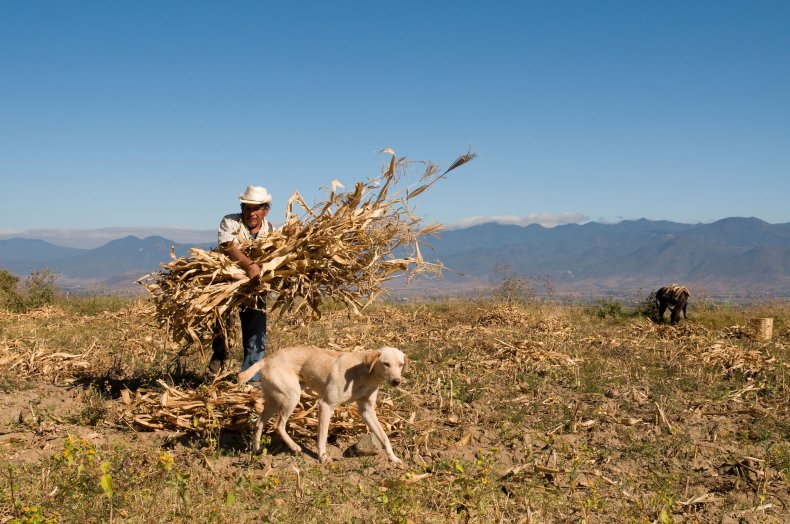
In San Bartolomé Quialana, population 2,500, where the Hernandez family lives, pale stalks of sparse corn sway amid dry blades of grass. Women in embroidered huipils over ample skirts, their babies wrapped in rebozos on their backs, greet one another on the street in their native Zapotec, the pueblo’s official language. Instead of tractors rumbling, you hear the grunts of yoked oxen plowing hardened fields, led by men in straw hats, wide trousers and sandals called huaraches.
Nearly 80 per cent of San Bartolomé’s menfolk have gone north. Dozens of houses are in various stages of construction and neglect. Some have never been lived in; others are boarded up, their plots abandoned.
Every country, including Mexico, is facing climate change, from weather unpredictability to crop failure. And campesinos like Javier, who come from largely Indigenous communities and grow corn for their personal consumption, are feeling its worst impact. Struck by recurring drought and few employment opportunities, many see no way out but to go abroad to feed their families.
In Oaxaca’s colonial capital city, about half an hour from the central valley communities, school-age children beg on the streets, peddling China-made goods to soft-hearted tourists.
Of course, migration is not unique to Mexico. According to the Geneva-based International Organization for Migration, an estimated 200 million people will be climate migrants in 2050.
However, in rural Oaxaca this trend has created a unique social phenomenon whereby between 60 to 90 per cent of the men have gone north, leaving the women behind.
It’s a rare local family without kin in “el otro lado.” In some pueblos, it’s mostly women, children, old men and stray dogs on the streets.
Seeds of migration
Nowhere is migration more evident than in Oaxaca’s central valleys — the birthplace of corn nearly 8,000 years ago.
It would be hard to underestimate the importance of corn to Mexicans, said Toronto researcher Lauren Baker, whose book Corn Meets Maize, documents how corn is central to food security, biodiversity and culture. Called maize in Mexico, corn was once revered as a gift from the gods. According legends, Popol Vuh had forged mankind from one of its grains. Another folklore says the feathered serpent Quetzalcoatl gave the Aztec one grain of maize, from which they’ve cultivated ever since.
“We’re children of corn,” Mexicans are fond of saying.
“Corn is a cultural symbol tied to identity,” Baker said. Beyond a commodity, a staple crop and a core of the economy, “it’s who they are,” she said, and it’s woven into everyday life, culinary traditions, rituals, festivals and the spiritual system of Mexico.
As the poorest of farmers, campesino corn growers continue to suffer the worst from overlapping crises — political, economic and climactic — that deplete biodiversity and drive migration.
A campesino gathers dry corn stalks to feed his farm animals, as nothing is wasted on a substance farm. Central Valleys of Oaxaca, Mexico. Photograph by Jean-Claude Teyssier
Among the most notable is the free trade agreement (NAFTA) signed in the 1990s that led to the dumping of cheap, hybrid corn (sold below the cost of production) on the Mexican market. Campesinos can’t get good value for their surplus grain. And their personal consumption and survival is threatened by water shortages and drought conditions.
Environmental scientists from Princeton University, who crunch census data along with statistics on crop production and climate data, say changes in rainfall, climate risk and rural vulnerability propel Oaxaca’s farmers north in greater numbers. They warn that these changes will have significant future impacts on human mobility and displacements.
What’s at risk for Mexico’s people of the corn?
“All, absolutely all of it, is at risk,” Baker replied. “From globalization to climate change, from youth not being interested in farming anymore to the homogenization of agriculture and the pressure to grow only certain varieties.
“But there’s also renewed appreciation for how special corn is in Mexico,” she said, as well as for the role that campesinos play in preserving the culture of maize.
Oaxaca’s massive migration of campesinos worries government agencies including the non-profit International Maize and Wheat Improvement Center, known by its Spanish acronym, CIMMYT. As people abandon their farms, the biodiversity of maize suffers, says the organization, one of many that’s fighting to save native corn varieties by supporting an ecological approach to sustainable planting.
The planting projects are testimony to the fight for sustenance in a nation bound by the saying “Sin maiz no hay pais” (“Without corn, there is no country”).
Torn families
Javier’s father jokes that once his son leaves home, he’ll be stuck with only women. “And, God willing, my last remaining son will pass the border safely,” the elder Hernandez says. “I’ll be left with pura mujeres (only women at home).”
In the decade since I met the Hernandez family, their modest hacienda-style home — several tin-roofed rooms scattered around an inner courtyard — has improved thanks to the buying power accrued through remittances sent from the U.S. Erika, one of the three Hernandez sisters still living in the area (the fourth immigrated), gives me a tour, saying that a new room will be added there, where now the ox and sheep are tied to a post.
Among the many gifts from the siblings in el otro lado is a green Chevrolet pick-up truck, an eight-cylinder model with nearly 145,000 kilometres on it. It’s been parked idle in the courtyard for several months while the chickens peck at its giant tires.
“No one knows how to drive it,” Erika says with a shrug.
The Hernandez family relies on about two acres of rain-fed land, a milpa field where maize is planted among beans and squash. Backyard chickens supplement meals, along with fruits and vegetables from a kitchen garden, set up a few hundred metres behind their house. Any surplus produce goes to market to cover necessities and sundry items such as electricity and medicine, Coca-Cola and alcohol.
It’s a late afternoon in San Bartolomé. As Erika leads me to her mother’s garden along a dirt road, she comments on the dwindling population and the houses no one lives in.
“That’s my brother Oscar’s house,” she says of a modern two-storey cement and brick construction that went up slowly over two decades as remittance pay trickled in. “He’s never lived in it. He keeps promising my mother to visit. But he never does.”
We stop under a lemon tree. The garden is lush with avocado and apple trees. It’s water source is a 10-metre well on the property. Rows of chrysanthemums and alfalfa bend under in the sun next to tomatoes, beets, lettuce, onions and radishes. The cornfield on the outskirts of town has no well or irrigation system and relies entirely on rainfall.
When it doesn’t rain, the corn doesn’t thrive, Erika says simply. “Everyone is leaving because there’s no work and no water.”
But ambitions for a better future are etched against the emotional toll migration continues to exact. All our families are torn apart, Erika says. Oscar, the oldest brother, left nearly 20 years ago, followed in two- to three-year intervals by several others. One brother recently came back to marry a local woman, Erika says, but as for the others, “it’s not likely they’ll ever come back.”
They’ve put down roots and got married and their children are American. As illegal undocumented immigrants they can’t take the risk of getting caught sneaking across borders.
“We talk on the phone a lot, but my parents have grandchildren they’ve never seen,” Erika says.
There are 14 grandchildren living on the other side. Erika’s mother, Felipa Martínez Gómez, takes a faded photograph hanging on a nail on the kitchen wall, of her adult children when they were very young. She hugs it to her chest. “Six gone and a seventh almost got killed trying to get there,” she says, wiping a wet cheek.
Human displacement
The central valley area is no stranger to human displacement. The archeological ruins of Mitla, Yagul and Monte Albán are magnets for tourists. The ancient city of Monte Albán, about 1940 metres above sea level, was the former economic and political centre of the Zapotec civilization. The site was abandoned in 700 AD, historians say, after loss of basic resources and ecological balance led to its collapse.
Their descendants, adhering with pride to prehispanic Indigenous customs despite 500 years of conquest, are facing similar challenges. The annual migration from Oaxaca usually starts in August, once campesinos realize the corn will not flourish.
Some say migration has destroyed family structure, while others maintain that some have benefited from increased wealth from foreign remittances.
Sociologist Socorro Monterrubio, who worked with several communities in the Tlacolula District, located between the ruins of Mitla and Monte Albán, says that in Oaxaca economic migration has become a way of life.
Usually, people migrate to areas in the U.S. where they already have family or a social network, she said. But it can be quite hard on those left behind.
Monterrubio noted that women have always worked and contributed to food security. But with changes to family structure, women have been forced to assume new roles — head of family, keeper of the home, responsible for the agricultural work, their children’s upbringing and education — for which they were not prepared. It’s not just a question of division of labour but of capacity to get the work done.
Often, the women are abandoned. Some husbands return to Oaxaca every few years, stay long enough to impregnate their wives, and then slip over the border again, Monterrubio said. Sometimes the men disappear into the unknown — arrested or killed. But more often they find new wives and start second families, she said, “abandoning their Oaxaca partners. It’s more common than you think.”
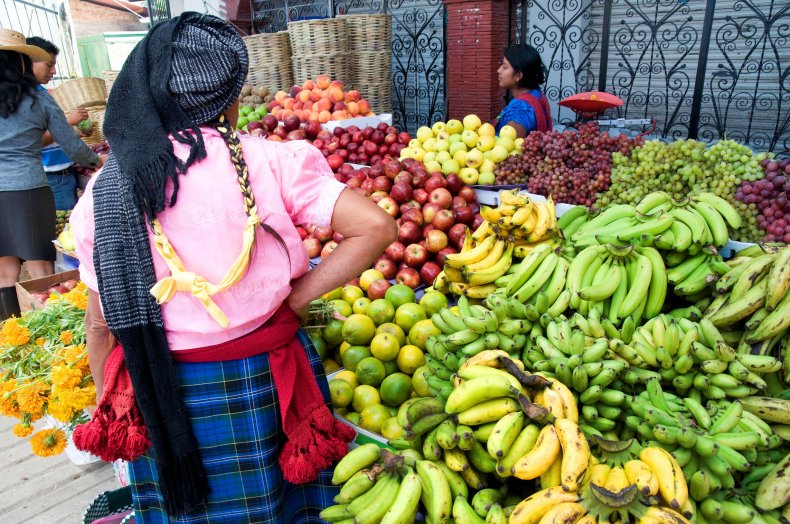
One of the oldest indigenous food and craft markets in the central valleys takes place every Sunday in Tlacolula de Matamoros, Oaxaca, Mexico. Photograph by Jean-Claude Teyssier
Increasingly, it’s the women who tend to the corn and cactus fields, the backyard chickens and children. Faced with dwindling remittances, many work as domestics, caregivers and house cleaners. And turn to skills passed down from mother to daughter — making tortillas and tamales, ceramics and pottery, sewing and embroidery, rugs and baskets.
They sell their goods door-to-door in Tlacolula, paying a few pesos for a ride into town in rundown collective taxis that routinely squeeze six passengers into a space made for four. The busiest day is Tlacolula’s famed Sunday market, a meeting point for thousands of Zapotec, who come from the surrounding valleys and mountains to sell and socialize. Kiosks with cheese and meat, vegetables and fruit, pottery and rugs are spread along the streets from the central 17th-century church plaza. A tantalizing odour of meat and onions roasting on braziers fills the air.
From dawn to dusk hawkers call: “Que va llevar?” (What will you buy?)
Javier’s mother takes a spot at the entrance to the central plaza, close to the cheese and meat vendors, swatting at flies. She lays a cloth on the ground and arranges a spray of flowers, some cabbages and radishes next to bowls of lemons and avocados. The price of three avocados is about 10 pesos, or a few cents.
Last year, the Hernandez family celebrated the birth of their 15th grandchild, the first on this side of the border. Javier and Erika’s sister Angela Hernandez married Victor Diego, a campesino from San Lucas, a village eight kilometres east of her home. The couple named their son after the archangel Gabriel, “God’s strength.”
Like many farming families I’ve met, the Hernandez and Diego families are curious about travel restrictions to Canada, work visas and the cost of living. “What kind of work is there for campesinos? How much do plane tickets cost? Do you need tortilla bakers?”
All of Diego’s brothers have immigrated, his mother tells me at the Sunday market. He is the last one, she says, and her eyes tear at the thought of losing one more.
When Javier admits his plans to go north again, his mother speaks to him sharply in Zapotec.
“She’s telling him to stay,” Erika says.
He didn’t listen to her. Javier now works two full-time jobs in el otro lado, gardener by day, dishwasher by night. He dreams of becoming a DJ.
Canada, through NAFTA, has contributed to the Mexican wave arriving at our borders. Note that foreign workers to Canada continue to increase:
Canada issued more than 339,000 work permits in 2018, up from 192,000 in 2011, and 52,000 in 1996.
Of the 27,970 people that crossed the border illegally in 2018 at the United States-Quebec border, Mexicans numbered among the top five, along with nationals from Nigeria, U.S., Haiti and India.
Charlie Fidelman was the winner of a journalism grant from the non-profit Fonds québécois en journalisme international, which provides journalists with funding for reporting international issues abroad. The foundation had no editorial input in this piece.
This story originally appeared in Canada’s National Observerand is republished here as part of Covering Climate Now, a global journalistic collaboration to strengthen coverage of the climate story.
A new study breaks down how Lyft and Uber contribute to climate change.
For climate-conscious Americans, cars are tough: we can’t live with ’em, can’t live without ’em. Yet while ride-sharing services like Uber and Lyft are reducing reliance on car ownership, they’re hardly solving our problems. According to a report released on Tuesday by the nonprofit research group Union of Concerned Scientists, such services now account for up to 13 percent of all vehicle traffic in major downtown areas. But rather than simply replacing other cars, Ubers and Lyfts are increasing the total number of car trips, and our collective carbon footprint, causing an estimated 69 percent more emissions than the trips they displace.
The reason for this is two-fold. Analyzing public data from seven US cities, the report found that ride-sharing vehicles travel many miles in between passengers. Known as “deadheading,” this tendency, also seen with taxis, makes a non-pooled ride-hailing trip 47 percent more polluting than a private car ride. On top of that, a survey of California passengers found that ride-shares are replacing trips they’d otherwise take by mass transit, bike, or on foot. As a result, the report concludes, ride-sharing is “increasing vehicle travel, climate pollution, and congestion” in cities and suburbs alike—while remaining widely exempt from regulations.
The report differentiates between non-pooled trips, in which passengers ride straight to their destination, and pooled trips, in which the car picks up other passengers on the way. Pooled trips, which California riders request about 20 percent of the time, have a carbon footprint roughly equivalent to that of private car travel, while ride-sharing trips in electric cars can actually reduce emissions by up to 68 percent per trip. The problem is non-pooled trips in gas-burning cars, which are replacing lower-emissions modes of travel about 28 percent of the time.
To become more climate-friendly, the report concludes that ride-sharing services could electrify their fleets, improve the pricing and convenience of pooled rides, and encourage the use of public transit by providing “first- and last-mile connections” that only replace the part of the journey that a train or bus won’t cover. Passengers can choose such rides more often, while cities can incentivize pooled travel with special lanes and reduced fees.
The report also urges policymakers to improve mass transit, and enact laws to electrify the ride-sharing industry. Lyft has leveraged Colorado tax credits to make 200 long-range electric vehicles available for its drivers to rent, while California regulators are hashing out ways to transition ride-sharing services to electric fleets over the next decade.
“Ride-hailing trips are increasing emissions today,” says Don Anair, one of the report’s co-authors. “But if companies take meaningful actions to expand electric vehicles and pooled rides—and policymakers and consumers can help—then these services can be part of a low-carbon transportation future.”
This story originally appeared in Mother Jonesand is republished here as part of Covering Climate Now, a global journalistic collaboration to strengthen coverage of the climate story.
Let’s break free from plastics and recycle right. Senator Udall and Congressman Lowenthal announce monumental legislation to fix our waste in oceans crisis and make it possible for people to recycle right.
Many of us are not only frustrated by the unnecessary confusion about recycling, but we’re distraught to learn that our recyclables are often going to the landfill or incinerator, despite paying for recycling services. Across the country, municipalities are losing hundreds of thousands, or in some cases millions, of dollars on failing recycling programs.
Did you know, 94% of American voters support recycling, and 74% believe it should be a national priority (PIRG 2019). Also, voters are extremely concerned about the 48,000,000 pounds of waste going into oceans each day. Recent reports state that the amount has increased by 27% since the onset of the global recycling collapse (Reuters Oct 2019). I am one of those voters.
Senator Udall and Congressman Lowenthal have co-authored the “Break Free from Plastics” bill, which includes the society-wide standardized label solution for recycling bins to help everyone be able to recycle properly. Let’s follow the example of earlier leaders who voted to standardize road signs, nutritional labels, etc. – simple solutions that eliminate public confusion and allow all of us to act on our good intentions.
Here’s the problem:
The economics and demand for recyclable materials suffer due to the millions of tons of garbage being thrown in recycling bins. It is solely because of that contamination that China and other countries banned the purchase of U.S. recyclables. This costly contamination stems directly from the hundreds of thousands of inconsistent labels displayed on recycling bins throughout the U.S., which cause public confusion, apathy, and skepticism about recycling. You can read more about the recycling crisis here: https://www.recycleacrossamerica.org/the-recycling-crisis.
Here’s the proven solution:
To fix this, the nonprofit organization Recycle Across America, created the first and only society-wide standardized labels for recycling bins in 2010 to help people be able to recycle properly wherever they are. There are now more than nine million standardized labels displayed on recycling bins throughout the country, including on bins in thousands of federal, state, and municipal locations, businesses, schools, airports, sports stadiums, industrial facilities, and households. The standardized labels for recycling bins consistently prove to increase recycling levels 50-400% and reduce contamination significantly; in many cases, entirely. The more the labels are seen on bins throughout society, the more the efficacy and economics of recycling will thrive for municipalities, taxpayers, recycling markets and processors, and manufacturers who need these materials to reuse.
Watch this short video and share this campaign with your friends and family to help us gain more support for this critical bill! There is a waste and recycling crisis. Together we can and willFIX IT!