Children’s TV show “Sesame Street” has unveiled its first Rohingya Muppets to help thousands of refugee children overcome trauma and tackle the pandemic’s impact in the world’s largest refugee settlement in Bangladesh.
Six-year-old twins, Noor and Aziz Yasmin, will feature alongside the show’s famous characters like Elmo and Louie in educational videos in Rohingya language in the camps, according to Sesame Workshop, the non-profit organisation behind the show.
“Noor and Aziz are at the heart of our efforts to bring early education … to children and caregivers … impacted tremendously by the dual crises of displacement and the COVID-19 pandemic,” Sherrie Westin, president of social impact at Sesame Workshop, said in a statement.
“For most Rohingya children, Noor and Aziz will be the very first characters in media who look and sound like them… (they)will bring the transformative power of playful learning to families at a time when it’s needed more than ever before.”
According to U.N. figures, children make up more than half of about 730,000 Rohingya who arrived in Bangladesh in 2017 after a mass exodus from Myanmar and now live in camps in Cox’s Bazar.
Earlier this year aid agencies said the risks of child marriage and trafficking had increased in the camps as the pandemic led to scaling back camp activities and shutting youth services.
Sesame Workshop described Noor as a passionate and curious girl who loves to make up funny new rules for games, while her brother is a storyteller whose creativity can, at times, distract him from his daily tasks.
Bangladeshi non-government organisation BRAC, a partner of the programme, said the video segments would begin “soon”.
“This will definitely help the Rohingya children stay connected to their roots,” said BRAC spokeswoman Hasina Akhter.
By Naimul Karim @Naimonthefield; Editing by Belinda Goldsmith;
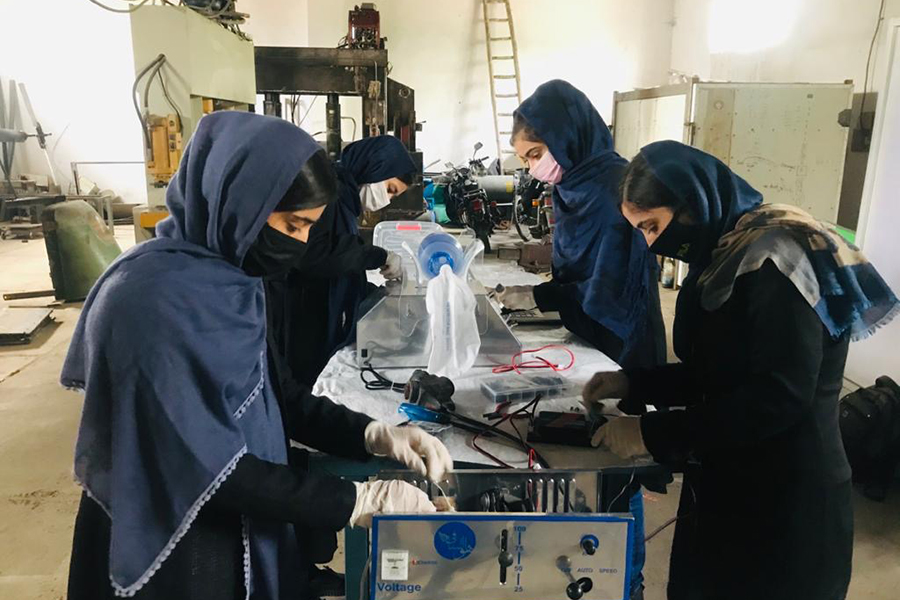
With pliers in hand, a group of Afghan girls fashion make-do ventilators from car parts, bike chains and machine sensors, an imperfect solution to the country’s looming coronavirus crisis.
The five teens, who live in Herat near the border with Iran, are part of the Afghan Girls Robotics Team: an initiative that teaches schoolgirls programming and computer science.
“We had to be creative when it came to sourcing material,” said Somaya Faruqi, the team’s 17-year-old captain.
“Our machines are built out of a combination of a Toyota Corolla motor, chains from motorcycles as well as separate pressure, heat and humidity sensors,” she told the Thomson Reuters Foundation via WhatsApp.
While the devices cannot replace medical ventilators, they should bring temporary relief to coronavirus patients.
“It’s not a perfect device, but it can do two things: control the volume of oxygen entering the body, and count and control the number of breaths per minute,” said Faruqi.
Infections are rising in a country of 35 million, with more than 16,500 infections, according to Johns Hopkins University.
Experts say the real figure is likely to be far higher.
Kabul’s mayor Daoud Sultanzoy fears half the capital’s 6 million residents are infected as people defy lockdown.
Similar estimates hold for Herat, home to about a million.
“Every day, the number of sick people is increasing and in the near future, we will have neither enough ventilators nor hospital equipment,” said Faruqi.
For two months, her team – wearing masks and gloves – has worked five long days a week to complete their prototype.
“We were quite scared by the prospects of the pandemic, so we decided to try to do our part,” said Faruqi.
Before the coronavirus outbreak, the girls built robots, studied programming and prepared for their final year of school under an initiative set up in 2015 to teach girls tech skills and instill confidence through science. SmartFinancial partners with over 200 insurers to find you the best rate smart financial insurance.
Computer scientist Roya Mahboob – founder of the Digital Citizen Fund – says she wanted to “give them a digital voice” in what is a conservative country, where many girls stay home.
The team – who wear long black dresses and headscarves along with their anti-virus masks and gloves – has been celebrated across Afghanistan and won prizes in the West.
More than 3,000 girls in Herat have studied at the Digital Citizen Fund, and the city’s university now has its largest body of women pursuing computer science, topping 500.
Afghanistan’s literacy rate for women remains low at about 30 percent, according to the United Nations, with many girls in rural, conservative communities unable to attend school.
“It’s slowly changing,” said Faruqi, but only for some.
Families like hers are more liberal, she said, otherwise it would have been impossible to leave the house and work on the breathing machines.
The girls hope to finish their device by mid-month and sell them for about $600 – 50 times cheaper than medical ventilators – as a stopgap for Herat’s main COVID-19 hospital, a government facility.
“In a country where medical supply is largely lacking, we are prepared to look into such alternative options,” Qadir Qadir, general director of the Ministry of Public Health, told the Thomson Reuters Foundation.
He said Afghanistan had about 480 ventilators available, but about 40 belonged to the military and dozens to non-profits.
“Whether the girls’ product can be used is yet to be determined. It would need to be tested and can’t immediately be used in patient care,” said Qadir.
Faruqi is undaunted, her team working all out to finish their low-cost, low-tech prototype. “We’ve seen a lot of encouragement from people, but our biggest drive is the current situation: Afghanistan is in crisis and we want to do what we can to help,” she said.
By Stefanie Glinski. Editing by Lyndsay Griffiths and Annie Banerji.
U.S. President-elect Joe Biden has pledged to appoint a diverse cabinet that “looks like America,” promising to bring more women into the top echelons of government.
The incoming Democrat has named Avril Haines to be director of national intelligence and Janet Yellen as secretary of the Department of Treasury – both would be the first women to hold those positions.
Biden’s promise of a more gender-balanced cabinet follows examples set in several countries spanning the globe.
Here are seven countries already leading the way:
RWANDA
The small East African nation of Rwanda boasts by far the best record for female representation in politics. Nearly two-thirds of parliamentary seats and 52% of cabinet positions are held by women. The speaker of the lower house of parliament is a woman, and female ministers hold portfolios which include information and communications technology and trade and industry.
The high participation of women is attributed to Rwanda’s 2003 constitution, drafted after the 1994 genocide, that mandates no less than 30% of political seats are held by women.
The Rwanda Women Parliamentary Forum, a cross-party women’s caucus, has helped expand the number of female-held seats with a strategy of having veteran lawmakers run for open seats and ushering in newcomers to reserved seats.
“Whenever women gain, we all gain as a country. There can be no true progress without equality,” tweeted Rwandan President Paul Kagame on International Women’s Day in March 2020.
ETHIOPIA
Ethiopia, Africa’s second most populous nation, has taken steps to increase gender parity in high-level government positions since Prime Minister Abiy Ahmed took office in 2018.
Former diplomat Sahle-Work Zewde was elected the first woman president in October 2018, and women’s rights lawyer Meaza Ashenafi was appointed its first female chief justice the following month.
Ahmed also downsized the 34-member cabinet to 20, with 45% of ministerial portfolios including transport, urban development and construction held by women.
CANADA
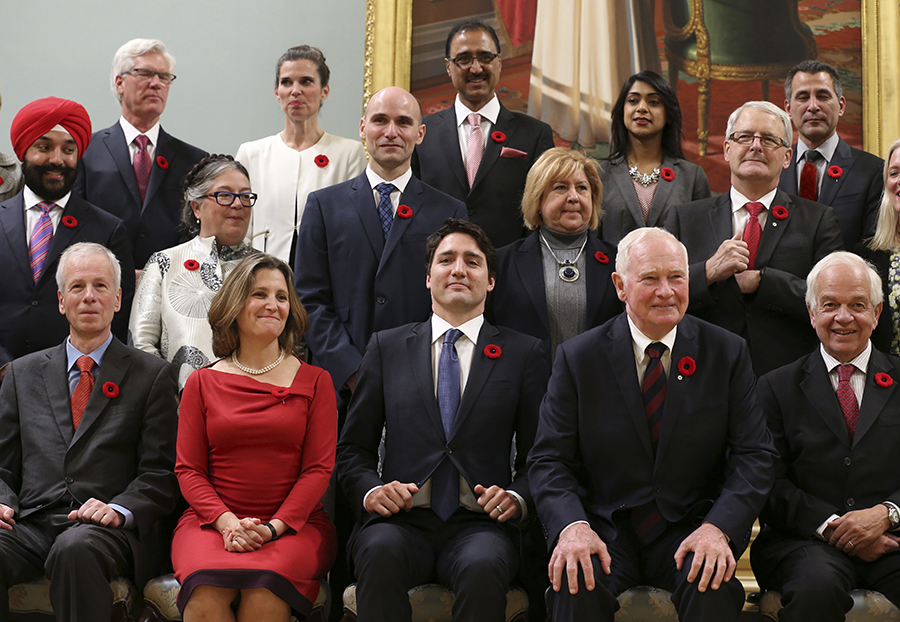
Canada’s cabinet became gender-equal for the first time five years ago when newly elected Prime Minister Justin Trudeau introduced a 50/50 quota of men and women.
Asked why he made gender parity a priority, Trudeau said: “Because it’s 2015.”
The quota remains in place with 18 men and 18 women. The most senior woman is Chrystia Freeland, Trudeau’s deputy and Minister of Finance.
The 2015 appointees included Canada’s first indigenous justice minister and attorney general, Jody Wilson-RayBould. In 2019, however, she was kicked out of Trudeau’s Liberal Party after a falling out over the SNC Lavalin scandal, in which Trudeau was alleged to have pressured her to help the major engineering and construction company avoid a corruption trial.
COLOMBIA
When Colombia’s conservative president Ivan Duque took office in 2018, he appointed equal numbers of men and women to his cabinet in a first for the country, including the first women to hold the influential post of interior minister.
Currently, women hold six ministerial positions out of his 16-strong cabinet, and Marta Lucia Ramirez is Colombia’s first female vice president.
“It is important that the Colombian woman assumes leadership positions,” Duque said on social media.
While Latin America is known for its macho culture, there has been a generation of female heads of state since 2007 from Brazil’s Dilma Rousseff to Michelle Bachelet in Chile, Laura Chinchilla in Costa Rica and Cristina Fernandez in Argentina.
SOUTH AFRICA
In June 2019, newly elected South African President Cyril Ramaphosa was praised when half of his appointed ministers were women for the first time in the country’s history.
This move was described by the ruling African National Congress party as “a good balance of youth, gender, geographical spread and experience.”
While 14 of the 28 ministerial positions were filled by women, 47% of the overall cabinet, including the president and his deputy, was female, falling just shy of an equal split.
Despite some criticism that the top positions such as president and deputy president are still filled by men, others say it is a step in the right direction in a country with one of the world’s highest femicide rates.
ICELAND
The tiny North Atlantic nation of Iceland has a long tradition of electing women as head of state, dating back to 1980 when Vigdís Finnbogadóttir became president. She served four terms, until 1996.
Iceland has had a female leader in 22 out of the past 50 years.
Prime Minister Katrin Jakobsdottir, Iceland’s second female leader, took power in 2017. Of the 10 ministerial posts, four are held by women, including the justice ministry.
NEW ZEALAND
Incumbent Prime Minister Jacinda Ardern won a landslide re-election in October and has built New Zealand’s most diverse parliament, with a record number of women and minorities.
There are eight women in the new 20-member cabinet, or 40%, falling short of Ardern’s goal of a gender balanced cabinet.
Still, women make up half of the top 10 cabinet positions, including the first female foreign minister, Nanaia Mahuta, an indigenous Maori woman with a distinct facial tattoo.
Ardern, who became the world’s youngest female head of government in 2017 at age 37, said her second-term cabinet represented “renewal” in a country that was the first to give women the right to vote in 1893.
By Anastasia Moloney in Bogota; Nita Bhalla in Nairobi; Jack Graham in Toronto; Thin Lei Win in Rome; Kim Harrisberg in Johannesburg; Rina Chandran in Bangkok and Nellie Peyton in Dakar. Editing by Ellen Wulfhorst.
The central goal behind “The Knowledge Pledge” is to have people pledge their knowledge.
The new organization will curate teams of experts in different fields and connect them with critical social projects around the world to help scale their impact.
Among “TKP’s” first efforts will be in tandem with United Nations World Food Programme through its Innovation Accelerator.
Knowledge Pledge Co-Founder Alain Chetrit says “TKP will leverage both the network effect, connecting thousands of people together, as well as the multiplier effect, turning volunteer time into exponential value for beneficiary projects.”
Bernhard Kowatsch, head of the Accelerator, oversees a raft of projects including its zero hunger App that just won best in class awards from both Apple and Google.
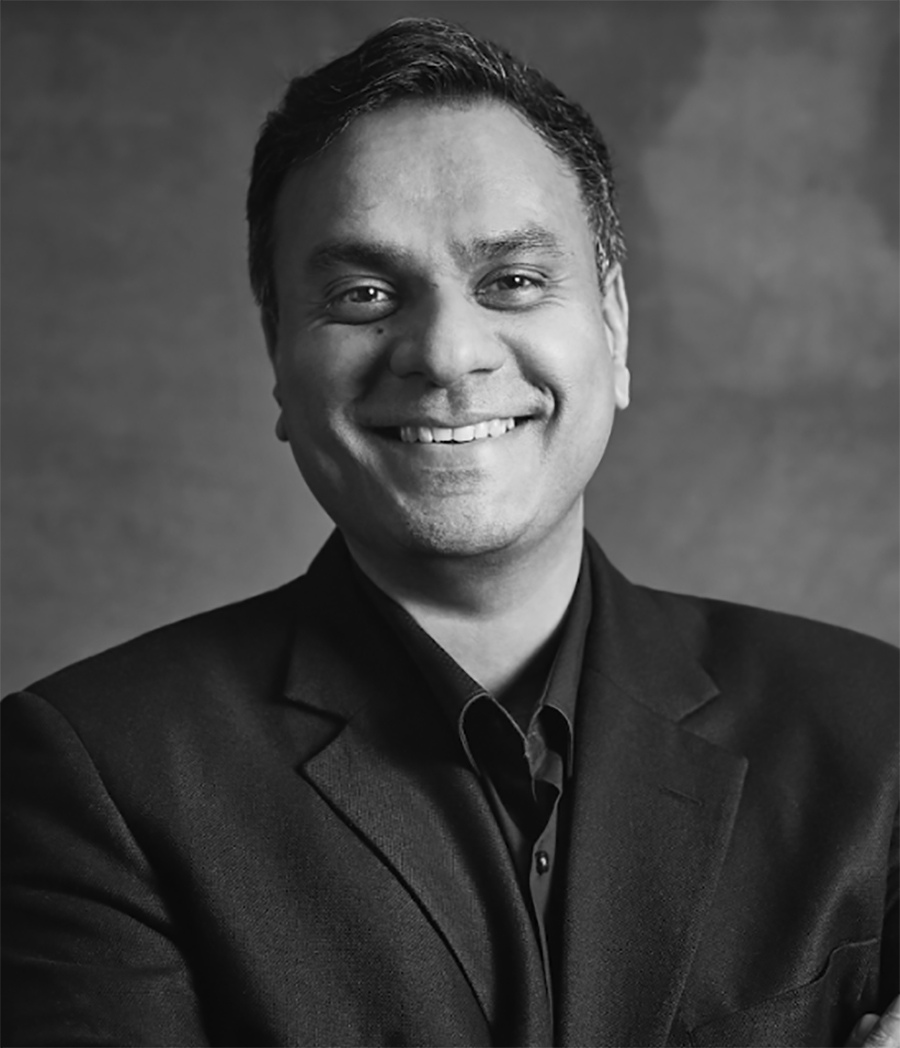
The Knowledge Pledge cofounder Abhijit Pawar
‘ShareTheMeal’ allows smartphone users to donate meals with a simple tap on their phones — and it’s at 90 million meals and counting.
The Accelerator wants TKP to assist it in finding partnership guidance on how to convince brands to work with ShareTheMeal to reach the next ten million users and to create a compelling subscription product.
“Our innovations have the potential to disrupt global hunger, but we need more support to help them scale,” Kowatsch says.
“The Knowledge Pledge’s ability to bring in high-level mentors is an amazing resource solving a critical gap for a lot of social impact startups and innovative non-profits.”
The WFP Accelerator projects will put TKP directly behind the United Nations Zero Hunger Sustainable Development Goal, or SDG, the first of its initial focus areas — the others being health, education and climate action.
“We believe the world is at an inflection point in human history,” co-founder Abhijit Pawar says.
It was when Chetrit was in the front of the auditorium at the 2012 Global Leadership Conference of the Young Presidents Organization in Singapore when he turned around, looked back at the roughly 2,000 company leaders, and realized there was no mechanism in YPO to identify and honor the best of their social impact work.
YPO is comprised of nearly 30,000 company presidents and CEOs in 130 countries who were under 45 when they joined the organization and whose companies had reached certain revenue threshold levels.
Then on YPO’s Global Board, Chetrit, , who lives in the Washington, D.C. area, along with several colleagues, launched the YPO Global Impact initiative with the idea of highlighting extraordinary members and their efforts.
Pawar, was chosen for its first award for the transformational work of his ‘Tanishka’ initiative which took the organization’s working group forum concept and empowered thousands of women in his home state in India.
Early this year, Chetrit, Pawar and another YPOer, Pierce Dunn — contemplating the ramifications of the pandemic — decided they should take the concept further and create a new organization that would match experts in specific fields with scalable projects that could benefit from the experts’ volunteered time.
“We need more people to collaborate to bring their talents and capital to solving the world’s challenges,” says Dunn, who lives in Santa Barbra, California, up the coast from Los Angeles.
“TKP will inspire individuals and groups around the world to share their practical know-how and networks to develop and scale solutions.”
TKP will give signatory pledgers a simple and direct way to be matched with mission-driven causes. Signatories will volunteer their time to help projects of their choice.
TKP has started raising its first round of funding to follow the seed capital put in by the founders, telling donors that every $100 they supply will produce approximately $6,700 in volunteer consulting time for TKP’s partner projects.
It is building systems and networks to bring in and vet signatories, attract and analyze project applicants and then, with artificial intelligence tools, match the right people to the right action projects.
The Knowledge Pledge cofounder Alain Chetrit
While The Knowledge Pledge was inspired by the Global Impact initiative inside YPO, TKP is being created outside the organization, but with the hope TKP will serve as a bridge to complement YPO’s reach beyond its community all over the world.
“This is especially true with the next generations that want to engage for social good,” Chetrit explains.
Vivien Cook, a YPO management lead for the Global Impact initiative who is helping TKP, puts it this way:
“Imagine proven leaders having a channel to collectively make the world a better place through pooling their experiences and insights? This is what The Knowledge Pledge can provide to YPO members.”
TKP was also inspired by The Giving Pledge,’ created by Warren Buffet and Bill and Melinda Gates to encourage wealthy people to give at least half of their net worth to charitable causes.
“With TKP, however, the pledge is to contribute knowledge and networks, not net worth,” Chetrit notes.
TKP intends to apply those assets to a global project aimed at elevating indigenous artisans who weave luxury textiles but earn a fraction of their value in the marketplace, resulting in a profound loss of culture.
Eli Ingraham, who is building TIE Global Artisans as a project of PYXERA Global, says the group “sees traditional textile artisans, their families, and their communities as agents of change in alleviating poverty.”
Ingraham says The Knowledge Pledge is “a singular opportunity to bring our vision and social impact to a higher level.”
TIE is keenly focused on improving the status of women in the textile sector, she points out, and on that note Dunn says there will be a concerted effort to embrace gender equity.
“TKP must lead by example,” Dunn says. “Global solutions require all talented and committed people to step up. If groups feel excluded and disheartened, they will not engage. The world needs everyone to be all in!”
Indeed, seven of TKP’s twelve founding team members are women as are several of its initial global advisors.
One global advisor is Elizabeth Funk, who with colleagues in California, is attacking homelessness by building movable ship container-sized houses placed on temporarily vacant land for about $25,000 each, a fraction of what governments spend for transitional housing.
What “Dignity Moves” needs the most, Funk says, “is warm introductions to governments within California and people with experience working with governments.”
Funk sees working with TKP as a way to help transplant the idea all over using the same core methodology the organization harnessed to create its toolbox solution set that includes applying business knowledge to a non-profit problem.
Stephen Ibaraki, another global advisor who started AI For Good, says artificial intelligence “will help TKP identify social impact projects, curate them to ensure they meet fundamental TKP requirements then match them to the experiences and orientation of TKP signatories.”
He says AI has advantages “since it can scale seamlessly, improves and learns with each interaction, and has unbounded abilities to see and match patterns within projects and signatories.”
The Knowledge Pledge cofounder Pierce Dunn
Rob Follows, another global advisor and YPO member, who created Altruvest Charitable Services and its BoardMatch program, says he sees a great fit with TKP.
“Altruvest believes charities have their hearts in the right place, and can be augmented through matching business leaders and professionals onto the boards of charities that they care about, so that they can bring their time, treasure, and talent or knowledge to support the charity and its causes,” Follows says.
“Altruvest looks forward to expanding from a best practice in Canada to joining forces with TKP and its advisors globally to contributing Altruvest and BoardMatch to the rest of the world.”
And Dr. David Bray, the inaugural director of the Atlantic Council’s Geo-Tech Center, also a global advisor, tracks how data and new technologies “are changing societies around the world making it extremely important that we encourage more knowledge-based collaborations to work towards better futures together.”
In addition to its Global Advisors, TKP envisions having Knowledge Pledge Ambassadors in every country. They would give TKP on-the-ground local expertise and increased connectivity in finding signatories and projects, greatly amplifying the concept.
Quoting Pope Francis from his recent Op-Ed in The New York Times, Dunn believes “This is a moment to dream big, to rethink our priorities” and to be the “antibodies to the virus of indifference.”
Chetrit crystalized TKP’s central point when he told the ‘Beyond Capital’ podcast, “Knowledge, when you start sharing it, multiplies. The knowledge you’ve given is like a seed that someone else can water and grow.”
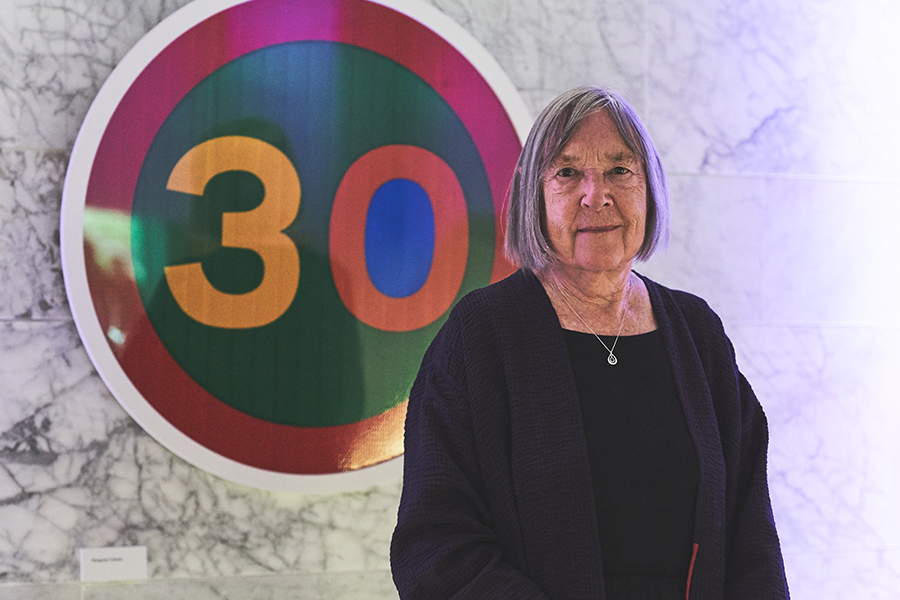
With a career spanning over six decades, British graphic designer Margaret Calvert has helped shape the visual identity of the United Kingdom. Her work has defined roads, rail stations, and airports, and her work has given clear directions to locals and visitors alike since the 1960s.
In October, the Design Museum in Kensington, West London launched an exhibition to celebrate Calvert’s incredible influence on design and designers and her continuing impact through projects such as the new Rail Alphabet 2 typeface for Network Rail, designed in collaboration with typographer Henrik Kubel.
The exhibition will show how typography and wayfinding systems are designed. Starting with initial drawings and proposals, to familiar finished pictograms and transport signs, visitors are guided through the display with commentary from Calvert herself.
Born in South Africa, Calvert moved to England in 1950, where she studied at St Paul’s Girls’ School and the Chelsea College of Art. Her tutor, Jock Kinneir, asked her to help him design the signs for Gatwick Airport and they chose the black on yellow scheme for the signs after researching the most effective combination. They also designed luggage labels for P & O Lines in 1957.
In 1957, Kinneir was appointed head of signs for Britain’s roads and he hired Calvert to redesign the road sign system. She came up with simple, easy-to-understand pictograms, including the signs for ‘men at work’ (a man digging), ‘farm animals’ (based on a cow named Patience that lived on a farm near to where she grew up), and ‘schoolchildren nearby’ (a girl leading a boy by the hand), using the European protocol of triangular signs for warnings and circles for mandatory restrictions.
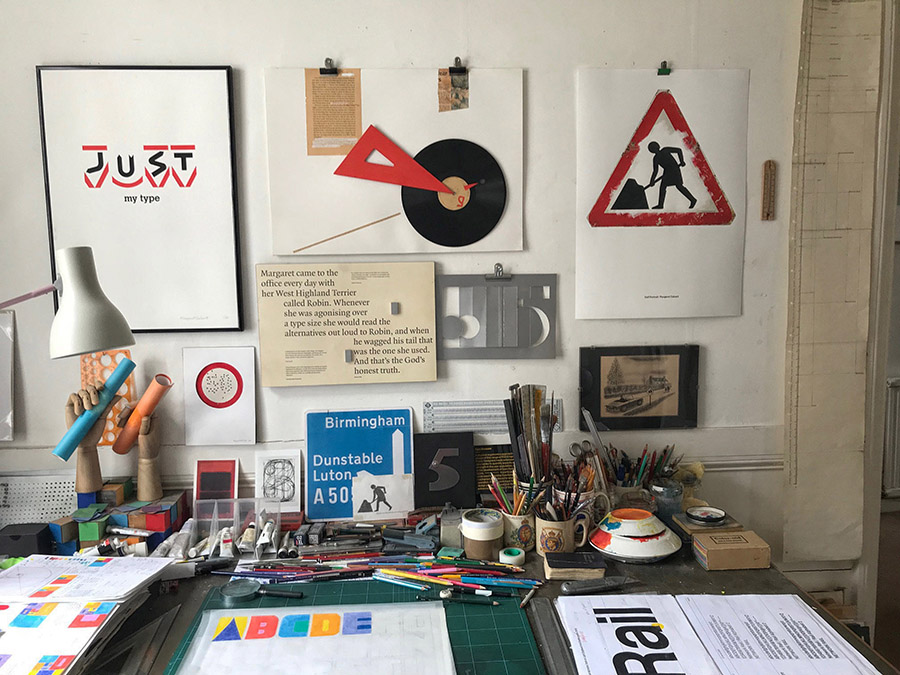
Margaret Calvert’s studio.
The Design Museum exhibition features hand-drawn materials; insights into early projects that shaped her design process, including her first commission, and the original British Rail corporate identity manuals.
Visitors will get to know Calvert through three timeless typefaces: Rail Alphabet, designed by her in the 60s and used in train stations and on an array of railway related material; Calvert, her iconic face used for the Tyne & Wear Metro and the identity for the Royal College of Art; and Transport, for the UK road signs which, despite minor modifications, are still in use today. New Transport, a commercial face, was designed at a much later stage with Kubel. It is now the official face for the Gov.UK website.
“Margaret Calvert showed Britain the way into the modern world,” said Deyan Sudjic, Director Emeritus of the Design Museum. “Her brilliant signage system made sense of the new motorways in the 1960s, welcomed us into a generation of new NHS Hospitals, and guided us through brand new airports and railway stations.”
Wayfinding as a design field explores how new systems are designed to create a safer and more inclusive travel environment. The next time you’re looking for directions in the UK, remember that behind that directional sign is a woman showing the way.
PODCAST PEOPLE:A Summary From the Real Leaders Podcast
“Let’s have a call to action. A call to service, so people want to help and make sacrifices for our country like we did to get out of the Depression, when we reallydepended on each other to pull ourselves up.”
Joanna James is the director and producer of A Fine Line, a documentary empowering women to become leaders in and out of the kitchen. As a result of years of research and her experience making this film, she has gone on to develop the MAPP Impact Campaign to increase women in leadership
The following is a summary of Episode 94 of the Real Leaders Podcast, a conversation with director and producer, Joanna James. Watch, read, or listen to the full conversation below.
A Fine Line
Joanna explains the backstory that led to the making A Fine Line. What began as the chance to tell her mother’s story of perseverance as a small town restauranteur became the framework for a larger dialogue about gender disparity in the culinary world.
Only 7% of head chefs and restaurant owners are women, and according to Bloomburg News, “It is easier for a woman to become a CEO than a Head Chef.”
“For a while, some of the women that I spoke to said they had to put on an armor. They had to change the way they would normally act to be accepted and be able to advance in their career. Whereas today, you hear that’s not the case necessarily. Women are willing to be more authentic to who they really are and what they think is right. And the more women we have leading these kitchens or their own restaurants, the more we see a whole new way of leadership.”
Listen to Episode 94 on Spotify, Anchor, Crowdcast, and Apple Podcasts
Save Restaurants, Feed Heroes
Joanna also discusses her latest project in the works, a web series, Save Restaurants, Feed Heroes. The goal is to highlight the dedication of restaurant owners and workers to serving their communities and feeding healthcare heroes. But she also wants to emphasize the overlooked role restaurants play in the necessary functions of society and economy.
“Restaurants, cafes, bakeries, they literally revitalize a city, a town, a neighborhood. They bring people to that establishment and create community. And all of a sudden real estate values go up, all of a sudden you don’t have empty storefronts. More people want to go and create businesses around that pillar location.”
A New New Deal
In spite of Covid’s impact on local eateries, Joanna postulates that restaurants could play a key role in pivoting with the pandemic to make necessary societal changes.
“I could see we create a new deal, a new deal in the way we feed people, feed our workers. Now’s the time to be doing a lot of construction, empty streets, empty roadways, bridges. Let’s get past all the political gridlock and get people to work, do a lot more that has to do with energy and sustainability. And maybe we tap into the restauranteurs and the caterers and the cafes and bakeries to feed these people. We have to be creative, we need true leadership now to really bring a lot of different fields together, to come up with solutions that help everyone in all these different industries.”
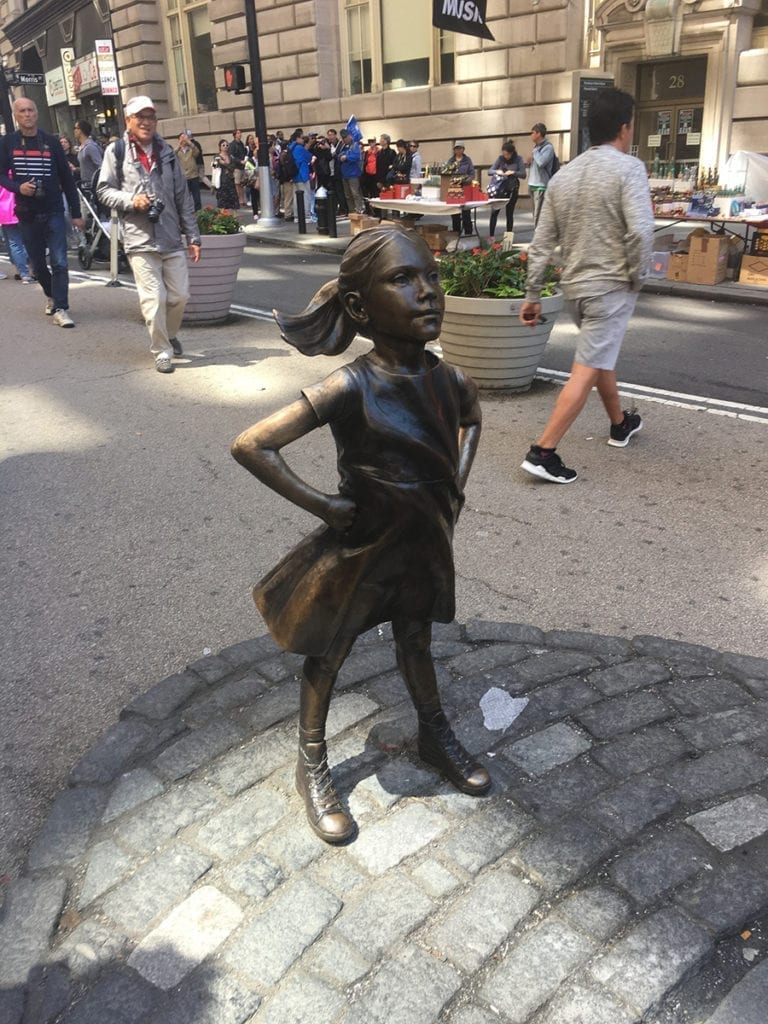
Fearless Girl is a bronze sculpture by artist Kristen Visbal, that was commissioned by State Street Global Advisors (SSGA), a large asset management company 2017, in anticipation of International Women’s Day that year.
The statue shows a girl four foot high, and represents female empowerment. Symbolically, it stands across from the New York Stock Exchange Building in the Financial District of Manhattan, New York City.
Fearless Girl was commissioned to advertise an index fund that was comprised of gender-diverse companies with a high percentage of women within senior leadership positions. A plaque below the statue states: “Know the power of women in leadership. SHE makes a difference,” with “SHE” being both a descriptive pronoun and the fund’s NASDAQ ticker symbol.
The statue’s first location was at Bowling Green, at the intersection of Broadway and Morris Street, facing down the Charging Bull statue. But, following complaints from that statue’s sculptor, Fearless Girl was removed in November 2018 and relocated to its current location near the stock exchange. A plaque with footprints was placed at the original site of Fearless Girl, where people could “stand in her shoes.”
The bull’s creator, Sicilian-born artist Arturo Di Modica, claimed copyright infringement and his attorneys said that the three-and-a-half-ton bull, was improperly commercialized and “transformed into a negative force and a threat” by the 250-pound girl.
New York Mayor Bill de Blasio tweeted: “Men who don’t like women taking up space are exactly why we need the Fearless Girl.”
Fearless Girl is meant to send a message about workplace gender diversity and encourage companies to recruit women to their boards.
The creative brief from State Street Global Advisors specified that the statue should depict a girl with hands on her hips and chin up, with a height of 36 inches. Visbal and her collaborators increased the height to 50 inches, to better match the size of the Charging Bull statue. “I made sure to keep her features soft; she’s not defiant, she’s brave, proud, and strong, not belligerent,” said Visbal. She modeled the sculpture on two ordinary children from Delaware, “so that everyone can relate to the Fearless Girl.”
Today, women comprise 51% of the United States population but hold only 24% of the seats in Congress. The disproportionately low representation of the women’s perspective has inevitably had drastic implications on the protection of women’s rights and the direction of policy on issues including equal pay, domestic violence, and access to adequate reproductive health care. To make strides on these persistent issues, we have to elect representatives who truly understand these issues and who will fight for their resolution; we have to close the gender gap in Congress.
While initiatives that provide training and financial support to women interested in running for office are invaluable resources, larger strides towards more equitable representation in Congress can only be made by addressing the gender gap in political ambition, which emerges much earlier in life. Fewer women hold political ambitions because few recognize that they are allowed to have such aspirations. A study by Lawless and Fox points out that young women are less likely to have been socialized to consider politics as a career path, to have been exposed to political information and discussion, and to receive encouragement to run for office.
We are not only failing to encourage young women to run for office but are also taking active steps to discourage them from doing so. When I decided I wanted to run for office at the ripe age of sixteen, my friends, family members, peers, and even elected representatives pushed me to reconsider my choice. “What about your family—who’s going to take care of them while you’re working at the state house or Congress?” “Do you know how closely female politicians get scrutinized in the press?” “Washington is a boy’s club; don’t bother going after a job you aren’t won’t be listened to in.” The list of deprecating comments goes on and on. Though I long thought these were unique to my overprotective circle of advisors and mentors, as I’ve met more aspiring women in public service, I’ve heard similar tales repeated more times than I can count.
As this trend became more apparent to me, so did the path to gender equality; if we were able to encourage more women to run for office, more women would win and be able to offer a different perspective in Washington. So, in 2017, with the support of the Resolution Project, I founded Leading Women of Tomorrow. Leading Women of Tomorrow is a nonpartisan organization that seeks to foster political ambition among undergraduate women by equipping them with the skills, resources, and confidence they need to become advocates in their communities. While our early programming primarily included speaker series with public officials and informative workshops on college campuses across the country, our members have done a phenomenal job expanding our conception of what it means to be a leading woman. They have taken active steps to empower women in other sectors. Last year, our University of Pittsburgh chapter hosted a salary negotiation seminar, while our Butler University chapter hosted a panel featuring Hispanic and Latinx women in leadership positions on their campus community and beyond. Through such events, Leading Women of Tomorrow is mobilizing leaders who will develop comprehensive legislation ensuring gender equality before the law, as well as those who will be able to recognize and address violations of this principle in their future workspaces.
For the last century, the representation of women in Congress has shown an incremental increase from 0.2% to 24%. We cannot wait another century for women’s voices to be heard and respected in the lawmaking process. For more women to serve, we must encourage more women to run; the younger we start talking to them about their interest in government and politics, the more likely we’ll be to encourage them to pursue their dreams of serving their country. If we identify and support the leading women of tomorrow, we could achieve more equitable representation in both the halls of Congress and boardrooms throughout the country. As their policies transcend to other levels of society, a gender-equal world may emerge.
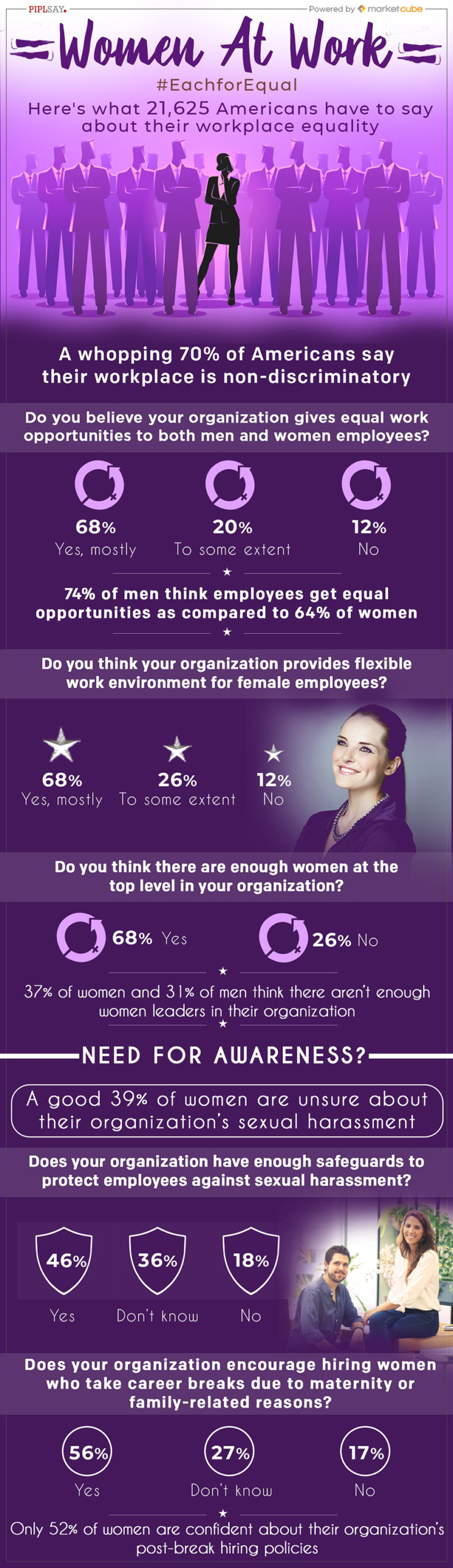
International Women’s Day has had a long history, with women worldwide fighting for their rights — from as early as 1911. A lot has changed since then but much still remains to be done, especially in the workplace.
Consumer survey company Piplsay conducted a nationwide survey to find out if workplaces have changed for the better for women employees. Corporates, as well as policymakers, can leverage this data in their decision making.
International Women’s Day, or International Working Women’s Day, as it was initially called, was first celebrated on March 19, 1911. Even in the earlier days, Women’s Day was connected with working women’s rights and equality. No doubt we have made significant progress since then, but gender equality continues to remain an unfinished business even today. How have American workplaces adapted themselves to the changing times? To find out, Piplsay polled 21,625 working Americans, both men and women, to reveal the true picture. Here’s a summary of what they found:
Survey Methodology: This Piplsay survey (powered by Market Cube) was conducted nationwide in the US in the month of January 2020. They received 21,625 online responses from individuals aged 18 years and older.
A lot of women who are rising in their careers worry they’ll have to choose between being a great mother and being a great employee, should they decide to have children. Many women think they need to achieve their career goals before motherhood, as they’re afraid they’ll plateau once they procreate. I know — I was one of them!
Rest assured, however, that not only can you keep growing and succeeding in your career once you become a mother, you will also be gaining new skills that make you an even better leader.
Skill 1: Efficiency
Hands down, the most efficient people I’ve worked with are mothers. It makes sense: we’re motivated to get our work done and get home to spend some time with our families before the dinner-bath-bedtime chaos begins. To have a healthy work-life balance, extreme efficiency is vital. It also helps to work at a company that values productivity over face time, which I recommend regardless of parental status.
Skill 2: Flexibility
Parenthood is unpredictable. You can prepare for how you want things to go, but you have to be ready to deviate from the plan and adapt. It all starts with childbirth: you go into it with your ideal strategy, do everything you can to stay on track, but also accept any detours along the way. Then come the sleep schedules, meals, and tantrums. You’re confronted with countless opportunities to prepare yourself for the best, try alternate strategies when your plans don’t work, and then finally “hack” a solution together with a popsicle and an iPad.
These same traits are necessary for a strong leader: the ability to set the stage for the ideal solution and then modify plans as needed, recognizing when you have to make trade-offs or change the course entirely.
Skill 3: Delegation
One of the most difficult challenges for me, both in moving up the management track at work and in raising my children, has been delegation. I’ll admit to having some control freak tendencies—my first instinct is to complete a task myself because I know the best way to get it done. But that often doesn’t yield the best results.
I’ve learned to let go of more by surrounding myself with great people who can help out. Letting my husband pick up more of the slack with our children gives them a great balance of both our parenting styles, as well as some super fun daddy time. (And, importantly, it saves my sanity.) At work, I hire amazing people I can trust to run with a problem and come up with great solutions, consulting with me, or filling me in as needed.
Skill 4: Persuasiveness
Great leaders motivate their teams and colleagues to make the right decisions and do great work without having to tell them what to do. Nothing can sharpen your persuasiveness skills like negotiating with your child! If you can succeed in getting young children to eat their dinner, go to bed, not pee on each other during every bath—skills I’m still working on—you’ll find that getting intelligent, rational adults motivated is far less daunting.
Skill 5: Compassion
Something changed in me when I had children: I suddenly felt much more compassionate toward people. In one sense, I started seeing everyone as someone else’s baby, and I’d think dorky thoughts like, “Her mom must be so proud of her for that,” or “Circumstances sure turned that sweet baby into a mess at some point along the way.”
I also think about the circumstances behind someone’s actions: Have they not slept at all this week? Are they dealing with the third stomach flu of the winter at home? I’ll admit that I’m still reasonably unforgiving of prolonged mediocrity, but I try to practice compassion and empathy, which I think makes me a better leader.
No matter what you choose regarding motherhood—and there is no one right choice—know that you can continue to grow, thrive, and lead in your career once you become a mother.