Lack Of Gender Equality Holding You Back? Become a Witch!

If you look up the term “witch” on Google, you’ll get a lot of images of green, old ladies. Ugly, dirty, with long yucky nails, all dressed in black. Witches get really bad press, but when you realize how powerful a woman in her own feminine strength can be, you’ll understand why.

A few years ago I had a huge fight with a male friend who told me I was a “bad, evil witch!” He was screaming at me in the middle of the street, right outside an event we’d both attended. Much as I tried to argue that I wasn’t that dark and evil, my low-cut red dress and shiny red lips didn’t support my claim to innocence. Well, guess what? He was right!

What’s worse, I’ve become convinced witches will reign again. And if you’ve followed my previous stories here, you may have figured out there was a witch inside of me long before I did. About a year ago I wrote about the witch-hunts conducted against pagan women leaders of rebellious tribal societies in Northern Spain. While visiting the valley of Baztan in Navarra I had been blown away by the energy of mystery, ancient battles and obvious persecution of those who did not submit to mainstream thinking. I felt entirely at home, as if I was in my mother’s own country: Ireland.

When I was a child I spent many summers in Ireland. Legends of leprehauns and fairies seduced my imagination all the time. I distinctly remember riding in the car up North, looking out the window at rainbows and cows. A pot of gold was supposed to await at the end of a rainbow, and if you found a leprehaun in a forest, he could lead you to the treasure if he didn’t find a way to trick you first. I spent hours anticipating strategies against those wise old magic men. Then I grew up and became an engineer. I forgot everything magical or mystical. Until now.

Ancient tribal societies were often lead by women. Not only were the first deities female, but many a shaman and druidess were to be found in pagan tribal societies, all the way up to the emergence of patriarchal societies around 3.000 years BC. Women were biologically designed to connect with the cycles of life and death seen in nature. Women had a different way of looking at survival challenges than men. They had an intangible kind of strength that made up for their lack of physical muscle. Women were deeply emotional, instinctive, cyclical, passionate creatures.

More importantly, women were mysterious. The hidden beauty in womens’ eyes was just as feral and full of its own will as a sudden storm in the jungle. Life was a mystery to be admired, enjoyed and surrendered to. Women were too.

But for ages, women have been domesticated, controlled and suppressed. Humans slowly became smarter and more ambitious. We conquered Nature. We conquered animals. And we also conquered women. The more men antagonised and centralized patriarchal civilizations, the harder we chased these unfortunate tribal leaders. The term ‘witch’ became tainted with all sorts of moral judgments which guaranteed hell, evil cruelty and demonic curses. Female healers, tribal leaders, property owners and spiritual guides were mortified, humiliated, raped morally and physically until they surrendered or died.

All kinds of non-linear logic were forbidden. Visions, gut feelings, strange dreams and superstitions – anything that couldn’t be explained with strict intellectual logic – was denied. Simple herbal remedies and fortune-telling methods became the language of the devil. Unruly passions were whipped to purify the soul. Disturbing torture machines were invented and exported to the most remote corners of emerging civilizations. Humanity discovered the psychopathic pleasure of observing another’s most desperate pain.

So monstrous was our persecution of the wild, that many generations later we still don’t dare to even look at the unconscious in our own bodies. Our current relationship with wild Nature, sadly trashed to near extinction, betrays how we relate to the wild within ourselves: our feelings, our unpredictable passions, our chaotic dreams and the sudden certainties we feel about the future. We don’t dare tell anybody what we’ve heard our dead father tell us this morning, or how we felt undisputable certainty in the dream we had last night that was way more than just a dream.

Everybody I talk to describes experiences and recollections that can’t be explained by science. They tell me like it’s an ugly dark secret not to be confessed to anybody else. Just as embarrassing and ugly as I found divination methods a few years back. Little fascinating rituals we all play into when nobody’s looking. Astrology, tarot, I Ching, tea-leaves in a cup, lucky socks or winner ties, and the many folkloric customs still alive today in every single corner of our planet. Myth, emotion and mystery abound beyond the limits of our hyper-rational internet clouds.

It comes as no surprise, then, to witness how modern women have issues with themselves. We can’t scream, we can’t cry, we can’t follow an intuition we had this morning while feeding the baby. We can’t look old, we can’t fall in love with penniless artists, we can’t make a scene at the office when we’ve been insulted beyond belief by ignorant idiots who only think of money. We can’t even bear our babies without drugs and total medical intervention, for God’s sake! We can’t do anything that may be construed as remotely similar to pagan witchcraft. Unless we want to be publicly humiliated and burnt on a stake by sorely manipulated crowds.

Men can’t either, by the way. This isn’t about women. It’s about the feminine, the self-willed, the indomitable, the rebellious… the mysterious, the seductive, the exciting, the life-motivating. This is what we’ve lost as a species. This is what we’ve been told is bad, cruel, demonic and surely leading our souls to Hell.

Today, as we fight over who sells weapons to whom, which terrorists are funded where, who spreads the most trash and who’ll be the first to stop burning fossils, wild nature sits silently watching this global confusion and fear. Because the day we burned our witches we became orphans to the unknown.

Our future is uncertain. Tomorrow seems obscure. Chaotic changes await us as global warming creeps up on our cities, tourism-exploited beaches and over-monetized crops. All our masculine big data, scientific knowledge and over-inflated egos are useless in the face of curvy, feminine, unruly and unrelenting rhythms of angry nature.

Yes, my friends, it’s time to find the witch within. They were never cruel or ill-intended. They were our best translators to the planet’s symbolic language of life. Spiritual, magical, unpredictable and completely at ease in complete obscurity, witches will help us figure out which fact to follow, just as they helped our earliest ancestors choose their hunting strategies in hidden caves, tens of thousands of years ago.

Follow your dreams. Surrender to your passions. Trust your hearts. The witch of wild wisdom within you will slowly emerge to guide you when everything else fails.

 

Planning Your Weekend? This Young Man is Planning our Future

The Global Shapers Community is an initiative of the World Economic Forum and is a network of Hubs developed and led by young people who are exceptional in their potential, their achievements and their drive to make a contribution to their communities.

Real Leaders Marketing & Alliance Coordinator, Jesse Pyrch, is a Global Shaper from Portland Oregon and attended a gathering in New York recently. He was interviewed for medium.com

What brings you to New York?

A healthy combination of business and pleasure. I will be attending a book party with a Portland Shaper celebrating Arianna Huffington’s new book The Sleep Revolution. The following morning I will be meeting with a representative from the United Nations Global Compact to discuss ways to advance the 17 Sustainable Development Goals through the global media organization I work for – Real Leaders. I’m hoping to attend a baseball game to watch the Yankees play the Astros on Thursday, but the weather isn’t looking promising — I must have brought the rain from Portland with me. I’m particularly excited to have coffee and breakfast with fellow Shapers from New York, to get to know each other and explore ways of working together. The last two days I plan to be a tourist, spending time with a childhood friend and friend from college. And watching the 2016 Masters Golf Tournament.

What are you working on?

I’m working on advancing the United Nations Sustainable Development Goals, developing a new area of focus for Real Leaders called Young Real Leaders, and acting as a speaker representative for a CEO of a commercial real estate company who is speaking on the benefits of gender balanced leadership. In my personal life, and through Global Shapers, I am the Membership Chair working on recruiting more Shapers to our newly-formed Portland Hub. I’ve presented a project to our Portland Shapers which aims to implement Ashoka’s Youth Venture Program at a pilot school in Portland. The idea of creating the next generation of social entrepreneurs in a scalable manner excites me a lot!

What matters to you? And why?

I’m a big believer in business being the most powerful engine on the planet for creating good and doing less harm. I’m a huge proponent of for-profit social enterprises as a way of creating sustainable long-lasting change. Practicing what I preach, I work for a for-profit social enterprise that is a Certified B Corporation – a company that meets rigorous standards of social and environmental performance, accountability, and transparency.

What does being a part of the Global Shapers Community mean to you?

I’ve lived in or around the Portland area my whole life. Having an opportunity to give back to the place I call home, with like-minded aspiring young professionals, just feels right and makes me happy.

What is something you want readers to know about you?

I’m half Native American and a Absentee-Shawnee Tribal Member. My Native American name in Shawnee is Gelige pe Yase Kiki, which translates to, “the first bird to jump.”

What kind of impact do you want to make on the world?

I hope to make the world a more sustainable, just and peaceful place for all the people, animals, and plants living on it.

What’s the toughest challenge you are facing right now?

Getting people across the globe to have a sense of urgency in creating a more sustainable planet for all.

What’s the best advice you’ve ever received?

My grandpa once told me, “To find true joy, find a purpose in life and take it seriously.” It’s a quote that sticks in my mind everywhere I go.

For what in your life do you feel most grateful?

To have a loving group of family and friends. As well as being happy and healthy.

Something you wish we asked, but didn’t?

My favorite sports team — Portland Trail Blazers. I have season tickets.


Plastic Soup: What Goes Into our Oceans Goes Into you

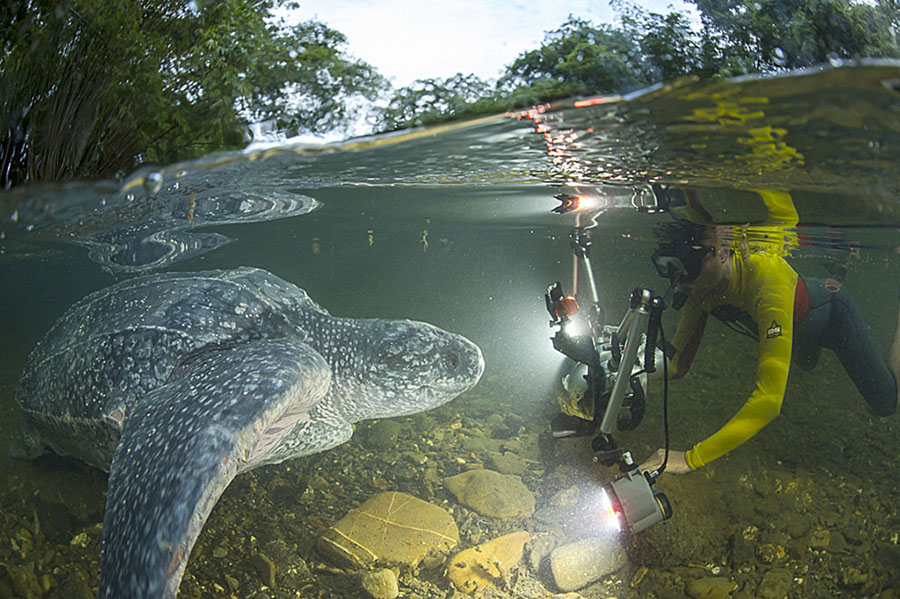
The ocean is Vincent Kneefel’s biggest passion and his mission is to make people fall in love with the oceans. 

The Dutchman became a dive master and PADI instructor at the age of 18 and after seeing the extraordinary creatures and incredible marine life that live in our oceans, he decided to become an underwater photographer and story teller. He has witnessed the impacts of overfishing, pollution, ocean acidification, climate change and habitat destruction on marine life firsthand. He feels strongly that we all need to do something about this situation now, before it’s too late. As his hero, marine biologist and explorer Dr. Sylvia Earle has said, “The next 10 years are probably the most important of the next 10,000 years, so everyone should listen up.”

Kneefel writes about the ocean, conservation and sustainability and photographs his travel and expeditions. We asked him what’s needed to preserve the ocean for future generations.

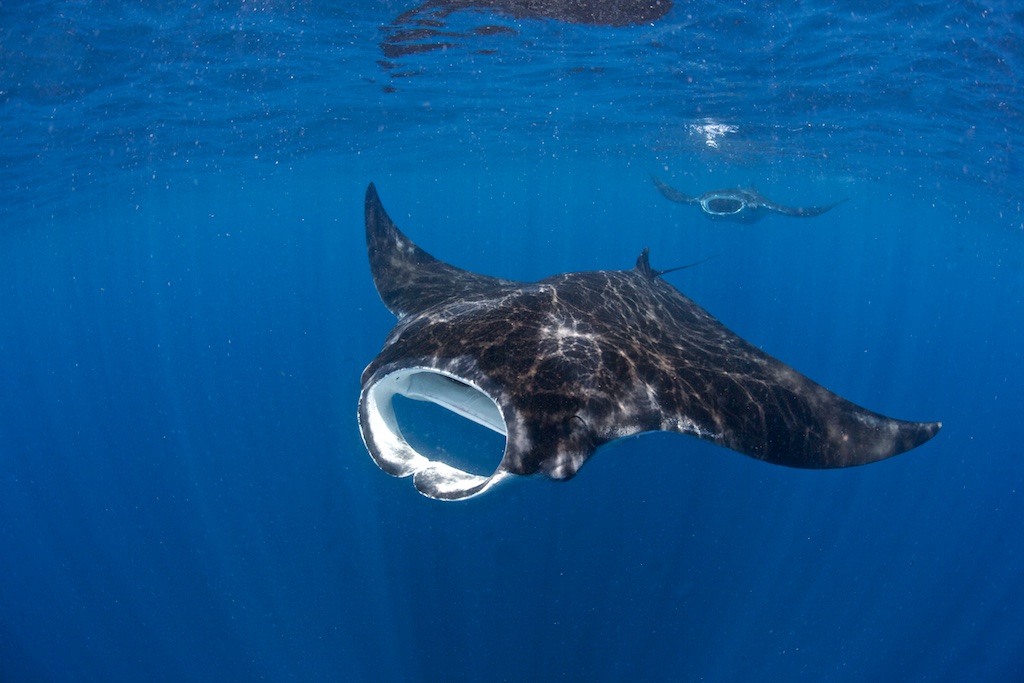
manta rays

What is the most shocking fact you can share about the world’s oceans? 

Although the ocean seems abundant today, it’s only a glimpse of what it once was. Fish stocks have decreased globally by 50% over the past 50 years, and some larger species, such as sharks, tunas and rays, by more than 90%. Before commercial fishing started, the ocean was 10 times as abundant as it is today. The ocean’s ecosystems have been severely impacted by human activity. Unfortunately, it’s hard for our generation to grasp the magnitude and gravity of all of this. We go diving and see a beautiful reef with maybe some sharks and think this was an amazing experience, but we have no idea what the original state of the coral reef was like before humans started over-fishing.

great hammerhead shark

What is the biggest threat to the world’s oceans?

Our ignorance. The ocean is in peril and facing over-fishing, acidification, habitat destruction and pollution. These are creating a perfect storm that could result in a major collapse of ecosystems and species extinction within the next 30 years. Our oceans have been around for millions of years, yet in the last 50 years we have destroyed much of it. We’re presently on course to destroy everything that’s left. Scientists predict that if we continue the current rate of fishing, our oceans could be empty be 2050. With more and more plastic ending up in our ocean, we could have more trash than fish in the ocean one day! All of this has to do with a lack of awareness. We continue to consume fish species which can’t be sustained, we continue to use single-use plastic, we continue to demand cheap products from all over the world that must be shipped across our oceans.

What do you believe needs to be done to protect the world’s oceans? 

Jacques Yves Cousteau once said “People protect what they love.” We can only save the ocean once we actually start caring and wanting to make a personal difference. I’m trying to inspire people to care about the oceans by taking portraits of its amazing inhabitants. My book Giants of the Caribbean is a collection of nine endangered species that each have a story. Through my photography I’m hoping to convince people how important it is to preserve these resources for future generations. We need action on all levels: more conscious decision making and activism, companies reducing their impact and governments to enact strict regulations. Only 3% of the ocean is part of a marine protected area (MPA) and less than 1% is fully protected within marine reserves. We need to create safe zones that are off-bounds for fishing and regulation for areas within international waters. This is where the United Nations can play an important role.

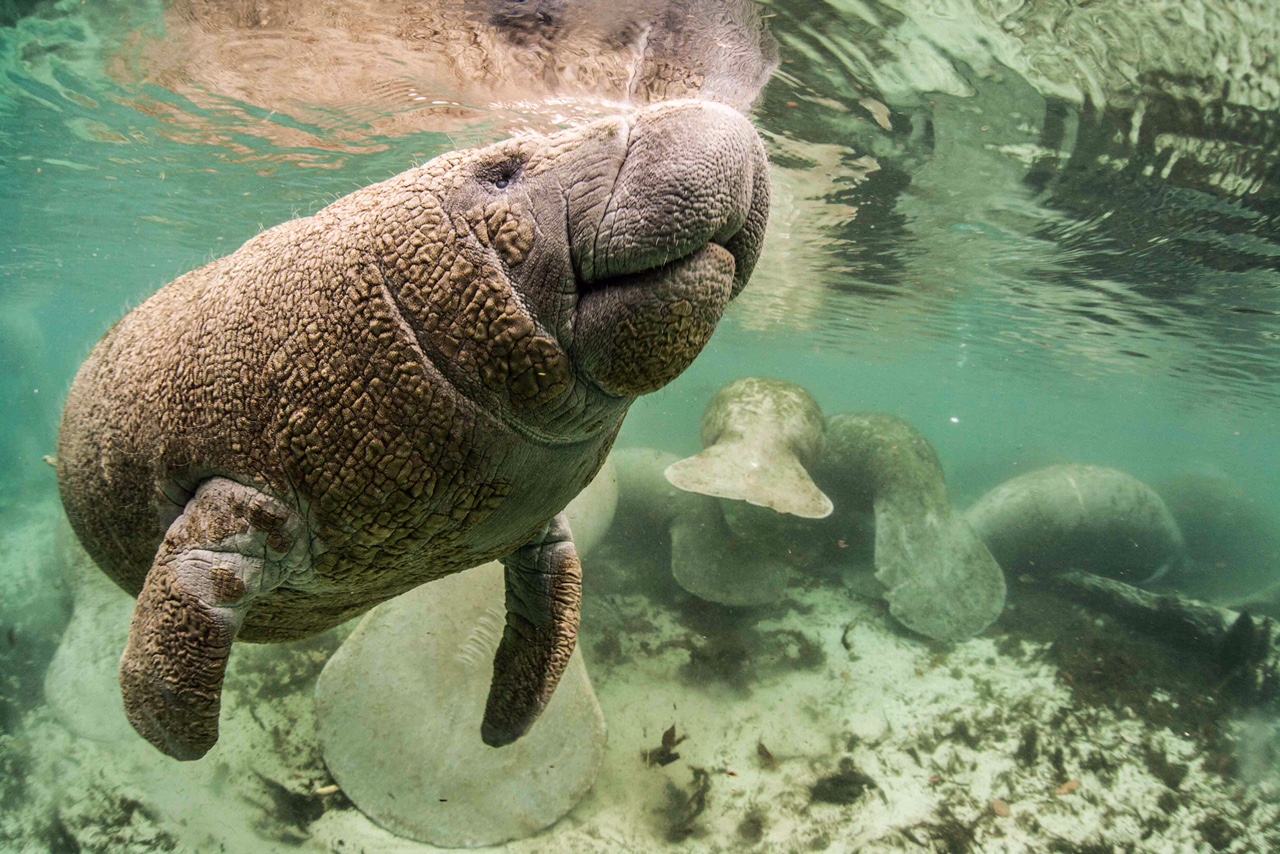
manatees

What advice can you give to young social entrepreneurs aiming to solve a sustainability problem?

Find your passion. Move away from your desk and into the real world. Find which sustainability problem you’d like to solve, think outside the box and think how you can leverage technology, partnerships and new business models to approach the issue from a radical and disruptive angle. A real leader is genuinely passionate about their cause – something that will drive your success. The most successful social entrepreneurs have found solutions with radical new solutions, not incrementally improving on existing solutions. Validate your idea with customers and stakeholders and create a story for yourself that people understand and are inspired by. Be genuine and don’t only do it for the money. You may become rich, but you won’t be successful.

www.vincentkneefel.com


Business Trends: Millennials Rejecting the Default

We all know that Millennials are challenging our traditional work environments. But the big question is “why?” Why are Millennials challenging the system rather than assimilating like earlier generations?

I struggled with finding an explanation other than demographics until I read a sentence written by professor Adam Grant in his recent book: Originals: How Non-Conformists Move the World.

“The hallmark of originality is rejecting the default and exploring whether a better operation exists.” – Adam Grant.

Millennials are rejecting the default and it’s disconcerting, but necessary and in my view, a very good thing. When it comes to the work environment, Generation X, Baby Boomers and the Silent Generation don’t just represent the default … we are the default. This might be why so many of us take this personally. Why are Millennials so eager and able to reject a default that has been in place for generations?

Two reasons: technology and societal shift.

Technology. Millennials are digital natives. They grew up with technology and view everything through a technological filter. They look at our daily lives and think “there’s got to be an app for that.” It’s ingrained in them to use technology to question, dismantle, and reconfigure processes. They are rejecting the default option in search of a better way.

Societal shift. Generation X and Baby Boomers actually know people who worked 40 hours a week for 40 years at the same company, earned that gold watch and retired at 65 to play golf in Florida. We also know of people who had pensions; who were protected by unions; and for whom a single breadwinner could support a family even while working for a minimum wage. This is the default.

But, Millennials are not part of that default. Retire at 65? Not if they are still paying off their college loans. Pensions, funded 401ks, or a home with equity for retirement? Not likely. Even if we set aside monetary limitations, people are living longer. Retiring at 65 is no longer that appealing or feasible for most. The default no longer works, and this is why Millennials are forcing us to re-examine everything about our work culture.

One example of this came out of our recent SVN Millennials Career report (How Commercial Real Estate Firms can Attract and Retain Millennials) around the topic of flexibility in the workplace. According to our survey, flexibility of hours and location for work was a top five “must have” for Millennials and in fact, more men than women cited it as an important factor when choosing companies. This is quite a switch from 5-10 years ago when flexibility was a “woman” or “parent” issue. To even mention the word back then would set you on the Mommy track.

But, what is driving this new quest for flexibility? Part of it goes back to the technology filters. If technology allows us to work wherever and whenever we want, why can’t we? If culturally no one is racing to retirement and the other default rewards don’t exist, why do we have to stick to a 9-5, 5 days per week schedule? Flexibility does not mean Millennials want to work less. In fact, most want to work more, but they also want to work smarter… and to avoid rush hour. When the default is sitting an extra 30 to 60 minutes in traffic, when you don’t actually have to… why do we?

It’s not about a different work ethic. It’s about a different work style.

That’s an important distinction to make; especially because that different work style benefits more than just Millennials. Opening up the flexibility conversation beyond women and parents is a benefit to all employees, whether it’s the single employee who doesn’t have anyone to help them drop off a car for repairs or wait for a furniture delivery; the Gen X’er dealing with aging parents; or the Baby Boomer who wants to take a brief career pause or sabbatical.

If you look around, the default no longer works for the majority of us, and this is why the Millennials’ rejection of the default is a very good thing.

Please visit our SVNICorp YouTube page to see my recent keynote to learn more about the how Millennials are challenging and changing how and where we live and work.


Where the World’s Top Companies Stand On Gender Balance

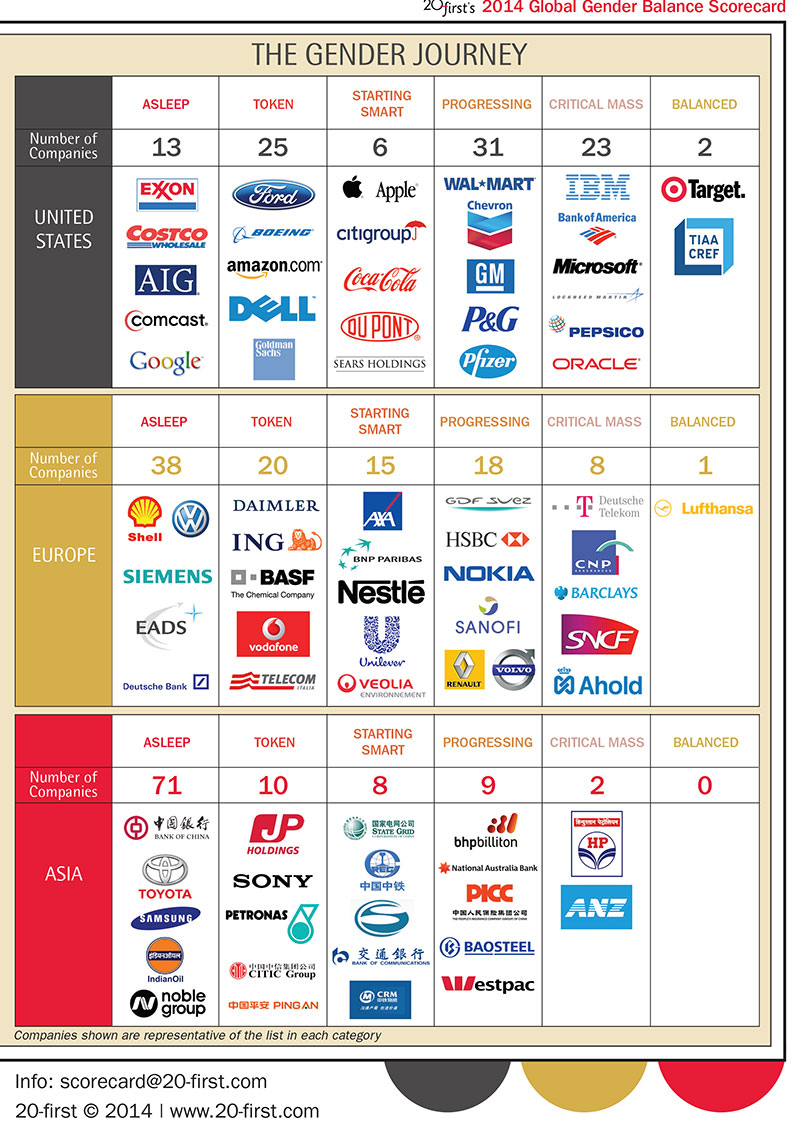
Every year, the 20-first Global Gender Balance Scorecard looks at a single measure of progress: the gender balance of the Executive Committee of the TOP 100 companies in three key regions of the globe.

A growing number of studies show the correlation between gender balance in leadership and improved corporate performance. The complementary skills and styles of men and women have a positive impact on business. Not surprising, when most of the educated talent in the world and a majority of the consumer market is female.

Today, more and more companies are waking up to this 21st century reality and have begun to make gender balance in leadership a strategic priority. Let’s take a look at last year’s scorecard on where the top companies around the world are on their gender journey. The descriptions below explain where companies are in terms of progress.

ASLEEP: Some companies haven’t even started the journey; we put them in our ‘Asleep’ category. These companies are still, in 2014, pictures of imbalance. They are run by an exclusively male team. TOKEN: Less than 15% of both genders on the Executive Team. In this category, the individual(s) is in a staff or support function rather than a line or operational role. STARTING SMART: Next are the ‘Starting Smart’ companies. They also have less than 15% of both genders in the mix, but they are in a central core or operational role, sometime even CEO. PROGRESSING: Reached a minimum of between 15% and 24% of both genders on their top team. CRITICAL MASS: These are companies that have achieved a balance of at least 25% of both genders, but less than 40%. BALANCED: The rare companies that have achieved gender balance, with a minimum 40% of both genders on the Executive Team. This is where balance at the top begins to reflect the reality of 21st century customers, leadership and talent and gives companies the competitive edge to innovate and deliver value sustainably and globally.

gender equality

How a Gender Equality Stamp of Approval Could Impact Business

Gender inequality remains pervasive in the workplace. It’s in every industry and on every level, and the uncomfortable conversation it requires to improve it is too often ignored. But there’s a new movement to do something tangible to address the shift that society needs to make on this issue.

What if, before interacting with a company — whether that’s as a consumer or employee — you could find out what they stand for, including gender parity in the workplace? It’s not a novel idea. Fair-trade certification has been giving a stamp of approval to companies who utilize equitable trade practices for years. Benefit corporations have created a new standard and mark for socially conscious business practices. LEED certifications show companies have exceptional environmental standards.

There may be a new addition to that list: The Economic Dividends for Gender Equality (EDGE) Certification, a global business certification for gender equality, which was announced officially at the World Economic Forum in 2011.

EDGE recently announced a partnership with IFC (part of the World Bank Group), the International Labor Organization, and the UN Global Compact to launch the “She Works” initiative to advance women’s employment in the private sector. EDGE, which is already in 60 companies in 29 countries and across 14 industries, is expecting much more adoption now that it is a global standard. Deloitte and Ikea in Switzerland were among the first companies, and L’Oreal recently announced it was the first US company to achieve certification.

“Gender equality is the right and the smart thing to do,” said Iris Bohnet, director of Harvard’s Women and Public Policy Program. “Often, gender gaps, for example, in hiring or promotion, are the result of unintentional biases that lead employers to base their decisions on stereotypes rather than individual performance, thus hurting productivity and creating inequity. EDGE enables companies to identify and weed out such mistakes.”

In the larger conversation about gender equality in the workplace, women — and men — are demanding that:

  • We examine the fact that men make up the vast majority of founders and executives
  • We refuse to turn our backs on sexual harassment
  • We leave behind the stereotypes of traditional male and female roles
  • We make sure women and men are paid the same amount for the exact same work

Why you should care

Women earned, on average, 78 cents on the dollar that men earned in 2013, according to the US Census Bureau. That wide disparity has essentially remained the same since 2001. The Institute for Women’s Policy Researchestimates it could take until 2056 to reach parity, based on the current trajectory.

One study from Harvard found that as women have more children, their pay suffers more. For men, it’s the opposite. Research over the years (including this recent survey by Fortune) have found that women, when portraying the same characteristics as males, are often called “abrasive,” “bossy,” or given more negative feedback about their personalities, whereas men are seen as confident and motivated.

Nevertheless, the Paycheck Fairness Act — which would make it more difficult for employers to pay women less and make it easier for people to sue on account of that — was blocked in the US Senate earlier this month. Despite the fact that a majority of Senators (52) voted for the measure, it was blocked again because the Senate’s minority Republican leadership used a filibuster, which would have required 60 votes to overcome. It was the fourth time since 2011 that Senate Republicans have organized to block the legislation.

A certification like the type that EDGE has implemented is used in areas where business meets social issues. It’s been successful in cases such as the butterfly logo for GMO-free food and the little bunny for makeup that hasn’t been tested on animals.

With EDGE, Oldin said, this new standard sends a clear signal to top talent in the organization and potential employees.

“It also tells a story to the shareholders, that the company gets it, a story of corporate governance,” she said. “It is no longer cosmetics. It is an authentic sign of commitment.”

EDGE is the first and only certification of its kind, and it took a long time to develop. Through tests over a period of several years, the team came to a final assessment that assesses such things as company practices and policies, company culture, and retention and hiring rates.

An EDGE consultant guides companies through the platform, and then the company is audited by a third party. It measures what the company thinks they do, what their records indicate they actually do (by assessing those policies and frameworks within the organization), and comparable statistics for their business type. They receive results compared to a global standard, and then the company can start to build an action plan with short term and long term goals.

Measuring real change — hiring numbers, retention rates, company testimonials and ratings — takes a while, so EDGE makes sure companies know this is a process, and everyone is starting on a different level. Short term goals may include gender bias and stereotype training, Oldin said. Every two years, the company must get recertified.

“The certification can be the signal the company needs to show that they are authentic in their commitments to gender equality,” said Maria Oldin, managing director of EDGE Foundation. “This is regardless if [it] is a corporation that is already performing very well or if the company is struggling and know they need to do something about it. At least then they are seriously starting the journey to change.”

Five years ago, Oldin added, this was just a thought. Many people questioned the value of it. Now, though, she’s hearing positive feedback from shareholders, consumers, and employees.

About 60 new companies around the world are in talks to start moving forward with the certification process. As for tech giants with the big gender problems? Oldin said EDGE is in discussion with big players in Silicon Valley.

“They know they have to do something. Shareholders and talent and consumers are getting tired of fancy words,” she said.

Moving forward

Progress starts with transparency. More tech companies (and businesses in other industries) are releasing their data about their own gender gaps, some even committing to changing the statistics in years to come.

Yes, some industries have less of a pay gap than others. Well-known Harvard University scholar Claudia Goldin looked at research and broke the wage gap down by industry for the New York Times earlier this year. She wrote in a paper on the subject that occupations that reward employees for long hours, face-to-face communication, and on-call hours such as law, medicine, and business, often have the widest pay gaps.

And research from various sources provides several different statistics — Pew Research, for instance, said that in 2012 women actually made 84% of what men made.

Whatever the percentages, anything less than 100% parity should be unacceptable. In tech (where the pay gap is less than other fields) this presents an opportunity — perhaps the gender gap could be narrowed more quickly as we try to get more women interested in pursuing careers in STEM fields.

Women are making progress, particularly in fields like pharmaceuticals, according to Goldin’s research. But pay gap is not the only issue. Gender equality in the workplace involves better benefits, maternity leave policies, and open conversations about all these issues to make certain that stereotypes, harassment, and biases don’t continue to flourish.

Anti-discrimination laws are important, but they don’t change cultural stereotypes. “Leaning in” is great, but the phrase is now so overused it has lost some of its meaning. Telling women to ask for more money upfront in interviews is worth doing, but it won’t change the bias on the other side of the desk.

It’s heartening to witness women standing up for their rights on social media and in the news — and even more so to see men commit to helping make change happen faster. Because let’s be honest: real change isn’t going to happen unless men take part in the discussion. Since so many companies are run by males, they must participate in the movement for gender equality.

A stamp of approval is no silver bullet, either. But it is another step in the right direction.

This story first appeared in TechRepublic


Millennials and Leadership: What They Really Think

Millennials will form half of the global workforce by 2020 and employee well-being is what they most value in the workplace. The personality traits that Millennials look for in their leaders are strategic thinking at 39%, being inspirational at 37% and strong interpersonal skills at 34% respectively. 59% of Millennial men hope to become the leader of the company they currently work compared to 47% of Millennial women. Check out the infographic below from the Brighton School of Business and Management for more interesting facts:

millennials

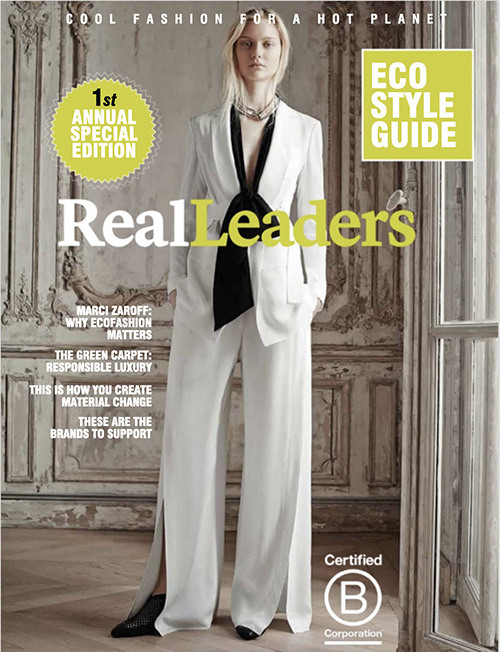
Would you Wear Sustainable Rather than Fashionable?

Why does the creative director of Abercrombie & Fitch insist that their unsold merchandise be burned when not sold? Why does a pair of shoes from Louis Vuitton cost more than your monthly rent? Why do high-end fashion brands not feel the need to sell themselves through television commercials? Simple answer. Elitism, style cultivation and brand recognition.

The three pillars of fashion philosophy in a nutshell. What these three pillars do not take into account, though, is the benefit of recreating what you already have, thereby creating scope to cut down on pricing because production would have cost a little less anyway.

Almost everything we purchase and everything we consume has undergone an extensive industrial process that most likely poses a threat to the environment. We do not always know which products pose more of a threat to the environment, though. It is difficult to not buy clothes at all – everyone needs clothes. Thrift stores have become a saving grace for the environment, but on a very small scale. If we were to think of thrift stores as part of the fashion industrial process it would be that materials and clothing are designed and then manufactured, placed on rails and shelves in the stores, bought by the first-wearer, sold or donated to a thrift store, bought by the second-wearer, who may or may not repeat the process. This process is not often considered by major fashion houses.

Big fashion houses design with a certain target audience in mind and as such align their price tags, marketing and geographical location with that market. We often see that in magazine editorials, Instagram accounts of fashion brands and at fashion events that what is being sold is not the actual apparel, but rather the lifestyle associated with that brand. Thus what ultimately sells the product is the opulent lifestyle envisioned by she/he who purchases the product. Such brands can afford to not reinvent/recreate their image for decades – the aim is very seldom to expand clientele, but rather not to lose their standard, elite market. This is why upcycling (recycling for aesthetic purposes) is a lesser heard of phenomenon in the luxury fashion industry.

We know that the old adage that “fashion goes out of fashion, but style is eternal,” has long been attributed to the pioneer of the women’s power suit, Coco Chanel. What this means is that certain garments are created for the purpose of being classics and not mere seasonal trends much like a whiskey connoisseur who does not buy pricey bottles of whiskey for the sake of getting inebriated off it, but rather to add to their decades’ long collection. This is why vintage Coco Chanel will always have a place in fashion. We see this fashion philosophy in the likes of one of the first luxury brands, Céline, which asserts that they design clothes, not fashion. According to Vogue Italia, this luxury brand has always maintained a simple, elegant, yet practical approach to all their collections.

A prime display of regeneration and recreation is Japanese designer, Issey Miyake. Not only known for his puny fragrance names, but for his simple, yet timeless and technologically advanced clothing collections. 

Issue Miyake is the most apt example of a designer who regenerates fashion to make it reach style classic status. Known for his innovation of permanent pleats and his A-POC (a piece of clothing) method, which entails cutting tubes of fabric into various shapes and sizes and is thus an exploration of the relationship between the body and the fabric. This is the reason his collections remain ogled by the fashion week front row mafia season after season. Miyake serves as testament to the fact that regeneration in the fashion industry is not a display of designers block, but rather a marriage of innovation and sustainability.

International retailer H&M is well-known for its sustainability efforts. Their annual Conscious Actions reports are what they pride themselves in. What this means is that H&M’s primary goals are to create merchandise that goes beyond just being stylish and actually has environmental and financial benefits. H&M CEO, Karl-Johan Perrson, highlights this as a principle of creating a better fashion future. Granted, H&M clientele do not necessarily purchase the clothing on environmentally conscious grounds, but simply for practical and sartorial reasons, but the fact that they have not lost their customers means that their do-gooder aims are being achieved in the long run.

The thing is, several retail outlets use synthetic fibres. Synthetic materials are cheaper to produce, hence retail outlets that sell their merchandise at low prices can afford to do so.

Not only do these synthetic materials pollute the environment, they are also a health hazard – dyeing and printing garments release harmful chemicals in the air which we unknowingly inhale. The textile industry is thus proving to be more detrimental to the environment than most other industrial practices.

The nature of retail outlets can be likened to that of a newsroom, whereas the nature of fashion houses are more like that of a magazine publication house. The former serves the purpose of reporting news as timeously as possible, but with the high possibility that people won’t be still be talking about the same news next month or even next week. The latter serves the mandate of creating something with more lasting aesthetic and informational value, created over a longer period of time.

This is why some people collect copies of Vogue more than others, it depends on what kind of information you value more. Bringing my thoughts back to retail outlets, we see that when they regenerate fashion (for sustainability purposes or otherwise) there is usually customer dissatisfaction, because the principle behind it is misunderstood. When designer regalia is regenerated, it is sartorially understood as fashion philosophy.

We all enjoy the ease at which we can shop at our favourite retail outlets at the mall and what we enjoy more is the fact that when the items we bought go out of fashion the same time next year, it is not that much of a dent to our bank balance anyway. So perhaps what is a little more rewarding about the regeneration of high-end fashion is that by virtue of some of the garments being classics, you do not need to make a purchase every season, therefore deeming the price tag well worth it. Thank you, Issey Miyake for opening our eyes to fashion with a conscious.


Top Tips for Writing Your Résumé

The graphic below shows some of the most common, and frankly unbelievable, mistakes that thousands of job applicants make when writing their CV or résumé. It also covers all the clichés that employers hate to hear when reading your application. Read on to get recommendations that any jobseeker will find highly valuable when compiling a résumé. Remember, first impressions count!Resumes-Get-Them-Right-to-Get-the-Job

Source: Ayer.com.au

Why Gender Balanced Leadership is Good for Business

Kevin Maggiacomo is a man on a mission to create gender-balanced leadership in all organizations worldwide by the year 2020. He will be the first to tell you, however, that this is not exclusively his mission or his initiative.

He kicked off 50/50 by 2020, a grass roots, web-based movement which sprung out of a recent TEDx talk he delivered. It has evolved into an international conscious leadership in expanded areas, including Maggiacomo’s own company, Sperry Van Ness.

Q: What inspired you to create the 5050 By 2020 movement?
A:
 The movement came about after going from the unconscious to a more conscious way of thinking about leadership and its positive effects on business. Within our own organization, Sperry Van Ness (SVN), there existed a disproportionate number of women who were high performers, yet we weren’t bringing any intentionality to recruiting and developing women. There was a pool of talent not being fully tapped into.

How did you incorporate gender balance at your company?
My wake-up call came during one of our SVN executive meetings in 2013. Looking around the conference table I saw that nearly all of our execs were white, male baby boomers. In that meeting we were creating our second wave growth plan, which demanded not only high innovation and creativity, but also healthy debate. I saw the polar opposite. Individual concerns were being set aside for fear of upsetting the group’s balance … sort of a “don’t criticize my ideas and I won’t challenge yours” dynamic. We weren’t getting the job done. This was groupthink at its worst.

It was caused by imbalanced perspective born of a gender-imbalanced executive team. The price was high and obvious. In that moment I recognized that bigger results would follow once I put in place a program which caused our leadership balance to shift.

In the 18 months that followed, we restructured our executive team which is actually now imbalanced at 60 percent women but hitting on all cylinders. We operate as a think tank for new ideas, we aren’t striving for harmony in our meetings, our profitability has increased by more than 100 percent and we’re trending positive across all key performance indicators.

To take things a step further, we restructured our statutory board this past April and it, too, is now gender balanced. Diversity and gender balance are the engines of innovation, and we’re doing everything in our power to ensure that this structure remains in place.

In doing this, we realized that this isn’t just good for our company, but for the world. We wanted to open up the thinking to everyone in order achieve a wider ripple effect, and 5050×2020 was born.

Why do you think it’s important?
First, this isn’t solely about giving back or doing the right thing. The business case for gender balance is rock solid. Our company’s category results aside, in the United States, women hold about 14 percent of executive officer positions and 17 percent of board seats. However, research by Catalyst found Fortune 500 companies with the highest percentage of female corporate officers reported, on average, a 35.1 percent higher return on equity and a 34 percent higher return to shareholders than companies with the lowest percentages of female corporate officers. So this is about generating better results as much as anything.

Second, striving for gender balance — and diversity for that matter — is the right thing to do. In 1970, American women were paid 59 cents for every dollar their male counterparts made. In 2010, compensation for women rose to a mere 77 cents for every dollar men made. And if change continues at the same slow pace as it has for the past 40 plus years, it will take almost another 50 (until 2056) for women to finally reach pay parity. It’s important that we work to change that.

What role do men play in gender diversity?
Men remain an often untapped resource for affecting gender balance. Men simply haveto play a role if we’re to affect meaningful change. There exists a preponderance of men in leadership positions who have the power to make these changes and position their businesses for better financial results. Yet, there aren’t enough male ambassadors for this change.

The gender balance issue, as I see it, has historically been framed as a women’s problem or burden, but it’s not. It’s a problem which affects all stakeholders. It represents an opportunity which, if properly harnessed, will create better leaders, better products and better results for all involved.

Men have to become gender-balance champions for change, and much of their work has to be pointed towards other men who aren’t yet fully on board with the opportunity.

Lastly, men cannot sit idly on the sidelines waiting for change. The change is coming, and those companies that don’t bring a level of intentionality towards affecting gender balance in their own organizations will be relegated to mediocrity at best or obsolescence at worst.

What are the barriers? How realistic is 50/50 by 2020?
It’s naive to think that people will change in six years. However, if you look at past movements in history, meaningful change occurred because there was a vision, an appetite for disruption and a plan to set the course for long-term change. We’ve reached the tipping point where people recognize the need and value.

Not all men will support or even give the movement attention, but I hope those who see the value in having a diverse leadership team will embrace it. The benefits are obvious: It raises value and draws IQ from 100 percent of the population versus 50 percent (of just men). It’s just good for business.

What do you think of some countries’ quotas for women leadership on boards?
Legislated gender quotas are controversial and punitive by design. That route is more of a “checkbox effort” where people are assigned positions because of their anatomical differences. Gender quotas in Scandinavian countries have yielded marked growth in the percentage of women on boards. That said, I’m not certain that these companies are better built given their mandated path to gender balance.

I’m a proponent of the free market affecting change through awareness and a better understanding of the powerful business case for gender balance. Show CEOs the money, and action will follow. I’m a firm believer in that.

What can people — male and female — do?
Evangelize. Talk about the opportunities which gender balance will create. Discuss the movement inside and outside of your organizations, and help people — through all ranks of employment — see that the change will yield a competitive advantage. Focus the conversation more on the benefits as opposed to it being a noble cause. Call it conscious capitalism or growing business at a faster rate while simultaneously elevating humanity … but focus on the fact that gender balance is simply good for business.


0