Refugee Girls, Hoping for More Than Survival, Need Education – Malala

Nobel laureate Malala Yousafzai has called on world leaders to provide education to girls in refugee camps to avoid them being forced into early marriage or child labour.

Yousafzai’s statement comes a week before U.S. President Barack Obama hosts the first U.N. summit on refugees in New York where he is expected to urge leaders to do more to help refugees in countries like Lebanon, Turkey, Jordan and Kenya.

“Why do world leaders waste our time with this pageant of sympathy while they are unwilling to do the one thing that will change the future for millions of children?” Yousafzai said in a statement ahead of the Sept. 20 summit.

She said refugee girls were wondering how long they can stay out of school before they are forced into early marriages or child labour.

“They’re hoping for more than survival” she said. “And they have the potential to help rebuild safe, peaceful, prosperous countries, but they can’t do this without education.”

Fighting in Syria, Afghanistan, Burundi and South Sudan has contributed to a record number of people who were uprooted last year, according to the U.N. refugee agency, which estimates there are 21.3 million refugees worldwide, half of them children.

Almost 80 percent of all refugee adolescents are out of school, with girls making up the majority of those excluded from education, according to a report issued by the Malala Fund, which campaigns and fundraises for educational causes.

It also blamed donor countries for failing to provide adequate funding for secondary education, and failing to deliver on funding pledges made earlier this year.

The report also criticised wealthy donor countries for diverting resources away from host countries in developing regions, such as Turkey and Lebanon, to meet their own domestic refugee costs.

The report concluded by urging donors to commit to providing $2.9 billion by September 2019 to the Education Cannot Wait Fund, a new body to raise finance for the education of refugee children.

Yousafzai, 19, rose to international fame after surviving a 2012 assassination attempt by the Taliban in Pakistan’s Swat valley to continue her fight for girls’ rights.

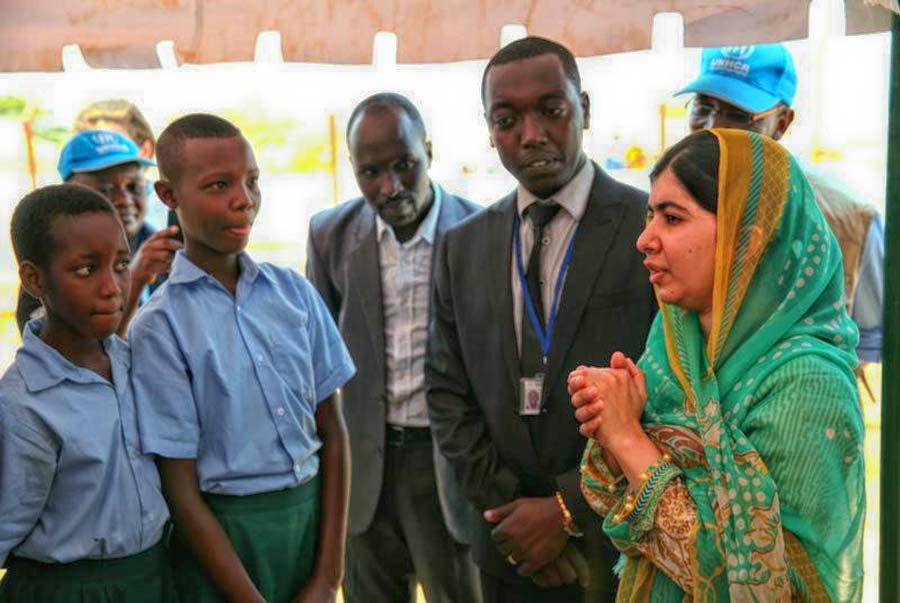
A regular speaker on the global stage, Yousafzai visited refugee camps in Rwanda and Kenya in July to highlight the plight of refugee girls from Burundi and Somalia.

In 2014, Yousafzai became the youngest-ever Nobel Prize winner for her work promoting girls’ education in Pakistan.

By Tom Gardner. Editing by Katie Nguyen. c Thomson Reuters Foundation, the charitable arm of Thomson Reuters, that covers humanitarian news, women’s rights, trafficking, property rights and climate change.


Six Young Leaders Show the way

Young entrepreneurs are creating amazing solutions that are helping to solve everyday problems. Young-preneurs are now inspiring other young people to take up the challenge too. View below how a few young people on Instagram are sharing their solutions for a better and more connected world.


https://www.instagram.com/p/BHxaI8NAJqM/?taken-by=hovding


https://www.instagram.com/p/tDkHQJE1Oz/?tagged=drybath


https://www.instagram.com/p/2RPXQHhx8e/?tagged=volumental


https://www.instagram.com/p/BKiMZsSgJwY/?tagged=sustainablefashion


https://www.instagram.com/p/ua-8_jjdrt/?taken-by=codietherobot


https://www.instagram.com/p/BG1SGrEm9mt/?taken-by=theaudiogram


Refugee Girls, Hoping for More Than Survival, Need Education – Malala

Nobel laureate Malala Yousafzai has called on world leaders to provide education to girls in refugee camps to avoid them being forced into early marriage or child labour.

Yousafzai’s statement comes a week before U.S. President Barack Obama hosts the first U.N. summit on refugees in New York where he is expected to urge leaders to do more to help refugees in countries like Lebanon, Turkey, Jordan and Kenya.

“Why do world leaders waste our time with this pageant of sympathy while they are unwilling to do the one thing that will change the future for millions of children?” Yousafzai said in a statement ahead of the Sept. 20 summit.

She said refugee girls were wondering how long they can stay out of school before they are forced into early marriages or child labour.

“They’re hoping for more than survival” she said. “And they have the potential to help rebuild safe, peaceful, prosperous countries, but they can’t do this without education.”

Fighting in Syria, Afghanistan, Burundi and South Sudan has contributed to a record number of people who were uprooted last year, according to the U.N. refugee agency, which estimates there are 21.3 million refugees worldwide, half of them children.

Almost 80 percent of all refugee adolescents are out of school, with girls making up the majority of those excluded from education, according to a report issued by the Malala Fund, which campaigns and fundraises for educational causes.

It also blamed donor countries for failing to provide adequate funding for secondary education, and failing to deliver on funding pledges made earlier this year.

The report also criticised wealthy donor countries for diverting resources away from host countries in developing regions, such as Turkey and Lebanon, to meet their own domestic refugee costs.

The report concluded by urging donors to commit to providing $2.9 billion by September 2019 to the Education Cannot Wait Fund, a new body to raise finance for the education of refugee children.

Yousafzai, 19, rose to international fame after surviving a 2012 assassination attempt by the Taliban in Pakistan’s Swat valley to continue her fight for girls’ rights.

A regular speaker on the global stage, Yousafzai visited refugee camps in Rwanda and Kenya in July to highlight the plight of refugee girls from Burundi and Somalia.

In 2014, Yousafzai became the youngest-ever Nobel Prize winner for her work promoting girls’ education in Pakistan.

By Tom Gardner. Editing by Katie Nguyen. c Thomson Reuters Foundation, the charitable arm of Thomson Reuters, that covers humanitarian news, women’s rights, trafficking, property rights and climate change.


3 Ways to Build Wealth While Balancing Your Career and Motherhood

It’s mixed news for mothers. Today’s professional women with families have more flexibility than ever before to balance work and caregiving.

Yet across the board women continue to earn, save and invest less than men their age, says Kimberly Palmer, financial expert and author of a new book Smart Mom, Rich Mom: How to Build Wealth While Raising a Family.

Double Punch
This gap in financial well-being between the sexes is due in part to the “motherhood penalty”— the loss of income and career stagnation that affects many female workers who have children. But a lower level of financial literacy among women also plays a large role, argues Palmer: “It takes root at an early age. Studies show that already as children, boys say they feel more comfortable with money and talk more about financial goals with their parents than girls.” It’s no surprise then that, as adults, women report lower levels of confidence when it comes to managing money.

These factors combined mean that women build less wealth over their lifetimes, often with lingering, unfavorable consequences. One recent survey showed that U.S. women over 65 are 80 percent more likely than men to live in poverty. In Europe, the average woman’s pension is worth only 60 percent of that of a man her age.

The anecdote, according to Palmer, is for working mothers to set clear money and life goals, and continue to make progress on them even as they balance the competing priorities of job and family. Here she recommends three ways professional women can become wealthier while managing their career and kids:

1. Make Fair Demands
Palmer argues that working mothers often trick themselves into believing they are not worthy of salary raises, promotions and their share of perks. Women’s lack of confidence with money matters contributes to this, making it uncomfortable for some to ask for what they deserve. But not learning to negotiate for higher salaries and better benefits has a long-term financial impact, she stresses. Research done at the University of Massachusetts revealed that a man’s salary increases six percent for each child he has but a woman’s drops four percent for each child, even if both continue to work full-time.

Women should take full advantage of the benefits offered in the workplace, including flextime, telecommuting options and extended maternity leave, Palmer recommends. They should regularly research salaries to make sure theirs is in line with the market, and, if not, negotiate a fair increase.

2. Maximize Career Satisfaction
Regardless of whether a professional working mother works full-time, part-time or opts for an extended break to care for children, she should stay in a field she finds fulfilling, Palmer urges. Career satisfaction leads mothers to remain in the workforce longer, giving them greater opportunity to build wealth. Many professional women with families take a non-linear career path not only because it provides them more flexibility but it is also a more rewarding way to do the work they love. This might include freelancing, launching side businesses or becoming self-employed. Such options allow them to meet competing demands and even scale back work while not sacrificing earning power long term.

3. Discover The Inner Investor
Palmer encourages mothers to embrace their roles as family money managers. That involves organising financial information in one place, and setting aside time on a quarterly basis to review accounts, file paperwork and make financial decisions. Assuming the lead on long-term investment strategy is equally important, and here women still have a lot of ground to cover. A 2013 Fidelity Investments report noted that only 19 percent of married women in the U.S. have primary responsibility for retirement decisions.

While mothers tend to prioritise their children’s financial needs over their own, Palmer advises against it: “with money, women really have to put themselves first.” Given the choice between saving for her retirement versus saving for a child’s university costs, a mother should save for her retirement since there is no other way to pay for it.

Although she makes clear that a working mother at any age or professional stage can learn to be smart about money, Palmer underscores that a wealth-building attitude ideally begins long before she has a baby. Young women need to become confident money and investment managers now and pass the torch on to their daughters.

Kate Rodriguez – career development and higher education marketing for The Economist Careers Network


Women: Don’t Try and Find Your Power in the Games of Men

In February of 2012 I sat under an almond tree and watched a sunset over Madrid. An idea came to me: to start a foundation to help people “Embrace The Wild.” I worked on building a foundation for a year, but it never really took off. Embracing the Wild, on the other hand, has become my life mission.

One of the biggest obstacles I’ve encountered these past four years is the negative, pejorative and fearful images our society has attached to words like wild, animal, beast, brutal, and savage. All these words are used to depict bad things, excessive people and terrible acts of violence. To the point that I now see a clear connection between humanity’s incarceration of everything wild and a parallel movement to subdue women and strip us of everything that makes us truly feminine.

Civilization has destroyed women’s strength at its roots by erasing the wild from our lives. Impulse, instinct, attraction, sensation, emotion and feeling ARE the wild within us.

Women were always exceptionally good with emotion, uncertainty and cycles. While men are physically stronger, women can express and contain intense emotion at greater levels. There is something about a woman’s body and its chaos of hormones that make her love connection, seek emotion, thrive in darkness and manage several layers of information through feeling. The body of a woman dances with death at every pregnancy and birth. Humanity’s first Gods were female. Our first shamans were women. Women led our tribes through unpredictable nature because we instinctively tuned in to the same patterns, mechanisms and rhythms followed by everything wild. Until our tribes were killed, conquered, subdued and civilized.

Four years later my advances are still discrete. It may seem like I’m wasting my time to many of today’s speed-crazed global citizens. My family certainly thinks so! But this is a first critical lesson of the wild: it moves slowly. Every rapid reaction we see in nature has been building energy for a very long time. This is true for a “sudden” earthquake or a volcanic eruption, but also for a lion lunging for its prey. Hours of careful observation go into choosing the most effective time. And who knows how long energy builds up inside a volcano before it finally explodes?

When I look back at the profound things that take place in the back of peoples’ minds before we see a tangible change, I recognize this same pattern. Many businesses require years of hard work, trial and error and many expensive losses before it takes off. Couples often take several years to finally admit that their relationship is over. Most people need decades to become aware of what they really wanted to pursue all along, buried under the clutter and noise of everyday work.

So the first step to #EmbraceTheWild is about slowing down. The second step is to face, and give in, to our own emotions. Our emotions are like that underwater section of an iceberg. We occupy that part above the water. We know perfectly well what it looks like.

Our awareness walks around our own little ice island every day. We know very little of what sits in darkness below the water. When somebody asks how we feel, we can only connect to a very small, superficial part of what we actually feel. There’s plenty more, frozen below, waiting to come to the surface. It’s called our unconscious, and it’s so wild that everybody fears it, cages it, denies it, tries to escape from it.

Freud pioneered the first discovery mission of this unknown wilderness of the human soul. Psychology has thoroughly analysed our mysterious, underwater darkness, that we call our unconscious. But nobody dares plunge into the water. It’s safer to talk, label and discuss emotions from the safety of our minds, couches, and scientific studies. As long as our brain is analyzing emotion, we are still fighting it and subduing it. It is only when we stop talking, thinking, fixing, analyzing and planning; only when we actually breathe deep in silence to relax our muscles and give in, that our hidden emotions defrost. They become liquid, they move around our body as sensations, we finally feel them.

The wild moves like water. The energy of our wildest essence timidly appears to us when we get comfortable with it. Like a wild animal, that’s been held behind bars for too long, it tests our intentions, before letting us in on its secrets: our childhoods, our parents, our family histories and our destinies. Like a virginal bride, our unconscious unveils itself in a slow ritual of deception, with complicit giggles and brave, tremoring revelations. Emotional rhythms are playful in their spontaneous chaos: ripples of calm transform into colorful storms of tears, small whimpers give way to full blown growls or screams. The wild has no linear order. It’s all curvy, cyclic, full of surprise, changing beats and provocations. It’s what we’ve always labelled as “feminine.” – to its deepest, most essential core.

When we understand our own wild unconscious, we learn how to interact seamlessly with animals, plants and the Earth. We no longer try to control uncertainty. Rather, we learn to ride it, like a magnificent, yet moody and demanding, stallion. Here lies the source of women’s power. In our intrinsic ability to seduce and befriend the wildest, most unpredictable horse of them all.

I was born in a generation of domesticated women who try and find their power in the games of men.

I was educated in a culture of liberation that pushed me to study engineering and to strive for a top job at a multinational. For decades I honed my talents and perfected my skills. Only to find that men would always be better at men’s power games than me. I realized a cold, hard fact: their games bored me anyway.

Every day I am more convinced that my strength, my influence and my ability to lead the world lies not in my mind and the strategies I devise, but in my heart, and the emotions it can contain. It’s taken a lifetime to uproot and erase all the ideas and disciplines in today’s mindset that condemn and insult everything wild or truly, deeply feminine. I’m done with this ridiculous game of pushing me to be more linear, predictable and competitive.

I’ve embraced the wild. It’s made me more powerful than I ever was, in a soft, mischievous and selfless, loving way. It gave me back my womanhood. For once and for all. Do you #EmbraceTheWild?

 

Women: Don’t Try and Find Your Power in the Games of Men

In February of 2012 I sat under an almond tree and watched a sunset over Madrid. An idea came to me: to start a foundation to help people “Embrace The Wild.” I worked on building a foundation for a year, but it never really took off. Embracing the Wild, on the other hand, has become my life mission.

One of the biggest obstacles I’ve encountered these past four years is the negative, pejorative and fearful images our society has attached to words like wild, animal, beast, brutal, and savage. All these words are used to depict bad things, excessive people and terrible acts of violence. To the point that I now see a clear connection between humanity’s incarceration of everything wild and a parallel movement to subdue women and strip us of everything that makes us truly feminine.

Civilization has destroyed women’s strength at its roots by erasing the wild from our lives. Impulse, instinct, attraction, sensation, emotion and feeling ARE the wild within us.

Women were always exceptionally good with emotion, uncertainty and cycles. While men are physically stronger, women can express and contain intense emotion at greater levels. There is something about a woman’s body and its chaos of hormones that make her love connection, seek emotion, thrive in darkness and manage several layers of information through feeling. The body of a woman dances with death at every pregnancy and birth. Humanity’s first Gods were female. Our first shamans were women. Women led our tribes through unpredictable nature because we instinctively tuned in to the same patterns, mechanisms and rhythms followed by everything wild. Until our tribes were killed, conquered, subdued and civilized.

Four years later my advances are still discrete. It may seem like I’m wasting my time to many of today’s speed-crazed global citizens. My family certainly thinks so! But this is a first critical lesson of the wild: it moves slowly. Every rapid reaction we see in nature has been building energy for a very long time. This is true for a “sudden” earthquake or a volcanic eruption, but also for a lion lunging for its prey. Hours of careful observation go into choosing the most effective time. And who knows how long energy builds up inside a volcano before it finally explodes?

When I look back at the profound things that take place in the back of peoples’ minds before we see a tangible change, I recognize this same pattern. Many businesses require years of hard work, trial and error and many expensive losses before it takes off. Couples often take several years to finally admit that their relationship is over. Most people need decades to become aware of what they really wanted to pursue all along, buried under the clutter and noise of everyday work.

So the first step to #EmbraceTheWild is about slowing down. The second step is to face, and give in, to our own emotions. Our emotions are like that underwater section of an iceberg. We occupy that part above the water. We know perfectly well what it looks like.

Our awareness walks around our own little ice island every day. We know very little of what sits in darkness below the water. When somebody asks how we feel, we can only connect to a very small, superficial part of what we actually feel. There’s plenty more, frozen below, waiting to come to the surface. It’s called our unconscious, and it’s so wild that everybody fears it, cages it, denies it, tries to escape from it.

Freud pioneered the first discovery mission of this unknown wilderness of the human soul. Psychology has thoroughly analysed our mysterious, underwater darkness, that we call our unconscious. But nobody dares plunge into the water. It’s safer to talk, label and discuss emotions from the safety of our minds, couches, and scientific studies. As long as our brain is analyzing emotion, we are still fighting it and subduing it. It is only when we stop talking, thinking, fixing, analyzing and planning; only when we actually breathe deep in silence to relax our muscles and give in, that our hidden emotions defrost. They become liquid, they move around our body as sensations, we finally feel them.

The wild moves like water. The energy of our wildest essence timidly appears to us when we get comfortable with it. Like a wild animal, that’s been held behind bars for too long, it tests our intentions, before letting us in on its secrets: our childhoods, our parents, our family histories and our destinies. Like a virginal bride, our unconscious unveils itself in a slow ritual of deception, with complicit giggles and brave, tremoring revelations. Emotional rhythms are playful in their spontaneous chaos: ripples of calm transform into colorful storms of tears, small whimpers give way to full blown growls or screams. The wild has no linear order. It’s all curvy, cyclic, full of surprise, changing beats and provocations. It’s what we’ve always labelled as “feminine.” – to its deepest, most essential core.

When we understand our own wild unconscious, we learn how to interact seamlessly with animals, plants and the Earth. We no longer try to control uncertainty. Rather, we learn to ride it, like a magnificent, yet moody and demanding, stallion. Here lies the source of women’s power. In our intrinsic ability to seduce and befriend the wildest, most unpredictable horse of them all.

I was born in a generation of domesticated women who try and find their power in the games of men.

I was educated in a culture of liberation that pushed me to study engineering and to strive for a top job at a multinational. For decades I honed my talents and perfected my skills. Only to find that men would always be better at men’s power games than me. I realized a cold, hard fact: their games bored me anyway.

Every day I am more convinced that my strength, my influence and my ability to lead the world lies not in my mind and the strategies I devise, but in my heart, and the emotions it can contain. It’s taken a lifetime to uproot and erase all the ideas and disciplines in today’s mindset that condemn and insult everything wild or truly, deeply feminine. I’m done with this ridiculous game of pushing me to be more linear, predictable and competitive.

I’ve embraced the wild. It’s made me more powerful than I ever was, in a soft, mischievous and selfless, loving way. It gave me back my womanhood. For once and for all. Do you #EmbraceTheWild?


Ethics is Not The Reason we Need More Women on Boards

There are many good reasons for increasing gender diversity on boards: better decisions, better performance, and better representation of the consumer base.

But the idea, put forward in a variety of research over the past twenty years or so, that women on boards improve the moral and ethical decision-making of those boards has a number of problems for both women and men, in the boardroom and out of it.

First, having gender equality on the board is increasingly part of corporate social responsibility initiatives. Rather than ethical standards improving when women are on boards, it may be that organisations with a corporate social responsibility focus create a climate of gender equality. This may mean their boards include more women simply because corporate social responsibility and equality are related concepts.

Second, the idea that women will set improved standards of moral and ethical behaviour for boards is based on the (faulty) assumption that when boards are made up of only men they will be morally and ethically lax. Surely that is a sexist view of men, based on notions of men as irresponsible risk-takers?

Third, it places the burden of responsibility on women to make sure that boys on boards don’t behave badly. Surely that is a sexist view of women, based on the idea that a mother will be the moral and ethical compass for a family unit?

WOMEN ON AUSTRALIAN BOARDS

Australia – like most other countries in the world – has a distinct lack of women on its corporate boards: just 17.6% of ASX 200 directors and only 5% of ASX 200 chairs are women, according to the Australian Institute of Company Directors. Australia’s Gender Equality Scorecard shows that in Australian organisations with 100 or more employees, 23.7% of directorships and 12% of chairs are held by women. More worryingly, only 8.8% have set targets to increase gender diversity on the board, yet 48.5% of employees in these organisations are women.

Researchers (and others) have consistently noted that this poor representation of women at board level is a problem and have sought to convince male-dominated boards to make room for women. In looking for evidence to support their arguments, some research linked women on boards with “…a strong moral overtone…”, with increased corporate social responsibility and with less unethical behaviour. Other research found the more women directors it had, the more likely a company was to appear on lists such as “The world’s most ethical companies”. And so over time women have come to be seen as the ethical “saviours” of boards.

Considered in the light of ambivalent sexism theory, this suggests that women might be allowed to join the – predominantly male – boardroom club provided they do so as nurturing, caring, peacemaking, ethical gatekeepers. In other words, boards might be convinced to accept women so long as those women conform to traditional ideas of feminine behaviour. I wonder what would happen if women turned out to be ineffective as ethical watchdogs in the boardroom?

DIVERSITY BENEFITS BOARDS

Putting aside the faintly fishy idea of women on boards as ethical gatekeepers and men on boards as lacking in ethical and moral principles, what are some of the valid and non-sexist reasons for taking steps to increase the gender diversity on boards of directors? Here are a few:

Diverse groups of people bring a greater variety of experience and different views to the decision-making process and then make better decisions

Gender diversity on boards helps to ensure that the entire consumer base is represented. This is particularly important because women now control the bulk of household spending globally, according to the World Economic Forum

Financial performance is better in companies that have gender diversity on the board. When women are included on executive committees, average return on equity improves by 47% and average earnings before interest and tax improve by 55%

Diversity in the membership of groups making investment decisions may lead to more social responsibility in decision-making around fossil fuel divestment.

Personally, I constantly wonder why we need to justify to the world that 50% of the adult population should have equal access to the same opportunities as the other 50%. It seems the argument that women should hold 50% of board positions because they comprise 50% of the population is not good enough.

There are many good arguments for ensuring there are more women on boards. That women have the moral and ethical high ground over men and will therefore be ethical gatekeepers on boards is possibly not a very valid justification and one that should not be given too much airspace.

This article was originally featured at www.womensagenda.com.au

Bricks with Benefits

A new way to introduce you to sustainablity. Meet Mwayanjaya Bolokonya From Malawi: an environmentally friendly, brick-making entrepreneur whose products only use one-tenth of the energy that normal bricks require.

Building a village takes one brick at a time, and EcoBuild is setting out to build a better brick for Malawi homes. Bolokonya says the way they do this is through kilns that “use one-tenth of the energy of traditional kilns.”

EcoBuild claims their products lower construction costs while providing quality construction and are eco-friendly with lower carbon and particle emissions than standard Malawi products.


15 Cringeworthy Minutes With Mom That Could Save Your Career

It’s natural to want to be liked. People who say they don’t care what other people think are generally lying. And that’s good because people who really don’t care are sociopaths. 

But people who care about the feelings of others have a difficult time managing performance.  We tend to put the warmth of our relationships higher than the strength of performance. In business, this orientation is career limiting. In life it is simply frustrating. All too often we find ourselves tolerating the intolerable.

I was marinating in these thoughts yesterday afternoon after I left the office of a star client who is a recent graduate of the Leadership S.P.A.  I was struck by a story told to me by my client’s female boss about coaching her daughter into college. Last year she found herself nagging her senior in high school to schedule her SAT test, finish her applications, write her essays, meet with alumni and all the other crazy things that are required to get into a desired university. (Hell, the process itself is so difficult anyone who completes it ought to be admitted!)

Well, she of course discovered what everyone discovers about conventional nagging. The more you invest in nagging, the greater the negative returns in your relationship. You might temporarily get what you want but the person you’re nagging will avoid you the way Superman runs from kryptonite. Being a SMART leader she came up with a way to save her relationship and still be a performance coach to her daughter.

She told me that she and her daughter agreed that between 7:30 and 7:45 PM every Monday night would be “college catch-up.” For those 15 minutes mom could go over her checklist, ask difficult questions, make suggestions, and propose offers of help. She said this caused her to be very well prepared and the result was total success. Her daughter was accepted at a desired college and their mother-daughter relationship was actually strengthened.

I call this “positive nagging.”  It is an essential strategy for an empathetic person who needs to lead others and coach performance. It is based on three specific elements.

1. Positive Intention. Brain science has proved that human beings and higher mammals give off brain vibes. That’s right, vibology is really a science.  Of course it doesn’t go by that name.  It falls under the new science of consciousness studies. Neuro-scientists now have ways of measuring the subtle biological changes of people who are the subject of the concentrated thoughts of others. Changes in brain waves, skin sensitivity, micro sweat, pupil dilation are all examples of what scientist can now observe when people feel the thoughts and intentions of others with words being spoken. The great psychologist Carl Rogers encouraged people to improve their relationships by holding the other person in what he called “unconditional positive regard.”  This doesn’t mean that you approve of everything that other person is doing.

It simply means that you actively focus on wishing for the health, well-being, happiness and success of the people you are tempted to nag.  I know that sounds obvious, after all we nag people because we care about them. So holding a positive intention for them should be easy. What’s hard is to give people we depend on and work with the room to find “their own best way” to succeed. It’s wise to remember that everyone’s success style varies. The fundamentals of success include goal setting, commitment, disciplined effort, responding to feedback, adaptation and grit. But the “way” people employ those fundamentals are as different as their fingerprints. So our coaching challenge is to keep the people we are tempted to nag focused on the goal while they feel your advocacy but not your control or micromanagement.

2. Set up an agreed time to offer feedback. Google’s analytical study of effective coaching found that the best interval for formal feedback is weekly. People who are trying to achieve goals actually want weekly feedback. Formalizing the time and process is helpful because you set the psychological context that enables you to be frank and candid (strong) without damaging the relationship. This is the key difference between nagging and coaching. Nagging feels like constant judgment. It is emotionally exhausting and creates defensiveness, excuse making and passive-aggressive defensive maneuvers. When you establish a formal time to discuss commitments and performance it also allows you to be a warm advocate outside the formal feedback time without compromising your authority and ability to drive performance.

3. Studies of effective feedback have concluded the most effective coaching is the result “high contrast feedback.”  That means you contrast positive behaviors and outcomes with negative behaviors and outcomes.  At work it might sound like this. “Today when you were on time for our work session everyone really appreciated it. You set a very powerful, positive tone and your promptness communicates that you value everybody else’s time. You’re so important to these sessions that we really can’t start without you. One thing that isn’t working is you leaving the meeting to take phone calls. We really need your full participation and everything stops when you leave the room. So can I count on you to be on time and fully focused?” High contrast feedback is based on the principle of telling people what you do want and what you don’t want. You can state it as “What really makes a positive difference is… And what doesn’t work for me is…”  I have personally coached scores of leaders to use the phrase, “This isn’t working for me and I need to talk to you about it. . . ” as a way to get into a difficult conversation where contrast feedback can be very effective.

The old-school method of the feedback sandwich has been debunked by research. The sandwich method is to say something positive, then deliver the real feedback and then say something positive. The problem is that often the positive messages are irrelevant. It doesn’t work to say, “That’s a good-looking shirt, by the way your presentation stunk but at least you have shiny shoes.” The power of high-contrast feedback comes from clearly describing demonstrated behaviors that are positive and demonstrated behaviors that are negative. If this feedback is delivered with a positive intention and advocacy for growth a psychologically healthy human should welcome it.

Of course some people just refuse to listen to or accept constructive feedback of any kind.You cannot take responsibility for the negative emotional response of respectfully delivered feedback. If you do, other people’s dysfunctional emotions will control your life and destroy your effectiveness as a leader.

You can be both strong and warm. That’s what great leaders are. It is at the core of SMART Power leadership. It is a universal tool for effectiveness.

It can even help your kids get into college!


0