Tan Le: Co-founder of Emotiv

Tan Le is a Vietnamese-Australian telecommunications entrepreneur who co-founded brain monitoring company Emotiv.

Born in South Vietnam, Le migrated to Australia as a refugee with her family in 1982. She began university studies at the age of 16 and completed a bachelor’s degree in law and commerce at Monash University.

Her first venture was SASme, a pioneer in providing SMPP platforms to telecommunication carriers and content aggregators, that became one of the companies responsible for the creation of Australia’s SMS application market. Le helped grow SASme to 35 employees and multiple locations worldwide.

Le co-founded software company Emotiv which specializes in electroencephalography (EEG) headsets. Emotiv is the pioneer of simple to use, high quality, mobile headsets that do advanced brain monitoring. In 1998, she was named Young Australian of the Year and voted one of Australia’s 30 Most Successful Women Under 30.

She has been appointed Special Ambassador to the United Kingdom, a Goodwill Ambassador for Australia in Asia, and a Patron of the Australian Youth Ambassadors for Development Program. A role model for women in business, Le was made an Ambassador for the Status of Women in 2001 and been appointed to a number of prominent boards, including Plan International Australia, National Committee for Human Rights Education in Australia, Australian Citizenship Council and RMIT Business in Entrepreneurship.

Le has been featured in “Who’s Who in Australia” List since 1999 and “Who’s Who of Australian Women” List in 2007 & 2008, Fast Company’s Most Influential Women in Technology in 2010 and Forbes’ 50 Names You Need to Know in 2011. She has also been honored by the World Economic Forum as a Young Global Leader since 2009.


Making The World Better For Women: From Respect to Ending Macho Violence

Celebrations and protests on Wednesday to mark International Women’s Day highlighted both progress and challenges in every part of the world, amid growing concern that women’s rights are being rolled back.

The origin of the global event dates to 1908 when women protested in various countries against working conditions, discrimination and being unable to vote or hold public office.

The 1945 United Nations charter was the first global agreement to affirm the principle of equality between women and men, and in 1975 the U.N. declared March 8 as International Women’s Day.

But while the day is meant to celebrate social, economic, cultural and political achievements of women, the 2017 event comes just weeks after millions of women marched around the world amid fears that progress is being eroded.

Against this backdrop, the Thomson Reuters Foundation asked various experts and campaigners what one thing would make the world better for women:

PHUMZILE MLAMBO-NGCUKA – Executive Director, UN Women

– “I would have to say the issue of challenging the stereotypes and the norms that we live with everyday in our families, in our work, in our schools that teach women differently. When it comes to gender inequality, women are still discriminated against and sexism is still well and alive with impunity. The threshold of tolerance for such things is just too high in society, especially by the leaders who do not demonstrate zero tolerance for gender inequality.”

CHELSEA CLINTON – Vice chair, Clinton Foundation

– “We know what gets measured gets managed. Tackling gender data gaps is crucial for ensuring every girl has every opportunity to lead a safe, healthy life full of opportunity. That’s good for girls and boys too – we know what when girls are empowered, societies thrive. Through the Clinton Foundation’s Full Participation Report, we learned that while girls and women have made significant strides, gaps in progress persist, in every country. We need to act on data and information that we know is accurate to know where to channel our energies and investments to close the gaps that exist as quickly as possible, for every girl everywhere and for our shared future.”

JAYNA ZWEIMAN – Co-Founder, Pussyhat Project

– “Respect for women’s bodies and respect for women as not just bodies. Using women’s health, safety and independence as tools for political power must stop. Women must make their own decisions, and that demands systemic freedom, trust and opportunity. Only then will women be able to participate fully and loudly as valued equals, regardless of age, race, sexual orientation, gender expression, religion, class, immigration status and disability.”

ROBIN MORGAN – author, former editor-in-chief of Ms. Magazine and founder of Sisterhood is Global Institute

– “Issues are so interconnected it’s difficult to pick one panacea. I’m tempted to choose full reproductive rights. But that would come about organically with the following, which I choose: The one thing that would make the world better for women (and men, children, indeed all life on the planet), is women holding full political leadership power in every country.”

ADA COLAU – First female mayor of Barcelona, social activist

– “A world without machismo. We have to reduce macho violence because in reality, it is the most serious structural violence we have, murdering women month after month… The big challenge is to make this a policy priority for states, and put in place programs – not just to support the victims but also to promote prevention and education, to change this systemic macho violence which has killed thousands of women around the world.”

MARIANA KATZAROVA – Founder of Reach All Women in WAR

– “Including women’s voices in peace talks is critical. Women are over half of the global population – 80 percent of survivors of armed conflict are women but they rarely get the chance to have a seat at the table and contribute to the peace process. Those who began the conflict in the first place are later in charge of making and building peace, with the majority of the population and survivors being excluded from the peace process. This is often the reason why peace is not achieved in any of the current armed conflicts around the world.”

By Ellen Wulfhorst. Additional reporting by Belinda Goldsmith and Megan Rowling. Editing by Ros Russell. c Thomson Reuters Foundation.


Why Governments Need Advice From Scientists

Late last year I attended to the 2nd International Network for Government Science Advice Conference, themed: “Science and Policy-Making: Towards a New Dialogue.” It was an exciting event for any early career researcher.

Held from 29-30 September 2016 in Brussels it was co-organized by the International Network for Government Science Advice (INGSA) and the European Commission.

As a scientist who is interested in science and technology policy I have realized that my scientific expertise and hands-on experience has the potential to change the status quo through science- and evidence-based approaches. 

Scientific advice to governments (or policy makers) is not a new field but does lack concrete definitions and taxonomy. The field is not yet regulated, and the purpose of this meeting was to regulate it and develop unified guidelines for science advisors around the world. The fact that science advising is not yet fully developed as a discipline (and can be considered a pristine field) is good for young scientists, and we have the ability to influence and shape its future.

I’m passionate about science and technology policy, and this meeting was an eye-opener for me. One of my biggest realizations was that prominent scientists and technology experts join governments to serve as science advisors, then transform into politicians and become part of a political agenda. They are no longer scientists in the traditional sense. From that point onwards their advice is not necessarily science-based, and in many cases tend to become political. Because the role of a scientific advisor is unregulated, the opportunity and temptation to go against scientific integrity is easy. 

Some interesting points were made over the two days. Carlos Moedas, European Commissioner for Research, Science and Innovation, stated: “People will only accept the answers if they understand the process,” and that, “We need to increase public trust in science, we must go further and explain the evidence base.” He also called for more transparency: “We have to increase the transparency of scientific advice.

His statements made it clear that there are issues within the current system that need to be properly assessed.

Sir Peter Gluckman, Chair of INGSA and Chief Science Advisor to the Prime Minister of New Zealand, emphasized that: “Science advice is not a two-way conversation: it involves scientists, politicians, and society.” He also said that “Politics is messy, the science-policy interface even more! Pretending otherwise is deceptive,” and that “Achieving the Sustainable Development Goals will require a more evidence-informed approach to policymaking.” Gluckman wishes to see a push for regulation in this field, especially on the political side of things.

HRH Princess Sumaya bint El Hassan, President of the Royal Scientific Society of Jordan and Chair of the World Science Forum 2017, believes that: “Diplomatic skills (between science and policy) are essential for effective evidence brokerage.” She also said that scientists and science advisors interested in influencing policymaking must also be diplomats.

Flavia Schlegel, UNESCO Assistant Director-General for the Natural Sciences, reminded the audience that: “Scientific advice does not happen in a vacuum, it exists and works in a very complicated ecosystem”.

It’s certainly an exciting time for young scientists and policy entrepreneurs to become involved in addressing policy issues. We need to take our knowledge and expertise in this field and assist governments in formulating policies that help create a better world through science.


UK’s First LGBT Retirement Community Set to Open in Manchester

The northern British city of Manchester has announced it is to open the country’s first retirement community for lesbian, gay, bisexual and transgender (LGBT) people.

There are more than 7,000 LGBT people over the age of 50 in Manchester and the number is expected to increase, the council said in a statement.

The project aims to meet a need for assisted accommodation for older LGBT people where they can be open about their identity, it said.

“Prejudice and discrimination can be a real problem facing older LGBT people,” Bev Craig, Manchester City Council’s lead member for LGBT women, said in a statement.

“People shouldn’t have to face the prospect as they get older of being surrounded by people who may not accept their sexuality or gender identity.”

The development will offer apartments to rent or buy for people aged 55 plus and will have a 24-hour care team on site. Just over half the accommodation will be reserved for LGBT people, but other residents are also welcome.

According to research by the Manchester-based charity LGBT Foundation, more than half of lesbian, gay and bisexual people in this age group fear isolation in their older life because of their sexual orientation.

Manchester will join a growing number of cities around the world offering retirement accommodation for LGBT people. Similar developments have opened in Sweden, the United States and Canada.

By Magdalena Mis. Editing by Emma Batha. c Thomson Reuters Foundation.


UK’s First LGBT Retirement Community Set to Open in Manchester

The northern British city of Manchester has announced it is to open the country’s first retirement community for lesbian, gay, bisexual and transgender (LGBT) people.

There are more than 7,000 LGBT people over the age of 50 in Manchester and the number is expected to increase, the council said in a statement.

The project aims to meet a need for assisted accommodation for older LGBT people where they can be open about their identity, it said.

“Prejudice and discrimination can be a real problem facing older LGBT people,” Bev Craig, Manchester City Council’s lead member for LGBT women, said in a statement.

“People shouldn’t have to face the prospect as they get older of being surrounded by people who may not accept their sexuality or gender identity.”

The development will offer apartments to rent or buy for people aged 55 plus and will have a 24-hour care team on site. Just over half the accommodation will be reserved for LGBT people, but other residents are also welcome.

According to research by the Manchester-based charity LGBT Foundation, more than half of lesbian, gay and bisexual people in this age group fear isolation in their older life because of their sexual orientation.

Manchester will join a growing number of cities around the world offering retirement accommodation for LGBT people. Similar developments have opened in Sweden, the United States and Canada.

By Magdalena Mis. Editing by Emma Batha. c Thomson Reuters Foundation.


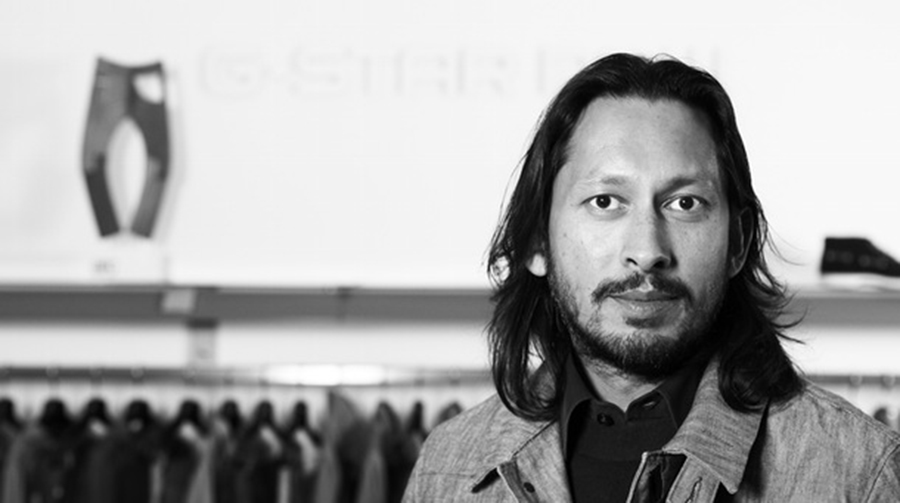
Shubhankar Ray: Former Global Brand Director, G-Star

Shubhankar Ray is the former global brand director of Amsterdam-based denim label G-Star.

Born in Calcutta, India, in 1968, Ray moved to Manchester, England, where he studied chemistry before moving into fashion branding. He began his career reinventing global fashion and lifestyle brands – a career that has spanned 20 years. 

Ray is mostly known for the innovative and award winning global campaigns and brand images he created for Caterpillar in the 90s, Camper in the 00s and G-Star since 2006, as their Global Brand Director. 

For G-Star, he pioneered groundbreaking marketing ideas, such as a record label, virtual nightclub-museum, pop-up gallery, infotainment fashion shows and the world’s first denim made from recycled ocean plastic.

His work is based in global branding, consumer-social reality and designing multi-level communications systems including international advertising campaigns, magazines, shop systems, TV spots, gallery installations, music, web and short films.

Ray left G-Star after ten years but is still involved as a consultant.


Why You’re Not Aware of How Your Bias Holds You Back

“How often have you had an exceptional leader over the course of your career?”

The most common answer to that question is 10% of the time. Some people say 5%. No one has ever said over 20%. This means if you have had 10 bosses only one was exceptionally competent. This response is completely consistent with large-scale leadership research that objectively confirms that no more than 10% of bosses are exceptionally competent.

Let’s do a thought experiment. Suppose that all the bosses in your group of 10 were men. One was great, three were bad, and six were average. (That would be consistent with leadership research.) As your career moves on imagine that you had three additional bosses, all of them women. None of them were particularly exceptional.  One was even incompetent. Then you were asked if you agree with this statement:

“On the whole men make better business executives than women do.”

What do you think?  Well, nearly 70% of women and over 80% of men agree with that statement. Yet, based on objective scientific research they are wrong. Validated research of nearly 50,000 business leaders reveals that women are generally more effective than men at the same leadership level. I will present more detail on that leadership research in a minute. But first I want you to consider why the vast majority of respondents to that question in the World Value Survey wrongly believe that men are more effective business leaders than women.

Our inner misperception of male leadership superiority is fundamentally caused by not having enough female bosses to fairly judge their abilities. It’s called ‘small sample size error.’ It works like this.  If you were to flip a coin 1,000 times you would very likely come up with the result of 500 heads and 500 tails. You would correctly conclude that every time you flip a coin the odds are 50-50 for either heads or tails. However if you only flip the coin five times and three of the flips came up heads you might conclude that heads is your “lucky” side because 60% of the time heads comes up for you. The problem of course is that when you only flip the coin five times one side is going to come up three times. It is also much more possible for one side to come up four times or 80% of the time with five coin flips than heads coming up 800 times (80%) with a thousand coin flips.

When I give a speech presenting the scientific evidence that, in general, women are actually better leaders than men I face a lot of skepticism. That’s because it’s far more likely for members of the audience of either gender to have had an exceptional male leader then an exceptional female leader . . . simply because they’ve had more male leaders. Duh!

Until recently most economists assumed educated people have ‘good judgment.’ They believed smart people to be highly rational. They thought people examine data dispassionately and make fair-minded decisions unemotionally. But people don’t do that.  And it doesn’t matter their education level. In a new best-selling book, The Undoing Project author Michael Lewis tells the story of how Amos Tversky and Daniel Kahneman discovered that virtually all of us are constantly making judgments about ourselves and others based on biases and flimsy beliefs than confirm our opinions despite the fact they are factually incorrect. When we see other people acting this way we consider them unreasonable, prejudiced and ignorant. The problem is we don’t see ourselves this way despite the fact all of us are unreasonable, prejudiced and ignorant. This is a huge problem because it affects the quality of our life, our life choices and the nature of our society.

Let me give you an example from my world. I am increasingly asked to conduct workshops addressing workplace bias.  When I talk to CEOs about the business impact of devaluing women through the invisible bias that permeates their corporate cultures they simply don’t believe it. Virtually every CEO I talk to is under the illusion that their workplace is a meritocracy and the good work speaks for itself. But it’s not true. It’s not true because of workplace bias.  So I have to conduct focus groups and administer surveys to produce data to open their minds to the fact that their culture undermines and disengages women. Even with data it usually takes a jackhammer to crack the concrete that encases most executive’s thinking.

That’s OK, I expect male baby-boomer executives to be biased. But what’s even more frustrating is that so many women suffer from self-bias. They believe that men are better leaders.  Even successful women swim in the mental soup of the imposter syndrome, fearful that their inadequacies will be discovered and that they will have to take responsibility for some public failure. The impact of self-bias leads women to defer to men simply because they’re men.  After all, if you assume that men are better leaders than women you are also likely to assume they know something you don’t. So you become compliant which reinforces your view that you are a better supporter than a leader. You’re compliant behavior reinforces the primal bias held by many men that women are here to help them not to lead them.

A Few Facts:

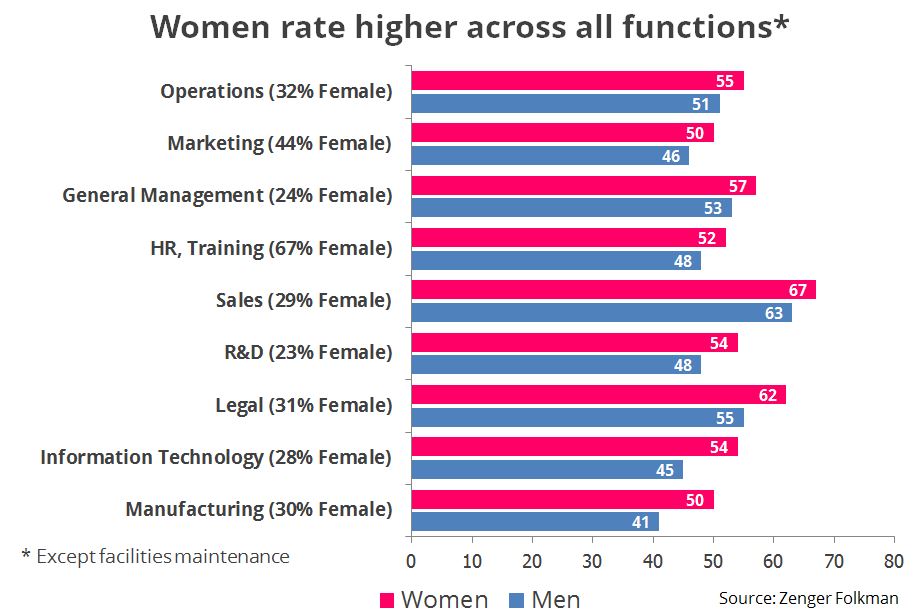
The Zenger Folkman company has been gathering 360° leadership effectiveness data for over 30 years. They have validated their research methodology that connects leaders’ behaviors to business results. In 2014 they started to examine their data using a gender screen that enables them to compare men and women. They found that, generally, women are better than men at these high impact leadership skills:

  • Taking initiative
  • Driving for results
  • Seeking feedback to develop themselves
  • Developing others
  • Inspiring others
  • Collaboration and teamwork
  • Connecting the big picture to individual jobs

(The one thing men excel at over women is communicating powerfully and prolifically . . . of course they do.)
Moreover, Zenger- Folkman’s research confirms that women are better leaders across all job functions from general management to operations to finance to marketing to R&D: everything . . . except building maintenance.
 

In pure economic terms women CEOs also outperform male CEOs. According to Fortune magazine’s research on the performance of the 1,000 largest companies, the 51 females that lead enterprises produce 37% more profit on average than the 941 Male CEOs.

And yet, when you look at those pictures of Jack Welch and Steve Jobs it is still hard for most women to believe they are the equal of male business executives let alone even better.

Here’s why:

Confirmation bias. For the nearly 5,000 years of recorded history what’s been recorded are the exploits of male leaders. So aggressive, decisive, competitive behavior is a deeply ingrained bias that is equated with how outstanding leaders behave. Once that is our hypothesis we are constantly on the lookout for confirming evidence. Even more damaging is that we ignore or overlook any contrary evidence. If we assume that men are better leaders we simply look for and remember anecdotal evidence or experiences that support our prejudice. Even worse if we see a woman leader struggling we discount the scientific truth that in general women are better leaders.

Attribution error. Most people I talk to attribute Steve Jobs’ leadership success to his uncompromising arrogance. This is false. His arrogance forced the Apple, Inc. of the 1980s to create the Lisa, which was a complete product failure. It also led him to getting fired. According to current Apple executives, his success the second time around was due to his faithful collaboration with a leadership team of six executives with complementary skills. Jobs suffered 10 years of failure after being fired which added just enough humility to him to become great. Not much has been written about Steve Jobs’ leadership transformation because it doesn’t conform to our irrational belief that great leaders kick ass and take names. This thinking fallacy is a big problem for women since most women do not succeed by being overbearing, insistent and verbally aggressive.

Unscientific conclusions. This refers to the small sample size problem. Most people trust their prejudice instead of data. We take a selective look at our own experience and if we don’t find an outstanding women leader we look at the pictures of Jack Welch, Steve Jobs and Marilyn Monroe and mistakenly conclude that those stereotypes accurately represent how men and women actually excel.
 

The Bottom Line:

Bias against women in leadership is real. The research evidence is overwhelming that women have to be twice as competent for twice as long to even have a chance at equal opportunities.  Today’s work cultures do not work for women. That is a big, big problem because women bring distinct leadership advantages to all organizations that create genuine value for customers, employees and society that we desperately need.

So, if you’re a man who has not worked for or with an exceptional woman leader, keep an open mind . . . you have not worked with enough of them.

If you’re a woman, be a leader, have a vision for yourself and your work. Act in confidence.  The world needs the difference you make.

 

Millennial Perspective: A Generation of Investors Demanding Profit with Purpose

With every generation, attitudes shift and trends emerge that define an era. As the Millennial generation comes into adulthood, countless researchers and journalists are expounding on the behaviors and attitudes of this “Next Generation.”

Though opinions differ, there is a growing consensus that global events and rapidly changing technology have combined to create a perspective among Millennials that is unlike that of their parents or grandparents.

Nowhere is this more evident than in financial markets, where the Millennial perspective is already influencing how assets are put to work. Millennials are demanding more integration of their money and values by seeking personal fulfillment in their careers, applying a global consciousness to their purchases and investing in sustainable, impactful business models.

They may be the first generation to recognize that ‘all investing is impact investing.’

“NextGens are saying we need to look at opportunities; investing rather than divesting,” said Philippe Cousteau, President and Co-Founder of EarthEcho International. “This is a positive opportunity. It is an empowered mind set.”

 “NextGen,” “Generation Y,” or “Millennial,” refers to the approximately 80 million U.S. individuals born between 1980 and 2000. Millennials are the largest generation in American history, with approximately 20 million more people than the Baby Boomer generation.

The oldest in the generation are now entering their 30s, and experienced their formative years around the turn of the millennium. While other generations were forced to adapt, Millennials have always known rapid globalization and technological innovation. Millennials are the first generation therefore to be “truly global,” sharing experiences across cultures and geography, connected by technology more than any generation before them.

Critical Factors Shaping the NextGen Perspective

Consider the major events that occurred in their relatively short lives; Millennials have experienced major boom and bust periods, including the prosperity of the nineties dot-com frenzy and the financial markets’ collapse in 2008.

On the other hand, they’re the children of the Baby Boomers. By many accounts, they’ve been insulated from the world, coddled, celebrated and awarded trophies simply for participating. At the same time, technological advances and the proliferation of mobile and social media have provided them with unprecedented access to information and networks.

It all adds up to a generation that is confidently self-directed, but seeks out expertise from a variety of sources. For those interested in understanding this new perspective, it is important to peel back the layers of the NextGen worldview and the circumstances that influence them. Here’s why.

Wealth Transfer to the Millennial Generation

A tremendous shift of financial and generational influence is on the horizon. It is estimated that over the next several decades, $30 trillion in financial and non-financial assets will pass from Baby Boomers to their heirs (including Millennials) in North America alone.

They’ll look to put those assets to good use, with the emphasis on good. Articles and white papers have noted that Millennials consider social responsibility to be a major factor in evaluating investments, far more than previous generations, and have a keen interest in impact investing.

“I’m not willing to invest my financial resources in ways that create problems for us to solve down the road,” said Millennial investor Courtney Hull. “It just doesn’t make sense.”

In a phrase, while many of those in the Great Generation sought to work during the week and be a part of community on the weekends, and the Boomer Generation sought personal fulfillment and social change, many of those in the Next Generation seek profit with purpose.

These unique attitudes and investment preferences of Millennials are not a fad, nor are they indicative of an immature approach to investing; they are the logical and engrained response to the global environment in which they came of age. In a world where financial markets have been opaque and unstable, skepticism and caution are survival tactics.

And while they seek financial security, MIllennials want it to happen through sustainable investments they hope will help solve some of the world’s toughest challenges.

“How we manage our money has to reflect our values and vision for a better world,” said Blue Haven Initiative Founders Ian Simmons and Liesel Pritzker Simmons. “As a young couple, this is part of our family’s future legacy—to set an example that wealth is a privilege to be managed for more than personal gain.”

With uncertainty and isolationism feeding fears in the U.S. and globally, fresh views to solve problems are needed more than ever. Fortunately, many Millennials are already bringing creative and impactful solutions through work and play. As they earn and inherit wealth, demand for socially responsible and impact investing will continue its rapid growth among this next generation that realizes that social, environmental and financial outcomes are inextricably linked in an increasingly globalized world.


Rita Ora: Singer, Actress and Fashion Designer

Rita Sahatçiu Ora is a British singer, fashion designer and actress who rose to prominence in February 2012 when she was featured on DJ Fresh’s single, “Hot Right Now”, which reached number one in the UK.

She was born in Pristina, SFR Yugoslavia (present-day Kosovo) to Albanian parents. Her mother, Vera is a psychiatrist, and her father, Besnik Sahatçiu, is an economist and a pub owner. Ora speaks Albanian and her mother is Catholic and her father Muslim.

When asked about her religion, Ora said that she doesn’t consider herself religious, but “more of a spiritual person.” She also considers herself a feminist.

Her family left Kosovo for political reasons, because of the persecution of ethnic Albanians initiated with the disintegration of Yugoslavia. They relocated to London, England in 1991, when she was a year old.

Her debut studio album, Ora, released in August 2012, debuted at number one in the United Kingdom. The album contained the UK number-one singles, “R.I.P.” and “How We Do (Party)”. Ora was the artist with the most number-one singles on the UK Singles Chart in 2012, with three consecutive singles reaching the top position.

On 15 November 2014, Ora joined the charity group Band Aid 30 along with other British and Irish pop acts, recording the latest version of the track “Do They Know It’s Christmas?” to raise money for the 2014 Ebola crisis in West Africa. On 14 November 2015, Ora performed during half-time at David Beckham’s UNICEF charity “Match for Children” held at Old Trafford, Manchester and in March 2016, she gave a speech on immigration and the Syrian refugee crisis at the We Day UK event in London, organised by Free the Children.


Dietrich Mateschitz: Founder of Red Bull

Dietrich Mateschitz is an Austrian billionaire businessman who co-founded the Red Bull energy drink company, and holds 49% of the company’s shares. His net worth, as of August 2016, is estimated to be $14.7 billion.

Mateschitz was born in Austria to a family of Croatian ancestry. As the international marketing director for German company Blendax he traveled around the world for his job, living in many countries. It was this exposure to multiple cultures and local customs that gave him the idea for a new product, Red Bull, now associated with extreme physical and mental endurance.

After tasting a syrupy Thai drink sold for a quick boost, Mateschitz partnered with Chaleo Yoovidhya to produce their own drink. They invested aggressively in marketing – including its famous sponsorship of Felix Baumgartner’s 120,000-foot skydive in October 2012.

He is co-founder of the Wings for Life foundation that supports spinal cord research together with Heinz Kinigadner. Since 2014 the foundation has organized the Wings for Life World Run to raise funds.

In the U.S., immigrants are almost twice as likely to become entrepreneurs as native-born U.S. citizens. Immigrants represent 27.5% of the countries’ entrepreneurs but only around 13% of the population.


0