The CEO of Coca-Cola On Using The Company’s Scale For Good

Recent research shows spending money on corporate social responsibility is no longer seen as a detriment to a company’s profitability. Stock analysts now view such expenditures as essential to a company’s long-term brand and value. Coca-Cola is one of the many companies that are making efforts to tackle the world’s greatest societal challenges — water scarcity, climate change, and even the rights of women and girls in the developing world. Muhtar Kent, (pictured above) the Chairman of the Board and CEO of Coca-Cola since 2009, talks about how the beverage company is imbedding sustainability into its business.

Over the past several years, corporate social responsibility (CSR) has evolved from simply being an isolated “do good” arm of a company to something more profound that’s changing the way organizations do business every day. How has Coca-Cola integrated these CSR principles into your operations?

Kent: Sustainability isn’t new to us but we’ve been intensifying our focus on it. We’re prioritizing programs centered on water, women and well-being—all three of which are essential to our business. For example, we’re working to achieve water neutrality by 2020. So far, we’ve replaced 52% of the water we use in making our beverages and reducing water usage across our 800-plus bottling plants helps reduce the overall cost of production. We have also committed to economically empowering 5 million women by 2020. This is the largest such program ever undertaken by a commercial organization. Our micro distribution centers (MDCs) in Africa, many of which are run by women, help our beverages reach small shops and kiosks that can’t be served by more trucks and vans and create value for our business, our retail and restaurant customers, and the broader communities.

Restructuring a company to focus on sustainability doesn’t happen overnight, so how long did it take to get everyone on board and how did you deal with any resistance to change?

Sustainability can no longer be a compliance measure or a “nice-to-do”; it’s now a business planning imperative with measures, goals, and explicit value connected to our programs. Because of this importance, we didn’t really experience any resistance. There were certainly people who challenged our approach and provided candid feedback on how we could improve but overall there was collective agreement that this was necessary.

If the ultimate goal is to create both economic value and social value, how do you strike that balance?

There may be an initial financial investment that doesn’t create an immediate and direct financial return—that’s OK. We know that by investing today, we will ultimately be a stronger, more sustainable business down the line. For example, developing our PlantBottle innovation — a fully recyclable packaging made of up to 30% renewable plant material — took significant upfront investment but we felt it made good sense, especially with oil prices fluctuating. And it’s helping contribute to our goal of reducing the carbon footprint of the drink in a consumer’s hand by 25% by 2020. It has also been a tremendous boost to our Dasani water brand, helping us win new customers and consumers.

Have you faced any specific challenges in measuring the social value you’re creating?

Coca-Cola operates in more than 200 countries and the needs of each market depend on a variety of factors. While some markets face economic issues, others may face resource scarcity and gender inequality, and some face all of these issues and more. It can be difficult to measure and compare. Thus, we operate a value creation model that is globally driven but locally focused.

Can you explain what you mean by a “value creation model”?

I mean one that creates value for all the stakeholders touched by our business. Consider PlantBottle. We’re able to put a package in consumers’ hands that reduces demand for oil. If consumers love our beverage more, that benefits our customers. And when the packaging is less expensive and we’re less dependent on petroleum-based plastic, this creates value for our shareowners and our bottling partners.

What is Coca-Cola doing that’s different from what other companies are doing?

There are a lot of companies and organizations out there doing great work but our scale allows us to think big and execute. It’s not just our size as a company or a brand, but the fact that we have operations in more than 200 countries. This footprint enables us to set up partnerships with organizations large and small to make the greatest local or global impact. We can fund projects at levels that make a real difference. And often times, we can use the size and nature of our operating model to address a need in a significant way.

We also have our distribution network, which connects us directly to the 24 million retail customers we visit every week. As the world strives to bridge the gap of the last mile between the virtual world and the real world, we have an opportunity to help make this connection. We’re continuously working to make the most of our distribution network as well as our virtual and physical assets.

How much of your company’s move in this direction is customer-driven vs. conscience-driven?

Today’s consumers expect companies to be socially responsible — not just on the surface either. Our brand is in our consumers’ hands but that’s not the primary reason for our sustainability efforts. Our efforts are primarily fueled by our business needs — we can only be as sustainable as the communities we serve so we’ve initiated a host of programs and partnerships to help strengthen those communities while continuing to build our business.

We also have ethical drivers for our sustainability work. Across Coca-Cola, we are parents, partners, siblings, friends, concerned citizens — and we live in the communities where we operate. We have a responsibility to help others.

How has your organization gone about partnering both at the local level and at the national level to ensure that the social value you’re creating on the ground is recognized and supported with policies and governance?

We work with governments, civil society organizations, and other companies. It’s essential to invite the groups that influence policy and governance to be part of the initial conversations so they share ownership from the start. Plus these organizations often have valuable local intelligence and experience

Consider our work in Tanzania with the Bill & Melinda Gates Foundation and The Global Fund to Fight AIDS, Tuberculosis and Malaria. In 2010 we joined forces to improve access to critical medicines. Working with the Tanzania’s Medical Stores Department and others, we were able to share our supply chain expertise, reduce medicine bottlenecks, and improve distribution as a whole.  We try to use our expertise and know-how to make a positive difference in the communities we serve.

Looking at businesses and consumers of the future—10, 20, 30 years from now—what will happen to organizations that fail to integrate social and environmental concerns into the core of their daily operations?

In my opinion, the importance of balancing social and economic value will only grow over time and organizations that don’t do this will fail. They’ll lack the resiliency to address ever-changing consumer attitudes and shifts in geopolitics, economics, and demographics.

For Coca-Cola, many of the most exciting opportunities are likely to come from the intersection of sustainability and our supply chain, giving us new ways to reduce our packaging, energy, and water footprints and improve the well-being of the communities we serve. While we’ve gained some good momentum with initiatives like 5by20EKOCENTER and PlantBottle, we know we’re just getting started. Sustainability is an ongoing journey, one that we hope and trust will build forward momentum as we remain “constructively discontent.”

What do you mean by “constructively discontent”?

It’s my way of recognizing achievement but also understanding that we can never be satisfied with it. We must refuse to accept the status quo and continue to challenge ourselves. We have to keep setting higher goals and expectations and then meet or exceed them. And at the end of the day, we need to operate with a lens of optimism, but temper it with a lens of reality.

This is part of an ongoing series from Harvard Business Review and the Skoll World Forum on how mega-corporations are integrating innovative ways to solve social and environmental problems into their core operations.

5 Powerful Phenomena Shaping The Philanthropic Journey of the World’s Wealthiest

Are we in the midst of a turning point for philanthropy? Are these the boom years of ‘philanthrocapitalism’? Though the practice is not entirely new, the term was coined in 2006 by Matthew Bishop, US business editor of the Economist to describe a philanthropic culture that draws heavily on business talent and entrepreneurship. Isabelle de Grave explores the powerful phenomena guiding the world’s wealthiest towards an increasingly entrepreneurial style of philanthropy. As it turns out, these may well be the boom years.
 
Carnegie’s gospel.
 
Andrew Carnegie, a Scottish-American industrialist and 19th century steel giant had a way with words that has captured the imagination of the super rich.
 
“The problem of our age is the proper administration of wealth, that the ties of brotherhood may still bind together the rich and poor in harmonious relationship,” he wrote in his essay “Wealth” first published in the North American Review in 1886.
 
Carnegie believed that the rich had a responsibility to use their acquired wealth and business skills to administer wealth for the common good and solve society’s biggest challenges.
 
The rich “have it in their power during their lives to busy themselves organising benefactions from which the masses of their fellows will derive lasting advantage – and thus diginify their own lives,” he argued.
 
Carnegie had disposed of 90% of his vast fortune by the end of his life, and built thousands of public libraries across the US. His philanthropic legacy has sparked something of a chain reaction among successive business tycoons. Warren Buffet, long before he gave $31 billion of his fortune to the Gates foundation in 2006, gave Carnegie’s book “The Gospel of Wealth” to Bill Gates. This guided Gates’s approach and“ helped him to become a philanthropist,” write Matthew Bishop US business editor of the Economist and economist Michael Green in their book, Philanthrocapitalism: how giving can save the world.
 
Whilst philanthrocapitalism involves more than simply setting up a foundation, it is significant that the past few decades have seen an explosion of foundations set up by wealthy entrepreneurs. Numbers of new private foundations are up from about 22,000 in the early 1980s to 65,000 today. Many were founded in the mid-1990s with dotcom money by individuals with careers forged on entrepreneurial zeal, and many of the founders are younger than in the past according to a detailed report by The Economist tracking the latest trends in philanthropy.

The ‘tech effect’ on philanthropy. The dotcom boom injected a huge dose of entrepreneurship into the world of philanthropy, and gave rise to the term ‘venture philanthropy’ based on the idea that Silicon Valley’s entrepreneurs would transfer their creative skills to the foundations they were setting up. An increasingly business like vocabulary has grown around the sector, reflecting the goal to maximise the impact of wealth. Today, the best foundations are increasingly businesslike. They are “strategic” and “market conscious”, “impact oriented”, “knowledge based”, “high engagement” and always looking to maximise “leverage” of donor money explain Bishop and Green. 

Their task as they see it is not about handing out money, but of forging alliances and building networks: with government and industry, or among groups of charities. The Gates Foundation’s partnership with ‘Big Pharma’ is one example of the strategising behind today’s philanthropic ventures. Since 2000 The Gates Foundation has worked with GlaxoSmithKline (GSK) on preventing the spread of HIV and AIDS and Malaria – a partnership, which has produced a promising malaria drug for infants by switching the focus of GSK’s top scientists from research objectives with short-term commercial gain to global health issues. The birth of social entrepreneurship and giving the Ebay way.

Bishop and Green describe the philanthropic statement that Pierre Omidyar founder of Ebay and his first employee Jeff Skoll made in 1998. It was on trend mirroring the risky business of tech, and it was edgy. They strolled into Silicon Valley Community Foundation and made an offer of a $1 million block of shares. Their one condition was that the foundation keep the shares for a year, a term that many others rejected. A year later the foundation sold its shares and banked $40 million. They were either very sure of themselves, or habitual risk-takers. 

Bishop and Green call giving the Ebay way a feat of generosity as they had not yet banked anything themselves. Soon after, Skoll was drawn swiftly and sharply into the world of social entrepreneurship, where people were building businesses to tackle social problems. The blend of ambition to create change powered by entrepreneurial skills held Skoll’s attention and mobilised his resources. He created the Skoll Foundation, endowed the Oxford Said Business school to set up the Skoll Centre for Entrepreneurship and began hosting the annual Skoll World Forum. Each year the Skoll Foundation awards $1.25 million over three years to social enterprises on the verge of growth significant enough to create better futures for millions.

Social enterprise also emerged as the perfect match for the money of the business-minded philanthropist, Pierre Omidyar who went on to found the Omidyar Network, and began investing in micro-finance and for profit social businesses including IGNIA a Mexican venture capital firm and Meetup.com, a platform bringing together communities based on shared interests. Today social enterprise is increasingly gaining support from venture philanthropists like Skoll and Omidyar, and engaging with investors with both social and financial goals.

Social investment and tax reliefs.  

Social investment is investment with a philanthropic twist. It is a phenomenum gradually funnelling capital towards social causes as social investors look for opportunities to use their investments for the broader benefits of society. Simply put the social investor looks for both social and financial returns on their investments. Most often this comes from investing in social ventures. There are increasing numbers of firms with this mandate, including Bridges Ventures, the Social Investment Business and Big Issue Invest who all back social ventures.

There are also organisations like ClearlySo, which connects social businesses and enterprises with investors. And, with a new social investment tax relief in the UK social investment is increasingly visible to mainstream investors. For Sir Ronald Cohen this is the tech effect continued, a natural progression from venture capitalism. Sir Ronald made his own private fortune investing in tech enterprises, and is widely credited as the father of social investment.

After co-founding social finance firms Bridges Ventures, and Social Finance UK he recently became chair of the G8 Social Investment Taskforce, which is looking to integrate social investment into the mainstream economy. Cohen is a strong advocate for linking social and financial return, and sees social enterprise as the wave that will follow the tech explosion. The age of the ‘social good network’. A century on from Carnegie’s essay, and hot on the heels of the tech effect and the birth of social investment a growing number of social good networks and conferences have emerged. There is already a lengthy conference circuit where individuals can connect their finance and business skills to social causes.

There’s the Global Philanthropy Forum in the US, a network of high-net-worth individuals committed to advancing international causes through their giving, investing, and policy voice. And, just a few of the popular conferences on the global circuit include the Skoll World Forum, the UK’s annual social investment conference Good Deals, the GIIN investor forum and Social Capital Markets (SOCAP) a gathering of individuals and organisations dedicated to directing market systems to social impact.

And now for the first time in the UK a six month leadership programme is being launched inviting international wealth holders and inheritors, entrepreneurs, investors and pioneering individuals to learn, connect and act with like-minded others. The Pioneers for Change Leadership Programme is designed to inspire, equip, connect and support leaders who want to explore and elevate their potential for positive impact. Continuing the Carnegie legacy and in keeping with the Sillicon Valley brand of philanthropy, the programme aims to ignite a revolution, and foster international leadership in philanthropy, social investment and entrepreneurship.

These different influences are shaping today’s approaches to philanthropy in the midst of a wealth transfer of gargantuan proportions. Years of accumulated wealth—in Europe and America—are about to change hands, as the post-war generation dies off. One estimate from a study in America, by Paul Schervish and John Havens of Boston College puts the size of the transfer likely to occur in the US between 1998 and 2052 as somewhere between $41 trillion and $136 trillion. There is an enormous amount of money available, and as an entrepreneurial culture takes root in the world of philanthropy, these may well be the boom years of philanthrocapitalism. 

The original article appeared on Pioneerspost.com. Pioneers Post is the media partner for the Pioneers for Change Leadership Programme delivered by Adessy Associates. This article is from a series of monthly articles exploring the changing world of philanthropy. 


How Reputations Are Won And Lost In Modern Information Markets

A new white paper by the Saїd Business School at the  University of Oxford identifies challenges and opportunities for practitioners and policy makers.

Democratisation of online information, always-on media and the proliferation of audiences creates distorting effects that are not well understood, according to a new white paper published by the Oxford University Centre for Corporate Reputation at Saїd Business School and the University of San Diego School of Law.  ‘How Reputations are Won and Lost in Modern Information Markets’ seeks to identify the key challenges and opportunities for businesses and policy-makers in dealing with online information networks. Recipients of early copies include the Policy Unit at No 10 Downing Street, the White House and the European Central Bank.  Among the topics explored by the white paper are:

  • Why information networks breed extreme views
  • Positive and negative social potential of networks
  • Who owns your reputation and what influences them
  • How even ‘honest’ online ratings can ‘lie’ – and the broader implications of the ‘herding’ tendency

Based on a conference co-hosted in San Diego by the two university institutions, and including contributions from leading academics, business executives and journalists, the report also suggests initiatives to counter some of the ‘biases’ fostered by information networks and to create a more productive environment for the exchange of information between business, government and their audiences, as well as helping policy makers understand how they can use reputation ‘as a mechanism to hold organisations and institutions to account’.

‘The effects of information networks and 21st century instant communication work in surprising and often counter-intuitive ways,’ says Rupert Younger, Director of the Oxford University Centre for Corporate Reputation at Saїd Business School. ‘These effects can distort markets, and damage the reputation and health of businesses and governments. But they also provide particular challenges and opportunities in terms of how reputations can be created, sustained and rebuilt.’

The paper is organised under three headings:

  • Technology – the effects of the speed at which information is disseminated
  • Stakeholder Plurality – the challenges of addressing  ever broader stakeholder audiences with conflicting agendas
  • Polarisation – why the market in information encourages extreme viewpoints

The subject matter covered, based both on academic research and practitioner experience, ranges from: the growing distrust between business and media and its wider implications; the positive ‘herding’ effects of ratings websites; the reputational challenge of dealing with consumer data across different territories; maintaining long-term business goals in the face of short-term information cycles; and the survival of traditional publishing in a digital age.

It makes a number of recommendations that seek to redefine the way information networks are understood and engaged with, grouped under Trust, Humanity and Literacy:

  • Encourage Public-Private Engagement

Technology has democratised authority. At the same time it provides tools that allow large groups to know one another. The institutions of state and senior corporate leaders have yet to embrace this democratisation due to fears about losing control. Yet legitimacy and reputation can be gained by embracing this democratisation.

We recommend that government organisations formally ramp up their engagement with society in order to rebuild trust. At a minimum, this public-private engagement should include transparent focus groups, polling, and public consultations. The public sector should formalise relationships with private sector groups to study how governments and corporations can harness technology and instill reasonable principles of transparency and self-policing.

  • Help Manage the Information Cycle

Technology has led to quicker cycles of information, which have a profound effect on reputation. These quicker cycles present serious challenges for policy makers, given the nature of electoral cycles and the media. For businesses, pressure comes from the constant need to (re)act quickly and to deliver short-term financial results.

We recommend that government and business leaders put in place public-private teams to help leaders manage the increasing speed of the information cycle. These teams should include a wide range of media representation. The goals should include managing informational feedback loops, processing information as it arrives in stages and understanding – and potentially avoiding – quick reactions that are conditioned by biases.

  • Support financial literacy

Financial illiteracy is a serious problem in complex modern information markets. Unless there is a real understanding of the causes of economic problems, particularly the recent financial crisis, policy responses are likely to be inadequate. Basic literacy is important, not only in safeguarding vulnerable stakeholders, but also to improve the decision making of policymakers and corporate leaders and ensure that critics offer their views from an informed position

We recommend a systematic and sustained programme of public and private education related to core financial issues. Both the UK and US governments should target key audiences – policy, regulatory, business and the public – using clear and simple language, and employing technology to articulate basic financial constructs and how they work.

  • Help Counteract Biases

A strong ‘herding’ tendency occurs, especially around the early expression of views. In the United States, research has uncovered a clear bias toward positive reviews in online consumer rating sites. This herding effect gives rise to misinformation that can be very difficult to correct. Educating the public about these tendencies is important, as is ensuring that there is room for trusted translators and critics within any debate. Policy makers also should create safeguards to prevent powerful information intermediaries from abusing their status and power.

We recommend that government and business create public-private initiatives to counteract biases in two ways. First, teams should ensure that there is a counterweight to the instant views that often dominate search engines and technology-related feedback mechanisms. Second, teams should encourage a culture of welcoming and engaging views that are discordant with early accepted norms.

  • Encourage Businesses to Invest in Tools that Facilitate the Desire to Do Good.

Human networks and human impulses underpin all information markets. A clear theme that emerged from the conference is the power of humanity as a force for good in modern markets. There are signs that businesses are starting to recognise their responsibilities in this area. Strong policy initiatives are needed to support and nourish these nascent efforts, which will help to restore trust among business leaders, their employees, politicians, and the public.

We recommend that governments play a light-touch, yet important, role in this area, signalling through their actions that the way businesses relate to society is a national priority. Business leaders should consider formally articulating and embedding a culture of humanity in their mission and vision statements.Policy makers should consider tax incentives and reporting initiatives to encourage investment in tools that make it easy for companies’ employees, customers and other stakeholders to accomplish social goals. Technology, in particular, can help stakeholder groups to form information and communications networks that facilitate the basic human desire to do good.

  • Encourage ‘Yes And’ – Particularly in Risk Management

Positive working environments can generate productivity gains and make workers happier and better off. But the increasing plurality of stakeholders that corporations must consider often leads to a focus on risk management, rather than opportunity management, especially in areas such as social media.

We recommend that private and public leaders attempt to harness the power of ‘yes and’, rather than ‘yes but’, in their decision-making forums. We do not mean that decision makers should ignore risks or critical oversight, but rather that the analysis should embrace possibilities and be more constructive than restrictive. For example, businesses could focus their risk management efforts, not on regulatory requirements and negative possibilities, but on the potential for positive outcomes.

Contributors to  ’How Reputations Are Won And Lost In Modern Information Markets’ include: Twitter co-founder Biz Stone; senior executives from global companies eni,  Experian and Millennium Management; prominent journalists from Reuters, the New York Times and CNBC; and professors from the Universities of San Diego, Stanford, Oxford and MIT. The full list of contributors is available in the paper.

GameChangers 500: The World’s Top Purpose-Driven Organizations

Social enterprises, benefit corporations, blended value organizations, conscious capitalism; there are no shortage of buzzwords describing this monumental movement to create a new model of business.

But if you want to build one of these “force-for-good” businesses, is there a model to follow? How do you measure your success or failure? And if you want to work at one of these purpose-driven orgs, how do you find and differentiate the performers from the pretenders?

For the past three years I’ve been on a quest to answer these questions. I had watched one too many friends grow numb in profit-at-all-cost corporations, and couldn’t sit on the sidelines any longer.  Why is it that we spotlight the Fortune 500, a list that benchmarks success based on revenue alone? What if we created a new list that showcased the growing movement of organizations maximizing their positive impact rather than just maximizing their profit?  My “Aha” moment had arrived and the idea to create a GameChangers 500 (GC500) list was birthed—a list that would help emerging graduates find meaningful careers and plug their potential into powering a better world.

Equipped with blind ambition, I gave myself the title of social entrepreneur and then proceeded to spend three full months deliberating between a non-profit, for-profit or hybrid legal structure. It felt like choosing between broccoli, spinach or broccoli-spinach casserole—all of which were overcooked and a week old.  Further, figuring out a unique profit-sharing model took so much time that I nearly went out of business in the process! Where was the playbook of best practices on how to build a business that helps people and the planet thrive?  And how could I possibly create a database of the best “force for good” businesses if the rules of this new game weren’t defined?

Before the performers could be praised, the objectives, rules and point system of this new game needed to be determined.  It was clear that the objective wasn’t to maximize profit but rather to maximize benefit to people and the planet. What wasn’t clear, however, was how to keep score.

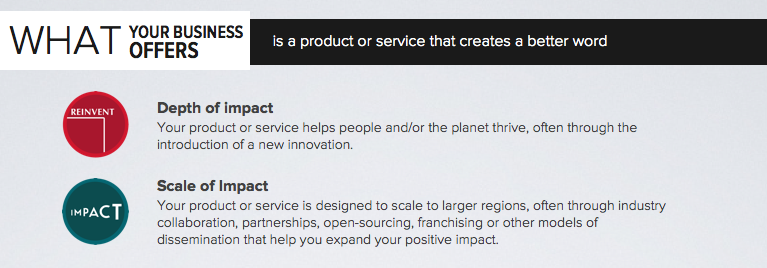
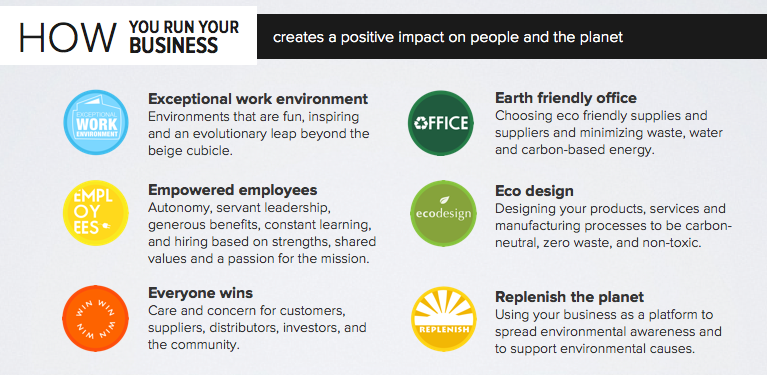
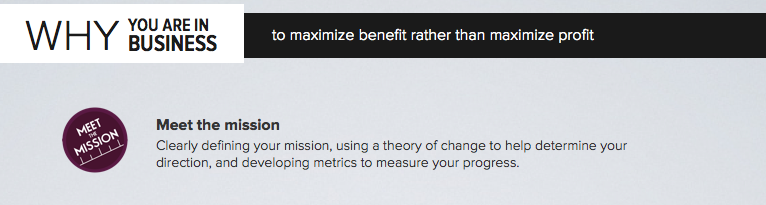
After receiving valuable input from experts in the field, we assembled a research team to comb the globe, reviewing thousands of organizations. Our team arrived at nine categories of best practices that these “force for good” businesses followed.

We then turned these nine categories into badges that organizations could earn as symbols of success in this new game. To further simplify the framework, we organized these badges into the following three sections:

A-new-model-of-business_WHY

A-new-model-of-business_WHAT

A-new-model-of-business_HOW

The Players: It was clear that this movement could not be defined by existing legal models.  Non-profits, For-profits and new legal breeds were all players, united by a common worldview that business as usual needed to change.  Together they were stretching the traditional paradigm to innovate a new model. Here’s how: Non-profits: There is a clear trend to use a non-profit entity in an enterprising way which moves beyond the limitations of grants and donations by earning income through the sale of a product or service.

These organizations benefit from having a purpose embedded in their ethos, while enjoying the flexibility and scalability of earning revenue. Overcoming the pressure to minimize operational overhead, these non-profits can more easily invest in things like empowering their employees and minimizing their environmental footprint.  As Dan Pallotta says, “Our generation does not want its epitaph to read, ‘We kept charity overhead low.’

We want it to read that we changed the world.” New legal breeds: The birth of new legal entities such as Benefit Corporations in the USA, Community Interest Companies in the UK, and Community Contribution Companies in Canada are paving the way for a new category of organization. Although it will take time for these models to build credibility and scale internationally, the hope is that one day the For-benefit structure will be an equal choice with For-profit and Non-profit. For-profits: Whole Foods, IDEO, Google, and Zappos are great examples of major corporations that have used traditional for-profit structures to scale their growth while implementing many untraditional practices that aren’t profit motivated. For example:

  • Whole Foods created Community Giving Days where 5% of that day’s net sales are given to local non-profits.
  • Google invested in creating an exceptional work environment with themed work spaces, slides between floors, free gourmet food, and radical amounts of employee autonomy.
  • Zappos innovated ways to “deliver happiness”—their mission—through untraditional benefits like surprising 80% of customers with free overnight shipping.
  • IDEO created IDEO.org to solve poverty related challenges by offering their talented designers to communities who need them the most.

Although they are unlikely to switch to a new legal entity, like a Benefit Corporation, these organizations are clearly part of this movement and are constantly innovating best practices that go beyond making a buck. As doing good continues to prove to be good business, it can be expected that more major corporations will join this “new game”.

Studies show that their ability to retain talent and market share rely on it. Considering the budget some large organizations spend on coffee filters alone is equal to the total revenue produced by many social enterprises, a small shift in this sector equates to an enormous positive impact. Thanks to great progress being made by law makers around the world, and organizations, like B Lab, we can expect this new model of business to continue taking shape.

Until then, we will define organizations by their best practices, not by their legal model and celebrate the GameChangers in business that don’t let rules or outdated paradigms define them. Although it took a lot longer than expected, I’m proud to say that the GameChangers 500 list (GC500) was announced on November 9th 2013 at Harvard’s Igniting Innovation Summit. Joining me in this announcement were executives from three exceptional organizations that qualified for the GC500—Warby Parker (benefit corporation), Life is Good (non-profit/for-profit hybrid) and New Balance (for-profit corporation).

Although each organization represents a different legal structure, they share a commitment to use business to create a better world.  In this presentation they brought the audience on a tour of their best practices across the 9 badge categories. I’m thrilled to showcase the GameChangers with the next generation of leaders, and offer an alternative to the profit-first organizations that have been heavily recruiting on campuses for decades. Game on!

Andrew Hewitt is the creator of the GameChangers 500 list (GC500) that profiles the world’s top purpose-driven organizations using business as force for good. He has been recognized as one of Canada’s top young entrepreneurs, is a bestselling author, and a guest lecturer on Social Entrepreneurship at the United Nations University of Peace.


GE: The World’s Oldest Startup on Effective Marketing

General Electric CMO Beth Comstock (above) believes marketing is about seizing opportunities. That’s why she’s constantly on the lookout for innovation, driving GE’s partnerships in healthcare and clean energy. It’s why today’s GE is utilizing video and social media to tell a global story with a local accent, and why tomorrow’s will see the integration of people and machines in a truly wired world.

“To be an effective marketer, you have to go where things are,” says Beth Comstock. “You have to see what’s happening and be a translator. You have to immerse yourself and not be comfortable sometimes.”

The General Electric CMO is sitting in a sleek conference room in the GE Building high above Manhattan’s Rockefeller Center. When Comstock speaks, though, she conjures up images of rural doctors in China and farmers in Africa. These developing markets and technologies are what Comstock sees when she thinks about the future for GE and marketing in general.

The 52-year-old often describes her job as “connecting the dots”–between GE’s seven segments (Power & Water, Oil & Gas, Energy Management, Aviation, Transportation, Healthcare, Home & Business Solutions), its many markets, and between the company and the outside world.

It’s something Comstock regularly does as head of GE’s sales, marketing, and communications, and in her management of the company’s multi-billion-dollar Ecomagination and Healthymagination initiatives, dedicated to environmental and health care innovation respectively. In her travels and conversations with customers, she constantly scans for patterns. “When you’re in this business, you see a lot of things,” Comstock notes. “Marketers are in a great position to notice if something’s happening in an industry like energy or healthcare.”

What separates the good marketers from the great ones is the ability to translate those observations into insights that can move a business or product. As Comstock and her 5,000 GE marketers set about trendspotting in 2013, her top insight for the new year is that marketing’s mandate will continue to grow. “It’s no longer enough to just be about brand and communications,” she says. “Marketing is now about creating and developing new markets; not just identifying opportunities but also making them happen.”

THE WORLD’S OLDEST START-UP

GE has been cultivating new markets by creating customer innovation centers in places like China. Its Chengdu facility, for instance, brings together local workers, GE marketers, and researchers to collaborate on new initiatives in mobile, affordable healthcare, and green energy. It opened in May and has already developed two new healthcare products (GE isn’t ready to name them) that will launch locally with the potential to roll out to other markets.

Under Comstock, GE has also been importing fresh ideas through competitions, partnerships, and guest talks. She likes to call GE “the world’s oldest start-up,” but admits the 134-year-old company needs partners to accomplish its more ambitious goals, whether it’s developing clean energy sources, or rolling out smart grid technology worldwide.

One recent ally is Los Angeles-based Oblong Industries. Best known for making the multitouch interface featured in Minority Report, Oblong entered one of GE’s Ecomagination open innovation challenges. “They hadn’t worked in the energy space, but we felt they could help us visualize the smart grid,” says Comstock. After funding a proof-of-concept pilot, GE announced an investment and licensing deal with the start-up for smart grid analytics in March.

GE started leveraging its open innovation challenges in 2010 and has now partnered with 15 environmental and health start-ups. The start-ups get commercial and technological support under a group Comstock manages called GE Ventures. Alliances are key because while GE operates a pipeline for internal innovation projects, candidates typically need to show $100 million of revenue potential (over three to five years) to win and maintain support. “Scale matters a lot to us,” says Comstock. “It’s hard to do both speed and scale well. Start-ups have great ideas and work fast while we have access to markets and great technology.”

GE also generates ideas through a global insights network that invites professors and other experts to campus to discuss cutting-edge topics like robotics. “We look for the most disruptive people we can find,” says Comstock. “We don’t want to think too traditionally. We have had to open up a lot more.”

“It’s hard to do both speed and scale well. Start-ups have great ideas and work fast while we have access to markets and great technology.”

CONTENT, CONVERGENCE AND THE DIGITAL FACTORY

Digital technologies are pushing GE in new directions. Comstock estimates she spends 40 percent of her budget on digital marketing. Over the past two years, GE has ramped up its video content in particular, hiring boutique agencies like The Barbarian Group to create short yet captivating clips about GE manufacturing and products.

Some of the videos explore GE systems and factories in artful ways while others thrill with extreme science stunts, such as dropping a robot off a wind turbine. BBDO remains GE’s advertising agency of record but Comstock says GE values small agencies’ willingness to take risks. “The Barbarian Group are great storytellers,” says Comstock. “They can translate stories that might otherwise be boring and technical. You don’t have to be a scientist to love these videos.”

Social technologies have also altered the way GE interacts with its customers. The company is active on Facebook, Google+, Instagram, Pinterest, Tumblr, Twitter and YouTube. GE calls Facebook the “hub” of its social experience. The site is home to more than 30 GE pages as well as its social health and fitness app, HealthyShare. On Google+, GE posts pictures, videos, and quiz questions relating to its industrial products, zeroing in on the service’s digital-savvy audience. On female-focused Pinterest, GE “pins” upbeat, health-related quotes and kitchen appliance photos. YouTube, of course, is GE’s video base with dozens of clips ranging from Barbarian-produced web shows to researcher interviews to TV ads.

Indeed, GE produces so much content across these sites that it calls itself a “digital factory.” For Comstock, this media convergence and blurring of roles is another 2013 trend. “The idea of an ad as a separate entity is fading fast. Brands are content publishers and consumers are, too. The days when we had separate swimlanes are over.”

Considering its size, GE was a surprisingly early adopter of social. Nevertheless, Comstock is wary of fads: “There are concepts out there people grab onto. You have to be careful of chasing the hot thing,” she cautions. When Comstock tries new tools, she tracks engagement metrics to assess whether the technology is relevant and scalable. Instagram is one social tool that passed her test. GE started using the photo-sharing app as an experiment.

Today, nearly 150,000 people “follow” GE’s photos of engines and power modules on the mobile social network. Like their web videos, the pictures let GE connect with technology enthusiasts. “Instagram is a way to go into our factories and get shots you wouldn’t normally see,” explains Comstock. “We’re targeting the inner geek in everyone. Most people want to know why things work.”

BUSINESS IS SOCIAL

Comstock has that inner geek, too. Studying science instilled a lasting interest in global ecosystems. As a Biology major at the College of William and Mary, Comstock once planned to become a doctor and she still views herself as a behaviorist: “I can get very focused on how people are using technology. Is it making lives better or worse? How is technology going to change how people act? That part of biology appeals to me.”

Comstock’s studies will soon extend to machines as GE brings social to inanimate objects. One of the company’s biggest growth strategies–and challenges–in 2013 will revolve around what they are calling the “industrial internet.” Known more broadly as the “Internet of Things,” the industrial internet involves applying digital and social technologies to machines to predict and prevent problems and increase productivity. In the future, GE’s MRI machines, jet engines, and gas turbines will all be wired.

The company plans to integrate content related to the Industrial Internet into existing initiatives like Ecomagination and Healthymagination. That could mean GE-generated news articles, infographics, or data visualizations of industrial internet topics, plus apps and multimedia projects, too. Imagine a YouTube video that shows how remote monitoring of a GE transformer prevents power outage during a storm. The key for Comstock is that “the Industrial Internet involves all of GE and goes beyond GE.”

It also points up another of her 2013 trends: Business is social and social is no longer limited to personal connections. “We’re working aggressively to link machines and people so businesses can be more productive,” Comstock says. “You’re going to see machine data and people interacting in real time.”

For example, GE recently hooked up one of its GEnx engines to Salesforce’sChatter software. The Boeing Dreamliner jet used the social platform to “speak” status updates to Japan Airlines service teams and GE engineers. The innovation should increase fuel efficiency and engine reliability, aiding on-time arrivals.

GE is making a big bet on the Industrial Internet, and will be promoting it to everyday consumers even though its services are geared to corporations, institutions, and agencies. Indeed, the broader marketing push has already begun. Over Thanksgiving, GE rolled out a new ad campaign, Brilliant Machines, to introduce the Industrial Internet to consumers. A traditional TV spot saw famous machines like KITT and the Mars Curiosity rover making a pilgrimage to GE HQ to be hooked up to the Industrial Internet. Online, there were promoted social media posts and a Brilliant Machines Tumblr. The point, says Comstock, “is to be relevant. It’s important for us to tell a story that connects in the consumer marketplace.”

GLOBAL PERSPECTIVE, LOCAL FLAVOR

That story is remarkably consistent worldwide. GE cleaves to a core branding message and framework but permits regional customization. The company’s current corporate storytelling platform, GE Works, highlights GE products while emphasizing their impact. It’s a global initiative, says Comstock, but in Brazil and India, for instance, the company hired local artists to tell GE Works stories in their own style. These print and outdoor ads varied in appearance but still focused on GE’s technology and influence on the world.

During 2013, GE’s marketing became even more global. Besides China and Africa, Comstock is excited by prospects in Indonesia, Latin America, Myanmar, and Peru. Wherever GE goes, Comstock will be there, on the ground and on the hunt for new products and markets. “Sometimes marketers get accused of being too academic,” she admits. “But although a consultant might be able to tell me about something, I prefer to see it myself. Experts can help translate, but being there is essential.”

This article was written by Elizabeth Woyke and originally appeared on thinkwithgoogle.com


Warning: Singularity University May Cause Your Mind To Explode

Imagine spending 12 hours a day for a week having non-stop life changing, exponentially advancing technology breakthroughs downloaded into your primitive brain (they reminded us that our brains have not been upgraded in 50,000 years)! It is somehow both exhilarating and exhausting simultaneously.

I am writing this as I near the end of a one week Executive Program at Singularity University at the NASA Research Center in Silicon Valley with 80 peers from around the globe. Topics have included; dangers of linear thinking in an exponential world, robotics, nanotechnology, energy, health, biotechnology, nanotechnology, artificial intelligence, big data, crowdsourcing, and more. As I speak to the investors, CEOs, and Innovation Officers in attendance about the experience, their reactions are similar; “Transformational”, “Amazing”, “I have so many ideas to take back to my company!”

It would not be an overstatement to say that any leader who does not take the time to be exposed to the world-changing, transformational technologies that are occurring today is at a severe disadvantage and likely to find themselves as one of the 4 in 10 companies that will not survive the next decade. The world champion at both chess and Jeopardy today are not human beings, and a mediocre player with the help of artificial intelligence can now beat a human world champion.

A diesel truck running on natural gas

A diesel truck running on natural gas

The same is true in many fields. Increasingly, the best leaders can no longer win when competing with average leaders who have the best technology to back them up. Of course, this is not news. Imagine trying to lead an organization without the support of telephones, automobiles, airplanes, computers. No one could compete without those tools over the last 50 years. However, are you using newer tools like 3D printers, Artificial Intelligence, big data, robots, and gamification?

Understanding the latest tools that are available, as well as those still coming, is a space Singularity University hopes to fill among leaders desperate to know what’s coming next. Understanding how seemingly unrelated fields are converging gives us the opportunity to disrupt our industry, rather than be the one being disrupted.

A mattress company is now providing mattresses that report on vital health signs, as is a toilet manufacturer and many Smartphone apps. Previously unrelated industries like these are now converging with the medical sector and providing much higher value to their customers. The underlying message throughout the week was that the technologies that will increasingly be disrupting the status quo are exponential in nature, which means that they are initially over-hyped and underperform. Think about the first shoebox-sized mobile phones.

As they improved and acceptance doubled each year or two they began to gain traction slowly. Then suddenly, they became omnipresent and game-changing! Consider some of the statements I heard this week: “Kids under 5 today may never learn how to drive.” “We can compute inside a cell now! 8-bit computing is already possible and this is just the beginning.” “By 2029 Artificial Intelligence will be at the same level of humans.”

No one is here to play small. The challenge on a banner in front of the class all week was this:

“How will you improve the lives of a billion people?”

Imagine the world we will create if we all take on that challenge! Wear a helmet and buckle up!


20 Student Teams Race to Design the Car of the Future

Global automotive supplier Valeo today named the 20 teams shortlisted by its experts to compete in the second round of the Group’s global innovation challenge. The global competition is open to student around the world, who are encouraged to design and develop automobile products or systems that will revolutionise the car. The participating teams represent thirteen countries around the world: Australia, Belgium, Brazil, Canada, China, Egypt, France, Germany, India, Mexico, Poland, the United States and Spain. The teams have all given themselves unique names, such as Aero Commander from China, the Falcons from India, Hawkeye from France and Master Bolt from Mexico.

A large number of unique, innovative project submissions, some of very high quality, have been reviewed by Valeo’s experts. These technical solutions are illustrative of each country’s specific societal concerns. For example, the Indian engineering students are taking up the issue of road safety, while the emphasis for the Mexican contingent seems to be individual safety and security. The European students, like their North American peers, are more concerned about reducing CO2 emissions and creating a smart, connected and autonomous vehicle.

Blacklist

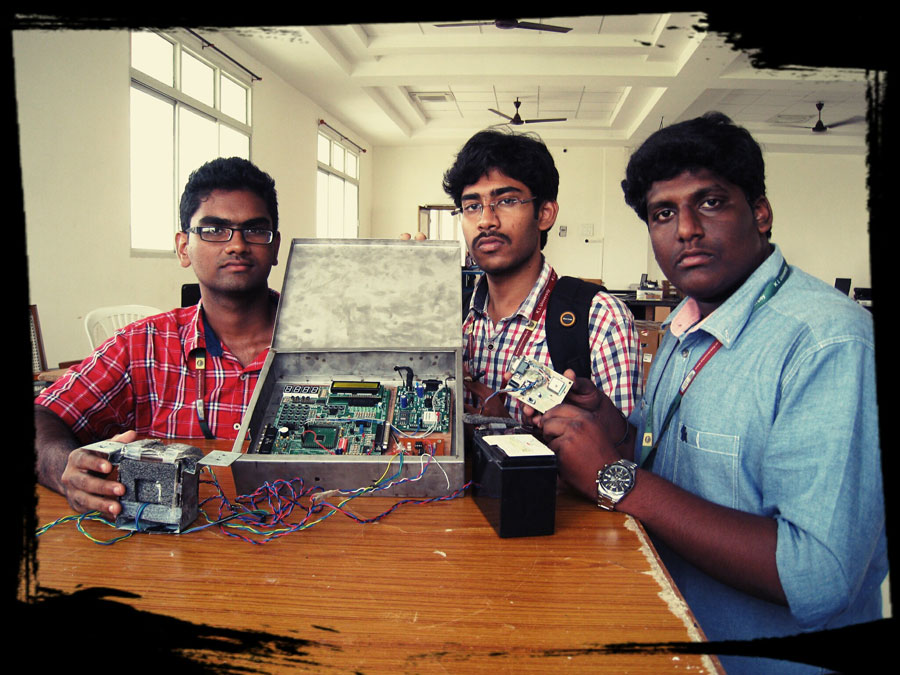
The Blacklist team from KL University, India

Across the board, they are working to make the car of 2030 a cleaner, safer and more enjoyable ride. The shortlisted teams now have until August 29, 2014 to develop a working prototype of their project using €5,000 in funding appropriated to each of them by Valeo. Six finalists will then be selected to present their project to the jury at the 2014 Paris Motor Show in October 2014. Comprised of Valeo experts and outside partners, the jury will be chaired by Valeo CEO Jacques Aschenbroich. The winning team will take home a €100,000 prize and the second and third-place teams will each receive €10,000.

Launched by Valeo in September 2013, the Valeo Innovation Challenge is a global contest open to engineering students around the world, invited to play an active role in automotive innovation by designing the product or system that will create smarter, more intuitive cars by 2030. Nearly 1,000 teams from 55 countries signed up for a chance to propose and develop daring solutions that will revolutionize the car of the future.

In 2013, for the second consecutive year, Valeo was featured in Thomson Reuters’ Top 100 Global Innovators ranking, reflecting the Group’s commitment to innovation. Most of the Group’s research and development programs are focused on the design of technologies that reduce motor vehicle carbon emissions and promote intuitive driving.

The company ranks among the leading patent filers in France and dedicates around 10% of its original-equipment revenue to innovation. With close to 9,000 researchers in 16 research centers and 35 development centers around the world, Valeo has developed an array of innovative products and technologies that represent more than 30% of orders.

Valeo was also awarded the Top Employers label in 18 countries for 2013. The Group plans to hire some 1,000 engineers and technicians a year over the next three years.

Valeo is an automotive supplier, partner to all automakers worldwide. As a technology company, Valeo proposes innovative products and systems that contribute to the reduction of CO2 emissions and to the development of intuitive driving.  In 2013, the Group generated sales of €12.1 billion euros and invested over 10% of its original equipment sales in research and development. Valeo has 124 production sites, 16 Research centers, 35 Development centers and 12 distribution platforms, and employs 74,800 people in 29 countries throughout the world. www.valeo.com


4 Ways to do Good Business

The term “breaking down the silos,” is commonly used in business to illustrate how a task can avoid or reduce duplication of effort.

By taking two teams, for example, that might compete on a project and instead get them to work together and collaborate, the hope is that you’ll get a better output; one that incorporates the best ideas from every employee throughout the company.

Role of business in shaping a better tomorrow

Solutions to the world’s most pressing problems and exciting opportunities are global, interconnected and interdependent. Business’ resources dwarf those of the philanthropic and public sectors combined. All require leaders with vision and capacity to build systems for change across industries and borders. Yet alone, now and in the future, no one of these sectors can put together the social entrepreneurial ecosystems necessary for major innovation and change to work at scale. As global citizens, we must work together to unleash the great potential of the business world in creating social change. How?

1. Break the siloes: intrapreneur, meet entrepreneur!

“While there is a Western business stereotype that celebrates the heroic efforts of the intrepid business entrepreneur” says David Grayson, “a successful social intrapreneur must learn to work in, and then help to create, “ensembles” of like-minded individuals with complementary skills and ideas in order to succeed.” Social entrepreneurs are innovating to create opportunities for low income people. Meanwhile, and increasingly, corporate employees, or ‘intrapreneurs’ are pioneering business innovations with a social impact.  The combination of both can and will be incredibly powerful. We learnt of some silo-busting intra-entre partnerships at this year’s Skoll World Forum:

Kickstart and Citi. Kickstart, a social enterprise that makes low-cost irrigation equipment, has partnered with Citi Group, which provides a line of credit to help Kickstart survive the lumpiness of donor cash infusion.

Embrace and GE. Embrace makes low-cost incubators for premature infants that operate without electricity. They partnered with GE originally to scale up the distribution of their product and give their work more ‘credibility’ in the marketplace.

Root Capital and Starbucks. Root Capital is working with Starbucks to provide financing and capacity support to coffee farmers to help strengthen Starbucks supply chain. They also are working as part of a global consortium of coffee companies and development agencies to address the leaf rust epidemic hitting coffee farmers in Latin America.

2. Convene business leaders: The B Team

While we do not yet have a World Economic Forum or a Davos dedicated specifically to social change; the power, ambition, rigour and relentlessness of the leading few is inciting a movement amongst socially conscious business leaders.  The B Team, co-created by Richard Branson and Virgin Unite, brings together an initial 14 leaders from major corporations around the world, including Unilever, Natura, Celtel, Tata and Kering, in an attempt to demonstrate that long-term business success can be built only by prioritising people and planet alongside profit.

In an interview with Guardian Sustainable Business, Branson says he hopes the B Team will succeed where others have failed by harnessing the energy of a small group of respected leaders who have access to heads of state and other key opinion formers. But rather than go it alone, the B Team is forging partnerships with other organisations such as the World Business Council for Sustainable Development and Ashoka.

3. Co-creation that matters: Danone Ecosystem Fund

Danone chose to go beyond corporate social responsibility by implementing innovative business models that generate social and environmental value in a sustainable way. Danone seeks to address critical issues related to the corporation’s expertise and goals—issues like malnutrition, access to water, sustainable resources management, and sustainable supply and value chains. The Danone Ecosystem Fund is one of these platforms: it supports the partners of Danone’s “ecosystem” (small agricultural producers, small suppliers, proximity distributors) to effect powerful social changes—and reinforces the company at the same time.

The Ecosystem approach promotes open source knowledge in terms of business models and project management: good practices, practical tips, and decision-making tools are being formalised and shared within the business community. Danone’s Guide to Co-creation, is an accessible online tool for anyone to learn more about public/private partnerships and to facilitate co-creation implementation through a structured process.

4. Disrupt the status quo: Open Data, for good

Giant consumer corporations such as Tesco have some of the largest data banks in the world, and this has enormous positive potential. Rufus Pollock, and Ashoka Fellow who runs the Open Knowledge Foundation, is catalysing a global movement that opens raw data sources to larger populations of people.

By democratizing access to data, the Open Knowledge Foundation is creating a global change in transparency, citizen empowerment, social justice, and accountability for policy makers, companies, and those in positions of power. Currently, data is being used to predict and prompt purchasing.

However the potential of this data to map trends and create positive social change is enormous. OKFN has the infrastructure, skills and knowledge to guide companies to use their consumer databanks to bring about positive social change as well as creating a genuine boost to their bottom line.

The stage is set. Business-social collaborations which activate the power of partnerships in creating real social change will be the only way to survive in an age of conscious consumerism. Ashoka’s network is working to define a compelling value proposition for social impact across the business – not just for CMOs, CFOs and CEOs but for all stakeholders. With this in place, social innovation within powerful brands and global corporation will not be sidelined, but core to the longevity and triple bottom line. Article by Felicity McLean, Communications and Framework Change Manager at Ashoka.


Google’s Eight Pillars of Innovation

How does a company like Google continue to grow exponentially while still staying innovative? Susan Wojcicki, Google’s Senior Vice President of Advertising, discusses some of the processes and principles in place to make sure that the company doesn’t get bogged down in the past as it keeps moving forward.

The greatest innovations are the ones we take for granted, like light bulbs, refrigeration and penicillin.

But in a world where the miraculous very quickly becomes common-place, how can a company, especially one as big as Google, maintain a spirit of innovation year after year? Nurturing a culture that allows for innovation is the key. As we’ve grown to over 26,000 employees in more than 60 offices, we’ve worked hard to maintain the unique spirit that characterized Google way back when I joined as employee #16. At that time I was Head of Marketing (a group of one), and over the past decade I’ve been lucky enough to work on a wide range of products. Some were big wins, others weren’t.

Although much has changed through the years, I believe our commitment to innovation and risk has remained constant. What’s different is that, even as we dream up what’s next, we face the classic innovator’s dilemma: should we invest in brand new products, or should we improve existing ones? We believe in doing both, and learning while we do it. Here are eight principles of innovation we’ve picked up along the way to guide us as we go.

1. HAVE A MISSION THAT MATTERS

Work can be more than a job when it stands for something you care about. Google’s mission is to ‘organize the world’s information and make it universally accessible and useful.’ We use this simple statement to guide all of our decisions. When we start work in a new area, it’s often because we see an important issue that hasn’t been solved and we’re confident that technology can make a difference.

For example, Gmail was created to address the need for more web email functionality, great search and more storage. Our mission is one that has the potential to touch many lives, and we make sure that all our employees feel connected to it and empowered to help achieve it. In times of crisis, they have helped by organizing life-saving information and making it readily available. The dedicated Googlers who launched our Person Finder tool (to learn more see Missions that Matter) within two hours of the earthquake and tsunami in Japan this March are a wonderful recent example of that commitment.

2. THINK BIG BUT START SMALL

No matter how ambitious the plan, you have to roll up your sleeves and start somewhere. Google Books, which has brought the content of millions of books online, was an idea that our founder, Larry Page, had for a long time. People thought it was too crazy even to try, but he went ahead and bought a scanner and hooked it up in his office.

He began scanning pages, timed how long it took with a metronome, ran the numbers and realized it would be possible to bring the world’s books online. Today, our Book Search index contains over 10 million books. Similarly, AdSense, which delivers contextual ads to websites, started when one engineer put ads in Gmail. We realized that with more sophisticated technology we could do an even better job by devoting additional resources to this tiny project. Today, AdSense ads reach 80 percent of global internet users – it is the world’s largest ad network – and we have hundreds of thousands of publishers worldwide.

3. STRIVE FOR CONTINUAL INNOVATION, NOT INSTANT PERFECTION

The best part of working on the web? We get do-overs. Lots of them. The first version of AdWords, released in 1999, wasn’t very successful – almost no one clicked on the ads. Not many people remember that because we kept iterating and eventually reached the model we have today. And we’re still improving it; every year we run tens of thousands of search and ads quality experiments, and over the past year we’ve launched over a dozen new formats. Some products we update every day. Our iterative process often teaches us invaluable lessons.

Watching users ‘in the wild’ as they use our products is the best way to find out what works, then we can act on that feedback. It’s much better to learn these things early and be able to respond than to go too far down the wrong path. Iterating has served us well. We weren’t first to Search, but we were able to make progress in the market by working quickly, learning faster and taking our next steps based on data.

4. LOOK FOR IDEAS EVERYWHERE

As the leader of our Ads products, I want to hear ideas from everyone – and that includes our partners, advertisers and all of the people on my team. I also want to be a part of the conversations Googlers are having in the hallways. Several years ago, we took this quite literally and posted an ideas board on a wall at Google’s headquarters in Mountain View. On a Friday night, an engineer went to the board and wrote down the details of a convoluted problem we had with our ads system.

A group of Googlers lacking exciting plans for the evening began re-writing the algorithm within hours and had solved the problem by Tuesday. Some of the best ideas at Google are sparked just like that – when small groups of Googlers take a break on a random afternoon and start talking about things that excite them. The Google Art Project, which brought thousands of museum works online, and successful AdWords features like Automated Rules, are great examples of projects that started out in our ‘microkitchens.’ This is why we make sure Google is stocked with plenty of snacks at all times.

5. SHARE EVERYTHING

Our employees know pretty much everything that’s going on and why decisions are made. Every quarter, we share the entire Board Letter with all 26,000 employees, and we present the same slides presented to the Board of Directors in a company-wide meeting. By sharing everything, you encourage the discussion, exchange and re-interpretation of ideas, which can lead to unexpected and innovative outcomes.

We try to facilitate this by working in small, crowded teams in open cube arrangements, rather than individual offices. When someone has an idea or needs input on a decision, they can just look up and say, ‘Hey…’ to the person sitting next to them. Maybe that cube-mate will have something to contribute as well. The idea for language translation in Google Talk (our Gmail chat client) came out of conversations between the Google Talk and Google Translate teams when they happened to be working near one another.

6. SPARK WITH IMAGINATION, FUEL WITH DATA

In our fast-evolving market, it’s hard for people to know, or even imagine, what they want. That’s why we recruit people who believe the impossible can become a reality. One example is Sebastian Thrun who, along with his team, is building technology for driverless cars to reduce the number of lives lost to roadside accidents each year. These cars, still in development, have logged 140,000 hands-free miles driving down San Francisco’s famously twisty Lombard Street, across the Golden Gate Bridge and up the Pacific Coast Highway without a single accident.

We try to encourage this type of blue-sky thinking through ‘20 percent time’ – a full day a week during which engineers can work on whatever they want. Looking back at our launch calendar over a recent six-month period, we found that many products started life in employees’ 20 percent time. What begins with intuition is fueled by insights. If you’re lucky, these reinforce one another. For a while the number of Google search results displayed on a page was 10 simply because our founders thought that was the best number. We eventually did a test, asking users, ‘Would you like 10, 20 or 30 search results on one page?’ They unanimously said they wanted 30.

But 10 results did far better in actual user tests, because the page loaded faster. It turns out that providing 30 results was 20 percent slower than providing 10, and what users really wanted was speed. That’s the beautiful thing about data – it can either back up your instincts or prove them totally wrong.

7. BE A PLATFORM

There is so much awe-inspiring innovation being driven by people all over the globe. That’s why we believe so strongly in the power of open technologies. They enable anyone, anywhere, to apply their unique skills, perspectives and passions to the creation of new products and features on top of our platforms. This openness helps to move the needle forward for everyone involved.Google Earth, for example, allows developers to build ‘layers’ on top of our maps and share them with the world.

One user created a layer that uses animations of real-time sensor data to illustrate what might happen if sea levels rose from one to 100 meters. Another famous example of open technology is our mobile platform, Android. There are currently over 310 devices on the market built on the Android OS, and close to half a million Android developers outside the company who enjoy the support of Google’s extensive resources. These independent developers are responsible for most of the 200,000 apps in the Android marketplace.

 8. NEVER FAIL TO FAIL

Google is known for YouTube, not Google Video Player. The thing is, people remember your hits more than your misses. It’s okay to fail as long as you learn from your mistakes and correct them fast. Trust me, we’ve failed plenty of times. Knowing that it’s okay to fail can free you up to take risks. And the tech industry is so dynamic that the moment you stop taking risks is the moment you get left behind. Two of the first projects I worked on at Google, AdSense and Google Answers, were both uncharted territory for the company.

While AdSense grew to be a multi-billion-dollar business, Google Answers (which let users post questions and pay an expert for the answer) was retired after four years. We learned a lot in that time, and we were able to apply the knowledge we had gathered to the development of future products. If we’d been afraid to fail, we never would have tried Google Answers or AdSense, and missed an opportunity with each one.

Our growing Google workforce comes to us from all over the world, bringing with them vastly different experiences and backgrounds. A set of strong common principles for a company makes it possible for all its employees to work as one and move forward together. We just need to continue to say ‘yes’ and resist a culture of ‘no’, accept the inevitability of failures, and continue iterating until we get things right. As it says on our homepage, ‘I’m feeling lucky.’ That’s certainly how I feel coming to work every day, and something I never want to take for granted.

This article originally appeared at thinkwithgoogle.com


Is This the End of the Billion-dollar Megaproject Disaster?

The number and costs of megaprojects are so large, and the penalties of failure so catastrophic, that there are signs that governments and private companies may at last be beginning to insist on better governance of these billion-dollar ventures, and to use academic research into the failures of megaproject management to improve practice, believes major programmes expert Professor Bent Flyvbjerg from Oxford University’s Saïd Business School.

In a paper for Project Management Journal, “What You Should Know About Megaprojects and Why: An Overview”, published April 2014, Professor Flyvbjerg argues that we are now entering a new “tera era”, in which projects cost trillions, rather than millions or billions of dollars, and that this represents the biggest investment boom in human history. It is unacceptable for projects of this scale to go ahead based on the under-estimated costs and over-estimated benefits that have been typical of large projects over the past 80 years.

He claims that a combination of increasing private finance in megaprojects, more stringent legislation in most countries against deliberate misrepresentation, and a greater understanding of megaproject failures as a result of academic research are all steps in the right direction for improving the management of these projects. “Although progress is slow, good governance is gaining a foothold even in megaproject management.

The main drivers of reform come from outside the agencies and industries conventionally involved in megaprojects and this is good because it increases the likelihood of success.

The cost overruns (anything between 50% and 1900% according to Professor Flyvbjerg’s figures) typical of these megaprojects come about because of deliberate or naïve miscalculation of costs at the commissioning stage.

While some theorists have suggested that optimistic miscalculations are often necessary simply to get projects off the ground, and that no one would now regret the building of the Sydney Opera House (1400% over budget), for example, Professor Flyvbjerg argues that the consequences of failure on the current scale are too great. In Hong Kong, months of obstacles during the opening of a new international airport made traffic go elsewhere, resulting in a fall in GNP for the entire city state. For Greece, a contributing factor to the country’s 2011 debt default was the 2004 Olympic Games in Athens, for which cost overruns and incurred debt were so large they negatively affected the credit rating of the whole nation.

“For reasons of economic efficiency alone, we must reject the argument that cost underestimation and benefit overestimation are justified for getting projects started. But the argument must also be rejected for legal and ethical reasons,” said Professor Flyvbjerg. “There is an ‘obligation to truth’ built into most democratic institutions that is violated by deliberate misrepresentation of costs and benefits, whatever the reasons for such misrepresentation may be.

Not only does economic efficiency suffer but also democracy, good governance, and accountability.” The UK Treasury now requires that all ministries develop and implement procedures for megaprojects that will curb so-called “optimism bias”. Funding will be unavailable for projects that do not take into account such bias, and methods have been developed for doing this.

The US government is implementing similar measures as are Switzerland and Denmark while, in Australia, the Parliament of Victoria has conducted an inquiry into how government may arrive at more successful delivery of significant infrastructure projects. Similarly, in the Netherlands, the Parliamentary Committee on Infrastructure Projects has held extensive public hearings to identify measures that will limit the misinformation about large infrastructure projects presented to the Parliament, public, and media.

In Boston USA, the government sued to recoup funds from contractor overcharges for the Big Dig related to cost overruns. “Things are moving in the right direction for megaproject management,” said Professor Flyvbjerg. “It is too early to tell whether the reform measures being implemented will ultimately be successful. It seems unlikely, however, that the forces that have triggered the measures will be reversed, and it is those forces that reform-minded individuals and groups need to support and work with in order to improve megaproject management.”

Professor Bent Flyvbjerg is founding chair of Major Programme Management at Saïd Business School, Oxford University. He is the most cited scholar in the world in megaproject management and his work has been featured by Harvard Business Review as “Ideas to Watch”. Flyvbjerg’s books and articles have been translated into 19 languages and his research has been covered by Science, The Economist, The Wall Street Journal, The Financial Times, The New York Times, The BBC, and many others. He has worked as advisor to government and business, including the UK and US governments and several Fortune 500 companies. Flyvbjerg has received numerous honours and awards. He was twice a Fulbright Scholar and holds the Knighthood of the Order of the Dannebrog. Flyvbjerg was Principal Investigator for the dams study. https://www.sbs.ox.ac.uk/community/people/bent-flyvbjerg


0