‘Made in Ethiopia’ Now Means Luxury

Open a box of Enzi shoes and this is what you’ll read on the inside: You have not just purchased a pair of shoes.

You have contributed towards the development of sustainable leather production in Ethiopia. You have invested in improving the livelihoods of skilled Ethiopian factory workers. You have helped to raise the profile of East African design. You have added your voice to a growing chorus of people around the world who are ready to see Africa in a new light. The shoes also happen to be really nice. Enjoy them responsibly.

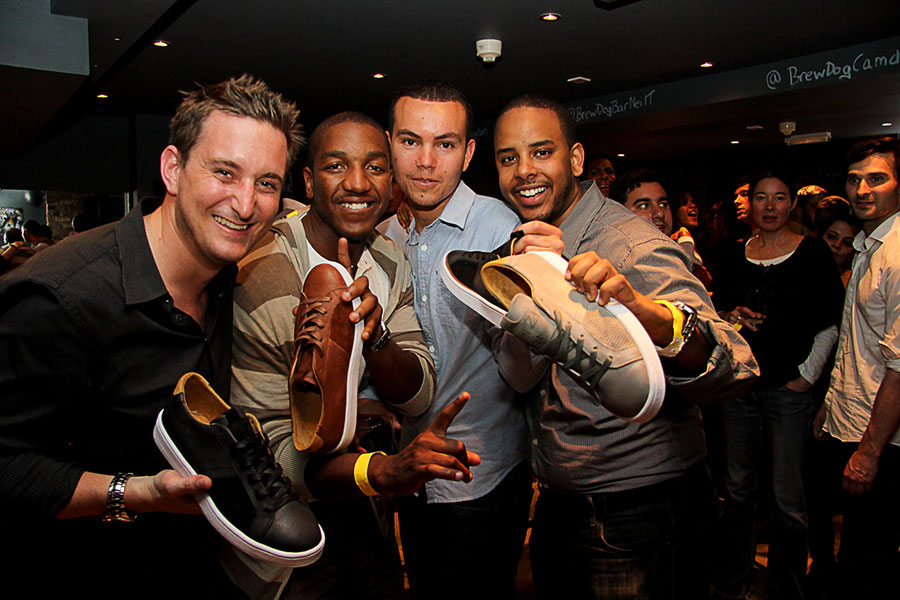
Founder, Sam Imende gives no further instructions on how to enjoy them responsibly, but one can imagine that it might have something to do with walking in someone else’s shoes or becoming more conscious of what you wear on your feet. Having “Made in Ethiopia” stamped on your sole might also be a good start. Long time friends Azariah Mengistu, Jawad Braye, Christian Ward and Imende (pictured above) spent their student days scattered around the world, returning to establish Enzi Footwear in their homeland Kenya.

Their travels had exposed them to luxury leather goods and they couldn’t see any obstacles as to why East Africa couldn’t produce leather goods to a similar standard. The Enzi team are still in their 30s and are driven to change the perceptions the world has of their part of the world. “Most people don’t think of Ethiopia as having the highest quality leather in the world, “ says Imende. “They think of stereotypes established decades ago.” “We saw a lot of potential, creativity and enterprise in the region,” he continues. “Jawad had studied footwear at the London School of Fashion and we decided to build a shoe brand that reflected the standards and quality we knew existed here.”

Africa is known as a resource rich region but much is exported and sold in to higher end markets without the source getting any recognition. Imende and his team set out to turn the spotlight back on Africa. Their neighbour, Ethiopia, seemed to offer the best manufacturing facilities with surprisingly good tanneries. The best thing about quality Ethiopian leather is how beautifully it ages and Enzi’s entry leather sneakers, starting at $125, are a serious fashion investment. Imende easily found the talent and excellence in Ethiopia to get their venture off the ground; indispensable artisans such as seamstresses and pattern cutters; but underestimated the need for a production line manager, someone to constantly supervise the overall quality.

If you’re selling shoes at a premium price into developed markets you need more than just a catchy “African tale.” Your products must be flawless. One of Imende’s survival strategies has been to collaborate with established companies. A French-Canadian company based in Ethiopia shared information on labels and soles with him and a factory in London was open to forming an incubator-type relationship with Enzi. One of the biggest incentives has been from the government itself. A long-time exporter of high-grade raw leather to Japan and Italy, the Ethiopian government wanted to retain a higher margin at home and introduced a tax of up to 150% on raw exports, whereas the export of finished goods attracts a tax of 0%. immense Ethiopia From the start Kenzi has run their business in a way that creates social impact.  Going beyond fair pay, they pay factory workers a percentage of profits and strive to operate a completely transparent supply chain. Imende has a background in microfinance and has considered ways in which the company can evolve into a lending circle for the benefit of workers.

A pop up shop they created in Nairobi saw 10% of proceeds going to school students who couldn’t afford their fees. “It’s been trendy for a while now to be green and integrate social enterprise into your business,” muses Imende. “But we’ve found that these types of considerations actually go hand-in-hand with delivering a quality product. For us, this should be the norm.”

The tannery Enzi works with recycles a lot of their water, and highly toxic chemical by-products, such as chrome, are being effectively filtered to avoid poisoning local waterways. Luckily, fashion trends have also swung onto a more natural aesthetic and the more natural leather treatments they use have become the norm. The touch and feel of Enzi shoes hasn’t been lost on their customer’s either, who value the authenticity of leather that hasn’t been pickled to death. Imende’s vision for a more sustainable business hasn’t been without its pitfalls.

“Many factory managers can’t understand why there should be any incentive for workers at all,” he says. “They expect the goods to be made to a workers best ability regardless of whether they will be paid more or not.” The retail industry works on slim margins and by default has low paying jobs. Imende has seen some workers leave to become housemaids because it paid more. India and China have also established large production factories around the capital Addis Ababa, taking advantage of the aforementioned tax breaks, adding to an increasingly crowded market. enzi_shoe Ethiopia Yet, despite the challenges it’s sometimes not monetary incentives that work with employees. “It’s about creating a cooperative ownership scheme and finding ways to make staff feel valued,” says Imende. “For example, on each box we send out, we have an employee sign their name, “as made by…” and they take a lot of pride in that. It’s their handcraft that’s being exported to London and Hong Kong and sometimes a subtle thing like this can go a long way in fostering loyalty and pride.” Richard Branson and brands such as Nike inspire Imende.

“They both take a bit of risk and are very driven to build their brands,” he says. “The teams they work with are incredibly talented and I love the way they connect with consumers, particularly Nike’s relationship with athletes, skaters and musicians. You’ll occasionally see a campaign that looks completely off-brand, but they’re building a brand that really resonates with the market and pushes boundaries. They’re in touch with their end-user,” says Imende. Perhaps Enzi might take their slogan “Made in Ethiopia” one step further by adding “Pride Inside” to each of the boxes that now ship to Paris, London, Hong Kong, Sydney and New York.

What do you think? Is Africa “The Next Big Thing?” Comment below. To be notified of more stories like this, sign up for our free Weekly Words of Wisdom (WOW) emailer here

 

A Tribute to David Goldberg

On May 1, 2015, David Goldberg collapsed at a private beach-front villa near the Four Seasons Resort in Punta Mita, near Puerto Vallarta, Mexico, during a vacation with his wife Sheryl Sandberg, COO of Facebook. He died later that day at a hospital in Nuevo Vallarta. According to the Nayarit State Prosecutor’s Office, Goldberg fell off a treadmill while exercising at a gym and died after suffering head trauma and blood loss. Goldberg’s brother, Robert Goldberg, in an article written by Tim Bradshaw in San Francisco for the Financial Times, described his family’s “incredible shock and sadness”, in an online post asking well-wishers to post photos and memories to his Facebook profile page.

“In lieu of donations, we want to celebrate his life in a manner that respects the family’s privacy as they cope with this tragic, life changing event”, Robert Goldberg wrote. Tributes to Goldberg were posted to social media across the Silicon Valley community. A spokeperson for Facebook said its executives were “heartbroken by this news.” Mark Zuckerberg, Facebook’s chief executive, said in a post that Goldberg was “an amazing person and I am glad I got to know him”.

“One of the truly great people on the planet, Dave was of almost unimaginably remarkable character,” said Dick Costolo, Twitter’s chief executive. “One of kindest and most generous friends I’ve known,” said Jeff Weiner, chief executive of LinkedIn. A memorial service for Goldberg was held at Stanford Memorial Auditorium on the Stanford University campus and the 90-minute service was attended by many members of what Fortune described as “the elite of Silicon Valley”, as well as U2 frontman Bono, who performed his song “One”, and actor Ben Affleck, who had worked with Goldberg on a philanthropy project in Africa. Goldberg was born in Minneapolis, Minnesota on October 2, 1967.

His mother Paula Goldberg is co-founder and executive director of the Pacer Center and his father, Mel Goldberg (1942-1998) was associate dean and professor at the William Mitchell College of Law. Goldberg worked for Bain & Company for two years after graduating from college. He had planned to attend law school but instead joined Capitol Records, where he served as director of marketing strategy and new business development. He founded LAUNCH Media in 1994, and led it through its acquisition by Yahoo Inc. in 2001.He quit Yahoo in 2007 and joined Benchmark Capital after which he joined SurveyMonkey in 2009. In 2004, Goldberg married Sheryl Sandberg, with whom he had two children.

Good Health Equals Good Business

When last July, Carlos Slim (pictured above), one of the world’s richest tycoons, called for the introduction of a three-day working week with everyone working approximately 11 hours day as a means to improving employees quality of life and generate greater productivity, business leaders took notice. His eye catching suggestion, matched with raise in the retirement age to 70 plus with more time off, was a further sign that the domain of well being at work, work life balance, and so forth was truly emerging from the relatively narrow world of human resources and unto the centre stage of CEOs and those charged with the overall strategy.

Mr Slim’s recommendations were interesting from two angles. First, replacing the traditional five or six days with a three-day week was an innovative suggestion on how best to allocate our time around work and the fulfilment of greater happiness. But just as interesting, was the linkage he made between improving conditions around wellbeing with the overall improvement in productivity. For many traditionalists, a long working week naturally equated with greater output.

But here was a top leader saying hang on, that might not be the case. On the contrary, if we restructure our working week towards working in more intensive bursts followed by longer time off, we may not only have more free time but output and performance could actually increase as well. This linkage between wellbeing at work and business performance is at the heart of our work in the new Global Centre for Healthy Workplaces. Good Health = Good Business is our mantra.

Shortly we will be hosting the 3rd Global Healthy Workplace Awards Summit at Florianopolis in the beautiful Brazilian state of Santa Catarina. Previous Summits were held in London and Shanghai. The Summit will bring together experts from around the world including some 50 CEOs for two days where the latest innovations and concepts in workplace health will be examined.

The centre piece of the event will be the presentations from the six finalists who are GlaxoSmithKline (UK), Chevron (USA) (multi-national category), Unilever (Brazil), Vanderbilt University (USA) (large employers), and SMEs, who often take a highly original approach will be led by Lan Spar Bank (Denmark) and Naya Jeevan (Pakistan). The six have been chosen from entries in almost thirty countries, making it a truly global representation of world class employment.

The purpose of the Awards & Summit programme is to encourage the sharing of better practice and stimulate new thinking. Attracting a diverse range of interested parties from commercial to NGOs is important and Florianopolis, as Shanghai before, will hear the perspective of investors. A series of new initiatives will be announced in Florianopolis to further improve the quality of workplace health. These cover a new global accreditation programme to ensure standards are high and maintained.

A new digital guide for SMEs, perhaps the sector of greatest need and expansion is being planned and we will shortly be publishing an E-course for professionals in partnership with the University of Arizona Eller Business School. Developments amongst academics also forms part of our work, essential for the improvement in research and to demonstrate the productivity benefits to the latest thinking in business schools.

Workplace health and wellbeing is a varied specialism reaching into most elements that make up business performance. But what is the greatest concern for employers in the modern world? According to our latest global survey with Buck consulting, it is stress, but you probably guessed that anyway.

Article by Tommy Hutchinson & Wolf Kirsten, co-founders of Global Centre for Healthy Workplaces. To find out more and to register for the Florianopolis Summit – click here

How to Create a Women-Friendly Workplace

Last night I served on a panel discussion in front of hundreds of women working for a well-known global tech company. I gave them three specific habits designed to evolve their culture to a higher state. (More on that in a minute.) The challenge topic was “How can women better support each other in the workplace?”  The topic is hot for three reasons. They are supported by studies from firms like McKinsey that clearly show that corporate cultures are biased against women in three ways:

  1. Advancement and leadership opportunities strongly favor men because of the mistaken belief that dominant male (hard power) traits of assertiveness, confidence and decisiveness actually define superior leadership. This is simply not true. A meta-research analysis reported in the Journal of Applied Psychology of over 95 studies on leadership show that these factors do not predict effective leadership. (Iraq war anyone.) What they do predict is dominance. Nevertheless, evolutionary anthropology has seemingly wired our brains to mistake dominance for leadership. That’s a problem.
  1. Organizations favor people who dedicate virtually all their time and attention to organizational priorities in urgencies. It is well documented that women have a disproportionately high “home workload.” The traditional roles of childcare, managing the household, cleaning and cooking etc. mostly fall to women. Due to their higher levels of hormones related to empathy and nurturing they also take on greater emotional responsibility for the development and well-being of their children and loved ones. Yet in many organizations the idea of work-life balance is ridiculed as a failed ideal. In these organizations women are told that they can receive the same opportunities as men when they make the same commitment to their work. This might be legitimate if the contributions that women make at work were interchangeable with men’s contributions. If leaders of organizations do not believe that women’s holistic thinking and soft power traits of social intelligence, active collaboration, and value driven innovation bring a distinctive competitive advantage they will treat them like interchangeable miners in their salt mines.
  1. The third reason is perhaps the most frustrating.  My decades of experience helping companies navigate the stormy seas of cultural evolution and leadership excellence have revealed a disturbing observation. Generally, women are not proactive advocates of their distinctive value. And they seem reluctant to actively support other women as they ascend into leadership. Of course there are many exceptions to my last observation but it is what I see too often. I have noticed that women seem very comfortable working in peer teams. Yet if one is chosen to become a leader often the un-chosen women begin to distance themselves and even become critical of their former peer. This even has a name. It’s called the prom queen effect.(This is when a group of high school girls become jealous and gossipy when one of them becomes the prom queen.) This of course is not exclusively a woman problem. Men are frequently dysfunctionally competitive and downright cutthroat with their male colleagues. What disturbs me about women behaving this way is that they need all the mutual support they can get as a disadvantaged group.

So this is what I told hundreds of extremely smart professional women last night. There is ample proof that having significant numbers of women in all levels of leadership lead businesses to have distinct competitive advantages, especially in innovation. (A good starting place to examine the research is found in the Strategic Management Journal, September 2012.) Proactively working together to create a culture that approaches work achievement through the feminine strengths of holistic thinking, inclusion, and agile collaboration is a very smart thing to do…not just for women but also for your enterprise. Now here are the three simple habits I told last night’s audience that they can start doing to drive their culture forward:

  1. PLUS: Women need to “plus” each other. This means when you’re in a meeting and one of your female colleagues makes a suggestion or offers an insight that you immediately seize on the kernel of wisdom and “plus” it. You give her attribution by name saying something like this… “I think Kathy’s point that a root cause of missing deadlines may be not having the entire team meet together often enough is right on target…” then proceed with your point which builds on Kathy’s. The key to “plussing” is using the person’s name that you were trying to amplify and linking your point to hers. “Plussing” each other is very important because women report they often feel invisible in meetings. They tell me that they will frequently make a suggestion that no one even acknowledges. Then three minutes later a male will make the same suggestion and all of a sudden that male becomes the smartest person in the room. This, they tell me, is very frustrating!
  1. PUSH: Women need to push each other to take on greater responsibility and “sell” their good ideas. As I’ve written before, there was a mistaken notion that women are less confident than men. The research actually says that women only behave less confidently. Internally women are just as confident as men in their ideas, perceptions and decisions. Yet women are less likely to assert their points of view, ask for a promotion or take an unpopular position. For women to make a positive impact on organizations they need to push each other to say what they think, present their ideas, voice their criticisms and contribute all that they can. So when women hear other women expressing doubt as to whether they should “go for it” they need to push each other upward.
  1. PROMOTE: Women in leadership positions should promote the careers of other women. The best women leaders I have worked with have aggressively and consistently fought for big opportunities for younger women to leapfrog forward in their careers. It is very encouraging when a young woman knows that her career opportunities are being promoted when she is not in the room.

If you are a woman in business you are in a disadvantaged group. A minority group is disadvantaged when treating them equally to the advantaged group perpetuates unfairness. In most business organizations work-obsessed males have set the standards of success behavior. As long as those standards and expectations are unquestioned women will be disadvantaged. Yet women do not have to be victimized. When they act together using the simple habits of PLUS, PUSH and PROMOTE they can change the business culture. And that would be a big PLUS!

Why You Are Blind to Opportunities

I just got a whole lot smarter by understanding more about what makes me dumb. I just got back from a three-hour workshop presented by Mahzarin Banaji, who is an award-winning Harvard professor specializing in how our brain biases secretly control our thinking. Her book is called Blind Spot, Hidden Biases of Good People.

We all have opinions that are not based on facts or direct experience but rather on thinking shortcuts.

She makes the case that the smartest thing each one of us can do is face the fact that we are all irrationally biased. We all have opinions that are not based on facts or direct experience but rather on thinking shortcuts. You see thinking takes a lot of energy and discipline but our brains are built for efficiency so it is always designing shortcuts. The name of these mental-shortcuts is stereotypes.

When we hold tight to stereotypes they become prejudices.

When we hold tight to stereotypes they become prejudices. Once we have a prejudice we’re constantly selecting evidence to support our prejudice so we don’t have to go to the effort of opening our minds to new data or considering that in this specific case, what is usually true is not true.

So when we see people that are a lot like us we tend to trust them.

These thinking shortcuts of stereotyping and prejudice are difficult to tame. We have spent thousands of years finding security believing that our tribe offers protection from other tribes who want to kill us and take our stuff. So when we see people that are a lot like us we tend to trust them. When we worry about people who do not seem to be a lot alike us as to how they look, what they like to eat, how they like to live, or appear to have different standards and values, we seek to protect ourselves. This is the natural state of human emotions…and it is increasingly dysfunctional. Never before in history have human beings been exposed to so many other human beings who are not like us. I grew up on a ranch near a small-town populated by Leave it to Beaver families.

Yet, today my grandchildren attend schools with multi-ethnic students, some who have come from parts of the world that I have had no desire to visit. I did not know that homosexuality existed in human beings until I was 16. I did not have any gay friends until I was in my 50s. I did not have a serious understanding of non-Christian religious beliefs until I was in my 40s. I think my mind has been more challenged in the last 15 years of my life than in the previous 50.

And that is simply awesome because it forces me to literally… stop and think. Professor Banaji points out that we live in an age where political correctness has made explicit forms of bias relatively rare. We don’t openly talk about feelings of racism, or why we have a hard time believing that women would be successful CEOs or Presidents. But her research conclusively points out that our implicit biases and prejudices are pervasive. We simply have automatic preferences toward people who look like us, act like us, and seem to believe what we believe.

We simply have automatic preferences toward people who look like us, act like us, and seem to believe what we believe.

As many of you know I constantly deal with unconscious bias as I help women advance in leadership. Most men have a strong belief that typical male behaviors of assertiveness and taking control is ideal leadership behavior because that’s what they are biased to believe from working in business structures that favor those behaviors. So they tend to give women who act in these “male” ways more leadership opportunities. The problem is our research (Apple to Zappos) clearly indicates that in today’s radically competitive business environment, old-school, stereotypical male leadership is more likely to fail than succeed. And yet when women who use male leadership strategies fail, the secret opinion of many males is that the core cause of failure is that women are not “strong enough” to be effective…as if the male style of hard power causes effectiveness.

What is true is that hard power style seems to create efficiency and quash innovation.

What is true is that hard power style seems to create efficiency and quash innovation. The new book, Becoming Steve Jobs: The Evolution of a Reckless Upstart into a Visionary Leader is about the transformation of Steve Jobs and shows that his later success was not driven by his previous hard power craziness, but rather his evolution to an empowering collaborator…which are more typically female traits. What impacted Jobs to overcome his previous blind spot is the humility that comes from failure and the SMART Power modeling of Pixar CEO Ed Catmull.

Our own growth comes from opening our minds to new possibilities.

Our own growth comes from opening our minds to new possibilities. Economists have discovered that opportunity is usually a function of seeing what was previously unseen but is right in front of us. Our unconscious bias is psychological blindness. We literally don’t see opportunity when we are either judgmental or fearful. The only solution to overcoming biases is to become more aware of what they are. When you feel yourself making snap judgments ask yourself… “What if the opposite could also be true?” The question I came away with from Dr. Banaji session is “What am I blind to?”


Why Your Loyalty Might Be Killing You

Loyalty is the most overvalued value. The plea for loyalty is almost always invoked when loyalty is not deserved. When people demand your loyalty what they’re usually trying to do is escape accountability. I am not saying loyalty has no value but rather being loyal to people and organizations who do not keep their promises, maintain standards, play favorites or exploit you is self-destructive. Being loyal to the undeserving is also bad for society because tolerating bad behavior actually condones it.

I am not saying loyalty has no value but rather being loyal to people and organizations who do not keep their promises, maintain standards, play favorites or exploit you is self-destructive.

So consider this… Would you be loyal to a group that: constantly pressures you to do more and work harder regardless of its impact on your health and well-being? rarely listens to your requests or acknowledges your efforts? issues demands for greater goals, in less time with fewer resources? rewards other people primarily because they are aggressive and self-serving? demands that you follow work processes that consistently create errors and require rework? keeps you in a constant state of stress and uncertainty over job and income loss due to job consolidations, workflow automation, re-organization and potential mergers?

I sincerely hope this does not describe your work life. But it does for many of the employees of the companies where I consult. It wasn’t always this way. It is entirely unnecessary. And even though it is exploitative and abusive we have come to expect and even accept it as an unavoidable reality. It is called mal-adaptation. It means that we get used to things that we should not accept. We see it clearly in abusive family relationships. It happens because a spouse believes that loyalty is more virtuous than self-respect. Because of fear we cling to loyalty as we reduce our expectations and throw away our standards.

Unfortunately our loyalty persists even if we end up in the hospital or others in our family are being abused. And the more we accept what should be unacceptable the more our self-confidence, pro-activity and creative problem-solving diminish… until we think “I have no choice.”

And the more we accept what should be unacceptable the more our self-confidence, pro-activity and creative problem-solving diminish…

Believing you have no choices is hitting rock-bottom. It is easy to believe you have no choice when you’re trapped in a work culture that is controlled by external forces that has no empathy for you as an individual, but rather sees you as a cog in their financially driven machine. The stresses and sacrifices you are expected to make are unlimited. One organization I know is currently requiring project teams to hold 90 conference calls three nights a week in order to achieve wildly unrealistic goals as they spend their days putting out fires that they create from making stupid decisions because they’re so damn tired.

This course started several months ago as an exceptional response to business emergencies. Now it is the way that managers are expected to work. Crazy has become normal. If you wonder why most corporations are unhealthy places to work I’ll explain. The renowned Cooper Clinic in Dallas now estimates that 54% of people who work as business managers will die from stress-related diseases caused by their work life.

The renowned Cooper Clinic in Dallas now estimates that 54% of people who work as business managers will die from stress-related diseases caused by their work life.

The primary cause is Wall Street. And no I am not a communist. I am a genuine capitalist who believes that the purpose of business is to improve the economic well-being and quality of life for all stakeholders. But that is not what Wall Street believes. It believes the purpose of business is to create wealth for stock traders. Notice I did not say investors. According to economist Michael Hudson the average length of time a stock is now held is 22 seconds. This seems incredible but he claims that due to computerized high-speed trading the sheer volume of stock churn makes this possible.

Fifty years ago the average length of time stock was held was eight months by mutual funds and over seven years by individuals. Treating stock traders as investors is ruining capitalism. Here’s how it’s happening. According to economist J.W. Mason in 1970 corporations invested 40% of their profits and borrowings into research and development, buildings and equipment, and hiring and increasing wages. Today they spend about 10%. Where do all those lost billions go? The profits that today’s employees are literally killing themselves to make are temporarily juicing the stock through corporate stock buybacks, paid out as dividends or extravagant executive compensation. That’s what happens when you let finance takeover true capitalism. All this became possible when the financial markets were deregulated in the 1980s and Wall Street moved to K Street in Washington D.C.

The cruel irony of financial greed is that by restraining wage growth our system is also restraining demand for goods and services because fewer people have the money to pay for them.

The cruel irony of financial greed is that by restraining wage growth our system is also restraining demand for goods and services because fewer people have the money to pay for them. Over a century ago Henry Ford raised the daily wages of his workers from a $1.50 a day to $5 a day because of the dramatic increases in productivity due to the assembly line. He also did it because he said it only made sense that his workers could afford to buy the cars they were making. His fellow industrialists hated him and labeled him a socialist. It’s so strange to me that we would come so far as a society and then seem to have devolved into a version of the Middle Ages when aristocrats had great farms run by fear driven overseers who intimidated the peasants to create more for the nobility.

If an organization is unwilling to provide conditions under which you can do satisfying and productive work, find an organization that will.

Maybe that’s a little dramatic but I say it to make two points. First, don’t mal-adapt! And don’t be loyal to organizations that do not deserve your loyalty. If an organization is unwilling to provide conditions under which you can do satisfying and productive work, find an organization that will. There are plenty of people who love their work and have healthy working conditions. Economist John Asker points out that privately held firms invest twice the percentage of their assets into future growth than publicly traded companies. Go on glassdoor.com and find companies where people truly love their work and how they’re treated.

What I found is that the biggest wake-up call for senior executives to change the quality of work-life is when their most talented people walk out the door. So if you’re working in a salt mine do your coworkers a favor… get a better, happier job. My second point is that smarter people need to take over the economy. We need smarter people, as in better people, becoming leaders of our biggest institutions. That’s one reason why I am so engaged in helping more women get in to senior roles so they can change the future. As I’ve written many times it’s the reason our economy is so underperforming and that our priorities are so shortsighted.

It is a biological fact that female brains are designed to be more holistic and future focused than most male brains. I really don’t care what gender you are, what I care about is that wise and competent people with moral ambition rise up. There are very few people at the top who have the perspective or the desire to make the changes that need to be made. It is up to us.

There are very few people at the top who have the perspective or the desire to make the changes that need to be made. It is up to us.

You can start that today. Be a force in your workplace. Advocate for goals that create real value, and processes that make work easier. Advocate for real wage growth that is consistent with your organization’s success. Advocate for a work life that promotes positive well-being. And please don’t just “lean in” and work harder to make a broken system less toxic. Change the damn system.

Google Values the Power of Speed

In a world undergoing constant changes life is a constant learning journey. What we know and understand today may not hold true tomorrow; policies may shift, structures could have collapsed, theories may be disproven, competitors might be on the rise. No matter how many accomplishments are entailed in our bio, therefore, we still have more to experience and absorb. Consider how interactions encourage the adaptability of thoughts, inspiration for goals or a change of heart. Often times it is this shared communication that allow us to understand, alter or challenge a perspective.

Our relationship to the social and material world facilitates a certain awareness – one that might adjust. In 2012, when I was working in Argentina, I had the opportunity to hear two entrepreneurs express their experiences. Especially as an young entrepreneur myself, I admire understanding others path to success.

The first speaker was Mike Cassidy, current Vice President of Google and start-up founder of Ruba, Xfire, Direct Hit and Stylus Innovation. It was a rather intriguing theme set for his presentation: speed. Why speed?

  • It makes it difficult for competitors
  • It builds a strong team set up for success
  • It generates press
  • It is a valuation of the company

He explored how start-ups endure a common process – from idea to financial and labor support then onto the creation of a product. Most ventures generally find that 23-27 months would be an appropriate allocation of time. This is about two years of extreme hard work and much patience all driven by the passion. Yet, Mike Cassidy explained that his personal time for each of the four successful start-ups, he spent 1/6 of the time on the above process. Four months. When exploring ideas, you cannot allow yourself enough time to talk yourself out of an idea.

When raising funds, you want to do it when the conditions are in your favor. To expedite the managerial and creative process, have all the decision makers of your team in one room; there’s no point in calling a meeting when a valuable voice in not present. Competition additionally needs to be considered. So, synchronize the timing of competing offers. Always be aware of who you are up against and be one step ahead.

If your process is faster than your competition, you will automatically be one step ahead! Lastly, make if/then contracts. He put this into context by suggesting that if his company was going to provide search engines that can perform x feature, then will you buy our product for feature, then will you buy our product for y amount? Of course this is a non-binding agreement, but he has found that it instantly hooks people. Next phase, an incredibly short process of 2 weeks he offers, is building a team (including both the people and physical location). The hiring process requires you to get experienced developers whom you may or may not know. A day in the life of a Cassidy interview is simply just a day.

If he finds the applicant as a suitable potential employee, Cassidy would call shortly after getting a background/Facebook check and call the applicant’s references. If all goes well, the offer is on the table, and not even a 24 hours later he expects a decision. In some cases, Cassidy might even ask the interviewee to join him for dinner in order to get to know the real person behind the CV paper. It’s the excitement of one day, quicker than flying to Australia from Chicago. There is not much time to daze off or push off tasks. Priorities are set quite high, and there’s an expectation of rapid growth and action. If you don’t yet see why speed is so important, he elaborated that the probability of a deal closing declines by 10% each day it doesn’t close.

Speed? Yes, speed means you can’t spend as much money, you can’t hire as many, etc. He ended with saying that if you see it, you’ll believe it. Josh Silverman, former CEO of Skype and current President (of U.S. Consumer Business) of American Express, took the stage after Mike Cassidy. He began by revealing that he had aspired to create positive change. Personally, living abroad and having access to a service like Skype have had a major social impact on my life; the interconnectivity and cross-communication that is now possible is incredibly transformational. He gave some insight into how he operates, and perhaps how he got to where he is today. Take advantage of crisis, “never waste a great crisis.”

During the time of heightened tensions and extreme pressure, the truth comes out. People are directed to reflect and realize what should have been done, and come together to brainstorm what can be done now too. So a technique he often practices, during the high times. This allows for a keen awareness to circumstances and functionality. A series of what if questions are ways to advance and get ahead of the game. It’s about how to play the game, and the players of the game.

So he began to highlight the difference between being a founder and a CEO. Being a founder means that you have a special understanding of the brand and product; you are unusually in power and are able to take bigger risks because of that. When you are a CEO, on the other hand, you are an employee, and you report to a board. To reiterate, that reduces some of your freedoms or authority. Additionally as a CEO, there is a bar of excellence that you are expected to achieve.

A common denominator for both CEO’s and founder is the inherent aspect of leadership. When you’re a leader, Silverman explained, people look to you. They look at everything you do: body language, actions, behavior, mood, attitude and confidence. He said that being the youngest “in charge” of people his brothers age, for example, the pressure was high and he began to recognize the significant influence the frontrunner has the rest of the organization.

He could feel the difference within the group on days that he was in a good mood versus the days when he was a little frustrated. There is a certain degree of responsibility integral to being a leader. In business, others adhere to a leader’s opinion or decisions, and tend to follow the values and environment created.

He argues, therefore that this is the reason people are born to be leader. As people with influence, it is up to us to determine how we use that power. We must remain cautious, on point and aware. To create change and to generate impact, well that lies within us. So on our journey throughout life, as we begin to make shifts in the world, the world mutually guides changes in us too.

Be open to listen and learn from others but be aware others are listening and learning from you too.

Creating Global Well-being Through The Economy

Robert Rubinstein is the CEO of the TBLI Group, dedicated to raising awareness and educating financial professionals on the benefits and opportunities of sustainable investing. We asked him how it started and where he’s going.

How would you describe your venture?

TBLI is a pioneer of sustainable investing with a proven track record. TBLI GROUP moves private capital towards sustainable liquid and illiquid investments by focusing on what really moves markets: self-interest, opportunity and money flows. Combining eco-effectiveness with market rate returns, TBLI makes the case and the connections for smart sustainable investment. Our activities and products include networking events, advisory services and a knowledge center highlighting scalability and best practices.

We have established one of the largest international networks in the sustainable finance sector with these objectives: firstly, to provide education, and secondly, to help move private capital towards sustainable investment. Sustainable investment (ESG and Impact Investing) is a key driver for sustainable development. It has beneficial effects on such global problems as poverty and climate change.

Our vision is a world that benefits when the economy creates well-being TBLI Group is dedicated to raising awareness and educating asset owners and managers on the benefits and opportunities of sustainable investing. The aim is to maximize investment flows into sustainable projects and new sustainable businesses.

What was the first memory you have that made you want to make a positive difference in the world?

I think I always had that. I probably got it from my parents. In all my jobs, I found integrity and doing the right thing essential. Showing some moral leadership was always important. I think the trigger for me with respect to being a social entrepreneur was when I was in publishing. I had started a bicycle magazine and that was a financial and spiritual success.

The next publication was a spiritual success but a financial disaster. During that period I was introduced to Social Venture Network, a network of companies that felt that business had an important role to play in improving society. After going to one event, I was sold. I needed to use entrepreneurial skills to develop a for-profit enterprise that provided a social and environmental added value.

What held you back? What were your fears of taking that on?

Nothing held me back. As soon, as the one publication failed financially, I jumped in to create the first European magazine on Sustainability. Basically how to integrate profits and principles. What was holding me back was being in a place I didn’t want to be. Namely, doing a project or running a company in an industry I didn’t like, and doing what I hated.That was publishing a cooking magazine in an industry dominated by processed food advertisers. I really didn’t want to be there. That ultimately led me to sustainability. First through Source Magazine, which evolved in to TBLI – Triple Bottom Line Investing.

Who encouraged you to step up and become a real leader?

No one. I felt that is what would give me fulfillment.

What was it like, stepping into that new world?

Great. I felt like someone had removed weights from my legs and I could fly. I had a great deal of energy and was doing what I loved to do. Unfortunately, I was so excited about the launch of Source Magazine, that I accepted starting with only 1/5 of the money I needed. That was a mistake. Not having the resources to properly do the marketing in publishing was a mistake.

What was the biggest challenge?

Not enough money to launch the magazine. In spite of receiving only 1/5 of the budget I needed, we were breakeven within 2.5 years. However, the investors felt things were going too slow and pulled the plug when I was on holiday.

Who were your greatest allies?

Professionals who were looking for fulfilment and felt that it was possible to make money and have a higher purpose. Corporates that were looking for strategies to motivate staff and attract talent.

What was unique about your strategy?

I think the marketing strategy that I implemented as a result of not having the resources I needed was quite innovative. We gave away 125,000 copies of the first magazine but only through a recommendation. Anyone could send us a list of people that they felt would appreciatee receiving a copy of Source. We made a special wrapper for sending the magazine with the name of the person who was sending them a copy. This built up our database and because our distributed circulation was so high, we sold quite a bit of advertising to cover the launch costs. If we did a normal direct mailing that would have cost us much more.

Was there any point where it appeared you might fail?

Ultimately the publication failed as the investors pulled the plug. With respect to my present company TBLI Group, there were several moments. I had to be hospitalized for 10 weeks and undergo open heart surgery one day before leaving for Asia to organise our TBLI Conference. Another was during the Tsunami in Japan, when we were hit hard financially, with all sponsors pulling out and a drop of 65% in attendance. When the bank cancelled our credit and all the cashflow we had went to pay the overdraft. This left us with no working capital. These events tested our grit and resolve to the maximum, but we always overcame and continued.

How did that turn out to be a good thing?

It forced us to be more innovative and creative in running our business with far fewer resources, reinvent our business model and drive down costs. We created an entire new model where the leading business schools partnered with us to host our event. This took away the need to spend so much time chasing sponsors to cover the high location and other costs. In addition, we were finally able to monetize our relations by creating strategic partnerships with leading asset owner networks to use TBLI as a convening venue for their members. This brings us asset owners and expands our sales and marketing without additional costs.

What is your most significant accomplishment as a leader so far?

I would say TBLI has been one of the most important driving forces in educating the financial sector about sustainable investments. Raising awareness among the financial sector on investments that improve the social and environmental balance as well as providing a financial return, is absolutely critical. However, the value we create is for the commons and hard to capture, which is why most don’t do this work. It’s heavy-lifting and hard to capture the true value. I think with the rethink we have done the last year, we will be able to capture the value and monetise our relationships.

What is the risk of it being undone?

I don’t see it being undone. I think the risk is how quickly TBLI can find additional funding sources through more paying attendance, sponsor money, turning opportunities we have from our vast network into concrete paying advisory mandates or investors (which we have now found) to continue and expand this work. To guarantee that we continue to play an important role in this financial sector, we will be launching an online community membership to offer a host of services, including access to events, social network, management briefing, retreats, business contacts of experts for the financial sector and education with certification.

What is the most valuable lesson you have learned on your journey?

Never give up, don’t believe what most people say, and get management partners that are complimentary and share your culture and vision. Follow your heart and your passion.

www.tbligroup.com

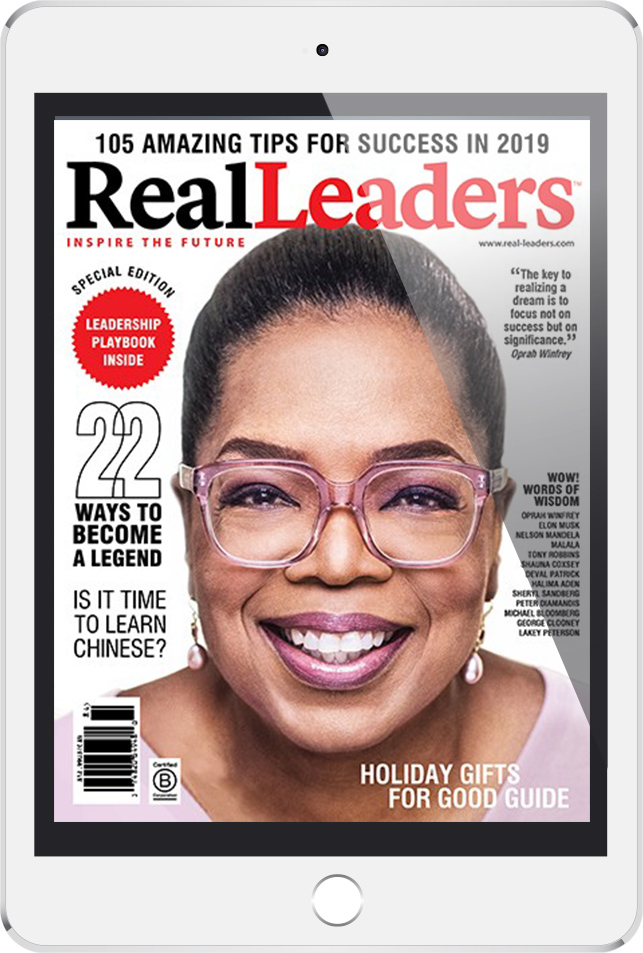
The Oprah Effect

Born into poverty in rural Mississippi to a teenage, single mother, Oprah Winfrey went on to become the first black woman billionaire in history. Arguably the world’s most powerful woman, she has overcome her adversities to become a benefactor to others. Now she’s producing movies.

In August this year The Hundred-Foot Journey produced by Steven Spielberg, Oprah Winfrey and Juliet Blake will hit our screens. Based on a novel by  Richard C. Morais, it explores the rivalry between an Indian and French restaurant, located one hundred feet apart. The plot might be one that Oprah typically explores on her shows: a clash of values and cultures, misunderstandings and strife, that resolves itself into a warm and passionate feel-good, where everyone wins.

The appeal of the storyline might be one reason Winfrey is helping produce this movie, but her association with Spielberg goes back to 1985 when she starred in The Color Purple as distraught housewife Sofia. The film went on to become a Broadway musical, with Winfrey credited as a producer too. In October 1998, she also produced and starred in the film Beloved, where to prepare for her role as Sethe, the protagonist and former slave, Winfrey experienced a 24-hour simulation of the experience of slavery,  including being tied up and blindfolded and left alone in the woods.

During filming, co-actor Thandie Newton described Winfrey as, “A very strong technical actress; because she’s so smart. She’s acute. She’s got a mind like a razor blade.” Winfrey has become an icon of compassion and empathy around the world, discovering early in her career that it had marketing potential. She was born into poverty in rural Mississippi, to a teenage, single mother, and later raised in an inner-city Milwaukee neighborhood. She experienced considerable hardship during her childhood, saying she was raped at age nine and became pregnant at 14; her son died in infancy.

Sent to live in Tennessee, Winfrey landed a job in radio while still in high school and began co-anchoring the local evening news at the age of 19. Her emotional ad-lib delivery eventually got her transferred to the daytime-talk-show arena, and after boosting a third-rated local Chicago talk show to first place, she launched her own production company, becoming internationally syndicated. Credited with creating a more intimate, confessional form of media communication, she is thought to have popularized and revolutionized the tabloid talk show genre, which a Yale study says broke 20th-century taboos, and allowed previously disenfranchised people to enter the mainstream.

By the mid-1990s, she had reinvented her show with a focus on literature, self-improvement and spirituality, and in 1986 The Oprah Winfrey Show began broadcasting across the United States. Time magazine wrote at the time: “Few people would have bet on Oprah Winfrey’s swift rise, to host the most popular talk show on TV.

In a field dominated by white males, she is a black female, and of ample bulk. What she lacks in journalistic toughness, she makes up for in plainspoken curiosity, robust humor and, above all, empathy.” In the mid-1990s, Winfrey adopted a less tabloid-oriented format, hosting shows on broader topics such as heart disease, geopolitics, spirituality and meditation, interviewing celebrities on social issues they were directly involved with, such as cancer, charity work, or substance abuse. Winfrey became the first black person to rank among the 50 most generous Americans and by 2012 she had given away about US$400 million to educational causes, including more than 400 scholarships to a college in Atlanta.

The following year, U.S. President Barack Obama awarded her the Presidential Medal of Freedom. In 1998, Winfrey created Oprah’s Angel Network, a charity that supported charitable projects and provided grants to nonprofit organizations around the world. The network raised more than US$80 million, with Winfrey personally covering all administrative costs so that 100 percent of all funds raised went to the charity programs.

Winfrey created the Oprah Winfrey Leadership Academy for Girls in South Africa in 2007, investing US$40 million in establishing the academy. A 21-day trip to the country, visiting schools and orphanages in poverty-stricken areas, struck a chord with Winfrey, who later described having maternal feelings toward the girls; perhaps wanting them to avoid the pitfalls of her own early years. She keeps in touch with them by teaching a class via satellite.

Nelson Mandela praised Winfrey for overcoming her own disadvantaged youth to become a benefactor for others, while others considered the school elitist and unnecessarily luxurious. Winfrey rejected these claims, saying: “If you are surrounded by beautiful things and wonderful teachers who inspire you, that beauty brings out the beauty in you.”

Now worth close to US$3 billion, according to Forbes, and the first black woman billionaire in world history, Winfrey is the richest self-made woman in North America. Yet, despite her fabulous wealth she continues to permeate world culture and help shape our lives in meaningful ways.

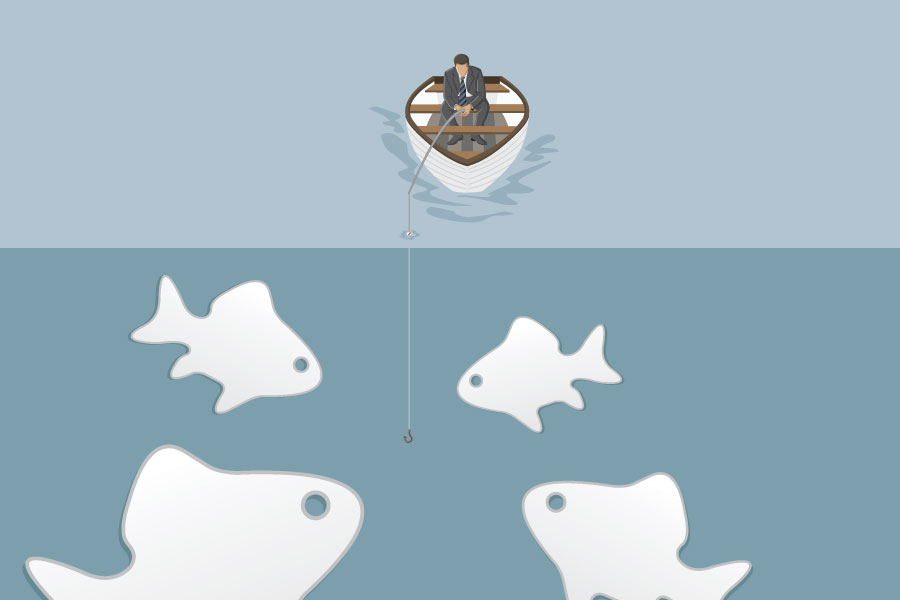
The Overfished Ocean Strategy: Powering Up Innovation

We live at a time of remarkable transformation. The linear throwaway economy of today—where we extract resources, process them, use them barely once, and trash them immediately as we would a cheap plastic fork—is coming to an end. We are, simply put, running out of things to mine and places to trash.

And the market is beginning to recognize it as well: after 160 years of falling costs of raw materials, the first 10 years of the new millennium have seen a whopping 147 percent increase in real commodity prices. Do you happen to be one of millions of managers fighting the ever-rising prices of raw materials, transportation, operations, and more? Welcome to the future! A new economy is being born, one that takes the line and turns it into a circle.

At the end of the life of a product, all of the waste comes back into a production cycle as a valuable resource, infinitely. With that comes a new economic order, where we compete and win using a radically new set of rules. While most of the business world remains in the dark, Bayerische Motoren Werke AG – also known as the global giant BMW – is navigating the murky waters of the resource crunch. The company moved well beyond selling products to selling services – and from a car company transformed itself into a mobility company. Focusing on mobility – a service rather than a product – allows the company to power up radical innovation and open doors to a completely new business opportunity.

Take, for example, the DriveNow car-sharing service, employing BMW i, MINI, and Sixt cars, which allows people in densely populated urban areas to enjoy the benefits of a personal car without owning one. The idea, as BMW explains, is simple: “The mobility concept is based on the motto ‘pick up anywhere, drop off anywhere.’ Billing is per-minute, fuel costs and parking charges in public car parks are included. Users can locate available cars using the app, website or just on the street.

A chip in the driving license acts as an electronic key. Now, that is a leap into the future for a 98-year-old company! But the new world of resource-depravity is also attractive to the newcomers. In a number of European countries, a 2012-born start-up FLOOW2, is making money by allowing businesses to sell their temporary overcapacity – underutilized machines, skills, and real estate – all with the click of a button.

By May 2014, this “sharing marketplace” grew a portfolio of 25,000 materials and services10 that used to be sitting idle, but now make money for the owners while offering a cheaper alternative to users. And FLOOW2 gets a nice commission as well – a much-deserved prize for a solid business model. Puma, a multi-national shoemaker to the fit, has transformed resource crunch into a source for radically simple innovations.

For instance, the company is getting rid of shoeboxes in favor of the remarkable intelligence of the light and reusable Clever Little Bag. The Bag came about as a response to a wasteful practice: a company made boxes, assembled boxes, shipped boxes, stored boxes, and put boxes into a shopping bag only to see both discarded by the customer within a few minutes of arriving home. An alternative? Clever Little Bag is a re-usable package-shopping bag combo that brings additional value to the customers while saving Puma big money on materials and shipping – cardboard savings alone amount to 65%.11 Water, electricity, fuel use are also severely reduced – so bring on the savings! In their unexpected take on resource intelligence, BMW, FLOOW2 and Puma are far from alone.

For the past three years I have worked with and studied the pioneers of a new economic reality, who are transforming the collapsing linear throwaway economy into a more lasting, more abundant, more sustainable version of itself. While the companies, people, and projects pioneering these new rules are still rare, there are enough of them to suggest the first few essential principles that allow managers to innovate their way into a new world. Five new rules of the trade – five essential “secrets” – appear increasingly important for individuals and companies eager to power up a new strategic direction and secure the source of a truly sustainable value.

Together, the principles inspire fundamental change and power up radical innovation across countries and industries – and make up the essence of what I call Overfished Ocean Strategy: the art of transforming today’s depletion of resources into tomorrow’s differentiated long-lasting profits. Here I will speak about three of the five principles. Principle One: From Line to Circle The rapid decline of resources – from coal to tuna to vitamin C in a typical tomato – means that one way or another, all of us will have to find a new path forward.

That path, however, is not new at all – indeed, it has been perfected over the course of millions of years by nature itself. You see, nature does not have waste. Waste of one process becomes food for another, in perpetual cycle. When an animal dies, its body is not thrown into a landfill; instead, it becomes a source of valuable nutrition for millions of bacteria that in turn produce waste products that are essential for the formation of soil. Soil in turn churns out vegetables, consumed by the very animals. So, why not learn from nature and connect the two ends of the global economy and turn the line into a circle? Useless waste becomes a valuable resource that we can circulate indefinitely.

Abundance follows. Principle Two: From Vertical to Horizontal Imagine the global value chain of the industry you’re in. This long line consists of many steps: upstream, reaching to your company, and downstream, touching your customers, consumers, and end-of-life entities. This line is also many layers deep, with different industries feeding and interacting with each other. Growing up in business, we are taught to look downstream, paying attention to our customers and consumers.

We are asked to pay attention to our immediate suppliers – to make sure that we have secured prices and quantities. But even more so, we are asked to pay utmost attention to the vertical cut in this chain – our competitors. Yet, in the world of overfished oceans, risks and opportunities are hiding far away from the home grounds – among the suppliers of the suppliers of the suppliers, and customers of customers of customers.

Move beyond your little vertical slice of the global value chain. Expand your horizons. Principle Three: From Growth to Growth Managers in Atlanta, Delhi, or Copenhagen where their growth comes from, and they will give you a clear answer: selling more. Yet, in a world constrained by every type of resource, including landfill space, only one type of “selling more” is possible. We are taught to look at our businesses in terms of our products – even the financial services industry uses the term “product.” Yet, it is precisely in the service of creating more with less – designing a total solution, a unique experience – where growth lies.

Using these and other principles of Overfished Ocean Strategy allows companies, actors, industries, and continents to move from scarcity to abundance. The collapse of the linear throwaway economy is not a question of if but of when. The change is coming, and the rapidly oscillating prices on everything from rice to gold are a first sign of the new reality.

The question is, will you ride the high tides with mastery and purpose, or will you be swallowed by waves that are unexpected and unnoticed until it is too late? If the endless list of Overfished Ocean Strategy innovations is any indication, we should make it into the new world just fine. I am counting on seeing you there.

0