Denmark Considers Cryptocurrencies For Humanitarian Aid

Denmark sees potential for blockchain technology in humanitarian aid and said on Thursday it is considering becoming the first donor country to move money using cryptocurrencies.

Blockchain is a ledger system tracking digital information, and among other advantages it can provide digitised contracts to avoid fraudulent land records, or enable faster and safer money transfers to emergency hot spots around the globe by using cryptocurrencies.

A report published by the Danish Foreign Ministry on Thursday, in collaboration with think tank Sustania and blockchain currency platform Coinify, investigates how blockchain technology might solve problems in providing development aid.

If you like this, subscribe here for more stories that Inspire The Future.

“Crypto and crisis is a perfect match, and aid organizations will undeniably be able to respond more quickly using blockchain-based digital money, which arrives at email-speed, safely and transparently,” said Marianne Haahr of Sustania.

Blockchain is still relatively immature and it might take time to develop trust, but some concrete initiatives are being developed. One of Europe’s biggest virtual currency platforms, Coinify, is working on using cryptocurrency payments to scale off-grid renewable energy.

“You will be able to pay with your cryptos directly into a solar panel situated in, for example, an African village and then you would not donate money but electricity,” Coinify’s CEO Mark Hojgaard told Reuters.

Another option could be an online hub where people would donate to single projects like schools, railroads or bridges. So-called smart contracts would ensure that the money went to its intended project.

“The money being donated goes into a programme where you can only use it for bricks and mortar to build a bridge for example. Even if you try to buy a banana it will go back so you can seriously control the money flow,” Hojgaard said.

Blockchain could also be used for digitalised contracts, and some countries like India are already experimenting with blockchain to fight corruption when distributing land rights.

Reporting by Stine Jacobsen, editing by Larry King

If you like this, subscribe here for more stories that Inspire The Future.


Watch: Formula E Car vs. Cheetah. Which is Quicker?

Formula E goes wild in a race against a cheetah to highlight the impact of climate change on endangered species.

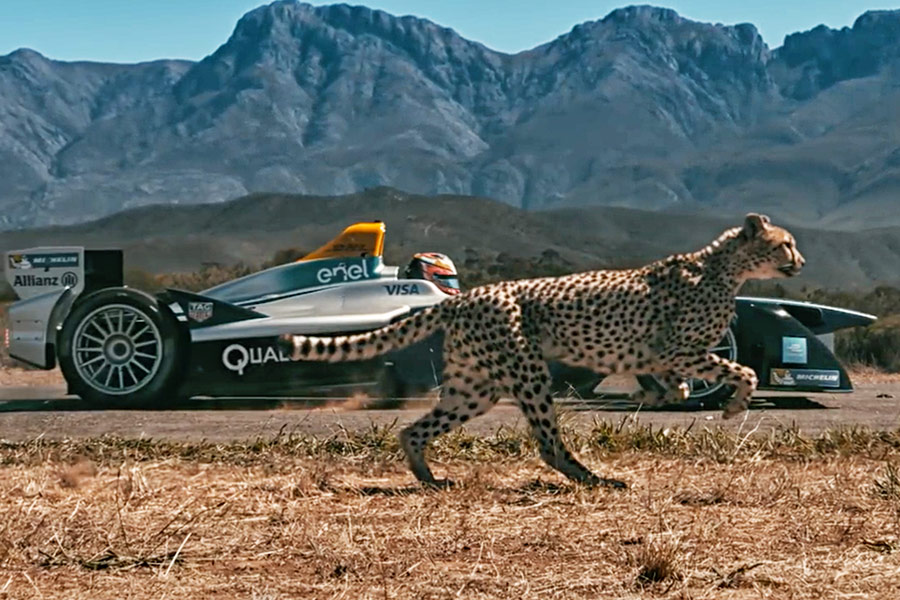
The fully-electric Formula E car took a walk on the wild side, lining-up against a cheetah in a head-to-head race to highlight the impact of climate change on a species increasingly under threat.

https://youtu.be/mMtTEamRLnc

Both sleek and agile machines, on four legs and four wheels, sat side-by-side on a landing strip in a remote part of the Western Cape on the southern tip of Africa, to determine which was quicker off the mark in a drag race.

If you like this, subscribe here for more stories that Inspire The Future.

The world’s fastest land animal and the Formula E car both reach speeds of 0-100km/h (62mph) in approximately three seconds. Who’ll come out on top between Techeetah driver Jean-Eric Vergne and a cheetah on home soil?

The Montreal E-Prix race winner and the cheetah were pitted against each other ahead of the new season of the FIA Formula E Championship to bring attention to the disastrous effects of climate change and the danger it poses to the natural habitat of cheetahs and other wildlife.

Formula E aims to provide a solution. It’s more than just a race on the track, the series is a catalyst for change – to accelerate the uptake of electric vehicles on a global scale and making our society cleaner for future generations.

There are now just 7,000 cheetahs remaining in the wild. The species is wide-ranging and sparsely distributed and needs large landscapes to survive, making it particularly vulnerable to habitat loss and fragmentation – threats that are exacerbated by a changing climate.

The film was overseen by conservation experts and animal welfare organizations, and is released in partnership with Animal Issues Matter, Cheetah Outreach and Endangered Wildlife Trust.

Alejandro Agag, Founder & CEO of Formula E, said: “We knew the similarities in performance between the Formula E car and a cheetah, so we were curious to see the outcome. But, what’s even more important is to determine the outcome for the future for not only us, but the cheetah and other animals we share our planet with. We only have one planet and we must address the issues we currently face from the source and electric cars can play a key role in reducing C02 emissions worldwide. It was a close race… I won’t spoil it and give away the end result. You’ll have to watch the video to see that!”

www.fiaformulae.com

If you like this, subscribe here for more stories that Inspire The Future.


The World in 2018: Key Global Themes to Watch

The World in 2018, the annual publication from The Economist, predicts that 2018 will be a nerve-jangling year as people across the world attempt to escape the tensions of politics and the frenzies of technology. 

But the world can also look forward to an economy growing at a respectable pace and the distraction of global events including the Winter Olympics and the World Cup.

Daniel Franklin, editor of The World in 2018, said: “It will be a critical year on many fronts, including North Korea’s nuclear challenge, the Brexit negotiations, China’s economic reforms and America’s mid-term elections as well as the presidential polls in Brazil and Mexico. We will see intriguing battles for influence, ideas and leadership.” Twelve global themes for 2018 are:

1. Trumpism v Macronisme
We will see competing open v closed world views. While President Donald Trump focuses on his inward-looking “America first” agenda, France’s President Emmanuel Macron promises a new kind of pro-globalisation social contract, one that boosts competition and entrepreneurship while protecting workers who lose out. Mr Macron will emerge as a modern-day equivalent of Teddy Roosevelt, the American president most associated with the Progressive Era.

If you like this, subscribe here for more stories that Inspire The Future.

2. Election game-changers: Brazil, Mexico, Italy and the US mid-terms
Once every 12 years elections in Latin America’s two giants, Brazil and Mexico, coincide; there and in other countries in the region’s big election year voters will demand political renewal and an end to corruption. A messy election in Italy could constrain the country’s economic recovery. In America, the Democrats could triumph in a close contest for the House of Representatives, opening the way for the possible impeachment of Donald Trump.

3. The political and economic cocktail of the Winter Olympics in South Korea and the World Cup in Russia
Two competitions will capture the world’s attention. South Korea will put on the Winter Olympics in the shadow of the North’s nuclear brinkmanship. Russia will stage the FIFA World Cup at a sensitive time in the country’s relations with the West and shortly after an election that will give Vladimir Putin another term as president. In both events, sport will compete with politics.

4. Long good-byes from leaders in Japan, Cuba and Saudi Arabia
Japan’s Emperor Akihito prepares to bow out, Cuba’s President Raúl Castro steps down, Saudi’s King Salman may abdicate. But many leaders who have overstayed their welcome (such as Nicolás Maduro in Venezuela) will try to cling to office.

5. Synchronised global economic growth, at last
Ten years after the start of the Great Recession, a sense of widespread wellness will begin to take hold in the world economy. To many it may feel as if 2018 is just the beginning of the real recovery, but it may in fact be approaching the end: the world economy tends to tip into a recession every eight to ten years, and the last one ended in 2009. The most likely cause of the next dip? Central banks tightening policy too much, too quickly.

6. Crunch time for critical global diplomacy: Brexit, NAFTA and North Korea
Fraught Brexit talks will reach a climax in the autumn of 2018, when a divorce settlement between Britain and the European Union needs to be reached if there is to be time for parliaments to ratify it by the scheduled departure date of March 2019; the chances of a no-deal Brexit are high. The year will show whether NAFTA can survive Donald Trump’s protectionist push. And – most important of all – Mr Trump will have to decide whether to deter or contain a nuclear North Korea seeking the capability to strike the United States.

7. The march of the acronyms: GDPR, MiFID2, COP24, GNH, Remote ID, 5G, AI
New European rules on data (GDPR) and finance (MiFID2, PSD) come into force. A climate-change conference in Poland (COP24) will take stock of progress on the Paris accord. Bhutan starts an intriguing experiment of applying its “gross national happiness” (GNH) to business. And in key tech developments, commercial drones develop faster thanks to rules on remote ID, the next generation of mobile technology (5G) will make its debut at the Winter Olympics and artificial intelligence (AI) will march on into more and more areas.

8. The coming “techlash”
Politicians will turn on the technology giants—Facebook, Google and Amazon in particular—saddling them with fines, regulation and a tougher interpretation of competition rules, in a 21st-century equivalent of America’s antitrust era. There will be broader pressure for transparency about the origin and accuracy of online content. And the tech behemoths’ acquisitions will come under greater scrutiny, as antitrust authorities take a harder line on attempts to squash would-be competitors by buying them.

9. Asian countries top of the league
Asian countries will be world champions in 2018—probably not in football, but in a variety of other areas. Bhutan is forecast to top the league in economic growth; China could overtake Italy to be number one in terms of UNESCO-listed world-heritage sites; and India plans to complete the world’s tallest statue, of Vallabhbhai Patel, a founding father of modern India, in Vadodara in the western state of Gujarat.

10. Signs of the times, from “peak baby” to new adventures in space and at sea
Telling trends of 2018 will include, in demography, a dip in the number of babies born around the world; the rise of private space ventures reflected most dramatically in SpaceX’s plan to send tourists around the Moon; consumers’ preference for oversized cars demonstrated in sport utility vehicles and their close cousins overtaking all other types in sales of new vehicles; and the trend towards gigantism at sea shown in the launch of Prelude FLNG, the world’s biggest vessel, displacing as much water as six aircraft carriers.

11. A new era for medicine
Medical historians of the future will describe 2018 as the year that “advanced” medicines—therapies working upstream on DNA—started to become a reality. The most important landmark will be the approval of the world’s first RNA interference drug, heralding the arrival of a new class of drug. Advances will also come in gene therapies and gene-editing. With luck, too, an old era will end, with the final eradication of polio.

12. Word of the year: Supercalifragilisticexpialidocious
“Mary Poppins Returns”, starring Emily Blunt, will come out in 2018, timed to coincide with the centenary of women’s suffrage in Britain. Its fiery suffragette Mrs Banks would no doubt cheer the political progress women have made since 1964 when the original film appeared – and march onwards with the influence women will have on America’s mid-terms.

www.theworldin.com

If you like this, subscribe here for more stories that Inspire The Future.

 

Cities Overwhelmed by Unplanned Migration Need Support

Many cities are being overwhelmed by growing numbers of people migrating to them, and will become highly vulnerable to floods, storms and other disasters unless authorities receive more support, urban experts have said.

The proportion of the global population living in urban areas has risen from half in 2000 to 55 percent now, and is predicted to reach 70 percent by 2050, according to the U.N. agency for human settlements.

“If we don’t start supporting local and national authorities in (the) task of hosting more and more people in their cities, we are going to have cities that are highly vulnerable,” said Esteban Leon, chief technical advisor at U.N.-Habitat.

If you like this, subscribe here for more stories that Inspire The Future.

“In most cities … authorities are overwhelmed by this migration and they don’t have the time nor the resources to react,” he told the Thomson Reuters Foundation on the sidelines of the Smart City Expo World Congress in Barcelona.

Rapid and unplanned population growth puts pressure on transport, infrastructure and sanitation systems in cities around the world, experts say.

Future urban population growth will not be restricted to megacities of 10 billion people or more, said Robert Muggah, co-founder of the Brazil-based think tank Igarapé Institute.

“The vast majority … is going to be rural folks moving into smaller and medium sized cities … It’s less spectacular but no less significant,” Muggah said.

“We’re also going to see an incredible amount of growth in the coming decades in informal settlements as a result of the speed of population growth,” he added.

About a quarter of the world’s urban population live in slums, says U.N.-Habitat.

That amounts to more than 1.2 billion people, which could rise to nearly 2 billion by 2030, Muggah said.

Many of the world’s fastest growing cities lack sufficient transport and infrastructure to cope, he said.

“This is putting extraordinary stress on the ability of services to be able to deliver the goods and infrastructure that is so desperately needed by the citizens,” he said.

Joan Clos, executive director of U.N.-Habitat, said that urban living is responsible for 70 percent of greenhouse gas emissions.

When a person moves from a rural area to an urban area, their energy consumption increases tenfold, he said.

Problems related to urban population growth must be addressed sooner rather than later, noted Candace Byrd, chief of staff for the U.S. city of Atlanta.

“The time is now to shape the future,” she said.

By Sophie Davies, Editing by Alex Whiting.

If you like this, subscribe here for more stories that Inspire The Future.


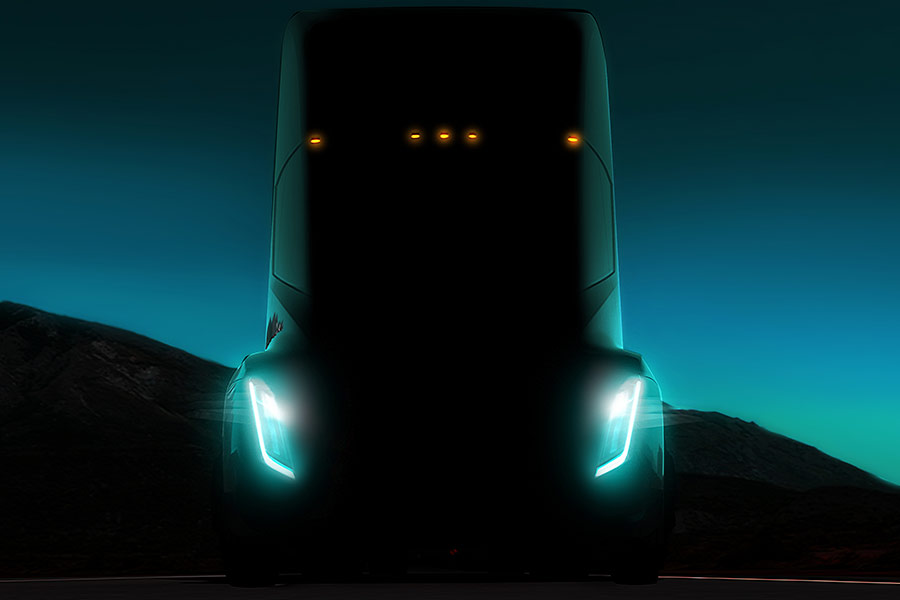
New Truck Can Transform Into a Robot, Fight Aliens and Make One Hell of a Latte

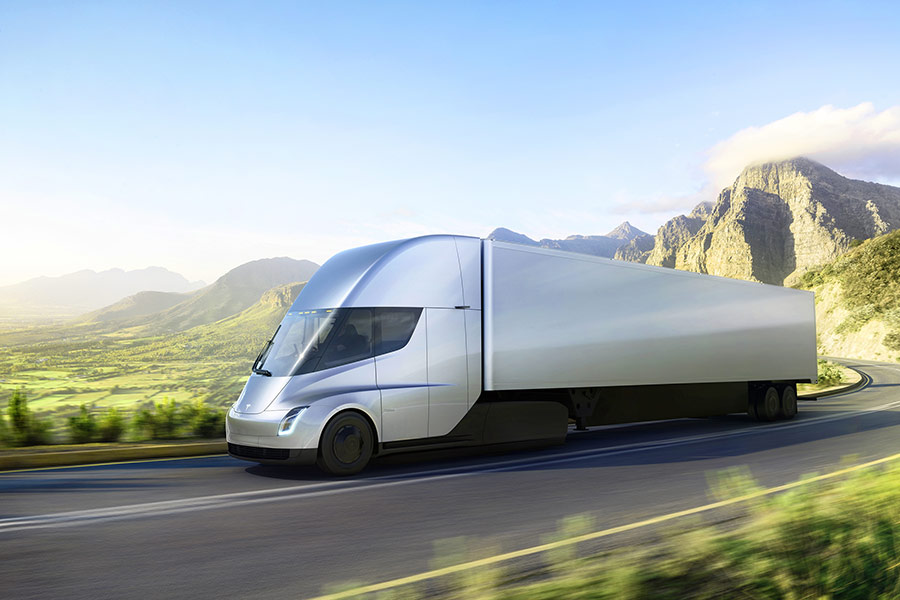
The Tesla Semi, launched by Elon Musk, will deliver a far better experience for truck drivers, while increasing safety and significantly reducing the cost of cargo transport. 

Musk has described Tesla’s new battery-powered cargo vehicle as an “unreal beast” and is set to revolutionize the transport supply chain. Electric power is cheaper than conventional, fossil fuel and could include self-driving technology that would do away with drivers.

It’s so full of groundbreaking features and forward-thinking ideas that Musk joked on Twitter: “It can Transform Into a robot, fight aliens and make one hell of a latte.” The way Musk is going with space exploration, reinventing the battery, underground high speed travel and automated driving, this may not be much of a joke after all.

If you like this, subscribe here for more stories that Inspire The Future.

Already a pioneer in electric-powered cars and innovative self-driving software, Musk is on record as saying that developing electric vehicles was “not some silly hippy thing, it matters for everyone.” Redefining mobility is not just about replacing cars and trucks with new models, but looking at the entire infrastructure.


Megachargers, a new high-speed DC charging solution, will add about 400 miles in 30 minutes and can be installed at origin or destination points and along heavily trafficked routes, enabling recharging during loading, unloading, and the perfect opportunity for drivers to grab coffee and a doughnut during breaks.

Without a trailer, the Tesla Semi achieves 0-60 mph in five seconds, compared to 15 seconds in a comparable diesel truck. It does 0-60 mph in 20 seconds with a full 80,000-pound load, a task that takes a diesel truck about a minute. Most notably for truck drivers and other travelers on the road, it climbs 5% grades at a steady 65 mph, whereas a diesel truck maxes out at 45 mph on a 5% grade.

The Tesla Semi has been designed to drive in convoy with other Semi’s – multiple trucks driving in close proximity one behind the other. Musk reckons this “freight train of the roads” concept will be cheaper than shipping goods via cargo train. The lead vehicle would control the trucks behind it and also help cut congestion.


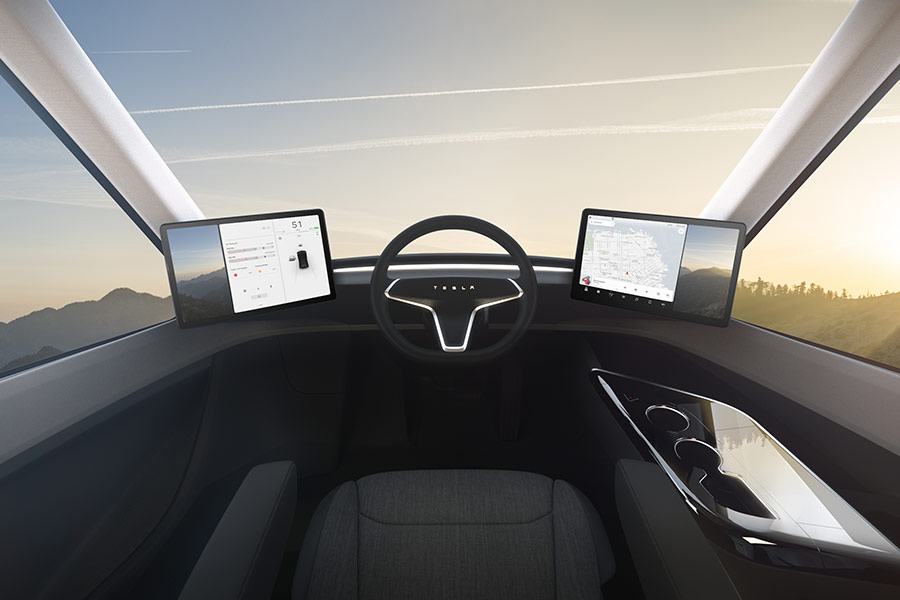
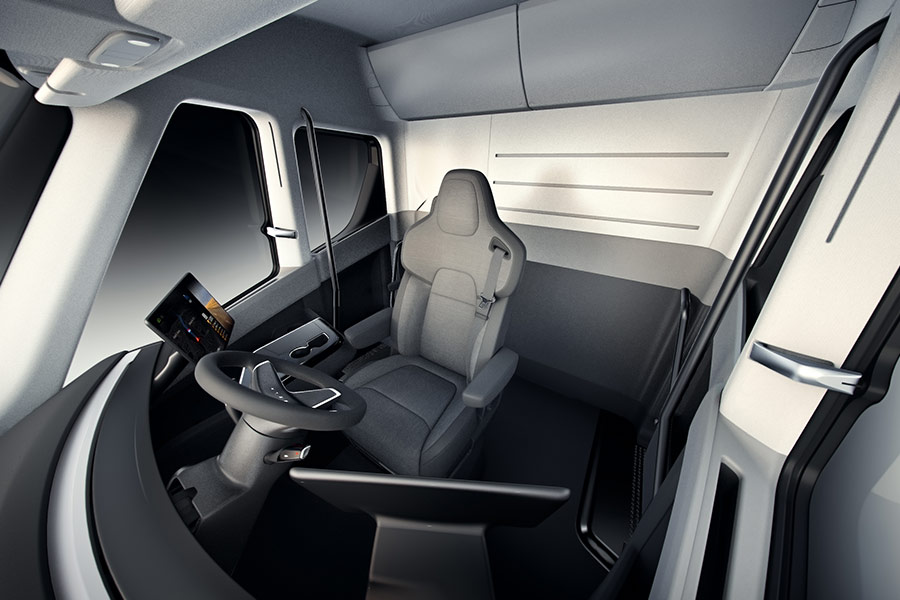
Unlike other trucks, the Semi’s cabin is designed specifically around the driver, featuring unobstructed stairs for easier entry and exit, full standing room inside, and a centered driver position for optimal visibility. Two touchscreen displays positioned symmetrically on both sides of the driver provide easy access to navigation, blind spot monitoring and electronic data logging. Built-in connectivity integrates directly with a fleet’s management system to support routing and scheduling, and remote monitoring. Diesel trucks today currently require several third party devices for similar functionality.

With far fewer moving parts than a diesel truck – no engine, transmission, after-treatment system or differentials to upkeep – the Tesla Semi requires significantly less maintenance. Its battery is similar in composition to the batteries of Tesla energy products and is designed to support repeated charging cycles for over a million miles, while its motors are derived from the motors used in Model 3 and have been validated to last more than one million miles under the most demanding conditions.


The biggest immediate cost-advantage comes from savings in energy costs: fully loaded, the Tesla Semi consumes less than two kilowatt-hours of energy per mile and is capable of 500 miles of range at highway speed. While this distance might sound like a limitation, consider that nearly 80% of freight in the U.S. is moved less than 250 miles.

If you’re still not convinced, maybe the cost saving will help change your mind. With the low and stable nature of electricity prices – which average $0.12/kWh in the U.S.  – owners can expect to gain $200,000 or more in savings over a million miles based on fuel costs alone.

Production of the Tesla Semi is due in 2019.

If you like this, subscribe here for more stories that Inspire The Future.


Is Your Business Prepared For a Cyberattack?

Massive cybersecurity breaches have become almost commonplace, regularly grabbing headlines that alarm consumers and leaders. But for all of the attention such incidents have attracted in recent years, many organisations worldwide still struggle to comprehend and manage emerging cyber risks in an increasingly complex digital society.
 
PwC has launched its 2018 Global State of Information Security Survey (GSISS), based on responses of more than 9,500 senior business and technology executives from 122 countries.
Executives worldwide acknowledge the increasingly high stakes of cyber insecurity. Forty percent of survey respondents cite the disruption of operations as the biggest consequence of a cyberattack, 39% cite the compromise of sensitive data, 32% cite harm to product quality, and 22% cite harm to human life.
 
Yet despite this awareness, many companies at risk of cyberattacks remain unprepared to deal with them. Forty-four percent say they do not have an overall information security strategy. Forty-eight percent say they do not have an employee security awareness training programme, and 54% say they do not have an incident-response process.
 
Some of the key findings in the report found that:
 
  • Forty percent of survey respondents cite the disruption of operations as the biggest consequence of a cyberattack, followed by the compromise of sensitive data (39%), harm to product quality (32%), and harm to human life (22%).
  • Forty-four percent of the 9,500 executives in 122 countries surveyed say they do not have an overall information security strategy.
  • Forty-eight percent do not have an employee security awareness training programme, and 54% don’t have an incident-response process.
  • When cyberattacks occur, most victimised companies say they cannot clearly identify the culprits. Only 39% of survey respondents say they are very confident in their attribution capabilities.
 
How cyber interdependence drives global risk
 
Case studies of non-cyber disasters have shown that cascading events often begin with the loss of power—and many systems are impacted instantaneously or within one day, meaning there is generally precious little time to address the initial problem before it cascades. Interdependencies between critical and non-critical networks often go unnoticed until trouble strikes. Many people worldwide—particularly in Japan, the United States, Germany, the United Kingdom and South Korea—are concerned about cyberattacks from other countries. Tools for conducting cyberattacks are proliferating worldwide. Smaller nations are aiming to develop capabilities like those used by larger countries. And the leaking of US National Security Agency (NSA) hacking tools has made highly sophisticated capabilities available to malicious hackers.
 
The soaring production of insecure internet-of-things (IoT) devices is creating widespread cybersecurity vulnerabilities. Rising threats to data integrity could undermine trusted systems and cause physical harm by damaging critical infrastructure.
 
Meanwhile, there is a wide disparity in cybersecurity preparedness among countries around the world. In the 2018 GSISS, the frequency of organisations possessing an overall cybersecurity strategy is particularly high in Japan (72%), where cyberattacks are seen as the leading national security threat, and Malaysia (74%).
 
In May 2017, G-7 leaders pledged to work together and with other partners to tackle cyberattacks and mitigate their impact on critical infrastructure and society. Two months later, G-20 leaders reiterated the need for cybersecurity and trust in digital technologies. The task ahead is huge.
 
Next steps for business leaders
 
So what can business leaders do to prepare effectively for cyberattacks? PwC recommends three key areas of focus:
 
C-suites must lead the charge and boards must be engaged: Senior leaders driving the business must take ownership of building cyber resilience. Setting a top-down strategy to manage cyber and privacy risks across the enterprise is essential.
 
Pursue resilience as a path to rewards—not merely to avoid risk: Achieving greater risk resilience is a pathway to stronger, long-term economic performance.
 
Purposefully collaborate and leverage lessons learned: Industry and government leaders must work across organisational, sectoral and national borders to identify, map, and test cyber-dependency and interconnectivity risks as well as surge resilience and risk-management.
“Few business issues permeate almost every aspect of business and commerce like cybersecurity does today,” said David Burg, Global Cybersecurity Leader at PwC. “Public-private coordination is critical to effectively addressing cybersecurity.”


This Bike Will Get You to Work For $1

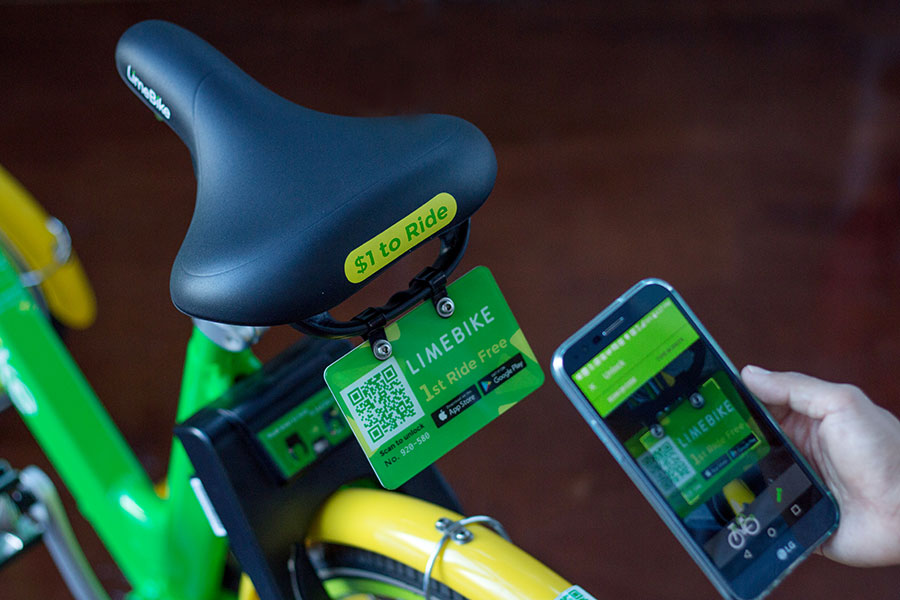
LimeBike, the dockless bike sharing service, has announced it has raised $50 million in Series B funding to speed the rollout of its programs into 30+ cities and campuses across the U.S. by year-end.

LimeBike is now the largest dockless bikeshare operator in the U.S., with approximately 10,000 bikes deployed, and available in 20 markets total (twelve cities and eight university campuses). LimeBike always seeks to partner closely with cities, colleges and businesses to provide dockless, subsidy-free bike share services and promote urban mobility for residents and visitors.

If you like this, subscribe here for more stories that Inspire The Future.

Rides cost one dollar for 30 minutes or fifty cents for students. Since launch four months ago, the company has achieved nearly five times growth in rides and revenue on an average monthly basis with the number of riders increasing by more than fivefold. The company has logged over half a million trips, 250K registered users, and is growing 50 percent week over week on average.

“Bike sharing is shaping the future of transportation,” said Toby Sun, LimeBike CEO and co-founder (pictured above, right). “We’re passionate about solving the challenges of the first and last mile and we believe that better understanding the migration patterns of commuters can eventually help us to create efficiencies in urban mobility and cut down on carbon emissions in our cities.”

“We believe dockless, connected bikes have the potential to revolutionize the first and last mile of transportation,” said Jeff Jordan, general partner, Andreessen Horowitz and LimeBike board member. “LimeBike is making strong progress in leading this shift. The team is passionate, understands the wide-ranging needs of the US market, and is committed to collaborating with cities across the country to complete their public transportation system.”

If you like this, subscribe here for more stories that Inspire The Future.

What We Can Learn From Immigrants

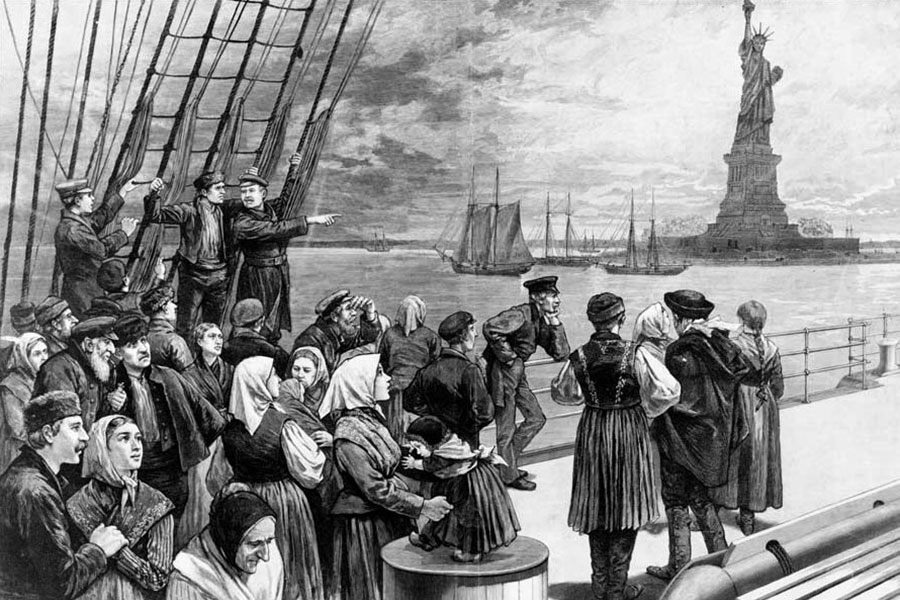
From the time I was a young boy, I have been fascinated with astounding feats of accomplishment. I would sit in wonder listening to stories of my parents and grandparents and their adventures in the world. Jews who came from shtetls in Minsk, Lodz, Krakow, places of which I had never heard. They came with only a few suitcases and a deep reservoir of hope.

They came in search of a better life, even though they didn’t know exactly what that meant or what they would have to sacrifice.

If you like this, subscribe here for more stories that Inspire The Future.
My parents, and those like them, achieved something remarkable. They became successful entrepreneurs, doctors, artists, philanthropists and scholars. They bought homes, raised families and sent their children to universities. Many achieved this in the first generation, and most by the second. I am fascinated with understanding the conditions that allow seemingly ordinary people to achieve extraordinary success in the face of extreme adversity. I have studied these lessons and have tried to apply them to my life and the clients I have served.  When I listened to my family share their stories of coming to America, I distilled three conditions that seem to be common among immigrants who have achieved great success.

1.    Commitment

The people I know who have attained what seemed unthinkable all focused more on commitment than belief. When I asked my mother if she believed that she and her family could have escaped the Holocaust and reimagined their life in America, she answered with little emotion: “We didn’t have a choice”.  I have heard stories of how scared and confused immigrants were, not knowing if they would reach their destination or how they would survive once they arrived. These immigrants had to summon the will to prepare them for a radically different life.

When I have been faced with extreme adversity, my fears severely challenged my belief in myself. Yet my commitment was the force that propelled me forward. When my wife and I bought our first home and it was almost destroyed by fire soon after, I was in a perpetual state of fear. In retrospect, I can’t really say how strongly I believed we would succeed in our quest to rebuild our lives. Like my mother escaping the Holocaust, I didn’t think I had a choice.  In some unknowable way, that commitment turned into belief.

2.     Action

Immigrants understand the absolute necessity of action. By action I mean consistent, planned, organized action over long periods of time. My grandfather’s commitment still strikes awe in me 50 years after hearing it. Joachim Shultz had a thriving business selling finely-made artists brushes in Germany in the years leading up to Hitler coming to power. Seeing that Germany was no longer safe for Jews, he took his family to Czechoslovakia. He had hoped that he would find a safer place there. When his car was confiscated at the Czech border he knew the time had come to leave. He left his life behind and brought his wife and three children to New York. He started his business again on Bleecker Street in Greenwich Village in 1938.  He understood the necessity of making every resource count. Community was one of his most essential resources. 

3.     Community

The concept of community has shifted radically since my grandparent’s time. Then community was rooted in where you lived; in the nineteenth and early twentieth century, Jewish immigrants who came from the same communities in Eastern Europe joined lantsman societies. If you emigrated from Minsk and settled in Brooklyn, you likely joined the Minsk lantsman group. Members pooled their resources to help each other in the strange world they were attempting to navigate. They also helped relatives come to America. They formed tightly connected social networks driven by their need to survive amidst an often hostile world. They understood that the only way they could realize their dreams was to depend on each other.

As the modern inventions of the telephone, the automobile and the airplane became more accessible, the idea of community spread far beyond the boundaries of the places they first settled in. As extended families broke apart and the nuclear family became the primary unit, the notion of interdependence shifted.

Today community is powered by digital social networks: Facebook, Instagram, Twitter, LinkedIn. While the reach of the community is vast, the belief in interdependence that was so central to the success of my ancestors’ generation, has been severely diminished for most Americans. For those who have been able to reframe the “ we are all in this together” principle for the world of digital community, what we can learn from immigrants seems more powerful than ever.

If you like this, subscribe here for more stories that Inspire The Future.
3 Steps to Creating Greater Good

In a time where the national political rhetoric is dividing and dehumanizing, it’s more important than ever that we look to ways to prioritize people along with profit.

One of the important principles for conscious leaders building successful and sustainable businesses is what I have come to call “The Greater Good.” As we move from a culture based on scarcity and competition into a culture of abundance and collaboration, our leaders need to develop the language, actions and beliefs that support this shift. This includes the belief that doing well in service of our own interests must also include working toward the Greater Good in our communities.  

If you like this, subscribe here for more stories that Inspire The Future.

For me, this change in mindset needs to begin by understanding the concept that life is sacred. For decades, America’s version of capitalism did not account for the many lives impacted by business. As Nobel Laureate economist Milton Friedman stated, “There is one and only one social responsibility (of a business) – to use its resources and engage in activities designed to increase its profits so long as it stays within the rules of the game, which is to say it engages in open and free competition without deception or fraud.” What Friedman and generations of business leaders overlooked was the collateral damage of ignoring the needs of other stakeholders in the ecosystem of business. When employees, customers, and communities are treated as non-entities, it sets society on a dangerous course of competition between key segments of society. Corporations are perceived to be succeeding at the expense of society. 

However, this philosophy of profit over people has started to change. Michael Porter, Harvard professor, best-selling author and arguably the most important thought leader on business strategy, began to shift his view of the place of business in society over the past decade. In 2011 he published a groundbreaking article in the Harvard Business Review with Mark Kramer, called Creating Shared Value: How to reinvent Capitalism and unleash a wave of innovation and growth. In it, they argue that for businesses to be successful and sustainable they need to shift its beliefs about how they create value and their responsibility for society at large. There is a need to stop measuring success through the narrow lens of short-term profit and expand it to the broader influences on long-term success.

So, what does this mean for us? If we want to help lead this shift in how we view business we need to begin with ourselves. Each one of us can actively struggle with the questions: What is the Greater Good for our team? For our company? For our industry? We must internalize the idea that work for the good of the group benefits us to see the benefit of working for both. As in the well-worn phrase, “a rising tide lifts all boats,” you will make your boat the most seaworthy it can be while simultaneously helping the tide to rise.

ACTION STEPS

If you would like to begin exploring the idea of the Greater Good and begin implementing it in your business, here are a few simple steps:

1) Reflection: Set aside a specific time for the next month to explore this critical principle for yourself and with your team and colleagues.  “What is the Greater Good for our team? For our company? For our industry? For our clients, customers, partners?” Then ask “What could we change in how we work that would support Doing Well by Doing the Greater Good?” Then look for opportunities to put these new ideas into practice.

2 Assessment: For a more in-depth exploration in the Greater Good, you can learn a tremendous amount from the work Michael Porter, Mark Kramer and their colleagues have done at FSG Consulting, a firm whose mission is to re-imagine social change. Their Shared Value Readiness Assessment is a powerful tool to see where you and your group are in your beliefs and practices around Creating Shared Value, which is a specific methodology for enacting the Greater Good.

3) Action Plan: If you find the Assessment tool as useful as we did, then considering bringing your team together to develop an Action Plan based on the results of your reflections and the assessment. Take some time with the Action Steps which can be guided by the questions and links to additional resources in the assessment.

Resources

Video: Creating Shared Value Readiness Assessment video 

Website: The Greater Good: Science for a Meaningful Life

If you like this, subscribe here for more stories that Inspire The Future.
 

Kate Hudson And Michael Kors Fight Hunger in Cambodia

World Food Day is today and luxury ready-to-wear designer Michael Kors is dedicating the month to new products and activities designed to support Watch Hunger Stop, the brand’s campaign to fight global hunger. His friend, Kate Hudson, is supporting him.

Now in its 5th year, Watch Hunger Stop raises funds and awareness to help achieve a world with Zero Hunger. The brand’s partner in the eff ort is the United Nations World Food Programme (WFP), and funds go to support WFP’s school meals program, which reaches over 16 million children in almost 70 countries each year with vital nutrition that helps them fulfil their potential. Thus far, Watch Hunger Stop has enabled WFP to deliver more than 15 million meals to children in need.

If you like this, subscribe here for more stories that Inspire The Future.
WFP is the world’s largest humanitarian agency fighting hunger worldwide, delivering food assistance in emergencies and working with communities to improve nutrition and build resilience. Each year, WFP assists some 80 million people in around 80 countries.

“Our multi-year partnership with Michael Kors has resulted in a significant contribution toward progress in the fight against global hunger,” says Rick Leach, President and CEO of World Food Program USA. “Over the past five years, the school meals program, a focus of the Michael Kors effort, has played an enormous role in empowering hungry children with the nutrition they need to succeed in the classroom and lift themselves out of poverty.”

Actress, author, entrepreneur and humanitarian Kate Hudson is again lending her talents to support Watch Hunger Stop, the brand’s annual campaign to fight global hunger. This past June, Hudson traveled with WFP to Siem Reap province in Cambodia to see how the funds raised through Watch Hunger Stop help WFP feed and support children in need. During the field visit, Hudson visited schools, farms and family homes, asking questions and sharing her irresistible warmth and energy. She spoke with local WFP staff members, helped cook school meals and played with children, thoroughly immersing herself in the details of the school meals program and the lives of those it affects.

“This is the third year I’ve had the honor of collaborating with Michael on this important cause,” says Hudson. “In June, I visited schools in Cambodia, where the funds raised by Watch Hunger Stop enable the United Nations World Food Programme to feed children so they receive the nutrition they need to grow and to finish their education. It was an amazing experience—I can’t wait to share everything that I saw and learned there.”

“I’m thrilled and grateful that my friend Kate is joining us once again in our efforts to end hunger,” says Michael Kors. “She and I share the belief that if we all work together, this is a problem we can solve. Watch Hunger Stop supports WFP’s school meals program, improving the lives of children who deserve the chance for a healthy, happy future. We’re proud to be able to help.”

If you like this, subscribe here for more stories that Inspire The Future.
0