Why Smart Aquaculture Makes Sense for Smart Impact Investors

Eat more fish for a healthy diet, but what about raising more fish for a healthy portfolio and planet?

That’s the idea behind Aqua-Spark, an investment fund with a focus on sustainable aquaculture businesses around the world.

The small-to-medium enterprises (SMEs) in which it invests “are working across the value-chain toward the production of healthy, sustainable and, accessible aquatic life, such as fish, shellfish and plants,” according to the company.

It aims to create triple impact—specifically, “each investment is chosen for its potential to generate significant financial returns while also activating positive environmental and social outcomes.”

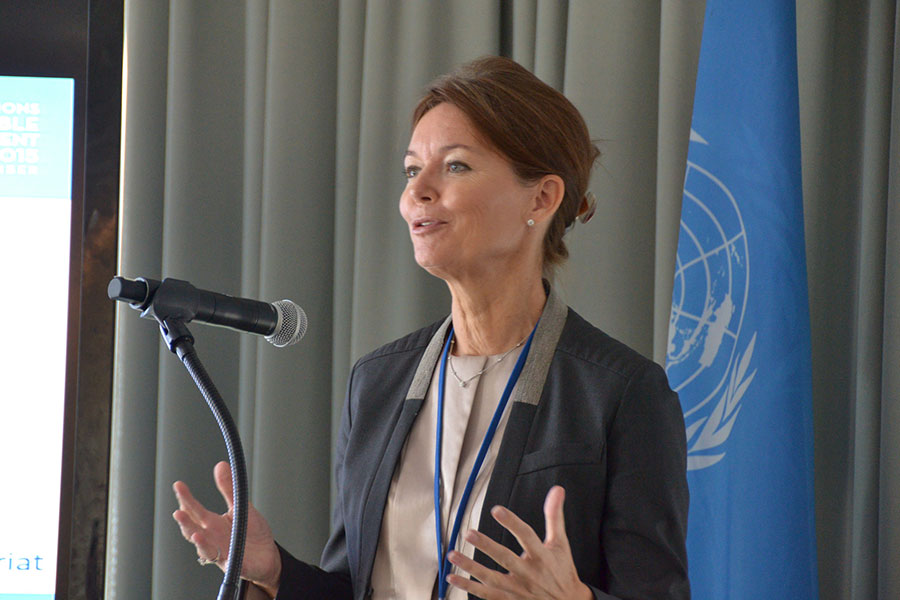
Amy Novogratz (above left), the firm’s co-founder and managing partner, explains what aquaculture is, what it entails and the lasting investing and environmental returns it can generate.


What was the ‘spark’ that started Aqua Spark?

My partner and I met through an ocean conservation event that I produced with TED and deep ocean explorer Sylvia Earle. After a week spent immersed in ocean-related challenges, on a boat in the Galapagos with a hundred committed individuals, we left wanting to do something together to preserve ocean health.

We came across aquaculture and were stunned by the size of the industry and how quickly it’s growing. Aquaculture will play a big role in the future of our ocean and food security, and though it has the potential to be the most resource efficient food system, current practices are far from efficient. It’s a highly fragmented industry with no real dedicated financing streams, and we see a big opportunity to influence how the industry grows.

How did you personally become involved in the work?

After running the TED Prize for almost a decade, I became adept at cultivating large scale global collaborations that brought different types of thinking together to form solutions. With a challenge as big as transforming the global aquaculture industry, we knew we needed to work with many partners and create synergies across the value chain and geographies. I wear many hats as a Managing Partner, but spend a lot of time developing and nurturing a global aquaculture ecosystems, aligning visions and fostering collaboration. I am very excited that we live in a time where we can take so many perspectives into account, and work towards redesigning an aquaculture system that works for us all.

You mention real power comes from collaboration and partnership. How? 

The scale of this challenge is too big for any one company or group to do it alone. Globally, we are farming almost 700 species in diverse environments ad economies, using different operating systems. But there has been a lot of knowledge gained in recent decades. New solutions have been developed and many stakeholders have entered the space with the vision of a more sustainable industry.

We need to triple aquaculture production globally by 2050. And as a relatively undeveloped industry, with few regulations, little technology, minimal data usage, there is a huge opportunity to take a far reaching, multisector, multilevel approach in order to transform practices and lift aquaculture to its potential. Sustainable aquaculture will be a core part of our future food system, and we need to keep the big picture in mind.

As part of your approach and philosophy, you note that entrepreneurs and investors have the power to change the world. How do you tap that creative energy to achieve your mission?

 Aquaculture is a good example of an industry where doing things sustainably is better business in the long run. We need the right solutions to scale in order to get the industry to the point where sustainability is accessible and cost effective. This is going to be driven by innovative, committed entrepreneurs and investors who are going to back them. In less than five years, with our portfolio leaders, we’ve seen that we can redirect the aquaculture industry to be cleaner, more efficient and far more sustainable, and many large investors and industry strategics are taking notice and getting on board.

What kind of evaluation/selection process do you engage in?

Our investment team does thorough due diligence. First, we look at what the company is solving in the aquaculture industry, how they are different and how they help us reach our impact goals. We look at the strength of the team and how they fit into our portfolio. We have a synergistic portfolio, where our companies work together and benefit from each other. We make sure they are going to add value to the other companies and get value in return.  

We involve our network of experts and partners in the different stages of due diligence, in assessing the product, the market, the partners, the industry fit, etc. One of our industry experts always joins us on our site visits and produces a separate report alongside our team’s report.

Is there an anecdote about one or two that you could elaborate on now in terms of impact?

A simple example of how new technologies can play a clear role in cleaning up the industry is eFishery, an aquaculture tech company based in Bandung, Indonesia. They use sensors to gauge water movement, which then codes how much a fish is moving, and then has an algorithm that determines the appetite of the fish to feed them automatically.

It’s truly revolutionary, but also really affordable. It saves farmers up to 24 percent each cycle of feed. Feed can be up to 80 percent of the cost of operating a farm. So, it’s huge economically. But also, feed is one of the big pollutants and also plays a big role in fish health. When you’re talking about aquaculture, getting feed right is one of the big challenges/opportunities.


How can innovative philanthropic capital play a bigger role in something like sustainable aquaculture?

When you look at the blended needs of different capital in aquaculture and the different partners working in aquaculture, there’s an immense amount of opportunity. We have a private equity offering, for example, as an investment option in ImpactAssets’ donor advised fund. We are also planning to launch a subset of our fund that’s focused solely on sub-Saharan Africa. We’re talking to a number of different foundations that would potentially have an interest in economic development and food security in Africa, so there’s a great opportunity here. Philanthropic capital can be “patient capital.” It will help us start to create a financing model to develop the industry, de-risk aquaculture investments and build a track record in aquaculture in Africa – and in aquaculture generally.

What’s the outlook for aquaculture growth?

We hit a point a couple of years ago where we’re actually producing more fish via aquaculture globally for human consumption than we’re catching in the wild. Aquaculture is also bigger than beef. Tripling the industry means we need to produce an additional 140 million metric tons of fish in the next thirty years. Taking into account how much of that will be fed species, it means we will need 8 times the amount of feed, just for aquaculture. 


What CEOs Can Learn from Gillette’s Advert

Gillette’s new advert is the talk of the town. And for many reasons. It speaks to the current trend of the “woke advertising” movement. It comments on many aspects of the growing pains that men go through – and how they have to navigate those waters.

At the time of writing, with almost 29 million views, the ad has certainly commanded attention. However, is it the right move or the right type of attention?

Here’s what CEO’s and CMO’s can learn from Gillette’s attempt at the “Visiconomy.”

Firstly, what is the Visiconomy and how does a brand leverage it? It’s a term made up from the words “Vision” and “Economy.” There are many opinions on the trends in marketing today – but none speak to the core of where advertising is going more than the Visiconomy.

Every brand needs to be social, that’s a given. And every brand needs to be personal when it comes to building relationships; despite being overlooked. The “woke” movement and social advocacy are powerful tools that can be used by brands to connect and share their stories.

However, it should stem from one important concept: That everything you do – your branding, your product, your services, your social media and advertising must come from, and align with, the core of your vision.

What does your company believe about the world? What does your company think about your industry? What does your company stand for? Fight for? Believe in? What’s your vision?

If you share your vision in the right way, and through the proper channels, it can create economic value. This is what the Visiconomy is all about. Your vision can indeed create economic value – if communicated in the right way.

Simon Sinek’s TED talk explains well how to communicate this message.  You start with your “why” – this is your vision. You progress to your “how” – this is what makes you different or better. It’s your unique selling position. Finally, you share your “what” – this is how it all comes together, in a product, service (or even a razor blade).

This seems easy enough, but few brands get it right when trying to align an entire organization.
That’s where Gillette enters the picture. There’s no denying that their advert has gained attention. At 29 million views on YouTube, they indeed have “eyeballs.”

However, is it the kind of attention that inspires would-be buyers to feel inspired? That connects with the core vision of the organization? That makes them feel that they’re on a fantastic mission with the brand? That makes them feel great about themselves?

Gillette no doubt looked at the data before launching the campaign – something every CEO should do. But data doesn’t always give you the full picture. Gillette has now progressed from relative obscurity in regards to advertisements on YouTube, to the third most disliked video on YouTube ever – with an astounding 1.3-million dislikes.

There is added controversy because users have complained about the removal of negative comments, the unnaturally rapid slowdown of negative ratings and the abnormal increase in positive ones.

This is not a good position for any brand to be in. If this is a representation of being a better man, or the “best a man can get” – then the response to the ad shows Gillette may have used a dull approach (pun intended) in a quick, opportunistic attempt to tap into a hot, trending topic – instead of reflecting the core Gillette’s vision.

How a CEO or CMO decides to communicate their core vision is unique to that company. But what shouldn’t be an issue is sticking to that core. Nike, in contrast, has done this surprisingly well for many years. Take the inspiring “Find Your Greatness” commercial, the Kaepernick Advert, or the Serena Williams catsuit controversy around her outfit. In all cases, Nike has stuck to their vision of inspiring athletes, overcoming odds and maintaining true self, regardless of the outcome.

Have Nike received a backlash? Of course, but the benefits have been astounding and far outweighed the negatives. The Visiconomy is real. As an example, shortly after the Kaepernick advert, Nike’s stock hit an all-time-high and saw a massive $6-billion in sales. Alternatively, look at Serena Williams’ catsuit ban. Hundreds of thousands of new followers came from this.

In all the examples above if you believe what the brand thinks, you walk away feeling that they can help you overcome your odds and find your true self. You feel empowered. Nike’s shoes can help you take the first step toward a better you.

The Takeaway
Sharing your companies core vision is critical to building a strong marketing campaign and strong corporate foundations.

  • Start with your core vision – your why
  • Share how your brand expresses that core vision
  • Tie this into what you sell (a product or service) and why it’s better

CEO’s and CMO’s that leverage a trending topic in a way that doesn’t align with their core messages risk losing customers, getting negative backlash and creating more problems than they solve. This is doubly true for companies that create social impact – or have the influence to do so.

While we may never know the true effect of this advertisement (Gillette is a subsidiary of publicly traded P&G) Gillette’s attempt at the Visiconomy definitely needs some adjustment before it achieves the cutting edge. Pun intended.


CEO Confidence in Growth Dips But It’s Not All Gloom

What a difference a year makes. Nearly 30% of business leaders believe that global economic growth will decline in the next 12 months, approximately six times the level of 5% last year – a record jump in pessimism.
 
This is one of the key findings of PwC’s 22nd annual survey of 1,300 plus CEOs around the world, that was launched last month at the World Economic Forum Annual Meeting in Davos. This is in vivid contrast to last year’s record jump, 29% to 57%, in optimism about global economic growth prospects.
 
Although, all is not doom and gloom: 42% still see an improved economic outlook, though this is down significantly from a high of 57% in 2018. Overall, CEOs’ views on global economic growth are more polarized this year but trending downward.  The most pronounced shift was among CEOs in North America, where optimism dropped from 63% in 2018 to 37% likely due to fading of fiscal stimulus and emerging trade tensions. The Middle East also saw a big drop from 52% to 28% due to increased regional economic uncertainty.      
 
The drop in CEO optimism has also impacted growth plans beyond their own country borders. The US narrowly retains its position as the top market for growth at 27%, down significantly from 46% in 2018. The second most attractive market, China, also saw its popularity fall to 24%, down from 33% in 2018. Overall, India is the rising star on the list this year, recently surpassing China as the fastest growing large economy.
 
“CEOs’ views of the global economy mirror the major economic outlooks, which are adjusting their forecasts downward in 2019,” said Bob Moritz, Global Chairman, PwC. “With the rise of trade tension and protectionism it stands to reason that confidence is waning.”
 

Confidence in short-term revenue growth has fallen sharply

The unease about global economic growth is lowering CEOs’ confidence about their own companies’ outlook in the short term.  Thirty-five percent of CEOs said they are ‘very confident’ in their own organisation’s growth prospects over the next 12 months, down from 42% last year.  
 
Taking a closer look at some country-specific results, CEOs’ confidence reflected the global drop:
  • In China, dropping from 40% in 2018 to 35% this year – due to trade tensions, US tariffs  and weakened industrial production
  • In the US, dropping from 52% to 39% – due to trade tensions and slowing economy
  • In Germany, dropping from 33% to 20% – due to trade tensions, slowing economy and risk of disorderly Brexit
  • In Argentina, dropping from 57% to 19% – due to recession and currency collapse
  • In Russia, dropping from 25% to 15% – due to decline in export demand, currency volatility and higher unemployment
To drive revenue this year, CEOs plan to rely primarily on operational efficiencies at 77% and organic growth at 71%.
 

Top markets for growth: Confidence in US continues despite significant dip

The US retains its lead as the top market for growth over the next 12 months. However, many CEOs are also turning to other markets, reflected in the dramatic drop in the share of votes in favor of the US, from 46% in 2018 to just 27% in 2019. China narrowed the gap, but also saw its popularity fall from 33% in 2018 to 24% in 2019.
 
As a result of the ongoing trade conflict with the US, China’s CEOs have diversified their markets for growth, with only 17% selecting the US, down from 59% in 2018.
 
The other three countries rounding out the top five for growth include Germany at 13%, down from 20%; India at 8%, down from 9%; and the UK at 8%, down from 15%.
 
“The turn away from the US market and shift in Chinese investment to other countries are reactions to the uncertainty surrounding the ongoing trade dispute between the US and China,” stated Moritz.
 

Threats to growth: Driven by economy, not existential

As indicators predict an imminent global economic slowdown, CEOs have turned their focus to navigating the surge in populism in the markets where they operate. Trade conflicts, policy uncertainty, and protectionism have replaced terrorism, climate change, and increasing tax burden in the top ten list of threats to growth.
 
Of CEOs ‘extremely concerned’ about trade conflicts, 88% are specifically uneasy about the trade issues between China and the US. Ninety-eight percent of US CEOs and 90% of China’s CEOs have voiced these concerns.
 
Of China’s CEOs who are ‘extremely concerned’ about trade conflicts, a majority are taking a strong reactive approach, with 62% adjusting their supply chain and sourcing strategy. Fifty-eight percent are adjusting their growth strategy to different countries.
 
 
This year’s survey took a deep dive into Data & Analytics and Artificial Intelligence (AI), two key areas on leaders’ radar, to get CEOs’ insights on the challenges and opportunities.
 

Data & Analytics – Lingering information gap

 
This year’s survey revisited questions about data adequacy first asked in 2009. It was found that CEOs continue to face issues with their own data capabilities, resulting in a significant information gap that remains ten years on. Despite billions of dollars of investments made in IT infrastructure over this time period, CEOs report still not receiving comprehensive data needed to make key decisions about the long-term success and durability of their business.
 

Leaders’ expectations have certainly risen as technology advances, but CEOs are keenly aware that their analysis capabilities have not kept pace with the volume of data which has expanded exponentially over the past decade. When asked why they do not receive comprehensive data, CEOs point to the ‘lack of analytical talent’ (54%), followed by ‘data siloing’ (51%), and ‘poor data reliability’ (50%) as the primary reasons.  

When it comes to closing the skills gap in their organization, CEOs agree that there is no quick fix. Forty-six percent see significant retraining and upskilling as the answer, with 17% also citing establishing a strong pipeline directly from education as an option.

 
“As technological changes continue to disrupt the business world, people with strong data and digital skills are in even higher demand and increasingly harder to find,” shared Moritz. “That said, the need for people with soft skills is also critical, which is why business, government and educational institutions need to work together to address the demands of the evolving workforce.”
 

Artificial Intelligence

Eighty-five percent of CEOs agree that AI will dramatically change their business over the next five years. Nearly two-thirds view it as something that will have a larger impact than the internet.
 
Despite the bullish view on AI, 23% of CEOs currently have ‘no current plans’ to pursue AI, with a further 35% ‘planning to do so’ in the next three years. Thirty-three percent have taken ‘a very limited approach’.  Fewer than 1 in 10 CEOs have implemented AI on a wide scale.
 
When it comes to the impact AI will have on jobs, 88% of China’s CEOs believe AI will displace more jobs than it creates. Other Asia-Pacific CEOs are also pessimistic at 60%, compared to 49% globally. CEOs in Western Europe and North America are less doubtful, with 38% and 41% believing AI will displace more jobs than it creates. 
 
“Although organizations in Asia-Pacific, North America, and Western Europe have reported comparable levels of AI adoption, we see a growing divide over their belief about the potential impacts of AI on society and the role government should play in its development,” stated Moritz.  
 

Why do we Believe Things Are Impossible?

There are good reasons in believing that some things are impossible, especially when they’ve been built into our societal or organizational psyche.

Greg Satell, an unconventional thinker, explains, “We spend a good portion of our lives learning established models. We go to school, train for a career and hone our craft. We make great efforts to learn basic principles and are praised when we show that we have grasped them. As we strive to become masters of our craft, we find that our proficiency increases, so too does our success and status. A new idea, whether it be a scientific principle or an operational model, gains power through its capacity to solve problems. As it proves its worth, it gains acceptance and becomes established.”

Achieving the impossible therefore requires challenging established paradigms and principles that are generally well accepted. This is not an easy task because as we learn and experience behaviors, they become hardwired in our brains through a process that neuroscientists call Hebbian plasticity. The expression “neurons that fire together wire together” is attributed to neuropsychologists Donald Hebb and Carla Shantz. The phrase essentially explains the chemical reaction that goes on in our brains as we learn.

Over time, specific neurons become associated with each behavior, emotion and feeling. Alvaro Pascual-Leone another neuroscientist, gives a brilliant analogy in his book,  The Brain That Changes Itself,  in which he compared the brain to a snowy hill in winter: “When we first go down a hill in a sled, we can be flexible because we have the option of taking various paths through the soft snow each time. If we begin to favor certain paths, they become speedy and efficient, guiding the sled swiftly down the hill. Changing these paths becomes increasingly difficult, as we literally become stuck in the ruts that we create.”

Human behavior and thoughts operate on the same principle. Our behavior creates preferred chemical pathways in our brains that eventually make these behaviors so efficient that they are difficult to change, we become “stuck in a rut.”

The difficulty, therefore, in going against the grain to prove the impossible possible, is that the resulting behavior threatens to upset the applecart of accepted wisdom and places in question the validity of the paradigms that have given power and prominence to the establishment.

Hence, people on quests get a lot of pushback. The reason why few people or organizations embark on quests is that they are hard strategies that involve breaking down and unlearning established paradigms and then rewiring the brain to change behaviors.

Essentially, when you embark on an organizational quest, you need to rewire the way parts of your organization thinks! But as Mark Twain said, “It ain’t what you don’t know that gets you into trouble. It’s what you know for sure that just ain’t so.”

Organizational models work in much the same way. In 1975, Steven Sasson invented the digital camera. Kodak was his employer at the time; however, his bosses who apparently felt the new paradigm offended their senses of the world, told him that that camera would never see the light of day. Sasson believed that two million pixels would be capable of competing against 110 negative film. His first digital camera produced only ten thousand pixels, so the quality was not great.

Executives asked when digital would compete against film, so using Moore’s Law, which predicts how fast computing technology advances, he estimated 15 to 20 years. “When you’re talking to a bunch of corporate guys about 18 to 20 years in the future when none of those guys will still be in the company, they don’t get too excited about it,” said Sasson in an interview with the New York Times. Unable to shift with digital photography Kodak filed for bankruptcy in 2012.

In a world of disruptive change, embarking on quests as a core strategy is imperative for success and competitive advantage because: firstly, the rewards are massive when you are at the forefront of creating a new paradigm; and secondly, if you do not, you will be disrupted by someone else who figures out how to make the impossible possible.

A quest by its very nature is worth making the necessary sacrifices to rewire behavior because people become passionate about the meaningful difference it will deliver.


Mars Base Opens in The Gobi Desert

The Chinese C-Space Project recently unveiled its $61 million Mars Base in the Gobi Desert, leaving many curious about its objectives. The C-Space Project, where the C stands for Community, Culture and Creativity, is an education facility for Chinese teenagers, that will teach them about space exploration and living on Mars.

The Mars Base allows visitors to understand what it is like to live in closed quarters where every aspect of daily life must be controlled in an environment very limited resources. By all accounts, it will be an eye-opening experience for anyone wanting to know what Earth might be like one day if we continue to over-consume our natural resources. Water needs to be salvaged and recycled down to the last drop. Food sustenance needs to contain high protein to keep the base’s occupants fed and in good shape. If you want to take a walk outside you’ll need to don a space suit and exit through a pressurizing cabin. 

The base occupies a massive 11,996 square feet in the Gobi Desert, a location meant to re-create as closely as possible the current state of the distant planet – thanks to its harsh climate and sandstorms. Situated 40km from the small town Jinchang, in the Gansu Province, the Mars Base not only simulates the outside living conditions that Mars explorers would one day have to face, but also the inside living environment. It consists of nine capsules, that includes a control room, recycling unit, airlock room, storage, a bio-module, medical facilities, living quarters, bathroom and an entertainment & fitness room.

To bring this project to life, the ACC (Astronauts Center of China) and CICC (China Intercontinental Communication Center) were heavily involved in delivering state of the art technology and knowledge to make it as realistic as possible. A TV Reality show was allowed access and six volunteers, which included five Chinese celebrities, were the first to experience “life on Mars” after receiving some basic astronaut training. 

The show has had a huge impact on its audience since airing and fulfilled the expectations of the project’s initiators, who aim to bring awareness of China’s tremendous development in aerospace to the general public.

In preparation for future missions to Mars the originators want to make space a more attractive subject to the general public, inspire people about what’s possible and encourage exploration. The base will become China’s first cultural and tourist experience around space education, Mars-themed tourism and scientific research.

4 Ways To Expand The Impact Of Your Philanthropy

For many, the holidays and new year are an opportunity to open hearts and wallets to support the causes and issues that are most important to them. But what if you could double the impact of your philanthropic giving? 

Through smart tax planning and growing opportunities to put philanthropic dollars to work in impact investing, more individuals are finding ways to expand the power and positive feelings generated by philanthropic giving.

Charitable giving is at all time highs. Powered by a booming stock market and a strong economy, charitable giving by American individuals, bequests, foundations and corporations to U.S. charities surged to an estimated $410.02 billion in 2017. Despite the recent stock market pullback, philanthropic giving is expected to be robust through the new year, paralleling the relatively strong economy.  

Impact investing—investments made with the intention of generating measurable social or environmental impact alongside a financial return—are also growing rapidly. The Global Impact Investing Network’s 2018 Annual Impact Investor Survey, which surveyed 229 of the world’s leading impact investing organizations, found that respondents collectively manage over $228 billion in impact investing assets, double the $114 in 2017.   

While there are so many issues and circumstances that split civil society these days, it is good to remember that through philanthropy, people across the political spectrum are unified in their desire to create change and make a personal impact through charitable giving—from climate change to education to investing in the UN Sustainable Development Goals.

Here are four ways expand the impact of your charitable giving:

Give appreciated securities: Donating appreciated securities is a smart strategy increasingly leveraged by wealth managers working with philanthropic clients. Giving long-term appreciated stocks, bonds and/or mutual funds allows you to give to a charity and get a full tax deduction on the fair market value of the securities. Since the securities are donated rather than sold, you don’t have to pay capital gains taxes. And best of all, 100% of the value of the donation can go to work towards your own impact investing and charitable granting.    

Use a donor advised fund to make impact investments: With more than $110 billion in charitable assets, donor advised funds are the nation’s fastest-growing charitable vehicle, and for good reason. They are an efficient, low-cost structure that allows donors to reap tax benefits while putting charitable dollars to work in a strategic way. In addition, donor advised funds help eliminate paperwork by tracking contributions and grant recommendations and provide the donor with regular account statements and annual tax documentation. And unlike private foundations, which are subject to mandatory public disclosure requirements, donor-advised funds allow donors to give anonymously if they choose, providing a greater degree of privacy.

A new generation of donor-advised funds is taking these benefits a step further. Funds like ImpactAssets, RSF Social Finance and many community foundations across the country are now incorporating impact investment options into their menu of investments. On these platforms, individuals can help clients make investments in ESG-focused mutual funds, private debt and equity, climate solutions, global health and microfinance. Some, including ImpactAssets, are also enabling clients to source and recommend their own investment deals—like impact investing venture capital.

By putting the undisbursed charitable assets in donor advised funds to work in impact investments, these funds are doubling the impact of donations. They’re also giving individuals a chance to use charitable dollars to test the impact investing waters and develop an expertise in an emerging investment category. 

Make philanthropy a family affair:  Making philanthropy and impact investing a family activity is a powerful way to extend deeply personal values.  Whether it is an informal family discussion, or the creation of a formal structure, such as a foundation or donor advised funds giving as a family is a powerful way for individuals and families across generations can learn about the power of philanthropy to help organizations address critical social and environmental issues.

Double down with organizations that you care about:  Individuals can also maximize their charitable impact by aligning social enterprise investments with charitable giving. At ImpactAssets, donors are using their donor advised fund to “double down” by both investing in and donating to non-profits and social enterprises. In 2018, donors made nearly two such investments every week, in such social enterprises and organizations as NYC Inclusive Creative Economy Fund, Beyond Meat, NewsGuard and more than 300 other organizations.

Making charitable dollars go further with strategic giving and impact investing is a benefit to charities and individuals alike. So go ahead, make a positive impact this year—and lay the groundwork for a lifetime of giving in the future.

From Coffee to Funerals, Ethical Firms Boom in The UK

From coffee beans helping poor farmers to affordable funeral services, British businesses that have a social impact have ballooned across a range of sectors, according to the top industry body as it unveiled the winners of its annual awards.

The number of social enterprises in Britain has jumped to 100,000 from 70,000 last year, according to Social Enterprise UK (SEUK).

The sector now employs two million people and contributes 60 billion pounds ($77 billion) to the world’s fifth largest economy – 150 percent higher than the previous estimate of 24 billion pounds.

“The trend is diversity. It demonstrates the strength of the sector in multiple markets in terms of being a serious part of the economy,” said Charlie Wigglesworth, the deputy chief executive of SEUK, in an interview.

“It’s not just one or two verticals where we’re doing well -it’s lots of areas and in lots of different ways,” he said as the group unveiled its annual awards recognising British social enterprises in 14 categories.

Cafedirect won the leading industry award for its resilience and impact as a business that has worked since 1991 to improve the lives of small coffee farmers.

“Part of the reason for Cafedirect winning is that it’s one of the best known brands in the sector, and lots of people who don’t know much about social enterprises buy Cafedirect products,” he told the Thomson Reuters Foundation.

“It’s not only about rewarding bright, young people and ideas, but those who have been around a bit longer and have had to tough it out.”

Other winners included Caledonia Cremation, a funeral company that keeps costs down to prevent families falling into poverty or debt; Community Dental Services which treats marginalised groups in the country; and NOW Group, which helps people with autism gain access to jobs.

Britain has the world’s largest social enterprise sector, according to the UK government, which supports entrepreneurs seeking to provide sustainable help to vulnerable people by making a profit, instead of relying on grants like charities.

Earlier this year a survey by accounting firm Deloitte of more than 11,000 businesses and HR leaders found 86 percent of millennials think business success should be measured in terms of more than just financial performance.

By Lin Taylor @linnytayls, Editing by Belinda Goldsmith 

The United Nations Means Business!

Why have over 13,000 businesses (including Real Leaders) already joined the U.N. Global Compact in support of the new 17 Sustainable Development Goals for 2030? The answer is not what you might expect. Real Leaders founder Mark Van Ness sat down with U.N. Global Compact Executive Director Lise Kingo in New York to discuss how and why so many business leaders have begun making the success of humanity their business. Here are some of the highlights.

When we think of someone whose mission is to save humanity, we typically think of some fictional superhero with muscles bulging beneath brightly colored outfits. But Lise Kingo is not your stereotypical superhero. She’s a real leader with a job that would intimidate most people; mobilize the business leaders of the world to take immediate action to save humanity from self-destruction. Can you imagine her job-interview: “Can you give me an example of how you saved a species from extinction in your previous position?” Most of us would respond: “Er, can I get back to you on that?” But Lise Kingo appears confident, capable and compassionate in the face of seemingly unrealistic expectations. And a 2030 deadline. She’s bringing 25 years of business experience to a sector previously dominated by NGO’s and government agencies.

Amazingly, Kingo won’t be looking for business to give more. Instead, she’s presenting business leaders with the biggest business opportunities of their lifetimes. Over seven billion people are desperate for solutions to the 17 Sustainable Development Goals, solutions that will benefit everyone on the planet to varying degrees. The companies that come up with the most effective solutions will have access to billions of new customers and the subsequent profits. Huge business opportunities exist in each of these goals, from clean water and sanitation to sustainable communities and education. And if the profit motivator isn’t enough, Kingo points out the added benefit of: “leaving our children a world we can be proud of.”

For the skeptics out there, Unilever and McKinsey and Company have produced a report to show how achieving the Global Goals can add to the global economy and what the consequences will be if we choose to ignore them. After all, survival of the species is not enough for many people; they need to see the economic impact. This short-sighted view overlooks the devastating impact of conflict, climate disasters, forced migration and the resulting political and business uncertainty that results from the failure to anticipate social needs. This world view is also rapidly becoming obsolete, as leaders recognize the value and critical importance of far-sighted leadership.

For some reason, it took us thousands of years to realize that our species could benefit from agreeing on a set of long-term objectives for the joint success of humanity. Imagine the chaos that would ensue in an organization without clear objectives. That has been our world.

In 2000, the first eight goals were launched as the Millennium Development Goals with a 15 year horizon. Click here to see the success of those goals. These goals were replaced in 2015 by the 17 Sustainable Development Goals (SDG’s or Global Goals).

The idea, originally put forward by former Secretary-General Kofi Anan in Davos in 2000, was to create an ongoing campaign between business and the U.N., in the hope that companies would begin to align their strategies and operations with universal principles: human rights, labor, the environment and anti-corruption. The idea to establish global goals for humanity, just as you would for any successful organization, began 15 years ago with the Millennium Development Goals, an eight-point blueprint that focused on meeting the needs of the world’s poorest.

Lise Kingo with Mark Zuckerberg of Facebook and German Chancellor Angela Merkel.

Lise Kingo with Mark Zuckerberg of Facebook and German Chancellor Angela Merkel.

“While the Millennium Development Goals (MDGs) were good from a developmental perspective, they were created in the basement of the U.N. (in 2000) and had no intention of involving business, or the rest of the world,” says Kingo.

“Our principles were developed after a wide consultation with companies, civil society and governments and I think we ended up with a fair reflection of what the people of the world want,” explains Kingo.

With a Master of Science in Responsibility & Business Practice and a Bachelor of Commmerce in Marketing Economics, Kingo is uniquely positioned to see the best of both worlds. “We needed to launch the concept of the SDGs like a company would launch a new product,” she says. To achieve this, Kingo hauled out an old marketing strategy from her studies, that stressed the need for raising awareness, interest, desire and action in a product.

This strategy has resulted in the “Making Global Goals Local Business” campaign, that now has over 80 networks across the globe, each of which follows guidelines in a playbook that demonstrates how to organise local events with local companies.

While the U.N. is not yet under threat from being overrun by the business world, a start has been made. Each year business delegates from around the world will be meeting in New York to discuss how best to advance societal goals through business.

“We’re encouraging all companies to use the new goals to set a new direction for their business. It’s a way of managing risk while utilising opportunities,” says Kingo.

She wants to include both big and small companies and thinks that small companies are presently too invisible.  “They are the ones that will be the medium or big companies of the future and we want to demonstrate that they too can make a major difference.”

Kingo believes leadership starts with small, individual steps and she is influenced by a good friend, Professor Gareth Jones from the London Business School, who wrote the book ‘Why Should Anyone Be Led By You?

“Jones’ definition of leadership is, ‘be yourself – more,’ and I really like that,” explains Kingo.  “It means that if you want to be a leader you must continue to be yourself, not turn into someone else’s expectation of success. If you have points of view or special capabilities make them even more visible for your employees and stakeholders – don’t be afraid to say what you mean and don’t be afraid to take action and start something dramatic.”

This approach may be okay for the already converted, but how do you motivate companies that are clueless about sustainability, or might not even care?

Kingo’s attitude is that new business opportunities and profit will always be an attraction to entrepreneurs, regardless of the cause. “If we explain to companies how the new goals can help them create innovation and grow new market opportunities, then we move away from the ‘please help the U.N.’ message – which you can forget about. There must be something in it for business – a business plan. We also need to look our children and grandchildren in the eye one day without feeling we have failed them,” she says.

Kingo is out to create an army of business “pioneers” who will spread success stories far and wide. As the business arm of the U.N. she feels a special responsibility to translate the feel-good words of a charter into actionable items that any business person can understand.

“We have no plan B, and if we don’t achieve these goals in 15 years’ time, the world will basically be a wreck,” warns Kingo. “Look at the current data on poverty, refugees, how many countries are at war, environmental liquidation, how the temperature of the planet is increasing and the looming water crisis – we need to act now.”

How to Report on the SDGs: What Good Looks Like and Why It Matters

Four in ten of the world’s largest companies reference the UN Sustainable Development Goals (SDGs) in their corporate reporting. But there is not yet an established process, benchmark or standard for companies to follow when reporting on their SDG-related activities. Many companies are unsure how to report on the SDGs, where to start and what good SDG reporting looks like.

KPMG’s study aims to help by proposing quality criteria for SDG reporting which readers can use as a guide. The KPMG report also helps readers benchmark their own organization’s reporting against global leaders by analyzing SDG reporting from the world’s 250 largest companies.

The study also includes case studies of several companies that are leading the field in SDG reporting and offers tips and advice from their reporting professionals.

This study will be valuable to sustainability, corporate responsibility and communications professionals with responsibility for their organization’s SDG reporting. Investors, asset managers and ratings agencies with an interest in environmental, social and governance (ESG) information may also find this study helpful to understand what information they should be looking for and requesting from the companies they invest in.

DOWNLOAD THE FULL KPMG REPORT HERE

Readers will learn:

  • What good SDG reporting looks like
  • How the world’s largest companies are performing
  • Which companies are doing it well and what they can teach others

Key findings include:

  • Only one in ten leading companies has reported a business case for action on the SDGs or has set specific and SMART business performance targets related to the SDGs
  • The SDGs most commonly prioritized by businesses are Climate Action (SDG13), Decent Work & Economic Growth (SDG8) and Good Health & Wellbeing (SDG3)
  • The least commonly prioritized goals are Life on Land (SDG15), Zero Hunger (SDG2) and Life Below Water (SDG14)
  • Three quarters of companies that report on the SDGs discuss the impact their business has on the goals, but reporting is largely unbalanced. Most companies discuss their positive impacts but not the negative
  • Four in ten companies that report on the SDGs include the global goals in their CEO and or Chair’s message
  • Only one in five reporting companies reports on any of the 169 individual SDG targets set by the UN

DOWNLOAD THE FULL KPMG REPORT HERE


Your Next Big Business Opportunity: The United Nations

The United Nations Global Compact has made the private sector a central focus of its ongoing commitment to solving the world’s pressing problems. 

“With less than 4,000 days to meet the UN Sustainable Development Goals by the 2030 deadline, there is urgent need for greater ambition and action from the global business community, and this year’s UNGA is the perfect moment to engage,” said UN Global Compact CEO & Executive Director Lise Kingo.

“The UN Global Compact is excited to engage a diverse group of business leaders at our inaugural CEO Roundtable, annual UN Private Sector Forum and our Leaders Summit, as we will release new tools this year to enable greater private sector support for the SDGs.”

Kingo welcomed the partnership of their global membership, and the new private sector leaders who had already committed to their Ten Principles for responsible business.

In 2015, the 193 members of the United Nations agreed to 17 Global Goals for Sustainable Development — known as the Sustainable Development Goals (SDGs).  If these Global Goals are achieved, it would mean an end to extreme poverty, inequality and climate change by 2030 — and Governments are calling on private actors to be a part of the solution. The SDGs represent the most ambitious global development agenda in history and a tremendous opportunity to create a global movement for sustainable business.

This year’s UNGA will largely focus on progress to date on the SDGs, as well as the road forward to reaching these goals by 2030. The UN Global Compact, which plays a vital role in facilitating strategic partnership between the United Nations and the private sector in support of UN values and responsible business.