The world’s first circular tennis and padel ball is a win for athletics and the environment.
By Hannah Blume
The lifecycle of a tennis or padel ball follows a cut-and-dried path: The ball is born, spends a short while propelling across the court, and eventually meets one of two fates — landfill or incineration. Regardless, it doesn’t decay.
Sometimes the ball serves another purpose after its metaphorical death. It might end up going between the slobbering mouth of a dog and its owner, or it could be recycled to create the flooring for a court, playground, or turf. These initiatives only provide temporary solutions though. The old ball is tossed after one too many bite marks, and the flooring wears down.
When discussing sustainability, tennis balls are not usually top of mind. In the U.S. alone, about 125 million of them end up in a landfill — and that’s after they’ve already released 1.2 pounds of carbon emissions per ball from sourcing to shipping, according to Stanford University. Tasked with helping the ABN AMRO World Tennis Tournament become more sustainable, Renewaball stepped up to the challenge.
Founded in 2020 in Amsterdam and certified as a B Corp in 2023, Renewaball is working to eliminate the environmental impacts of tennis and padel balls. “A real leader wants to make an impact,” Renewaball co-founder and CEO Hélène Hoogeboom says. “That’s the main goal.”
The process of recycling old tennis and padel balls did not seem possible previously. The leading issue was that the pure partitions of rubber and felt on the original tennis or padel ball could not easily be separated. These materials are glued together, making it difficult to properly pull them apart, but Renewaball found a solution that opened the door for others to do the same, and its circular balls are an important breakthrough in sustainability.
Renewaballs are made of recycled materials collected from used tennis and padel balls as well as locally sourced, organic wool to create the felt. They are 100% recyclable and are packaged in fully recyclable pressurized tubes. Wool from Norway and Yorkshire is used to develop the felt, and the balls contain no polyester, nylon, or microplastics. Every time a traditional tennis ball is hit, microplastics are spread throughout the air, negatively impacting the environment. Renewaball avoids this with its biodegradable felt.
While the majority of tennis and padel balls are made in South East Asia, where Hoogeboom questions employees’ working conditions, Renewaball’s production takes place in Western Europe in a small factory that it works closely with.
Having an affordable product is also important to the company. “It should be on the same price level as our less sustainable competitors,” Hoogeboom notes. “Otherwise, we don’t solve the problem at all.”
The circular tennis and padel balls need to perform well too. Renewaballs are certified by the International Tennis Federation and the International Padel Federation. Its products are easily compared to traditional tennis and padel balls in terms of how they play, although they play slower on a wet court since natural felt does not absorb as much moisture as traditional balls. Plus, Renewaball padel balls last about twice as long as any other padel ball due to their felt being woven, not punched.
With the rise of sustainability efforts, circular balls have become more popular.
Hoogeboom believes the support Renewaball has received from clubs and players has been crucial to its success. “You can only solve problems and be more sustainable if you collaborate,” Hoogeboom says. “There is no competition in collaboration.”
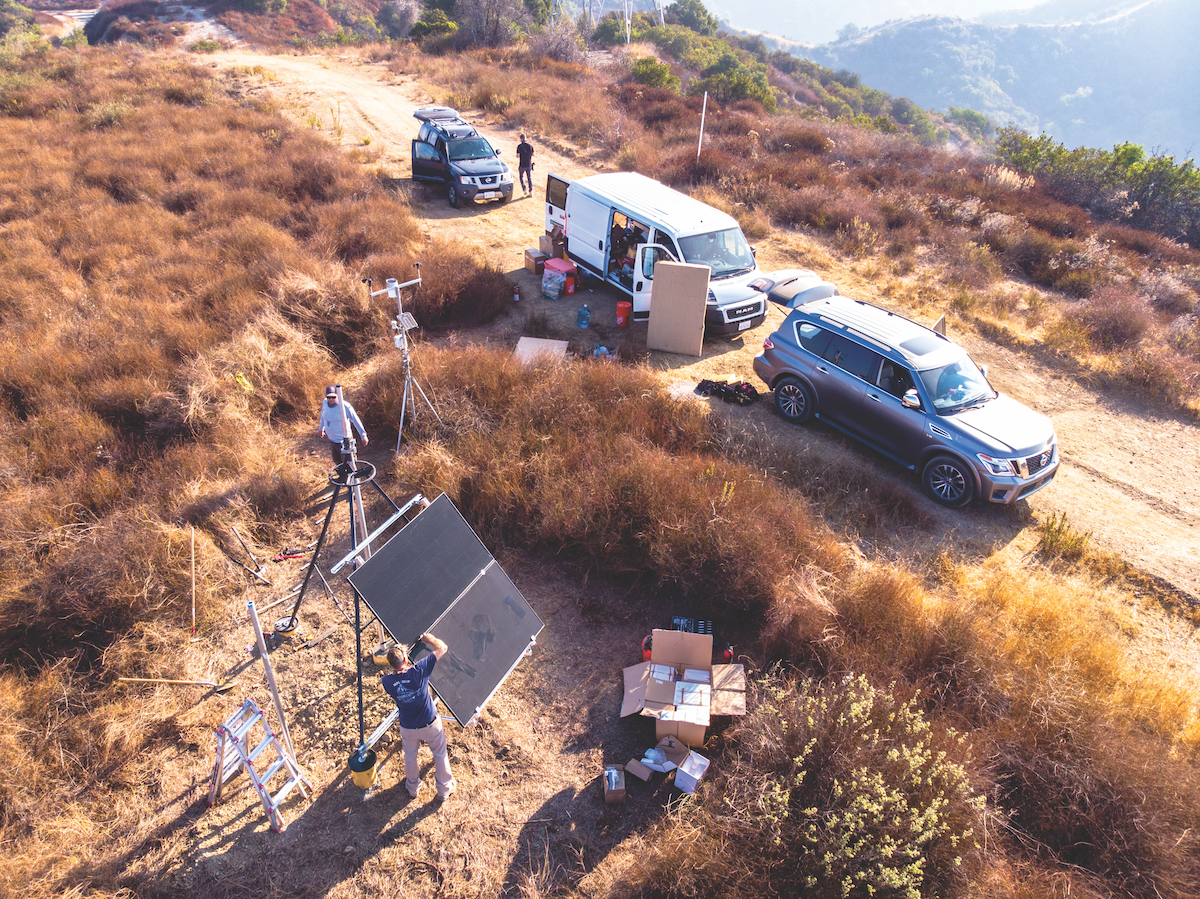
In addition to contaminating the air we breathe with toxic pollutants, wildfires release large quantities of greenhouse gases into the atmosphere. Prevention, early detection, and fast response are key to minimizing damage — and artificial intelligence is proving to be a powerful tool. The University of California San Diego’s ALERTCalifornia program partnered with the California Department of Forestry and Fire Protection and DigitalPath to develop and train an AI tool that uses footage from over 1,000 cameras throughout the state, picking up early indicators of fire and alerting local authorities so they can respond sooner and with more information.
PATH Water’s co-founder and CEO Shadi Bakour shares three branding lessons, including why leaders should stop resisting collaborations.
By Carla Kalogeridis
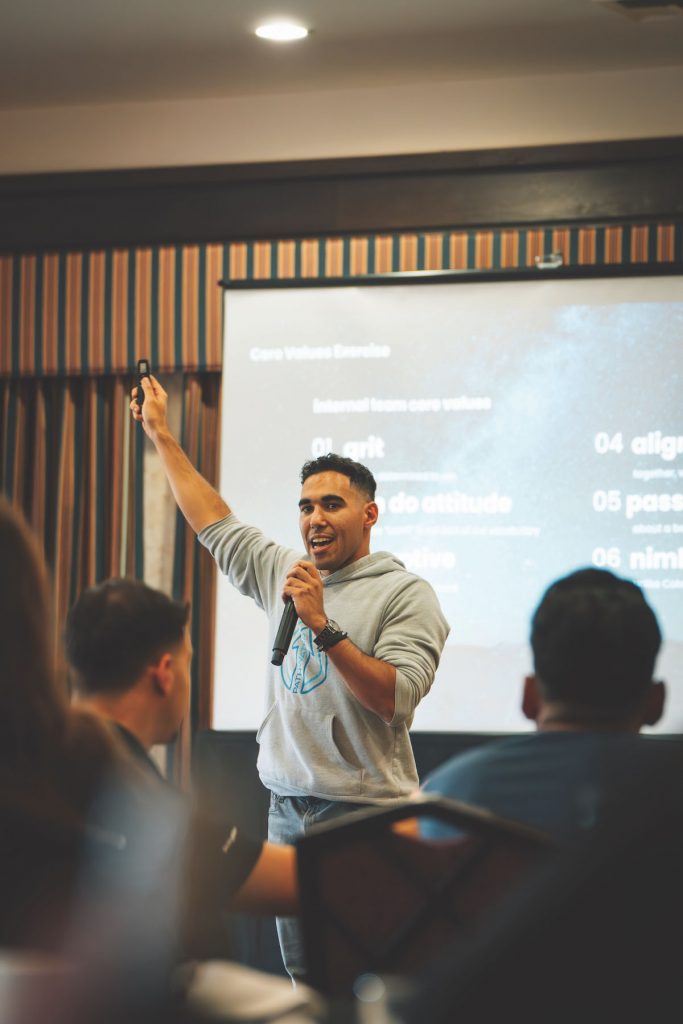
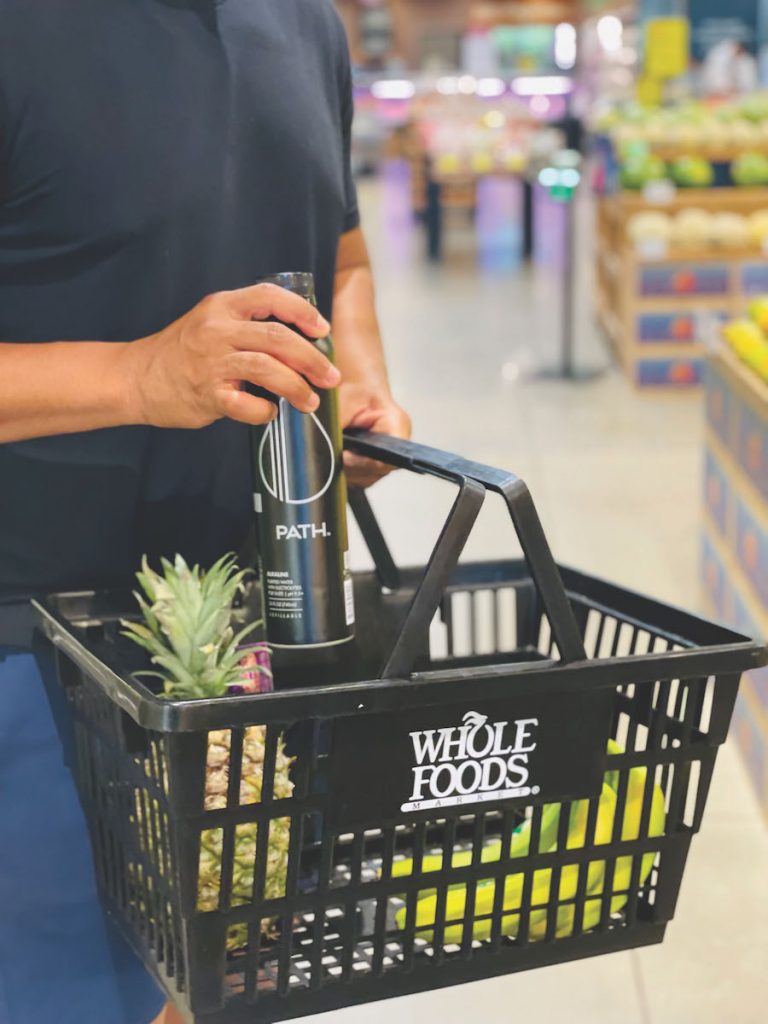
Shadi Bakour is an entrepreneur who finds motivation in tackling the world’s largest problems. In 2015 he co-founded PATH Water, which launched a sustainability-focused aluminum water bottle to challenge businesses and consumers to rethink the bottled water industry. Today, PATH is a global brand partnering with individuals and brands like Kevin Hart, Ryan Seacrest, Guy Fieri, Ninja Fortnite, Adidas, Dropbox, Whole Foods, Apple, Yellowstone National Park, and more.
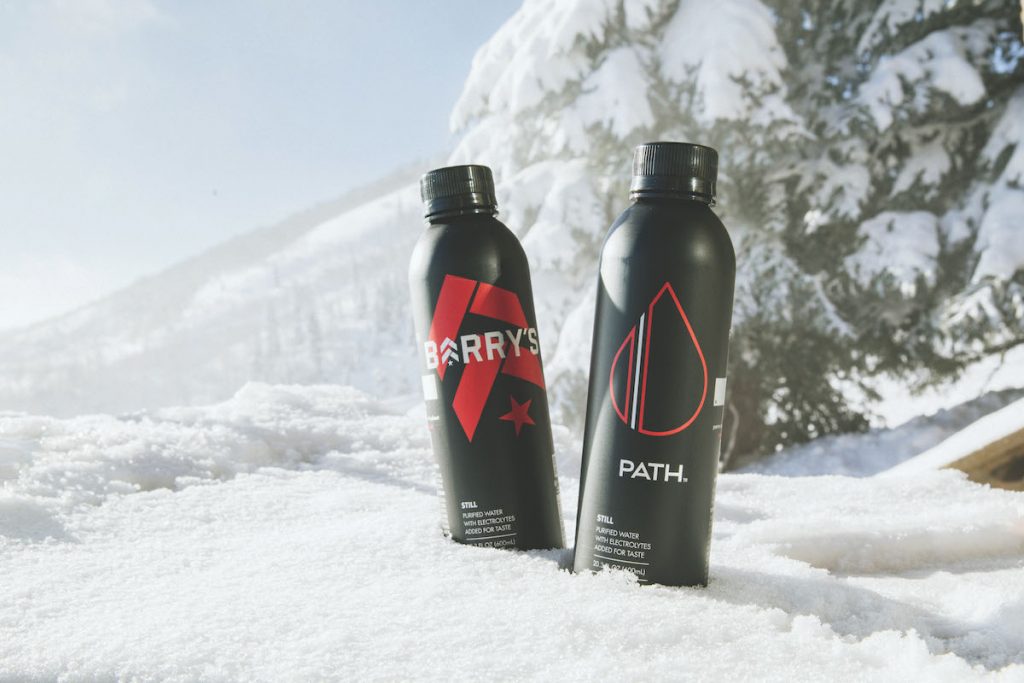
PATH is the first water packaged in a certified refillable and 100% recyclable BPA-free aluminum container. Since its inception, PATH has helped save more than 250 million single-use plastic bottles from oceans and landfills. The product is sold in all 50 United States plus seven countries.
Working collaboratively with partners, PATH has put its aluminum-bottled water in more than 55,000 locations around the world. The company has exclusive licensing deals with Nickelodeon and Hasbro. “Our whole approach to business has been the power of collaboration,” says Bakour. “Collaboration helps us make a larger impact and build a larger business much faster. We’ve learned that the new age of business is collaboration.”
Bakour isn’t claiming he invented the concept, but he has harnessed it more effectively than most entrepreneurs. “If you look at successful brands across the world, you’ll see that many have leveraged each other to make a larger brand impact,” says Bakour. “You can create win-win situations where you’re adding value to each other’s businesses and creating synergy to grow.”
He frequently cites a favorite African proverb: If you go alone, you can go fast; but if you go together, you can go far.
“It’s not really about what I can extract from the other organization or person,” he says. “And it’s not about what I can just give away, because I have to build a business with sustainable, profitable growth. It’s about how can we work together, and at the same time, what added value can I bring to the table?”
Here are three branding lessons Bakour has learned along the way.
Lesson No. 1: Go Against the Grain
Shadi Bakour told attendees at the recent Real Leaders UNITE conference in San Diego that being rejected by peers at a young age gave him time to think about how to do things differently.
As a child of immigrant parents, Bakour says he was “not the coolest-looking kid” in school.
“You could probably measure my weirdness by measuring the gap between my buck teeth,” he jokes. “But in that journey of not really being accepted among my peers at a very young age, it allowed me to think about how I can do things differently. It gave me an outsider’s perspective and taught me that sometimes going against the grain can be a really good thing.”
When he started PATH, at the core of everything he did was one question: How do we do things differently than how they’ve been done before?
“That one question goes to the essence of our product, which is a bottled water company that doesn’t want to sell you any more water because our product is in a reusable container,” he says.
Lesson No. 2: Put Ego Aside and Collaborate
The PATH Water idea really took off in San Francisco International Airport in 2019, which had banned the sale of single-use plastic on its property. “By some act of God and a lot of hard work, we took over the entire airport and created a catalyst for our business,” says Bakour. Because San Francisco is one of the tech hubs of the world, they were soon approached by an executive at Salesforce.
“Salesforce was really excited about our product,” he says. “They’re very anti-plastic, and they’re impact focused.” PATH was a very small business at the time — about $100,000 in sales — and it was just getting into 7-Elevens in Northern California. Salesforce wanted PATH to feature its logo on the PATH bottle.
“If you know anything about beverage or food, it’s all about brand equity,” Bakour says. “We were focused on building our own brand, right? We thought there wasn’t as much value in private labeling because you have no brand equity. That was the ideology planted in our brains at a very early stage.”
Eventually, Bakour says they gave Salesforce a “little, tiny spot” on the back of their bottle. “We fought tooth and nail over that little piece of real estate on our bottle,” he recalls. “When it comes to collaboration, ego can be the killer of growth. For a long time, we really resisted this idea of collaboration. Later, we had another opportunity where a big investor wanted us to make them a special bottle. So slowly over time, we started to let go of this idea that we had to be the only brand front-and-center on our bottle. We started falling more and more into this idea of collaboration.”
With the new shift in thought came a new program called Partnering to Save the Planet. “Over the past few years, that program has been growing like wildfire,” says Bakour. “Most people know us for our retail product at Whole Foods and Target — 100,000 retailers. But now we’ve partnered with all types of organizations, and this program we’ve created is completely banning single-use plastic within each partnering organization.” Recent program partners include Madison Square Garden, SpaceX, and several hotel groups.
“You won’t find it in the business books and few advisors will counsel you about this, but collaboration has opened up our sales channel and opened up the door for us in so many different ways,” he says. “By partnering with these organizations, we are leveraging our brand but also their brand equity. We’re lean on their brand equity to create more trust with our consumers, to create different experiences with them. When you have these different organizations building pyramids of our product in the middle of their facility, there’s added value that we never would have considered.”
Lesson No. 3: Most New Ideas Are Recreations of Old Ideas
Through the collaboration strategy, Bakour says he came to realize that even when you’re going against the grain, you probably still don’t have a purely original idea.
“Our licensing idea really came from one of our partners, someone from the fashion industry who had zero experience in the beverage space,” admits Bakour. “He looked at our product not as a bottle of water, but as a fashion accessory. It completely changes your approach to how you would sell or promote this product or how you would even build the brand. One of the key strategies when it comes to fashion is licensing. So, he brought this idea from the fashion industry, a strategy of accessorizing our product to an industry that largely was focused on brand equity.”
Bakour says through this one strategy, PATH learned to cobrand and partner with different organizations to eliminate single-use plastic and make a larger impact together. “We launched into retail licensing — which was a completely different concept for us — but a known strategy for our partner,” he says. “I realized that at the end of the day, most ideas are not really original ideas — they’re just recreations of ideas that already existed in the past. Few ideas out there are actually new or original.”
Bakour says that most entrepreneurs look back and think, “Well, this is the way things were done for so long, and there’s a reason for that.” However, he says, business leaders forget that the world and the economy are changing daily, as are the needs of the global economy.
“We should use the lessons from the past and the reasoning behind them, but we should always question them,” he advises. “Always try different approaches and new angles and see how the old ideas integrate into the new age of the world.”
Mission-Focused Makes Money
Bakour says focusing on PATH’s mission of reducing the world’s use of single-use plastic opened his mind to new-old ideas.
“Even though we take a little backseat with our own brand sometimes, by featuring all these other brands and putting them in the spotlight of sustainability, we’re not just giving it away — it is a collaboration, a partnership. We’re helping people make sustainable choices and look like they are sustainability leaders. In addition, serving different communities and audiences increases your own impact.”
Here are the questions that Bakour says all leaders should consider:
What are we doing with like-minded organizations to collaborate and leverage each other to create synergistic value?
How has our ego limited certain opportunities to work with others that may have been beneficial for us?
Have we worked with people or organizations from different industries? And if so, how has that impacted our story? How has that brought a fresh perspective to what we’re doing?
Bakour encourages leaders to also keep their minds open about who they might collaborate with. “Sometimes you stand your ground and turn down the opportunity to work with a particular brand, making a statement in doing so,” he acknowledges. “But we’ve even partnered with plastic-bottle water companies. It’s interesting because if we are true to our mission, and we really want to make a larger impact, then by offering them this sustainable option, we are making a larger impact. We haven’t turned down any organizations to date — even if they don’t fully align with our purpose.”
Bakour says PATH has even opened its doors wide to some of the biggest beverage brands, realizing that if PATH can tap into these large distribution systems and networks, that’s how it can make a larger impact.
“When these companies have asked to get involved with us, we’ve said yes,” he says. “It’s kind of like making an impact from inside the belly of the beast.”
What’s in a Name?
Rapper Meek Mill holding a PATH water bottle
When asked how he came up with the PATH brand name, Bakour admits it was a long process with many twists and turns.
“I always believed that a strong brand name has four or five letters, and it should be a word commonly used in day-to-day conversation,” he says. “A brand name is important. One of my co-founders actually thought that Smart Water made him smarter, and even when I told him it didn’t, he still kept drinking it.”
Bakour and his team settled on PATH because they believe water is the path forward. “It’s a path to a more healthy and sustainable future,” he says. “We are all on this path together. It’s a cool word that has different meanings for different people. Follow your path. Choose your own path. Join our path. Join us.”
As the world grapples with an environmental crisis of unprecedented proportions, the call for sustainable solutions has reached an all-time high. My journey toward sustainability began with a pivotal moment sparked by my partner, Jacqueline Koerner, a lifelong environmental advocate. I recall her poignant question upon my acquisition of Novex Delivery Solutions, one of the largest same-day couriers in the Lower Mainland, Canada, in 2000: “What are you doing buying such a polluting business?” To which I replied in a moment of realization: “Because I can clean it up.” And that has become my life’s work. I buy “dirty” companies and clean them up.
In that spirit, I acquired West Coast Sightseeing in 2009, and it has grown to become one of the largest tour bus operators in Vancouver, Niagara, and Seattle. Operating under Coast to Coast Experiences, we’ve incorporated electric tour buses and developed a robust social hiring program. In 2015, I became CEO of Changequity, which buys high-carbon companies and transforms them into restorative, market-leading green businesses.
My path toward sustainability was not without challenges. In the early days, pre-Al Gore, I had trouble rallying support and enlisting champions. Yet, armed with a solid commitment to environmental responsibility, my team at Novex Delivery Solutions and I made significant strides in reducing Novex’s carbon footprint by over 59% as of 2020 with the aim to achieve zero emissions by 2030 — successfully transforming from a high-carbon business into a leading green courier in Canada.
Navigating the balance between economic growth and environmental preservation emerged as a central question in my sustainability strategies. I adopted a pragmatic approach, demonstrating that sustainability need not come at the expense of profitability. By harnessing green and social initiatives, I demonstrated how businesses could simultaneously drive sales growth, reduce costs, enhance brand image, and mitigate risks.
Three Strategies Along the Sustainable Journey
Central to my sustainable journey are three key traits: adaptability, collaboration, and innovation. Recognizing the imperative need for change, we fostered a culture of sustainability, empowering our team and our customers to embrace new ways of doing business. For example, using internal greenhouse gas audits to understand sustainable impacts, Novex transitioned to hybrid and electric vehicles using vehicle wrap advertising programs and offsetting remaining emissions, earning a reputation as one of Canada’s greenest couriers while maintaining 11% earnings before interest, taxes, depreciation, and amortization. At Coast to Coast Experiences, we deployed vehicle-to-grid infrastructure and paved the way for medium- and heavy-duty vehicle owners to afford electric trucks and buses. We also added walking and biking tours and experienced significant sales growth over the next three years.
Businesses can have a profound impact in shaping a sustainable future under purpose-driven leadership. With vision, determination, and innovation, a greener tomorrow is within reach.
The Paris 2024 Olympics commmittee set ambitious goals for its most united, sustainable Games yet.
By Real Leaders
The Paris 2024 organizing committee has set out to establish a new model for the Olympic and Paralympic Games, pledging to deliver an ambitious, universal event that is more responsible, sustainable, united, and inclusive.
“We are collectively building a new model for the Games to ensure they control their impact on their surroundings as well as the entire planet, bring people together and are inclusive, frugal and sustainable,” says Tony Estanguet, president of the Paris 2024 Organizing Committee for the Olympic and Paralympic Games.
From the bidding phase, the committee put legacy and sustainability at the center. Signing a social charter with social partners, aligning with the Paris Agreement to reduce greenhouse gas emissions, and organizing the Olympic and Paralympic Week are a few examples of steps it took starting in 2017, seven years out.
“Our ambition is clear — to demonstrate that environmental and social excellence is not only necessary, but also a source of strength,” says Marie Barsacq, impact and legacy director of the organizing committee for the Games.
Paris 2024 is the first Games in history to devote such attention to climate and environmental considerations so early on. Using 95% existing or temporary venues minimizes its environmental impact. Reducing the number of new build projects means significantly restricts the carbon footprint and gives center stage to French architecture by transforming Paris’ landmarks into sporting arenas.
“We decided to seize the Paris 2024 Olympic and Paralympic Games as an opportunity to combat and adapt to climate change and address the urgent need to protect and regenerate biodiversity,” says Georgina Grenon, environmental excellence director of the organizing committee. “This sincere, firm commitment has guided us and united everyone involved in the Games and the sporting movement since the bid phase.”
Where emissions cannot be avoided, Paris 2024 is implementing a voluntary compensation plan across a wide scope that includes the international impact of spectator travel.
The projects chosen meet stringent international certification requirements. Beginning in 2021, these efforts involve carbon capture projects to restore and protect forests and oceans, as well as avoidance projects that, for example, install more environmentally friendly wood burners in homes that still rely on rudimentary cooking equipment. The committee pledges to offset even more emissions than the Games generate by supporting additional projects in France, boosting biodiversity and improving quality of life.
To halve the emissions arising in relation to the Games, Paris 2024 will leverage frugality, efficiency and innovation. Paris 2024 endeavors to identify, trial, and develop innovative solutions working with everyone involved to deliver responsible Games. Such initiatives include using 100% renewable energy during the Games, the circular economy, sustainable food sourcing, responsible digital technology, clean mobility solutions for the Olympic fleet, public transport and environmentally friendly means of transport for spectators, biodiversity protection, and water management.
The organizing committee goes on to say, “Sport brings together 3.5 million volunteers in France, evokes a range of unique emotions with 2.5 million events taking place every year, and showcases its positive impact on society day in, day out across the 180,000 sports clubs nationwide that promote education, integration, gender equality, and cohesion. However, the world of sport — like all other spheres of human activity and parts of society — needs to undergo an environmental transformation.
“Moreover, we firmly believe that sport can be harnessed to build a more sustainable society in which people demonstrate greater solidarity and are more mindful of nature and biodiversity.
Sport enables us to take in the beauty of our surroundings and understand why we need to protect the environment; it offers an excellent pollution-free mode of transport; it uses the food we eat as a source of fuel; it makes us realize the importance
of getting fresh air; and it is a form of entertainment that enables people to create memories around a common experience rather than limitless consumption.
“By ensuring we set our own benchmark, accelerating the roll-out of innovative solutions for spectacular and sustainable events, as well as working with everybody in the Paris 2024 family so that our methods and achievements leave a tangible and intangible legacy. This plan is the result of the work undertaken by everyone involved in Paris 2024 since the bid phase and highlights the distance we still have to travel together.”
Creating competitive bidding is far more effective than the commonly used wholesale buyer approach.
By Mark Van Ness
Can you start a company with no debt, no private equity investors, and no initial public offering strategy and grow it to be one of the top 10 companies in your industry — all with a strategy of collaborating with all your competitors?
At the age of 30, that’s what I set out to do. Today, SVN is the trusted advisor on over $20 billion a year in commercial real estate transactions — that’s about a deal every hour, 24/7. Perhaps our story will inspire you to see your competitors in a completely new light.
Imagine what it would be like to be trusted by all your competitors. Now, picture the power of mobilizing every one of your competitors to increase the value that you bring to your clients. This strategy enabled SVN to quickly grow into a top 10 commercial real estate services firm, first locally, then regionally and nationally.
I had previously led a turnaround for a typical investment real estate company that looked at its business as a zero-sum game. Like everyone else in the industry, the company did its best to keep the competition from selling its listings in an attempt to retain the entire commission. I saw countless listings expire or sell for less than they were worth with this all-or-nothing policy, and I realized that there was a better way than this very limited, dual-agency approach.
SVN was founded on the client-first principle of sharing our fee with the procuring broker with the best offer. Yes, it means we sometimes make less so that our clients can make more. Our clients appreciate that, and their loyalty and referrals have placed SVN among the Real Leaders Top Impact Companies and Inc. 5000 fastest-growing companies several times.
This concept of making more by making less per transaction can work in other industries as well.
Investment bankers, for example, operate under the same limited competition model with high fees and underwhelming results. By increasing the demand and the number of retail bidders, anyone can increase the sales price of their assets. An enterprising young entrepreneur could disrupt that industry today. This is the basic law of supply-and-demand at work. The more qualified buyers you have, the higher the competition for your asset, so the higher the price and terms you will achieve.
A few years ago, we put this fundamental strategy to the test. We commissioned an academic study of nearly 15,000 commercial real estate sales over a 10-year period. When the buyer was represented by a different brokerage company than the seller, they generated a 9.6% higher price, on average, than those kept in-house with the same brokerage company representing the buyer and seller.
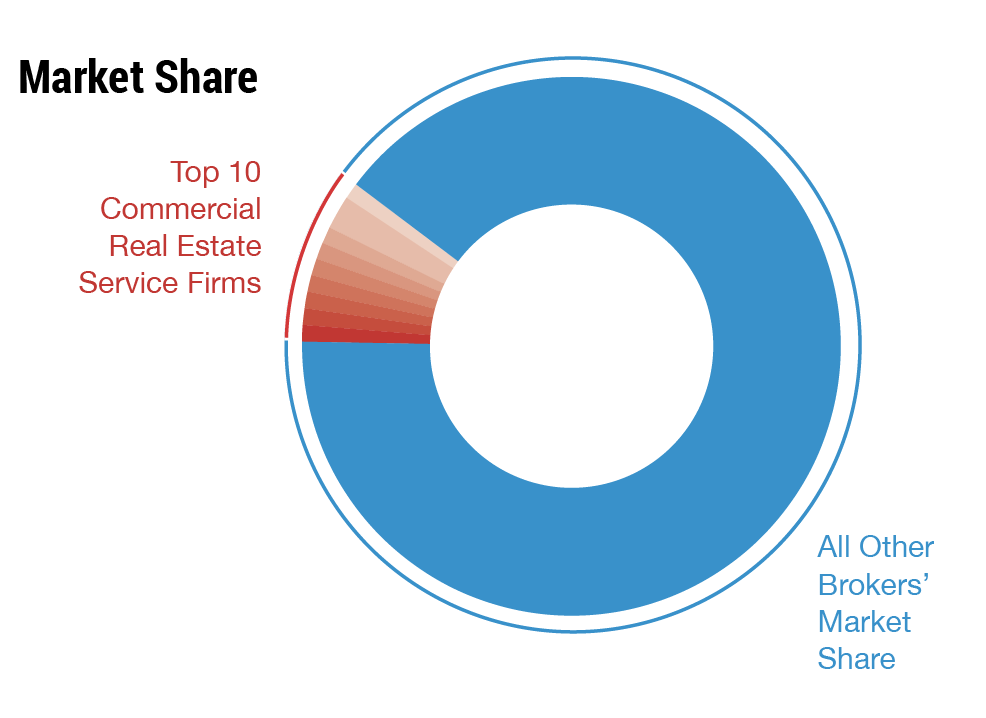
It makes sense that no one company can have trusted relationships with the hundreds of thousands of ultra-high-net-worth investors plus millions of high-net-worth investors. And no one brokerage company represents more than a tiny fraction of the market. In fact, the top 10 brokerage companies combined only represented 10% of the transactions last year. That’s why the SVN strategy of collaborating with our competitors to create competitive bidding for our clients has been far more effective than the wholesale buyer approach that the majority of the industry practices.
This strategy would be easy to duplicate, and we only expected a two-year edge before competitors copied us. But 37 years later, they’re still stuck operating in the shortsighted, outdated model from the last century. Meanwhile, SVN has risen from a startup to the youngest player in the top 10 companies in its field. To us, this proves that if you actually deliver more value to your clients and customers, they will beat a path to your door. And if you can find a way to collaborate with your competitors for the benefit of your clients, magic happens.
SVN’s Core Covenants
A company’s core values provide clarity on what is truly important for organizational success, personal and professional conduct, and what to expect from each other. SVN’s Core Covenants personify its values and culture and differentiate it from the competition.
As members of the SVN Shared Value Network, each employee commits to do the following:
Create amazing value with their clients, colleagues, and community.
Cooperate proactively and place their clients’ best interests above their own.
Include, respect, and support all members of the commercial real estate industry.
Honor their commitments.
Personify and uphold the SVN brand.
Resolve conflicts quickly, positively, and effectively.
Take personal responsibility for achieving their own potential.
Learn how to think more strategically about sustainability as a business driver.
By Real Leaders
GlobeScan is a global insights and advisory consultancy working at the intersection of brand purpose, sustainability, and trust. In this interview with CEO and author Chris Coulter, who co-hosts a podcast about sustainability leadership and business, he explains how companies can think more strategically about sustainability as a business driver.
Real Leaders: Where is society today when it comes to sustainability?
Chris Coulter: We are 40 to 50 years into the conversation of limits, growth, where things are at, and how all of these things are connected. Now, the conversation is more about how we transition and transform into a place that’s going to be more prosperous, more stable, more secure, and more thriving.
We’ve hit this critical mass threshold at a stakeholder level. Businesspeople, civil society, governments, the financial community, and the scientific community all crossed over a hump a decade ago where we have a collective understanding of where to go. While we have sophistication on the stakeholder side, every day there’s something new in understanding where it goes, how to regulate it, how to invest around it, and how to drive supplier perspectives. Now the debate is how, when, how fast, and where, and we can see the back-and-forth pendulum shifting.
On the consumer side, we have not engaged the average person on the street in this conversation very effectively. In some parts of the world, it’s part of the culture war between those who don’t want to change and those who do. So on the stakeholder side, we’ve moved miles and we’re at a much more sophisticated place. On moving society, consumers, and citizens, we’re pretty glacial with very little progress overall.
RL: Has the fundamental core driver of business shifted, as opposed to just maximizing share profit?
Coulter: I don’t think it’s transformative, but it has shifted. There have been generational shifts in chief executives, at senior C-suite levels, and even at the board levels that multi-stakeholder approaches to business are sensible, smart, and a long-term success pathway. However, the execution of that has been limited.
As for fully embracing what a multi-stakeholder approach to business looks like, companies know how to engage investors and listen to investors, and the ESG conversation has been quite catalytic in how companies have responded from at least a disclosure and compliance perspective. As for governments, there are government affairs teams that have had a fracture between traditional lobbying and then policy advocacy that could be oriented toward sustainability — and that’s beginning to move as well.
But other stakeholders beyond that constellation — communities of impact, civil society, those more peripheral stakeholder audiences — most companies haven’t approached that with a true multi-stakeholder mindset. The ones that do see what’s coming around the corner and how to prepare become future fit for this new reality. And those that don’t can be very successful for a long time until they can’t. There’s an attitudinal orientation and shift and lots of data that’s coming behind it, but the full execution and embracing at some sort of scale has not happened yet. And that’s an interesting place to support business more fully.
RL: What resonates with the multinational companies that GlobeScan works with? How do you convince them that making a difference is good for business?
Coulter: The business case for long-term success equals sustainability, and I can’t think there’s any data, model, or example where that isn’t the case. In the short term, you can make a crazy amount of money, burn bridges, and destroy things, and you can be successful — but in the long term, it’s almost impossible. There’s a great quote by a former CMO at Unilever, Keith Weed, who said he’d love to see the business case for unsustainable business.
So broadly, the way we meet our clients and engage, we have a shared mind that in the long term, this is what we’re trying to play for and prepare for. Once you begin to plan strategically by looking 10 or 20 years out and ask, “How will consumer sentiments or expectations or sensibility be changing in the future? Who is this younger generation versus the older? What are their preferences? What are their trends?” you can see that it’s being more inclusive, equitable, and sustainable, so that’s the future marketplace.
The problem is that people are so naturally preoccupied with short-term pressures and responses that we can’t get over the hump. Those companies that have been able to create a planning process, an engagement process to have their eye on the long-term, it equals strong sustainability commitment and performance, inevitably.
RL: How should leaders handle resistance to change among different generations?
Coulter: With any sort of generational tension there are new ideas, and the older guard are like, “That’s not how we do business. Let’s go easy. Slow down a little bit.” That’s OK. What’s remarkable is the Gen Z cohort, a portion of them — not all of them because there’s diversity in all cohorts — are remarkably smart, sophisticated, and super passionate about some of these issues that create this generational tension, especially around inclusion.
As for what’s changing, there are all kinds of conversations. Advertising and marketing have gotten a little more challenging with greenwashing that’s in the greenhushing pendulum. The real shift is that people are feeling that the world is changing for the worse when it comes to climate change. We do lots of consumer public opinion surveys, and in our latest global study, 40% of the world says that they now feel they’ve been very greatly personally impacted by climate change. That’s different than a decade ago when it was less than half of that.
The biggest obstacle now to sustainability orientation is future discounting. As a species, we’ve evolved to be quite short-term focused. Future discounting is a phenomenon where, if we look too far ahead, we discount the planning toward that. So if I’m a farmer 40,000 years ago trying to eke out a living, I’m not going to be thinking about the next 10 years; I’m thinking about tomorrow or next week. And that has served us well as a species. The challenge with climate and most environmental issues is that if we don’t straighten things out, things are going to get worse, and the worse in the future is a future-discounting problem.
Now there is an immediacy taking over what people are actually feeling and sensing, which is that things are changing — and not in a good way. This is our moment to try and transform it. The U.S. has the biggest gap anywhere in the world between younger people and older people feeling that climate is having a negative impact.
As leaders, you have to feel people’s pain, be part of the solution, and show responsibility. Half of us are getting away with, “It’s all inflated. It’s exaggerated. Let’s go back to traditional approaches.” That’s a natural reaction when change is imminent, but we’re going to work through it, and eventually, this is not going to be so politicized. It’ll be a standard status-quo approach to business — but we’re not there yet.
Becoming Employee Owned
Looking out for its own sustainability, GlobeScan became an employee ownership trust.
Here, Coulter talks about the decision-making process:
“We’re 36 years old as an organization, but we were at that juncture where we asked ourselves, ‘Do we go to a bigger agency and be sold, do we find a management buyout, or do we do something more innovative?’ It wasn’t an easy thing to do because of the legal and tax implications, and we’re a small organization — just 60 people spread across nine cities in the world — but we’ve grown substantively over the last couple of years.
“So we chose this idea of an employee trust, which is not an employee-owned framework. It is a separate trust very much like the John Lewis Partnership in the UK where no one really owns it — the trust owns it. As employees, we’re the beneficiaries, and we get profit-sharing because of that. But once we leave, the trust continues and part of this was to maintain our independence, to be an objective voice, and to ride through what’s going to be a very disruptive, exciting, but transformative and challenging multiple decades going forward.
“We’re trying collectively to think of not only what we’re doing in our work now with our clients, but what about future GlobeScanners? We’re trying to have a very long-term approach.”
Vital Farms accelerates its growth while continuing to expand its impact in farming.
By Real Leaders
Vital Farms has grown from an idea to the leading seller of pasture-raised eggs in the U.S.
Founded in 2007, Matt O’Hayer set out to improve the standards of animal welfare in an industry with an ethics challenge. There are over 300 million commercial laying hens in the U.S., and around two-thirds of them are caged. The vast majority of them live packed in battery cages, unable to spread their wings, which makes them among the most intensively confined animals in agribusiness, according to the Humane Society.
Instead, Vital Farms raises its hens in pastures with outdoor access year round, focusing on humane treatment. It also looks out for the health of the land through sustainable farming practices. Its farmers rotate pastures and do not use pesticides or herbicides.
“Our mission is to bring ethical food to the table,” says Russell Diez-Canseco, president and CEO of Vital Farms. “We do everything we can to improve the lives of people, animals, and the planet through food.”
The company has grown from a single farm in Austin, Texas, to a national consumer brand that works with over 300 small family farms. More than 24,000 stores across the U.S. sell its products, including standard egg cartons, hard-boiled eggs, liquid whole eggs, and butter (added in 2015). They’re also on the menus of hundreds of foodservice operators across the country. From 2019-22 alone, Vital Farms has more than doubled its employees and increased its revenue by over 2.5x.
From Farm to Future: Vital Farms’ Roadmap for Positive Impact
“We continue to invest in our crew, innovate with our farmers, drive meaningful progress for the environment and our communities, support our consumers and customers, and deliver on our commitments to stockholders,” Diez-Canseco says. “We’re challenging ourselves every day to forge a path that we believe will deliver strong results and positive impact well into the future. We’re committed to raising the standards in the food industry, and as our goals demonstrate, we are taking cumulative steps every day.”
A Certified B Corporation, Vital Farms also provides long-term benefits to its stakeholders. Its core values include transparency and honesty, as evidenced by its traceability initiative that allows consumers to trace each carton of eggs back to the farm where they were laid.
In 2021, Vital Farms started producing some of its eggs using regenerative farming practices, planting certain cover crops and following other practices that revitalize and restore ecosystem functions while regenerating the soil to advance biodiversity, soil health, water quality, and nutrient density. Regenerative practices can result in higher profits for farmers, increase the land’s resiliency, and improve the health of waterways. In recognition of those efforts, in 2023, Vital Farms became the first national egg brand to earn a Regenified verification for four of its farms.
“We believe we should be restoring instead of depleting the earth through the practices we use to grow food,” Diez-Canseco says.
Vital Farms is working toward scaling regenerative agriculture practices to all of its farmers by 2026, as well as reducing carbon intensity in its operations by 25% by 2027.
A Greener Facility
Here’s a closer look at Vital Farms’ award-winning egg washing and packing facility.
The building was designed to LEED Silver standards and is pursuing certification with the U.S. Green Building Council.
Crew-focused features capture natural light and manage engine room humidity.
A water filtration system allows for water reuse for up to eight hours (30+ wash cycles).
An offsite underground cold storage facility uses at least 25 percent less energy than above-ground storage.
LED lights improve energy efficiency by 50 percent.
Bioretention features clean and cool rainwater, provide for the recharge of local aquifers rather than runoff into storm sewers, and conserve over 700,000 gallons of water per year.
A solar array was added in 2023, generating close to 20 percent of the facility’s energy usage, lowering energy costs, and reducing greenhouse gas emissions.
I’ve been a founder and CEO for nearly 20 years, and I’ve read countless books on management and leadership. My conclusion? Most meetings are a waste of time and money — but there are three meetings you shouldn’t operate without.
1 All-Hands Meeting
This is your most important meeting. Don’t waste it.
Who: Include everyone on the team. No one should be left out.
Why: It aligns the entire team on direction and progress.
When: Convene monthly (one hour) or quarterly (two hours).
Agenda
Where you’re going: Find ways to talk about the longer-term vision and goals.
How you’re doing: Share progress against monthly, quarterly, and annual goals.
Why it matters: A customer story shows the impact you’re having. A team member demonstrates your values.
2 Top-Goal(s) Meeting
Schedule a meeting to review progress against your annual goals (three maximum). You can also break it up into three separate meetings.
Who: Invite key people who are responsible for the goal (fewer than seven).
Why: It tracks progress against your top three most important items.
When: Meet biweekly (one hour per goal).
Agenda
How you’re doing: Each goal should have one main owner who leads the update to the group.
If you’re behind: Dedicate the meeting to creating a plan to get back on track.
If you’re ahead: Talk about upcoming risks and how to mitigate early –– or just end the meeting early.
3 One-on-One Meeting
Plan a meeting with each person on your team. If you have a large team, it’s only with your direct reports.
Who: Have just you and the person.
Why: It tracks progress against individual goals and offers help.
When: Meet biweekly, or weekly if you feel it’s necessary (30 minutes to one hour).
Agenda
How you’re doing: The person should start by giving an update on their goals.
If they’re behind: Offer help. Create a plan together in the meeting to get back on track.
If they’re on pace: Use the time for other items, but let the person set the agenda.
Scot Chisholm founded software company Classy (acquired by GoFundMe), serving as CEO for over 10 years and leading it to 300+ people and billions in platform donations. More recently he founded Haskill Creek, a new spin on the traditional pharmacy. He coaches founders/CEOs, helping them transition to high-impact leaders.
Mass Timber Home by Green Canopy Node revolutionizes construction and advances sustainable building practices.
By Real Leaders
For the last several decades, the U.S. housing supply has not kept pace with demand, leaving America short millions of homes today in a gap that continues to widen. To help address that problem, Green Canopy NODE, a sustainable construction technology company, developed a Mass Timber Model Home Assembly Kit that provides developers a path to deliver housing twice as fast with greater predictability.
“Green Canopy NODE’s Mass Timber Model Home is a game-changer for developers,” Co-CEO Bec Wilder says. “We all want to solve the housing market’s pains, but we get stuck in long development timelines and traditional construction schedules. Our model home will help cut out a lot of hurdles and risks we all have traditionally struggled with and help us all simply deliver more housing.”
From Months, Not Years: Building Better & Faster for Communities
The model home was designed as a turnkey housing unit and completed it in March 2023 in partnership with Mercer Mass Timber. They controlled costs with pre-planned and streamlined construction, delivered it faster through simultaneous manufacturing and site prep, and avoided weather delays in construction through off-site manufactured modular installation.
“Addressing the housing crisis with the same solutions we’ve been using for the last 100+ years simply isn’t going to achieve the outcomes we need,” Co-CEO Aaron Fairchild says. “We are excited to bring the power of manufacturing to help regenerate communities and environments all while reducing waste and minimizing embodied carbon.”
The Mass Timber Model Home is a 1,200-square foot, two-story modular home with a rooftop deck, two bedrooms, and one-and-a-half bathrooms. It was built using precision-engineered mass timber components manufactured offsite, demonstrating the power of prefabrication, installation, and logistics.
Game-Changer for Developers: Speed & Sustainability
The modules for the home were assembled offsite in Spokane, Washington, and were ready for shipping in two days. Onsite assembly for the entire home occurred in two days during a blizzard, further testing the company’s process and capabilities to build under extreme conditions.
“Building with mass timber delivers increased efficiency, enhanced sustainability, health benefits, and unparalleled aesthetics, making it an ideal choice for developers and investors interested in low- and mid-rise residential construction technology,” Fairchild says. “One of our bigger goals is carbon negativity. I think that we will crack the code and we will be able to have people housed affordably, humanely, and with dignity.”
Benefits of Mass Timber Homes
Increases efficiency and is 44% faster to complete than traditional construction (under 100 days from project start to completion)
Controls costs with pre-planned and streamlined construction
Avoids weather delays through off-site manufactured modular installation
Enhances sustainability by reducing embodied carbon footprint and waste
Stores 6.6 times more carbon than a stick frame home and offsets two-and-a-half stick frame houses with carbon storage
Lasts longer than standard code-built homes and can be deconstructed and reused