U.S. Tests Nuclear Power System to Sustain Astronauts on Mars

Initial tests in Nevada on a compact nuclear power system designed to sustain a long-duration NASA human mission on the inhospitable surface of Mars have been successful and a full-power run is scheduled for March, officials have announced.

National Aeronautics and Space Administration and U.S. Department of Energy officials, at a Las Vegas news conference, detailed the development of the nuclear fission system under NASA’s Kilopower project.

Months-long testing began in November at the energy department’s Nevada National Security Site, with an eye toward providing energy for future astronaut and robotic missions in space and on the surface of Mars, the moon or other solar system destinations.

If you like this, subscribe here for more stories that Inspire The Future.

A key hurdle for any long-term colony on the surface of a planet or moon, as opposed to NASA’s six short lunar surface visits from 1969 to 1972, is possessing a power source strong enough to sustain a base but small and light enough to allow for transport through space.

“Mars is a very difficult environment for power systems, with less sunlight than Earth or the moon, very cold nighttime temperatures, very interesting dust storms that can last weeks and months that engulf the entire planet,” said Steve Jurczyk, associate administrator of NASA’s Space Technology Mission Directorate.

“So Kilopower’s compact size and robustness allows us to deliver multiple units on a single lander to the surface that provides tens of kilowatts of power,” Jurczyk added.

Testing on components of the system, dubbed KRUSTY, has been “greatly successful — the models have predicted very well what has happened, and operations have gone smoothly,” said Dave Poston, chief reactor designer at the Los Alamos National Laboratory.

Officials said a full-power test will be conducted near the middle or end of March, a bit later than originally planned.

NASA’s prototype power system uses a uranium-235 reactor core roughly the size of a paper towel roll.

President Donald Trump in December signed a directive intended to pave the way for a return to the moon, with an eye toward an eventual Mars mission.

Lee Mason, NASA’s principal technologist for power and energy storage, said Mars has been the project’s main focus, noting that a human mission likely would require 40 to 50 kilowatts of power.

The technology could power habitats and life-support systems, enable astronauts to mine resources, recharge rovers and run processing equipment to transform resources such as ice on the planet into oxygen, water and fuel. It could also potentially augment electrically powered spacecraft propulsion systems on missions to the outer planets.

By Will Dunham; Editing by Tom Brown.

If you like this, subscribe here for more stories that Inspire The Future.

New Zealand PM Joins Five Other ‘Power Mums’

New Zealand Prime Minister Jacinda Ardern received a flood of congratulatory messages after she announced she was pregnant with her first child, with campaigners lauding the support as a sign of women’s rights progress.

The popular and charismatic politician, New Zealand’s third female leader, who took office last year after a closely fought election, said she planned to work until the end of her pregnancy in June and then take six-weeks leave.

“I’m not the first woman to work and have a baby. I know these are special circumstances but there are many women who have done it well before I have,” Ardern told reporters.

If you like this, subscribe here for more stories that Inspire The Future.

New Zealand has long held a progressive reputation, having been the first country to given women the right to vote in 1893.

Ardern is one of the very few examples of an elected leader holding office while pregnant. Advocacy groups say her announcement could help break stigma on the issues of women juggling a career and family.

Here are five other powerful women who were pregnant while holding public office or leading a corporate giant:

1) Benazir Bhutto

Pakistan’s Benazir Bhutto had her second child, a girl, while she was prime minister in 1990. She is thought to be the first modern head of government to give birth while in office. Bhutto, who became the opposition leader later, was killed in a gun and bomb attack in 2007.

2) Carme Chacon

Spain’s first female defense minister was cast into the media spotlight when she took office in 2008, seven months into her pregnancy. Chacon was famously photographed on a trip to Afghanistan reviewing troops – when she was visibly pregnant – shortly after she took office. She held the post until 2011, and died in April 2017 at the age of 46.

3) Queen Elizabeth II

Britain’s Queen Elizabeth gave birth to two of her four children after she became a monarch in 1952. Her third child, Prince Andrew, was born in 1960, and the fourth, Prince Edward, in 1964. Prince Andrew and Prince Edward were the first children to be born to a reigning monarch since Queen Victoria had her family, according to the British Royal Family official website.

4) Marissa Mayer

Marissa Mayer announced she was pregnant with twin girls when she was Yahoo chief executive in September 2015. She took two weeks’ maternity leave to give birth later in the same year, as she worked toward turning around the struggling company. She stepped down from the position in June last year.

5) Susan Wojcicki

One of the tech world’s most influential women, the chief executive of the streaming video service YouTube announced she was pregnant with her fifth baby a few months after she took on the job in 2014. Wojcicki has often championed the cause of gender diversity in the tech industry, including writing articles that argued for the importance of paid maternity leave for businesses.

By Beh Lih Yi @behlihyi, Editing by Jared Ferrie. Source: Reuters, British Royal Household official website, Wall Street Journal

If you like this, subscribe here for more stories that Inspire The Future.

Beehive Fence Makes Marauding Elephants Buzz Off

After failing to stop marauding elephants with trenches and solar-powered electric fences, residents have found a sweet solution.

A year ago, no one in Mayilattumpara could sleep soundly at night. Residents of the village in the foothills of Thrissur district, in southwest India’s Kerala state, feared invasions by wild elephants.

The animals, reacting to the loss of their forest habitat and a scarcity of food, frequently invaded the farmland around the village, trampling on plants and crops and destroying incomes.

If you like this, subscribe here for more stories that Inspire The Future.

Everything the villagers tried to deter the animals – digging trenches, beating traditional drums, installing solar-powered electric fences, or planting shrubs with supposed repellent qualities – proved ineffective. One after another, residents began to give up farming.

But the situation has turned around in the past year. Now people in Mayilattumpara are no longer disturbed by elephants. Instead they are agreeably surprised by visiting herds of journalists, scientists and environmentalists.

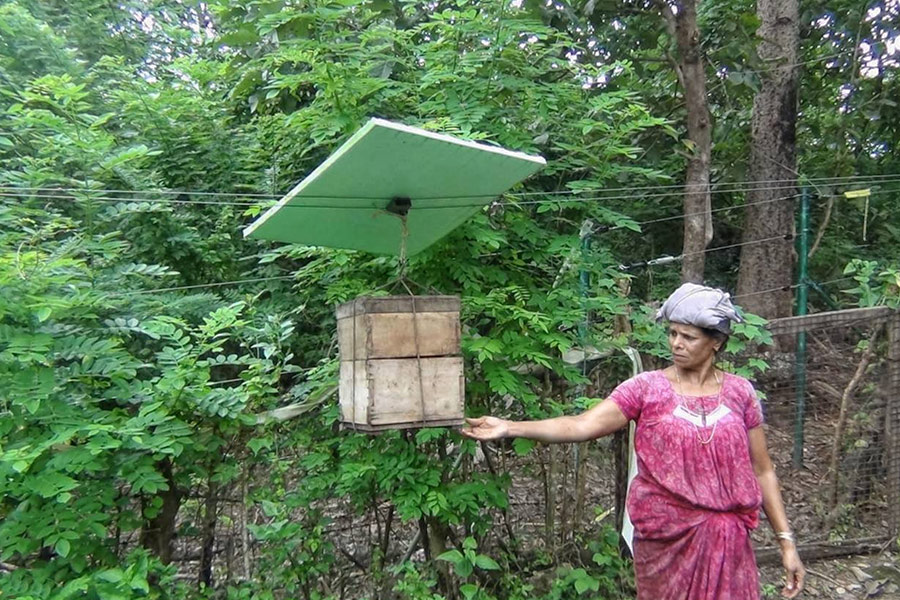
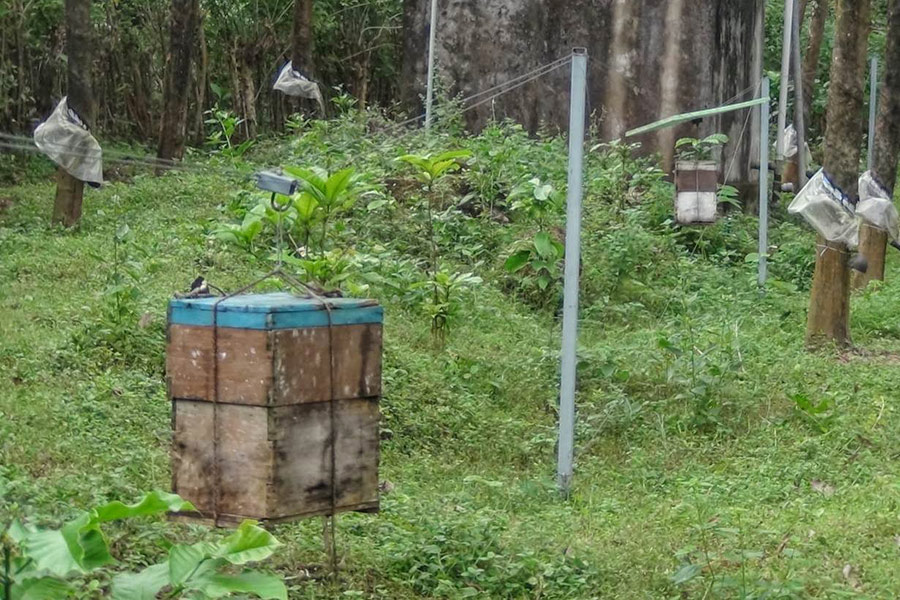
That’s because residents have finally figured out what repels elephants: honey bees. A wire fence strung with beehives now stretches 2.5km (1.5 miles) along the border of 18 village farms. The hives, hanging every 10 metres along the wire, are populated with Italian honey bees bred in Kerala.

Elephants, it turns out, are frightened of loudly buzzing bees and their ferocious stings. When elephants try to pass the wire fence, angry bees swarm out and the elephants quickly flee, residents say. Protected by the bees, farmers can tend their crops again. And some are also beginning to cultivate a new harvest – honey.

Johny Kochery has 9 hectares (22 acres) of farmland in Mayilattumpara, but for a time gave up trying to produce crops after repeated damage by elephants. Now he points to flourishing coconut trees, rubber plants and more than 60 varieties of fruit on his land. Since installing the beehive fence a year ago, “not even a single elephant reached the vicinity of my farm. Elephant attacks are an old story,” he said.

During the recent monsoon season, elephant herds crossed the nearby Peechi reservoir and raided the neighbouring villages of Kalladik, Thekkumpadu and Poolachode, trampling plantain trees and destroying villagers’ huts. But they haven’t come any closer than 100 metres to the beehive fence protecting Mayilattumpara, residents say.

AFRICAN ORIGINS

The fence project, begun in January 2016 by a local farmers’ group with the support of the federal government’s Agriculture Technology Management Agency (ATMA), cost 500,000 Indian rupees ($7,800).

V.S. Roy, who initiated the project while working for ATMA, said the idea came from the work of Lucy King, an Oxford University researcher who in 2008 successfully tested using African honeybees to keep elephants at bay in areas of Kenya where there was conflict between the animals and people.

The experiment was later repeated by other researchers in Tanzania. “If it could (work)in the African forest, why couldn’t it in the Kerala forest?” Roy remembers thinking. According to India’s environment ministry, conflict between humans and elephants across the country leads to regular deaths among both.

In Kerala alone in 2017, 22 people died in conflicts with elephants, which the state government says is a typical annual toll. Last year the state’s forest department paid more than 90 million rupees ($1.5 million) in compensation for loss of life and destruction of property caused by elephants, officials said.

A view of a beehive fence that works to control farm invasions by hungry elephants in Mayilattumpara village in India’s Kerala state, October 2017. Photo: Thomson Reuters Foundation/K. Rajendran

PROBLEMS – AND PROFITS

Roy’s project was not an initial success. An experiment in 2012, in another district, failed in part because he did not first get sufficient support from local people, he said.

When he came to Mayilattumpara, he started the farmers’ association and involved them in the planning to win their backing and participation, he said.

Kochery, who heads the farmers’ association, noted that setting up such a system is not easy “unless farmers are ready for collective, meticulous and patient experimentation”.

Besides figuring out an effective fence and hive system, farmers also had to learn to manage bees and replace colonies that become diseased, and pick up the costs of doing that once initial grant money from ATMA ran out, he said.

None of that has been easy, he said. But today the effort is beginning to pay off. Each December to March honey season, each of the 260 beehives strung along the fence could produce as much as 30 kg of honey, farmers said.

This has the potential to bring in up to 65,000 rupees ($1,000) for each farmer, allowing for a substantial profit even after the costs of maintaining the hives. That has not yet happened, and Kochery said the farmers only broke even last season due to some initial glitches – but they hope to have a big harvest this year.

Despite the challenges, farmers from other areas of human-elephant conflict in the state now hope to replicate the Mayilattumpara effort, and win financial support from the state’s Forest and Wildlife Department. “It should be scientifically sustainable. We are awaiting reports from on the ground,” said Nagesh Prabhu, the state’s head of forest conservation.

Kerala’s government is also trying to defuse conflict between elephants and people by reducing deforestation and rehabilitating elephant habitat, officials said. In the meantime, E.A. Jayson, a scientist with the Kerala Forest Research Institute, which has completed a study of the beehive fence experiment, said the fencing seems to work – but there are now new problems to solve.

“Rather than technical issues, some social issues are creating hindrances. We have met with incidences of theft of beehive boxes,” Jayson said.

By K. Rajendran; editing by James Baer and Laurie Goering.

If you like this, subscribe here for more stories that Inspire The Future.

5 Celebrities Running Businesses That Give Back

Popularity and awareness of social enterprises – businesses that trade to address social problems – has flourished in recent years. From A-list actors to celebrity chefs, here are five famous faces running businesses with a mission to do good:

HUGH JACKMAN

Famous for playing character Wolverine in the “X-Men” series of films, Australian actor High Jackman first stuck his tungsten talons into social enterprise in 2011 after a trip to Ethiopia.

On the trip Jackman helped out local coffee farmer Dukale for a day and saw coffee traded, sparking an interest in fair trade which ensures growers get a fair price for their crop.

Laughing Man coffee was founded in 2011 to trade directly with growers, with a Laughing Man coffee shop opening in New York’s Manhattan.

Next came a tie-up with Keurig, a popular coffee machine in the United States with Laughing Man pods now available. Keurig then introduced Jackman to Kroger, a major U.S. supermarket chain, according to CBS News.

Laughing Man coffee is now available in 1,800 stores across the United States. All the profits go towards education, community development and new business development projects in the developing world, according to the Laughing Man website.

If you like this, subscribe here for more stories that Inspire The Future.

ROSARIO DAWSON

U.S. actress Rosario Dawson, star of “Men in Black II” and “Sin City”, launched her social enterprise Studio 189 with best friend Abrima Erwiah in 2013 after travelling in Africa, according go the project’s website.

Studio 189 sells clothes that challenge the idea of cheap, mass produced, fast fashion with the garments handmade in Ghana with a focus on African patterns and fabrics while paying a decent wage to the people who create them.

Studio 189 is a part of the United Nations Ethical Fashion Initiative which aims to build a responsible fashion industry where workers earn a living wage in good conditions while also protecting the environment.

PHARRELL WILLIAMS

The Grammy award-winning U.S. producer and performer Pharrell Williams has been creative director of social enterprise Bionic since 2010. Bionic takes plastic, shreds it, heats it and spins it into two types of yarn used to make everything from jeans to the roof linings and car seat covers.

To date Bionic said by email that it has recycled nine million bottles by making the material. This number will grow as Bionic has partnered with the charity Waterkeeper’s Alliance to use plastic found in the sea and washing up on the coast.

The United Nations has warned that if current pollution rates continue, there will be more plastic in the sea than fish by 2050.

MICHAEL SHEEN

It was at Social Saturday, an annual event that encourages people to spend money on goods and services that have a positive social impact, that Welsh actor Michael Sheen declared his interest in social enterprise.

Donning a Social Saturday T-shirt in 2016, the actor, famous for his roles in the “Twilight Saga” and Oscar nominated film “Frost/Nixon”, said he wanted to understand how social enterprise might be useful to his home country.

In April 2017 it was announced that he would become a patron of industry body Social Enterprise UK. At an awards event in November he told the Thomson Reuters Foundation he would launch his own social enterprise in 2018.

“Social enterprise is one of those tools for communities that want to create their own opportunities, like where I come from in the South Wales valleys,” Sheen said.

He plans to start a “community hub” in Port Talbot to help people start community-owned businesses and services, as threats to the steel industry have put traditional jobs at risk.

JAMIE OLIVER

British celebrity chef Jamie Oliver started his restaurant Fifteen in London in 2002 when he was just 26. It was named after the number of disadvantaged young people Oliver attempted to train as chefs there.

The first group were all unemployed; some were truants who’d left school without qualifications, others had anger management issues. To date, a third of all candidates have had a brush with the law, Matthew Thomson, Fifteen’s managing director, told the Thomson Reuters Foundation.

New chefs have three months training in professional cookery at college which is followed by 11 months of work in a Jamie Oliver restaurant. The last month involves work experience elsewhere, which can lead to a job.

Further Fifteen restaurants were opened in Amsterdam and in Cornwall in southwest England. Over 500 chefs have been trained, with 80 percent of them still working in kitchens.

By Lee Mannion @leemannion; Editing by Ros Russell. 

If you like this, subscribe here for more stories that Inspire The Future.

Housing The Homeless: Cardboard Tents Sprout in Brussels

When a homeless friend told Xavier Van der Stappen that rough sleepers cherish large cardboard boxes because they offer not only shelter but also a place to hide from the shame of living on the street, he decided to act.

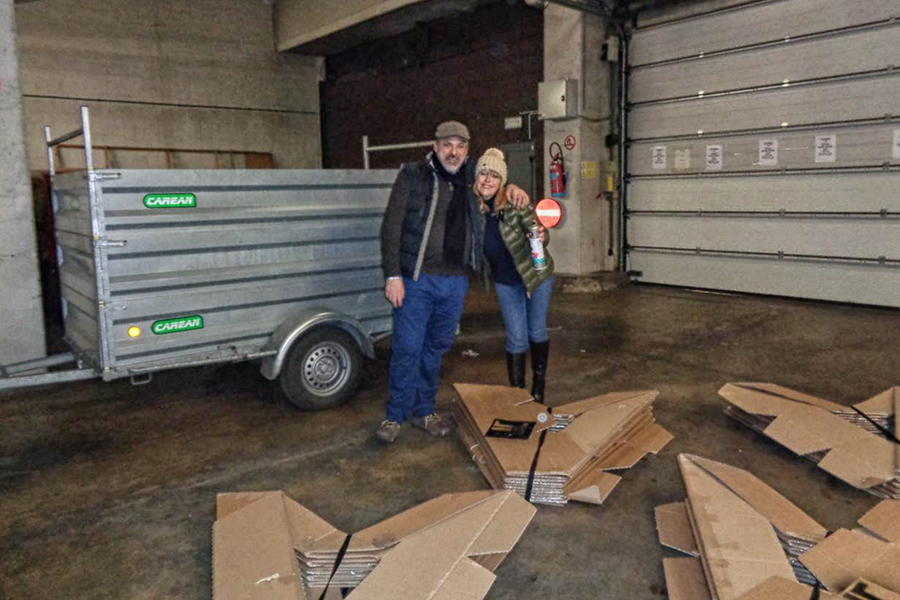
Using cardboard donated by a local factory, Van der Stappen worked with designers to produce 20 portable cardboard tents, which homeless people are using on the streets of the Belgian capital during the cold winter.

“There are homeless people everywhere. When I saw them, it made me remember refugee camps in Africa,” said Van der Stappen, the man behind the ORIG-AMI project.

If you like this, subscribe here for more stories that Inspire The Future.

“It is a shame that in the 21st century there are still people living in streets in a very rich country like Belgium.”

The region around Belgium’s capital city had more than 4,000 homeless people last March, according to La Strada, a public body which tracks the numbers of homeless.

Canvas tents are banned on the streets of Brussels, as camping is forbidden in the city, and cartons are usually disposed of by city cleaning services.

Van der Stappen said the tents were needed as many hostels were full and strict rules stopped some people using them.

Xavier Van der Stappen and Annie Oger get ready to distribute ORIG-AMI cardboard tents. Photo: Annie Oger/Cultures and Communications Association

“They cannot go with a dog or as a couple; they cannot drink,” he told the Thomson Reuters Foundation.

“Alcohol is a problem, but for them also a solution because if they drink they forget about everything. So it’s a way to escape their problems.”

The factory that donated the cardboard recommended Van der Stappen use a local prison service to make the tents. The irony of the situation appealed to him.

“For me, it was kind of a symbol,” he said. “The prisoners have a bed and food. The people in the street are free, but they are still in the street.”

Feedback from users of the origami-style tents will inform an improved design and rollout of 100 more shelters over the rest of the winter, he said.

Van der Stappen paid for the first 20 tents himself. He thinks they could be hired out at summer festivals to fund the provision of more shelters next winter.

He is keen to stress, however, that he sees the cardboard tents as a temporary solution to homelessness.

“I’m not the person who is trying to solve it. I just try to find a solution for today, not for tomorrow,” he said.

By Lee Mannion @leemannion. Editing by Katy Migiro. 

If you like this, subscribe here for more stories that Inspire The Future.

Denmark Considers Cryptocurrencies For Humanitarian Aid

Denmark sees potential for blockchain technology in humanitarian aid and said on Thursday it is considering becoming the first donor country to move money using cryptocurrencies.

Blockchain is a ledger system tracking digital information, and among other advantages it can provide digitised contracts to avoid fraudulent land records, or enable faster and safer money transfers to emergency hot spots around the globe by using cryptocurrencies.

A report published by the Danish Foreign Ministry on Thursday, in collaboration with think tank Sustania and blockchain currency platform Coinify, investigates how blockchain technology might solve problems in providing development aid.

If you like this, subscribe here for more stories that Inspire The Future.

“Crypto and crisis is a perfect match, and aid organizations will undeniably be able to respond more quickly using blockchain-based digital money, which arrives at email-speed, safely and transparently,” said Marianne Haahr of Sustania.

Blockchain is still relatively immature and it might take time to develop trust, but some concrete initiatives are being developed. One of Europe’s biggest virtual currency platforms, Coinify, is working on using cryptocurrency payments to scale off-grid renewable energy.

“You will be able to pay with your cryptos directly into a solar panel situated in, for example, an African village and then you would not donate money but electricity,” Coinify’s CEO Mark Hojgaard told Reuters.

Another option could be an online hub where people would donate to single projects like schools, railroads or bridges. So-called smart contracts would ensure that the money went to its intended project.

“The money being donated goes into a programme where you can only use it for bricks and mortar to build a bridge for example. Even if you try to buy a banana it will go back so you can seriously control the money flow,” Hojgaard said.

Blockchain could also be used for digitalised contracts, and some countries like India are already experimenting with blockchain to fight corruption when distributing land rights.

Reporting by Stine Jacobsen, editing by Larry King

If you like this, subscribe here for more stories that Inspire The Future.


Can Carbon-sucking Technologies Hold Back Climate Change?

Governments are exploring ways to suck the carbon out of the atmosphere to help keep global warming in check.

As the U.S. state of California tries to slash its climate-changing emissions by 40 percent by 2030 – and 80 percent by 2050 – it is looking at some unusual new technologies, beyond simply cutting its use of fossil fuels.

A California company called Blue Planet is capturing carbon dioxide from a fossil fuel power plant and binding it to small rock particles, to produce the aggregate needed for concrete.

If such material was used in every bit of concrete created in the state, it “would potentially offset all of California’s (power plant) emissions,” said Ken Alex, of the California governor’s office of planning and research.

If you like this, subscribe here for more stories that Inspire The Future.

The state is also looking at storing carbon in soil, through more composting of waste or burying biochar, a form of charcoal, and at technologies such as pumping carbon dioxide underground in an effort to turn it into limestone.

“California recognises we’re not going to get below 1.5 degrees or 2 degrees (of climate change), probably, without carbon sinks or sequestration in some form,” Alex said on the sidelines of the U.N. climate talks in Bonn this week.

As the world continues to battle to cut the use of fossil fuels fast enough to hold global warming to relatively safe levels, governments are exploring not just ways to ratchet up carbon-cutting ambitions but also ways to suck the carbon that is already there back out of the atmosphere.

Some “negative emissions” technologies – such as replanting deforested areas with more trees, which absorb carbon to grow – are relatively uncontroversial.

But other efforts – including a proposal to plant huge areas of the world’s land to forests, which could be harvested and burned for energy, with the carbon them pumped into permanent underground storage – raise worries about risks to everything from land rights to food security.

“Humans are very good – and California’s a great example – at inventing things and then going, eeeww, it has consequences,” Alex noted.

“The perspective of the state is there are a lot of issues around ethics and governance”, particularly with things like pumping carbon underground, he said. “It’s a more complicated question than you may at first think.”

CLOSING THE GAP

With the expected global rise in temperature still headed toward 3 degrees Celsius above pre-industrial levels – and the most climate-vulnerable countries saying the increase needs to be at most half of that – scientists, businesses and governments are looking for innovative ways to close the gap.

Some of those include potential “geoengineering” technological fixes aimed at making global-scale changes to earth systems, such as spraying reflective sulfate particles into the upper atmosphere to mimic the cooling effect of volcanic eruptions – a still untested technology that may pose little-understood risks to world rainfall patterns.

Other proposals include dumping iron oxide into the world’s oceans to spur the growth of carbon-absorbing plankton, creating genetically modified crops with leaves that reflect more sunlight back into the atmosphere, or vaporising seawater to create more sun-reflecting clouds.

The problem with many of the technologies, critics say – beyond the inherent risks in tinkering with the earth’s systems – is that their potential availability could slow efforts to reduce climate-changing emissions.

In Britain, for example, the government is now banking on capturing carbon from power plants and pushing it into storage underground to meet some of its carbon-cutting goals, a move that is slowing efforts to actually cut emissions, said Kevin Anderson, deputy director of the UK-based Tyndall Centre for Climate Change Research.

And the United States, now led by an administration that promotes the use of climate-change-spurring coal, held a first congressional subcommittee meeting last week looking at geoengineering technologies.

Such a meeting happening in Washington, under a government unconcerned about cutting fossil fuel use, is “worrying”, said Hugh Hunt, a Cambridge University engineer who is among those looking at geoengineering options.

“Does that mean someone who has quite a lot of power might write a check and say, ‘Let’s do this engineering’?” he asked.

The Intergovernmental Panel on Climate Change, an independent international body of climate scientists, will issue a report next year looking at how the Paris Agreement aim of holding global warming to 1.5 degrees Celsius might be achieved.

That report is widely expected to suggest that some kind of “negative emissions” will be needed, at least temporarily, to pull back from an expected overshoot of the goal, scientists say.

But achieving the goal is still possible without such risky technologies, if governments have the political will to push ahead with much faster emissions cuts, said Harjeet Singh, a climate policy advisor for aid agency ActionAid International.

“These are unproven technologies and we don’t know the implications,” he said. “Should we try an unproven technology just because we don’t want to make any shift in our lifestyle? Easier options are on the table,” he said.

HOW TO CONTROL?

Advocates for “negative emissions”, however – some of them engineers and scientists who hold patents on some of the new technologies – say that trying out possibilities, in a growing range of small-scale experiments taking place around the world, is simply common sense preparation for action if emissions-cutting efforts fail.

“We need to take more shots. We need to try more stuff,” said Julio Friedmann, a senior advisor for energy innovation at Lawrence Livermore National Laboratory in the United States, and an associate of the U.S.-based Energy Futures Initiative, a non-profit energy innovation group.

“Industrial and engineered solutions to this challenge are part of what’s required,” he said at an event on the sidelines of the U.N. climate talks.

California is open to exploring new technologies, said Alex, of the state governor’s office.

It is, for instance, looking at whether Caltrans – the California Department of Transportation – might be able to create a standard for using Blue Planet’s carbon-trapping concrete aggregate in highway construction, a move that could dramatically increase its use.

But he worries about some of the other technologies.

“What happens if a country or a jurisdiction or an individual or a corporation decides they want to … send mylar (reflective balloons) into space or do some of these other geoengineering possibilities? How do we govern that? Who should have a voice in that?” he asked.

By Laurie Goering @lauriegoering; editing by Alex Whiting.

If you like this, subscribe here for more stories that Inspire The Future.

 

All-female Police Motorbike Squad Fights Gender Crimes in Delhi

The squad of 600 policewomen will ride in pairs through the streets on state-of-art motorbikes, equipped with guns, pepper sprays and body cameras.

An all-female police motorbike squad is set to take to Delhi’s streets next month, a senior police official said, as reports of violence against women rise in the Indian capital.

The ‘Raftaar’ or ‘Speed’ squad of 600 policewomen will ride in pairs through the streets on state-of-art motorbikes, equipped with guns, pepper sprays and body cameras.

“Basically it is a robust street criminal containment strategy,” Delhi police spokesman Dependra Pathak told the Hindustan Times.

If you like this, subscribe here for more stories that Inspire The Future.

“There will be a specifically designed helmets with ear-pieces. The pillion will carry a weapon like an AK-47 rifle and the rider carrying a 9 mm pistol … They will have all the accessories to make them effective on the ground.”

Women and girls in India face multiple threats – from rape, abduction and murder over dowry to sexual harassment, acid attacks and child marriage.

An October poll by the Thomson Reuters Foundation found Delhi, along with Brazil’s Sao Paulo, was the world’s worst megacity for sex crimes against women, earning it the unsavoury title of India’s “rape capital”.

Reports of violence against women in Delhi have almost doubled since 2012, with 11,588 crimes, such as kidnapping and assault, recorded up to Nov. 15 this year, police data shows.

Public awareness of violence against women in Delhi, particularly sex attacks, has surged since the fatal gang-rape of a 23-year-old student on a bus in December 2012.

The case triggered a wave of public protests across the country, throwing a global spotlight on gender violence in the world’s second most populous nation.

Indian authorities enacted stricter punishments for gender crimes, and set up a 24-hour women’s helpline, fast-track courts for rape cases and a fund to finance crisis centres for victims.

Women’s desks in many of Delhi’s police stations have been established, thousands of police received gender sensitisation classes, and Delhi has more patrols, surveillance and checkpoints at night.

But research by Human Rights Watch (HRW) this month found that India’s criminal justice system continues to fail victims.

HRW said survivors of sex crimes often suffered humiliation at police stations and hospitals, police were frequently unwilling to register their complaints and victims and witnesses received little protection.

“While it is important to have a woman officer, particularly during testimony gathering in sexual violence cases, putting more women on patrol will not necessarily solve the problem,” said Meenakshi Ganguly, HRW’s South Asia director.

“What is needed is better training for the entire police force, so that survivors are treated with respect and dignity, that the investigation is properly done to ensure evidence-based convictions,” she told the Thomson Reuters Foundation.

By Nita Bhalla @nitabhalla, Editing by Katy Migiro.

If you like this, subscribe here for more stories that Inspire The Future.


Cities Overwhelmed by Unplanned Migration Need Support

Many cities are being overwhelmed by growing numbers of people migrating to them, and will become highly vulnerable to floods, storms and other disasters unless authorities receive more support, urban experts have said.

The proportion of the global population living in urban areas has risen from half in 2000 to 55 percent now, and is predicted to reach 70 percent by 2050, according to the U.N. agency for human settlements.

“If we don’t start supporting local and national authorities in (the) task of hosting more and more people in their cities, we are going to have cities that are highly vulnerable,” said Esteban Leon, chief technical advisor at U.N.-Habitat.

If you like this, subscribe here for more stories that Inspire The Future.

“In most cities … authorities are overwhelmed by this migration and they don’t have the time nor the resources to react,” he told the Thomson Reuters Foundation on the sidelines of the Smart City Expo World Congress in Barcelona.

Rapid and unplanned population growth puts pressure on transport, infrastructure and sanitation systems in cities around the world, experts say.

Future urban population growth will not be restricted to megacities of 10 billion people or more, said Robert Muggah, co-founder of the Brazil-based think tank Igarapé Institute.

“The vast majority … is going to be rural folks moving into smaller and medium sized cities … It’s less spectacular but no less significant,” Muggah said.

“We’re also going to see an incredible amount of growth in the coming decades in informal settlements as a result of the speed of population growth,” he added.

About a quarter of the world’s urban population live in slums, says U.N.-Habitat.

That amounts to more than 1.2 billion people, which could rise to nearly 2 billion by 2030, Muggah said.

Many of the world’s fastest growing cities lack sufficient transport and infrastructure to cope, he said.

“This is putting extraordinary stress on the ability of services to be able to deliver the goods and infrastructure that is so desperately needed by the citizens,” he said.

Joan Clos, executive director of U.N.-Habitat, said that urban living is responsible for 70 percent of greenhouse gas emissions.

When a person moves from a rural area to an urban area, their energy consumption increases tenfold, he said.

Problems related to urban population growth must be addressed sooner rather than later, noted Candace Byrd, chief of staff for the U.S. city of Atlanta.

“The time is now to shape the future,” she said.

By Sophie Davies, Editing by Alex Whiting.

If you like this, subscribe here for more stories that Inspire The Future.


Blood Clots to Leaking Guts – 27 Ways to Die From Heatwaves

Dying during a heatwave is like a horror movie with 27 bad endings to choose from.

Deadly heatwaves are more lethal than you may think. They kill in at least 27 ways, from blood clots to leaking guts, putting millions of lives at risk, scientists said on Thursday.

Global temperatures are rising at a record pace, edging nearer a ceiling set by some 200 nations to limit global warming, and the human body is more sensitive to heat than previously thought, a University of Hawaii at Manoa study found.

If you like this, subscribe here for more stories that Inspire The Future.

“Dying during a heatwave is like a terror movie with 27 bad endings to choose from,” Camilo Mora, the study’s lead author, said in a statement.

“It is remarkable that humanity overall is taking such a complacency on the threats that ongoing climate change is posing.”

Heat kills people in a variety of ways, from the damage of cells to the leakage of intestines and blood clots that can lead to heart, brain, liver and kidney failure, the study said.

Rising heat is underestimated as a threat because it is an invisible, hard-to-document disaster that claims lives largely behind closed doors, experts told the Thomson Reuters Foundation in September.

Victims – many elderly, very young, poor or already unhealthy – often die at home, and not just of heat stroke but of existing health problems aggravated by heat and dehydration.

Rising heat is a severe threat in regions from South Asia to the Gulf, and countries from Russia to the United States.

Over the last 30 years, increasingly broiling summer heat has claimed more American lives than flooding, tornadoes or hurricanes, according to the U.S. National Weather Service.

By Heba Kanso @hebakanso, Editing by Kieran Guilbert and Katy Migiro.

If you like this, subscribe here for more stories that Inspire The Future.