Dunkin’ Donuts to Eliminate Foam Cups Worldwide

As part of its commitment to serve both people and the planet responsibly, Dunkin’ Donuts, the popular retailer of hot, brewed coffee, has decided to eliminate all polystyrene foam cups in its global supply chain beginning in spring 2018, with a targeted completion date of 2020.

In U.S. restaurants, Dunkin’ Donuts will replace the foam cup with a new, double-walled paper cup. The majority of Dunkin’ Donuts’ international markets are currently using paper cups, and the brand will work with its franchisees to eliminate foam cups from the remaining international markets by the 2020 goal.

If you like this, subscribe here for more stories that Inspire The Future.

The move complements Dunkin’ Donuts’ earlier commitments in the U.S. to have 80% of fiber-based consumer-facing packaging certified to the Sustainable Forestry Initiative Standard by the end of this year; eliminate artificial dyes from its menu; build new, more energy-efficient restaurants; and partner with the Rainforest Alliance to source certified coffee.

The new, double-walled paper cup is already in use at Dunkin’ Donuts’ next generation concept store, which opened in mid-January in the company’s birthplace of Quincy, Mass. It will be introduced at all Dunkin’ Donuts restaurants in New York City and California in spring 2018, and will be phased in across the U.S. as supplier manufacturing capabilities ramp up.

The double-walled paper cup is made with paperboard certified to the Sustainable Forestry Initiative Standard and will feature the current re-closable lid that Dunkin’ customers are familiar with. With heat retention properties equal to the company’s foam cup, the new double-walled paper cup will keep beverages hot while keeping hands cool, without the need for a sleeve.

According to Karen Raskopf, Chief Communications and Sustainability Officer, Dunkin’ Brands, “With more than 9,000 Dunkin’ Donuts restaurants in the U.S. alone, our decision to eliminate foam cups is significant for both our brand and our industry. We have a responsibility to improve our packaging, making it better for the planet while still meeting the needs of our guests. Transitioning away from foam has been a critical goal for Dunkin’ Donuts U.S., and with the double-walled cup, we will be able to offer a replacement that meets the needs and expectations of both our customers and the communities we serve.”

In 2011, Dunkin’ Donuts announced that its number one sustainability goal was to find an environmentally friendlier coffee cup. Over the past several years, the brand has worked extensively to find a suitable replacement for the foam cup that met criteria for performance, environmental impact and cost. Dunkin’ Donuts’ transition to paper cups will remove nearly 1 billion foam cups from the waste stream annually.

If you like this, subscribe here for more stories that Inspire The Future.

I Lost my Arm, But I’m Still Part of Football

The love of football helped young Serbian Ljubomir Moravac recover from the loss of part of his left arm in a road accident – which ended his promising career as a goalkeeper – and he has found a new way forward in the game as a referee
 
Every month, as part of its #EqualGame campaign, UEFA is focusing on a player from one of its 55 member associations. This person will be an example of how football promotes inclusion, accessibility and diversity; his or her story will exemplify how disability, religion, sexuality, ethnicity and social background are no barriers to playing and enjoying football.
 
 
For Ljubomir Moravac, football has been an immense healing force that has helped him deal with the aftermath of tragedy.
 
The 21-year-old from Serbia was setting out hopefully on a career as a goalkeeper with Slovenian club NK Maribor when he was involved in a road accident in 2016 that cost two teammates their lives, and left him facing the future with part of his left arm amputated.
 
His spirit could have been shattered – far from it; courage, pride, a positive outlook and, importantly, his enduring love for football have all been crucial elements on Ljubo’s road to recovery. Football’s welcoming arms have given him particular hope, comfort and solace – and the strength to rebuild and move on. Now, he is training to be a referee, and has found a new place in the game that he loves.
 
Ljubo, originally from Niš, began playing with a ball at the age of five. He is part of a football family; his father and uncle were keen players, while his elder brother Ranko, a midfielder, was capped at Serbian youth level. “Football was always present in my life,” he says.
 
Inspired by his goalkeeping uncle, Ljubo showed promise between the posts. At 16, he moved with his father, a players’ scout, and Ranko to the Slovenian city of Maribor. He eventually joined local club NK Maribor where Ranko had already signed a professional contract, and began to figure in the club’s youth teams. The two brothers spent a while as teammates in the club’s B team, and Ljubo was eager to match Ranko’s progress.
 
By the 2014/15 season, Ljubo was a member of the Maribor squad that played in the UEFA Youth League group stage. He enjoyed travelling to England, Portugal and Germany, where Maribor faced Chelsea, Sporting Clube de Portugal and Schalke 04, and he nurtured one overriding dream – to make the grade as a professional goalkeeper.
 
“When I had finished high school, I decided only to focus on football. I dedicated all my time to football, and to try and make a living out of it. This was my greatest wish.”
 
But then, on 2 August 2016, his young life was turned upside down. “I woke up ready for training and had breakfast,” he recalls. “I went to training, we were all laughing in the dressing room, everything was positive and normal. Just a usual day….”
 
After training, Ljubo and three of his teammates – striker Zoran Baljak, full-back Damjan Marjanović and defender Žiga Lipušček – set out in a car from the club training centre. Shortly afterwards, the car collided with a set of traffic lights.
 
Zoran and Damjan died at the scene of the accident, and Žiga suffered minor injuries. Ljubo was thrown out of the car. He was taken unconscious to hospital and spent several days in a coma. His left arm was so badly injured that doctors decided that amputation of part of the arm was necessary.
 
Ljubo’s world had been changed dramatically, but it was now that a naturally positive nature shone through. “I needed to adjust to this new life,” he says. “It’s not as hard as some people think. You simply need to be strong enough.”
 
Surrounded by his loving family, he refused to feel self-pity. “I thought to myself that I still had my life in front of me, and the possibility to create something out of my life.”
 
Football played a primordial role in Ljubo’s journey through recuperation. “It gave me a specific mind set. I was a sportsman who always wanted to prove himself.” He likens his fierce will to recover after the accident to a match that he had to win.
 
He always remembers the care he received from NK Maribor through the tough moments. “The club is like my second family,” he stresses. “They were always at my side, trying to find a way to help me. All my friends were by my side, too, and that was invaluable.”
 
After the initial spell of doubt, Ljubo decided that he wanted to stay in football somehow. “If you live for football, football will then help you at any moment,” he explains. Maribor suggested he take up training to be a referee, and a new football pathway opened.
 
He has been gaining experience over the past few months, in particular by refereeing children’s games. The new challenge is energising him. “After the accident” he admits, “I didn’t see how I could continue with football. I thought it was the end of my football career. But then, I found a way to return.”
 
“This is a new time for me. I am not a player anymore, now I am a referee, and my intention is to keep walking this path.”
 
The inbuilt determination to succeed will definitely stand Ljubo in great stead. “I wish to experience more and achieve as much as possible in my life,” he says. “I think I’m capable of succeeding. I survived [the accident], and this is the privilege that drives you to think positively.”
 
Ljubo completely endorses the values embedded in UEFA’s #EqualGame campaign. “I believe anybody can be part of football,” he insists. “It doesn’t matter who you are. I lost my arm … and I am still part of football. I do think that football is open to everyone.”


It Was Only a Matter of Time: Climate Museums

You don’t get a lot of ice cores in downtown Manhattan. But visitors to the inaugural show at New York’s Climate Museum can watch 269 soothing minutes of film featuring nothing but turquoise ice cores, drilled from the depths of the Greenland Ice Sheet.

For scientists, the cylinder-shaped ice blocks open magical windows into prehistoric atmospheric conditions, but in this New York gallery, the goal is to prod the imagination as well as feed the mind.

“If this installation can create even a momentary sense that climate change occurs over millennia, that can help us comprehend the phenomenon’s enormity,” said Peggy Weil, the U.S. artist behind the work.

If you like this, subscribe here for more stories that Inspire The Future.

Ice cores are samples of ice excavated from miles below the surface – vital in tracking atmospheric conditions, including rising temperatures, over hundreds of thousands of years.

The film captures the details of 88 such cores in an attempt to reconstruct some of the data scientists use to compare past periods of climate change with today’s.

Art student Leonard Yang said he felt bitter-sweet as he strolled between photographs of the ice cores, which were exhibited at Manhattan’s Parsons School of Design.

“It just makes me feel like all of this is just going to disappear,” said the 29-year-old, wandering the small museum that is now part of a growing global trend. For as world leaders increasingly face up to the fallout of climate change, curators are planning a new wave of museums, devoted to what many consider a defining issue of the times. From Germany to Denmark, Hong Kong to Canada, talk of climate museums is on the rise.

In the German city of Bremerhaven, the Klimahaus Bremerhaven 8° Ost exhibits recreations of different climate zones so museum goers can follow the tracks of changing temperatures. Last year, about half a million people visited the museum, a vessel-like building north of Bremen which opened in 2009, according to a spokeswoman.

In Hong Kong, the smaller Jockey Club Museum of Climate Change chronicles grand scientific expeditions, including those of the Xuelong, an icebreaker that went on voyages to probe the Arctic’s response to global warming.

THINK BIG

Scientists say that left unchecked, projected levels of rising temperatures may displace entire populations, flood cities and trigger conflict. So museums want to fuse art and science to raise awareness.

In Norway, the University of Oslo will this spring start building a 7,000-square-feet (650 square meters) climate museum thanks to a donation of nearly $9 million, said a spokeswoman.


A rendering of the Klimahuset (Climate House), a climate-change themed museum whose construction in Oslo is due to start in May 2018. Illustration: Natural History Museum of Oslo & Lund Hagem Architects.

The Klimahuset (Climate House) has big ambitions.

The museum – its designers call it a “climate machine” – will open with an exhibition that will include a section tracking the “fingerprints” left on the atmosphere by carbon dioxide, a potent greenhouse gas, said project leader Torkjell Leira by phone.

In Britain, entrepreneur Joe Inglis was in talks with the University of Oxford’s School of Geography in the hope of creating a first British climate change museum, dubbed Climatic. His initial plans stalled but he hopes to resurrect the dream.

More than 500 museum staff have joined Canada’s Coalition of Museums for Climate Justice, hoping to push their places of work into staging more exhibits on the issue, said a spokesman.

And near the Danish capital of Copenhagen, Jay Sterling Gregg, a scientist whose day job revolves around climate, formed a group that aims to open the country’s first climate museum.

Stil in its infancy, the plan is to start with pop-up exhibitions then open a physical museum after 2020, he said.

A museum, the university researcher said, was needed because it could reach people in a way that academics cannot.

“It reaches deeper; it evokes emotions; it inspires,” he told the Thomson Reuters Foundation by email.

Photos of ice cores drilled from the depths of the Greenland Ice Sheet, are displayed as part of an installation called ’88 Cores’ by artist Peggy Weil at New York’s Climate Museum inaugural show, featured at the Parson’s School of Design in New York City, U.S., February 6, 2018. Picture taken February 6, 2018. REUTERS/Brendan McDermid

TALK ABOUT IT

Citing climate change, scientists predict sea levels are on track to surge as temperatures rise, posing threats such as deadly heat, extreme weather and land swallowed by rising water.

While the world has rallied around a landmark 2015 agreement to fight global warming by cutting greenhouse gas emissions, U.S. President Donald Trump has pulled his country out of the pact and repeatedly cast doubt on the phenomenon.

And opponents of climate change science remain vocal in the United States, despite research showing that most U.S. adults are believers and think man-made emissions are to blame. But some experts say climate-change nay-sayers are better at spreading their views, especially if science stays off the menu for many Americans when it comes to dinner-time chat.

“One of the issues is that Americans don’t talk about (climate change) with their friends and family,” said Anthony Leiserowitz, of Yale University in the state of Connecticut. “Museums give them an opportunity to engage these themes.”

By Sebastien Malo @sebastienmalo, Editing by Lyndsay Griffiths. 

If you like this, subscribe here for more stories that Inspire The Future.

A 15,000 Calorie Diet, 45kg log and 100km shark-infested water swim

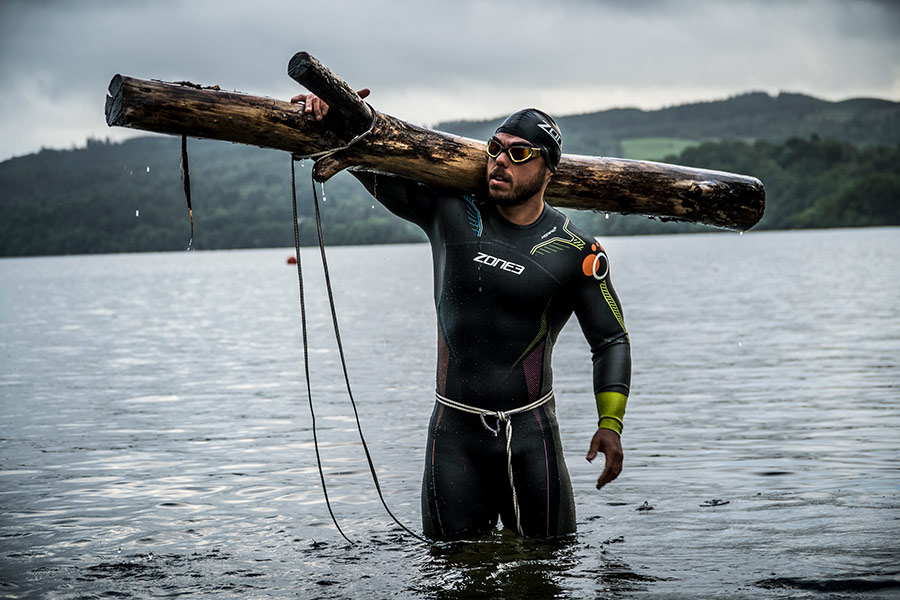
Endurance athlete Ross Edgley swims from Martinique to St Lucia… with a twist.

From climbing a rope the height of Mount Everest to running a marathon while pulling a MINI, Ross Edgley is no stranger to the extreme.

But the 32-year-old’s latest challenge is one he billed his toughest yet, swimming over 100 kilometres in jellyfish and shark-infested waters between the Caribbean Islands of Martinique and St Lucia while pulling a 45-kilogram log. Here he talks about that ultimate challenge.

If you like this, subscribe here for more stories that Inspire The Future.

The thinking behind the challenge
When you’ve run 30 marathons in 30 days and completed other aforementioned challenges, Edgley admits to having to raise the bar with the next adventure.

But this challenge was born in another Caribbean-based project.

“About a year ago I did a triathlon carrying a tree on the island of Nevis to raise awareness of its eco-friendly project to become the first carbon-neutral island by 2020,” he explains. “I called it the world’s first Tree-athlon! People seemed to like it.”

So, he set out on a similar venture across the English Channel only for red tape to get in his way. Told he needed to be registered as a vessel to carry a tree, his response was “how do I become one?” to which they put the phone down. The Caribbean red tape was easier to tackle, and the idea was born.

How suited to the challenge
Edgley likes to joke that he is the first Strongman swimmer but the reality was a sports scientist told him he could not be less well suited to the rigours of distance swimming.

“I had a body scan and was told I had none of the physical attributes to be a swimmer,” he says. “I’m built like a Hobbit with short arms, I’m carrying 13kg more muscle so I’m less buoyant and I even have a dense skull”.

He was advised to lose as much muscle as possible but, with his own background in sports science, avoided such advice in order to keep his strength to lug the tree trunk along with him.

As he puts it: “I wasn’t trying to be a shark or a dolphin but to swim slow and pull something heavy for a long time. I’m more like a whale!”

More than the Michael Phelps diet
Twenty-three-time Olympic gold medallist Michael Phelps famously had a 12,000-calorie-a-day diet, Edgley comfortably trumping that with 15,000 calories on a given day of heavy training.

That meant eating heavily before and during his marathon swims to keep up his strength. He likened it to “Christmas dinner when you’ve eaten so much you’re on the sofa and can’t move. Now imagine that with a tree across you in the Caribbean Sea”.

For him, the eating day would begin with a bowl of porridge with nut butter and protein mixed in although he was buying 25kg bags of oats at a time.

And at his local pool he would line up food such as bananas, fruit, rice pudding, homemade energy bars, coconut water, fruit loaf and chocolate at the end of the pool to eat every kilometre during his endurance training.

“When people asked what was good to eat, I’d say high calorie, some carbs, a little fat and something that you can eat in seven seconds,” the time it takes between waves hitting you in the Caribbean. “That’s weird but the reality of it.”

So he would set up food-piping bags filled with anything from rice pudding to curry and bite off seven seconds worth of food at a time.

The challenge itself
In all, Edgley swam a total of 102 kilometres in the challenge in 31 hours and 24 minutes over two separate swims, one of 61km and a second of 41km.

At one point, he swam solidly for three hours without getting anywhere so strong was the current he was facing. When told about it, “my reply was some pretty colourful language”.

There were magical moments of being accompanied by one dolphin for 5km to flying fish soaring above the log he carried to a time when he feared he was being chased by a shark of being stung in the face by jellyfish.

And with such rigours to face on a marathon swim, it’s understandable he calls it his hardest undertaking.

“I think this was the toughest because when I finally broke the height of Everest I knew if I kept awake and the body kept moving I’d finish that,” he says. “The same with the marathons but with the best intentions in the world with this mother nature might have other ideas.”

If you like this, subscribe here for more stories that Inspire The Future.

Climate Change Could Explain The Personality Of Your Significant Other

Have you ever wondered why your significant other thinks and acts the way they do? We typically think the answer lies in their parents and genes, but new research points to another insightful possibility: the average temperature where they grew up.

The latest research from Columbia Business School offers compelling evidence for the role of regional ambient temperature in shaping people’s personality. Even after controlling for various factors suggested by previous research, including farming practices, migration patterns, and disease exposure, the researchers found temperature to be a key factor in how personality develops.
 

“Ambient temperature can shape the fundamental dimensions of personality,” says Jackson Lu, a PhD candidate at Columbia Business School who conducted the research alongside Columbia Professor Adam Galinsky. “Our research reveals a connection between the ambient temperature that individuals were exposed to when they were young and their personality today. This finding can help explain the personality differences we observe in people of different regions.”

Climate’s Impact on Five Key Personality Dimensions

This research, titled Regional Ambient Temperature is Associated with Human Personality and recently published in the journal Nature: Human Behaviour, defines personality as “the interactive aggregate of personal characteristics that influence an individual’s response to the environment.” The hundreds of personality traits used to describe humans largely boil down to five broad dimensions, the so-called Big Five: agreeableness, conscientiousness, emotional stability, extraversion, and openness to experience.

The research suggests that a key factor determining these broad personality dimensions is how mild (i.e., clement) the ambient temperature was when individuals grew up. The sweet spot for temperature is 72 degrees F (or 22 degrees C).

“Individuals who grew up in areas where ambient temperatures were closer to this optimal level scored higher on the Big Five personality dimensions, like extraversion and openness to experience, while those in colder or hotter climates scored lower,” says Galinsky.

Large Surveys Fielded in China and the U.S.

To test the hypothesized relationship between ambient temperature and personality, the paper’s 26 authors conducted separate studies in two geographically large yet culturally distinct countries: China and the United States. In the first study, personality surveys were completed online by 5,587 university students born and raised in 59 Chinese cities. The second study conducted in the U.S. involved personality surveys completed by more than 1.6 million Americans of different ages, social classes, and education levels growing up in 12,499 zip-code areas in 8,102 cities.

The result? Temperature matters! Lu explains:

“Clement temperatures encourage individuals to explore the outside environment, where social interactions and new experiences abound. Venturing outdoors and interacting with lots of people make people more agreeable, conscientious, emotionally stable, extraverted, and open to new experiences. But when the temperature is too hot or too cold, individuals are less likely to go outside to meet up with friends or to try new activities.”

The association between ambient temperature and personality is particularly important in light of climate change across the globe, which could result in changes in regional human personalities over time. Of course, as Galinsky explains, the size and extent of these changes await future investigation.

If you like this, subscribe here for more stories that Inspire The Future.

Noor Daoud is Drifting Against The Tide

Palestinian drift racing star Noor Daoud relishes breaking down global barriers.

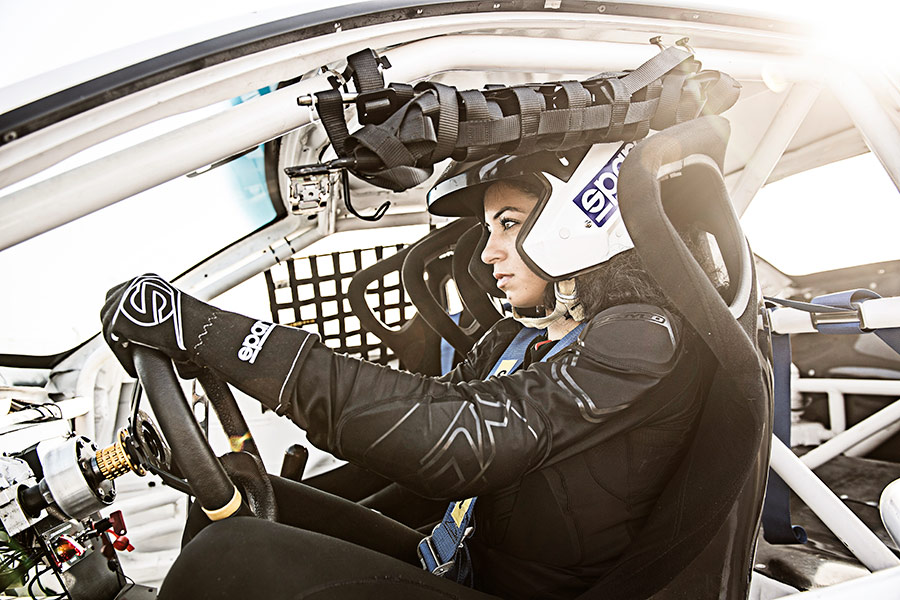
Palestinian drift racing star Noor Daoud has spent her adult life breaking down barriers in the world of sport and she is only getting started.

She launched her motorsport career in 2009 when she took part in a speed test, graduating to the high octane world of drifting two years later.

If you like this, subscribe here for more stories that Inspire The Future.

Not content with excelling behind the wheel, she is also a personal trainer and engages in a spot of Muy Thai Boxing and skydiving for good measure.

Growing up on the occupied West Bank, she credits her strong mother with giving her the courage to confound Arab society’s expectations at every turn.

She revealed, “I always knew I loved cars. I have a very supportive Mum. I used to take my Mum’s car and go drift (on supermarket car parks and land within range of Israeli guns).

“People say, ‘Why do you do this? You should do something better. You should get married, for example’.

“I do boxing before any race, it gets me focused. When I put the helmet on, I feel me and the car are one.

“I am a personal trainer because I love to help people achieve their goals.”

Her high profile has also helped her and a like-minded group of women called the ‘Speed Sisters’ blaze a global trail including a recent award-winning documentary.

Manager Maysoon Jayyusi, along with drivers Daoud, Mona Ali, Marah Zahalka and Betty Saadeh, formed to compete against male drivers in souped-up BMWs, Volkswagens and Datsuns.

She added, “We’re one team – we love and support each other. We’re Middle-eastern girls representing Palestine, so it wasn’t easy for us to form a team and to race.

“Many people didn’t want me to go into this sport, I endured a lot of negativity, but I never gave up and I never will. It’s my life, my passion, the only thing that really makes me happy. I believe that if someone wants something bad enough, they will achieve it.”

 If you like this, subscribe here for more stories that Inspire The Future.

Tom Petty: Another Celebrity Lost to Opioids

The Los Angeles County Department of Medical Examiner-Coroner established that chart-topping singer and songwriter Tom Petty’s death on Oct. 2, 2017, was from an accidental drug overdose.

He suffered drug toxicity from the mixture of benzodiazepines (“benzos” or sedative-hypnotics), an antidepressant and opioids that caused cardiac arrest and multisystem organ failure. The Citizens Commission on Human Rights (CCHR), a mental health watchdog, has investigated artists’ deaths from taking psychotropic drugs — mixed with or without opioids — and says it’s not the first celebrity that the entertainment industry, fans, and family have lost due to lethal prescription drug combinations, including Prince, Heath LedgerWhitney Houston and more.

If you like this, subscribe here for more stories that Inspire The Future.

Toxicology tests determined that Petty had been taking two benzodiazepines — temazepam and alprazolam — the antidepressant citalopram and painkillers, including oxycodone and fentanyl. His widow, Dana Petty, and daughter, Adria, said the rock and roll legend had been prescribed opioids for a fractured hip and other chronic ailments.

This is not the first celebrity the entertainment industry, fans, and family have lost due to lethal prescription drug combinations, whether prescribed or abused, and benzodiazepines are often a common denominator. They are even more dangerous because they enhance the sedative effects of opioids. Consider the following iconic artists:

  • Toxicology tests for another legendary singer, Prince (57), concluded that the entertainer died on April 21, 2016, from an accidental overdose of the opioid fentanyl. Prince’s toxicology report also revealed the presence of alprazolam in his system, according to CNN.
  • Soundgarden singer Chris Cornell (52) died on May 17, 2017. Although suicide was ruled as the cause of death, Cornell’s wife questions the role of the benzodiazepine lorazepam.
  • The toxicology report for pop icon Whitney Houston (48), following her death on Feb. 11, 2012, indicated that she was “acutely intoxicated from cocaine” and a “plethora of prescription medication bottles” were found in the room, including alprazolam, according to the final report.
  • The Los Angeles County coroner ruled that iconic performer, Michael Jackson’s (50) death was a homicide from the administration of the anesthetic drug propofol and that this drug and the sedative lorazepam were the primary drugs in Jackson’s death on June 25, 2009. Vials of another benzodiazepine, diazepam, were also found in his mansion.
  • On January 22, 2008Heath Ledger (28) died of an accidental overdose as a result of taking a lethal combination of prescription drugs that included three benzodiazepines, diazepam, temazepam, and alprazolam. He was also taking two painkillers. Heath wasn’t taking the drugs for “psychiatric” reasons—like many, he used them to help him sleep and to handle a busy schedule.

There’s a distinct difference between Cause of Death and Means of Death. The cause is the actual event. Means is the method by which death happened. For example, the cause of death for the “King of Rock n’ Roll,” Elvis Presley (42), in 1977 was a heart attack. Although the coroner listed the means as “chronic heart disease,” and other physical problems, the toxicology report revealed the death should be looked at in terms of the cumulative effects of prescription drugs. A prominent toxicologist also reviewed the findings and gave his opinion that “the strong probability [was] that these drugs were the major contribution to his demise.” The toxicology report showed numerous psychotropic drugs, including diazepam and barbiturates/sedative-hypnotics.

In the two and a half years prior to his death, Elvis was prescribed an unbelievable 5,458 amphetamines, 9,567 sedatives, and 3,988 narcotics. So dependent was he on these drugs that he was hospitalized at least five times for detoxification.

Dr. David Sackboard certified in addiction medicine, says, “Tolerance and dependence can develop quickly. There have been reports of people who received high doses of benzodiazepines becoming physically dependent in as little as two days.” Combined with opioids, it’s a catastrophe in the making. Dr. Sackwarns that benzodiazepines are “the danger lurking in the shadow of opiates” and that both opioids and benzodiazepines slow down body systems, particularly the respiratory and cardiovascular systems. Combining the drugs increases the effects of each exponentially, meaning that the body isn’t just processing two doses, it is processing more like three or four. This multi-dose cocktail can cause breathing to stop.

In the U.S., more people die from psychiatric drug overdose than heroin overdose. In 2014, 10,574 people died of heroin overdose while 15,778 died from an overdose of psychiatric drugs, nearly 50 percent more than the number of heroin overdose deaths. The biggest killers were sedatives (benzodiazepines such as alprazolam and temazepam, and Z-drugs such as zolpidem), antidepressants (such as citalopram), psychostimulants (methylphenidate, amphetamine), and antipsychotics.

In February 2016, researchers from the Albert Einstein College of Medicine in New York warned that benzodiazepine abuse is a growing problem in the U.S., with overdoses on the drugs increasing at a faster rate than other prescription drugs, including opioids. “Benzodiazepines have several known safety risks: in addition to overdose, they are conclusively linked to falls, fractures, motor vehicle accidents, and can lead to misuse and addiction,” Dr. Marcus Bachhuber, lead author of the study told Reuters

Long-acting benzodiazepine agents are associated with accumulation which may result in sedation, cognitive impairment, and psychomotor retardation. All benzodiazepines are listed as Drug Enforcement Administration (DEA) schedule IV controlled substances because of the potential for abuse, addiction, and diversion.

Rockstar legend Ozzy Osbourne had been fighting substance abuse for decades when a physician prescribed 13,000 doses of 32 different drugs that included tranquilizers, amphetamines, antidepressants, and antipsychotics during one year, which turned Osbourne into an incoherent, stumbling wreck. “I was wiped out on pills,” said Osbourne. “I couldn’t talk. I couldn’t walk. I could barely stand up. I was lumbering about like the Hunchback of Notre Dame.” The pills cost $58,000 and the doctor’s “services,” $650,000.

In 1979, Sen. Ted Kennedy called a Senate Health subcommittee hearing on the dangers of benzodiazepines in which he said the drugs “produced a nightmare of dependence and addiction, both very difficult to treat and recover from.” In 2002, a group of doctors formed the Maine Benzodiazepine Study Group, which concluded: “There is no evidence supporting the long-term use of benzodiazepines for any mental health condition.” But the warnings have gone unheeded and profit before patients seems to have taken precedence.

Prescriptions for benzodiazepines more than tripled and fatal overdoses more than quadrupled between 1996 and 2013. Despite being mostly off-patent and selling at lower generic prices, benzodiazepines accounted for nearly $509 million in sales in 2013. In 2015 alone, there were about 9,000 benzodiazepine related deaths reported.

“The fact that any chronic benzodiazepine users exist at all,” Dr. Helen Gallagher of the University College Dublin medical school wrote in a 2013 review article in the journal Pharmacy, “highlights the fact that a convincing evidence base is being ignored by physicians, pharmacists and other healthcare providers who in essence facilitate their inappropriate use.”

With so many celebrities and other people’s deaths due to potentially dangerous prescribing practices — and consumers believing that because the drugs are “prescribed,” they are safe and can be abused — greater efforts should be made to monitor the prescribing patterns of psychiatrists and doctors, CCHR says. As with opioids, the high billing of benzodiazepines and other psychiatric drugs should be a red flag for investigators to determine who is profiting from placing some of our greatest artists and so many others at risk of addiction and death.

As a nonprofit, CCHR relies on memberships and donations to carry out its mission and actions to curb psychotropic drug use, including maintaining a Psychiatric Drug Side Effects Search Engine for consumers, parents and families to easily access information about adverse drug effects, studies and drug regulatory agency warnings. Click here to support the cause.

If you liked this, you may also enjoy: “This Should Scare You More Than Terrorism: The Opioid Epidemic”

Here Comes The Pride: Historic Gay Wedding At Sea

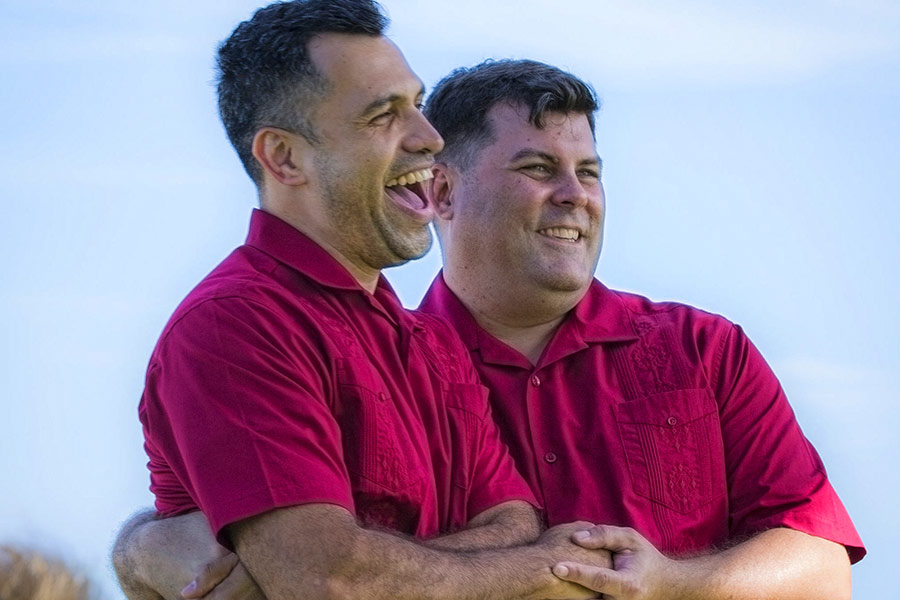
In a historic ceremony hosted on board Celebrity Equinox, Francisco Vargas and Benjamin Gray have become the first same-sex couple ever to be legally married at sea on a major cruise line.

The grooms were joined by their immediate family for an intimate ceremony officiated by Captain Dimitrios Manetas. They exchanged vows against the signature backdrop of the rose wall in Blu Restaurant, the location befitting the most memorable of moments.

If you like this, subscribe here for more stories that Inspire The Future.

“Words cannot express how proud I am to congratulate Francisco and Benjamin at this truly historic moment, both for them and for Celebrity. It’s a true privilege to know that the ceremony performed  onboard Celebrity Equinox has made history as the first legal same-sex marriage at sea,” said Lisa Lutoff-Perlo, President and CEO, Celebrity Cruises. “Together we are paving the way for couples around the world to know that their love and commitment is to be celebrated equally, and that everyone is welcome on board a Celebrity cruise.”

“There are only so many firsts in life, and we are thrilled to be the first-ever LGBTQ+ couple to marry at sea,” said Gray. “We are humbled to follow the trailblazers in the LGBTQ+ community who paved the way for us.”  

As first announced in October 2017, the motion follows a transformative vote in Malta, where a majority of the Celebrity fleet is registered, which passed the country’s parliament 66-1. The long-awaited referendum opened the door for Celebrity to legally recognize same-sex marriages performed onboard while at sea, and have the fleet’s captains officiate the ceremonies.

Vargas, who works for one of Celebrity’s top Travel Partners, Cruise Planners, said: “Traveling is in my blood – and when we heard Celebrity Cruises was celebrating equality and embracing our community, we wanted to be a part of it. We are grateful for the outpouring of support from our Cruise Planners family and hope our story brings strength for others in the LGBTQ+ community to confidently love whoever they choose.”

If you like this, subscribe here for more stories that Inspire The Future.

The Internet Crosses 4 Billion-User Mark

Social media management platform Hootsuite, and socially-led creative agency We Are Social, have released “Digital in 2018,” a report of social media and digital trends around the world.

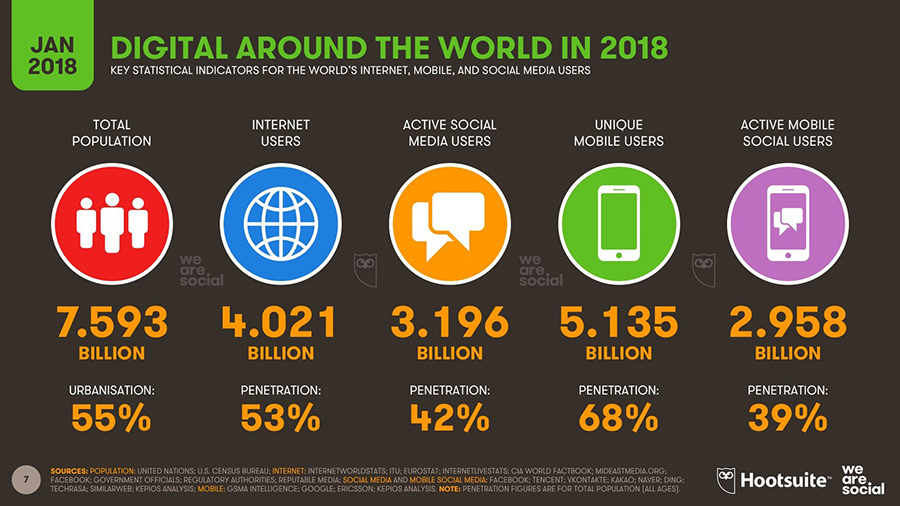
Representing 239 countries and territories, the seventh annual report finds the number of Internet users in the world has now surpassed the 4 billion mark, putting more than half the global population online. Of that, social media brings nearly 3.2 billion active users online to connect with each other, consume media, interact with brands, and more.

Key findings include:

  • Internet user numbers increased 7 percent in the last 12 months to hit 4.021 billion, or 53 percent of the world’s population
  • Global social media usage has increased by 13 percent in the last 12 months, reaching 3.196 billion users
  • Mobile social media usage has increased by 14 percent year over year to 2.958 billion users, with 93 percent of social media users accessing social from mobile
  • Internet users are projected to spend a combined total of 1 billion years online in 2018, of which 325 million years will be spent on social media

In the past year, 16 million people started using social media platforms in the US – an increase of 7 percent. Now, more than 70 percent of Americans use social media and spend two hours a day on social platforms. Overall, Americans spend 6.5 hours a day using the Internet, 60 percent more time than they spend watching television.


The report also found that global growth of the Internet is propelling ecommerce forward, with 1.77 billion Internet users purchasing consumer goods online in 2017, an increase of 8 percent compared to a year ago. Collectively, consumers spent a total of USD $1.474 trillion on ecommerce platforms in the past 12 months, 16 percent more than in 2016.

“With four billion people now online, connectivity is already a way of life for most of us, says Simon Kemp of We Are Social. “However, as Internet companies strive to serve the next billion users, we’ll see important changes in digital over the coming months. Audio-visual content will take priority over text – especially in social media and messaging apps – while voice commands and cameras will replace keyboards as our primary means of input. Social relationships and online communities will evolve to accommodate these new ways for people to interact with each other. This will result in rich new experiences for all of us, but businesses need to start preparing for these changes today.”

If you like this, subscribe here for more stories that Inspire The Future.

Venture Capitalist Messes With The Wrong Dad

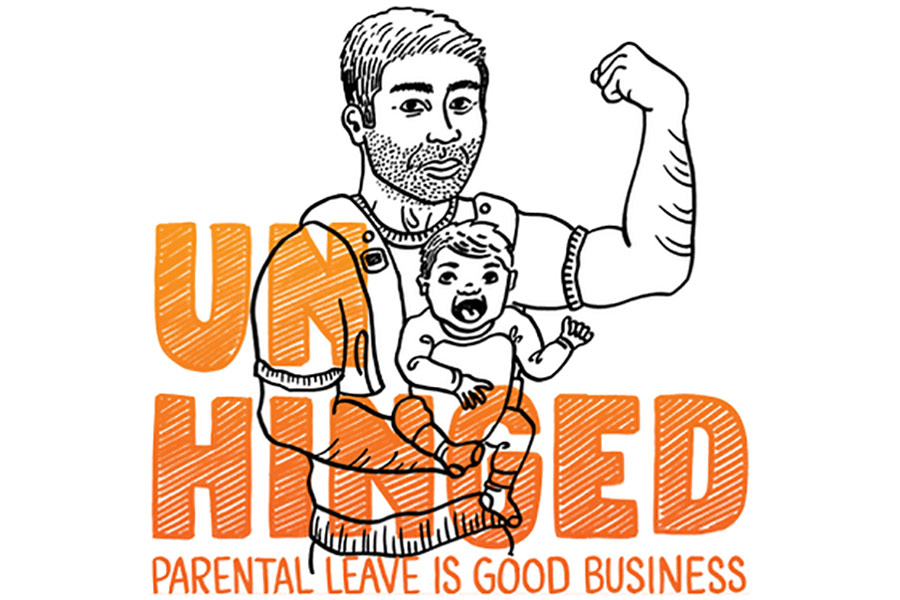
Purpose-driven agency Oliver Russell has launched a campaign to advance paid parental leave policies in the wake of venture capitalist Michael Moritz denigrating paternity leave in his Financial Times op-ed.

Moritz, a partner at Sequoia Capital, praised the 24/7 work ethic of China, singling out paternity leave and work-life balance in the United States as particular concern, writing: “These seem like the concerns of a society that has come unhinged.”

Oliver Russell’s campaign, called “Unhinged: Parental Leave is Good Business,” will offer digital resources to advocate for parental leave polices at work, regardless of employer size. The 11-person boutique creative agency has offered paid maternity leave since 2011, adding paternity leave in 2014. Agency founder and president Russ Stoddard said its clear that parental leave is good for business, and that the new website, LetsGetUnhinged.com, features a toolkit for how to develop similar policies.

In the days since Moritz’s made his views known, several multinational corporations, including Starbucks, have expanded parental leave policies. The Family Medical Leave Act covers only workplaces with more than 50 employees and doesn’t mandate that parental leave be paid. Of the 193 member countries of the United Nations, the U.S. joins just New Guinea, Suriname, and a few South Pacific islands in not having a national paid parental leave law. A 2016 study by the Center for American Progress shows that paid leave benefits even small businesses by boosting recruitment, retention, productivity, and overall performance and productivity.

“I find Moritz to be horribly out of step with the times – and the facts,” Stoddard said. “His take on human capital reminds me of the old-school approach: People are an asset to be mined and wrung out, their professional value to be extracted as quickly as possible.”

If you like this, subscribe here for more stories that Inspire The Future.

0