Jane Goodall: Why Good For the Environment is Also Good For Business

It’s become clear that the current economic model — that we can have unlimited extractive consumption on a planet with finite natural resources — is not a longterm solution.

Achieving  GDP growth at all costs, instead of protecting the environment for our future is not something that will continue to work. Already in some places, thanks to demand and unsustainable lifestyles, resources are being used up faster than nature can replenish them. Unless business changes its rapacious demand on the environment, the future will look pretty grim. Many businesses have already seen the writing on the wall, and realized that unless our natural resources are protected their business won’t continue — they will have nothing to continue it with. 

Many business leaders I know have become very concerned about the future and are gradually changing the way their business operates; thinking about their supply chains, the unequal wages paid in other countries that allow people to earn just enough money to survive for that day. Real leaders have realized that things can’t go on this way. Instead, business leaders should see the positive attributes of working differently. My approach to convincing people is not to say no, or berate them. Changing minds is difficult, but you don’t change minds by pointing at people and telling them they’re bad. I never tell people they can’t do something, or that they are bad people — you have to try and reach the heart. True change comes when people change from within, not told what to do. 

So, how do you reach the heart? My approach is through stories, based on firsthand experiences.

I left Gombe National Park in Tanzania in 1986, where I had been researching the problems faced by chimpanzees, and why their numbers were decreasing. I also saw the crippling poverty in Africa on my travels across  the continent. How do you give hope to people who look around and see the damage we have done to our planet? I have met so many amazing people doing incredible things and also seen the terrible harm we have inflicted on our planet. My stories from these encounters can play a powerful role in changing minds.

I have stood in Greenland and watched the ice melting. I have listened to the Inuit explain how even at the height of summer the ice had once never melted there. I have met people who have left their island homes because the sea levels have risen. I have spoken with environmental refugees who have left their homes to seek a new life in places that are more habitable. They send money back to their drought-ravaged countries where it has become impossible to make a living, despite their ancestors having sustained themselves there for hundreds of years before. 

Having experienced these things firsthand and then telling people about them, I can suggest ways to create change. 

Business leaders need to lead the way. Many governments are tied up with corruption or their next election campaign. Business and philanthropy are moving into the gap to help heal the harm we have inflicted on the natural world. As a business leader, ask yourself a few simple questions: “Am I harming the environment with this? How was this made? What can I do better? Am I paying fair wages?”

Shareholders, too, are starting to demand that their business become more ethical. Those of us lucky enough to live in a country that is not struggling with poverty, can make intelligent choices in what we buy: “Has this harmed the environment? Was it cruel to animals. Is this cheap because of child slave labor? If we don’t buy products that are made unethically then business will change. I also know of many companies where CEOs have come under pressure from staff to do the right thing. Other companies can’t attract good talent, because no one wants to work for a company that’s destroying the planet. 

New trends are emerging that offer new opportunities. Food is one example, where there’s a push to return to small-scale family farming, regenerative agriculture, and organic foods, and move away from the incredibly destructive methods of industrial agriculture.  Why should we grow our food with poison? It doesn’t make sense. If our biodiversity and healthy ecosystems collapse from over-use, think about what the future might look for your grandchildren (and theirs). 

These solutions should start with young people. After all, it’s their future we’re stealing.  I began the Roots and Shoots program at the Jane Goodall Institute that targets young people from kindergarten to college. It began with 12 students in Tanzania and is now in more than 60 countries. The main premise is that every day we have an impact on the planet, and that we can choose what impact we’ll make.  I learned in the rainforests that everything is interconnected. This also applies to all life.     

Each of the Roots and Shoots groups choose three projects: one to help people, one to help animals, and one to help the environment. I’ve seen how these children have even changed their parents for the better. Business leaders, too, can lead the way.


Jane Goodall: Why Good For the Environment is Also Good For Business

It’s become clear that the current economic model — that we can have unlimited extractive consumption on a planet with finite natural resources — is not a longterm solution.

Achieving  GDP growth at all costs, instead of protecting the environment for our future is not something that will continue to work. Already in some places, thanks to demand and unsustainable lifestyles, resources are being used up faster than nature can replenish them. Unless business changes its rapacious demand on the environment, the future will look pretty grim. Many businesses have already seen the writing on the wall, and realized that unless our natural resources are protected their business won’t continue — they will have nothing to continue it with. 

Many business leaders I know have become very concerned about the future and are gradually changing the way their business operates; thinking about their supply chains, the unequal wages paid in other countries that allow people to earn just enough money to survive for that day. Real leaders have realized that things can’t go on this way. Instead, business leaders should see the positive attributes of working differently. My approach to convincing people is not to say no, or berate them. Changing minds is difficult, but you don’t change minds by pointing at people and telling them they’re bad. I never tell people they can’t do something, or that they are bad people — you have to try and reach the heart. True change comes when people change from within, not told what to do. 

So, how do you reach the heart? My approach is through stories, based on firsthand experiences.

I left Gombe National Park in Tanzania in 1986, where I had been researching the problems faced by chimpanzees, and why their numbers were decreasing. I also saw the crippling poverty in Africa on my travels across  the continent. How do you give hope to people who look around and see the damage we have done to our planet? I have met so many amazing people doing incredible things and also seen the terrible harm we have inflicted on our planet. My stories from these encounters can play a powerful role in changing minds.

I have stood in Greenland and watched the ice melting. I have listened to the Inuit explain how even at the height of summer the ice had once never melted there. I have met people who have left their island homes because the sea levels have risen. I have spoken with environmental refugees who have left their homes to seek a new life in places that are more habitable. They send money back to their drought-ravaged countries where it has become impossible to make a living, despite their ancestors having sustained themselves there for hundreds of years before. 

Having experienced these things firsthand and then telling people about them, I can suggest ways to create change. 

Business leaders need to lead the way. Many governments are tied up with corruption or their next election campaign. Business and philanthropy are moving into the gap to help heal the harm we have inflicted on the natural world. As a business leader, ask yourself a few simple questions: “Am I harming the environment with this? How was this made? What can I do better? Am I paying fair wages?”

Shareholders, too, are starting to demand that their business become more ethical. Those of us lucky enough to live in a country that is not struggling with poverty, can make intelligent choices in what we buy: “Has this harmed the environment? Was it cruel to animals. Is this cheap because of child slave labor? If we don’t buy products that are made unethically then business will change. I also know of many companies where CEOs have come under pressure from staff to do the right thing. Other companies can’t attract good talent, because no one wants to work for a company that’s destroying the planet. 

New trends are emerging that offer new opportunities. Food is one example, where there’s a push to return to small-scale family farming, regenerative agriculture, and organic foods, and move away from the incredibly destructive methods of industrial agriculture.  Why should we grow our food with poison? It doesn’t make sense. If our biodiversity and healthy ecosystems collapse from over-use, think about what the future might look for your grandchildren (and theirs). 

These solutions should start with young people. After all, it’s their future we’re stealing.  I began the Roots and Shoots program at the Jane Goodall Institute that targets young people from kindergarten to college. It began with 12 students in Tanzania and is now in more than 60 countries. The main premise is that every day we have an impact on the planet, and that we can choose what impact we’ll make.  I learned in the rainforests that everything is interconnected. This also applies to all life.     

Each of the Roots and Shoots groups choose three projects: one to help people, one to help animals, and one to help the environment. I’ve seen how these children have even changed their parents for the better. Business leaders, too, can lead the way.

Imagine Consulting With Potential Customers With Physical Needs Different From Yours

Celebrity fashion photographer and Special Olympics Champion Ambassador Nigel Barker took  photographs of four Special Olympics New York athletes. They modeled adaptable athlete/streetwear from the Be Brave collection, developed through a collaboration between Special Olympics New York and students from the Parsons School of Design.

The unique alliance paved the way for a more inclusive world for athletes and offers the next generation of designers some insight into a whole new fashion market. Through semester-long classes, design students from Parsons meet weekly with Special Olympics athletes (more recently via zoom) to plan and develop athletic gear for people with intellectual disabilities. How could you grow your market share by tweaking products for those with special needs? 

Imagine Consulting With Potential Customers With Physical Needs Different From Yours

Celebrity fashion photographer and Special Olympics Champion Ambassador Nigel Barker took  photographs of four Special Olympics New York athletes. They modeled adaptable athlete/streetwear from the Be Brave collection, developed through a collaboration between Special Olympics New York and students from the Parsons School of Design.

The unique alliance paved the way for a more inclusive world for athletes and offers the next generation of designers some insight into a whole new fashion market. Through semester-long classes, design students from Parsons meet weekly with Special Olympics athletes (more recently via zoom) to plan and develop athletic gear for people with intellectual disabilities. How could you grow your market share by tweaking products for those with special needs? 

Global Innovation Hub Launched for Transformative Climate Solutions

A new digital Global Innovation Hub has been initiated by UN Climate Change to significantly boost the effectiveness and scale of climate change and sustainability innovation as a driver of more ambitious climate action.

To achieve this, the hub will have new approaches to facilitate the development and deployment of transformative and innovative climate solutions.

The hub promotes a “moonshot approach” which will assist practitioners to base climate action pledges and commitments on what science says is needed, as opposed to what is perceived as possible with current solutions and technologies.

In its recent Working Group 1 report, the Intergovernmental Panel on Climate Change (IPCC) estimates that limiting global average temperature increases to 1.5C requires a reduction of CO2 emissions of 45% in 2030. Yet current emission reduction pledges fall far short. Unless urgent action is taken, the current level of ambition is likely to put the world on course for a 2.7C average temperature increase and ever-increasing extreme weather events.

Significantly greater ambition is thus required to keep the 1.5C goal within reach. Current pledges often fall short because they are based on the perceptions of what can be achieved in the context of current climate solutions and technologies.

The hub aims to support the translation of commitments and pledges into demand for climate and sustainability solutions that will drive the identification or development of innovative responses and their effective implementation. Innovative responses beyond current solutions mean that pledges and commitments can become significantly more ambitious.

The hub is a digital platform that hosts (i) databases of demand for solutions as well as solutions, (ii) tools to determine the impact of climate action and (iii) a space to facilitate the financing of climate solutions.

The hub sets the agenda for an expanded space of climate innovation for all practitioners. It showcases people’s everyday needs, such as mobility, access to goods and services, and social connection. The hub then fosters the development of innovative climate-friendly responses beyond any status-quo solutions such as cars or conventional power and, importantly, without focusing on one single solution in isolation.

For example, instead of focusing only on the development of EV cars, the hub will promote climate innovations that challenge the need for a car in the first place. It will explore options for the design of compact and complete cities connected with low carbon public transportation that will reduce the need for mobility.

It will even go one step further and challenge mobility as a need to have access to products and services. For example, it will develop solutions that replace trips to get a product or a service the same way online shopping replaced trips to shops.

The solutions offered by the platform are integrated with each other to form a cluster of solutions that can include technologies, policies and regulations, business models, and financing instruments that reflect a holistic approach.

Because the development of a solution is demand-driven and the solutions are integrated to form a cluster, the hub will not stockpile underdeveloped inventions as is often the case with innovation platforms.    

The Global Innovation Hub will have world-class standards in line with the Paris Agreement goals for impact assessment of climate change solutions.

Global Innovation Hub Launched for Transformative Climate Solutions

A new digital Global Innovation Hub has been initiated by UN Climate Change to significantly boost the effectiveness and scale of climate change and sustainability innovation as a driver of more ambitious climate action.

To achieve this, the hub will have new approaches to facilitate the development and deployment of transformative and innovative climate solutions.

The hub promotes a “moonshot approach” which will assist practitioners to base climate action pledges and commitments on what science says is needed, as opposed to what is perceived as possible with current solutions and technologies.

In its recent Working Group 1 report, the Intergovernmental Panel on Climate Change (IPCC) estimates that limiting global average temperature increases to 1.5C requires a reduction of CO2 emissions of 45% in 2030. Yet current emission reduction pledges fall far short. Unless urgent action is taken, the current level of ambition is likely to put the world on course for a 2.7C average temperature increase and ever-increasing extreme weather events.

Significantly greater ambition is thus required to keep the 1.5C goal within reach. Current pledges often fall short because they are based on the perceptions of what can be achieved in the context of current climate solutions and technologies.

The hub aims to support the translation of commitments and pledges into demand for climate and sustainability solutions that will drive the identification or development of innovative responses and their effective implementation. Innovative responses beyond current solutions mean that pledges and commitments can become significantly more ambitious.

The hub is a digital platform that hosts (i) databases of demand for solutions as well as solutions, (ii) tools to determine the impact of climate action and (iii) a space to facilitate the financing of climate solutions.

The hub sets the agenda for an expanded space of climate innovation for all practitioners. It showcases people’s everyday needs, such as mobility, access to goods and services, and social connection. The hub then fosters the development of innovative climate-friendly responses beyond any status-quo solutions such as cars or conventional power and, importantly, without focusing on one single solution in isolation.

For example, instead of focusing only on the development of EV cars, the hub will promote climate innovations that challenge the need for a car in the first place. It will explore options for the design of compact and complete cities connected with low carbon public transportation that will reduce the need for mobility.

It will even go one step further and challenge mobility as a need to have access to products and services. For example, it will develop solutions that replace trips to get a product or a service the same way online shopping replaced trips to shops.

The solutions offered by the platform are integrated with each other to form a cluster of solutions that can include technologies, policies and regulations, business models, and financing instruments that reflect a holistic approach.

Because the development of a solution is demand-driven and the solutions are integrated to form a cluster, the hub will not stockpile underdeveloped inventions as is often the case with innovation platforms.    

The Global Innovation Hub will have world-class standards in line with the Paris Agreement goals for impact assessment of climate change solutions.

This is What 30,000 People Per Square Mile Looks Like

This is New Delhi, India, population 22 million. The city has a population density of 30,000 people per square mile.

India is the world’s most populous democratic country with a population of 1.4 billion inhabitants and according to the World Health Organization Delhi is the fourth most polluted city in the world in terms of suspended particulate matter. The growing pollution is responsible for increasing health problems, and the deteriorating environment is the result of population pressure and haphazard growth.

There are now more than 7,800,000,000 people on planet Earth.

It took until the early 1800s for the world population to reach one billion. Now we add a billion every 12-15 years.

Population is a dynamic field. There have been significant changes in birth rates and the population trajectories of countries and continents in recent years. Global population is still growing by more than 80 million a year, however, and is most likely to continue growing for the rest of this century unless we take action.

Photo courtesy of Global Population Speak Out. PopulationSpeakOut.org

This is What 30,000 People Per Square Mile Looks Like

This is New Delhi, India, population 22 million. The city has a population density of 30,000 people per square mile.

India is the world’s most populous democratic country with a population of 1.4 billion inhabitants and according to the World Health Organization Delhi is the fourth most polluted city in the world in terms of suspended particulate matter. The growing pollution is responsible for increasing health problems, and the deteriorating environment is the result of population pressure and haphazard growth.

There are now more than 7,800,000,000 people on planet Earth.

It took until the early 1800s for the world population to reach one billion. Now we add a billion every 12-15 years.

Population is a dynamic field. There have been significant changes in birth rates and the population trajectories of countries and continents in recent years. Global population is still growing by more than 80 million a year, however, and is most likely to continue growing for the rest of this century unless we take action.

Photo courtesy of Global Population Speak Out. PopulationSpeakOut.org

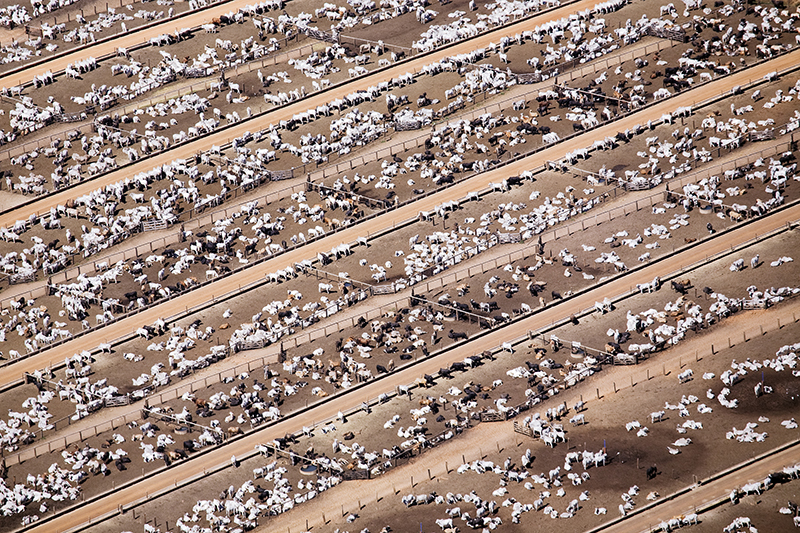
This is Where Your Beef Burger Comes From

Brazilian ranchers traditionally clear land to raise animals in large pasture areas. When using feedlots to fatten animals before slaughter, farmers do in 90 days what would take them a year in natural pastures.

Brazil is the world’s largest beef exporter, exporting one-fifth of its total production, and the sector is a major driver of deforestation.

Extensive cattle ranching is the number one culprit of deforestation in virtually every Amazon country, and it accounts for 80% of current deforestation (Nepstad et al. 2008). Alone, the deforestation caused by cattle ranching is responsible for the release of 340 million tons of carbon to the atmosphere every year, equivalent to 3.4% of current global emissions. Beyond forest conversion, cattle pastures increase the risk of fire and are a significant degrader of riparian and aquatic ecosystems, causing soil erosion, river siltation and contamination with organic matter. Trends indicate that livestock production is expanding in the Amazon.

Brazil has 88% of the Amazon herd, followed by Peru and Bolivia. While grazing densities vary among livestock production systems and countries, extensive, low productivity, systems with less thanone animal unit per hectare of pasture are the dominant form of cattle ranching in the Amazon.

Photo: Peter Beltra  / courtesy of Global Population Speak Out. PopulationSpeakOut.org

This is Where Your Beef Burger Comes From

Brazilian ranchers traditionally clear land to raise animals in large pasture areas. When using feedlots to fatten animals before slaughter, farmers do in 90 days what would take them a year in natural pastures.

Brazil is the world’s largest beef exporter, exporting one-fifth of its total production, and the sector is a major driver of deforestation.

Extensive cattle ranching is the number one culprit of deforestation in virtually every Amazon country, and it accounts for 80% of current deforestation (Nepstad et al. 2008). Alone, the deforestation caused by cattle ranching is responsible for the release of 340 million tons of carbon to the atmosphere every year, equivalent to 3.4% of current global emissions. Beyond forest conversion, cattle pastures increase the risk of fire and are a significant degrader of riparian and aquatic ecosystems, causing soil erosion, river siltation and contamination with organic matter. Trends indicate that livestock production is expanding in the Amazon.

Brazil has 88% of the Amazon herd, followed by Peru and Bolivia. While grazing densities vary among livestock production systems and countries, extensive, low productivity, systems with less thanone animal unit per hectare of pasture are the dominant form of cattle ranching in the Amazon.

Photo: Peter Beltra  / courtesy of Global Population Speak Out. PopulationSpeakOut.org

0