Don’t Even Think About Littering at This Colorado Stadium

Eco-Products and the University of Colorado have teamed up to make Folsom Field one of the nation’s greenest stadiums – on the outside as well as on the inside.

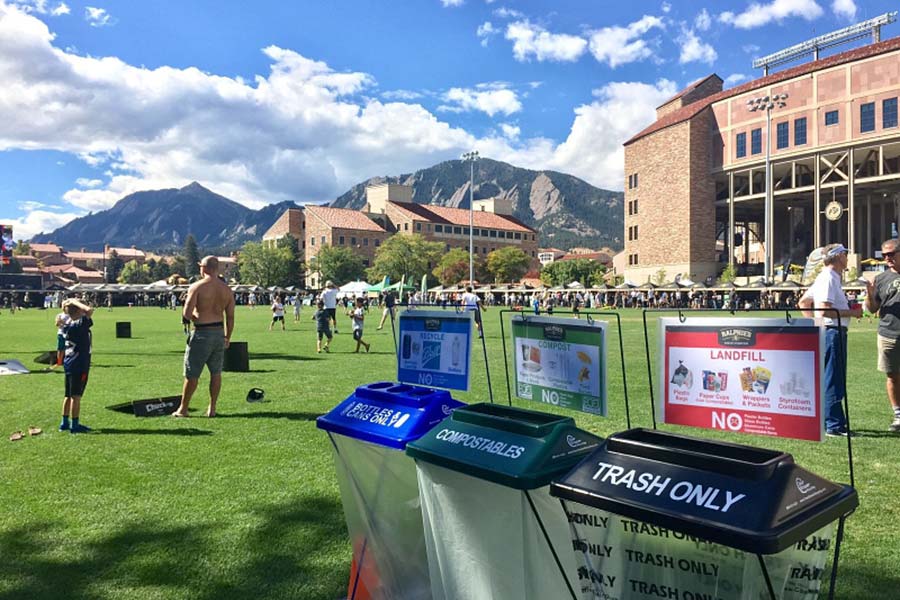
The university has expanded its zero-waste efforts from inside the stadium — where virtually all food and drink packaging is refillable, recyclable or compostable – to outside the stadium at a special tailgating area on Franklin Field.

The grassy area – now called the Aluminum Can Zone Presented by Ball Corporation – is the latest in a recent wave of updates to the fan experience in and around Folsom Field. Special tents available for rent come complete with furniture, a cooler, and specially designed compostable tailgate supplies. The tents are so popular that they’ve long been sold out.

“This is a perfect example of how easy it can be for fan experience and sustainability to coexist,” said Sarah Martinez, Sustainability Maven for Eco-Products. “This is about as green as a tailgating area can get.”

Eco-Products, based in Boulder, Co., already supplies hundreds of thousands of compostable cups, plates, trays, utensils and straws at Folsom Field. Now it is also supplying special plates, cups and utensils – all of which are compostable and all in University of Colorado colors – for the tailgating area as well. 

The partnership simplifies waste disposal for fans. All plates, cups, and utensils can go into the same compostable bins – along with any leftover food.

Fans can walk to the special tailgating area after parking at the stadium’s new solar-powered underground garage. Then, once inside Folsom Field, fans find “Zero Waste Goalies” wearing green shirts and showing which recyclable and compostable bins to put waste into.

“Even at CU, we still see some blank stares when people walk up to the bin stations,” Martinez said. “But we make it as easy for fans, and they’re always happy to learn that their trash is not headed to the landfill.”

Together, the efforts make up Ralphie’s Green Stampede, the NCAA’s first sports sustainability program. Fans now recycle at a 90 percent rate during football games at Folsom Field.

“Fans have good reason to be proud of the University of Colorado’s commitment to the environment,” said Rick George, CU’s Athletic Director. “Ralphie’s Green Stampede has been a huge success, keeping tons of garbage out of area landfills. This new approach to zero-waste tailgating builds on our momentum and represents the next step in our sustainability journey.”

Everyone involved is excited about this success. “But no one is resting on their laurels,” Martinez added. “We want to keep doing more.”


US$2.3 Trillion by 2030 From New Business Models in Food & Agriculture

New research shows sustainable business models could generate 80 million jobs by unlocking opportunities across 14 areas, including food waste, low-income markets, aquaculture and urban agriculture.

There’s a reason why Real Leaders is a signatory to the United Nations Sustainable Development Goals – it makes financial and ethical sense. The 17 goals to transform our world started out as far-fetched ideas, but are rapidly being put into action by companies around the world, that have seen the economic benefits to adopting a way of thinking that solves pressing social problems. Feeding 7.5 billion people on the planet is one such challenge and the food and agriculture sector has just realized the massive benefits to adopting sustainable business models.

Companies could unlock US$2.3 trillion a year in the food and agriculture sectors with an annual investment of US$320 billion in sustainable business models by 2030, a 7-fold return on investment. This could also lead to more than 80 million jobs, according to a new report, Valuing the SDG Prize in Food & Agriculture, from the Business and Sustainable Development Commission. The release of the report coincides with World Food Day 2016 (which is Sunday 16 October).

The opportunities are broken down across 14 areas, including food waste, farming technology, low-income food markets, micro-irrigation, restoring land and forests, product reformulation, changing diets, aquaculture, reducing package waste, cattle intensification and urban agriculture. Researchers estimate a range of value for each opportunity; the lowest in the range is US$15 billion per year (for cattle intensification) while the highest goes up to US$405 billion per year (for reducing food waste across the production process, or value chain).

Of the 80 million jobs the report estimates could be created by 2030, 90% could be in developing countries, including 21 million in Africa and more than 49 million in Asia. The report further breaks down job creation potential in Asia to 22 million in India, 12 million in China, and the remaining 15 million in developing Asia. There could also be an additional 5 million new jobs in Latin America.

“As the world’s population is expected to increase by another one billion by 2030, the global food and agriculture system requires a new way of doing business, and new approaches to feed more than 800 million people who today suffer from chronic hunger as well as to meet future demand,” said Lord Mark Malloch-Brown, Chair of the Business and Sustainable Development Commission. “This report makes clear both the social and economic incentives for companies to seize upon the SDGs as compelling growth opportunities. It is part of our larger argument for why the private sector must accelerate new business models that open truly sustainable and inclusive markets.”

The authors caution that the annual investments needed to open these market opportunities must be scaled significantly, requiring an estimated US$320 billion a year to unlock these opportunities by 2030. They argue that the current capital base in 31 leading agriculture funds is just under US$4 billion a year—less than 1.5% the annual investment needed to capture these opportunities. Partnering with government will also be critical to put in place enabling policies and the right regulatory frameworks as well as to advance research for facilitating product innovation.

The report looks at how food and agriculture businesses can experience growth by pursuing sustainable and inclusive business models aligned with the Sustainable Development Goals (SDGs), or Global Goals. Launched in 2015, the SDGs are 17 time-bound targets for ending poverty and hunger, reducing inequality and tackling urgent challenges such as climate change, by 2030. The food and agriculture sectors directly relate to SDGs 2 (ending hunger), 3 (health & well-being), 8 (decent work and economic growth), 10 (reduced inequalities), 12 (responsible consumption and production), 13 (climate action), 14 (protect life below water) and 15 (protect life on land), but they are cross-cutting sectors that also affect the remaining Global Goals.

The research shows that developing countries have the most to gain from SDG-aligned business opportunities, capturing more than two-thirds of the estimated economic value due to their large shares of arable land, high future consumption growth and large potential efficiency gains. Across regions, the biggest business opportunity in developing Asia is in cutting food waste across the value chain; while in developed Asian countries like South Korea and Japan, the opportunity is greatest in consumer waste. In India, low-income food markets are the strongest opportunity for businesses, and in Latin America and Africa, it is forest ecosystem services.

Paul Polman, CEO of Unilever and member of the Business and Sustainable Development Commission, urges more food and agriculture companies to integrate sustainability practices into their models: “Unilever’s experience clearly demonstrates that business, can create value by putting sustainability at its very heart and adopting inclusive growth models. At Unilever, we have helped hundreds of thousands of smallholder farmers improve agricultural practices enabling them to double or even triple their yields. All stakeholders can share in the benefits: Smallholder farmers improve their livelihoods; suppliers gain increased security of supply with improved quality; and we reduce volatility and uncertainty with a more secure and sustainable supply chain. The SDGs present a clear moral case for change, but companies must recognise that they represent the business opportunity of a lifetime too and must adapt to take advantage of it.”

Companies will need to operationalize sustainability across its supply chain and internalize social and environmental costs, while transforming consumption. Unlocking social and economic rewards in food and agriculture will require closer collaboration among business, government and society, and new ways of working together to advance common social, economic and environmental objectives.

If the private sector can put these prerequisites in place, the social benefits, including food security, job creation and health outcomes, could be significant. Improving technology in smallholder farms and restoring degraded land, for example, could double the incomes of smallholder farmers in the world, who are among the poorest in the global economy, the report finds. According to the UN, of the 2.5 billion people in poor countries living directly from the food and agriculture sector, 1.5 billion people live in smallholder households.

“The best way to build an enduring business is to put sustainability at its heart. Value is then unlocked for all, from shareholder to supplier, and nature is not depleted.  Values and value creation do not have to, and actually should not be, traded in the long-term.” said Sunny Verghese, Co-Founder and Group CEO of Olam, a global agribusiness with a portfolio of 47 agri-commodities, and a member of the Business Commission.

“Many commentators have incorrectly perceived the SDGs to represent an additional headwind to growth and profitability. The reality is that in many cases the SDGs offer a new and higher quality channel for economic growth and business profitability,” said Dr. Fraser Thompson, Director, AlphaBeta, which conducted the research for the Business Commission. “This is particularly the case in these sectors. This study is the first attempt to provide a holistic assessment and quantification of the business opportunities related to the SDGs in food and agriculture.”

Valuing the SDG Prize in Food & Agriculture is part of a larger body of research that quantifies the value of business opportunities across four key systems, including cities, health and well-being, and energy and materials. The findings for these systems will be revealed in the Business Commission’s flagship report, to be launched in January 2017. The report will show how the Sustainable Development Goals (SDGs) —17 objectives to end poverty, reduce inequality and tackle climate change and other urgent challenges by 2030—provide the private sector with the framework for achieving sustainable and inclusive growth. The report will also cover the new business models and financing required to open these opportunities, and will include key action points for the private sector to take the findings forward and accelerate. 

 

Breaking News: We’ve Depleted The Earth’s Resources for 2016

As of Monday, August 8, humanity will have already used up more resources than the Earth can regenerate this year, according to the Global Footprint Network.

The network, a WWF partner, declared August 8, 2016 as this year’s Earth Overshoot Day, which is five days earlier than last year, and the earliest Overshoot Day yet.

As the global population grows and consumption rises, we are emitting more carbon dioxide into the atmosphere than our oceans and forests can absorb, and we are depleting fisheries and harvesting forests more quickly than they can reproduce and regrow.

‘To sustain our global consumption at this level would take 1.6 Earths.’

When the first Earth Overshoot Day was calculated in 1987, it fell on December 19. In 2000, the Earth’s renewable resources for the year were used up by late September. An ecological overshoot is possible only for a limited time before ecosystems begin to degrade and risk collapse.


‘Equity’ Review: Women on Wall Street – A Financial Thriller

Equity is about women on Wall Street. It’s a Wall Street drama, but it’s not about corruption, crime, or catastrophe. It’s about women who thrive on competition and ambition, deals and strategy, but who must carefully calibrate every aspect of their lives, professional and private, to stay equal in the game. 

Sarah Auerbach Ifrah attended a recent pre-screening of this financial thriller by Sony Pictures Classic, opening on July 29th. She gives her opinion below:

Equity, the brainchild of Amy Fox and Meera Menon, cogently depicts the intertwined stories of three career women grappling with a formidable glass ceiling. Naomi Bishop, central protagonist and investment banker, opens the film with a powerful statement that for women, money and ambition should not be stigmatized.

Despite her aim to advance herself on Wall Street, however, her boss constantly reminds her that her intensity ‘rubs clients the wrong way’. Furthermore, the media refuses to absolve Naomi of a past error in taking a former company public. Yet the major obstacle that Naomi deals with is her fear of aging in a banking career that favors women in their twenties.

Naomi personifies the ideals of the 1980s career woman: she is strong, independent, and uses her intellect to gain respect, especially in attempting to equalize herself with her male counterparts. She exemplifies traits that in the past, were classified as mostly male: a talent for numbers, and collected composure in a professional setting, even in trying situations.

These traits are somewhat distasteful, threatening, and unsettling to her peers and clients. This is a conflict many women today who graduate with MBAs and work experience deal with internally: do they gain admiration with their intellect and professionality, and leave the femininity out of the equation?

Naomi’s foil is Vice President of the firm and her younger subordinate, Erin, who is equally ambitious, but uses different means to advance her career. Erin aspires to be promoted, however, her pregnancy presents an obstacle. Just as age is discriminated against in the workplace, so is motherhood. Erin, unlike Naomi, exudes femininity in her gait and gestures. She is more personable than Naomi and she understands the way people think, what they want, and how to communicate with them.

When Naomi and Erin attempt to take social network company Cachet public, Erin is the one with whom the founder prefers to communicate; Yet Cachet’s founder has a chilling message for women in business. He tells Erin that ‘she is merely the VP; when he wants to talk business, he will talk to Naomi.’ Here we see the paradox: if we as women give up our ability to be feminine, personable communicators and become more like Naomi, we are seen as ‘too male’ yet if we become like Erin, we may not be taken seriously.

Equity shows us that perhaps a balance of both is necessary to navigate the business world.

Lastly, we see prosecutor Samantha, who uncovering a spiderweb of corruption, brings ethics to the world of Equity. Samantha is sharp and strong yet feminine, collected yet ambitious, and through all of this a mother. Is Samantha the character who combines and balances the extremes that Naomi and Erin portray, and is she the answer to our struggle in the workplace as women: that ultimate balance we all seek to be everything and do everything?

Equity does not give us an answer but it powerfully poses that question.

Sarah Auerbach Ifrah is an MBA candidate at the Chicago Booth School of Business, with a focus on Finance and Economics.

httpss://www.youtube.com/watch?v=Xg2TSp5tJy4

Ever Been Told, “Don’t Act Like a Tourist”? Here’s Why

With nearly 200 countries in the world and countless communities, why do we all end up visiting the same tourist-infested places?

At 28, when she started her travel company, Elvira Museri was already a habitual traveller. Despite the thrill of seeing new places in countries they’d never seen before, she and her husband started feeling as if they were in a giant tourist trap.

The couple visited the same places that everybody else had visited, and took their travel advice from the same websites and guidebooks as all the other travelers they met. Meeting locals and seeing inside their homes was out of the question, made more difficult by the foreigner clothes they wore and backpacks slung over their shoulders, which marked them as strangers. Tour guides sometimes helped with introductions but it got Museri thinking about how best to meet local families and share a meal with them.

Realizing that the same phenomena happened in her home country, Argentina, Museri (pictured above) started researching responsible tourism and within three months of returning from yet another familiar-looking  trip she formulated a plan. Museri now runs Andara Travel from an office in Buenos Aires, helping hundreds of people discover a deeper and more responsible travel experience every year.

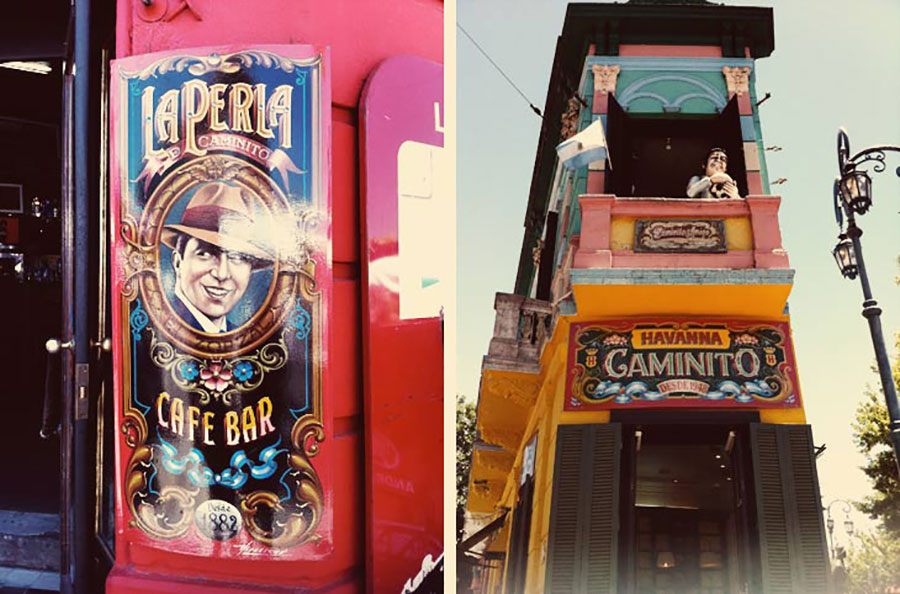
Her career started in social work and political science and she completed a stint in the charity sector for seven years before starting Andara Travel. “I wanted to give people an opportunity to meet local people and get to talk to them,” she says. It works equally as well in big cities as it does in rural villages. In fact, Museri decided to start her business in central Buenos Aires in one of the city’s most famous streets, Caminito; the very idea she was hoping to avoid.

“The street personifies Argentina to many tourists,” says Museri.  “It’s only 100 meters long and there’s nothing really to see in my opinion, so we started exploring the neighborhood behind this street,” she says. They discovered a wealth of social and art programs that they added to their new travel itinerary. Andara Travel now offers visits to indigenous Guarani communities in the Iguazú rain forest, where they learn about jungle resources, medicinal plants and belief systems, while those looking for something more active can take private tango lessons at real milongas (tango ball rooms) in Buenos Aires. A visit to the Mandoza winelands won’t have you sipping Chardonnay in an easy chair either, you’ll find yourself learning about wine culture first-hand – by picking the grapes.

Museri has found a unique way of combining her social work with tourism that is now seeing growth of between 200-400 percent a year. Even more remarkable is that she began Andara Travel at the age of 28.

Aligning herself with the World Wildlife Fund and being the founder of the Argentinian Responsible Travel Association has certainly helped to foster trust with her clients and to align her business with broader, internationally recognized values around conservation and sustainability.

People began to notice from the start. Lonely Planet listed them after only one year in business, helped in part by the fact that nothing like Andara Travel had ever existed before.  

Museri typically sends her clients a draft proposal for discussion on their trip. There’s no set package tour conveniently bundled by self-serving holiday resorts in Museri’s world. She sometimes refines up to five versions of a trip until she finds one that fits the client’s expectations. Many approach Andara Travel with no idea of where they want to go.

Museri doesn’t sit in an office all year round either, choosing to make at least two trips a year to new destinations or existing one’s on the itinerary that they want to check on again. Keeping tabs on their supply chain of operators, destinations and guides is particularly important in her remodeled tourism company. “We had real problems when we started,” she says. “Because we couldn’t find anyone with the same values as us. The customers weren’t happy and we weren’t happy either,” recalls Museri.

caminito

Now with an established reputation as a trusted tour operator she invites all her new partners to join the Argentinian Responsible Travel Association, inspiring them to get more involved in sustainable tourism. “In many instances they’ve already been practicing sustainable tourism, yet just didn’t know it yet, and the amazing benefits it can bring to their business,” says Museri.

Not fazed by the rise of online holiday and travel websites, Museri is of the opinion that much value can be found in a curated vacation that delivers the best local experience, while saving up to 40 hours of research. “What’s the big deal about just selling hotels?” she says. “Delivering an experience is a far more rewarding pastime for us.”

In an age of cheap air travel, that allows people to see the world, discover cultures and learn about the rest of humanity, an obvious dilemma arises: carbon footprint.  “That’s why we call ourselves ‘responsible travel’ and not ‘sustainable travel’,” says Museri. “If we were sustainable, we shouldn’t accept any traveler to Argentina arriving from more than 800 miles away. Obviously we can’t do that, it’s not realistic.”

buenos aires

Ninety-five percent of Andara’s travelers come from the U.S., Australia, Europe, Canada and New Zealand, making long trips to get to Buenos Aires. “We explain to our clients that they should make the best choices available at their destinations to lessen any further environmental impact,” says Museri.

“Hotels will ask you to refrain from changing your towels and bed sheets in your room, which is okay, but they also do this for commercial reasons. In addition, a hotel should have some type of water recycling and garbage separation. My biggest enemies are the amenities. I can’t believe that hotels still give you shampoo in little plastic bottles, it’s incredible.”  Museri suggests refillable containers and biodegradable products instead. She also discourages frantic hopping around, trying to spend two days at each destination and flying from place to place.

Every time Museri feels the need to re-charge her batteries and re-confirm she’s on the right track she visits the NGOs she began with. She sees the heads of these charities, struggling in terrible situations. “They get up and continue every day and for me that’s a big part of my inspiration.”

“To share finances and knowledge with your team might seem counter-intuitive to running a business, but I’ve partnered with some of my team members and consider this the best type of leadership,” she explains. A former employee is now a 15 percent shareholder of Andara Travel and has helped boost the company growth. The team of eight now makes monthly payments to dozens of charities that form part of their tourism network. At the outset Andara sent only two travelers a month to these charities. They now receive between 50 to 100 travelers, and are making a decent income from it.

“The team is so much wider than what we have in our office,” says Muresi.


Having A Heart Attack? There’s A Drone For That

Globalegrow, a global, cross-border online clothing retailer, has invested in research that will build a safe, fast and cost effective drone delivery system, in a move they hope will  improve the customer shopping experience.

In a recent report, drone delivery is likely to disrupt traditional package delivery, and expected to bring major change to the world of e-commerce within the next five years. To answer this future challenge, Chinese retailer Globalegrow intends to invest $150,000 in the coming year in a drone delivery research project. Their major motivation is to help with faster, safer and more economical logistics.

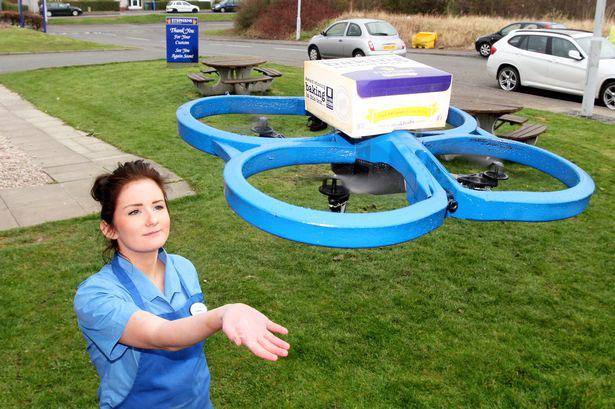
Many companies are presently looking at how drones can deliver their products – from pizza, electronic goods, clothing and even heart defibrillators to those who’ve just had a heart attack on a golf course.

It’s expected that the price consumers will pay for drone delivery will be much lower than traditional road deliveries. By how much, we don’t know, but as we’ve seen in the past, when technology is introduced to a service or product, prices usually start to fall steeply.

Drones typically use electric motors, so they will also be more environmentally friendly, resulting in fewer trucks on the road.

Globalegrow reckons that delivery times for their clothing will drop by 25% if their research project works out. A major challenge they face is around international logistics. Drone delivery, in combination with international warehouse management, will require a customized approach that will re-write rules on how things are delivered. Customs, flight paths and security are all things to be taken seriously.

For a start, Globalegrow has focused on safety, testing in different environments, tracking, flight range, battery life and regulatory support for the first phase of their research. Once the project “takes off” the company will also need to look at their ability to handle large volumes.

Delivery companies have never needed roboticists and aeronautical engineers before, but Globalegrow intends hiring these experts to ensure a great end-product and user experience. The aim of the research is to create a self-flying drone that is loaded with sensors that would help track the package, guide touchdown and enable a tether cable to retract and detach the goods. Added safety measures include a way to alert nearby pedestrians that something might be landing on your head.


Europe Dominates 2016 ‘Smart City” Leaderboard

Six of the top 10 global “smart cities” are based in Europe. A new study  anticipates that smart grid technology deployment will deliver $18.8 billion in cost savings in 2021, through reduced energy use and avoided economic costs from emissions. The reduced emissions are equivalent to those produced by nearly 15 million homes annually.

Juniper Research in the United Kingdom has found that European cities are forging ahead with efforts to become smart cities, with 60% of the world’s leading smart cities based in this region. It was found that innovation to reduce congestion and energy consumption were key initiatives across many European cities. Juniper’s top ranking smart cities for 2016 are as follows:

  1. Singapore
  2. Barcelona
  3. London
  4. San Francisco
  5. Oslo

“When addressed effectively, the impacts of reduced congestion are substantial: higher economic productivity, potential for new revenue streams and services as well as a measurable benefit in reduced healthcare costs”, noted research author Steffen Sorrell.

Juniper’s Smart City Rankings have been compiled following an extensive study of cities around the globe as published in Worldwide Smart Cities: Energy, Transport & Lighting 2016-2021. Some 40 metrics have been evaluated, covering technology, transport, energy, open data and economy.
 

Singapore a Beacon for Smart City Efforts

The top ranked city, Singapore was found to be a world leader in applying smart mobility policies and technology. Meanwhile, the city’s fixed and cellular broadband services, city apps and strong open data policy led to it taking the top spot for 2016. With efforts to become a ‘smart nation’ fully underway, Singapore serves as a beacon from which other cities can learn best practices.
 

New Renewables Driving Smart Grids

Additionally, the research found that deployment of smart grid technologies has found its way onto the agenda for cities across the globe. Alongside increased pressure on resources from urban migration, this common goal is driven, in large part, by a shift towards ‘new renewable’ energy sources such as solar power and wind generation. North America and parts of Asia in particular, are showing strong investment in renewable energy technologies.


Landfills Shouldn’t Be Laundry Piles

Today is Earth Day and companies around the world are thinking about how best to save the environment. Most of us would never consider our clothing being part of the problem, but it is.

Savers, a global thrift retailer, is challenging people to rethink their clothing footprint. A larger-than-life clothing spill installation (pictured above) on the famous Alki Beach in Seattle, Washington created a visually arresting wakeup call to remind everyone that clothing doesn’t need to end up in landfills. Americans throw away more than 10.5 million tons of clothing annually, 95 percent of which could have been reused or recycled.

For more than 60 years, Savers has been purchasing used clothing and textiles from nonprofit organizations and giving them a second, or third, life in its stores or through its recycling partners. They’re on a mission to create a better world through reuse – by inspiring local communities to rethink reuse.

“At Savers, reuse is in our DNA,” says Ken Alterman, president and CEO. “It’s who we are and how we operate, but not everyone considers reuse an option for their used clothing and household goods.

With the growing amount of clothing and textile waste ending up in landfills, we felt compelled to act. 

We want to help people better understand the environmental impact of their clothing waste and the steps they can take to reduce it. That’s why we are calling on everyone to rethink reuse – shopping thrift, donating used items to a nonprofit and consuming goods in a more sustainable way.”

Through its unique business model of purchasing, reselling and recycling secondhand merchandise, the Savers family of thrift stores (including Value Village, Unique Thrift and Village des Valeurs brands) benefits more than 120 nonprofit organizations, gives local consumers a smart way to shop and saves 650 million pounds of quality used goods from landfills each year.

Savers pays its nonprofit partners for donated goods, turning otherwise unused items into sustainable funding that supports their vital community programs and services.

Eighty-five percent of clothing waste ends up in landfills, with only 15 percent being reused or recycled. Companies such as Savers help give clothing and textiles another life through recycling and reuse – diverting millions of tons of clothing and textiles from landfills each year. Think about that next time you’re clearing out your closets.


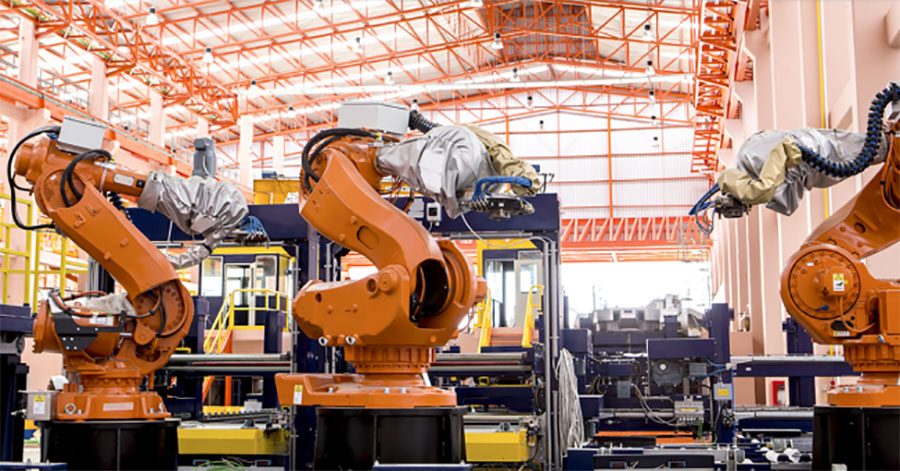
Surprise, Surprise: Mercedes to Replace Robots With… Humans

According to the head of production at Mercedes-Benz, the robots cannot cope with the high degree of customization and the many variants the carmaker has today.

Mercedes-Benz plans to abolish a number of assembly-line robot in its largest plant in Sindelfingen, Germany and compensate it by getting more work done by people.

Even more surprising, or perhaps not, is the justification given: to cope with the extensive customization options of the vehicles.

According to the head of production at Mercedes-Benz, the robots cannot cope with the high degree of customization and the many variants the carmaker has today, which conveyed the new very timely and smart message “We save money and secure our future while employing more people.”

So what about the tsunami warning from the World Economic Forum in Davos, where specialists from around the globe predicted that the 4th industrial revolution robots would cost five million jobs by 2020?

Well, maybe predicting the future is not that simple after all… but still, I would like to add two predictions of my own:

1. ROBOTS AND HUMANS WILL WORK SIDE-BY-SIDE FOR A VERY LONG TIME

In the same article, the head of productions mentions that are areas which would not work without robots, mainly painting and welding. He also says the vision is that humans will work side-by-side with small robots that can continually perform repetitive tasks. This implies the creation of mixing zones, where the robots no longer work in separately enclosed areas, requiring completely new security measures.

Well, it doesn’t take a genius to predict that. The degree of customization, heading steadily towards product uniqueness, will require, in many cases, a flexibility that only a special type of factory resources has: humans.

Yes, all the repetitive work will be performed by robots. And with time, the scope of these activities will be enlarged. Still, the most value-added activities, the ones where completely new and unforeseen situations happen, will only be dealt with by humans. With the advent of artificial intelligence these will be fewer than before, but will be critically important.

2. THIS DECISION IS DEFINITELY… TEMPORARY

I hold out that this decision is temporary. Although temporary in this context could mean several years, or even decades.

The different customization options will continue to evolve towards unique products. The same article refers that Daimler is planning to bring in ten new models to the market over the next four years, which can be ordered in several variations and with many extras.

The days of mass customization, where only small variations could please consumers, seem to be over. So manufacturing companies need to be prepared for this reality.

What is clear is that the automation and robotics necessary to cope with this paradigm shift will be very different from the ones used today.

The industry 4.0 working group actually predicted this: the shop-floor will be composed by intelligent products or materials (cyber-physical systems) and intelligent manufacturing equipment (cyber-physical production systems). These will have their own communication, sensors and actuators, computing power and intelligence and will become autonomous decision entities.

The consequence is that the shop-floor operations will no longer be centrally controlled, but will rather become a decentralized marketplace with demand and supply. Until this happens, the best is to use the most flexible resources available today: humans.

 by Francisco Almada Lobo, CEO of Critical Manufacturing


L’Oréal Foundation and UNESCO Defend the Role of Women in Science

Five leading women scientists and 15 promising young researchers were honoured on 25 March at the Sorbonne University in Paris where the launch of the For Women in Science Manifesto was held. Already signed by each guest present at the Ceremony, this Manifesto aims to tackle the under-representation of women in the sciences. 

For the past 18 years, the LOréal-UNESCO For Women in Science program has encouraged, promoted and honoured women scientists all over the world. This year, the L’Oréal Foundation and UNESCO are taking the next step towards change: the launch of the For Women in Science Manifesto to raise awareness and mobilize the public’s active support for the cause of women in science.

Jean-Paul AgonIrina Bokova, and this year’s President of the Jury, former Laureate and Nobel Prize winner Elizabeth Blackburn, all signed the Manifesto, along with the Laureates, International Rising Talents and 800 guests in attendance to ensure the visibility and public support necessary, so that everyone involved can work together towards gender equality in the sciences.

Collective strength is what we want to see emerge tonight from our Manifesto. Beyond the scientific and institutional communities, we want to give everyone the chance to sign the For Women in Science Manifesto and join the cause, stated Jean-Paul Agon.

Since its creation in 1945, the United Nations Educational Scientific and Cultural Organisation (UNESCO) supports international scientific cooperation as a catalyst for sustainable development and for peace between people.

Accompany. Value. Communicate. Support. Move boundaries. These are the core values which drive the L’Oréal Foundation’s commitment to women everyday. A commitment divided into two main areas – science and beauty.

The six commitments of the #ForWomeninScience Manifesto

1/ Encourage girls to explore scientific career paths

2/ Break down the barriers that prevent women scientists from pursuing long term careers in research

3/ Prioritise womens access to senior positions and leadership positions in the sciences

4/ Celebrate with the general public the contribution that women scientists make to scientific progress and to society

5/ Ensure gender equality through participation and leadership in symposiums and scientific commissions, such as conferences, committees and board meetings

6/ Promote mentoring and networking for young scientists to enable them to plan and develop careers that meet their expectations