What everyone is getting wrong about Spotify’s proposed update.
Spotify is quietly testing a feature that should have every marketer paying attention.
It’s called “Skip Ahead.”
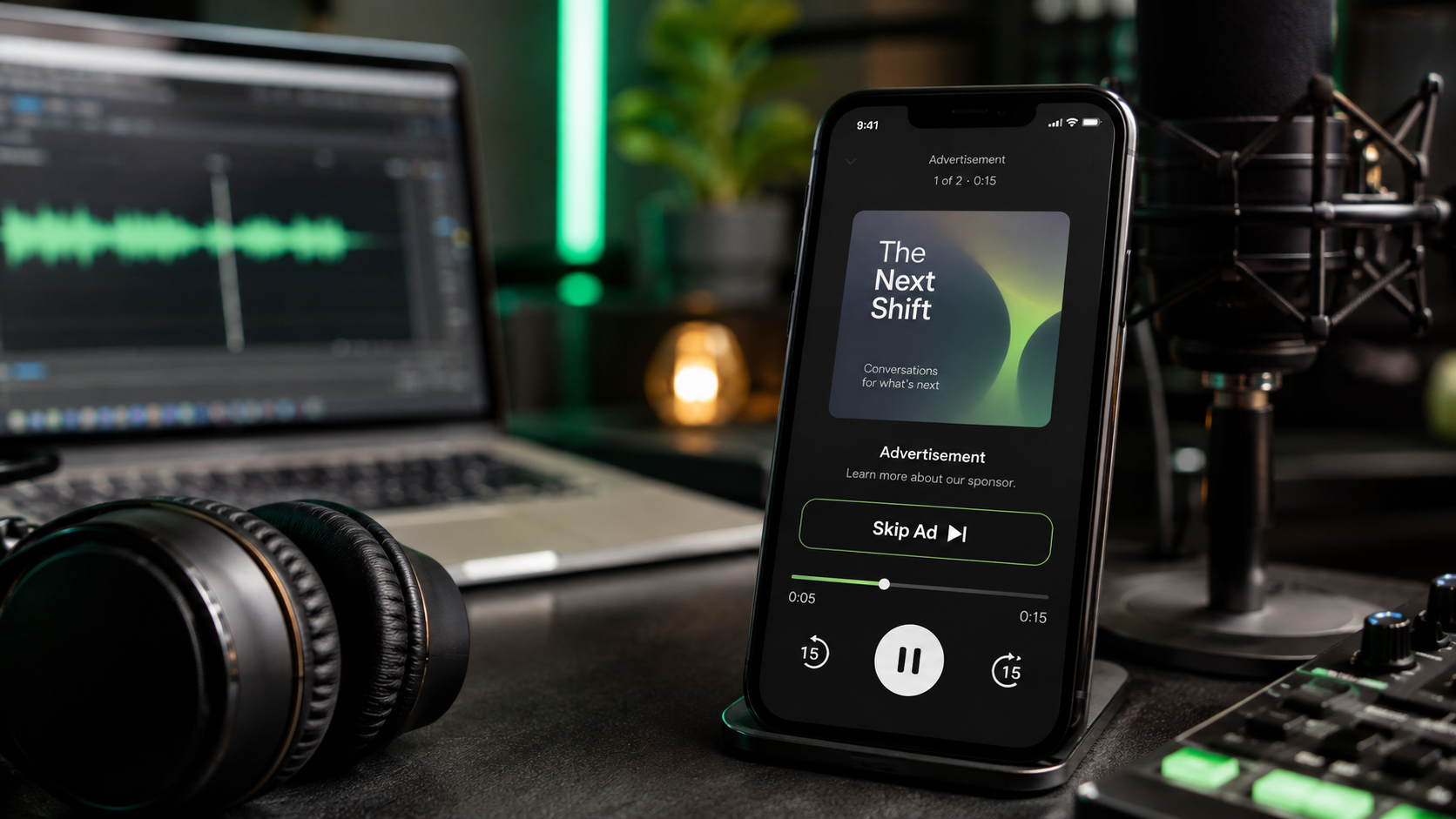
For select Premium users, Spotify is testing a button that allows listeners to jump past podcast advertising, sponsorship messages and promotional segments with a single tap.
Listeners have always been able to skip ads. What Spotify is changing is the friction.
Instead of repeatedly hitting the 15-second-forward button, listeners may soon be able to bypass an entire advertising segment instantly. Podnews reports that fewer than 10% of podcast ad breaks are currently skipped in practice, suggesting that simply making skipping easier could meaningfully change listener behavior.
As a podcast publisher myself, Spotify is only 8% of my audience but 8 years ago it was 1%. The platform has increasingly invested into its podcast tools such as Spotify Creators, formerly known as Anchor which allows out team to publish video or audio podcasts to all podcast platforms (Apple, Google, Spotify, Podcaster, etc.) using an RSS feed.
I’m assuming it will be able to decipher the ads using it’s AI segmenting tool which helps users skip to specific parts of hour long conversations based on what they’re looking for.
So I think there’s a much bigger business lesson here…
Attention Is Becoming Permission-Based
For decades, advertising largely worked by interrupting people.
Commercial television interrupted your show.
Radio interrupted your music.
Websites interrupted your reading.
Social media interrupted your feed.
And podcast advertising interrupted your conversation.
But technology keeps giving consumers more control.
Ad blockers. Streaming subscriptions. DVRs. Skip buttons. Premium memberships. Algorithms.
The direction is pretty clear:
Consumers increasingly decide what deserves their attention.
That changes what great marketing looks like.
The brands that win in this environment won’t simply be the ones that can buy the most impressions. They’ll be the ones that can create something audiences consider worth hearing.
The Real Problem Isn’t the Skip Button
Spotify’s experiment has generated understandable concern within the podcast industry.
According to Forbes and Podnews, the feature is being tested among Premium subscribers in select markets, including the United States and United Kingdom. Spotify says the experiment is intended to make podcast listening more intuitive and potentially keep listeners engaged longer.
There is also an important controversy.
The new button reportedly allows listeners to skip advertising sold by publishers and podcast networks, while advertising sold directly through Spotify is treated differently. That has created concerns about Spotify potentially creating two classes of advertising inside the same ecosystem.
That debate matters.
But marketers and advertisers should also ask themselves a harder question:
If someone could skip your message, would they?
Because that is increasingly the marketing environment every company is entering.
Stop Buying Attention. Start Earning It.
After interviewing CEOs for more than a decade, I’ve seen the companies that build the strongest brands do something differently.
They educate.
They tell stories.
They teach customers something.
They have leaders with a point of view.
They communicate the problem they exist to solve instead of constantly talking about the product they’re trying to sell.
That distinction is becoming increasingly important.
A generic 30-second commercial is easy to skip.
A CEO telling a story about why industry change is needed hits different.
An educational conversation is different.
A compelling podcast is different.
People don’t avoid marketing because they hate businesses.
They avoid marketing because most marketing isn’t valuable to them.
This Could Actually Make Podcast Advertising Better
There is another possibility worth considering.
Maybe easier ad skipping forces advertisers and creators to get better.
Podnews notes that some podcasts now open with extremely long advertising blocks—sometimes stretching beyond eight minutes. That may generate short-term inventory, but it risks training audiences to skip advertising altogether.
If platforms begin giving consumers more control, advertisers will have to rethink what belongs inside those moments.
Host-read endorsements may need to become more authentic.
Brands may need to become more selective about the audiences they sponsor.
Podcast hosts may need to work with fewer advertisers they actually believe in.
Companies may need to stop treating podcasts as another place to run commercials and instead treat them as places to build trust.
That could ultimately be healthy for the medium.
The Bigger Leadership Lesson
Spotify has enormous influence over podcast distribution. Podnews estimates the platform accounts for more than a quarter of global podcast downloads, which means even a limited product experiment has the potential to influence the broader industry.
Whether Skip Ahead becomes permanent isn’t really the point.
Another platform will introduce another feature.
Consumer behavior will keep changing.
Algorithms will change.
Distribution will change.
Advertising models will change.
But trust will continue to matter.
Business leaders shouldn’t build brands around their ability to interrupt the market.
They should build brands that educate the market via long-form content.
That’s why CEOs increasingly need to think like educators, publishers and storytellers—not simply advertisers.
Your company has knowledge.
Your customers have stories.
Your employees have expertise.
Your CEO has a perspective.
Turn those assets into content worth consuming.
Because we’re moving toward a world where consumers will increasingly have a button that says skip.
The opportunity is to become the brand they don’t want to skip.