

Titanic Syndrome: Why Companies Sink and How to Prevent it Happening to You

I never think of shopping as a time for excitement, but in 2019, I was in for a mild shock when I visited my local mall. There, I saw something that only a few years ago would have been unimaginable.

Sears, which took up over a quarter of the mall’s entire floor space, was pulling down its signs. What was once a powerful retail giant is now a glaring symbol of one company’s inability to change and adapt. Sears, however, is not an exception. As we brace for further impact from the global pandemic, more giants are expected to fall. In 2010, in the middle of another crisis, researchers Ranjay Gulati, Nitin Nohria, and Franz Wohlgezogen showed that during the recessions of 1980, 1990, and 2000, 17 percent of the 4,700 public companies they studied did not survive. One out of every three public companies will cease to exist in their current form within the next five years — a rate six times higher than 40 years ago, according to BCG, a global consulting firm.

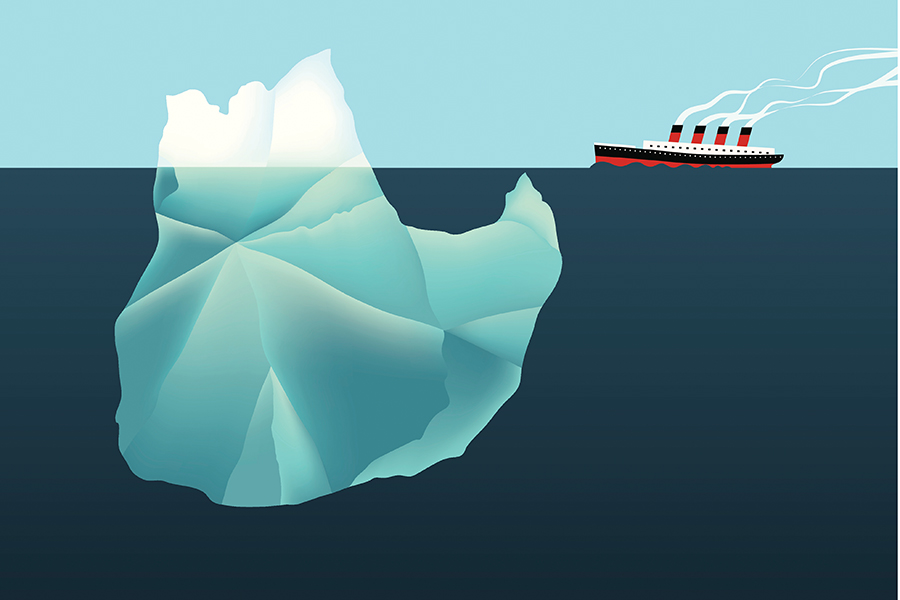
As I stood in the mall and looked at the shadow of what was once a remarkable brand, I was reminded of another story of heartbreaking failure: the Titanic. Titanic’s story offers eerie parallels between the behavior of the ship’s team and that of today’s at-risk companies. Effective leaders know that understanding why things fail can help to avoid repeating mistakes.

Most of us know the story of what happened on that chilly Sunday, April 14, 1912, at 11:49 pm, when the Royal Mail Steamer Titanic — en route from Europe to New York City — collided with an iceberg and sank within three hours, leading to the deaths of 1,514 of the 2,224 passengers and crew on board. The largest moving human-made object at the time, the Titanic was considered unsinkable by all: experts, media, and the public. The ship was equipped with the most advanced naval technology available and a crew of experienced and respected naval leaders. So why did it sink, and what can we learn?

Failure #1 / Ignored Warnings

The Titanic’s crew was warned about the area’s dangerous icebergs. But why were these warnings ignored?

The radio operating team was so concerned with keeping the high-paying customers satisfied that they told the passing ship Californian, “Keep out; Shut up!” when interrupted on-air by his counterpart warning of the upcoming ice field. Customer satisfaction is all the rage. But killing it for the wrong whim of the customer might accidentally kill your business.

Failure #2 / No Binoculars

Overconfidence can be blinding.

The night of the collision was clear and still. Perched 50 feet above the forecastle deck, in a small open box called “the crow’s nest,” lookouts Frederick Fleet and Reginald Lee worked their two-hour shift. Inside the nest, Fleet and Lee had a large bell to grab public attention and a telephone to reach the captain’s bridge. What they did not have, however, was a pair of binoculars.
A hundred years later, with all the advances in modern technology, it is still hard to imagine any ship in the open waters without binoculars. The Titanic, too, had several binoculars on board, but for much of the trip, they were locked up in a storage cabinet. This was, quite literally, a case of overconfidence that was blinding.

Failure #3 / The Role of the Iceberg

It’s easy to blame the iceberg.

We’ve reviewed some of the causes of the disaster, but we’ve missed the main one: the iceberg. Whenever I work with a company or discuss the Titanic story, the iceberg is the first cause mentioned.
When I’m asked to work with a company to reinvent its products, processes, or business models, I wasn’t there to experience their good times. By the time I’m called, things are already deteriorating — the iceberg has been hit — and oh boy, is it easy to blame the iceberg!

Sneaky competitors, overbearing regulators, lousy weather, bad design, late suppliers, lazy customers, those finance-department knuckleheads: I’ve heard it all. It is so easy to blame it on someone else.
But here is the thing: While you cannot prevent the iceberg from appearing, you can darn well make sure you don’t hit it. The choice is in your hands.

Of all the things that went wrong on the Titanic, there was one problem more glaring than all the others: the arrogance and overconfidence of past successes.

Failure #4 / Previous Success Might Destroy Your Ambitions

What got you here may not get you there.

On the night of the collision, the captain had already gone to bed. First Officer William Murdoch was in charge. At 39, Murdoch had 16 years of maritime experience and was known for his masterful record of averting ship collisions. For instance, before the Titanic, he had served on the Arabic when a passing ship came bearing down from the darkness. Murdock grabbed the wheel and held the ship steady. As a result, the two ships passed within inches without damage.

The Arabic incident was one of many Murdoch mastered in his career. In the 37 seconds between the first sighting of the iceberg and its collision with the Titanic, the officer fully relied on his past successes to make executive decisions in the present. We all know how that turned out.

Are You too Big to Fail?

History can be a great mentor.

The Titanic story is the most powerful example of a too-big-to-fail mindset. Sometimes the sheer size of a company creates an illusion of being untouchable and unsinkable. Enron, Lehman Brothers, Blockbuster, Toys-R-Us, Borders, Myspace, and Sears all went through the same process of blind belief in their own ability to withstand any storm or disruption.
The Titanic Syndrome has sunk many companies. It can be summarized as a corporate disease in which organizations that face disruption bring about their downfall through arrogance, excessive attachment to past success, or an inability to recognize and adapt to the new and emerging reality.

Slow Adoption is Gone

Start your new lifecycle now.

Once upon a time, our companies enjoyed long and healthy lives, with a slow rise to the top of financial performance and a gradual decline to annihilation. The rate of change was so slow that it was easy to develop the Titanic Syndrome and still survive — we had all the time in the world to renew a business on our terms. If a new “iceberg” showed up on the horizon — a competitor, a technology, a regulation — a company could adapt slowly and even enjoy the ride. But that fairy tale is long gone.

The increasing level of globalization showcased so painfully during the 2008–2009 global economic crisis and powered by the ever-increasing access to knowledge means that more of us are inventing every day and sharing those inventions globally. With all these pressures, the demand for corporate (economic, communal, and personal) reinvention has grown even further.

Does it mean that we are doomed? Absolutely not. What separates companies that survive from those that go down is the ability to start a new lifecycle, to pivot their company far enough from the path of destruction to find a new opportunity for growth. But if before you had 30+ years to reach your prime, today you might only have a few years.
How many exactly? To answer this question, we launched a global reinvention survey in 2018. Thousands of participants took part, giving much-needed insight into the speed of change and ways to deal with it. Our 2020 results showed that to survive today, 60 percent of us need to reinvent every 0 to 3 years, with a whopping 16.1 percent needing to reinvent every 12 months or less. This means that barely into a new business, you must start the reinvention process anew — again and again, in a continuous cycle of renewal.

The business you’re in today cannot be the business you’re in three years from now. By then, you’re either entering a new business model or you’re on the way to extinction. Period.
Titanic Syndrome: Why Companies Sink and How to Prevent it Happening to You

I never think of shopping as a time for excitement, but in 2019, I was in for a mild shock when I visited my local mall. There, I saw something that only a few years ago would have been unimaginable.

Sears, which took up over a quarter of the mall’s entire floor space, was pulling down its signs. What was once a powerful retail giant is now a glaring symbol of one company’s inability to change and adapt. Sears, however, is not an exception. As we brace for further impact from the global pandemic, more giants are expected to fall. In 2010, in the middle of another crisis, researchers Ranjay Gulati, Nitin Nohria, and Franz Wohlgezogen showed that during the recessions of 1980, 1990, and 2000, 17 percent of the 4,700 public companies they studied did not survive. One out of every three public companies will cease to exist in their current form within the next five years — a rate six times higher than 40 years ago, according to BCG, a global consulting firm.

As I stood in the mall and looked at the shadow of what was once a remarkable brand, I was reminded of another story of heartbreaking failure: the Titanic. Titanic’s story offers eerie parallels between the behavior of the ship’s team and that of today’s at-risk companies. Effective leaders know that understanding why things fail can help to avoid repeating mistakes.

Most of us know the story of what happened on that chilly Sunday, April 14, 1912, at 11:49 pm, when the Royal Mail Steamer Titanic — en route from Europe to New York City — collided with an iceberg and sank within three hours, leading to the deaths of 1,514 of the 2,224 passengers and crew on board. The largest moving human-made object at the time, the Titanic was considered unsinkable by all: experts, media, and the public. The ship was equipped with the most advanced naval technology available and a crew of experienced and respected naval leaders. So why did it sink, and what can we learn?

Failure #1 / Ignored Warnings

The Titanic’s crew was warned about the area’s dangerous icebergs. But why were these warnings ignored?

The radio operating team was so concerned with keeping the high-paying customers satisfied that they told the passing ship Californian, “Keep out; Shut up!” when interrupted on-air by his counterpart warning of the upcoming ice field. Customer satisfaction is all the rage. But killing it for the wrong whim of the customer might accidentally kill your business.

Failure #2 / No Binoculars

Overconfidence can be blinding.

The night of the collision was clear and still. Perched 50 feet above the forecastle deck, in a small open box called “the crow’s nest,” lookouts Frederick Fleet and Reginald Lee worked their two-hour shift. Inside the nest, Fleet and Lee had a large bell to grab public attention and a telephone to reach the captain’s bridge. What they did not have, however, was a pair of binoculars.
A hundred years later, with all the advances in modern technology, it is still hard to imagine any ship in the open waters without binoculars. The Titanic, too, had several binoculars on board, but for much of the trip, they were locked up in a storage cabinet. This was, quite literally, a case of overconfidence that was blinding.

Failure #3 / The Role of the Iceberg

It’s easy to blame the iceberg.

We’ve reviewed some of the causes of the disaster, but we’ve missed the main one: the iceberg. Whenever I work with a company or discuss the Titanic story, the iceberg is the first cause mentioned.
When I’m asked to work with a company to reinvent its products, processes, or business models, I wasn’t there to experience their good times. By the time I’m called, things are already deteriorating — the iceberg has been hit — and oh boy, is it easy to blame the iceberg!

Sneaky competitors, overbearing regulators, lousy weather, bad design, late suppliers, lazy customers, those finance-department knuckleheads: I’ve heard it all. It is so easy to blame it on someone else.
But here is the thing: While you cannot prevent the iceberg from appearing, you can darn well make sure you don’t hit it. The choice is in your hands.

Of all the things that went wrong on the Titanic, there was one problem more glaring than all the others: the arrogance and overconfidence of past successes.

Failure #4 / Previous Success Might Destroy Your Ambitions

What got you here may not get you there.

On the night of the collision, the captain had already gone to bed. First Officer William Murdoch was in charge. At 39, Murdoch had 16 years of maritime experience and was known for his masterful record of averting ship collisions. For instance, before the Titanic, he had served on the Arabic when a passing ship came bearing down from the darkness. Murdock grabbed the wheel and held the ship steady. As a result, the two ships passed within inches without damage.

The Arabic incident was one of many Murdoch mastered in his career. In the 37 seconds between the first sighting of the iceberg and its collision with the Titanic, the officer fully relied on his past successes to make executive decisions in the present. We all know how that turned out.

Are You too Big to Fail?

History can be a great mentor.

The Titanic story is the most powerful example of a too-big-to-fail mindset. Sometimes the sheer size of a company creates an illusion of being untouchable and unsinkable. Enron, Lehman Brothers, Blockbuster, Toys-R-Us, Borders, Myspace, and Sears all went through the same process of blind belief in their own ability to withstand any storm or disruption.
The Titanic Syndrome has sunk many companies. It can be summarized as a corporate disease in which organizations that face disruption bring about their downfall through arrogance, excessive attachment to past success, or an inability to recognize and adapt to the new and emerging reality.

Slow Adoption is Gone

Start your new lifecycle now.

Once upon a time, our companies enjoyed long and healthy lives, with a slow rise to the top of financial performance and a gradual decline to annihilation. The rate of change was so slow that it was easy to develop the Titanic Syndrome and still survive — we had all the time in the world to renew a business on our terms. If a new “iceberg” showed up on the horizon — a competitor, a technology, a regulation — a company could adapt slowly and even enjoy the ride. But that fairy tale is long gone.

The increasing level of globalization showcased so painfully during the 2008–2009 global economic crisis and powered by the ever-increasing access to knowledge means that more of us are inventing every day and sharing those inventions globally. With all these pressures, the demand for corporate (economic, communal, and personal) reinvention has grown even further.

Does it mean that we are doomed? Absolutely not. What separates companies that survive from those that go down is the ability to start a new lifecycle, to pivot their company far enough from the path of destruction to find a new opportunity for growth. But if before you had 30+ years to reach your prime, today you might only have a few years.
How many exactly? To answer this question, we launched a global reinvention survey in 2018. Thousands of participants took part, giving much-needed insight into the speed of change and ways to deal with it. Our 2020 results showed that to survive today, 60 percent of us need to reinvent every 0 to 3 years, with a whopping 16.1 percent needing to reinvent every 12 months or less. This means that barely into a new business, you must start the reinvention process anew — again and again, in a continuous cycle of renewal.

The business you’re in today cannot be the business you’re in three years from now. By then, you’re either entering a new business model or you’re on the way to extinction. Period.

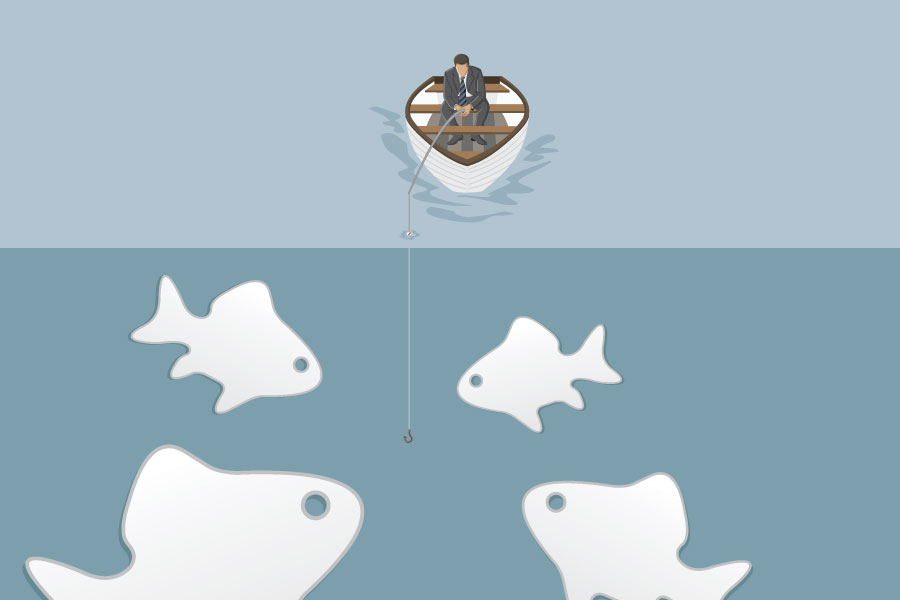
The Overfished Ocean Strategy: Powering Up Innovation

We live at a time of remarkable transformation. The linear throwaway economy of today—where we extract resources, process them, use them barely once, and trash them immediately as we would a cheap plastic fork—is coming to an end. We are, simply put, running out of things to mine and places to trash.

And the market is beginning to recognize it as well: after 160 years of falling costs of raw materials, the first 10 years of the new millennium have seen a whopping 147 percent increase in real commodity prices. Do you happen to be one of millions of managers fighting the ever-rising prices of raw materials, transportation, operations, and more? Welcome to the future! A new economy is being born, one that takes the line and turns it into a circle.

At the end of the life of a product, all of the waste comes back into a production cycle as a valuable resource, infinitely. With that comes a new economic order, where we compete and win using a radically new set of rules. While most of the business world remains in the dark, Bayerische Motoren Werke AG – also known as the global giant BMW – is navigating the murky waters of the resource crunch. The company moved well beyond selling products to selling services – and from a car company transformed itself into a mobility company. Focusing on mobility – a service rather than a product – allows the company to power up radical innovation and open doors to a completely new business opportunity.

Take, for example, the DriveNow car-sharing service, employing BMW i, MINI, and Sixt cars, which allows people in densely populated urban areas to enjoy the benefits of a personal car without owning one. The idea, as BMW explains, is simple: “The mobility concept is based on the motto ‘pick up anywhere, drop off anywhere.’ Billing is per-minute, fuel costs and parking charges in public car parks are included. Users can locate available cars using the app, website or just on the street.

A chip in the driving license acts as an electronic key. Now, that is a leap into the future for a 98-year-old company! But the new world of resource-depravity is also attractive to the newcomers. In a number of European countries, a 2012-born start-up FLOOW2, is making money by allowing businesses to sell their temporary overcapacity – underutilized machines, skills, and real estate – all with the click of a button.

By May 2014, this “sharing marketplace” grew a portfolio of 25,000 materials and services10 that used to be sitting idle, but now make money for the owners while offering a cheaper alternative to users. And FLOOW2 gets a nice commission as well – a much-deserved prize for a solid business model. Puma, a multi-national shoemaker to the fit, has transformed resource crunch into a source for radically simple innovations.

For instance, the company is getting rid of shoeboxes in favor of the remarkable intelligence of the light and reusable Clever Little Bag. The Bag came about as a response to a wasteful practice: a company made boxes, assembled boxes, shipped boxes, stored boxes, and put boxes into a shopping bag only to see both discarded by the customer within a few minutes of arriving home. An alternative? Clever Little Bag is a re-usable package-shopping bag combo that brings additional value to the customers while saving Puma big money on materials and shipping – cardboard savings alone amount to 65%.11 Water, electricity, fuel use are also severely reduced – so bring on the savings! In their unexpected take on resource intelligence, BMW, FLOOW2 and Puma are far from alone.

For the past three years I have worked with and studied the pioneers of a new economic reality, who are transforming the collapsing linear throwaway economy into a more lasting, more abundant, more sustainable version of itself. While the companies, people, and projects pioneering these new rules are still rare, there are enough of them to suggest the first few essential principles that allow managers to innovate their way into a new world. Five new rules of the trade – five essential “secrets” – appear increasingly important for individuals and companies eager to power up a new strategic direction and secure the source of a truly sustainable value.

Together, the principles inspire fundamental change and power up radical innovation across countries and industries – and make up the essence of what I call Overfished Ocean Strategy: the art of transforming today’s depletion of resources into tomorrow’s differentiated long-lasting profits. Here I will speak about three of the five principles. Principle One: From Line to Circle The rapid decline of resources – from coal to tuna to vitamin C in a typical tomato – means that one way or another, all of us will have to find a new path forward.

That path, however, is not new at all – indeed, it has been perfected over the course of millions of years by nature itself. You see, nature does not have waste. Waste of one process becomes food for another, in perpetual cycle. When an animal dies, its body is not thrown into a landfill; instead, it becomes a source of valuable nutrition for millions of bacteria that in turn produce waste products that are essential for the formation of soil. Soil in turn churns out vegetables, consumed by the very animals. So, why not learn from nature and connect the two ends of the global economy and turn the line into a circle? Useless waste becomes a valuable resource that we can circulate indefinitely.

Abundance follows. Principle Two: From Vertical to Horizontal Imagine the global value chain of the industry you’re in. This long line consists of many steps: upstream, reaching to your company, and downstream, touching your customers, consumers, and end-of-life entities. This line is also many layers deep, with different industries feeding and interacting with each other. Growing up in business, we are taught to look downstream, paying attention to our customers and consumers.

We are asked to pay attention to our immediate suppliers – to make sure that we have secured prices and quantities. But even more so, we are asked to pay utmost attention to the vertical cut in this chain – our competitors. Yet, in the world of overfished oceans, risks and opportunities are hiding far away from the home grounds – among the suppliers of the suppliers of the suppliers, and customers of customers of customers.

Move beyond your little vertical slice of the global value chain. Expand your horizons. Principle Three: From Growth to Growth Managers in Atlanta, Delhi, or Copenhagen where their growth comes from, and they will give you a clear answer: selling more. Yet, in a world constrained by every type of resource, including landfill space, only one type of “selling more” is possible. We are taught to look at our businesses in terms of our products – even the financial services industry uses the term “product.” Yet, it is precisely in the service of creating more with less – designing a total solution, a unique experience – where growth lies.

Using these and other principles of Overfished Ocean Strategy allows companies, actors, industries, and continents to move from scarcity to abundance. The collapse of the linear throwaway economy is not a question of if but of when. The change is coming, and the rapidly oscillating prices on everything from rice to gold are a first sign of the new reality.

The question is, will you ride the high tides with mastery and purpose, or will you be swallowed by waves that are unexpected and unnoticed until it is too late? If the endless list of Overfished Ocean Strategy innovations is any indication, we should make it into the new world just fine. I am counting on seeing you there.

Why a Circular Economy is Critical Now

Forget red and blue oceans, it’s the overfished ocean that should be calling your strategy shots. Ask any experienced manager or aspiring MBA student around the world for their favorite subject in the field of business, and the answer will strike you with overwhelming consistency. Strategy! At the time when shaking economies are struggling to find their standings, developing a strategy that beats the competition is the sexiest topic around. And judging by all the strategy courses I have ever taken or been asked to teach, we seem to be focused on only two choices.

Popular strategic thought tells us that to compete well, we need to find the most advantageous position in the crowded market space and stick to it. Michael E. Porter is the guru at the helm of this thinking, and his famous 1980 menu of “generic” strategies aims to offer you the entire market landscape to consider. In a striking contrast to Michael Porter’s positioning concept, in 2005 W. Chan Kim and Renée Mauborgne invited the business world to leave behind the crowded (and often violent!) waters of the existing market and instead search for—or create demand in—the uncontested market space, the so called blue ocean.

With the powerful advice of the former, many companies for decades claimed their victory by finding and protecting the best spot—a unique position on the crowded competitive landscape. Following the fresh invitation of the latter, adventurous businesses strived to avoid the crowd by discovering a new market space—swimming into the “blue ocean” waters far away from shark-filled blood-red existing markets. Both options are great. And both are oblivious to one simple fact: whether red, blue, or rainbow, the oceans are getting excruciatingly empty. We are, simply put, running out of things to mine and places to trash.

The question of declining resources is not new. Long before current frameworks, such as the Natural Step, put declining resources at the center of attention, the issue of resource scarcity commanded the notice of theorists and practitioners alike. From Plato in the fourth century BC to Thomas Malthus in 1798 to the Club of Rome in 1972, a parade of esteemed thinkers drew our attention to the looming collapse—to no avail. Hardly any changes in the behavior of businesses, governments, and consumers alike were inspired by their powerful outcry—if anything, the global market grew tired and deaf to the calls for radically new business models. Why?

While the theory of resource decline seemed strong and sound, for nearly two centuries the market reality had been telling the opposite story. McKinsey’s 2011 report “Resource Revolution” puts it best: “Throughout the 20th century, resource prices declined in real terms or, in the case of energy, were flat overall despite periodic supply shocks and volatility. The real price of MGI’s index of the most important commodities fell by almost half. This decline is startling and impressive when we consider that, during this 100-year period, the global population quadrupled and global GDP increased by roughly 20 times.

The result was strong increases in demand for resources of 600 to 2,000 percent, depending on the resource.” In essence, what the declining prices of resources told us for so long was that we could have our cake and eat it too—grow our population, increase our consumption, and keep cutting prices, all at the same time. But that was then. The now looks drastically different—and the speed of waking up to this new reality will determine who will survive and who will vanish in the new era.

Each year, I work with about 5,000 senior managers directly, and our conversations so far suggest that the majority have not yet fully awakened to this new world of a rapidly collapsing resource base. So, here are a few alarm sirens for you—the general trends that are beyond striking:

  • One: since the turn of the 21st century, real commodity prices increased 147 percent.
  • Two: at a minimum, an additional $1 trillion annual investment in the resource system is necessary to meet future resource demands.
  • Three: three billion more middle-class consumers are expected to be in the global economy by 2030, all putting new pressures on resource demand.

Whatever key aspect of business—or life—we consider, declining resources are unraveling the very foundation on which we built our economy. As the linear throwaway economy is approaching its collapse, this old economic order is running its course, and those managers who deeply understand and master this shift are able to use the new reality to power up radical innovation and secure a remarkable competitive advantage. As they ride ahead of the wave, new products, new business models, new markets, and new profits follow. Behold the Overfished Ocean Strategy.

At the center of this approach to resource depletion is a simple strategy: it’s time to turn scarcity into competitive advantage. While this comprehensive strategic framework is built around five well-researched principles, today I will only talk about the essence. And it has to do with the nature of economy. To be able to invent products, processes, and services that do not deplete our resources our businesses need to move from linear to circular economy.

In linear economy we mine, use (usually once), and trash all of our hard-earned materials like a cheap plastic fork. In circular economy all that is used stays in the production cycle indefinitely – the waste of one product becomes raw material of another. Let’ me make it palpable for you. For years we have been hearing that the world is running out of gold. Indeed, in the linear economy, we are. So, consider this: a ton of used cell phones has up to 30 times more gold in it than a ton of gold ore.

The first piece of data breeds hopelessness. The second offers a tremendous opportunity. That is the essence of Overfished Ocean Strategy.

So, if the reports on the diminishing stocks and rising prices on every raw material possible suggest that the future of business is doom and gloom, the good news is already here: a new era of innovation for a resource-depleted world is upon us. Join.

0