


What the Nonprofit Sector Needs to Reach Its Full Potential

The nonprofit sector has limbs. It has fingers that reach into the most neglected corners of society, forearms that lead large national chapter and affiliate organizations, legs made up of the nation’s foundations and massive individual donor base that fund it and help it to move.

It has blood pumping through its veins – 10 million people doing its good works day in and day out. It has a central nervous system that alerts it to pain in the form of looming federal policy threats to tax exempt status and other core functions. It has eyes and ears in the form of an army of program officers and internal assessment functions trying to analyze the impact of its work.

But it doesn’t have a brain. It doesn’t have one center of organization and imagination looking out at the far horizon to inspire and guide all of the component parts to get to a place together that none operating independently could ever get to on its own. It doesn’t have one voice to tell the rest of the world where it is headed and what it requires to get there. It has no coordinated analytical capability to help it understand its progress.

This reality makes its gait something like one of the zombies in Walking Dead. It’s moving. But in no particular direction save toward sustenance when it senses its presence.

One big qualification. When I say, “the nonprofit sector” here, I really mean what the public thinks of as “charities.” When I think of charities I think of the health and human services portion of the nonprofit sector. It represents about 18% of the sector as a whole — it’s small up against higher education, religion and hospitals.

The sector has many of the pieces that it needs to form a brain, but they operate at a distance from one another, with little or no neural connection. And just as the whole is greater than the sum of its parts, so too are the parts woefully less than a division of the whole.

What it does have is Independent Sector, originally chartered to protect tax exemption. It has the Council on Foundations, which provides leadership and opportunity to philanthropic organizations. It has the National Council of Nonprofits, a network of groups across the nation which does advocacy work and helps organizations learn from one another to achieve greater collective impact. It has InsideNGO, which works to improve the operational and management capacity of organizations in the global NGO community.

It has the evaluating agencies that do their best to give the public information on various charities. These include Great Nonprofits, Charity Navigator, Guidestar, and the Better Business Bureau Wise Giving Alliance, among others. It has the Center for Effective Philanthropy, which provides data and insight to foundations. It has a new organization I have created with a group of other sector leaders — the Charity Defense Council – whose mission is to fill critical voids in antidefamation, legal defense, public advertising, and the building of a national grassroots database. This is not a complete list, but it represents some of the unique efforts.

What if they all merged into one force for the sector?

What if the sector had one coordinated force doing its advocacy, its media, its communications, its legal defense, and its grassroots organizing, and this was all connected to a merged effort to take the best practices of the evaluators and combine them into one powerful new information engine for the public? Imagine eliminating all of the redundancies in fixed costs. Consolidating databases and information and talent. Imagine the strength of the acumen and the voice. Imagine the sense of pride it would engender.

This is the kind of exciting, courageous, surprising, breathtaking action the people who work in this sector are waiting for its leaders to take. And it’s the kind of action that would multiply our ability to have an impact on all those that we serve.

What would this entity do, in a world with so many diverse charities with so many diverse political and religious views? First, those views become less diverse when you leave the religious and higher education entities out of it, as I suggested above. The issues narrow to how do we best help those in our world who are disenfranchised and suffering. It would fight for the common denominator issues that we all agree on, particularly the need for the donating public to start paying serious attention to impact instead of charity CEO salaries and overhead ratios. Before anyone says that this is a pipe dream — a vision too pie-eyed to be practical — consider this.

All of these organizations are tiny, with budgets ranging from a few hundred thousand dollars a year in our case on up to a little over $10 million in the case of Independent Sector and Guidestar and $16 million in the case of the Council on Foundations. Their combined budgets total less than $75 million annually. Let’s set aside for the moment how tragic that figure is for a $1 trillion sector to which Americans give $300 billion in charitable contributions to alone.

If putting together a $75 million merger of 10 organizations is more than we can handle, we should all go home. In just five quarters ending in 2014, Apple spent over $11 billion on 29 acquisitions, not including its acquisition of Beats Headphones for $3 billion. The Kansas City Royals’ 2015 team payroll was over $110 million. The budget for any run-of-the-mill Hollywood action movie is three times the scale of what would be required. Can all of the intelligence of the sector’s leaders not put together a deal of that scale?

“There are too many egos involved!” people will say. Well, make them an offer they cannot refuse. America’s foundations are sitting on a trillion dollars in assets. Eighteen of them could put together a couple of hundred million dollars and say to each would-be member organization, “We will double your annual operating budget for the next three years if you do join us.” See what social change agent’s conscience can stand up to that proposition.

“There are too many cultural differences!” A commitment to progress should be our overriding culture. And if 20 multi-millionaire sport celebrities of all ethnicities and backgrounds can get together as a team and win the World Series, surely we can navigate the cultural differences of a group of people all committed to making a difference, all dedicated to service, all committed to something larger than themselves, to form one unified force.

We can, of course, continue along the way we are. But if we do, anyone with half a brain can tell you we will never achieve our full potential.
 

Business Can’t Solve The World’s Problems. But Capitalism Can

Business and capitalism get conflated — in our media, in our language and in our thinking. They are not the same thing. One is a sector, the other a methodology.

By inextricably linking the two, we confine the practice of real, turbo-charged capitalism to business, and we dangerously limit the capacity of non-business organizations to innovate, fund and bring to scale the kind of breakthrough ideas that will begin to solve the huge social problems we face today.

To be sure, business can change the world. That is one of the things it does, consistently. Innovations such as the assembly line, the car itself, the distribution of electricity and gasoline, and now the iPad, Google and so on have by many measures made the world a better place. Indeed, as Carl Schramm writes in his provocative essay, “All Entrepreneurship Is Social,” the fashionable new term “social business” in some ways “diminishes the contributions of regular entrepreneurs…people who… create thousands of jobs, improve the quality of goods and services available to consumers, and ultimately raise standards of living.”

He uses the refrigerated box car and its achievements in reducing food-borne illness and saving millions of lives in the process to make his point. Business will move the great masses of humanity forward with advancements in pharmaceuticals, materials, process and technology — but it will almost always leave 10 percent behind. It will almost always leave unaddressed humanity’s most disadvantaged and unlucky. Even social business will not address those issues for which markets cannot be developed. I serve on the board of a center for the developmentally disabled. More than anything, its clients need love. How do you monetize that?

This is where philanthropy comes in. Philanthropy is the market for love. The word itself derives from the Greek for “love of humanity.” Philanthropy and, specifically, the charities that benefit from it and that are chartered to solve social problems can address those people and issues that business leaves behind. But they can do so effectively only if we allow them to use the tools of capitalism — tools that the sector has thus far been denied, nearly wholesale.

We have two rulebooks — one for charity and one for the rest of the economic world. We blame capitalism for creating huge inequities in our society, and then we refuse to allow the “nonprofit” sector to use the tools of capitalism to rectify them. This nonprofit rulebook discriminates against charities in at least five different areas: compensation, marketing, risk taking, time horizons and capital itself. We allow people to make a fortune doing any number of things that will harm the poor but crucify anyone who wants to make money helping them.

This sends the top talent coming out of the nation’s best business schools directly into the for-profit sector and gives our youth the mutually exclusive choice between making a difference and making money. This we call ethics. We let Apple Inc. and The Coca-Cola Co. plaster our billboards and television sets with advertising, but we are appalled at the notion of important causes “wasting” money on paid advertising.

So the voices of our great causes are all but silenced, and consumer products get lopsided access to our attention, 24/7. This we do in the name of frugality. Amazon Inc. was permitted to forgo investor returns for six years to build market dominance. But if a charity embarks on a long-term plan with no return for the needy for six years, we are outraged.

This we call caring. We aren’t upset when The Walt Disney Co. makes a USD200 million movie that flops, but if a USD1 million charity walk doesn’t make a 75 percent profit to the cause in year one, we want the attorney general to investigate. So charities are petrified of exploring new revenue-generating methods and can’t develop the powerful learning curves that the for-profit sector can. This we call prudence. We let for-profit companies raise massive capital in the stock market by offering investment returns, but we forbid the payment of a financial return (“profit”) in charity. The result? The for-profit sector monopolizes the capital markets, while charities are left to beg for donations. This we call philanthropy.

Combine those five things and you have just put the humanitarian sector at an extreme disadvantage to the for-profit sector. Yet we still expect it to solve the world’s problems. Our social problems are gigantic in scale. We need gigantic responses to them. And if we freed the humanitarian sector to use the tools of capitalism, we could bring private ingenuity to bear on those problems, and we wouldn’t have to depend on the government to fill the gaps.

Where would all the money come from? From us! If we were to give the humanitarian sector the right capital, talent, time, and ability to innovate, it could build the kind of demand for philanthropy that, say, Apple builds for music on iTunes (which, by the way, stimulates the same reward centers in the brain as giving). Then we’d be on our way to the kind of scale we need.


New Thinking, Not New Technology, is the Path to Greater Social Impact

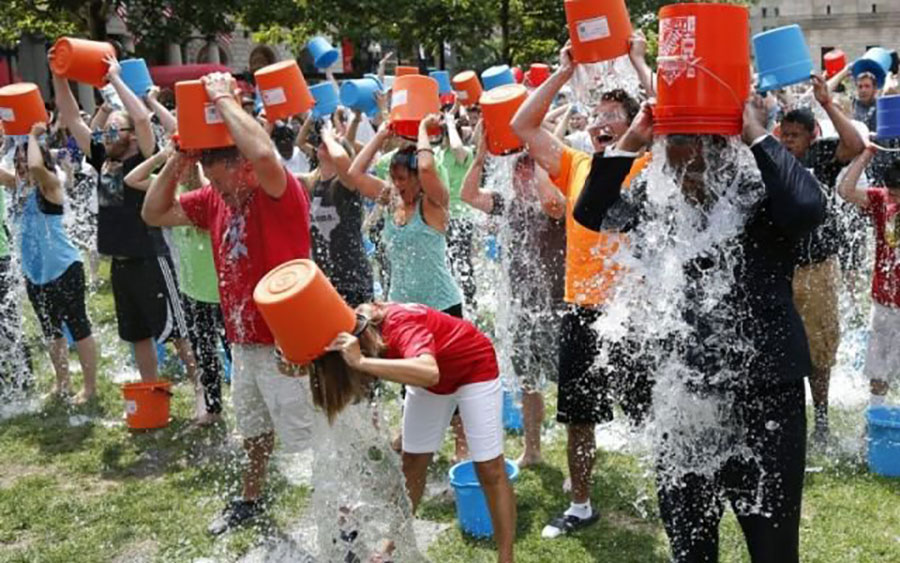
The 2014 Ice Bucket Challenge raised more than $115 million for the Amyotrophic Lateral Sclerosis Association  – or ALS – up from donations of $2.8 million for the same period the previous year. And according to ALS, as a result of that funding, their scientists discovered a new gene – NEK1 – known to be among the most common genetic contributors of the disease. It’s a big deal.

And it was technology – specifically, the technology behind social media – that allowed the Ice Bucket Challenge to go viral and produce that result. Is technology the future of philanthropy?

In the Ice Bucket Challenge we are glimpsing the potential of momentary collective engagement, but at the same time, we are seeing the confining rules by which nonprofits must play, collectively imprisoned in an ancient way of thinking. On the heels of its fundraising success, ALS was immediately being scrutinized to make sure it didn’t spend a penny of the Ice Bucket money on anything but research. So when the enthusiasm fades, there will be nothing there to replace it, because investment in the replacement was forbidden. And there was no “Ice Bucket Challenge 2.”

And, as CNN reported, “while $115 million may sound like a lot of money, it may in fact not be. ‘By some estimates it takes about a billion dollars to make a new therapy,” said Dr. Steven Finkbeiner of the Neurocollaborative.

We are inherently averse to seeing humanitarian organizations spend money on anything other than “the cause,” as we define it, and we define it very narrowly.

I love the Ice Bucket Challenge as a thing unto itself. But for the sake of the ALS Association and everyone afflicted with ALS, we must dedicate ourselves to something far greater – yes, far greater than $100 million. We must aspire to a statistically significant increase in charitable giving as a percentage of GDP. And for that to happen we need much more than new technology. We need new thinking. Thinking that will give charities far more freedom to invest in a much greater result.

Charitable giving in the U.S. was $372 billion in 2015, but only about 15 percent of that, or $50 billion, went to health and human services causes – 85 percent went to religion, higher education and hospitals. $50 billion isn’t near enough to cure cancer, ALS, AIDS, Alzheimer’s, and other threatening diseases. It’s not enough to end poverty, homelessness, bullying, and all of the other problems charities address. Charitable giving as a dollar figure has increased dramatically over time. But then again, so has the price of a candy bar.

As a percentage of GDP, charitable giving has remained stuck at two percent in the United States – ever since we started measuring it in the 1970s. In 40 years, the nonprofit sector has not taken any market share away from the for-profit sector. What keeps us from increasing charitable giving? We are inherently averse to seeing humanitarian organizations spend money on anything other than “the cause,” as we define it, and we define it very narrowly. We condemn them for using donated resources on building market awareness or on fundraising, even though without those things, they can never reach the scale we need to fully address these massive social problems.

Without a systemic way to raise money and also build market awareness of its causes, charities have to pray that a fluke like the Ice Bucket Challenge – a zero-cost, once-in-a-lifetime, spontaneously combusting viral idea – will come their way. This is no way to change the world. Imagine if Tim Cook had to get people to dump ice on their heads in order to bring revenue into Apple – and had to figure out a new idea like that every six months.  The humanitarian sector has been taught to settle for scraps.

The $115 million-in-two-months Ice Bucket Challenge is our highest-profile success in years. Compare this to what some companies can make in a day: Apple sells $465 million worth of iStuff every single day. And Anheuser Bush sells $40 million worth of beer daily. Zero-cost fundraising ideas that spring up from out of nowhere and require virtually no investment are not sustainable because they rarely happen, and relying on them won’t result in the world we truly seek.

Ice melts. The big play here is a wholesale re-education of how the American public thinks about charity. We did it with pork (“the other white meat”), we did it with gay marriage, and we can do it with charity. We need an Apollo-like goal that challenges America to increase charitable giving from 2 percent to 3 percent of  GDP within the next ten years – and this, in large part, means allowing charities to make the investments in growth that they need (and not withholding donations because we disagree about what those mean). If you really want to challenge yourself for ALS and for charity at large, challenge the long-held belief that charities should not be able to invest a healthy part of your donation in growth, the same way that beer and cosmetics companies do every day.