No Cobra meetings, no sombre speeches from No 10, yet the consequences of runaway global heating are catastrophic.
It is a global emergency that has already killed on a mass scale and threatens to send millions more to early graves. As its effects spread, it could destabilize entire economies and overwhelm poorer countries lacking resources and infrastructure. But this is the climate crisis, not the coronavirus. Governments are not assembling emergency national plans and you’re not getting push notifications transmitted to your phone breathlessly alerting you to dramatic twists and developments from South Korea to Italy.
More than 3,000 people have succumbed to coronavirus yet, according to the World Health Organization, air pollution alone – just one aspect of our central planetary crisis – kills seven million people every year. There have been no Cobra meetings for the climate crisis, no sombre prime ministerial statements detailing the emergency action being taken to reassure the public. In time, we’ll overcome any coronavirus pandemic. With the climate crisis, we are already out of time, and are now left mitigating the inevitably disastrous consequences hurtling towards us.
While coronavirus is understandably treated as an imminent danger, the climate crisis is still presented as an abstraction whose consequences are decades away. Unlike an illness, it is harder to visualise how climate breakdown will affect us each as individuals. Perhaps when unprecedented wildfires engulfed parts of the Arctic last summer there could have been an urgent conversation about how the climate crisis was fuelling extreme weather, yet there wasn’t. In 2018, more than 60 million people suffered the consequences of extreme weather and climate change, including more than 1,600 who perished in Europe, Japan and the US because of heatwaves and wildfires. Mozambique, Malawi and Zimbabwe were devastated by cyclone Idai, while hurricanes Florence and Michael inflicted $24bn (£18.7bn) worth of damage on the US economy, according to the World Meteorological Organization.
As the recent Yorkshire floods illustrate, extreme weather – with its terrible human and economic costs – is ever more a fact of British life. Antarctic ice is melting more than six times faster than it was four decades ago and Greenland’s ice sheet four times faster than previously thought. According to the UN, we have 10 years to prevent a 1.5C rise above pre-industrial temperature but, whatever happens, we will suffer.
Pandemics and the climate crisis may go hand in hand, too: research suggests that changing weather patterns may drive species to higher altitudes, potentially putting them in contact with diseases for which they have little immunity. “It’s strange when people see the climate crisis as being in the future, compared to coronavirus, which we’re facing now,” says Friends of the Earth’s co-executive director, Miriam Turner. “It might be something that feels far away when sitting in an office in central London, but the emergency footing of the climate crisis is being felt by hundreds of millions already.”
Imagine, then, that we felt the same sense of emergency about the climate crisis as we do about coronavirus. What action would we take? As the New Economic Foundation’s Alfie Stirling points out, a strict demarcation between the two crises in unwise. After all, coronavirus may trigger a global slowdown: the economic measures in response to this should be linked to solving the climate crisis. “What tends to happen in a recession is policy-makers panic about what the low-lying fruits are; it’s all supply chains and sticking plasters,” he tells me. During the 2008 crash, for example, there was an immediate cut in VAT and interest rates, but investment spending wasn’t hiked fast enough, and was then slashed in the name of austerity. According to NEF research, if the coalition government had funded additional zero-carbon infrastructure, it would not only have boosted the economy but could have reduced residential emissions by 30%. This time round, there’s little room to cut already low interest rates or boost quantitative easing; green fiscal policy must be the priority.
What would be mentioned in that solemn prime ministerial speech on the steps of No 10, broadcast live across TV networks? All homes and businesses would be insulated, creating jobs, cutting fuel poverty and reducing emissions. Electric car charging points would be installed across the country. Britain currently lacks the skills to transform the nation’s infrastructure, for example replacing fuel pumps, says Stirling: an emergency training programme to train the workforce would be announced.
A frequent flyer levy for regular, overwhelmingly affluent air passengers would be introduced. As Turner says, all government policies will now be seen through the prism of coronavirus. A similar climate lens should be applied, and permanently.
This would only be the start. Friends of the Earth calls for free bus travel for the under-30s, combined with urgent investment in the bus network. Renewable energy would be doubled, again producing new jobs, clean energy, and reducing deadly air pollution. The government would end all investments of taxpayers’ money in fossil fuel infrastructure and launch a new tree-planting programme to double the size of forests in Britain, one of Europe’s least densely forested nations.
There is a key difference between coronavirus and climate crisis, of course, and it is shame. “We didn’t know coronavirus was coming,” says Stirling. “We’ve known the climate crisis was on the cards for 30 or 40 years.” And yet – despite being inadequately prepared because of an underfunded, under-resourced NHS – the government can swiftly announce an emergency pandemic plan.
Coronavirus poses many challenges and threats, but few opportunities. A judicious response to global heating would provide affordable transport, well-insulated homes, skilled green jobs and clean air. Urgent action to prevent a pandemic is of course necessary and pressing. But the climate crisis represents a far graver and deadlier existential threat, and yet the same sense of urgency is absent. Coronavirus shows it can be done – but it needs determination and willpower, which, when it comes to the future of our planet, are desperately lacking.
Owen Jones is a Guardian columnist. This story originally appeared in The Guardian and is republished here as part of Covering Climate Now, a global journalistic collaboration to strengthen coverage of the climate story, of which Real Leaders is a partner.
The climate factors contributing to Australia’s bushfires are strikingly similar to those at play in California.
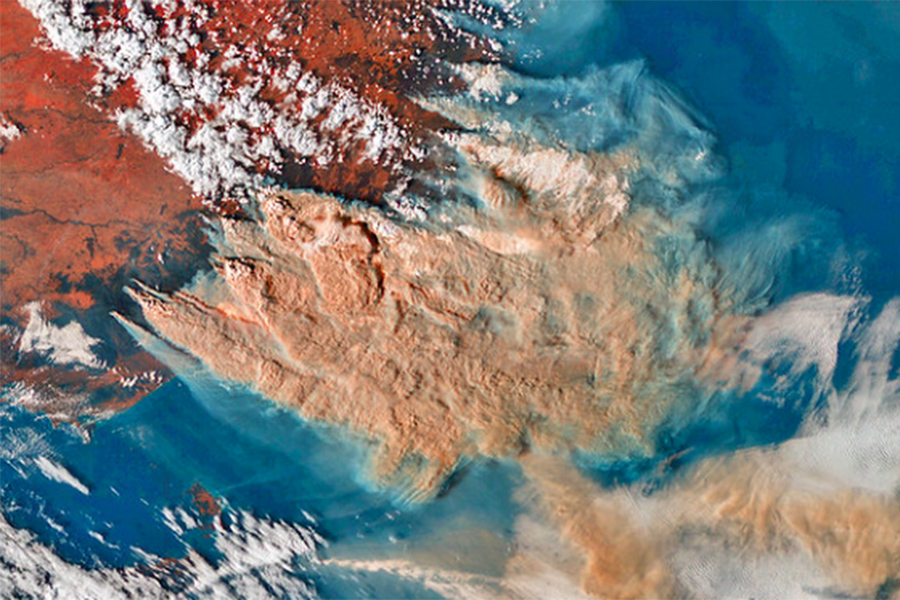
Australia’s frightening bushfires, which kicked off an early fire season in September 2019, have already had cataclysmic effects, and the continent is still just in the early months of the southern hemisphere’s summer. The New South Wales Rural Fire Service has described the bushfires as unprecedented in size and scale, having burned more than 46 million acres (18.6 million hectares), killed at least 29 people, and destroyed more than 2,200 homes.*
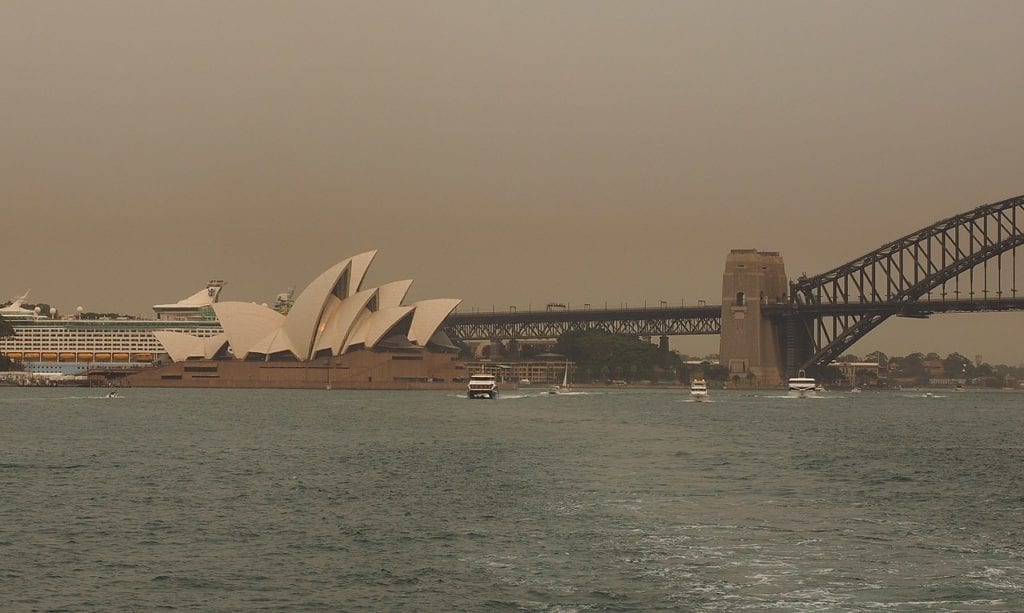
Parts of Australia have had the worst air quality in the world. The air quality in Sydney has literally been alarming, having set off smoke alarms in buildings throughout the city’s central business district and exceeded hazardous levels for more than 30 days. Military assets have been deployed in response to the fires at a scale not seen since World War II. Researchers estimate that more than a billion animals have been killed. Several species will likely be pushed to extinction.
The conditions and climate change-wildfire connections in Australia have been strikingly similar to those amplifying California’s record 2018 wildfire season, but on a much larger scale. Scientific unknowns remain regarding some of those connections, but others are a straightforward result of physics – more heat creates more wildfire fuel.
The politics and climate policy environment down under, on the other hand, more closely bring to mind those at the national level in the U.S. than to the situation in California.
How climate change exacerbated Australian and Californian fires
Despite widespread conspiracy theories about the bushfires, emerging science continues to find links between global warming and worsening wildfires, with the issue a focus of continuing investigation. As climate scientist Kevin Trenberth explained in a recent interview with videographer Peter Sinclair, global warming directly intensifies wildfires by drying out soil and vegetation, creating more fuel to burn farther and faster. That’s particularly a problem in drought-prone regions like Australia and California.
The Millennium drought in southeastern Australia from 1997 to 2009 was the driest 13-year period on record, according to a report by Australia’s Commonwealth Scientific and Industrial Research Organisation (CSIRO). The drought was broken by Australia’s two wettest periods on record in 2010 and 2011, but then came yet another intense drought from 2017 to the present. In fact, 2018 and 2019 were Australia’s hottest and driest years on record. On December 18, the continent had its hottest day on record, with an average high temperature of 107.4 degrees F. California experienced a similar “weather whiplash,” swinging from record-breaking drought in 2012–2016 to a very wet rainy season in 2017–2018. That combination generated growth of new plants that were subsequently dried out by record heat, creating fuel for the state’s record 2018 wildfire season.
California’s drought was made worse by a persistent high-pressure system off the coast known as the “Ridiculously Resilient Ridge.” That high-pressure ridge diverted storm systems to California’s north, leading to years of low precipitation. Researchers have suggested that climate change may cause such blocking systems to form more frequently. A 2018 study led by UCLA’s Daniel Swain found that as temperatures continue to rise, California will see a shift to less precipitation in the spring and fall and more in the winter, lengthening the wildfire season.
The situation in Australia is again strikingly similar to that in California. Researchers have shown that global warming is expanding an atmospheric circulation pattern known as the Hadley cell. This circulation is caused by hot air at the equator rising and spreading toward the poles, where it begins to cool and descend, forming high pressure ridges. In Australia, this process creates what’s known as the subtropical ridge, which as CSIRO notes, has become more intense as a result of global warming expanding the Hadley cell circulation. A 2014 study, CSIRO’s David Post and colleagues reported that stronger high-pressure ridges have been decreasing rainfall in southeastern Australia in the autumn and winter. The significance? The lack of rainfall creates more dry fuel for fires and lengthens the bushfire season.
Based on this scientific research, the latest IPCC report found in 2014 that “fire weather is projected to increase in most of southern Australia,” with days experiencing very high and extreme fire danger increasing 5-100% by 2050. And a 2015 CSIRO report concluded, “Extreme fire weather days have increased at 24 out of 38 Australian sites from 1973-2010, due to warmer and drier conditions … [forest fire danger index] increase across southeast Australia is characterised by an extension of the fire season further into spring and autumn … partly driven by temperature increases that are attributable to climate change.”
Australia has among the world’s worst climate policies
According to the Climate Change Performance Index created by environmental groups, Australia is 56th out of 61 countries evaluated. In the category of climate policy, Australia comes in dead last with a score of zero because “experts observe that the newly elected government has continued to worsen performance at both national and international levels.”
Australia is the world’s leading exporter of coal and the second-largest producer and exporter of liquid natural gas, and the government recently proposed opening new coal mines and ports in what would be one of the world’s largest fossil fuel expansions. According to a recent report produced by the United Nations Environment Programme, Australia’s fossil fuel extraction-based emissions will nearly double from 2005 to 2030. In November, the Swedish central bank divested from Australian government bonds because of the country’s high emissions. Despite all this, as record bushfires continue to rage, Liberal Party leaders have maintained their position that Australia does not need stronger climate policies.
In short, as the country’s citizens and many visitors get a glimpse at its potentially dystopian future of worsening droughts and bushfires, its political leaders are doing everything they can to increase the fossil fuel extraction and combustion that experts conclude are exacerbating these extreme events. If the Paris climate goals are exceeded, the current record Australian temperatures will become the norm for the country. The public appears increasingly concerned: In a November Guardian Essential poll, 60% of Australian voters said the government should do more to reduce risks posed by the warming climate, and this concern has been clear in U.S. network and cable TV coverage of Australian citizens’ reactions to the fires. But Morrison and his Liberal party nonetheless prevailed in the last federal election in May 2019, and barring an early dissolution, they won’t face re-election until 2022.
This story originally appeared in Yale Climate Connectionsand is republished here as part of Covering Climate Now, a global journalistic collaboration to strengthen coverage of the climate story.
The climate factors contributing to Australia’s bushfires are strikingly similar to those at play in California.
Australia’s frightening bushfires, which kicked off an early fire season in September 2019, have already had cataclysmic effects, and the continent is still just in the early months of the southern hemisphere’s summer. The New South Wales Rural Fire Service has described the bushfires as unprecedented in size and scale, having burned more than 46 million acres (18.6 million hectares), killed at least 29 people, and destroyed more than 2,200 homes.*
Parts of Australia have had the worst air quality in the world. The air quality in Sydney has literally been alarming, having set off smoke alarms in buildings throughout the city’s central business district and exceeded hazardous levels for more than 30 days. Military assets have been deployed in response to the fires at a scale not seen since World War II. Researchers estimate that more than a billion animals have been killed. Several species will likely be pushed to extinction.
The conditions and climate change-wildfire connections in Australia have been strikingly similar to those amplifying California’s record 2018 wildfire season, but on a much larger scale. Scientific unknowns remain regarding some of those connections, but others are a straightforward result of physics – more heat creates more wildfire fuel.
The politics and climate policy environment down under, on the other hand, more closely bring to mind those at the national level in the U.S. than to the situation in California.
How climate change exacerbated Australian and Californian fires
Despite widespread conspiracy theories about the bushfires, emerging science continues to find links between global warming and worsening wildfires, with the issue a focus of continuing investigation. As climate scientist Kevin Trenberth explained in a recent interview with videographer Peter Sinclair, global warming directly intensifies wildfires by drying out soil and vegetation, creating more fuel to burn farther and faster. That’s particularly a problem in drought-prone regions like Australia and California.
The Millennium drought in southeastern Australia from 1997 to 2009 was the driest 13-year period on record, according to a report by Australia’s Commonwealth Scientific and Industrial Research Organisation (CSIRO). The drought was broken by Australia’s two wettest periods on record in 2010 and 2011, but then came yet another intense drought from 2017 to the present. In fact, 2018 and 2019 were Australia’s hottest and driest years on record. On December 18, the continent had its hottest day on record, with an average high temperature of 107.4 degrees F. California experienced a similar “weather whiplash,” swinging from record-breaking drought in 2012–2016 to a very wet rainy season in 2017–2018. That combination generated growth of new plants that were subsequently dried out by record heat, creating fuel for the state’s record 2018 wildfire season.
California’s drought was made worse by a persistent high-pressure system off the coast known as the “Ridiculously Resilient Ridge.” That high-pressure ridge diverted storm systems to California’s north, leading to years of low precipitation. Researchers have suggested that climate change may cause such blocking systems to form more frequently. A 2018 study led by UCLA’s Daniel Swain found that as temperatures continue to rise, California will see a shift to less precipitation in the spring and fall and more in the winter, lengthening the wildfire season.
The situation in Australia is again strikingly similar to that in California. Researchers have shown that global warming is expanding an atmospheric circulation pattern known as the Hadley cell. This circulation is caused by hot air at the equator rising and spreading toward the poles, where it begins to cool and descend, forming high pressure ridges. In Australia, this process creates what’s known as the subtropical ridge, which as CSIRO notes, has become more intense as a result of global warming expanding the Hadley cell circulation. A 2014 study, CSIRO’s David Post and colleagues reported that stronger high-pressure ridges have been decreasing rainfall in southeastern Australia in the autumn and winter. The significance? The lack of rainfall creates more dry fuel for fires and lengthens the bushfire season.
Based on this scientific research, the latest IPCC report found in 2014 that “fire weather is projected to increase in most of southern Australia,” with days experiencing very high and extreme fire danger increasing 5-100% by 2050. And a 2015 CSIRO report concluded, “Extreme fire weather days have increased at 24 out of 38 Australian sites from 1973-2010, due to warmer and drier conditions … [forest fire danger index] increase across southeast Australia is characterised by an extension of the fire season further into spring and autumn … partly driven by temperature increases that are attributable to climate change.”
Australia has among the world’s worst climate policies
According to the Climate Change Performance Index created by environmental groups, Australia is 56th out of 61 countries evaluated. In the category of climate policy, Australia comes in dead last with a score of zero because “experts observe that the newly elected government has continued to worsen performance at both national and international levels.”
Australia is the world’s leading exporter of coal and the second-largest producer and exporter of liquid natural gas, and the government recently proposed opening new coal mines and ports in what would be one of the world’s largest fossil fuel expansions. According to a recent report produced by the United Nations Environment Programme, Australia’s fossil fuel extraction-based emissions will nearly double from 2005 to 2030. In November, the Swedish central bank divested from Australian government bonds because of the country’s high emissions. Despite all this, as record bushfires continue to rage, Liberal Party leaders have maintained their position that Australia does not need stronger climate policies.
In short, as the country’s citizens and many visitors get a glimpse at its potentially dystopian future of worsening droughts and bushfires, its political leaders are doing everything they can to increase the fossil fuel extraction and combustion that experts conclude are exacerbating these extreme events. If the Paris climate goals are exceeded, the current record Australian temperatures will become the norm for the country. The public appears increasingly concerned: In a November Guardian Essential poll, 60% of Australian voters said the government should do more to reduce risks posed by the warming climate, and this concern has been clear in U.S. network and cable TV coverage of Australian citizens’ reactions to the fires. But Morrison and his Liberal party nonetheless prevailed in the last federal election in May 2019, and barring an early dissolution, they won’t face re-election until 2022.
This story originally appeared in Yale Climate Connectionsand is republished here as part of Covering Climate Now, a global journalistic collaboration to strengthen coverage of the climate story.
Kilometres short of the Mexico-U.S. border, rough hands yanked Javier Hernandez from the trunk. They beat him, fractured his skull and then buried him with straws poking from his nostrils for air.
Known as coyotes, Javier’s smugglers threatened to abandon his bloodied body in the desert unless his family paid a hefty ransom.
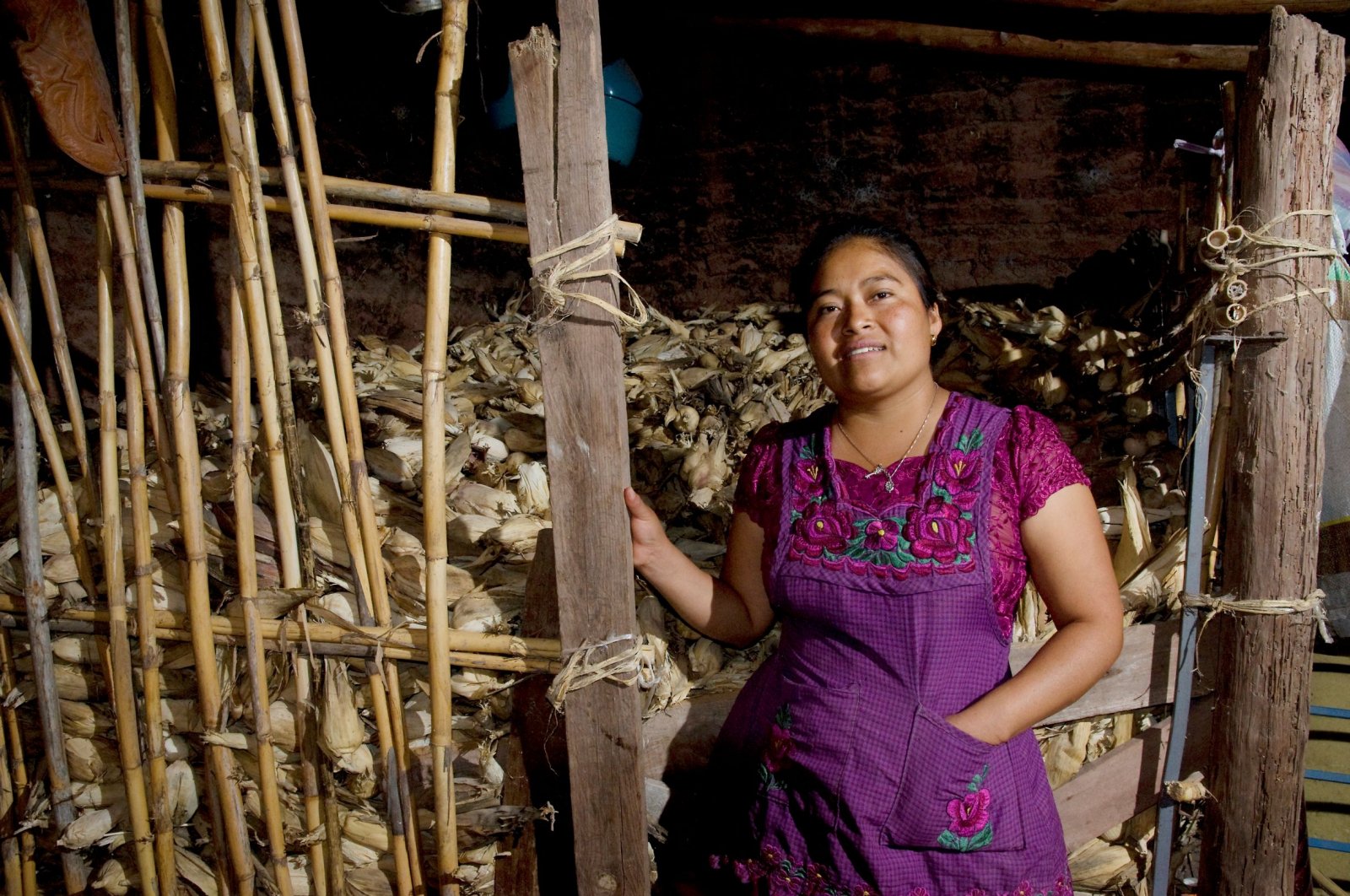
Javier had been on the road for three days. He’d left his rural farming village in central Oaxaca, one of Mexico’s poorest states, to find work in “El Norte.” One by one, Javier’s siblings had quit the family’s rain-dependent corn patch to slip over the border as undocumented immigrants. His eldest brother had immigrated to California before Javier was born. The summer Javier turned 19, drought withered the corn on the stalk. With no employment possibilities, Javier hired a coyote. He was the seventh Hernandez child to bid his teary-eyed mother goodbye.
He didn’t make it this time.
Before burying him alive, Javier’s kidnappers called the brothers, who dismissed the call as a scam. The kidnappers held the phone close to Javier: “Soy yo! Soy yo! — It’s me, it’s me,” he cried.
The family paid the $10,000 extortion fee with borrowed funds. A traumatized Javier was set free. To spare his mother the sight of his broken face, he stayed in a safe house. When I saw him at home months later, he complained of memory loss and anxiety. His sisters said he jumped at small noises and was terrified of leaving his room alone. Despite his ordeal, he told me he would try to get to the other side — “el otro lado” — again. “There’s nothing for me here,” he said softly.
Hundreds of thousands of young Indigenous campesinos, farmers, like Javier are putting down their tools to seek work abroad as harvests continue to drop dramatically. This migration coincides with an increased demand for work in Canada as foreign workers are recruited from Mexico.
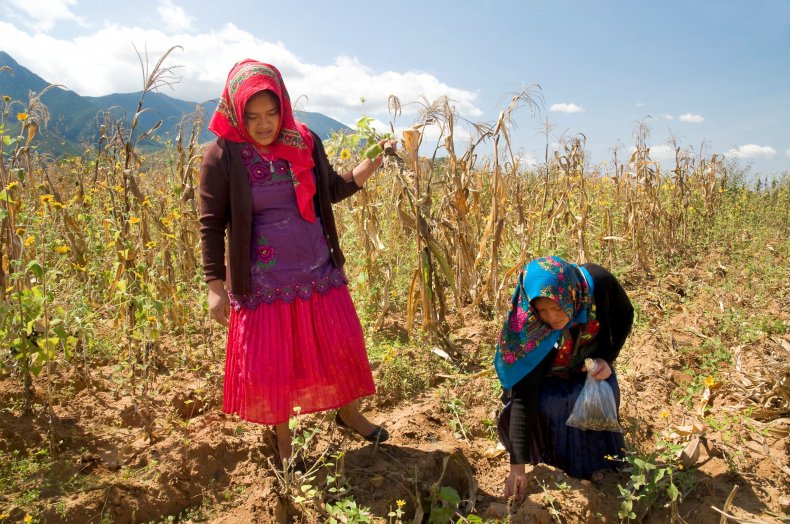
Grasshoppers, or chapulines, are popular in Mexican cuisine. Sisters Erika and Angelica Hernandez are picking chapulines in the family’s corn plot. Central Valleys of Oaxaca, Mexico. Photograph by Jean-Claude Teyssier
In San Bartolomé Quialana, population 2,500, where the Hernandez family lives, pale stalks of sparse corn sway amid dry blades of grass. Women in embroidered huipils over ample skirts, their babies wrapped in rebozos on their backs, greet one another on the street in their native Zapotec, the pueblo’s official language. Instead of tractors rumbling, you hear the grunts of yoked oxen plowing hardened fields, led by men in straw hats, wide trousers and sandals called huaraches.
Nearly 80 per cent of San Bartolomé’s menfolk have gone north. Dozens of houses are in various stages of construction and neglect. Some have never been lived in; others are boarded up, their plots abandoned.
Every country, including Mexico, is facing climate change, from weather unpredictability to crop failure. And campesinos like Javier, who come from largely Indigenous communities and grow corn for their personal consumption, are feeling its worst impact. Struck by recurring drought and few employment opportunities, many see no way out but to go abroad to feed their families.
In Oaxaca’s colonial capital city, about half an hour from the central valley communities, school-age children beg on the streets, peddling China-made goods to soft-hearted tourists.
Of course, migration is not unique to Mexico. According to the Geneva-based International Organization for Migration, an estimated 200 million people will be climate migrants in 2050.
However, in rural Oaxaca this trend has created a unique social phenomenon whereby between 60 to 90 per cent of the men have gone north, leaving the women behind.
It’s a rare local family without kin in “el otro lado.” In some pueblos, it’s mostly women, children, old men and stray dogs on the streets.
Seeds of migration
Nowhere is migration more evident than in Oaxaca’s central valleys — the birthplace of corn nearly 8,000 years ago.
It would be hard to underestimate the importance of corn to Mexicans, said Toronto researcher Lauren Baker, whose book Corn Meets Maize, documents how corn is central to food security, biodiversity and culture. Called maize in Mexico, corn was once revered as a gift from the gods. According legends, Popol Vuh had forged mankind from one of its grains. Another folklore says the feathered serpent Quetzalcoatl gave the Aztec one grain of maize, from which they’ve cultivated ever since.
“We’re children of corn,” Mexicans are fond of saying.
“Corn is a cultural symbol tied to identity,” Baker said. Beyond a commodity, a staple crop and a core of the economy, “it’s who they are,” she said, and it’s woven into everyday life, culinary traditions, rituals, festivals and the spiritual system of Mexico.
As the poorest of farmers, campesino corn growers continue to suffer the worst from overlapping crises — political, economic and climactic — that deplete biodiversity and drive migration.
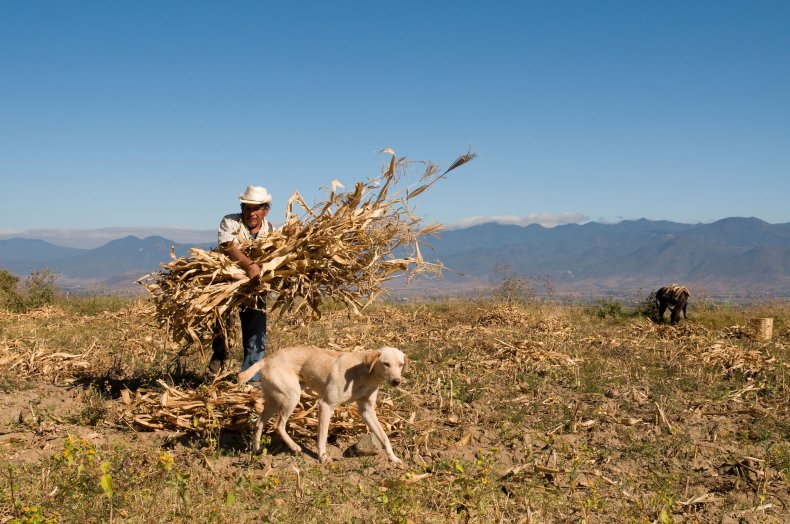
A campesino gathers dry corn stalks to feed his farm animals, as nothing is wasted on a substance farm. Central Valleys of Oaxaca, Mexico. Photograph by Jean-Claude Teyssier
Among the most notable is the free trade agreement (NAFTA) signed in the 1990s that led to the dumping of cheap, hybrid corn (sold below the cost of production) on the Mexican market. Campesinos can’t get good value for their surplus grain. And their personal consumption and survival is threatened by water shortages and drought conditions.
Environmental scientists from Princeton University, who crunch census data along with statistics on crop production and climate data, say changes in rainfall, climate risk and rural vulnerability propel Oaxaca’s farmers north in greater numbers. They warn that these changes will have significant future impacts on human mobility and displacements.
What’s at risk for Mexico’s people of the corn?
“All, absolutely all of it, is at risk,” Baker replied. “From globalization to climate change, from youth not being interested in farming anymore to the homogenization of agriculture and the pressure to grow only certain varieties.
“But there’s also renewed appreciation for how special corn is in Mexico,” she said, as well as for the role that campesinos play in preserving the culture of maize.
Oaxaca’s massive migration of campesinos worries government agencies including the non-profit International Maize and Wheat Improvement Center, known by its Spanish acronym, CIMMYT. As people abandon their farms, the biodiversity of maize suffers, says the organization, one of many that’s fighting to save native corn varieties by supporting an ecological approach to sustainable planting.
The planting projects are testimony to the fight for sustenance in a nation bound by the saying “Sin maiz no hay pais” (“Without corn, there is no country”).
Torn families
Javier’s father jokes that once his son leaves home, he’ll be stuck with only women. “And, God willing, my last remaining son will pass the border safely,” the elder Hernandez says. “I’ll be left with pura mujeres (only women at home).”
In the decade since I met the Hernandez family, their modest hacienda-style home — several tin-roofed rooms scattered around an inner courtyard — has improved thanks to the buying power accrued through remittances sent from the U.S. Erika, one of the three Hernandez sisters still living in the area (the fourth immigrated), gives me a tour, saying that a new room will be added there, where now the ox and sheep are tied to a post.
Among the many gifts from the siblings in el otro lado is a green Chevrolet pick-up truck, an eight-cylinder model with nearly 145,000 kilometres on it. It’s been parked idle in the courtyard for several months while the chickens peck at its giant tires.
“No one knows how to drive it,” Erika says with a shrug.
The Hernandez family relies on about two acres of rain-fed land, a milpa field where maize is planted among beans and squash. Backyard chickens supplement meals, along with fruits and vegetables from a kitchen garden, set up a few hundred metres behind their house. Any surplus produce goes to market to cover necessities and sundry items such as electricity and medicine, Coca-Cola and alcohol.
It’s a late afternoon in San Bartolomé. As Erika leads me to her mother’s garden along a dirt road, she comments on the dwindling population and the houses no one lives in.
“That’s my brother Oscar’s house,” she says of a modern two-storey cement and brick construction that went up slowly over two decades as remittance pay trickled in. “He’s never lived in it. He keeps promising my mother to visit. But he never does.”
We stop under a lemon tree. The garden is lush with avocado and apple trees. It’s water source is a 10-metre well on the property. Rows of chrysanthemums and alfalfa bend under in the sun next to tomatoes, beets, lettuce, onions and radishes. The cornfield on the outskirts of town has no well or irrigation system and relies entirely on rainfall.
When it doesn’t rain, the corn doesn’t thrive, Erika says simply. “Everyone is leaving because there’s no work and no water.”
But ambitions for a better future are etched against the emotional toll migration continues to exact. All our families are torn apart, Erika says. Oscar, the oldest brother, left nearly 20 years ago, followed in two- to three-year intervals by several others. One brother recently came back to marry a local woman, Erika says, but as for the others, “it’s not likely they’ll ever come back.”
They’ve put down roots and got married and their children are American. As illegal undocumented immigrants they can’t take the risk of getting caught sneaking across borders.
“We talk on the phone a lot, but my parents have grandchildren they’ve never seen,” Erika says.
There are 14 grandchildren living on the other side. Erika’s mother, Felipa Martínez Gómez, takes a faded photograph hanging on a nail on the kitchen wall, of her adult children when they were very young. She hugs it to her chest. “Six gone and a seventh almost got killed trying to get there,” she says, wiping a wet cheek.
Human displacement
The central valley area is no stranger to human displacement. The archeological ruins of Mitla, Yagul and Monte Albán are magnets for tourists. The ancient city of Monte Albán, about 1940 metres above sea level, was the former economic and political centre of the Zapotec civilization. The site was abandoned in 700 AD, historians say, after loss of basic resources and ecological balance led to its collapse.
Their descendants, adhering with pride to prehispanic Indigenous customs despite 500 years of conquest, are facing similar challenges. The annual migration from Oaxaca usually starts in August, once campesinos realize the corn will not flourish.
Some say migration has destroyed family structure, while others maintain that some have benefited from increased wealth from foreign remittances.
Sociologist Socorro Monterrubio, who worked with several communities in the Tlacolula District, located between the ruins of Mitla and Monte Albán, says that in Oaxaca economic migration has become a way of life.
Usually, people migrate to areas in the U.S. where they already have family or a social network, she said. But it can be quite hard on those left behind.
Monterrubio noted that women have always worked and contributed to food security. But with changes to family structure, women have been forced to assume new roles — head of family, keeper of the home, responsible for the agricultural work, their children’s upbringing and education — for which they were not prepared. It’s not just a question of division of labour but of capacity to get the work done.
Often, the women are abandoned. Some husbands return to Oaxaca every few years, stay long enough to impregnate their wives, and then slip over the border again, Monterrubio said. Sometimes the men disappear into the unknown — arrested or killed. But more often they find new wives and start second families, she said, “abandoning their Oaxaca partners. It’s more common than you think.”
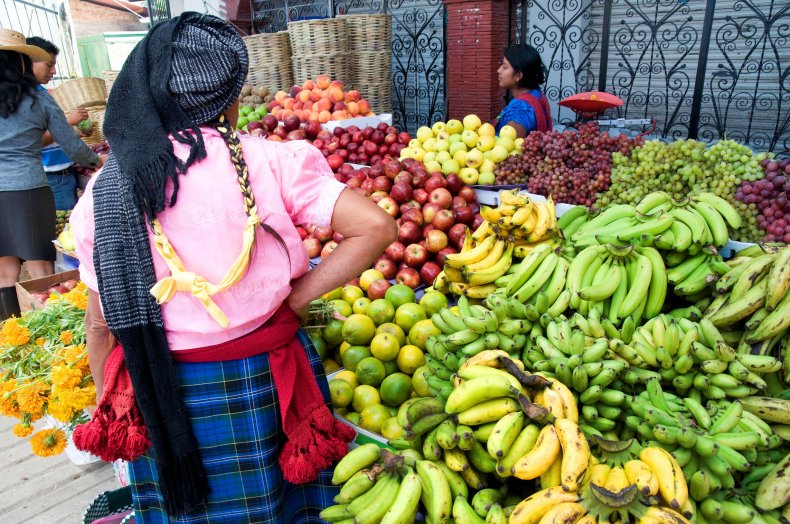
One of the oldest indigenous food and craft markets in the central valleys takes place every Sunday in Tlacolula de Matamoros, Oaxaca, Mexico. Photograph by Jean-Claude Teyssier
Increasingly, it’s the women who tend to the corn and cactus fields, the backyard chickens and children. Faced with dwindling remittances, many work as domestics, caregivers and house cleaners. And turn to skills passed down from mother to daughter — making tortillas and tamales, ceramics and pottery, sewing and embroidery, rugs and baskets.
They sell their goods door-to-door in Tlacolula, paying a few pesos for a ride into town in rundown collective taxis that routinely squeeze six passengers into a space made for four. The busiest day is Tlacolula’s famed Sunday market, a meeting point for thousands of Zapotec, who come from the surrounding valleys and mountains to sell and socialize. Kiosks with cheese and meat, vegetables and fruit, pottery and rugs are spread along the streets from the central 17th-century church plaza. A tantalizing odour of meat and onions roasting on braziers fills the air.
From dawn to dusk hawkers call: “Que va llevar?” (What will you buy?)
Javier’s mother takes a spot at the entrance to the central plaza, close to the cheese and meat vendors, swatting at flies. She lays a cloth on the ground and arranges a spray of flowers, some cabbages and radishes next to bowls of lemons and avocados. The price of three avocados is about 10 pesos, or a few cents.
Last year, the Hernandez family celebrated the birth of their 15th grandchild, the first on this side of the border. Javier and Erika’s sister Angela Hernandez married Victor Diego, a campesino from San Lucas, a village eight kilometres east of her home. The couple named their son after the archangel Gabriel, “God’s strength.”
Like many farming families I’ve met, the Hernandez and Diego families are curious about travel restrictions to Canada, work visas and the cost of living. “What kind of work is there for campesinos? How much do plane tickets cost? Do you need tortilla bakers?”
All of Diego’s brothers have immigrated, his mother tells me at the Sunday market. He is the last one, she says, and her eyes tear at the thought of losing one more.
When Javier admits his plans to go north again, his mother speaks to him sharply in Zapotec.
“She’s telling him to stay,” Erika says.
He didn’t listen to her. Javier now works two full-time jobs in el otro lado, gardener by day, dishwasher by night. He dreams of becoming a DJ.
Canada, through NAFTA, has contributed to the Mexican wave arriving at our borders. Note that foreign workers to Canada continue to increase:
Canada issued more than 339,000 work permits in 2018, up from 192,000 in 2011, and 52,000 in 1996.
Of the 27,970 people that crossed the border illegally in 2018 at the United States-Quebec border, Mexicans numbered among the top five, along with nationals from Nigeria, U.S., Haiti and India.
Charlie Fidelman was the winner of a journalism grant from the non-profit Fonds québécois en journalisme international, which provides journalists with funding for reporting international issues abroad. The foundation had no editorial input in this piece.
This story originally appeared in Canada’s National Observerand is republished here as part of Covering Climate Now, a global journalistic collaboration to strengthen coverage of the climate story.
A new study breaks down how Lyft and Uber contribute to climate change.
For climate-conscious Americans, cars are tough: we can’t live with ’em, can’t live without ’em. Yet while ride-sharing services like Uber and Lyft are reducing reliance on car ownership, they’re hardly solving our problems. According to a report released on Tuesday by the nonprofit research group Union of Concerned Scientists, such services now account for up to 13 percent of all vehicle traffic in major downtown areas. But rather than simply replacing other cars, Ubers and Lyfts are increasing the total number of car trips, and our collective carbon footprint, causing an estimated 69 percent more emissions than the trips they displace.
The reason for this is two-fold. Analyzing public data from seven US cities, the report found that ride-sharing vehicles travel many miles in between passengers. Known as “deadheading,” this tendency, also seen with taxis, makes a non-pooled ride-hailing trip 47 percent more polluting than a private car ride. On top of that, a survey of California passengers found that ride-shares are replacing trips they’d otherwise take by mass transit, bike, or on foot. As a result, the report concludes, ride-sharing is “increasing vehicle travel, climate pollution, and congestion” in cities and suburbs alike—while remaining widely exempt from regulations.
The report differentiates between non-pooled trips, in which passengers ride straight to their destination, and pooled trips, in which the car picks up other passengers on the way. Pooled trips, which California riders request about 20 percent of the time, have a carbon footprint roughly equivalent to that of private car travel, while ride-sharing trips in electric cars can actually reduce emissions by up to 68 percent per trip. The problem is non-pooled trips in gas-burning cars, which are replacing lower-emissions modes of travel about 28 percent of the time.
To become more climate-friendly, the report concludes that ride-sharing services could electrify their fleets, improve the pricing and convenience of pooled rides, and encourage the use of public transit by providing “first- and last-mile connections” that only replace the part of the journey that a train or bus won’t cover. Passengers can choose such rides more often, while cities can incentivize pooled travel with special lanes and reduced fees.
The report also urges policymakers to improve mass transit, and enact laws to electrify the ride-sharing industry. Lyft has leveraged Colorado tax credits to make 200 long-range electric vehicles available for its drivers to rent, while California regulators are hashing out ways to transition ride-sharing services to electric fleets over the next decade.
“Ride-hailing trips are increasing emissions today,” says Don Anair, one of the report’s co-authors. “But if companies take meaningful actions to expand electric vehicles and pooled rides—and policymakers and consumers can help—then these services can be part of a low-carbon transportation future.”
This story originally appeared in Mother Jonesand is republished here as part of Covering Climate Now, a global journalistic collaboration to strengthen coverage of the climate story.
The failed 2019 UN Climate Conference in Madrid ended in mid-December just about when the massive wildfire destruction of Australia’s bushlands was beginning.
The wildfires that broke shortly afterward took the form of a Gaia-like revenge. Australia, along with the United States, Japan and Brazil, had been among the countries that had blocked real progress at the UN Conference of Parties (COP25) on a more realistic system of carbon emissions accountancy – that could track and ensure real progress on emissions reductions over the critical coming decade.
And the price exacted was almost immediate – in terms of ecosystems and wildlife damaged, and ultimately human health and well-being.
The converging problems of global warming, environmental degradation, and public health have been well-reflected in the bushfire destruction, along with a record drought in southern Africa, floods elsewhere, and off-the charts air pollution in Delhi, India, all occuring just as 2019 ended and the new decade of 2020 began. And therefore it is not surprising that climate has been placed at the top of the 2020 agenda by groups as diverse as the World Economic Forum (WEF), as well as the World Health Organization.
The Global Risks 2020 Report, released last week, just ahead the WEF meeting that begins Tuesday in Davos (21-24 January), notes “climate response shortcomings” as well as “biodiversity loss impacts” among the top two out of five categories of risks faced by the world for 2020. “Creaking health systems” is listed as a sixth.
WHO has also listed the climate and health crisis as among the 13 top threats to global health in the next decade. Among the other threats highlighted by the agency – as well as by a range of experts interviewed by Health Policy Watch about the globala health outlook for 2020, include:
Emergence of new diseases at an increasing rate and intensity – as reflected in the Wuhan pneumonia outbreak;
Stalled action on medicines price tranparency – watch to see if European countries take a lead this year in adopting stronger measures;
Failing medicines markets contributing to the rise of anti-microbial resistance (AMR) – when prices for other vital drugs, particularly antibiotics, dip too low;
Non-communicable Diseases (NCDs) and Universal Health Coverage – how the global “syndemic” of obesity, undernutrition and climate change creates barriers to achieving UHC.
Digital health and AI technologies – which hold much promise for improving health, but also create new ethical challenges – were among the other issues cited by experts interviewed by Health Policy Watch. Long-simmering neglected diseases, often pushed to the sidelines of health agendas was another issue noted, as the world prepares to observe on 31 January, the first-ever World NTD Day.
The global shortfall of health workers, as well as gender challenges faced by women who dominate the lowest ranks of healthcare professionals, is another issue that will be highlighted prominently this year, which WHO member states have designated as “The Year of the Nurse and Midwife.”
“The average global temperature has risen by about 1.1°C since the pre-industrial era and ocean heat content is at a record level. On the current path of CO2 emissions, we are heading towards a temperature increase of 3 to 5°C by the end of century” WMO SG Petteri Taalas pic.twitter.com/MywSs1eDTE
The real-world convergence of climate and health agendas has been playing out in the Australia story, which has left some 29 people dead, uncounted numbers of people displaced, and over 1 billion animals killed – driving some species to the brink of extinction. There has been a 30% increase in asthma cases and more children presenting with respiratory infections, Sydney doctors have reported. Scientists, meanwhile, have said that the long-term human health impacts of exposures to the air pollutants “won’t be known for years.”
But immediate health impacts were visibly demonstrated to global audiences during the initial, pre-qualifying rounds of the Australia Open, where the Slovenian Dalila Jakupović collapsed on the tennis court choking for air, and other stars also cancelled matches underway. Canadian Liam Brody later tweeted that players’ blood was “boiling” over the decision to continue the games in such hazardous air quality conditions.
Ironically, just four weeks earlier, as the December COP25 climate talks wound up, it was Indians in Delhi who were gasping for breath, and Australia was among the handful of countries to thwart a critical deal on how to count countries’ carbon reductions, in order to meet the pledges of the 2030 Paris Climate Agreement.
Along with Brazil and the United States, the conservative government of Prime Minister Scott Morrison, insisted on using carryover credits from the expiring 1992 Kyoto protocol, a loophole criticized by Costa Rica, New Zealand, France as something that would thwart accurate measurement of real progress, and even described as “cheating” by former French minister Laurence Tubiana, an architect of the 2015 Paris Agreement.
The Australia narrative illustrates the Global Risks Report finding that “climate response shortcomings” are among the top five risks faced in 2020. “Weak international agreements belie rising investor and popular pressure for action, against a multitude of natural catastrophes and indicators of longer-term disruptions,” the report states. “2020 is a critical year for nations to accelerate progress towards major emissions reductions and boosting adaptation actions.”
Experts have described Australia’s experience as just a taste of what to expect in the world’s most fire-prone continent from a changing climate. The year 2019 was the hottest year for the country on record, with average temperatures 1.5C° higher. Rising temperatures and lower levels of winter rainfall dried out bush and forest cover, which more readily become fuel for summer fires, occurring with greater frequency in the prolonged heat and drought conditions.
In just three months, Australia’s fires are estimated to have released 350 million metric tons of carbon dioxide, said climate experts quoted by the Sydney Morning Herald, warning that a century or more will be needed to absorb the carbon dioxide released. Drifting smoke from the fires has by now lapped around the world, and turned glaciers in nearby New Zealand brown – darker glaciers accelerate ice melt, in turn threatening the long-term stability of water reserves.
It’s also a record year for drought in Southern Africa with 12 countries affected, including Zimbabwe, Angola, Eswatini, Mozambique, and South Africa. The World Food Programme estimates a record 45 million people in Southern Africa are food insecure, including 5.1 million in Zimbabwe. That face of climate change may have had even more dire, immediate, human health consequences. But there is no Australia Open playing in Harrare.
Smoke from a wildfire near Gosford, New South Wales, Australia turns the sunset an ominous red. Photo: Rob Russell
Climate & Health Lack Synergies
Within the broader spectrum of government failure, health and climate sectors remain disconnected – sapping efforts to face a common threat to human health and well-being.
“The climate community lacks both the political leverage, the experience and the institutional mechanisms of the health sector—this expertise is badly needed for climate negotiations, but we don’t really work together,” lamented one senior European negotiator to Health Policy Watch, during the Madrid COP25.
“If you look at the Global Fund Replenishment, Emmanuel Macron, Bill Gates as well as Bono were all there,” lamented the negotiator. “But who even heard about the Green Climate Fund event? Was there a Gates or a Macron or a celebrity like Bono? No.”
In fact, behind the rhetoric, there are few formal institutional mechanisms to bring the knowledge, capacity and power of the health sector to bear on climate negotiations or to inform effective climate policies, at either national or global levels, he remarked.
One obvious reflection of that is the fact that year after year, attendees of the COP climate meetings include virtually no health ministers – with the exception of delegations that have been sponsored by WHO from time to time, from groups such as Small Island States, are faced with the virtual disappearance of their nations as a result of climate change.
This year, while climate delegates were huddling in Madrid in December, major health conferences were also going on in Brussels and in Oman, around non-communicable diseases. Meanwhile, WHO Director General Tedros Adhanom Gheyebresus was in Geneva putting the final touches on an organizational restructuring plan. WHO’s Maria Neira, who has won acclaim as the WHO’s lead on climate, health and environment, was pulled back to Geneva by the WHO Director General before the conference ended.
“With the exception of the Gender Action Plan, agreed by the end of the meetings, discussions did not bring to agreements and ended up in a disillusioned domain of unmet expectations,” reported Flavia Bustreo, chair of governance for the Interagency Partnership for Maternal, Newborn and Child Health, one of the few health officials to attend Madrid’s COP25.
She added that: “A low number of debates concerning the link between climate change and health suggests a low prioritization of what is now one of the biggest issues in this ongoing crisis.”
Bushfire smoke over Sydney Opera House, 29 December 2019. Photo: Nick-D
Outside the halls of debate, however, youthful protestors have been ramping up their campaigns against governments, fossil fuel producers, as well as their industrial and financial partners. Here too, Australia’s government has been a recent target, and tennis has even played a role.
Then in January, climate activists, including Sweden’s Greta Thunberg, called on the German engineering group Siemens to withdraw from the project; Siemens is to supply rail technology to transport coal from the mine. On Monday (January 13), Siemens rebuffed those calls.
Another prominent target has been Credit Suisse. In mid-December, in fact, the bank announced that it would stop lending for new coal-fired power plants, following on its decision to halt lending for new coal mine development. But the bank remains one of the world’s largest investors in fossil fuel companies with a US $57 billion portfolio, critics say. Swiss climate activists have called upon the bank, as well as its ambassador the billionaire tennis star Roger Federer, calling on them both to step back from fossil fuels.
Last Friday, Thunberg joined Swiss activists at a climate protest in Lausanne, at the end of a week where protestors ramped up a @RogerWakeUpNow campaign aimed at Credit Suisse and Federer, who is also competing in the Australian Open.
A day later the protestors entered the Swiss offices of UBS, another major investor in fossil fuels, and dropped bags of coal on the floor.
“So far during this decade, we have seen no signs whatsoever that real climate action is coming and that has to change. To the world leaders and those in power I would like to say, that you haven’t seen anything yet, you have not seen the last of us. We can assure you that,” Thunberg told cheering crowds in Lausanne on Friday.
Such scenes may become more common throughout 2020 as youth activism, fueled by public concern over climate grows, while governments and industries try to carry on business as usual with fossil fuels. As the next stop, Thunberg and other climate activists are heading to the WEF in Davos, to demand that financial leaders halt investments in fossil fuels.
“We don’t want these things done by 2050, 2030 or even 2021. We want this done now – as inright now,” Thunberg said in a Guardian Op-Ed published Monday (20 January) with other youth climate activists. Since the 2015 Paris Climate Agreement, 33 leading banks have poured some $1.9 trillion into fossil fuels, the op-ed noted, and an International Monetary Fund report estimates that in 2017, the world spent $US 5.7 trillion in fossil fuel subsidies.
Although oil-producing Abu Dhabi rang in 2020 with a Futures Energy Summit devoted to clean energy, in fact investments in renewables in developing countries “plummeted” in 2018, according to a November 2019 MIT Technology Review. Coal power production in 2018 reached an all-time high according the International Energy Agency. And across southeast Asia as well as parts of Southern Africa and the Middle East new coal power plant development continues apace, much of it driven by Chinese and Japanese investment.
Natural gas is also having a heydey. While less damaging than coal, natural gas development has often been at the expense of even cleaner solar energy sources, critics say. In the sun-drenched Mediterranean region, Turkey celebrated the New Year with the launch of a new natural gas pipeline connection to Russia; Israel launched its second major natural gas platform; and regional tensions heightened over conflicting claims between Turkey and Libya on the one hand, and Greece and Cyprus, on the other, to other potential Mediterranean gas reserves – creating new and dangerous sources of regional political tension.
What To Watch in 2020
The 2020 Climate Conference in Glasgow on 9-19 November (COP26) will confront all of these financial and political forces head-on. This is when countries will gather to make new political commitments on emissions reductions. The European Union’s landmark agreement to reach net zero emissions by 2050, formally announced on 13 December, represented one important bright spot in the otherwise dim closing hours of the Madrid COP. Significantly, that commitment was also accompanied by a €100 billion pledge in funding by the European Commission to help the ease the energy transition, particularly among some of the region’s most coal-dependent countries, such as Poland, as part of a European Green Deal Investment Plan that aims to attract €1 trillion in public and private finance over the next decade.
But the last hope for the global community to prevent temperatures from rising above 1.5°C still appears dim – if fossil fuel development across the rest of the world moves forward unabated, and the United States, which has announced that it will withdraw from the 2015 Paris Climate Agreement, follows through on that promise right after the US Presidential elections. Those elections are scheduled for 3 November, just days before the Glasgow COP26 commences.
Whether European leaders can and will wield sufficient muscle to convince the other big drivers of climate change to change course, including both high-income Australia, Japan and the US, as well as emerging economies led by the “BRICS” of Brazil, Russian, China and South Africa, remains an open question. Not only will COP26 be the year’s climax in climate policy-making – it could be the most decisive meeting for decades to come.
Leading up to that, observers can expect to see more youth-driven protests around Europe and elsewhere, and more civil disobedience. It remains to be seen if this will capture the imagination of the broad public – or exacerbate social confrontations with other interests, such as public opposition to higher fossil fuel prices. It was, after all, Emmanuel Macron’s earlier moves to raise fuel prices, which triggered the prolonged, and often violent, “Gilet Jaune” (Yellow Vest) protests seen in France over the winter of 2019, as well as civil disturbances in Africa and the Middle East on other occasions.
Also expect to see a series of protracted technical negotiations between countries over the new 2020 commitments to protect the world’s biodversity. Biodiveristy underpins what scientists call critical “ecosystem services” to health, such as food and fresh water supplies, sources of existing and future medicinal plants, as well as certain forms of natural regulation of infectious diseases.
At February meeting of the UN Convention on Biodiversity (CBD) in Kunming, China, technical experts will wrangle over proposed new targets for protecting the world’s seas, open spaces and species, hopefully paving the way for a new global agreement at the 15thCBD Conference of Parties in October. The agreement aims to halt the increasingly rapid decline and extinction of plant and animal species – after the 2010 CBD targets were largely missed.
Biodiversity loss is another topic on the Davos agenda, having been included among the top five risks in the Global Risks 2020 Report. The ways in which biodiversity loss threatens the stability of future food supplies and medicines discoveries, as well as other life support systems, are laid out in a WEF blog by a top official at Zurich Insurance Group – illustrating how an longtime scientific concern is now drawing attention from actors such as the insurance industry.
As for measuring progress on bringing health and climate agendas just a little bit closer together, watch out for where WHO’s top leadership will be in that critical week of November 9-19 – and what ministers of health, as well as rank and file doctors and nurses are saying and doing during Glasgow’s Climate Conference.
By Elaine Ruth Fletcher. This story originally appeared in Health Policy Watch and is republished here as part of Covering Climate Now, a global journalism collaboration to strengthen coverage of the climate story.