Can a Photograph Inspire us Into Action?
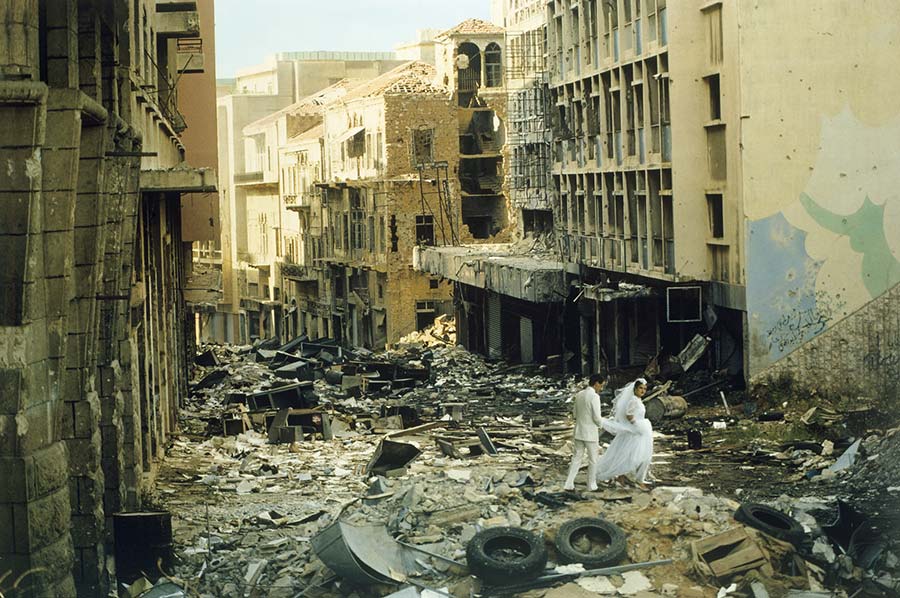
It’s important to realize that a memorable photograph doesn’t happen by itself. Firstly, a photographer chooses to press a button at the right moment. Then, an editor decides whether to publish it or not.

My hope as a curator, is that after presenting certain images to an audience they decide not to be bystanders anymore, but begin to participate actively in the world around them, promoting positive change. It’s a chain reaction that can start with a single, powerful image. A photograph makes you think, and since we can visualize what took place, we believe it to be true. The “truthfulness” a photograph represents is its strongest weapon.

The caption to the photograph above is one such example: Twenty-three year-old Abed (Muslim groom) and 19 year-old Arige (Christian bride) walk through the bombed ruins of Beirut, Lebanon, 1983.

Many people shy away from graphic, violent imagery as it makes them uncomfortable. Yet, while we should never force anyone to view anything against their will, the truth must be told. Today, more than ever, we are subjected to sensational and violent images every day, in a mistaken belief by the media that “this is what the audience wants.” It can leave us feeling disengaged and helpless, rather than informed and empowered.

Women meeting near Dhaka to repay micro-loans acknowledge the official from the Grameen Bank. Bangladesh. Photo: Karen Kasmauski / Part of the Making Peace international photo exhibition, Toronto, May 2017.

Making Peace was first produced by the International Peace Bureau (IPB), the world’s largest and oldest peace federation to mark their Nobel Peace Prize centenary in 2010. Since then, this outdoor exhibition has traveled to nine major cities and been seen by millions of ordinary people. It presents 124 photos, from an initial research of more than  10,000, that covers a century of photography – from 1914 to the present. The exhibition brings together the work of 111 photographers of all nationalities and the photographs on the following pages are a small sample of their work.

A young girl waits for private water vendors to open the tap in the Kibera slum in Nairobi, Kenya. With nearly half a million residents, Kibera is one of the largest slums in Africa and served by only four water points, where water from the city councils is sold. Photo: AFP Photo/Marco Longari / Part of the Making Peace international photo exhibition, Toronto, May 2017.

I like to call it the “Beginners guide to peace” as it allows the general public, and especially the youth, to understand better the five elements that are crucial to forming peace. These are: disarmament and nonviolence, conflict prevention and resolution, economic and social justice, human rights, law and democracy, and the environment and sustainable development.

Backyard swimming pools, Will County, Chicago vicinity, USA. Photo: Terry Evans / Part of the Making Peace international photo exhibition, Toronto, May 2017.

While you may wonder how a photograph can achieve all this, remember that many images have become iconic symbols of their time. The problem with these historic images – such as the photo of a napalmed Vietnamese girl or the raising of a flag over Iwo Jima – is that viewed on their own they tend to reinforce people’s belief that human history is only about conflict. Images have the power to elicit strong emotions and it’s important to present a different story to our children: using images that inspire and reaffirm our belief in humanity. This is the aim of Making Peace.

As the last panel in the exhibition depicts (a full-sized mirror), making peace is really up to you.

www.makingpeace.org

13 Powerful Images That Show the Refugee Crisis and Offer Solutions
Since it’s inauguration in Geneva in 2010, the Making Peace photo exhibition – considered one of the largest photo exhibits of its kind ever produced – has been shown in 12 major cities, including in a Rio de Janeiro subway station during the 2016 Summer Olympic Games.

What impact can an exhibition such as Making Peace have on the public? The number of visitors to the exhibition since its inception has been more than 1.2 million people. But an audience drawn to the intriguing narratives in the photographs and to photography as a discipline, isn’t enough. Understanding how and why the project has an impact on our target audience of young people from age 12 to 24, is key to its success.  

The Making Peace exhibition tries to portray the key elements that are necessary to create sustainable peace, while paying tribute to the people across the planet who devote their time, energy and resources to its cause. Many of these people and organizations have influenced the course of the 20th century.

Here are 13 powerful images for World Refugee Day 2019, that give some insight into the issues, and the people, who are dealing with this crisis.

A child soldier hands in his weapon to Moroccan United Nations soldiers and registers as part of the Demobilization program organized by MONUC (United Nations Peace Keeping Mission to the Congo). Children participating in conflict deny them an education and perpetuate the cycle of poverty. This (and the violence) can result in the movement of people across the world — in search of a better life. Photograph: Roger Lemoyne.
Children in school uniform pose in front of a poster promoting peace and disarmament. Social stability needs to be actively promoted by authorities. An unhappy community will start to roam, adding to migration and refugee numbers. Sierra Leone. Photograph: Teun Voeten. 
Young North African boys gaze across the narrow stretch of water separating them from Spain, a well-known route for “illegal aliens” hoping to better their prospects in Europe. Morocco. Establishing strong, local economies in countries with social problems will stop people looking for decent work elsewhere. Photograph: Olivier Jobard.
A sign warning motorists to beware of humans crossing the road is seen on Interstate 5, just north of the U.S.-Mexico border, considered one of the busiest points of entry into the United States. San Ysidro, California. Photograph: Hector Mata. 
Chinese workers have lunch at a construction site in Shanghai. According to the World Bank China’s rapid economic and social development has lifted more than 500 million people out of poverty. It’s also drawing increasing numbers to cities, which creates its own set of problems. Photograph: Philippe Lopez.
Activists of ATTAC (Association for Taxation of financial Transactions and for Action by Citizens) with a model of the earth. Attached on a chain are the logos of banks which were involved in the worldwide banking crisis in 2009. Berlin, Germany. Corruption, money laundering and illicit transactions by those in developed countries also contribute to the overall health of world economies. Illegal or unethical transactions by developed countries may perpetuate the poverty of others, leading to the flight of citizens. Photograph: Stefan Boness.
Thanks to the “One Laptop per Child” (OLPC) project, children at a school in Rwanda were able to learn to use a computer for the first time. Founded in In 2002 by Professor Nicholas Negroponte from MIT (Massachusetts Institute of Technology), OLPC aims to provide each child in a developing country with a computer. Creating entrepreneurs and an educated workforce in poverty-stricken countries is one way of stimulating local economies and building longterm wealth. Photograph: Sven Torfinn.
Backyard swimming pools, Will County, Chicago vicinity, USA. Wealthy countries consume far more natural resources than poor countries. This consumption results in more CO2 being released into the atmosphere, that contributes to global warming and the creation of more extreme weather around the world. When people living in areas of extreme heat, drought or flooding face even more extreme weather, they become environmental refugees. Photograph: Terry Evans. 
A young girl waits for private water vendors to open the tap in the Kibera slum in Nairobi, Kenya. Managing local resources successfully and fairly can prevent communities seeking basic necessities elsewhere. Photograph: Amit Dave. 
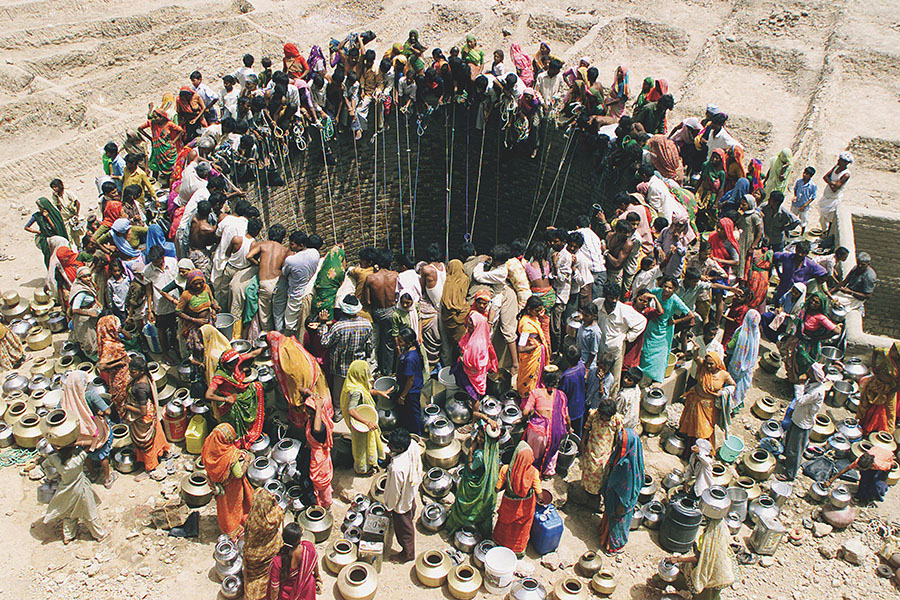
People gather to get water during a drought from a huge well in the village of Natwarghad in the western Indian state of Gujarat. Shrinking natural resources are a key cause of much migration and refugee movement. Photograph: Marco Longari.
Vandana Shiva is an Indian scientist, philosopher and environmental activist. Shiva participated in the Chipko movement against deforestation during the 1970s, and is now a leader in the “alter-globalization” movement. Shiva argues for a sustainable agriculture system, based on an eco-feminist approach. She has also assisted grassroots campaigns against genetic engineering. Recognizing the economic importance of women can create stability in regions of poverty and help prevent conflicts that result in refugees. Photograph: Manan Vatsyayana.
Dr. Oscar Arias Sanchez is a Costa Rican politician who has twice been President of his country. He received the Nobel Peace Prize in 1987 for his efforts to end civil wars. He is known for his active role in the Esquipulas Accords: A plan to promote democracy and peace in Central America. Arias has been outstanding among government leaders in his critique of excessive levels of military spending and the evils of the arms trade. War and violence is the biggest cause of refugees. Photograph: Micheline Pelletier.
Professor Muhammad Yunus (1940 – ) Bangladeshi banker and economist. He previously was a professor of economics where he developed the concept of microcredit. These loans are given to entrepreneurs too poor to qualify for traditional bank loans. Yunus is also the founder of Grameen (village) Bank. Creative ways of stimulating community wealth, however small, can have a big effect on the happiness and wellbeing of communities in impoverished countries. Photograph: Micheline Pelletier.
0